Business..!! Let us Start
“SELL THE PROBLEMS YOU SOLVE, NOT THE PRODUCT”
Made By: Alok Mishra, IIT Bhubaneswar
How to
Start a
Business
Write
Your
Business
Plan
Choose
Your
Business
Structure
Choose &
Register
Your
Business
Choose
Your
Business
Location
&
Equipment
Business
Licenses &
Permits
Learn
About
Business
Laws
Business
Financials
Finance
Your
Business
Filing &
Paying
Taxes
Hire &
Retain
Employees
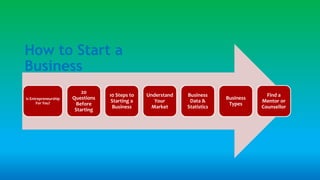
How to Start a
Business
Is Entrepreneurship
For You?
20
Questions
Before
Starting
10 Steps to
Starting a
Business
Understand
Your
Market
Business
Data &
Statistics
Business
Types
Find a
Mentor or
Counsellor
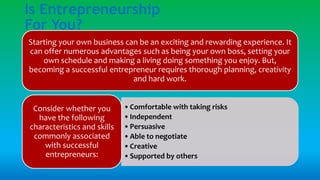
Is Entrepreneurship
For You?
Starting your own business can be an exciting and rewarding experience. It
can offer numerous advantages such as being your own boss, setting your
own schedule and making a living doing something you enjoy. But,
becoming a successful entrepreneur requires thorough planning, creativity
and hard work.
•Comfortable with taking risks
•Independent
•Persuasive
•Able to negotiate
•Creative
•Supported by others
Consider whether you
have the following
characteristics and skills
commonly associated
with successful
entrepreneurs:
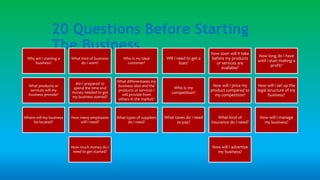
20 Questions Before Starting
The Business
Why am I starting a
business?
What kind of business
do I want?
Who is my ideal
customer?
What products or
services will my
business provide?
Am I prepared to
spend the time and
money needed to get
my business started?
What differentiates my
business idea and the
products or services I
will provide from
others in the market?
Where will my business
be located?
How many employees
will I need?
What types of suppliers
do I need?
How much money do I
need to get started?
Will I need to get a
loan?
How soon will it take
before my products
or services are
available?
How long do I have
until I start making a
profit?
Who is my
competition?
How will I price my
product compared to
my competition?
How will I set up the
legal structure of my
business?
What taxes do I need
to pay?
What kind of
insurance do I need?
How will I manage
my business?
How will I advertise
my business?
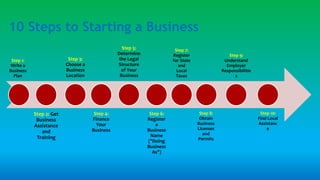
10 Steps to Starting a Business
Step 1:
Write a
Business
Plan
Step 2: Get
Business
Assistance
and
Training
Step 3:
Choose a
Business
Location
Step 4:
Finance
Your
Business
Step 5:
Determine
the Legal
Structure
of Your
Business
Step 6:
Register
a
Business
Name
("Doing
Business
As")
Step 7:
Register
for State
and
Local
Taxes
Step 8:
Obtain
Business
Licenses
and
Permits
Step 9:
Understand
Employer
Responsibilitie
s
Step 10:
Find Local
Assistanc
e
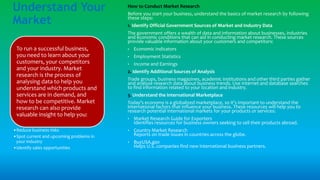
Understand Your
Market
How to Conduct Market Research
Before you start your business, understand the basics of market research by following
these steps:
1. Identify Official Government Sources of Market and Industry Data
The government offers a wealth of data and information about businesses, industries
and economic conditions that can aid in conducting market research. These sources
provide valuable information about your customers and competitors:
• Economic Indicators
• Employment Statistics
• Income and Earnings
2. Identify Additional Sources of Analysis
Trade groups, business magazines, academic institutions and other third parties gather
and analyze research data about business trends. Use Internet and database searches
to find information related to your location and industry.
3. Understand the International Marketplace
Today’s economy is a globalized marketplace, so it’s important to understand the
international factors that influence your business. These resources will help you to
research potential international markets for your products or services:
• Market Research Guide for Exporters
Identifies resources for business owners seeking to sell their products abroad.
• Country Market Research
Reports on trade issues in countries across the globe.
• BuyUSA.gov
Helps U.S. companies find new international business partners.
To run a successful business,
you need to learn about your
customers, your competitors
and your industry. Market
research is the process of
analysing data to help you
understand which products and
services are in demand, and
how to be competitive. Market
research can also provide
valuable insight to help you:
•Reduce business risks
•Spot current and upcoming problems in
your industry
•Identify sales opportunities
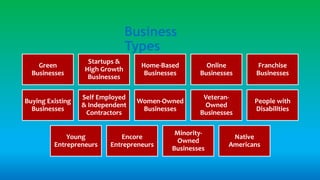
Business
Types
Green
Businesses
Startups &
High Growth
Businesses
Home-Based
Businesses
Online
Businesses
Franchise
Businesses
Buying Existing
Businesses
Self Employed
& Independent
Contractors
Women-Owned
Businesses
Veteran-
Owned
Businesses
People with
Disabilities
Young
Entrepreneurs
Encore
Entrepreneurs
Minority-
Owned
Businesses
Native
Americans
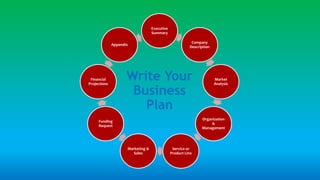
Write Your
Business
Plan
Executive
Summary
Company
Description
Market
Analysis
Organization
&
Management
Service or
Product Line
Marketing &
Sales
Funding
Request
Financial
Projections
Appendix
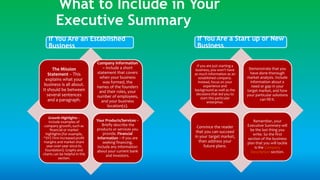
If You Are an Established
Business
The Mission
Statement – This
explains what your
business is all about.
It should be between
several sentences
and a paragraph.
Company Information
– Include a short
statement that covers
when your business
was formed, the
names of the founders
and their roles, your
number of employees,
and your business
location(s).
Growth Highlights –
Include examples of
company growth, such as
financial or market
highlights (for example,
“XYZ Firm increased profit
margins and market share
year-over-year since its
foundation). Graphs and
charts can be helpful in this
section.
Your Products/Services --
Briefly describe the
products or services you
provide. Financial
Information – If you are
seeking financing,
include any information
about your current bank
and investors.
If You Are a Start up or New
Business
If you are just starting a
business, you won't have
as much information as an
established company.
Instead, focus on your
experience and
background as well as the
decisions that led you to
start this particular
enterprise.
Demonstrate that you
have done thorough
market analysis. Include
information about a
need or gap in your
target market, and how
your particular solutions
can fill it.
Convince the reader
that you can succeed
in your target market,
then address your
future plans.
Remember, your
Executive Summary will
be the last thing you
write. So the first
section of the business
plan that you will tackle
is the Company
Description section.
What to Include in Your
Executive Summary
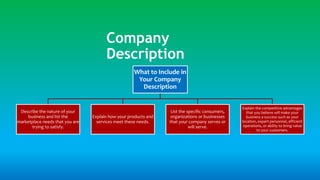
Company
Description
What to Include in
Your Company
Description
Describe the nature of your
business and list the
marketplace needs that you are
trying to satisfy.
Explain how your products and
services meet these needs.
List the specific consumers,
organizations or businesses
that your company serves or
will serve.
Explain the competitive advantages
that you believe will make your
business a success such as your
location, expert personnel, efficient
operations, or ability to bring value
to your customers.
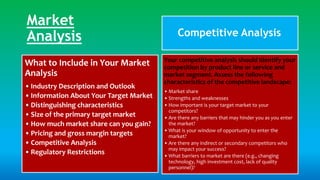
Market
Analysis
What to Include in Your Market
Analysis
• Industry Description and Outlook
• Information About Your Target Market
• Distinguishing characteristics
• Size of the primary target market
• How much market share can you gain?
• Pricing and gross margin targets
• Competitive Analysis
• Regulatory Restrictions
Competitive Analysis
Your competitive analysis should identify your
competition by product line or service and
market segment. Assess the following
characteristics of the competitive landscape:
• Market share
• Strengths and weaknesses
• How important is your target market to your
competitors?
• Are there any barriers that may hinder you as you enter
the market?
• What is your window of opportunity to enter the
market?
• Are there any indirect or secondary competitors who
may impact your success?
• What barriers to market are there (e.g., changing
technology, high investment cost, lack of quality
personnel)?
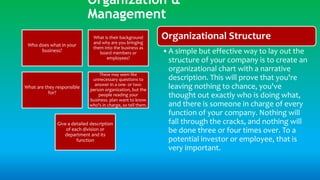
Organization &
Management
Organizational Structure
•A simple but effective way to lay out the
structure of your company is to create an
organizational chart with a narrative
description. This will prove that you're
leaving nothing to chance, you've
thought out exactly who is doing what,
and there is someone in charge of every
function of your company. Nothing will
fall through the cracks, and nothing will
be done three or four times over. To a
potential investor or employee, that is
very important.
Who does what in your
business?
What is their background
and why are you bringing
them into the business as
board members or
employees?
What are they responsible
for?
These may seem like
unnecessary questions to
answer in a one- or two-
person organization, but the
people reading your
business. plan want to know
who's in charge, so tell them.
Give a detailed description
of each division or
department and its
function
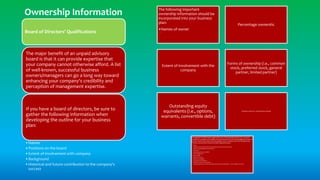
Ownership Information The following important
ownership information should be
incorporated into your business
plan:
•Names of owner
s
Percentage ownership
Extent of involvement with the
company
Forms of ownership (i.e., common
stock, preferred stock, general
partner, limited partner)
Outstanding equity
equivalents (i.e., options,
warrants, convertible debt)
Common stock (i.e., authorized or issued)
ManagementProfilesExperts agree that one of the strongest factors for success in
any growth company is the ability and track record of its owner/managementteam, so
let your readerknow about the key people in your company and their backgrounds.
Provide resumes that include the following information:
• Name
• Position (include brief position description along with primary duties)
• Primary responsibilities and authority
• Education
• Unique experience and skills
• Prior employment
• Special skills
• Past track record
• Industry recognition
• Community involvement
• Number of years with company
• Compensation basis and levels (make sure these are reasonable -- not too high or too low)
Board of Directors' Qualifications
The major benefit of an unpaid advisory
board is that it can provide expertise that
your company cannot otherwise afford. A list
of well-known, successful business
owners/managers can go a long way toward
enhancing your company's credibility and
perception of management expertise.
If you have a board of directors, be sure to
gather the following information when
developing the outline for your business
plan:
•Names
•Positions on the board
•Extent of involvement with company
•Background
•Historical and future contribution to the company's
success
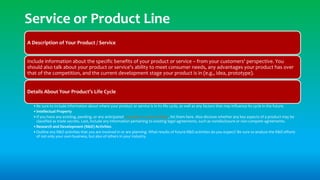
Service or Product Line
A Description of Your Product / Service
Include information about the specific benefits of your product or service – from your customers' perspective. You
should also talk about your product or service's ability to meet consumer needs, any advantages your product has over
that of the competition, and the current development stage your product is in (e.g., idea, prototype).
Details About Your Product’s Life Cycle
•Be sure to include information about where your product or service is in its life cycle, as well as any factors that may influence its cycle in the future.
•Intellectual Property
•If you have any existing, pending, or any anticipated copyright or patent filings, list them here. Also disclose whether any key aspects of a product may be
classified as trade secrets. Last, include any information pertaining to existing legal agreements, such as nondisclosure or non-compete agreements.
•Research and Development (R&D) Activities
•Outline any R&D activities that you are involved in or are planning. What results of future R&D activities do you expect? Be sure to analyze the R&D efforts
of not only your own business, but also of others in your industry.
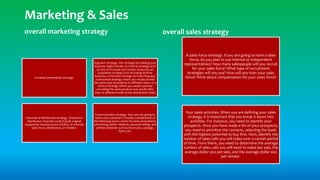
overall marketing strategy
A market penetration strategy.
A growth strategy. This strategy for building your
business might include: an internal strategy such
as how to increase your human resources, an
acquisition strategy such as buying another
business, a franchise strategy for branching out,
a horizontal strategy where you would provide
the same type of products to different users, or a
vertical strategy where you would continue
providing the same products but would offer
them at different levels of the distribution chain.
Channels of distribution strategy. Choices for
distribution channels could include original
equipment manufacturers (OEMs), an internal
sales force, distributors, or retailers.
Communication strategy. How are you going to
reach your customers? Usually a combination of
the following tactics works the best: promotions,
advertising, public relations, personal selling, and
printed materials such as brochures, catalogs,
flyers, etc.
overall sales strategy
A sales force strategy. If you are going to have a sales
force, do you plan to use internal or independent
representatives? How many salespeople will you recruit
for your sales force? What type of recruitment
strategies will you use? How will you train your sales
force? What about compensation for your sales force?
Your sales activities. When you are defining your sales
strategy, it is important that you break it down into
activities. For instance, you need to identify your
prospects. Once you have made a list of your prospects,
you need to prioritize the contacts, selecting the leads
with the highest potential to buy first. Next, identify the
number of sales calls you will make over a certain period
of time. From there, you need to determine the average
number of sales calls you will need to make per sale, the
average dollar size per sale, and the average dollar size
per vendor.
Marketing & Sales
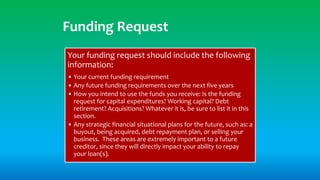
Funding Request
Your funding request should include the following
information:
• Your current funding requirement
• Any future funding requirements over the next five years
• How you intend to use the funds you receive: Is the funding
request for capital expenditures? Working capital? Debt
retirement? Acquisitions? Whatever it is, be sure to list it in this
section.
• Any strategic financial situational plans for the future, such as: a
buyout, being acquired, debt repayment plan, or selling your
business. These areas are extremely important to a future
creditor, since they will directly impact your ability to repay
your loan(s).
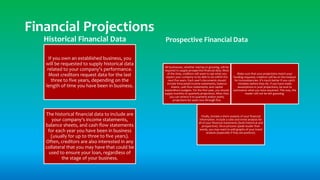
Historical Financial Data
If you own an established business, you
will be requested to supply historical data
related to your company's performance.
Most creditors request data for the last
three to five years, depending on the
length of time you have been in business.
The historical financial data to include are
your company's income statements,
balance sheets, and cash flow statements
for each year you have been in business
(usually for up to three to five years).
Often, creditors are also interested in any
collateral that you may have that could be
used to ensure your loan, regardless of
the stage of your business.
Prospective Financial Data
All businesses, whether startup or growing, will be
required to supply prospective financial data. Most
of the time, creditors will want to see what you
expect your company to be able to do within the
next five years. Each year's documents should
include forecasted income statements, balance
sheets, cash flow statements, and capital
expenditure budgets. For the first year, you should
supply monthly or quarterly projections. After that,
you can stretch it to quarterly and/or yearly
projections for years two through five.
Make sure that your projections match your
funding requests; creditors will be on the lookout
for inconsistencies. It's much better if you catch
mistakes before they do. If you have made
assumptions in your projections, be sure to
summarize what you have assumed. This way, the
reader will not be left guessing.
Finally, include a short analysis of your financial
information. Include a ratio and trend analysis for
all of your financial statements (both historical and
prospective). Since pictures speak louder than
words, you may want to add graphs of your trend
analysis (especially if they are positive).
Financial Projections
Appendix
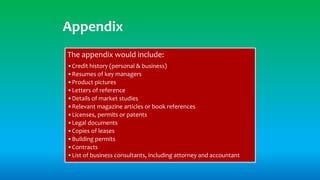
The appendix would include:
•Credit history (personal & business)
•Resumes of key managers
•Product pictures
•Letters of reference
•Details of market studies
•Relevant magazine articles or book references
•Licenses, permits or patents
•Legal documents
•Copies of leases
•Building permits
•Contracts
•List of business consultants, including attorney and accountant
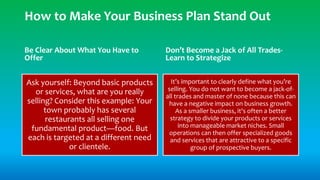
Be Clear About What You Have to
Offer
Ask yourself: Beyond basic products
or services, what are you really
selling? Consider this example: Your
town probably has several
restaurants all selling one
fundamental product—food. But
each is targeted at a different need
or clientele.
Don’t Become a Jack of All Trades-
Learn to Strategize
It’s important to clearly define what you’re
selling. You do not want to become a jack-of-
all trades and master of none because this can
have a negative impact on business growth.
As a smaller business, it's often a better
strategy to divide your products or services
into manageable market niches. Small
operations can then offer specialized goods
and services that are attractive to a specific
group of prospective buyers.
How to Make Your Business Plan Stand Out
Choose Your Business Structure
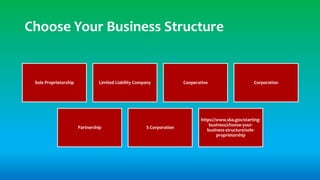
Sole Proprietorship Limited Liability Company Cooperative Corporation
Partnership S Corporation
https://www.sba.gov/starting-
business/choose-your-
business-structure/sole-
proprietorship

Start your business

  • 1.
    Business..!! Let usStart “SELL THE PROBLEMS YOU SOLVE, NOT THE PRODUCT” Made By: Alok Mishra, IIT Bhubaneswar
  • 2.
    How to Start a Business Write Your Business Plan Choose Your Business Structure Choose& Register Your Business Choose Your Business Location & Equipment Business Licenses & Permits Learn About Business Laws Business Financials Finance Your Business Filing & Paying Taxes Hire & Retain Employees
  • 3.
    How to Starta Business Is Entrepreneurship For You? 20 Questions Before Starting 10 Steps to Starting a Business Understand Your Market Business Data & Statistics Business Types Find a Mentor or Counsellor
  • 4.
    Is Entrepreneurship For You? Startingyour own business can be an exciting and rewarding experience. It can offer numerous advantages such as being your own boss, setting your own schedule and making a living doing something you enjoy. But, becoming a successful entrepreneur requires thorough planning, creativity and hard work. •Comfortable with taking risks •Independent •Persuasive •Able to negotiate •Creative •Supported by others Consider whether you have the following characteristics and skills commonly associated with successful entrepreneurs:
  • 5.
    20 Questions BeforeStarting The Business Why am I starting a business? What kind of business do I want? Who is my ideal customer? What products or services will my business provide? Am I prepared to spend the time and money needed to get my business started? What differentiates my business idea and the products or services I will provide from others in the market? Where will my business be located? How many employees will I need? What types of suppliers do I need? How much money do I need to get started? Will I need to get a loan? How soon will it take before my products or services are available? How long do I have until I start making a profit? Who is my competition? How will I price my product compared to my competition? How will I set up the legal structure of my business? What taxes do I need to pay? What kind of insurance do I need? How will I manage my business? How will I advertise my business?
  • 6.
    10 Steps toStarting a Business Step 1: Write a Business Plan Step 2: Get Business Assistance and Training Step 3: Choose a Business Location Step 4: Finance Your Business Step 5: Determine the Legal Structure of Your Business Step 6: Register a Business Name ("Doing Business As") Step 7: Register for State and Local Taxes Step 8: Obtain Business Licenses and Permits Step 9: Understand Employer Responsibilitie s Step 10: Find Local Assistanc e
  • 7.
    Understand Your Market How toConduct Market Research Before you start your business, understand the basics of market research by following these steps: 1. Identify Official Government Sources of Market and Industry Data The government offers a wealth of data and information about businesses, industries and economic conditions that can aid in conducting market research. These sources provide valuable information about your customers and competitors: • Economic Indicators • Employment Statistics • Income and Earnings 2. Identify Additional Sources of Analysis Trade groups, business magazines, academic institutions and other third parties gather and analyze research data about business trends. Use Internet and database searches to find information related to your location and industry. 3. Understand the International Marketplace Today’s economy is a globalized marketplace, so it’s important to understand the international factors that influence your business. These resources will help you to research potential international markets for your products or services: • Market Research Guide for Exporters Identifies resources for business owners seeking to sell their products abroad. • Country Market Research Reports on trade issues in countries across the globe. • BuyUSA.gov Helps U.S. companies find new international business partners. To run a successful business, you need to learn about your customers, your competitors and your industry. Market research is the process of analysing data to help you understand which products and services are in demand, and how to be competitive. Market research can also provide valuable insight to help you: •Reduce business risks •Spot current and upcoming problems in your industry •Identify sales opportunities
  • 8.
    Business Types Green Businesses Startups & High Growth Businesses Home-Based Businesses Online Businesses Franchise Businesses BuyingExisting Businesses Self Employed & Independent Contractors Women-Owned Businesses Veteran- Owned Businesses People with Disabilities Young Entrepreneurs Encore Entrepreneurs Minority- Owned Businesses Native Americans
  • 9.
  • 10.
    If You Arean Established Business The Mission Statement – This explains what your business is all about. It should be between several sentences and a paragraph. Company Information – Include a short statement that covers when your business was formed, the names of the founders and their roles, your number of employees, and your business location(s). Growth Highlights – Include examples of company growth, such as financial or market highlights (for example, “XYZ Firm increased profit margins and market share year-over-year since its foundation). Graphs and charts can be helpful in this section. Your Products/Services -- Briefly describe the products or services you provide. Financial Information – If you are seeking financing, include any information about your current bank and investors. If You Are a Start up or New Business If you are just starting a business, you won't have as much information as an established company. Instead, focus on your experience and background as well as the decisions that led you to start this particular enterprise. Demonstrate that you have done thorough market analysis. Include information about a need or gap in your target market, and how your particular solutions can fill it. Convince the reader that you can succeed in your target market, then address your future plans. Remember, your Executive Summary will be the last thing you write. So the first section of the business plan that you will tackle is the Company Description section. What to Include in Your Executive Summary
  • 11.
    Company Description What to Includein Your Company Description Describe the nature of your business and list the marketplace needs that you are trying to satisfy. Explain how your products and services meet these needs. List the specific consumers, organizations or businesses that your company serves or will serve. Explain the competitive advantages that you believe will make your business a success such as your location, expert personnel, efficient operations, or ability to bring value to your customers.
  • 12.
    Market Analysis What to Includein Your Market Analysis • Industry Description and Outlook • Information About Your Target Market • Distinguishing characteristics • Size of the primary target market • How much market share can you gain? • Pricing and gross margin targets • Competitive Analysis • Regulatory Restrictions Competitive Analysis Your competitive analysis should identify your competition by product line or service and market segment. Assess the following characteristics of the competitive landscape: • Market share • Strengths and weaknesses • How important is your target market to your competitors? • Are there any barriers that may hinder you as you enter the market? • What is your window of opportunity to enter the market? • Are there any indirect or secondary competitors who may impact your success? • What barriers to market are there (e.g., changing technology, high investment cost, lack of quality personnel)?
  • 13.
    Organization & Management Organizational Structure •Asimple but effective way to lay out the structure of your company is to create an organizational chart with a narrative description. This will prove that you're leaving nothing to chance, you've thought out exactly who is doing what, and there is someone in charge of every function of your company. Nothing will fall through the cracks, and nothing will be done three or four times over. To a potential investor or employee, that is very important. Who does what in your business? What is their background and why are you bringing them into the business as board members or employees? What are they responsible for? These may seem like unnecessary questions to answer in a one- or two- person organization, but the people reading your business. plan want to know who's in charge, so tell them. Give a detailed description of each division or department and its function
  • 14.
    Ownership Information Thefollowing important ownership information should be incorporated into your business plan: •Names of owner s Percentage ownership Extent of involvement with the company Forms of ownership (i.e., common stock, preferred stock, general partner, limited partner) Outstanding equity equivalents (i.e., options, warrants, convertible debt) Common stock (i.e., authorized or issued) ManagementProfilesExperts agree that one of the strongest factors for success in any growth company is the ability and track record of its owner/managementteam, so let your readerknow about the key people in your company and their backgrounds. Provide resumes that include the following information: • Name • Position (include brief position description along with primary duties) • Primary responsibilities and authority • Education • Unique experience and skills • Prior employment • Special skills • Past track record • Industry recognition • Community involvement • Number of years with company • Compensation basis and levels (make sure these are reasonable -- not too high or too low) Board of Directors' Qualifications The major benefit of an unpaid advisory board is that it can provide expertise that your company cannot otherwise afford. A list of well-known, successful business owners/managers can go a long way toward enhancing your company's credibility and perception of management expertise. If you have a board of directors, be sure to gather the following information when developing the outline for your business plan: •Names •Positions on the board •Extent of involvement with company •Background •Historical and future contribution to the company's success
  • 15.
    Service or ProductLine A Description of Your Product / Service Include information about the specific benefits of your product or service – from your customers' perspective. You should also talk about your product or service's ability to meet consumer needs, any advantages your product has over that of the competition, and the current development stage your product is in (e.g., idea, prototype). Details About Your Product’s Life Cycle •Be sure to include information about where your product or service is in its life cycle, as well as any factors that may influence its cycle in the future. •Intellectual Property •If you have any existing, pending, or any anticipated copyright or patent filings, list them here. Also disclose whether any key aspects of a product may be classified as trade secrets. Last, include any information pertaining to existing legal agreements, such as nondisclosure or non-compete agreements. •Research and Development (R&D) Activities •Outline any R&D activities that you are involved in or are planning. What results of future R&D activities do you expect? Be sure to analyze the R&D efforts of not only your own business, but also of others in your industry.
  • 16.
    overall marketing strategy Amarket penetration strategy. A growth strategy. This strategy for building your business might include: an internal strategy such as how to increase your human resources, an acquisition strategy such as buying another business, a franchise strategy for branching out, a horizontal strategy where you would provide the same type of products to different users, or a vertical strategy where you would continue providing the same products but would offer them at different levels of the distribution chain. Channels of distribution strategy. Choices for distribution channels could include original equipment manufacturers (OEMs), an internal sales force, distributors, or retailers. Communication strategy. How are you going to reach your customers? Usually a combination of the following tactics works the best: promotions, advertising, public relations, personal selling, and printed materials such as brochures, catalogs, flyers, etc. overall sales strategy A sales force strategy. If you are going to have a sales force, do you plan to use internal or independent representatives? How many salespeople will you recruit for your sales force? What type of recruitment strategies will you use? How will you train your sales force? What about compensation for your sales force? Your sales activities. When you are defining your sales strategy, it is important that you break it down into activities. For instance, you need to identify your prospects. Once you have made a list of your prospects, you need to prioritize the contacts, selecting the leads with the highest potential to buy first. Next, identify the number of sales calls you will make over a certain period of time. From there, you need to determine the average number of sales calls you will need to make per sale, the average dollar size per sale, and the average dollar size per vendor. Marketing & Sales
  • 17.
    Funding Request Your fundingrequest should include the following information: • Your current funding requirement • Any future funding requirements over the next five years • How you intend to use the funds you receive: Is the funding request for capital expenditures? Working capital? Debt retirement? Acquisitions? Whatever it is, be sure to list it in this section. • Any strategic financial situational plans for the future, such as: a buyout, being acquired, debt repayment plan, or selling your business. These areas are extremely important to a future creditor, since they will directly impact your ability to repay your loan(s).
  • 18.
    Historical Financial Data Ifyou own an established business, you will be requested to supply historical data related to your company's performance. Most creditors request data for the last three to five years, depending on the length of time you have been in business. The historical financial data to include are your company's income statements, balance sheets, and cash flow statements for each year you have been in business (usually for up to three to five years). Often, creditors are also interested in any collateral that you may have that could be used to ensure your loan, regardless of the stage of your business. Prospective Financial Data All businesses, whether startup or growing, will be required to supply prospective financial data. Most of the time, creditors will want to see what you expect your company to be able to do within the next five years. Each year's documents should include forecasted income statements, balance sheets, cash flow statements, and capital expenditure budgets. For the first year, you should supply monthly or quarterly projections. After that, you can stretch it to quarterly and/or yearly projections for years two through five. Make sure that your projections match your funding requests; creditors will be on the lookout for inconsistencies. It's much better if you catch mistakes before they do. If you have made assumptions in your projections, be sure to summarize what you have assumed. This way, the reader will not be left guessing. Finally, include a short analysis of your financial information. Include a ratio and trend analysis for all of your financial statements (both historical and prospective). Since pictures speak louder than words, you may want to add graphs of your trend analysis (especially if they are positive). Financial Projections
  • 19.
    Appendix The appendix wouldinclude: •Credit history (personal & business) •Resumes of key managers •Product pictures •Letters of reference •Details of market studies •Relevant magazine articles or book references •Licenses, permits or patents •Legal documents •Copies of leases •Building permits •Contracts •List of business consultants, including attorney and accountant
  • 20.
    Be Clear AboutWhat You Have to Offer Ask yourself: Beyond basic products or services, what are you really selling? Consider this example: Your town probably has several restaurants all selling one fundamental product—food. But each is targeted at a different need or clientele. Don’t Become a Jack of All Trades- Learn to Strategize It’s important to clearly define what you’re selling. You do not want to become a jack-of- all trades and master of none because this can have a negative impact on business growth. As a smaller business, it's often a better strategy to divide your products or services into manageable market niches. Small operations can then offer specialized goods and services that are attractive to a specific group of prospective buyers. How to Make Your Business Plan Stand Out
  • 21.
    Choose Your BusinessStructure Sole Proprietorship Limited Liability Company Cooperative Corporation Partnership S Corporation https://www.sba.gov/starting- business/choose-your- business-structure/sole- proprietorship