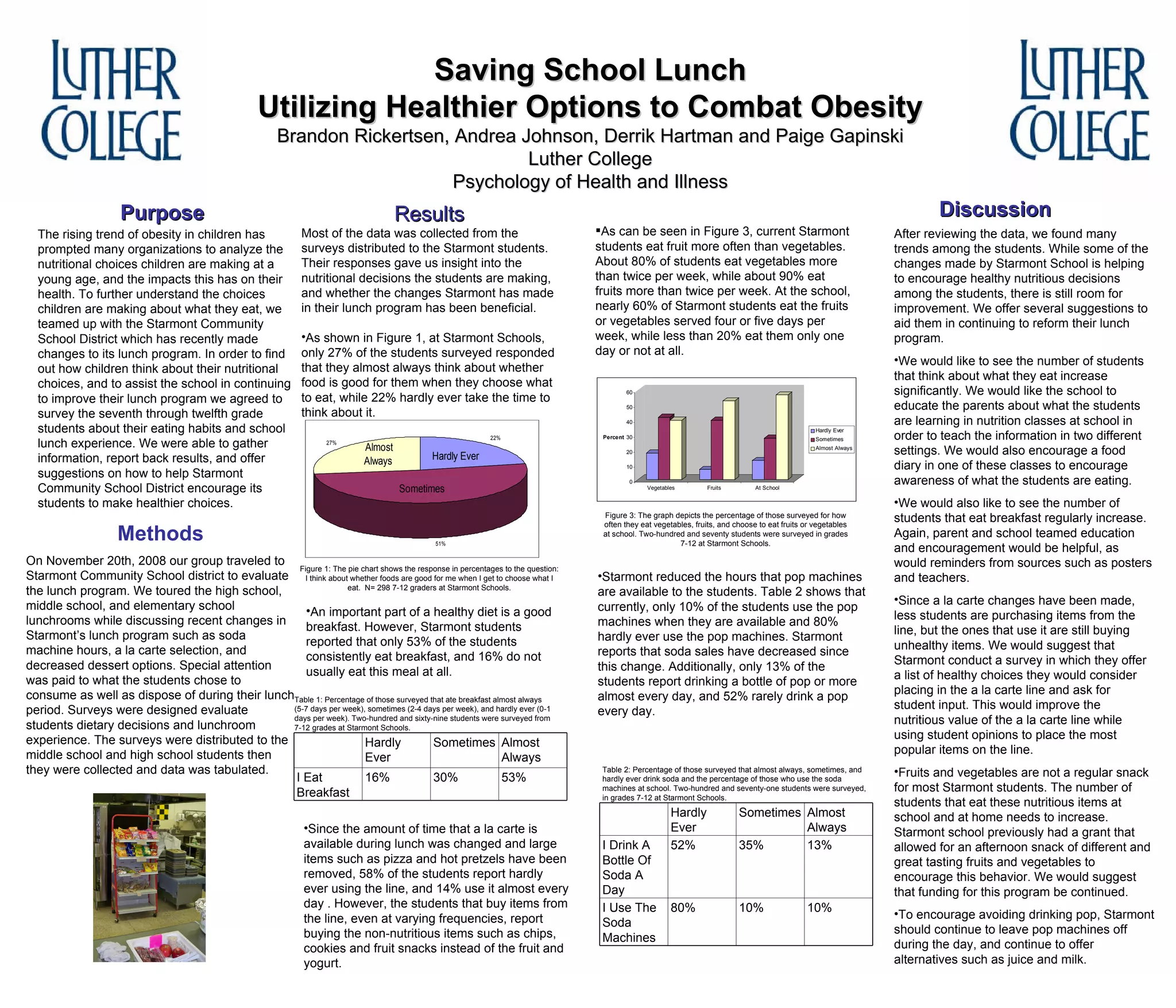
Saving School Lunch Utilizing Healthier Options to Combat Obesity Brandon Rickertsen, Andrea Johnson, Derrik Hartman and Paige Gapinski Luther College Psychology of Health and Illness Purpose   The rising trend of obesity in children has prompted many organizations to analyze the nutritional choices children are making at a young age, and the impacts this has on their health. To further understand the choices children are making about what they eat, we teamed up with the Starmont Community School District which has recently made changes to its lunch program. In order to find out how children think about their nutritional choices, and to assist the school in continuing to improve their lunch program we agreed to survey the seventh through twelfth grade students about their eating habits and school lunch experience. We were able to gather information, report back results, and offer suggestions on how to help Starmont Community School District encourage its students to make healthier choices. Methods On November 20th, 2008 our group traveled to Starmont Community School district to evaluate the lunch program. We toured the high school, middle school, and elementary school lunchrooms while discussing recent changes in Starmont’s lunch program such as soda machine hours, a la carte selection, and decreased dessert options. Special attention was paid to what the students chose to consume as well as dispose of during their lunch period. Surveys were designed evaluate students dietary decisions and lunchroom experience. The surveys were distributed to the middle school and high school students then they were collected and data was tabulated. As can be seen in Figure 3, current Starmont students eat fruit more often than vegetables. About 80% of students eat vegetables more than twice per week, while about 90% eat fruits more than twice per week. At the school, nearly 60% of Starmont students eat the fruits or vegetables served four or five days per week, while less than 20% eat them only one day or not at all. Discussion Figure 1: The pie chart shows the response in percentages to the question: I think about whether foods are good for me when I get to choose what I eat.  N= 298 7-12 graders at Starmont Schools. Table 1: Percentage of those surveyed that ate breakfast almost always (5-7 days per week), sometimes (2-4 days per week), and hardly ever (0-1 days per week). Two-hundred and sixty-nine students were surveyed from 7-12 grades at Starmont Schools. Table 2: Percentage of those surveyed that almost always, sometimes, and hardly ever drink soda and the percentage of those who use the soda machines at school. Two-hundred and seventy-one students were surveyed, in grades 7-12 at Starmont Schools.  Results Most of the data was collected from the surveys distributed to the Starmont students. Their responses gave us insight into the nutritional decisions the students are making, and whether the changes Starmont has made in their lunch program has been beneficial.  As shown in Figure 1, at Starmont Schools, only 27% of the students surveyed responded that they almost always think about whether food is good for them when they choose what to eat, while 22% hardly ever take the time to think about it.  Figure 3: The graph depicts the percentage of those surveyed for how often they eat vegetables, fruits, and choose to eat fruits or vegetables at school. Two-hundred and seventy students were surveyed in grades 7-12 at Starmont Schools. An important part of a healthy diet is a good breakfast. However, Starmont students reported that only 53% of the students consistently eat breakfast, and 16% do not usually eat this meal at all. Starmont reduced the hours that pop machines are available to the students. Table 2 shows that currently, only 10% of the students use the pop machines when they are available and 80% hardly ever use the pop machines. Starmont reports that soda sales have decreased since this change. Additionally, only 13% of the students report drinking a bottle of pop or more almost every day, and 52% rarely drink a pop every day. Since the amount of time that a la carte is available during lunch was changed and large items such as pizza and hot pretzels have been removed, 58% of the students report hardly ever using the line, and 14% use it almost every day . However, the students that buy items from the line, even at varying frequencies, report buying the non-nutritious items such as chips, cookies and fruit snacks instead of the fruit and yogurt. After reviewing the data, we found many trends among the students. While some of the changes made by Starmont School is helping to encourage healthy nutritious decisions among the students, there is still room for improvement. We offer several suggestions to aid them in continuing to reform their lunch program. We would like to see the number of students that think about what they eat increase significantly. We would like the school to educate the parents about what the students are learning in nutrition classes at school in order to teach the information in two different settings. We would also encourage a food diary in one of these classes to encourage awareness of what the students are eating. We would also like to see the number of students that eat breakfast regularly increase. Again, parent and school teamed education and encouragement would be helpful, as would reminders from sources such as posters and teachers. Since a la carte changes have been made, less students are purchasing items from the line, but the ones that use it are still buying unhealthy items. We would suggest that Starmont conduct a survey in which they offer a list of healthy choices they would consider placing in the a la carte line and ask for student input. This would improve the nutritious value of the a la carte line while using student opinions to place the most popular items on the line. Fruits and vegetables are not a regular snack for most Starmont students. The number of students that eat these nutritious items at school and at home needs to increase. Starmont school previously had a grant that allowed for an afternoon snack of different and great tasting fruits and vegetables to encourage this behavior. We would suggest that funding for this program be continued. To encourage avoiding drinking pop, Starmont should continue to leave pop machines off during the day, and continue to offer alternatives such as juice and milk. Hardly Ever Sometimes Almost Always I Eat Breakfast 16% 30% 53% Hardly Ever Sometimes Almost Always I Drink A Bottle Of Soda A Day 52% 35% 13% I Use The Soda Machines 80% 10% 10%

Saving School Lunch: Utilizing Healthier Options to Combat Obesity

  • 1.
    Saving School LunchUtilizing Healthier Options to Combat Obesity Brandon Rickertsen, Andrea Johnson, Derrik Hartman and Paige Gapinski Luther College Psychology of Health and Illness Purpose The rising trend of obesity in children has prompted many organizations to analyze the nutritional choices children are making at a young age, and the impacts this has on their health. To further understand the choices children are making about what they eat, we teamed up with the Starmont Community School District which has recently made changes to its lunch program. In order to find out how children think about their nutritional choices, and to assist the school in continuing to improve their lunch program we agreed to survey the seventh through twelfth grade students about their eating habits and school lunch experience. We were able to gather information, report back results, and offer suggestions on how to help Starmont Community School District encourage its students to make healthier choices. Methods On November 20th, 2008 our group traveled to Starmont Community School district to evaluate the lunch program. We toured the high school, middle school, and elementary school lunchrooms while discussing recent changes in Starmont’s lunch program such as soda machine hours, a la carte selection, and decreased dessert options. Special attention was paid to what the students chose to consume as well as dispose of during their lunch period. Surveys were designed evaluate students dietary decisions and lunchroom experience. The surveys were distributed to the middle school and high school students then they were collected and data was tabulated. As can be seen in Figure 3, current Starmont students eat fruit more often than vegetables. About 80% of students eat vegetables more than twice per week, while about 90% eat fruits more than twice per week. At the school, nearly 60% of Starmont students eat the fruits or vegetables served four or five days per week, while less than 20% eat them only one day or not at all. Discussion Figure 1: The pie chart shows the response in percentages to the question: I think about whether foods are good for me when I get to choose what I eat. N= 298 7-12 graders at Starmont Schools. Table 1: Percentage of those surveyed that ate breakfast almost always (5-7 days per week), sometimes (2-4 days per week), and hardly ever (0-1 days per week). Two-hundred and sixty-nine students were surveyed from 7-12 grades at Starmont Schools. Table 2: Percentage of those surveyed that almost always, sometimes, and hardly ever drink soda and the percentage of those who use the soda machines at school. Two-hundred and seventy-one students were surveyed, in grades 7-12 at Starmont Schools. Results Most of the data was collected from the surveys distributed to the Starmont students. Their responses gave us insight into the nutritional decisions the students are making, and whether the changes Starmont has made in their lunch program has been beneficial. As shown in Figure 1, at Starmont Schools, only 27% of the students surveyed responded that they almost always think about whether food is good for them when they choose what to eat, while 22% hardly ever take the time to think about it. Figure 3: The graph depicts the percentage of those surveyed for how often they eat vegetables, fruits, and choose to eat fruits or vegetables at school. Two-hundred and seventy students were surveyed in grades 7-12 at Starmont Schools. An important part of a healthy diet is a good breakfast. However, Starmont students reported that only 53% of the students consistently eat breakfast, and 16% do not usually eat this meal at all. Starmont reduced the hours that pop machines are available to the students. Table 2 shows that currently, only 10% of the students use the pop machines when they are available and 80% hardly ever use the pop machines. Starmont reports that soda sales have decreased since this change. Additionally, only 13% of the students report drinking a bottle of pop or more almost every day, and 52% rarely drink a pop every day. Since the amount of time that a la carte is available during lunch was changed and large items such as pizza and hot pretzels have been removed, 58% of the students report hardly ever using the line, and 14% use it almost every day . However, the students that buy items from the line, even at varying frequencies, report buying the non-nutritious items such as chips, cookies and fruit snacks instead of the fruit and yogurt. After reviewing the data, we found many trends among the students. While some of the changes made by Starmont School is helping to encourage healthy nutritious decisions among the students, there is still room for improvement. We offer several suggestions to aid them in continuing to reform their lunch program. We would like to see the number of students that think about what they eat increase significantly. We would like the school to educate the parents about what the students are learning in nutrition classes at school in order to teach the information in two different settings. We would also encourage a food diary in one of these classes to encourage awareness of what the students are eating. We would also like to see the number of students that eat breakfast regularly increase. Again, parent and school teamed education and encouragement would be helpful, as would reminders from sources such as posters and teachers. Since a la carte changes have been made, less students are purchasing items from the line, but the ones that use it are still buying unhealthy items. We would suggest that Starmont conduct a survey in which they offer a list of healthy choices they would consider placing in the a la carte line and ask for student input. This would improve the nutritious value of the a la carte line while using student opinions to place the most popular items on the line. Fruits and vegetables are not a regular snack for most Starmont students. The number of students that eat these nutritious items at school and at home needs to increase. Starmont school previously had a grant that allowed for an afternoon snack of different and great tasting fruits and vegetables to encourage this behavior. We would suggest that funding for this program be continued. To encourage avoiding drinking pop, Starmont should continue to leave pop machines off during the day, and continue to offer alternatives such as juice and milk. Hardly Ever Sometimes Almost Always I Eat Breakfast 16% 30% 53% Hardly Ever Sometimes Almost Always I Drink A Bottle Of Soda A Day 52% 35% 13% I Use The Soda Machines 80% 10% 10%