Teresa Wiemerslage
Iowa State University Extension
Communications and Program
Coordinator

NIFF Coalition Coordinator
wiemer@iastate.edu
(563) 794-0599
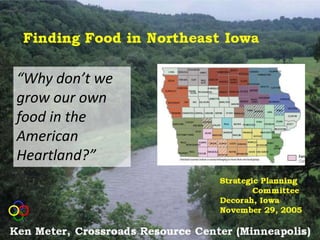
“Why don’t we
grow our own
food in the
American
Heartland?”
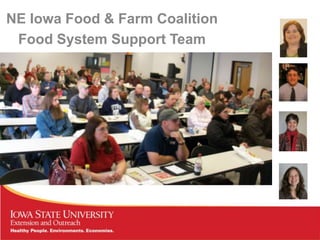
NE Iowa Food & Farm Coalition
 Food System Support Team


  Child Nutrition Programs
  Procurement Overview
Why Local?
Defining
Local for
Your School

      FFI Youth 4-H Team ICN
         January 18, 2012
Local Food is Good For…

•   You
•   Your Family
•   Community and School
•   Farmers
•   Environment
                   What we eat matters…
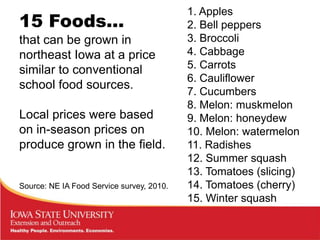
1. Apples
15 Foods…                                  2. Bell peppers
that can be grown in                       3. Broccoli
northeast Iowa at a price                  4. Cabbage
similar to conventional                    5. Carrots
                                           6. Cauliflower
school food sources.
                                           7. Cucumbers
                                           8. Melon: muskmelon
Local prices were based                    9. Melon: honeydew
on in-season prices on                     10. Melon: watermelon
produce grown in the field.                11. Radishes
                                           12. Summer squash
                                           13. Tomatoes (slicing)
Source: NE IA Food Service survey, 2010.   14. Tomatoes (cherry)
                                           15. Winter squash
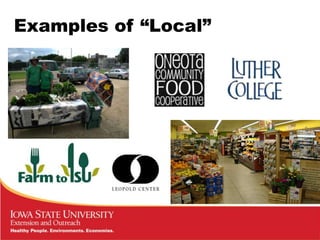
Examples of “Local”
Question

What is your definition of “local”?
Strategy A
Ensure that school district policies & practices support healthy
living of children, families and community members

Policy and System Change Target – Procurement policy
  allows for geographic preference of local foods in schools

Activities to support change in target:
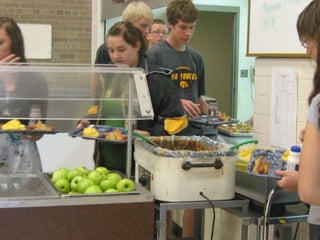
• Farm to School program
• Home Grown Lunch Week
• Food Service workshops
• Producers contracts
• K-3 Curriculum taught by high school students
• School gardens
What is Procurement?
•Generally, it is the process of purchasing goods
or services. Most important principle =
COMPETITION

• FREE AND OPEN competition. All suppliers
are on the same level playing field and have the
same opportunities for that business.
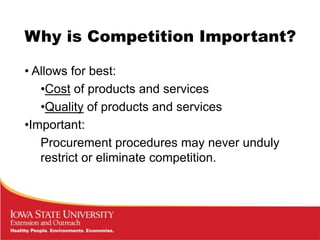
Why is Competition Important?

• Allows for best:
   •Cost of products and services
   •Quality of products and services
•Important:
   Procurement procedures may never unduly
   restrict or eliminate competition.
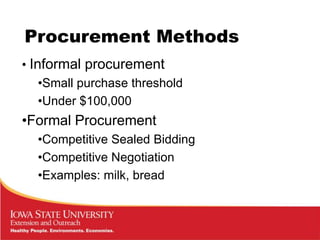
Procurement Methods
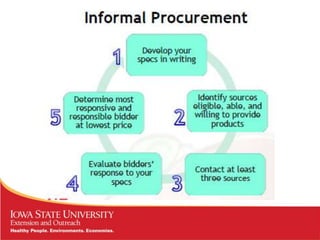
• Informal procurement
    •Small purchase threshold
    •Under $100,000
•Formal Procurement
  •Competitive Sealed Bidding
  •Competitive Negotiation
  •Examples: milk, bread
Question

Why do you think a local farmer
may need an advantage in bidding
to a school?
Geographic Preference
2008 Farm Bill amended the National School
Lunch Act to allow institutions receiving funds
through the Child Nutrition Programs to apply a
geographic preference when procuring
unprocessed locally grown or locally raised
agriculture products.
•Local = Discretion left to the institution
responsible for procurement
•Unprocessed = only those agricultural products
that retain their inherent character
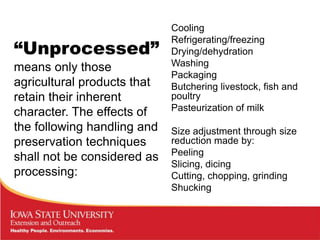
Cooling

“Unprocessed”
                             Refrigerating/freezing
                             Drying/dehydration
means only those             Washing
                             Packaging
agricultural products that   Butchering livestock, fish and
retain their inherent        poultry
                             Pasteurization of milk
character. The effects of
the following handling and   Size adjustment through size
preservation techniques      reduction made by:
                             Peeling
shall not be considered as
                             Slicing, dicing
processing:                  Cutting, chopping, grinding
                             Shucking
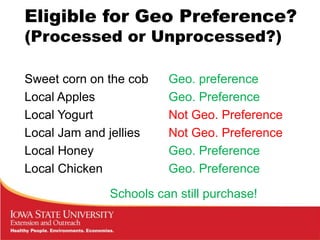
Eligible for Geo Preference?
(Processed or Unprocessed?)

Sweet corn on the cob   Geo. preference
Local Apples            Geo. Preference
Local Yogurt            Not Geo. Preference
Local Jam and jellies   Not Geo. Preference
Local Honey             Geo. Preference
Local Chicken           Geo. Preference

              Schools can still purchase!
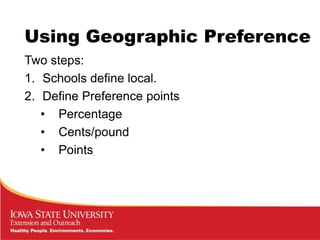
Using Geographic Preference
Two steps:
1. Schools define local.
2. Define Preference points
   • Percentage
   • Cents/pound
   • Points
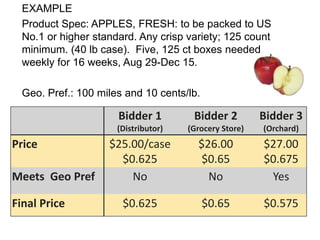
EXAMPLE
  Product Spec: APPLES, FRESH: to be packed to US
  No.1 or higher standard. Any crisp variety; 125 count
  minimum. (40 lb case). Five, 125 ct boxes needed
  weekly for 16 weeks, Aug 29-Dec 15.

  Geo. Pref.: 100 miles and 10 cents/lb.

                      Bidder 1         Bidder 2         Bidder 3
                      (Distributor)   (Grocery Store)   (Orchard)
Price               $25.00/case         $26.00          $27.00
                      $0.625             $0.65          $0.675
Meets Geo Pref          No                No             Yes

Final Price            $0.625              $0.65        $0.575
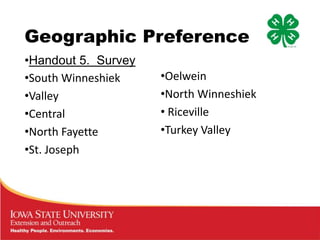
Geographic Preference
•Handout 5. Survey
•South Winneshiek    •Oelwein
•Valley              •North Winneshiek
•Central             • Riceville
•North Fayette       •Turkey Valley
•St. Joseph
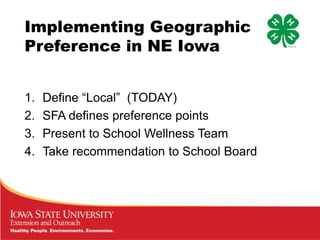
Implementing Geographic
Preference in NE Iowa


1.   Define “Local” (TODAY)
2.   SFA defines preference points
3.   Present to School Wellness Team
4.   Take recommendation to School Board
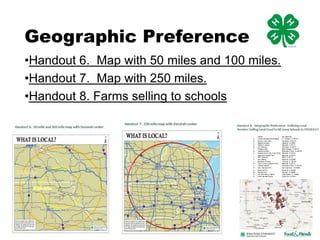
Geographic Preference
•Handout 6. Map with 50 miles and 100 miles.
•Handout 7. Map with 250 miles.
•Handout 8. Farms selling to schools
Step 1. Define Local
Ask your food service:
What local foods does your school serve?
What farmers supply local foods to your school?

What would be a good definition of local for your school
district? Discuss the pros and cons of each definition.
· Your county?
· Your county and surrounding counties?
· 50 mile radius?
· 100 mile radius?
· 250 mile radius?
· Your state?
Report Out
What’s Next?

1. Define “Local” (TODAY)
2. SFA defines preference points
3. Present to School Wellness Team

Take It Further:
4. Take recommendation to School Board

School food procurement

  • 1.
    Teresa Wiemerslage Iowa StateUniversity Extension Communications and Program Coordinator NIFF Coalition Coordinator wiemer@iastate.edu (563) 794-0599
  • 2.
    “Why don’t we growour own food in the American Heartland?”
  • 3.
    NE Iowa Food& Farm Coalition Food System Support Team Child Nutrition Programs Procurement Overview
  • 4.
    Why Local? Defining Local for YourSchool FFI Youth 4-H Team ICN January 18, 2012
  • 5.
    Local Food isGood For… • You • Your Family • Community and School • Farmers • Environment What we eat matters…
  • 6.
    1. Apples 15 Foods… 2. Bell peppers that can be grown in 3. Broccoli northeast Iowa at a price 4. Cabbage similar to conventional 5. Carrots 6. Cauliflower school food sources. 7. Cucumbers 8. Melon: muskmelon Local prices were based 9. Melon: honeydew on in-season prices on 10. Melon: watermelon produce grown in the field. 11. Radishes 12. Summer squash 13. Tomatoes (slicing) Source: NE IA Food Service survey, 2010. 14. Tomatoes (cherry) 15. Winter squash
  • 7.
  • 8.
    Question What is yourdefinition of “local”?
  • 10.
    Strategy A Ensure thatschool district policies & practices support healthy living of children, families and community members Policy and System Change Target – Procurement policy allows for geographic preference of local foods in schools Activities to support change in target: • Farm to School program • Home Grown Lunch Week • Food Service workshops • Producers contracts • K-3 Curriculum taught by high school students • School gardens
  • 13.
    What is Procurement? •Generally,it is the process of purchasing goods or services. Most important principle = COMPETITION • FREE AND OPEN competition. All suppliers are on the same level playing field and have the same opportunities for that business.
  • 14.
    Why is CompetitionImportant? • Allows for best: •Cost of products and services •Quality of products and services •Important: Procurement procedures may never unduly restrict or eliminate competition.
  • 15.
    Procurement Methods • Informalprocurement •Small purchase threshold •Under $100,000 •Formal Procurement •Competitive Sealed Bidding •Competitive Negotiation •Examples: milk, bread
  • 17.
    Question Why do youthink a local farmer may need an advantage in bidding to a school?
  • 18.
    Geographic Preference 2008 FarmBill amended the National School Lunch Act to allow institutions receiving funds through the Child Nutrition Programs to apply a geographic preference when procuring unprocessed locally grown or locally raised agriculture products. •Local = Discretion left to the institution responsible for procurement •Unprocessed = only those agricultural products that retain their inherent character
  • 19.
    Cooling “Unprocessed” Refrigerating/freezing Drying/dehydration means only those Washing Packaging agricultural products that Butchering livestock, fish and retain their inherent poultry Pasteurization of milk character. The effects of the following handling and Size adjustment through size preservation techniques reduction made by: Peeling shall not be considered as Slicing, dicing processing: Cutting, chopping, grinding Shucking
  • 20.
    Eligible for GeoPreference? (Processed or Unprocessed?) Sweet corn on the cob Geo. preference Local Apples Geo. Preference Local Yogurt Not Geo. Preference Local Jam and jellies Not Geo. Preference Local Honey Geo. Preference Local Chicken Geo. Preference Schools can still purchase!
  • 21.
    Using Geographic Preference Twosteps: 1. Schools define local. 2. Define Preference points • Percentage • Cents/pound • Points
  • 22.
    EXAMPLE ProductSpec: APPLES, FRESH: to be packed to US No.1 or higher standard. Any crisp variety; 125 count minimum. (40 lb case). Five, 125 ct boxes needed weekly for 16 weeks, Aug 29-Dec 15. Geo. Pref.: 100 miles and 10 cents/lb. Bidder 1 Bidder 2 Bidder 3 (Distributor) (Grocery Store) (Orchard) Price $25.00/case $26.00 $27.00 $0.625 $0.65 $0.675 Meets Geo Pref No No Yes Final Price $0.625 $0.65 $0.575
  • 23.
    Geographic Preference •Handout 5.Survey •South Winneshiek •Oelwein •Valley •North Winneshiek •Central • Riceville •North Fayette •Turkey Valley •St. Joseph
  • 24.
    Implementing Geographic Preference inNE Iowa 1. Define “Local” (TODAY) 2. SFA defines preference points 3. Present to School Wellness Team 4. Take recommendation to School Board
  • 25.
    Geographic Preference •Handout 6.Map with 50 miles and 100 miles. •Handout 7. Map with 250 miles. •Handout 8. Farms selling to schools
  • 26.
    Step 1. DefineLocal Ask your food service: What local foods does your school serve? What farmers supply local foods to your school? What would be a good definition of local for your school district? Discuss the pros and cons of each definition. · Your county? · Your county and surrounding counties? · 50 mile radius? · 100 mile radius? · 250 mile radius? · Your state?
  • 27.
  • 28.
    What’s Next? 1. Define“Local” (TODAY) 2. SFA defines preference points 3. Present to School Wellness Team Take It Further: 4. Take recommendation to School Board

Editor's Notes

  • #7 Source: NE IA Food Service survey, 2010. 15 foods Table 3. Foods that can be grown in northeast Iowa at a price similar to conventional school food sources. Local prices were based on in-season prices on produce grown in the field vs. high tunnel or greenhouse production.
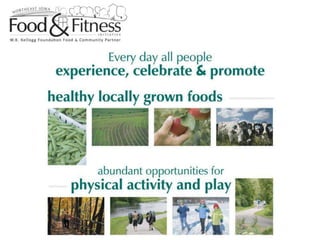
  • #10  Northeast Iowa Food and Fitness Initiative. ..Key messages of the FFI:It’s about people working together to create vibrant communities where the healthy choice is the easy choice. The healthy choice means that every day all people in NE Iowa have access to healthy, locally grown foods and abundant opportunities for physical activity and play.
  • #14 Ensures school food service receives best…Important to remember.
  • #15 Ensures school food service receives best…Important to remember.
  • #16 Important for schools, farmers and everyone in farm toschool have a basic grasp of procurement . Sound procurement benefits all partites.
  • #19 Including gc provides favor or extra weight for those products
  • #20 Cooling, refrigerating, freezing; size adjustment through size reduction made by peeling, slicing, dicing, cutting, chopping, shucking, and grinding; drying/dehydration; washing; the application of high water pressure or ―cold pasteurization‖; packaging (such as placing eggs in cartons) and vacuum packing and bagging (such as placing vegetables in bags); butchering livestock, fish and poultry; and the pasteurization of milk.
  • #22 Including gc provides favor or extra weight for those products