




Reignite Your PassionImplications of EDUCATEAlabama and the CCSS for School Library PracticesCarolyn Jo Starkey and Michelle M. WilsonWest Alabama Library Leadership Conference 2011 University of West Alabama, Livingston, ALSeptember 28, 2011
BiographiesCarolyn Jo StarkeySchool Librarian,Buckhorn High SchoolNew Market, ALCarolyn Starkey has been in education for 23 years, the last 13 related to school library media. She served as the library media specialist at Sloman Primary School for seven years, obtaining her certification by the National Board of Professional Teaching Standards in library media in 2003 while there. After a 4 ½ year stint as Assistant Professor of Library Education Media at Alabama State University, Carolyn is currently serving as a school librarian alongside Wendy Stephens at Buckhorn High School and completing her dissertation in instructional leadership/instructional technology at the University of Alabama. Her other professional commitments include positions as Co-Chair of the Children's and School Library Division of the Alabama Library Association, Editor of ASLA‘s The Alabama School Librarian, and Chair of ISTE's Media Specialist Special Interest Group newsletter committee. She also serves as a member of American Association of School Librarians' Publications Committee and NCATE Coordinating Committee and has recently taken on a Co-Manager position of the AASL blog. Carolyn is a frequent conference and professional development presenter on a wide range of topics in school librarianship, technology, and online learning. New areas of interest include the integration of the Common Core State Standards into school libraries and the implementation of the EDUCATEAlabama for Librarians formative performance assessment system. Carolyn served as a member of the EDUCATEAlabama for Librarians review committee and has presented on this topic over a dozen times in 2011. She has recently established a blog on the subject with the support of the Alabama School Library Association.Michelle M. WilsonSchool Librarian, North Highland Elementary SchoolHueytown, ALMichelle Wilson has been a school librarian for eight and a half years. She began her career as an elementary classroom teacher, and after a few years became an elementary school librarian. Michelle achieved National Board Teacher Certification in 2009 and is currently serving at North Highland Elementary School inJefferson County. She also works as her school's technology representative, principal's designee, as well as on numerous school and district committees. Recently she had the privilege of being part of the team charged with tailoring the EDUCATEAlabama continuum to school librarians.  Her interests and activities outside the school day include her family, serving in her church's preschool ministry, and advocating for orphans worldwide.
www.livebinders.comhttp://livebinders.com/edit?id=93898http://livebinders.com/edit?id=84777Session Resources
The Education Reform Movement is responsible for a variety of standard-based initiatives. Education Reform Movement
The two Alabama standards-based initiatives under discussion today:Governor’s Commission on Quality Teaching which focused on teacher effectiveness and resulted in the Alabama Quality Teaching Standards and EDUCATEAlabama.Common Core State Standards adoption which focused on student learning.Education Reform Movement
Part I
A Condensed History
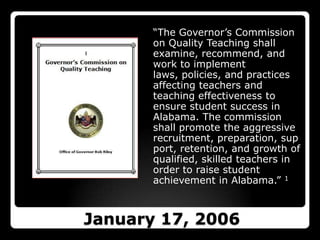
“The Governor’s Commission on Quality Teaching shall examine, recommend, and work to implement laws, policies, and practices affecting teachers and teaching effectiveness to ensure student success in Alabama. The commission shall promote the aggressive recruitment, preparation, support, retention, and growth of qualified, skilled teachers in order to raise student achievement in Alabama.” 1January 17, 2006
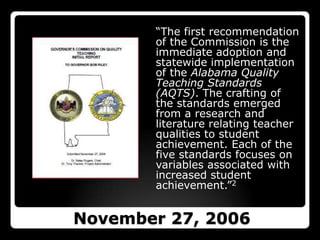
“The first recommendation of the Commission is the immediate adoption and statewide implementation of the Alabama Quality Teaching Standards (AQTS). The crafting of the standards emerged from a research and literature relating teacher qualities to student achievement. Each of the five standards focuses on variables associated with increased student achievement.”2November 27, 2006
AQTS AdoptionStandard 1—Content KnowledgeStandard 2—Teaching and LearningStandard 3—LiteracyStandard 4—DiversityStandard 5—ProfessionalismMarch, 2007
Adoption ofEducateAlabama ProcessA group of stakeholders, comprised of Alabama instructional leaders and educators, worked diligently in 2009 to develop the EDUCATEAlabamaprocess.May, 2009
Pilot ProgramThe pilot program took place statewide. Instructional leaders and educators received training to implement the process through a series of online training modules. 2009-2010 School Year
Continuum of Teacher Development
The AQTS constitutes the foundation of the teaching profession while the Continuum is a tool used to guide educator reflection, self-assessment, and goal setting for professional learning and growth. What is the Continuum?
The Continuum articulates a shared vision and common language of teaching excellence to guide an individual’s career-long development within an environment of collegial support.What is the Continuum?
The Continuum is based on two assumptions: (1) that growth in professional practice comes from intentional reflection and engagement in appropriate professional learning opportunities and (2) that a teacher develops expertise and leadership as a member of a community of learners focused on high achievement for all students.What is the Continuum?
EDUCATEAlabama is a formative system designed to provide information about an educator’s current level of practice within the Alabama Continuum for Teacher Development.How does EducateAlabama fit into the Continuum?
A formative system is designed to improve a product or process whereas a summative process provides information on the product or processes ability to do what it was designed to do.How does EducateAlabama fit into the Continuum?
EDUCATEAlabamawill use verbiage aligned to the Teacher Development Continuum to demonstrate levels of performance at the Emerging, Applying, Integrating, or Innovating level (as defined in the Continuum)and not numerical ratings. How does EducateAlabama fit into the Continuum?
EDUCATEAlabamawill be used to set expectations, goals, and plans for teacher professional growth. How does EducateAlabama fit into the Continuum?
The Continuum: A Closer Look
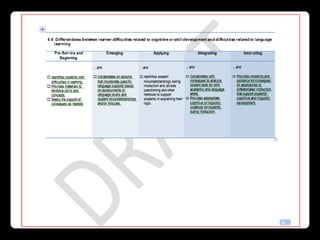
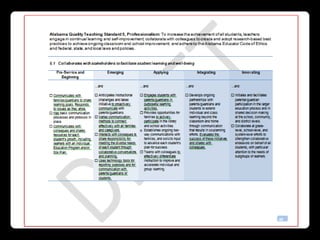
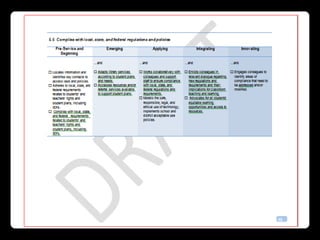
Content on pages 1-11 of the continuum are background information--essentially identical for teachers, librarians, and counselors, except on pages 9-11 which are the indicators for each profession. The Continuum: A Closer Look
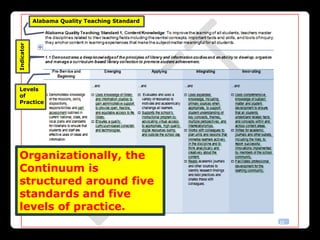
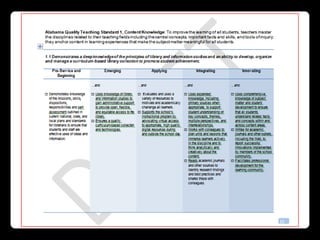
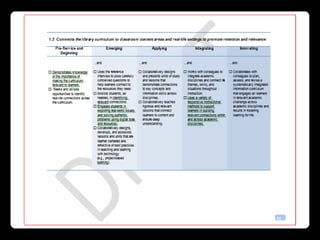
5 x 5Organizationally, the Continuum is structured around five standards and five levels of practice. Standards
Standard 1—Content Knowledge: To improve the learning of all students, teachers master the disciplines related to their teaching fields including the central concepts, important facts and skills, and tools of inquiry; they anchor content in learning experiences that make the subject matter meaningful for all students. Standard 1
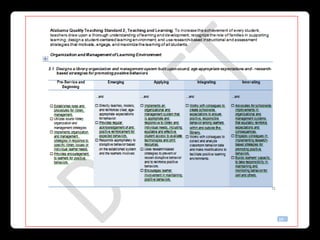
Standard 2—Teaching and Learning: To increase the achievement of every student, teachers draw upon a thorough understanding of learning and development; recognize the role of families in supporting learning; design a student centered learning environment; and use research based instructional and assessment strategies that motivate, engage, and maximize the learning of all students.Standard 2
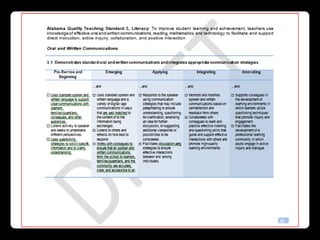
Standard 3—Literacy: To improve student learning and achievement, teachers use knowledge of effective oral and written communications, reading, mathematics, and technology to facilitate and support direct instruction, active inquiry, collaboration, and positive interaction.Standard 3
Standard 4—Diversity: To improve the learning of all students, teachers differentiate instruction in ways that exhibit a deep understanding of how cultural, ethnic, and social background; second language learning; special needs; exceptionalities; and learning styles affect student motivation, cognitive processing, and academic performance.Standard 4
Standard 5—Professionalism: To increase the achievement of all students, teachers engage in continuous learning and self improvement; collaborate with colleagues to create and adopt research-based best practices to achieve ongoing classroom and school improvement; and adhere to the Alabama Educator Code of Ethics and federal, state, and local laws and policies.Standard 5
Individuals who are at the Pre-Service and Beginning level of practice work within the context of supported and guided internship or induction experiences. Pre-service teachers engage in ongoing learning in classrooms and clinical settings. Through multiple and varied opportunities for guided practice in preK-12 settings, they receive ongoing formative feedback that enables them to reflect on their individual teaching practices and how those practices affect student learning. Teacher candidates emerge from the pre-service experience with the requisite knowledge and skills to assume full-time positions in the profession. With full responsibility for classrooms and as teachers of record, beginning teachers work to internalize and apply what they have learned about teaching. They develop a working knowledge of academic standards and assessments. They reflect on teaching practices and their impact on student learning. Beginning teachers rely on ongoing assistance from mentors and experienced colleagues for support and guidance.Pre-Service and Beginning
At the Emerging level of practice, teachers draw upon ongoing assistance and support from a mentor and other experienced colleagues to expand and enrich their knowledge and skills. These teachers utilize teaching theories and episodic classroom experiences to adjust and modify instruction. Emerging teachers become increasingly self-directed and independent in their professional practice, which is focused on their classrooms and each student therein.Emerging
At the Applying level of practice, career teachers operate at high levels of autonomy, internalizing and applying what they have learned about effective teaching. Utilizing their heightened awareness of students’ academic and behavioral patterns, career teachers anticipate students’ learning needs and responsively contextualize classroom experiences, both in the moment and in instructional planning. Career teachers systematically collect and use data to demonstrate the impact of their teaching on student achievement. They build upon varied professional learning opportunities to enhance personal practice while working collaboratively with colleagues to advance student learning.Applying
At the Integrating level of practice, accomplished teachers cultivate the classroom as a community of learners in which students are engaged and motivated. They skillfully adjust practice in response to various contexts. Their highly developed skills and self-efficacy enable them to integrate complex elements of curriculum, instruction, and assessment to maximize student engagement and learning. Their students consistently demonstrate increases in learning and achievement. Teachers at the Integrating level are also leaders among peers; they collaborate reflectively in learning communities to move classroom and schoolwide practices forward through aligned professional learning. Teachers at this level of practice guide apprentice and intern teachers, mentor beginning teachers, coach peers, assume leadership roles, and otherwise work to guide and develop colleagues. Integrating
At the Innovating level of practice, teacher leaders are consistently creating in all areas of teaching and learning. They facilitate the complex integration of teaching and learning among teachers at all levels of practice and continue to innovate in their own teaching to support increases in student learning and achievement. Innovating teachers initiate and provide leadership for collaborative learning communities that are engaged in such activities as enhancing curriculum, developing innovative instructional delivery techniques, and fostering positive learning cultures in a variety of educational settings. Leaders in the school, district, and local community, teachers at the Innovating level often lead professional learning and classroom-based research activities, write for professional print-based and electronic journals, or otherwise contribute to the broader education community. Innovating
Revision of the Continuum to Reflect Librarians’ Practice
Why did this revision take place?Revision of the Continuum to Reflect Librarians’ Practice
Who did the revision?Revision of the Continuum to Reflect Librarians’ Practice
How was the revision accomplished?Revision of the Continuum to Reflect Librarians’ Practice
Final Document
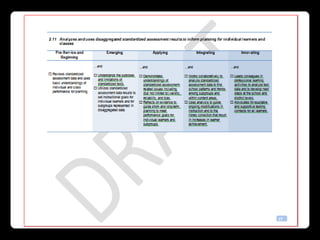
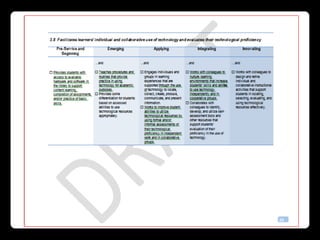
Alabama Quality Teaching StandardIndicatorLevelsof PracticeOrganizationally, the Continuum is structured around five standards and five levels of practice.
Education Directory Portalhttps://schools.alsde.edu/EdDir/Default.aspx
https://schools.alsde.edu/EdDir/TrainingVideos/CreateNewAccount/CreateNewAccount.htmlInstructions for Setting Up Educator Account Video
Bloghttp://educatealabamalibrarians.wordpress.com/
References
1 Governor’s Commission on Quality Teaching. (2006). pg. 5. Available at: http://ti_sp.alsde.edu/qt/Shared%20Documents/Governor%27s%20Commission.doc2 Governor’s Commission on Quality Teaching Initial Report. (2006). pg. 7. Available at: http://ti_sp.alsde.edu/qt/Shared%20Documents/GCQT%20INITIAL%20REPORT.pdf
Part II
A Condensed History
What is the Common Core State Standards Initiative?
What organizations are behind the development of the standards?
How do the creators envision that the standards will function in educational practice and eventually accomplish after implementation?A Condensed History: Questions
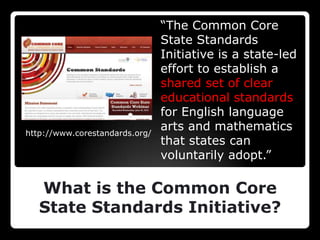
“The Common Core State Standards Initiative is a state-led effort to establish a shared set of clear educational standards for English language arts and mathematics that states can voluntarily adopt.”http://www.corestandards.org/What is the Common CoreState Standards Initiative?
The Council of Chief State School Officers (CCSSO) and the National Governors Association Center for Best Practices (NGA Center) are leading the effort to develop a common core of state standards.What organizations are behind the development of the standards?
“With American students fully prepared for the future, our communities will be best positioned to compete successfully in the global economy.”Why do we needCommon Standards?
Are aligned with college and work expectations;
Are clear, understandable and consistent;
Include rigorous content and application of knowledge through high-order skills;
Build upon strengths and lessons of current state standards;
Are informed by other top performing countries, so that all students are prepared to succeed in our global economy and society; and
Are evidence-based.What is expected fromCommon Standards?
“The Common Core State Standards provide a consistent, clear understanding of what students are expected to learn….to prepare them for college and the workforce.”http://www.corestandards.org/What is the vision of theCommon Core State Standards?
“Common standards will help ensure that students are receiving a high quality education consistently, from school to school and state to state.
Common standards will provide a greater opportunity to share experiences and best practices within and across states that will improve our ability to best serve the needs of students.”What will Common Standards accomplish?
What does "everyone" (educational theorists, visionaries, and practitioners) think about the standards?
What are the salient issues of the standards and are these issues potential areas of contention among educations?CC Opinions and Issues: Questions
Common Core State Standards Letters of Support
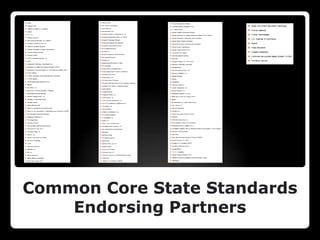
Common Core State Standards Endorsing Partners
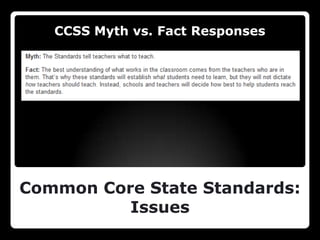
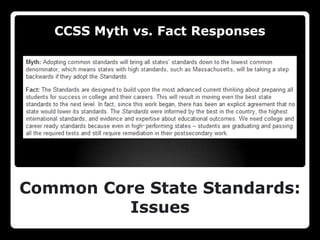
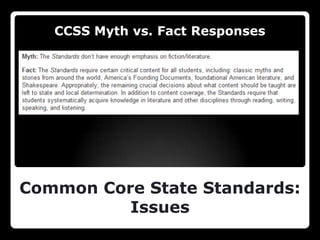
CCSS Myth vs. Fact ResponsesCommon Core State Standards: Issues
What do the ELA Standards say?
What do the members of the school library profession think of the standards?
What do fellow school librarians see as our role in implementation?Common Core State Standards for Librarians: Questions
http://www.corestandards.org/the-standardsWhat do the ELA Standards include?
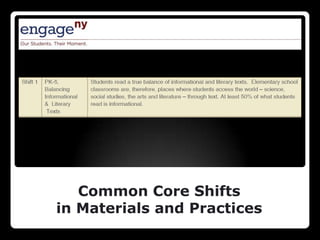
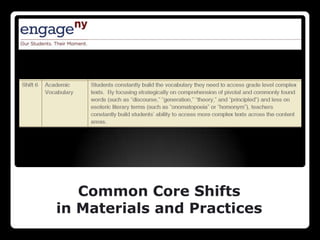
Common Core Shifts in Materials and Practices
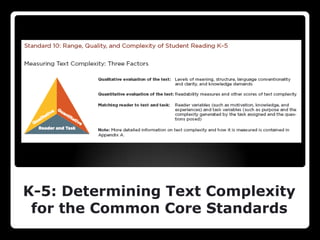
K-5: Determining Text Complexity for the Common Core Standards
K-5 Range of Text Types for the Common Core Standards
K-5 Sample Texts for the Common Core Standards
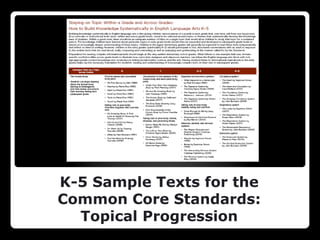
K-5 Sample Texts for theCommon Core Standards: Topical Progression
6-12: Determining Text Complexity for the Common Core Standards
6-12 Range of Text Types for the Common Core Standards
6-12 Sample Texts for the Common Core Standards
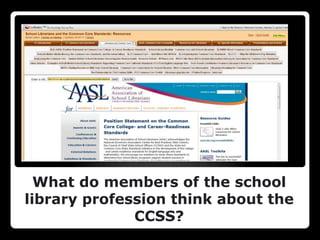
What do members of the school library profession think about the CCSS?

Starkey_WALL_Conference_2011_Reignite_Your_Passion_Implications_of_EDUCATEAlabama_and_CCSS_for_School_Library_Practices

  • 1.
    Reignite Your PassionImplicationsof EDUCATEAlabama and the CCSS for School Library PracticesCarolyn Jo Starkey and Michelle M. WilsonWest Alabama Library Leadership Conference 2011 University of West Alabama, Livingston, ALSeptember 28, 2011
  • 2.
    BiographiesCarolyn Jo StarkeySchoolLibrarian,Buckhorn High SchoolNew Market, ALCarolyn Starkey has been in education for 23 years, the last 13 related to school library media. She served as the library media specialist at Sloman Primary School for seven years, obtaining her certification by the National Board of Professional Teaching Standards in library media in 2003 while there. After a 4 ½ year stint as Assistant Professor of Library Education Media at Alabama State University, Carolyn is currently serving as a school librarian alongside Wendy Stephens at Buckhorn High School and completing her dissertation in instructional leadership/instructional technology at the University of Alabama. Her other professional commitments include positions as Co-Chair of the Children's and School Library Division of the Alabama Library Association, Editor of ASLA‘s The Alabama School Librarian, and Chair of ISTE's Media Specialist Special Interest Group newsletter committee. She also serves as a member of American Association of School Librarians' Publications Committee and NCATE Coordinating Committee and has recently taken on a Co-Manager position of the AASL blog. Carolyn is a frequent conference and professional development presenter on a wide range of topics in school librarianship, technology, and online learning. New areas of interest include the integration of the Common Core State Standards into school libraries and the implementation of the EDUCATEAlabama for Librarians formative performance assessment system. Carolyn served as a member of the EDUCATEAlabama for Librarians review committee and has presented on this topic over a dozen times in 2011. She has recently established a blog on the subject with the support of the Alabama School Library Association.Michelle M. WilsonSchool Librarian, North Highland Elementary SchoolHueytown, ALMichelle Wilson has been a school librarian for eight and a half years. She began her career as an elementary classroom teacher, and after a few years became an elementary school librarian. Michelle achieved National Board Teacher Certification in 2009 and is currently serving at North Highland Elementary School inJefferson County. She also works as her school's technology representative, principal's designee, as well as on numerous school and district committees. Recently she had the privilege of being part of the team charged with tailoring the EDUCATEAlabama continuum to school librarians.  Her interests and activities outside the school day include her family, serving in her church's preschool ministry, and advocating for orphans worldwide.
  • 3.
  • 4.
    The Education ReformMovement is responsible for a variety of standard-based initiatives. Education Reform Movement
  • 5.
    The two Alabamastandards-based initiatives under discussion today:Governor’s Commission on Quality Teaching which focused on teacher effectiveness and resulted in the Alabama Quality Teaching Standards and EDUCATEAlabama.Common Core State Standards adoption which focused on student learning.Education Reform Movement
  • 6.
  • 7.
  • 8.
    “The Governor’s Commissionon Quality Teaching shall examine, recommend, and work to implement laws, policies, and practices affecting teachers and teaching effectiveness to ensure student success in Alabama. The commission shall promote the aggressive recruitment, preparation, support, retention, and growth of qualified, skilled teachers in order to raise student achievement in Alabama.” 1January 17, 2006
  • 9.
    “The first recommendationof the Commission is the immediate adoption and statewide implementation of the Alabama Quality Teaching Standards (AQTS). The crafting of the standards emerged from a research and literature relating teacher qualities to student achievement. Each of the five standards focuses on variables associated with increased student achievement.”2November 27, 2006
  • 10.
    AQTS AdoptionStandard 1—ContentKnowledgeStandard 2—Teaching and LearningStandard 3—LiteracyStandard 4—DiversityStandard 5—ProfessionalismMarch, 2007
  • 11.
    Adoption ofEducateAlabama ProcessAgroup of stakeholders, comprised of Alabama instructional leaders and educators, worked diligently in 2009 to develop the EDUCATEAlabamaprocess.May, 2009
  • 12.
    Pilot ProgramThe pilotprogram took place statewide. Instructional leaders and educators received training to implement the process through a series of online training modules. 2009-2010 School Year
  • 13.
  • 14.
    The AQTS constitutesthe foundation of the teaching profession while the Continuum is a tool used to guide educator reflection, self-assessment, and goal setting for professional learning and growth. What is the Continuum?
  • 15.
    The Continuum articulatesa shared vision and common language of teaching excellence to guide an individual’s career-long development within an environment of collegial support.What is the Continuum?
  • 17.
    The Continuum isbased on two assumptions: (1) that growth in professional practice comes from intentional reflection and engagement in appropriate professional learning opportunities and (2) that a teacher develops expertise and leadership as a member of a community of learners focused on high achievement for all students.What is the Continuum?
  • 18.
    EDUCATEAlabama is aformative system designed to provide information about an educator’s current level of practice within the Alabama Continuum for Teacher Development.How does EducateAlabama fit into the Continuum?
  • 19.
    A formative systemis designed to improve a product or process whereas a summative process provides information on the product or processes ability to do what it was designed to do.How does EducateAlabama fit into the Continuum?
  • 20.
    EDUCATEAlabamawill use verbiagealigned to the Teacher Development Continuum to demonstrate levels of performance at the Emerging, Applying, Integrating, or Innovating level (as defined in the Continuum)and not numerical ratings. How does EducateAlabama fit into the Continuum?
  • 21.
    EDUCATEAlabamawill be usedto set expectations, goals, and plans for teacher professional growth. How does EducateAlabama fit into the Continuum?
  • 22.
    The Continuum: ACloser Look
  • 23.
    Content on pages1-11 of the continuum are background information--essentially identical for teachers, librarians, and counselors, except on pages 9-11 which are the indicators for each profession. The Continuum: A Closer Look
  • 24.
    5 x 5Organizationally,the Continuum is structured around five standards and five levels of practice. Standards
  • 25.
    Standard 1—Content Knowledge:To improve the learning of all students, teachers master the disciplines related to their teaching fields including the central concepts, important facts and skills, and tools of inquiry; they anchor content in learning experiences that make the subject matter meaningful for all students. Standard 1
  • 26.
    Standard 2—Teaching andLearning: To increase the achievement of every student, teachers draw upon a thorough understanding of learning and development; recognize the role of families in supporting learning; design a student centered learning environment; and use research based instructional and assessment strategies that motivate, engage, and maximize the learning of all students.Standard 2
  • 27.
    Standard 3—Literacy: Toimprove student learning and achievement, teachers use knowledge of effective oral and written communications, reading, mathematics, and technology to facilitate and support direct instruction, active inquiry, collaboration, and positive interaction.Standard 3
  • 28.
    Standard 4—Diversity: Toimprove the learning of all students, teachers differentiate instruction in ways that exhibit a deep understanding of how cultural, ethnic, and social background; second language learning; special needs; exceptionalities; and learning styles affect student motivation, cognitive processing, and academic performance.Standard 4
  • 29.
    Standard 5—Professionalism: Toincrease the achievement of all students, teachers engage in continuous learning and self improvement; collaborate with colleagues to create and adopt research-based best practices to achieve ongoing classroom and school improvement; and adhere to the Alabama Educator Code of Ethics and federal, state, and local laws and policies.Standard 5
  • 30.
    Individuals who areat the Pre-Service and Beginning level of practice work within the context of supported and guided internship or induction experiences. Pre-service teachers engage in ongoing learning in classrooms and clinical settings. Through multiple and varied opportunities for guided practice in preK-12 settings, they receive ongoing formative feedback that enables them to reflect on their individual teaching practices and how those practices affect student learning. Teacher candidates emerge from the pre-service experience with the requisite knowledge and skills to assume full-time positions in the profession. With full responsibility for classrooms and as teachers of record, beginning teachers work to internalize and apply what they have learned about teaching. They develop a working knowledge of academic standards and assessments. They reflect on teaching practices and their impact on student learning. Beginning teachers rely on ongoing assistance from mentors and experienced colleagues for support and guidance.Pre-Service and Beginning
  • 31.
    At the Emerginglevel of practice, teachers draw upon ongoing assistance and support from a mentor and other experienced colleagues to expand and enrich their knowledge and skills. These teachers utilize teaching theories and episodic classroom experiences to adjust and modify instruction. Emerging teachers become increasingly self-directed and independent in their professional practice, which is focused on their classrooms and each student therein.Emerging
  • 32.
    At the Applyinglevel of practice, career teachers operate at high levels of autonomy, internalizing and applying what they have learned about effective teaching. Utilizing their heightened awareness of students’ academic and behavioral patterns, career teachers anticipate students’ learning needs and responsively contextualize classroom experiences, both in the moment and in instructional planning. Career teachers systematically collect and use data to demonstrate the impact of their teaching on student achievement. They build upon varied professional learning opportunities to enhance personal practice while working collaboratively with colleagues to advance student learning.Applying
  • 33.
    At the Integratinglevel of practice, accomplished teachers cultivate the classroom as a community of learners in which students are engaged and motivated. They skillfully adjust practice in response to various contexts. Their highly developed skills and self-efficacy enable them to integrate complex elements of curriculum, instruction, and assessment to maximize student engagement and learning. Their students consistently demonstrate increases in learning and achievement. Teachers at the Integrating level are also leaders among peers; they collaborate reflectively in learning communities to move classroom and schoolwide practices forward through aligned professional learning. Teachers at this level of practice guide apprentice and intern teachers, mentor beginning teachers, coach peers, assume leadership roles, and otherwise work to guide and develop colleagues. Integrating
  • 34.
    At the Innovatinglevel of practice, teacher leaders are consistently creating in all areas of teaching and learning. They facilitate the complex integration of teaching and learning among teachers at all levels of practice and continue to innovate in their own teaching to support increases in student learning and achievement. Innovating teachers initiate and provide leadership for collaborative learning communities that are engaged in such activities as enhancing curriculum, developing innovative instructional delivery techniques, and fostering positive learning cultures in a variety of educational settings. Leaders in the school, district, and local community, teachers at the Innovating level often lead professional learning and classroom-based research activities, write for professional print-based and electronic journals, or otherwise contribute to the broader education community. Innovating
  • 35.
    Revision of theContinuum to Reflect Librarians’ Practice
  • 36.
    Why did thisrevision take place?Revision of the Continuum to Reflect Librarians’ Practice
  • 38.
    Who did therevision?Revision of the Continuum to Reflect Librarians’ Practice
  • 40.
    How was therevision accomplished?Revision of the Continuum to Reflect Librarians’ Practice
  • 42.
  • 43.
    Alabama Quality TeachingStandardIndicatorLevelsof PracticeOrganizationally, the Continuum is structured around five standards and five levels of practice.
  • 83.
  • 84.
  • 85.
  • 86.
  • 87.
    1 Governor’s Commissionon Quality Teaching. (2006). pg. 5. Available at: http://ti_sp.alsde.edu/qt/Shared%20Documents/Governor%27s%20Commission.doc2 Governor’s Commission on Quality Teaching Initial Report. (2006). pg. 7. Available at: http://ti_sp.alsde.edu/qt/Shared%20Documents/GCQT%20INITIAL%20REPORT.pdf
  • 88.
  • 89.
  • 90.
    What is theCommon Core State Standards Initiative?
  • 91.
    What organizations arebehind the development of the standards?
  • 92.
    How do thecreators envision that the standards will function in educational practice and eventually accomplish after implementation?A Condensed History: Questions
  • 93.
    “The Common CoreState Standards Initiative is a state-led effort to establish a shared set of clear educational standards for English language arts and mathematics that states can voluntarily adopt.”http://www.corestandards.org/What is the Common CoreState Standards Initiative?
  • 94.
    The Council ofChief State School Officers (CCSSO) and the National Governors Association Center for Best Practices (NGA Center) are leading the effort to develop a common core of state standards.What organizations are behind the development of the standards?
  • 95.
    “With American studentsfully prepared for the future, our communities will be best positioned to compete successfully in the global economy.”Why do we needCommon Standards?
  • 96.
    Are aligned withcollege and work expectations;
  • 97.
  • 98.
    Include rigorous contentand application of knowledge through high-order skills;
  • 99.
    Build upon strengthsand lessons of current state standards;
  • 100.
    Are informed byother top performing countries, so that all students are prepared to succeed in our global economy and society; and
  • 101.
    Are evidence-based.What isexpected fromCommon Standards?
  • 102.
    “The Common CoreState Standards provide a consistent, clear understanding of what students are expected to learn….to prepare them for college and the workforce.”http://www.corestandards.org/What is the vision of theCommon Core State Standards?
  • 103.
    “Common standards willhelp ensure that students are receiving a high quality education consistently, from school to school and state to state.
  • 104.
    Common standards willprovide a greater opportunity to share experiences and best practices within and across states that will improve our ability to best serve the needs of students.”What will Common Standards accomplish?
  • 105.
    What does "everyone"(educational theorists, visionaries, and practitioners) think about the standards?
  • 106.
    What are thesalient issues of the standards and are these issues potential areas of contention among educations?CC Opinions and Issues: Questions
  • 107.
    Common Core StateStandards Letters of Support
  • 108.
    Common Core StateStandards Endorsing Partners
  • 109.
    CCSS Myth vs.Fact ResponsesCommon Core State Standards: Issues
  • 110.
    CCSS Myth vs.Fact ResponsesCommon Core State Standards: Issues
  • 111.
    CCSS Myth vs.Fact ResponsesCommon Core State Standards: Issues
  • 112.
    CCSS Myth vs.Fact ResponsesCommon Core State Standards: Issues
  • 113.
    CCSS Myth vs.Fact ResponsesCommon Core State Standards: Issues
  • 114.
    What do theELA Standards say?
  • 115.
    What do themembers of the school library profession think of the standards?
  • 116.
    What do fellowschool librarians see as our role in implementation?Common Core State Standards for Librarians: Questions
  • 117.
  • 118.
    Common Core Shiftsin Materials and Practices
  • 119.
    Common Core Shiftsin Materials and Practices
  • 120.
    Common Core Shiftsin Materials and Practices
  • 121.
    Common Core Shiftsin Materials and Practices
  • 122.
    Common Core Shiftsin Materials and Practices
  • 123.
    Common Core Shiftsin Materials and Practices
  • 124.
    Common Core Shiftsin Materials and Practices
  • 125.
    K-5: Determining TextComplexity for the Common Core Standards
  • 126.
    K-5 Range ofText Types for the Common Core Standards
  • 127.
    K-5 Sample Textsfor the Common Core Standards
  • 128.
    K-5 Sample Textsfor theCommon Core Standards: Topical Progression
  • 129.
    6-12: Determining TextComplexity for the Common Core Standards
  • 130.
    6-12 Range ofText Types for the Common Core Standards
  • 131.
    6-12 Sample Textsfor the Common Core Standards
  • 132.
    What do membersof the school library profession think about the CCSS?