Starch
Properties
and
Reactions
Gelatinizataion
The sum of changes that occur in the first stages of heating
starch granules in a moist environment which includes
swelling of granules as water is absorbed and disruption of
the organized granule structure.
Viscosity
The resistance to flow, increase in thickness or consistency.
When the newly gelatinized starch is stirred, more swollen
granules break and more starch molecules spill causing
increase in viscosity or thickness.
hydration and swelling to several times
original size
Changes in Gelatinizataion of Starch
loss of birefringence
increase in clarity
marked rapid increase in consistency and
attainment of peak
"dissolution" of linear molecules and diffusion
from ruptured granulues
with heat removal, retro gradiation of mixture
to paste-like mass of gel
The type of sugar influences the
temperature and rate of gelatinizataion.
The effect of sugar is attributed to
competition for water. It was observed
that sugar actually interacts with the
amorphous areas of the starch granules
Different Sweeteners Added to
Starch Gel Preparation
HONEY MOLASSES
PANUTSA/ GRANULATED SUGAR
Retrogadation
is the process in which starch molecules, particularly the
amylose fraction, re-associate or bond together in an
ordered structure after disruption by gelatinizataion,
ultimately a crystalline order appears
Syneresis
Oozing of liquid from gel when cut and allowed to
stand (e.g jelly or baked custard). The oozing of liquid
from a rigid gel; sometimes called weeping.
PUDDINGS
This reaction occurs in all kinds of gels:
JELLIES
CUSTARD
GELATIN AGAR
Dextrinization
It is the process of forming dextrin. Dextrins - are partially
hydrolyzed starches that are prepared by dry roasting. In
home kitchens, dextrinization is achieved by toasting flour
to polvoron, rice flour for kare-kare sauce, and bread slices
for breakfast
Hydrolysis
Starches undergo hydrolysis during cooking or processing
and during storage of food where a chemical reaction in
which a molecular linkage is broken and a molecule of water
is utilized.
PROLONGED HEATING OF STARCHES WITH
ACID WILL PROMOTE HYDROLYSIS. THIS
CAN HAPPEN WHEN COOKING AN ACIDIC
FOOD, SUCH AS: PINEAPPLE RESULTING IN
REDUCED VISCOSITY OR FIRMNESS OF THE
PIE FILLING.
Starch plays various roles in food,
a typical multi-tasker
1. THICKENERS IN GRAVIES, SAUCES AND PUDDING. IT ABSORBS
WATER AND BECOME A GEL WHEN COOKED.
2. COLLOIDAL STABILIZERS
3. MOISTURE RETAINER
4. GEL FORMING AGENTS
5. BINDERS
6. PACKAGE
7. FLAVORS CARRIERS - ITS ABILITY TO TRAP OILS AND FATS, WHICH
ABSORBS FLAVORING SUBSTANCES MORE EFFICIENTLY.
Quiz
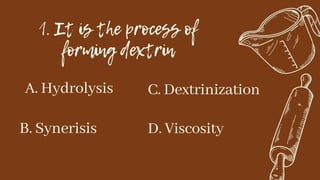
1. It is the process of
forming dextrin
A. Hydrolysis
B. Synerisis
C. Dextrinization
D. Viscosity
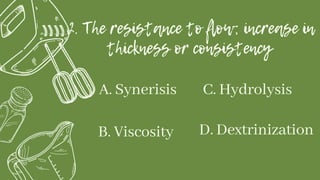
2. The resistance to flow; increase in
thickness or consistency
A. Synerisis
B. Viscosity
C. Hydrolysis
D. Dextrinization
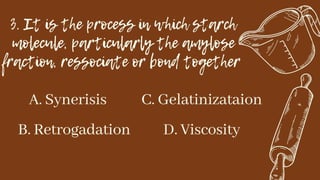
3. It is the process in which starch
molecule, particularly the amylose
fraction, ressociate or bond together
A. Synerisis
B. Retrogadation
C. Gelatinizataion
D. Viscosity
4. The following are functional
properties of starches EXCEPT ONE
A. Increase in clarity
B. Moisture retainer
C. Binders
D. Package
5.The resistance to flow, increase
in thickness or consistency
C O S T Y V I S I
Group 2
JANNEL BARADAS
LHARRIE MAE COMPAS
RIAN ELLA LUARCA
RONNA OSINSAO
JOHN ALEX MAPACPAC
PATRICK CUYONES
VON REY
Thank you!
for listening

Starch_Properties_and_Reactions_20231021_132038_0000.pdf

  • 1.
  • 2.
    Gelatinizataion The sum ofchanges that occur in the first stages of heating starch granules in a moist environment which includes swelling of granules as water is absorbed and disruption of the organized granule structure.
  • 3.
    Viscosity The resistance toflow, increase in thickness or consistency. When the newly gelatinized starch is stirred, more swollen granules break and more starch molecules spill causing increase in viscosity or thickness.
  • 4.
    hydration and swellingto several times original size Changes in Gelatinizataion of Starch loss of birefringence increase in clarity marked rapid increase in consistency and attainment of peak "dissolution" of linear molecules and diffusion from ruptured granulues with heat removal, retro gradiation of mixture to paste-like mass of gel
  • 5.
    The type ofsugar influences the temperature and rate of gelatinizataion. The effect of sugar is attributed to competition for water. It was observed that sugar actually interacts with the amorphous areas of the starch granules
  • 6.
    Different Sweeteners Addedto Starch Gel Preparation HONEY MOLASSES PANUTSA/ GRANULATED SUGAR
  • 7.
    Retrogadation is the processin which starch molecules, particularly the amylose fraction, re-associate or bond together in an ordered structure after disruption by gelatinizataion, ultimately a crystalline order appears
  • 8.
    Syneresis Oozing of liquidfrom gel when cut and allowed to stand (e.g jelly or baked custard). The oozing of liquid from a rigid gel; sometimes called weeping.
  • 9.
    PUDDINGS This reaction occursin all kinds of gels: JELLIES CUSTARD GELATIN AGAR
  • 10.
    Dextrinization It is theprocess of forming dextrin. Dextrins - are partially hydrolyzed starches that are prepared by dry roasting. In home kitchens, dextrinization is achieved by toasting flour to polvoron, rice flour for kare-kare sauce, and bread slices for breakfast
  • 11.
    Hydrolysis Starches undergo hydrolysisduring cooking or processing and during storage of food where a chemical reaction in which a molecular linkage is broken and a molecule of water is utilized.
  • 12.
    PROLONGED HEATING OFSTARCHES WITH ACID WILL PROMOTE HYDROLYSIS. THIS CAN HAPPEN WHEN COOKING AN ACIDIC FOOD, SUCH AS: PINEAPPLE RESULTING IN REDUCED VISCOSITY OR FIRMNESS OF THE PIE FILLING.
  • 13.
    Starch plays variousroles in food, a typical multi-tasker 1. THICKENERS IN GRAVIES, SAUCES AND PUDDING. IT ABSORBS WATER AND BECOME A GEL WHEN COOKED. 2. COLLOIDAL STABILIZERS 3. MOISTURE RETAINER 4. GEL FORMING AGENTS 5. BINDERS 6. PACKAGE 7. FLAVORS CARRIERS - ITS ABILITY TO TRAP OILS AND FATS, WHICH ABSORBS FLAVORING SUBSTANCES MORE EFFICIENTLY.
  • 14.
  • 15.
    1. It isthe process of forming dextrin A. Hydrolysis B. Synerisis C. Dextrinization D. Viscosity
  • 16.
    2. The resistanceto flow; increase in thickness or consistency A. Synerisis B. Viscosity C. Hydrolysis D. Dextrinization
  • 17.
    3. It isthe process in which starch molecule, particularly the amylose fraction, ressociate or bond together A. Synerisis B. Retrogadation C. Gelatinizataion D. Viscosity
  • 18.
    4. The followingare functional properties of starches EXCEPT ONE A. Increase in clarity B. Moisture retainer C. Binders D. Package
  • 19.
    5.The resistance toflow, increase in thickness or consistency C O S T Y V I S I
  • 20.
    Group 2 JANNEL BARADAS LHARRIEMAE COMPAS RIAN ELLA LUARCA RONNA OSINSAO JOHN ALEX MAPACPAC PATRICK CUYONES VON REY
  • 21.