Date: 17 January 2013
I have prepared a report summarizing our team’s activities in data collection and
comparative analysis of your industrial use anti-fatigue mat versus 3 other currently
available industrial anti-fatigue mats. We have finished our data collection and our
statistician has completed data analysis. We have prepared this report summarizing our
data collection techniques, statistical and empirical results, and overall implications of
our findings.
As was previously discussed, we recruited two sites for data collection; one, an industrial
furniture manufacturer, the other an industrial pipe/valve reconditioner/manufacturer;
both were in central Texas/Texas gulf coast regions. As per Texas A&M Internal Review
Board (IRB) approved procedures, we began recruiting subjects at these two locations.
We were able to recruit eighteen (18) subjects, ten (10) at one site and eight (8) at the
other. We were able to collect data on the ten-subject cohort twice, so our data is more
robust and represents a dataset more approximate to twenty-eight (28) subjects. Our
largest hindrance in recruitment was simply subject willingness. Both sites had
significantly more potential subjects, but several at both sites declined study
participation.
The procedure was one my colleague; Dr. Jerome Congleton has used many times in
similar studies in the past with great success. We essentially have what is referred to as a
control-treatment type of experiment. For the subjects who agreed to participate in the
study, signed the TAMU-IRB approved consent form, and completed this initial trial, all
were randomly assigned one of four anti-fatigue mats or used a “no mat” scenario as the
control. In this study design, each subject had 5 full days of data and time on each
scenario (4 mats, one “no mat” control). The jobs subjects were doing were all stand-
biased workstations. Some subjects had the opportunity to sit for short periods of time
throughout the day, but for the most part, all subjects were standing most of their 8-hour
workday. During this study, all mats, as well as the control, were assigned alpha-numeric
identifiers, so as to not inform study subjects of the manufacturer. The identifiers are
shown in Table 1.
CONDITION IDENTIFIER MAT BRAND
Mat A Let’s Gel
Mat B Vinyl corrugated top with nitricell sponge
attached base
Mat C Nitrile rubber surface attached to
Polymeric sponge base
Mat D Nitrile rubber surface with nitrile/pvc
attached foam
Mat E No Mat (Control condition)
At the beginning of each day/shift subjects’ height and sit-reach flexibility were
measured using a stadiometer and sit-reach flexibility box respectively (Figure 1). These
procedures were repeated at the end of the workday/shift for both measurements. All
measurements were collected in centimeters.
(A) (B)
Figure 1. Stadiometer (A), Sit-reach flexibility box (B).
The reasoning for these two particular measurements is physiologically-based. Many
methods have been performed in various studies, but these two continually prove to be
physiologically and statistically relevant for measurement and predictive power. For the
height measurement, during the day, as we stand or sit, our spines compress, or more
accurately, the intervertebral discs compress, and we lose stature throughout the day.
When comparing someone’s stature at the end of the day with the beginning, they will
always be shorter. For these purposes, effectiveness of the mat translates to less stature
lost throughout the course of the day. For sit-reach flexibility, the interpreted mat
effectiveness would be the opposite. As we work throughout the day, our muscles
theoretically relax and we become more flexible as the day goes on. So, for this
application, effectiveness of the mat would translate directly into greater flexibility at the
end of the day when compared to the beginning.
Analysis
Analysis on several factors was performed. For all statistical tests, we worked under the
assumption that there is no statistical difference between the mat conditions with respect
to baseline or outcome characteristics. First, because there were two trials from one site,
analysis was conducted to see if the pre/post/change for both trials was significantly
different. Fortunately, they were not significantly different, indicating compliance in the
data sets. Next, t-test, Wilcoxon sign-rank, and ANOVA tests (α = 0.05) were performed
on the “pre” data for each mat in comparison to the control to see if there were significant
differences before the interventions (mats) were put into place. Again, for both reach and
height data, there were no significant differences found between “pre” intervention data
for any mats when compared to the control. This is positive for the data analysis because
it indicates that at the beginning of the day, all conditions were not statistically different
and that any differences indicated in the study were due to the intervention. Additionally,
several post-hoc tests were performed to analyze any inter-mat dependencies or
differences.
Results
ANOVA, t-test, and Wilcoxon sign-rank tests (α = 0.05) were performed on the
difference between “pre” and “post” reach and height data for each mat in comparison to
the control. Mat “A”, the Let’s Gel mat, yielded results for both height and reach that
were significantly different than the no-mat control scenario for all measurements except
for reach in the second trial for the ten-subject cohort. None of the other mats yielded
results significantly different than the control for any measurement.
Height Change Results
The results for statistical comparisons of the height changes are shown in detail in
Figures 2-5. These figures, as highlighted by the p-level (p<0.05 for A and p>0.05 for all
others), indicate that the only mat condition the produced height changes significantly
different than the no-mat control scenario is Mat A (Let’s Gel). The other mats produced
height results that were no different than the no-mat control scenario, or at least not
statistically significantly different.
Comparing Means [ t-test assuming equal variances (homoscedastic) ]
Descriptive Statistics
VAR Sample size Mean Variance
A 28 1.125 0.30269
E 28 1.85357 0.19665
Summary
Degrees Of
Freedom 54
Hypothesized Mean
Difference 0.E+0
Test Statistics 5.45574 Pooled Variance 0.24967
Two-tailed distribution
p-level 0.00000125 t Critical Value (5%) 2.00488
Figure 2. Statistical comparison of conditions A and E (no-mat control)
Comparing Means [ t-test assuming equal variances
(homoscedastic) ]
Descriptive Statistics
VAR
Sample
size Mean Variance
B 26 1.6269 0.28764
E 28 1.85357 0.19665
Summary
Degrees Of
Freedom 52
Hypothesized Mean
Difference 0.E+0
Test Statistics 0.4287 Pooled Variance 0.22124
Two-tailed distribution
p-level 0.67063 t Critical Value (5%) 2.02619
Figure 3. Statistical comparison of conditions B and E (no-mat control)
Comparing Means [ t-test assuming equal variances
(homoscedastic) ]
Descriptive Statistics
VAR
Sample
size Mean Variance
C 26 1.8192 0.28833
E 28 1.85357 0.19665
Summary
Degrees Of
Freedom 52
Hypothesized Mean
Difference 0.E+0
Test Statistics 0.92008 Pooled Variance 0.22486
Two-tailed distribution
p-level 0.36319 t Critical Value (5%) 2.02269
Figure 4. Statistical comparison of conditions C and E (no-mat control)
Comparing Means [ t-test assuming equal variances
(homoscedastic) ]
Descriptive Statistics
VAR
Sample
size Mean Variance
D 26 1.7269 0.14265
E 28 1.85357 0.19665
Summary
Degrees Of
Freedom 52
Hypothesized Mean
Difference 0.E+0
Test Statistics 0.03244 Pooled Variance 0.18102
Two-tailed distribution
p-level 0.97429 t Critical Value (5%) 2.02439
Figure 5. Statistical comparison of conditions D and E (no-mat control)
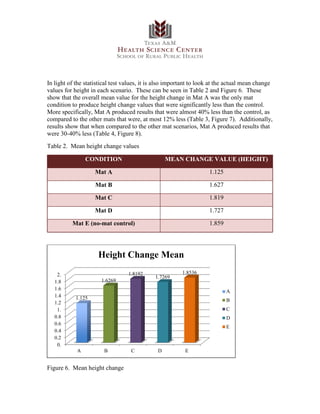
In light of the statistical test values, it is also important to look at the actual mean change
values for height in each scenario. These can be seen in Table 2 and Figure 6. These
show that the overall mean value for the height change in Mat A was the only mat
condition to produce height change values that were significantly less than the control.
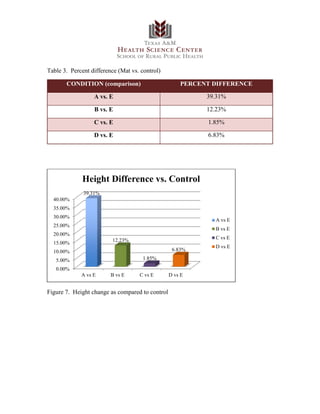
More specifically, Mat A produced results that were almost 40% less than the control, as
compared to the other mats that were, at most 12% less (Table 3, Figure 7). Additionally,
results show that when compared to the other mat scenarios, Mat A produced results that
were 30-40% less (Table 4, Figure 8).
Table 2. Mean height change values
CONDITION MEAN CHANGE VALUE (HEIGHT)
Mat A 1.125
Mat B 1.627
Mat C 1.819
Mat D 1.727
Mat E (no-mat control) 1.859
Figure 6. Mean height change
0.
0.2
0.4
0.6
0.8
1.
1.2
1.4
1.6
1.8
2.
A B C D E
1.125
1.6269
1.8192
1.7269
1.8536
Height Change Mean
A
B
C
D
E
Table 3. Percent difference (Mat vs. control)
CONDITION (comparison) PERCENT DIFFERENCE
A vs. E 39.31%
B vs. E 12.23%
C vs. E 1.85%
D vs. E 6.83%
Figure 7. Height change as compared to control
0.00%
5.00%
10.00%
15.00%
20.00%
25.00%
30.00%
35.00%
40.00%
A vs E B vs E C vs E D vs E
39.31%
12.23%
1.85%
6.83%
Height Difference vs. Control
A vs E
B vs E
C vs E
D vs E
Table 4. Height change Percent difference (Mat vs. Mat)
CONDITION (comparison) PERCENT DIFFERENCE
A vs. B 30.85%
A vs. C 38.16%
A vs. D 34.85%
Figure 8. Height change comparison (Mat vs. Mat)
Reach Change Results
Similarly, when we examine the results for sit-reach flexibility, Mat A was the only
scenario that produced results that were significantly different than the no-mat control.
These results can be seen in Figures 9-12. All other mats produced reach results that
were found to be not statistically different than the no-mat control.
0.00%
5.00%
10.00%
15.00%
20.00%
25.00%
30.00%
35.00%
40.00%
A vs B A vs C A vs D
30.85%
38.16%
34.85%
Height Difference Between Mats
A vs B
A vs C
A vs D
Comparing Means [ t-test assuming equal variances
(homoscedastic) ]
Descriptive Statistics
VAR
Sample
size Mean Variance
A 28 3.13571 4.31868
E 27 0.81071 3.64247
Summary
Degrees Of
Freedom 53
Hypothesized Mean
Difference 0.E+0
Test Statistics 4.36028 Pooled Variance 3.98058
Two-tailed distribution
p-level 0.00006 t Critical Value (5%) 2.00488
Figure 9. Statistical comparison of conditions A and E (no-mat control)
Comparing Means [ t-test assuming equal variances
(homoscedastic) ]
Descriptive Statistics
VAR
Sample
size Mean Variance
B 27 0.8 5.61556
E 27 0.81071 3.64247
Summary
Degrees Of
Freedom 52
Hypothesized Mean
Difference 0.E+0
Test Statistics 0.01863 Pooled Variance 4.62901
Two-tailed distribution
p-level 0.9852 t Critical Value (5%) 2.00488
Figure 10. Statistical comparison of conditions B and E (no-mat control)
Comparing Means [ t-test assuming equal variances
(homoscedastic) ]
Descriptive Statistics
VAR
Sample
size Mean Variance
C 26 1.07857 4.66841
E 27 0.81071 3.64247
Summary
Degrees Of
Freedom 51
Hypothesized Mean
Difference 0.E+0
Test Statistics 0.49165 Pooled Variance 4.15544
Two-tailed distribution
p-level 0.62496 t Critical Value (5%) 2.00488
Figure 11. Statistical comparison of conditions C and E (no-mat control)
Comparing Means [ t-test assuming equal variances
(homoscedastic) ]
Descriptive Statistics
VAR
Sample
size Mean Variance
D 27 0.77857 3.65434
E 27 0.81071 3.64247
Summary
Degrees Of
Freedom 52
Hypothesized Mean
Difference 0.E+0
Test Statistics 0.06296 Pooled Variance 3.64841
Two-tailed distribution
p-level 0.95003 t Critical Value (5%) 2.00488
Figure 12. Statistical comparison of conditions D and E (no-mat control)
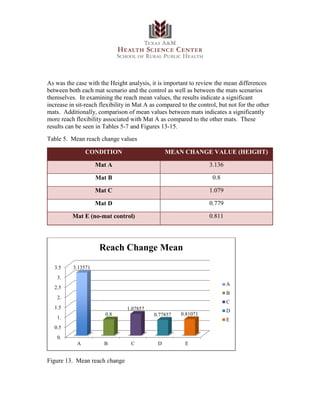
As was the case with the Height analysis, it is important to review the mean differences
between both each mat scenario and the control as well as between the mats scenarios
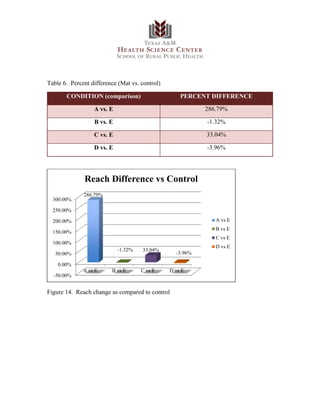
themselves. In examining the reach mean values, the results indicate a significant
increase in sit-reach flexibility in Mat A as compared to the control, but not for the other
mats. Additionally, comparison of mean values between mats indicates a significantly
more reach flexibility associated with Mat A as compared to the other mats. These
results can be seen in Tables 5-7 and Figures 13-15.
Table 5. Mean reach change values
CONDITION MEAN CHANGE VALUE (HEIGHT)
Mat A 3.136
Mat B 0.8
Mat C 1.079
Mat D 0.779
Mat E (no-mat control) 0.811
Figure 13. Mean reach change
0.
0.5
1.
1.5
2.
2.5
3.
3.5
A B C D E
3.13571
0.8
1.07857
0.77857 0.81071
Reach Change Mean
A
B
C
D
E
Table 6. Percent difference (Mat vs. control)
CONDITION (comparison) PERCENT DIFFERENCE
A vs. E 286.79%
B vs. E -1.32%
C vs. E 33.04%
D vs. E -3.96%
Figure 14. Reach change as compared to control
-50.00%
0.00%
50.00%
100.00%
150.00%
200.00%
250.00%
300.00%
A vs E B vs E C vs E D vs E
286.79%
-1.32% 33.04%
-3.96%
Reach Difference vs Control
A vs E
B vs E
C vs E
D vs E
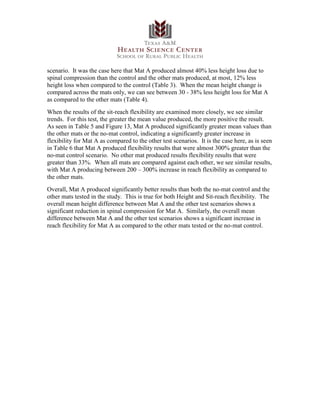
Table 7. Reach change Percent difference (Mat vs. Mat)
CONDITION (comparison) PERCENT DIFFERENCE
A vs. B 291.96%
A vs. C 190.73%
A vs. D 302.75%
Figure 15. Reach change comparison (Mat vs. Mat)
Conclusions
Based on the findings of the statistical analysis, Mat A is the only mat tested in this study
that produced results that were statistically significantly different than the control no-mat
scenario for both height change and sit-reach flexibility change.
In the case of height change, we examined change in height over the course of the
workday. For this test, the smaller the change produced, the more positive the result. As
seen in Table 2 and Figure 6, Mat A produced height change results that were
significantly less than both the control and the other mats tested, indicating significantly
less spinal compression when using Mat A than with any other mat or the control no-mat
0.00%
50.00%
100.00%
150.00%
200.00%
250.00%
300.00%
350.00%
A vs B A vs C A vs D
291.96%
190.73%
302.75%
Reach Difference Between Mats
A vs B
A vs C
A vs D
scenario. It was the case here that Mat A produced almost 40% less height loss due to
spinal compression than the control and the other mats produced, at most, 12% less
height loss when compared to the control (Table 3). When the mean height change is
compared across the mats only, we can see between 30 - 38% less height loss for Mat A
as compared to the other mats (Table 4).
When the results of the sit-reach flexibility are examined more closely, we see similar
trends. For this test, the greater the mean value produced, the more positive the result.
As seen in Table 5 and Figure 13, Mat A produced significantly greater mean values than
the other mats or the no-mat control, indicating a significantly greater increase in
flexibility for Mat A as compared to the other test scenarios. It is the case here, as is seen
in Table 6 that Mat A produced flexibility results that were almost 300% greater than the
no-mat control scenario. No other mat produced results flexibility results that were
greater than 33%. When all mats are compared against each other, we see similar results,
with Mat A producing between 200 – 300% increase in reach flexibility as compared to
the other mats.
Overall, Mat A produced significantly better results than both the no-mat control and the
other mats tested in the study. This is true for both Height and Sit-reach flexibility. The
overall mean height difference between Mat A and the other test scenarios shows a
significant reduction in spinal compression for Mat A. Similarly, the overall mean
difference between Mat A and the other test scenarios shows a significant increase in
reach flexibility for Mat A as compared to the other mats tested or the no-mat control.

Standing mat-study-texas-am-university-2013

  • 1.
    Date: 17 January2013 I have prepared a report summarizing our team’s activities in data collection and comparative analysis of your industrial use anti-fatigue mat versus 3 other currently available industrial anti-fatigue mats. We have finished our data collection and our statistician has completed data analysis. We have prepared this report summarizing our data collection techniques, statistical and empirical results, and overall implications of our findings. As was previously discussed, we recruited two sites for data collection; one, an industrial furniture manufacturer, the other an industrial pipe/valve reconditioner/manufacturer; both were in central Texas/Texas gulf coast regions. As per Texas A&M Internal Review Board (IRB) approved procedures, we began recruiting subjects at these two locations. We were able to recruit eighteen (18) subjects, ten (10) at one site and eight (8) at the other. We were able to collect data on the ten-subject cohort twice, so our data is more robust and represents a dataset more approximate to twenty-eight (28) subjects. Our largest hindrance in recruitment was simply subject willingness. Both sites had significantly more potential subjects, but several at both sites declined study participation. The procedure was one my colleague; Dr. Jerome Congleton has used many times in similar studies in the past with great success. We essentially have what is referred to as a control-treatment type of experiment. For the subjects who agreed to participate in the study, signed the TAMU-IRB approved consent form, and completed this initial trial, all were randomly assigned one of four anti-fatigue mats or used a “no mat” scenario as the control. In this study design, each subject had 5 full days of data and time on each scenario (4 mats, one “no mat” control). The jobs subjects were doing were all stand- biased workstations. Some subjects had the opportunity to sit for short periods of time throughout the day, but for the most part, all subjects were standing most of their 8-hour workday. During this study, all mats, as well as the control, were assigned alpha-numeric identifiers, so as to not inform study subjects of the manufacturer. The identifiers are shown in Table 1.
  • 2.
    CONDITION IDENTIFIER MATBRAND Mat A Let’s Gel Mat B Vinyl corrugated top with nitricell sponge attached base Mat C Nitrile rubber surface attached to Polymeric sponge base Mat D Nitrile rubber surface with nitrile/pvc attached foam Mat E No Mat (Control condition) At the beginning of each day/shift subjects’ height and sit-reach flexibility were measured using a stadiometer and sit-reach flexibility box respectively (Figure 1). These procedures were repeated at the end of the workday/shift for both measurements. All measurements were collected in centimeters. (A) (B) Figure 1. Stadiometer (A), Sit-reach flexibility box (B).
  • 3.
    The reasoning forthese two particular measurements is physiologically-based. Many methods have been performed in various studies, but these two continually prove to be physiologically and statistically relevant for measurement and predictive power. For the height measurement, during the day, as we stand or sit, our spines compress, or more accurately, the intervertebral discs compress, and we lose stature throughout the day. When comparing someone’s stature at the end of the day with the beginning, they will always be shorter. For these purposes, effectiveness of the mat translates to less stature lost throughout the course of the day. For sit-reach flexibility, the interpreted mat effectiveness would be the opposite. As we work throughout the day, our muscles theoretically relax and we become more flexible as the day goes on. So, for this application, effectiveness of the mat would translate directly into greater flexibility at the end of the day when compared to the beginning. Analysis Analysis on several factors was performed. For all statistical tests, we worked under the assumption that there is no statistical difference between the mat conditions with respect to baseline or outcome characteristics. First, because there were two trials from one site, analysis was conducted to see if the pre/post/change for both trials was significantly different. Fortunately, they were not significantly different, indicating compliance in the data sets. Next, t-test, Wilcoxon sign-rank, and ANOVA tests (α = 0.05) were performed on the “pre” data for each mat in comparison to the control to see if there were significant differences before the interventions (mats) were put into place. Again, for both reach and height data, there were no significant differences found between “pre” intervention data for any mats when compared to the control. This is positive for the data analysis because it indicates that at the beginning of the day, all conditions were not statistically different and that any differences indicated in the study were due to the intervention. Additionally, several post-hoc tests were performed to analyze any inter-mat dependencies or differences. Results ANOVA, t-test, and Wilcoxon sign-rank tests (α = 0.05) were performed on the difference between “pre” and “post” reach and height data for each mat in comparison to the control. Mat “A”, the Let’s Gel mat, yielded results for both height and reach that were significantly different than the no-mat control scenario for all measurements except for reach in the second trial for the ten-subject cohort. None of the other mats yielded results significantly different than the control for any measurement. Height Change Results The results for statistical comparisons of the height changes are shown in detail in Figures 2-5. These figures, as highlighted by the p-level (p<0.05 for A and p>0.05 for all others), indicate that the only mat condition the produced height changes significantly
  • 4.
    different than theno-mat control scenario is Mat A (Let’s Gel). The other mats produced height results that were no different than the no-mat control scenario, or at least not statistically significantly different. Comparing Means [ t-test assuming equal variances (homoscedastic) ] Descriptive Statistics VAR Sample size Mean Variance A 28 1.125 0.30269 E 28 1.85357 0.19665 Summary Degrees Of Freedom 54 Hypothesized Mean Difference 0.E+0 Test Statistics 5.45574 Pooled Variance 0.24967 Two-tailed distribution p-level 0.00000125 t Critical Value (5%) 2.00488 Figure 2. Statistical comparison of conditions A and E (no-mat control) Comparing Means [ t-test assuming equal variances (homoscedastic) ] Descriptive Statistics VAR Sample size Mean Variance B 26 1.6269 0.28764 E 28 1.85357 0.19665 Summary Degrees Of Freedom 52 Hypothesized Mean Difference 0.E+0 Test Statistics 0.4287 Pooled Variance 0.22124 Two-tailed distribution p-level 0.67063 t Critical Value (5%) 2.02619 Figure 3. Statistical comparison of conditions B and E (no-mat control)
  • 5.
    Comparing Means [t-test assuming equal variances (homoscedastic) ] Descriptive Statistics VAR Sample size Mean Variance C 26 1.8192 0.28833 E 28 1.85357 0.19665 Summary Degrees Of Freedom 52 Hypothesized Mean Difference 0.E+0 Test Statistics 0.92008 Pooled Variance 0.22486 Two-tailed distribution p-level 0.36319 t Critical Value (5%) 2.02269 Figure 4. Statistical comparison of conditions C and E (no-mat control) Comparing Means [ t-test assuming equal variances (homoscedastic) ] Descriptive Statistics VAR Sample size Mean Variance D 26 1.7269 0.14265 E 28 1.85357 0.19665 Summary Degrees Of Freedom 52 Hypothesized Mean Difference 0.E+0 Test Statistics 0.03244 Pooled Variance 0.18102 Two-tailed distribution p-level 0.97429 t Critical Value (5%) 2.02439 Figure 5. Statistical comparison of conditions D and E (no-mat control)
  • 6.
    In light ofthe statistical test values, it is also important to look at the actual mean change values for height in each scenario. These can be seen in Table 2 and Figure 6. These show that the overall mean value for the height change in Mat A was the only mat condition to produce height change values that were significantly less than the control. More specifically, Mat A produced results that were almost 40% less than the control, as compared to the other mats that were, at most 12% less (Table 3, Figure 7). Additionally, results show that when compared to the other mat scenarios, Mat A produced results that were 30-40% less (Table 4, Figure 8). Table 2. Mean height change values CONDITION MEAN CHANGE VALUE (HEIGHT) Mat A 1.125 Mat B 1.627 Mat C 1.819 Mat D 1.727 Mat E (no-mat control) 1.859 Figure 6. Mean height change 0. 0.2 0.4 0.6 0.8 1. 1.2 1.4 1.6 1.8 2. A B C D E 1.125 1.6269 1.8192 1.7269 1.8536 Height Change Mean A B C D E
  • 7.
    Table 3. Percentdifference (Mat vs. control) CONDITION (comparison) PERCENT DIFFERENCE A vs. E 39.31% B vs. E 12.23% C vs. E 1.85% D vs. E 6.83% Figure 7. Height change as compared to control 0.00% 5.00% 10.00% 15.00% 20.00% 25.00% 30.00% 35.00% 40.00% A vs E B vs E C vs E D vs E 39.31% 12.23% 1.85% 6.83% Height Difference vs. Control A vs E B vs E C vs E D vs E
  • 8.
    Table 4. Heightchange Percent difference (Mat vs. Mat) CONDITION (comparison) PERCENT DIFFERENCE A vs. B 30.85% A vs. C 38.16% A vs. D 34.85% Figure 8. Height change comparison (Mat vs. Mat) Reach Change Results Similarly, when we examine the results for sit-reach flexibility, Mat A was the only scenario that produced results that were significantly different than the no-mat control. These results can be seen in Figures 9-12. All other mats produced reach results that were found to be not statistically different than the no-mat control. 0.00% 5.00% 10.00% 15.00% 20.00% 25.00% 30.00% 35.00% 40.00% A vs B A vs C A vs D 30.85% 38.16% 34.85% Height Difference Between Mats A vs B A vs C A vs D
  • 9.
    Comparing Means [t-test assuming equal variances (homoscedastic) ] Descriptive Statistics VAR Sample size Mean Variance A 28 3.13571 4.31868 E 27 0.81071 3.64247 Summary Degrees Of Freedom 53 Hypothesized Mean Difference 0.E+0 Test Statistics 4.36028 Pooled Variance 3.98058 Two-tailed distribution p-level 0.00006 t Critical Value (5%) 2.00488 Figure 9. Statistical comparison of conditions A and E (no-mat control) Comparing Means [ t-test assuming equal variances (homoscedastic) ] Descriptive Statistics VAR Sample size Mean Variance B 27 0.8 5.61556 E 27 0.81071 3.64247 Summary Degrees Of Freedom 52 Hypothesized Mean Difference 0.E+0 Test Statistics 0.01863 Pooled Variance 4.62901 Two-tailed distribution p-level 0.9852 t Critical Value (5%) 2.00488 Figure 10. Statistical comparison of conditions B and E (no-mat control)
  • 10.
    Comparing Means [t-test assuming equal variances (homoscedastic) ] Descriptive Statistics VAR Sample size Mean Variance C 26 1.07857 4.66841 E 27 0.81071 3.64247 Summary Degrees Of Freedom 51 Hypothesized Mean Difference 0.E+0 Test Statistics 0.49165 Pooled Variance 4.15544 Two-tailed distribution p-level 0.62496 t Critical Value (5%) 2.00488 Figure 11. Statistical comparison of conditions C and E (no-mat control) Comparing Means [ t-test assuming equal variances (homoscedastic) ] Descriptive Statistics VAR Sample size Mean Variance D 27 0.77857 3.65434 E 27 0.81071 3.64247 Summary Degrees Of Freedom 52 Hypothesized Mean Difference 0.E+0 Test Statistics 0.06296 Pooled Variance 3.64841 Two-tailed distribution p-level 0.95003 t Critical Value (5%) 2.00488 Figure 12. Statistical comparison of conditions D and E (no-mat control)
  • 11.
    As was thecase with the Height analysis, it is important to review the mean differences between both each mat scenario and the control as well as between the mats scenarios themselves. In examining the reach mean values, the results indicate a significant increase in sit-reach flexibility in Mat A as compared to the control, but not for the other mats. Additionally, comparison of mean values between mats indicates a significantly more reach flexibility associated with Mat A as compared to the other mats. These results can be seen in Tables 5-7 and Figures 13-15. Table 5. Mean reach change values CONDITION MEAN CHANGE VALUE (HEIGHT) Mat A 3.136 Mat B 0.8 Mat C 1.079 Mat D 0.779 Mat E (no-mat control) 0.811 Figure 13. Mean reach change 0. 0.5 1. 1.5 2. 2.5 3. 3.5 A B C D E 3.13571 0.8 1.07857 0.77857 0.81071 Reach Change Mean A B C D E
  • 12.
    Table 6. Percentdifference (Mat vs. control) CONDITION (comparison) PERCENT DIFFERENCE A vs. E 286.79% B vs. E -1.32% C vs. E 33.04% D vs. E -3.96% Figure 14. Reach change as compared to control -50.00% 0.00% 50.00% 100.00% 150.00% 200.00% 250.00% 300.00% A vs E B vs E C vs E D vs E 286.79% -1.32% 33.04% -3.96% Reach Difference vs Control A vs E B vs E C vs E D vs E
  • 13.
    Table 7. Reachchange Percent difference (Mat vs. Mat) CONDITION (comparison) PERCENT DIFFERENCE A vs. B 291.96% A vs. C 190.73% A vs. D 302.75% Figure 15. Reach change comparison (Mat vs. Mat) Conclusions Based on the findings of the statistical analysis, Mat A is the only mat tested in this study that produced results that were statistically significantly different than the control no-mat scenario for both height change and sit-reach flexibility change. In the case of height change, we examined change in height over the course of the workday. For this test, the smaller the change produced, the more positive the result. As seen in Table 2 and Figure 6, Mat A produced height change results that were significantly less than both the control and the other mats tested, indicating significantly less spinal compression when using Mat A than with any other mat or the control no-mat 0.00% 50.00% 100.00% 150.00% 200.00% 250.00% 300.00% 350.00% A vs B A vs C A vs D 291.96% 190.73% 302.75% Reach Difference Between Mats A vs B A vs C A vs D
  • 14.
    scenario. It wasthe case here that Mat A produced almost 40% less height loss due to spinal compression than the control and the other mats produced, at most, 12% less height loss when compared to the control (Table 3). When the mean height change is compared across the mats only, we can see between 30 - 38% less height loss for Mat A as compared to the other mats (Table 4). When the results of the sit-reach flexibility are examined more closely, we see similar trends. For this test, the greater the mean value produced, the more positive the result. As seen in Table 5 and Figure 13, Mat A produced significantly greater mean values than the other mats or the no-mat control, indicating a significantly greater increase in flexibility for Mat A as compared to the other test scenarios. It is the case here, as is seen in Table 6 that Mat A produced flexibility results that were almost 300% greater than the no-mat control scenario. No other mat produced results flexibility results that were greater than 33%. When all mats are compared against each other, we see similar results, with Mat A producing between 200 – 300% increase in reach flexibility as compared to the other mats. Overall, Mat A produced significantly better results than both the no-mat control and the other mats tested in the study. This is true for both Height and Sit-reach flexibility. The overall mean height difference between Mat A and the other test scenarios shows a significant reduction in spinal compression for Mat A. Similarly, the overall mean difference between Mat A and the other test scenarios shows a significant increase in reach flexibility for Mat A as compared to the other mats tested or the no-mat control.