1
Stage of Mixed dentition and Occlusion Dr. Mohammed Alruby
Stage of
Mixed dentition
and
Occlusion
Prepared by:
Dr. Mohammed Alruby
2
Stage of Mixed dentition and Occlusion Dr. Mohammed Alruby
Dental arch perimeter
Occlusal changes in mixed dentition
1st
permanent molars eruption
Permanent incisors eruption
Cuspid and bicuspid eruption
Second permanent molars eruption
Occlusal adjustment
Intercanine and inter-molars changes
3
Stage of Mixed dentition and Occlusion Dr. Mohammed Alruby
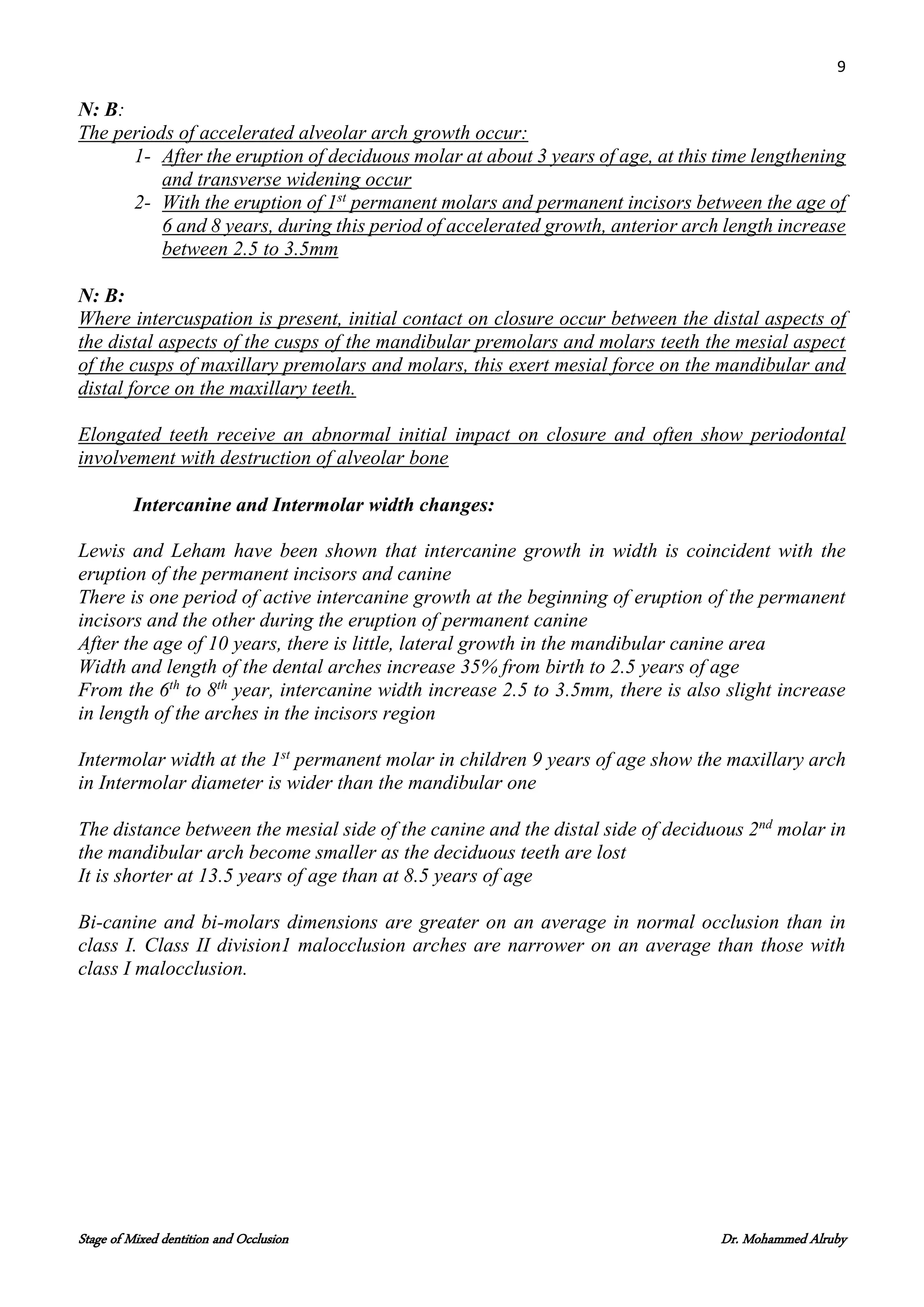
That period in which primary and permanent teeth are in the mouth together, the teeth that
replace the primary teeth is called successional teeth, the teeth that erupt posterior to the
primary teeth are termed accessional
From the clinical point of view, there are two very important aspects to the mixed dentition
period:
a- The utilization of the arch perimeter
b- The adaptive changes in occlusion that occur during transition from one dentition to
another
1- Uses of dental arch perimeter:
There are three uses of dental arch perimeter:
- Alignment of permanent incisors that arrive typically crowded
- Space for cuspids and premolars
- Adjustment of molars occlusion: the 1st
permanent molars which typically erupt end
to end, must change to class I relationship if normal occlusion is to be obtained
As the larger permanent incisors erupt, they find space in the arch because:
- The arch width increase slightly
- There was some inter-dental spacing in primary dentition
- The permanent incisors tip labially
- The primary cuspids are moved distally
There is a typical slight crowding which usually is not relieved until the primary cuspids are
lost
It has been suggested that the eruption of the 1st
permanent molars cause early mesial shift that
close part of primate space and other interdental spaces
In alternative theory, the primary space is closed by the eruption of incisors without loss of
perimeter
The lee-way space is the difference in size between the primary teeth and their permanent
successors: anteriorly there is a negative Lee-way space, posteriorly there is a positive Lee-way
space
The cuspids and premolars erupt into the normal excessive posterior Lee-way space if the molar
adjustment is to be achieved by dental means, there must be some posterior space left after the
arrival of the cuspids and premolars So that a late mesial shift of 1st
permanent molars takes
place.
In maxilla, similar accommodation adjustments occur during the mixed dentition, although the
matter is less critical since the upper incisors alter their inclination more and the maxillary
perimeter does not display such a tendency to shorten as does the mandible.
2- Occlusal changes in mixed dentition:
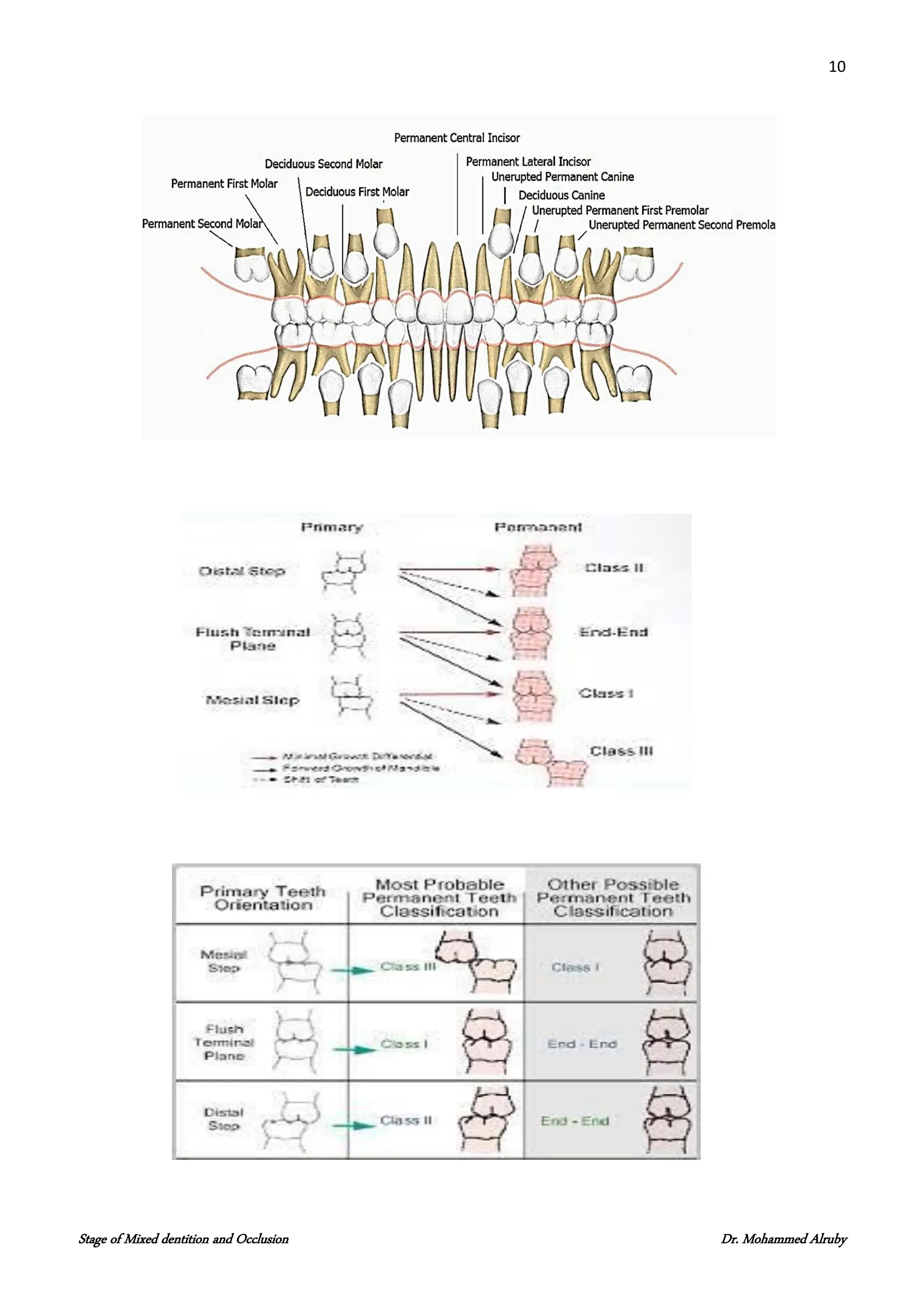
The usual flush terminal plane of primary dentition typically provides an end to end relationship
of 1st
permanent molars
The 1st
permanent molars normally achieves class I relationship by:
a- Late mesial shift after shedding of 2nd
deciduous molars
b- Greater forward growth of the mandible than maxilla
4
Stage of Mixed dentition and Occlusion Dr. Mohammed Alruby
Distal step in primary dentition reflects likely skeletal imbalance and likely will result in class
II occlusion in permanent dentition
If the child has flush terminal plane in primary dentition, a mild class II facial skeleton and
insufficient arch perimeter to permit late mesial shift of the 1st
permanent molars, the occlusion
likely will become class II by the end of the mixed dentition period
OR: an end to end molar relationship may obtain by the time of the eruption of the premolars
N: B:
No child has enough mandibular Lee-way space to achieve naturally class I molar relationship
within sever class II facial skeleton
3- 1st
molars eruption:
a- In mandible:
The majority of children erupt the 1st
permanent molar prior to the central incisors
The 1st
permanent molars are guided into their occlusal position during eruption by the distal
surface of 2nd
deciduous molars
The occlusal relationship that the mandibular 1st
molar initially obtains with its maxillary
antagonist is thus determined by the terminal plane relationship of 2nd
primary molars.
Changes in occlusal relationship that occurs during the period od 1st
molar eruption are not
caused by that eruption but are due to coincidental skeletal growth of mandible.
b- In maxilla:
During formation, the crowns of maxillary molars faced dorsally rather than occlusally, as the
maxilla moves forward, space is created posteriorly permitting appositional enlargement of
maxillary tuberosity, during this period of growth the 1st
permanent molars rotate and by the
time the crown pierce the gingiva and it is facing more occlusally
4- Incisors eruption:
a- In mandible:
Although the incisors follow the 1st
permanent molars in piercing the gingiva, they reach the
full clinical crown sooner
The permanent incisors developed lingually to the resorbing roots of the primary one forcing
the primary incisors labially to be exfoliated
As soon as the primary have been exfoliated, further eruption and lingual activity moves the
permanent incisors labially to their normal balanced position between the tongue and the lip
and facial musculature
As the lateral permanent incisors erupt not only push the primary lateral labially but also move
the primary cuspid distally and laterally to close the primate space BUT when the incisors are
large in size so its eruption may lead to exfoliation of the primary cuspid or unusual resorption
of the root of the primary cuspid
When the primary cuspid are prematurely lost, the anterior arc is less stable and the incisor
may be tipped lingually by the hyperactive mentalis muscle, a condition frequently found with
class II division 1 malocclusion or thumb sucking
Lingual tipping of incisors permits the developing permanent cuspid to slide labially, where it
may erupt later in labioversion
5
Stage of Mixed dentition and Occlusion Dr. Mohammed Alruby
b- In maxilla:
The maxillary anterior dental segment is supported by the mandibular one which is formed
earlier, providing a functional stop against which the maxillary incisors erupt
The maxillary permanent incisors erupt with more labial inclination than their predecessors, in
accordance with their greater labio-lingual thickness and wider diameter
Broadbent: the maxillary central incisors erupt with slight distal inclination and some midline
space between them (ugly duckling stage) in which space is diminished with eruption of lateral
incisors and closed as the cuspids wedge their way into the arch and growth at the base of the
nose
As maxillary lateral incisors erupt, the developing crown of the cuspids lie just labially and
distal to their roots. The cuspid in this position often can cause the lateral incisors to erupt more
labially than central, after erupting of cuspids the lateral correct itself and comes into position
beside the central incisors
There is a minor rotation in position of both central and lateral but they are usually correct as
the cuspids erupt
Because the upper canine takes the distal surface of lateral incisors as a guide for eruption SO
it is not good in practice to attempts to align central and lateral incisors while the cuspid crown
is on the root of lateral, SINCE orthodontic pressure against the lateral crown may press the
roots against the erupting cuspids crown and c cause root resorption
5- Cuspids and bicuspids eruption:
Favorable development of occlusion in this region is largely dependent on four factors:
a- Favorable sequence of eruption
b- Satisfactory tooth size – available space ratio
c- The attainment of normal molar relationship with minimal diminution of space available
for the cuspids
d- Favorable bucco-lingual relationship of alveolar process
a- In mandible:
The most favorable eruption sequence in the mandible is 3,4,5,7 – it is useful if the cuspid erupt
first, since it tends to maintain the arch perimeter and to prevent lingual tipping of incisors
When the incisors are tipped lingually they may over erupt, since by lingual tipping they lose
the centric stops with maxillary incisors
In severe class II malocclusion, the mandibular incisors erupt past to the plane of occlusion
until they find functional stops against the maxillary palatal mucosa. The more complication is
the movement of cuspids into labio - version direction
It is quite normal for the cuspid to lag behind the 1st
bicuspid during early development, but it
moves more rapidly during the later stages of eruption and usually pass the 1st
bicuspid before
breaking through the alveolar crest
Eruption of bicuspid may be hasted by the extraction of the primary cuspid while the root of
permanent cuspid start to form
6
Stage of Mixed dentition and Occlusion Dr. Mohammed Alruby
Bicuspid rotation sometimes occurs with uneven resorption of the roots of primary molars, if
such rotation is seen to be developing, it is good practice to:
- Construct space maintainer
- Hold space for erupting teeth
- Extract the primary molar (after completion of crown)
The second bicuspid is the last teeth to erupt so may have no room for it due to mesial movement
of 1st
molar permanent
When the 2nd
primary molar is lost prematurely, the erupting 2nd
molar often helps the 1st
molar
to move mesially before the 2nd
bicuspid can erupt
When Lee-way space is insufficient, the 1st
molar permanent must not allow to move mesially
until the 2nd
premolar had a chance in its proper position in the arch
Before the primary molars are lost (mixed dentition analysis) must be done to determine whether
mesial movement of 1st
permanent molar need to be controlled
b- In maxilla:
The sequence of eruption either 4 – 5 – 3 OR, 4 – 3 – 5. Although the maxillary anterior
segment is not prone to collapse lingually because it is supported by the mandibular arch, but
it is very easily displaced labially by: thumb sucking, tongue thrust, hyper active mentalis
muscle.
Such displacement of maxillary anterior segment effects the eruptive path of cuspid and bicuspid
The greater mesio-distal width of 2nd
primary molar permits easy eruption of end bicuspid into
its position in the arch. However, this Lee-way space in 2nd
bicuspid region may be necessary
to provide space anteriorly for the accommodation of the wider permanent cuspid even through
the anterior arc is increasing at this time.
The maxillary cuspid follow a more difficult and tortuous path of eruption than any other tooth,
when the child is 3 years it is high in maxilla, with its crown directed mesially and somewhat
lingually
It is move toward the occlusal plane, gradually uprighting itself until it seems to strike the distal
aspect of lateral incisor root, and become deflected to more vertical position.
It is often erupting into the oral cavity with marked mesial inclination. The eruption of cuspid
close the interdental spacing between the incisors providing space for final uprighting of the
cuspid
When in its correct occlusal position, it has a slight mesial inclination
If the arch length is short in both arches, the upper cuspid and lower 2nd
bicuspid arrive
malposed because they are typically the last teeth a head of the 1st
molar to erupt in their
respective arches
6- Second molar eruption:
Normally, the lower 2nd
molar arrives in the oral cavity after all teeth eruption anterior to it,
when it precedes 2nd
bicuspid, it may tip the 1st
molar mesially
The eruption of maxillary 2nd
molar a head to the mandibular one is said to be symptomatic of
developing class II malocclusion, it is also seen in the premolar primary loss and sometimes
may be seen in skeletal Class II malocclusion because they may be more space than normal in
7
Stage of Mixed dentition and Occlusion Dr. Mohammed Alruby
maxilla for the maxillary 2nd
molar development or less space in the shortened mandible for
lower 2nd
molar development
N: B:
 At 8 years of age:
The permanent incisors and 1st
molar are erupted, and the eruption of maxillary arch may
precede the lower permanent incisors and may produce deep over bite
It is important at this stage to differentiate between abnormal overbite of malocclusion and
stage of growth in which the overbite correct itself by subsequent occlusal adjustment
 At 10 years of age:
And continuing to 14 years, the arch length decrease by about 1mm in maxilla and 2mm in
mandible, primarily because the mesiodistal crown diameter of premolars teeth generally are
smaller than those of their deciduous predecessor
The maxillary intercanine distance increase during the incremental phase which start shortly
after the age of 10 years
In mandible the intercanine distance may decrease slightly between the age of 10 and 14 years
Changes in arch length and intercanine distances are small after the age of 14 years
 Maher method of determining the late mesial shift:
Measure from the midpoint of 1st
molar permanent to the midline before the loss of the 2nd
deciduous molar and after loss of it then compared together
He found that it is shorten greatly with loss of 2nd
deciduous molars
 Between 6 – 7 years of age:
20 deciduous teeth are present
4 permanent molars
All germs of permanent teeth, SO there are 52 teeth in all various stages of formation
and eruption in the jaws of child
N: B:
 Sassoni Lee-way space: 1.20 mm in upper and 2.47mm in lower
 Nance Lee-way space: 1.8mm in upper and 3.4mm in lower
This differences give a chance for the 1ts lower permanent molars to drift slightly to
mesial side and occlude in the proper position
 Broadbent shown: with the eruption of canine and increased growth at apical base of the
permanent incisors, the lateral incisor assumes more erect positioned
 At birth, the labial frenum is attached to the incisive papilla but growth of alveolar
process in an occlusal direction shows it later to be attached higher up on the labial
surface
N: B:
Path of eruption:
== if there is a tendency of the incisors to come edge to edge and if there is a slight shift of the
mandibular anterior, this lead to anterior cross-bite
8
Stage of Mixed dentition and Occlusion Dr. Mohammed Alruby
== injury of deciduous incisors may affect the formation and alter the path of eruption of
permanent successors which may erupt more lingually bringing them into cross-bite
relationship with mandibular incisors
== In Angle Class II division 2, the path and pattern of eruption of maxillary incisors is altered,
the lateral incisors erupt labially instead of eruption lingually and overlap the central, not only
the crown overlap but also root overlap
== coronal, radicular and median cyst and supernumerary teeth may cause deviation from the
normal path of eruption
Occlusal adjustment
There are three different mechanisms of normal occlusal adjustment as the deciduous dentition
enter the mixed dentition until permanent dentition is established
1- When the mesial vertical plane of the distal aspect upper deciduous 2nd
molars is distal
to the distal vertical plane of the lower deciduous 2nd
molars similar to the adult normal
occlusion, the permanent 1st
molar erupt directly into proper occlusion without altering
the position of deciduous teeth
2- When there is a primate space the normal occlusion of 2st molar is affected by an early
mesial shift of the deciduous molar closing the primate space distal to the lower
deciduous canine
3- When the distal aspect of 2nd
deciduous molars are on the same vertical plane, the 1st
permanent molar show a transitory end to end relationship on eruption
Normal occlusion is affected through a late mesial shift of the mandibular permanent 1st
molar
after the 2nd
deciduous molars are shed, failure of these teeth to come forward can initiate class
II molar relationship
At the time of eruption of permanent incisors, a transverse widening of the mandibular arc
occurs to provide space for erupting permanent incisor which have a greater mesiodistal width
than the deciduous incisors
Baume, found the mean increments to be 2.3mm, the widening of the arches appears to be due
to lateral growth of the alveolar process. The mean increase in the intercanine width is greater
in the maxillary than in mandibular one and also greater in deciduous without interdental
spacing than on spaced one.
Spaced deciduous arches are usually followed by favorably aligned permanent incisors. About
4% of deciduous arches without spacing show crowded permanent incisors.
The following changes occurs during the transition from the deciduous to the permanent
dentition:
1- Establishment of mesiodistal arch relation
2- Arch adjustment during permanent molar eruption
3- There may be a transitory cusp to cusp relationship which is later adjusted to normal or
abnormal occlusion
4- There may not be bilateral adjustment.
9
Stage of Mixed dentition and Occlusion Dr. Mohammed Alruby
N: B:
The periods of accelerated alveolar arch growth occur:
1- After the eruption of deciduous molar at about 3 years of age, at this time lengthening
and transverse widening occur
2- With the eruption of 1st
permanent molars and permanent incisors between the age of
6 and 8 years, during this period of accelerated growth, anterior arch length increase
between 2.5 to 3.5mm
N: B:
Where intercuspation is present, initial contact on closure occur between the distal aspects of
the distal aspects of the cusps of the mandibular premolars and molars teeth the mesial aspect
of the cusps of maxillary premolars and molars, this exert mesial force on the mandibular and
distal force on the maxillary teeth.
Elongated teeth receive an abnormal initial impact on closure and often show periodontal
involvement with destruction of alveolar bone
Intercanine and Intermolar width changes:
Lewis and Leham have been shown that intercanine growth in width is coincident with the
eruption of the permanent incisors and canine
There is one period of active intercanine growth at the beginning of eruption of the permanent
incisors and the other during the eruption of permanent canine
After the age of 10 years, there is little, lateral growth in the mandibular canine area
Width and length of the dental arches increase 35% from birth to 2.5 years of age
From the 6th
to 8th
year, intercanine width increase 2.5 to 3.5mm, there is also slight increase
in length of the arches in the incisors region
Intermolar width at the 1st
permanent molar in children 9 years of age show the maxillary arch
in Intermolar diameter is wider than the mandibular one
The distance between the mesial side of the canine and the distal side of deciduous 2nd
molar in
the mandibular arch become smaller as the deciduous teeth are lost
It is shorter at 13.5 years of age than at 8.5 years of age
Bi-canine and bi-molars dimensions are greater on an average in normal occlusion than in
class I. Class II division1 malocclusion arches are narrower on an average than those with
class I malocclusion.
10
Stage of Mixed dentition and Occlusion Dr. Mohammed Alruby

Stage of Mixed Dentition and Occlusion.pdf

  • 1.
    1 Stage of Mixeddentition and Occlusion Dr. Mohammed Alruby Stage of Mixed dentition and Occlusion Prepared by: Dr. Mohammed Alruby
  • 2.
    2 Stage of Mixeddentition and Occlusion Dr. Mohammed Alruby Dental arch perimeter Occlusal changes in mixed dentition 1st permanent molars eruption Permanent incisors eruption Cuspid and bicuspid eruption Second permanent molars eruption Occlusal adjustment Intercanine and inter-molars changes
  • 3.
    3 Stage of Mixeddentition and Occlusion Dr. Mohammed Alruby That period in which primary and permanent teeth are in the mouth together, the teeth that replace the primary teeth is called successional teeth, the teeth that erupt posterior to the primary teeth are termed accessional From the clinical point of view, there are two very important aspects to the mixed dentition period: a- The utilization of the arch perimeter b- The adaptive changes in occlusion that occur during transition from one dentition to another 1- Uses of dental arch perimeter: There are three uses of dental arch perimeter: - Alignment of permanent incisors that arrive typically crowded - Space for cuspids and premolars - Adjustment of molars occlusion: the 1st permanent molars which typically erupt end to end, must change to class I relationship if normal occlusion is to be obtained As the larger permanent incisors erupt, they find space in the arch because: - The arch width increase slightly - There was some inter-dental spacing in primary dentition - The permanent incisors tip labially - The primary cuspids are moved distally There is a typical slight crowding which usually is not relieved until the primary cuspids are lost It has been suggested that the eruption of the 1st permanent molars cause early mesial shift that close part of primate space and other interdental spaces In alternative theory, the primary space is closed by the eruption of incisors without loss of perimeter The lee-way space is the difference in size between the primary teeth and their permanent successors: anteriorly there is a negative Lee-way space, posteriorly there is a positive Lee-way space The cuspids and premolars erupt into the normal excessive posterior Lee-way space if the molar adjustment is to be achieved by dental means, there must be some posterior space left after the arrival of the cuspids and premolars So that a late mesial shift of 1st permanent molars takes place. In maxilla, similar accommodation adjustments occur during the mixed dentition, although the matter is less critical since the upper incisors alter their inclination more and the maxillary perimeter does not display such a tendency to shorten as does the mandible. 2- Occlusal changes in mixed dentition: The usual flush terminal plane of primary dentition typically provides an end to end relationship of 1st permanent molars The 1st permanent molars normally achieves class I relationship by: a- Late mesial shift after shedding of 2nd deciduous molars b- Greater forward growth of the mandible than maxilla
  • 4.
    4 Stage of Mixeddentition and Occlusion Dr. Mohammed Alruby Distal step in primary dentition reflects likely skeletal imbalance and likely will result in class II occlusion in permanent dentition If the child has flush terminal plane in primary dentition, a mild class II facial skeleton and insufficient arch perimeter to permit late mesial shift of the 1st permanent molars, the occlusion likely will become class II by the end of the mixed dentition period OR: an end to end molar relationship may obtain by the time of the eruption of the premolars N: B: No child has enough mandibular Lee-way space to achieve naturally class I molar relationship within sever class II facial skeleton 3- 1st molars eruption: a- In mandible: The majority of children erupt the 1st permanent molar prior to the central incisors The 1st permanent molars are guided into their occlusal position during eruption by the distal surface of 2nd deciduous molars The occlusal relationship that the mandibular 1st molar initially obtains with its maxillary antagonist is thus determined by the terminal plane relationship of 2nd primary molars. Changes in occlusal relationship that occurs during the period od 1st molar eruption are not caused by that eruption but are due to coincidental skeletal growth of mandible. b- In maxilla: During formation, the crowns of maxillary molars faced dorsally rather than occlusally, as the maxilla moves forward, space is created posteriorly permitting appositional enlargement of maxillary tuberosity, during this period of growth the 1st permanent molars rotate and by the time the crown pierce the gingiva and it is facing more occlusally 4- Incisors eruption: a- In mandible: Although the incisors follow the 1st permanent molars in piercing the gingiva, they reach the full clinical crown sooner The permanent incisors developed lingually to the resorbing roots of the primary one forcing the primary incisors labially to be exfoliated As soon as the primary have been exfoliated, further eruption and lingual activity moves the permanent incisors labially to their normal balanced position between the tongue and the lip and facial musculature As the lateral permanent incisors erupt not only push the primary lateral labially but also move the primary cuspid distally and laterally to close the primate space BUT when the incisors are large in size so its eruption may lead to exfoliation of the primary cuspid or unusual resorption of the root of the primary cuspid When the primary cuspid are prematurely lost, the anterior arc is less stable and the incisor may be tipped lingually by the hyperactive mentalis muscle, a condition frequently found with class II division 1 malocclusion or thumb sucking Lingual tipping of incisors permits the developing permanent cuspid to slide labially, where it may erupt later in labioversion
  • 5.
    5 Stage of Mixeddentition and Occlusion Dr. Mohammed Alruby b- In maxilla: The maxillary anterior dental segment is supported by the mandibular one which is formed earlier, providing a functional stop against which the maxillary incisors erupt The maxillary permanent incisors erupt with more labial inclination than their predecessors, in accordance with their greater labio-lingual thickness and wider diameter Broadbent: the maxillary central incisors erupt with slight distal inclination and some midline space between them (ugly duckling stage) in which space is diminished with eruption of lateral incisors and closed as the cuspids wedge their way into the arch and growth at the base of the nose As maxillary lateral incisors erupt, the developing crown of the cuspids lie just labially and distal to their roots. The cuspid in this position often can cause the lateral incisors to erupt more labially than central, after erupting of cuspids the lateral correct itself and comes into position beside the central incisors There is a minor rotation in position of both central and lateral but they are usually correct as the cuspids erupt Because the upper canine takes the distal surface of lateral incisors as a guide for eruption SO it is not good in practice to attempts to align central and lateral incisors while the cuspid crown is on the root of lateral, SINCE orthodontic pressure against the lateral crown may press the roots against the erupting cuspids crown and c cause root resorption 5- Cuspids and bicuspids eruption: Favorable development of occlusion in this region is largely dependent on four factors: a- Favorable sequence of eruption b- Satisfactory tooth size – available space ratio c- The attainment of normal molar relationship with minimal diminution of space available for the cuspids d- Favorable bucco-lingual relationship of alveolar process a- In mandible: The most favorable eruption sequence in the mandible is 3,4,5,7 – it is useful if the cuspid erupt first, since it tends to maintain the arch perimeter and to prevent lingual tipping of incisors When the incisors are tipped lingually they may over erupt, since by lingual tipping they lose the centric stops with maxillary incisors In severe class II malocclusion, the mandibular incisors erupt past to the plane of occlusion until they find functional stops against the maxillary palatal mucosa. The more complication is the movement of cuspids into labio - version direction It is quite normal for the cuspid to lag behind the 1st bicuspid during early development, but it moves more rapidly during the later stages of eruption and usually pass the 1st bicuspid before breaking through the alveolar crest Eruption of bicuspid may be hasted by the extraction of the primary cuspid while the root of permanent cuspid start to form
  • 6.
    6 Stage of Mixeddentition and Occlusion Dr. Mohammed Alruby Bicuspid rotation sometimes occurs with uneven resorption of the roots of primary molars, if such rotation is seen to be developing, it is good practice to: - Construct space maintainer - Hold space for erupting teeth - Extract the primary molar (after completion of crown) The second bicuspid is the last teeth to erupt so may have no room for it due to mesial movement of 1st molar permanent When the 2nd primary molar is lost prematurely, the erupting 2nd molar often helps the 1st molar to move mesially before the 2nd bicuspid can erupt When Lee-way space is insufficient, the 1st molar permanent must not allow to move mesially until the 2nd premolar had a chance in its proper position in the arch Before the primary molars are lost (mixed dentition analysis) must be done to determine whether mesial movement of 1st permanent molar need to be controlled b- In maxilla: The sequence of eruption either 4 – 5 – 3 OR, 4 – 3 – 5. Although the maxillary anterior segment is not prone to collapse lingually because it is supported by the mandibular arch, but it is very easily displaced labially by: thumb sucking, tongue thrust, hyper active mentalis muscle. Such displacement of maxillary anterior segment effects the eruptive path of cuspid and bicuspid The greater mesio-distal width of 2nd primary molar permits easy eruption of end bicuspid into its position in the arch. However, this Lee-way space in 2nd bicuspid region may be necessary to provide space anteriorly for the accommodation of the wider permanent cuspid even through the anterior arc is increasing at this time. The maxillary cuspid follow a more difficult and tortuous path of eruption than any other tooth, when the child is 3 years it is high in maxilla, with its crown directed mesially and somewhat lingually It is move toward the occlusal plane, gradually uprighting itself until it seems to strike the distal aspect of lateral incisor root, and become deflected to more vertical position. It is often erupting into the oral cavity with marked mesial inclination. The eruption of cuspid close the interdental spacing between the incisors providing space for final uprighting of the cuspid When in its correct occlusal position, it has a slight mesial inclination If the arch length is short in both arches, the upper cuspid and lower 2nd bicuspid arrive malposed because they are typically the last teeth a head of the 1st molar to erupt in their respective arches 6- Second molar eruption: Normally, the lower 2nd molar arrives in the oral cavity after all teeth eruption anterior to it, when it precedes 2nd bicuspid, it may tip the 1st molar mesially The eruption of maxillary 2nd molar a head to the mandibular one is said to be symptomatic of developing class II malocclusion, it is also seen in the premolar primary loss and sometimes may be seen in skeletal Class II malocclusion because they may be more space than normal in
  • 7.
    7 Stage of Mixeddentition and Occlusion Dr. Mohammed Alruby maxilla for the maxillary 2nd molar development or less space in the shortened mandible for lower 2nd molar development N: B:  At 8 years of age: The permanent incisors and 1st molar are erupted, and the eruption of maxillary arch may precede the lower permanent incisors and may produce deep over bite It is important at this stage to differentiate between abnormal overbite of malocclusion and stage of growth in which the overbite correct itself by subsequent occlusal adjustment  At 10 years of age: And continuing to 14 years, the arch length decrease by about 1mm in maxilla and 2mm in mandible, primarily because the mesiodistal crown diameter of premolars teeth generally are smaller than those of their deciduous predecessor The maxillary intercanine distance increase during the incremental phase which start shortly after the age of 10 years In mandible the intercanine distance may decrease slightly between the age of 10 and 14 years Changes in arch length and intercanine distances are small after the age of 14 years  Maher method of determining the late mesial shift: Measure from the midpoint of 1st molar permanent to the midline before the loss of the 2nd deciduous molar and after loss of it then compared together He found that it is shorten greatly with loss of 2nd deciduous molars  Between 6 – 7 years of age: 20 deciduous teeth are present 4 permanent molars All germs of permanent teeth, SO there are 52 teeth in all various stages of formation and eruption in the jaws of child N: B:  Sassoni Lee-way space: 1.20 mm in upper and 2.47mm in lower  Nance Lee-way space: 1.8mm in upper and 3.4mm in lower This differences give a chance for the 1ts lower permanent molars to drift slightly to mesial side and occlude in the proper position  Broadbent shown: with the eruption of canine and increased growth at apical base of the permanent incisors, the lateral incisor assumes more erect positioned  At birth, the labial frenum is attached to the incisive papilla but growth of alveolar process in an occlusal direction shows it later to be attached higher up on the labial surface N: B: Path of eruption: == if there is a tendency of the incisors to come edge to edge and if there is a slight shift of the mandibular anterior, this lead to anterior cross-bite
  • 8.
    8 Stage of Mixeddentition and Occlusion Dr. Mohammed Alruby == injury of deciduous incisors may affect the formation and alter the path of eruption of permanent successors which may erupt more lingually bringing them into cross-bite relationship with mandibular incisors == In Angle Class II division 2, the path and pattern of eruption of maxillary incisors is altered, the lateral incisors erupt labially instead of eruption lingually and overlap the central, not only the crown overlap but also root overlap == coronal, radicular and median cyst and supernumerary teeth may cause deviation from the normal path of eruption Occlusal adjustment There are three different mechanisms of normal occlusal adjustment as the deciduous dentition enter the mixed dentition until permanent dentition is established 1- When the mesial vertical plane of the distal aspect upper deciduous 2nd molars is distal to the distal vertical plane of the lower deciduous 2nd molars similar to the adult normal occlusion, the permanent 1st molar erupt directly into proper occlusion without altering the position of deciduous teeth 2- When there is a primate space the normal occlusion of 2st molar is affected by an early mesial shift of the deciduous molar closing the primate space distal to the lower deciduous canine 3- When the distal aspect of 2nd deciduous molars are on the same vertical plane, the 1st permanent molar show a transitory end to end relationship on eruption Normal occlusion is affected through a late mesial shift of the mandibular permanent 1st molar after the 2nd deciduous molars are shed, failure of these teeth to come forward can initiate class II molar relationship At the time of eruption of permanent incisors, a transverse widening of the mandibular arc occurs to provide space for erupting permanent incisor which have a greater mesiodistal width than the deciduous incisors Baume, found the mean increments to be 2.3mm, the widening of the arches appears to be due to lateral growth of the alveolar process. The mean increase in the intercanine width is greater in the maxillary than in mandibular one and also greater in deciduous without interdental spacing than on spaced one. Spaced deciduous arches are usually followed by favorably aligned permanent incisors. About 4% of deciduous arches without spacing show crowded permanent incisors. The following changes occurs during the transition from the deciduous to the permanent dentition: 1- Establishment of mesiodistal arch relation 2- Arch adjustment during permanent molar eruption 3- There may be a transitory cusp to cusp relationship which is later adjusted to normal or abnormal occlusion 4- There may not be bilateral adjustment.
  • 9.
    9 Stage of Mixeddentition and Occlusion Dr. Mohammed Alruby N: B: The periods of accelerated alveolar arch growth occur: 1- After the eruption of deciduous molar at about 3 years of age, at this time lengthening and transverse widening occur 2- With the eruption of 1st permanent molars and permanent incisors between the age of 6 and 8 years, during this period of accelerated growth, anterior arch length increase between 2.5 to 3.5mm N: B: Where intercuspation is present, initial contact on closure occur between the distal aspects of the distal aspects of the cusps of the mandibular premolars and molars teeth the mesial aspect of the cusps of maxillary premolars and molars, this exert mesial force on the mandibular and distal force on the maxillary teeth. Elongated teeth receive an abnormal initial impact on closure and often show periodontal involvement with destruction of alveolar bone Intercanine and Intermolar width changes: Lewis and Leham have been shown that intercanine growth in width is coincident with the eruption of the permanent incisors and canine There is one period of active intercanine growth at the beginning of eruption of the permanent incisors and the other during the eruption of permanent canine After the age of 10 years, there is little, lateral growth in the mandibular canine area Width and length of the dental arches increase 35% from birth to 2.5 years of age From the 6th to 8th year, intercanine width increase 2.5 to 3.5mm, there is also slight increase in length of the arches in the incisors region Intermolar width at the 1st permanent molar in children 9 years of age show the maxillary arch in Intermolar diameter is wider than the mandibular one The distance between the mesial side of the canine and the distal side of deciduous 2nd molar in the mandibular arch become smaller as the deciduous teeth are lost It is shorter at 13.5 years of age than at 8.5 years of age Bi-canine and bi-molars dimensions are greater on an average in normal occlusion than in class I. Class II division1 malocclusion arches are narrower on an average than those with class I malocclusion.
  • 10.
    10 Stage of Mixeddentition and Occlusion Dr. Mohammed Alruby