Data Structures: An
Introduction
Thiscourse, 21CSC201J, provides a comprehensive introduction to data
structures, covering fundamental concepts from C programming to
advanced data organization techniques.
2.
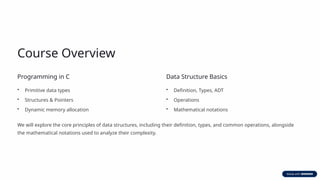
Course Overview
Programming inC
• Primitive data types
• Structures & Pointers
• Dynamic memory allocation
Data Structure Basics
• Definition, Types, ADT
• Operations
• Mathematical notations
We will explore the core principles of data structures, including their definition, types, and common operations, alongside
the mathematical notations used to analyze their complexity.
3.
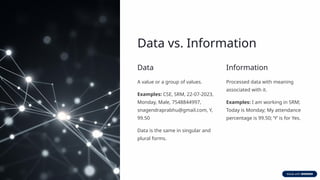
Data vs. Information
Data
Avalue or a group of values.
Examples: CSE, SRM, 22-07-2023,
Monday, Male, 7548844997,
snagendraprabhu@gmail.com, Y,
99.50
Data is the same in singular and
plural forms.
Information
Processed data with meaning
associated with it.
Examples: I am working in SRM;
Today is Monday; My attendance
percentage is 99.50; ‘Y’ is for Yes.
4.
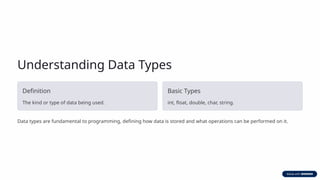
Understanding Data Types
Definition
Thekind or type of data being used.
Basic Types
int, float, double, char, string.
Data types are fundamental to programming, defining how data is stored and what operations can be performed on it.
5.
What is aData Structure?
A data structure is a group of data elements put together under one name, defining a particular way of storing and
organizing data in a computer so that it can be used efficiently.
6.
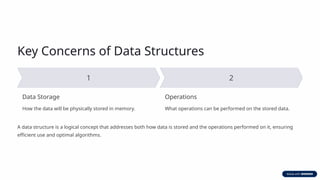
Key Concerns ofData Structures
Data Storage
How the data will be physically stored in memory.
Operations
What operations can be performed on the stored data.
A data structure is a logical concept that addresses both how data is stored and the operations performed on it, ensuring
efficient use and optimal algorithms.
7.
Applications of DataStructures
Compiler Design
Efficient parsing and code generation.
Operating Systems
Process scheduling and memory management.
Statistical Analysis
Organizing and processing large datasets.
DBMS
Storing and retrieving data efficiently.
8.
Further Applications
Numerical Analysis
Solvingcomplex mathematical problems.
Artificial Intelligence
Knowledge representation and problem-solving.
Simulation
Modeling real-world systems.
Graphics
Rendering and manipulating visual data.
9.
Types of DataStructures
Data structures are broadly categorized into linear and non-linear types,
each suited for different organizational needs and computational tasks.
10.
Key Takeaways &Next Steps
• Data structures are essential for efficient data storage and manipulation.
• They are foundational to various computing applications.
• Understanding complexity (Big O) is crucial for performance.
Next, we will delve into specific data structure types and their practical implementations.