eTwinning Project: “Let me tell you about my country”.  Escola El Brot (Spain)
Legend and tradition: The legend of Sant Jordi and the dragon (1) According to popular tradition, Sant Jordi was a Roman soldier and was born in the 3rd century in Capadocia in Turkey. This Saint, who was under the orders of the emperor Diocletian, refused to carry out the emperor's edict to persecute all Christians and for this reason he was martyred and decapitated by his companions. In the eastern part of the Roman Empire, he soon became venerated as a martyr and shortly after this, fantastic stories related to him began to appear. The exploits of Sant Jordi and the Dragon became popular throughout Europe around the 9th century under the name of "Golden legend" and were compiled by the archbishop of Genoa, Iacopo da Varazze, in 1264, in the book 'Legenda sanctorum '. In this version, however, the exploits took place in Libya.
Legend and tradition: The legend of Sant Jordi and the dragon (2) The most popular legend in Catalonia about Sant Jordi tells that at Montblanc, in Conca de Barberà, there was a terrible dragon which viciously attacked men and beasts. To pacify it, lots were drawn and a person was chosen to be given as a sacrifice to the monster. One day, the misfortune fell on the king's daughter, who would have died in the beast's claws if it had not been for the arrival of a handsome knight who challenged the dragon and killed it. This same legend, although with slight variations, is told as a popular legend in England, Portugal and Greece.
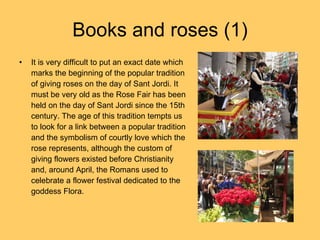
Books and roses (1) It is very difficult to put an exact date which marks the beginning of the popular tradition of giving roses on the day of Sant Jordi. It must be very old as the Rose Fair has been held on the day of Sant Jordi since the 15th century. The age of this tradition tempts us to look for a link between a popular tradition and the symbolism of courtly love which the rose represents, although the custom of giving flowers existed before Christianity and, around April, the Romans used to celebrate a flower festival dedicated to the goddess Flora.
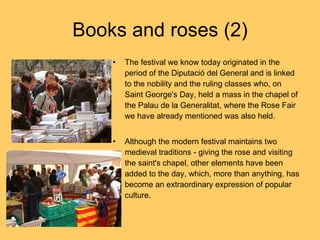
The festival we know today originated in the period of the Diputació del General and is linked to the nobility and the ruling classes who, on Saint George's Day, held a mass in the chapel of the Palau de la Generalitat, where the Rose Fair we have already mentioned was also held. Although the modern festival maintains two medieval traditions - giving the rose and visiting the saint's chapel, other elements have been added to the day, which, more than anything, has become an extraordinary expression of popular culture. Books and roses (2)

St Jordi (23 d'abril)

  • 1.
    eTwinning Project: “Letme tell you about my country”. Escola El Brot (Spain)
  • 2.
    Legend and tradition:The legend of Sant Jordi and the dragon (1) According to popular tradition, Sant Jordi was a Roman soldier and was born in the 3rd century in Capadocia in Turkey. This Saint, who was under the orders of the emperor Diocletian, refused to carry out the emperor's edict to persecute all Christians and for this reason he was martyred and decapitated by his companions. In the eastern part of the Roman Empire, he soon became venerated as a martyr and shortly after this, fantastic stories related to him began to appear. The exploits of Sant Jordi and the Dragon became popular throughout Europe around the 9th century under the name of "Golden legend" and were compiled by the archbishop of Genoa, Iacopo da Varazze, in 1264, in the book 'Legenda sanctorum '. In this version, however, the exploits took place in Libya.
  • 3.
    Legend and tradition:The legend of Sant Jordi and the dragon (2) The most popular legend in Catalonia about Sant Jordi tells that at Montblanc, in Conca de Barberà, there was a terrible dragon which viciously attacked men and beasts. To pacify it, lots were drawn and a person was chosen to be given as a sacrifice to the monster. One day, the misfortune fell on the king's daughter, who would have died in the beast's claws if it had not been for the arrival of a handsome knight who challenged the dragon and killed it. This same legend, although with slight variations, is told as a popular legend in England, Portugal and Greece.
  • 4.
    Books and roses(1) It is very difficult to put an exact date which marks the beginning of the popular tradition of giving roses on the day of Sant Jordi. It must be very old as the Rose Fair has been held on the day of Sant Jordi since the 15th century. The age of this tradition tempts us to look for a link between a popular tradition and the symbolism of courtly love which the rose represents, although the custom of giving flowers existed before Christianity and, around April, the Romans used to celebrate a flower festival dedicated to the goddess Flora.
  • 5.
    The festival weknow today originated in the period of the Diputació del General and is linked to the nobility and the ruling classes who, on Saint George's Day, held a mass in the chapel of the Palau de la Generalitat, where the Rose Fair we have already mentioned was also held. Although the modern festival maintains two medieval traditions - giving the rose and visiting the saint's chapel, other elements have been added to the day, which, more than anything, has become an extraordinary expression of popular culture. Books and roses (2)