Maltese Folklore What is folklore? The term "folklore" was first coined by W.J. Thomas in 1846 to refer to the ballads, folktales and customs of the rural past.
Nowadays "folklore" is taken to refer to the everyday culture and cultural traditions of all social groups - young as well as old, urban as well as rural, ourselves as well as others.  Maltese Folklore
Folklore is now accepted as being concerned with the lore of man and of all his numerous activities: accounts of the houses people lived in, the dress they wore, the food they ate, their social dealings with one another, their education and religious life, their festivals and amusements, births, marriages and deaths, together with beliefs in the afterworld, as well as innumerable other facets of human life, have been brought within the sphere of Folklore. Maltese Folklore
Maltese folklore preserves the soul of the past, embodying the ways of thought, the mode of life and the moral code of preceding centuries. This national heritage of lore and traditions is the product of simple, psychological reaction to the historical environments and to the various culture-contacts which our people have experienced in the past  Maltese Folklore
Maltese Folklore
This is what Maltese folklore is all about, exploring the history, literature, folktales, old wives tales, children's rhymes and games, traditional medicine, nicknames, birth and death rituals, feasts, and old customs from Malta and Gozo.   Maltese Folklore
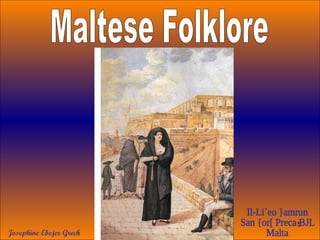
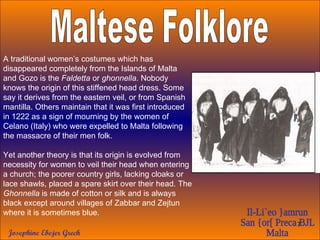
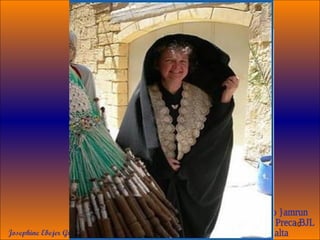
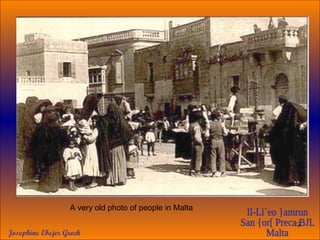
Maltese Folklore A traditional women’s costumes which has disappeared completely from the Islands of Malta and Gozo is the  Faldetta  or  ghonnella . Nobody knows the origin of this stiffened head dress. Some say it derives from the eastern veil, or from Spanish mantilla. Others maintain that it was first introduced in 1222 as a sign of mourning by the women of Celano (Italy) who were expelled to Malta following the massacre of their men folk.  Yet another theory is that its origin is evolved from necessity for women to veil their head when entering a church; the poorer country girls, lacking cloaks or lace shawls, placed a spare skirt over their head. The  Ghonnella  is made of cotton or silk and is always black except around villages of Zabbar and Zejtun where it is sometimes blue.
Maltese folklore incorporates fables, legends, proverbs, traditional songs (ghana), folk dance, music, games, feasts, entertainment, traditions, habits, old trades, traditional buildings such as farms, giren and rubble walls (hajt tas-sejjieh). In a few words, the Maltese folklore is the way Maltese used to live their lives and what makes our life as it is. Maltese Folklore
 
 
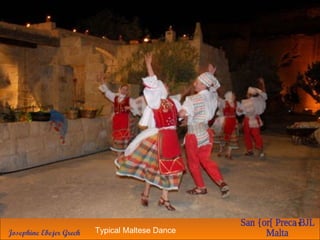
Typical Maltese Dance
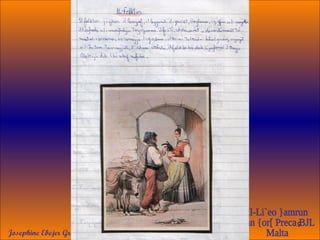
A very old photo of people in Malta
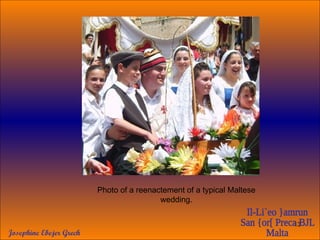
Photo of a reenactement of a typical Maltese wedding.

Maltese Folklore

  • 1.
    Maltese Folklore Whatis folklore? The term "folklore" was first coined by W.J. Thomas in 1846 to refer to the ballads, folktales and customs of the rural past.
  • 2.
    Nowadays "folklore" istaken to refer to the everyday culture and cultural traditions of all social groups - young as well as old, urban as well as rural, ourselves as well as others. Maltese Folklore
  • 3.
    Folklore is nowaccepted as being concerned with the lore of man and of all his numerous activities: accounts of the houses people lived in, the dress they wore, the food they ate, their social dealings with one another, their education and religious life, their festivals and amusements, births, marriages and deaths, together with beliefs in the afterworld, as well as innumerable other facets of human life, have been brought within the sphere of Folklore. Maltese Folklore
  • 4.
    Maltese folklore preservesthe soul of the past, embodying the ways of thought, the mode of life and the moral code of preceding centuries. This national heritage of lore and traditions is the product of simple, psychological reaction to the historical environments and to the various culture-contacts which our people have experienced in the past Maltese Folklore
  • 5.
  • 6.
    This is whatMaltese folklore is all about, exploring the history, literature, folktales, old wives tales, children's rhymes and games, traditional medicine, nicknames, birth and death rituals, feasts, and old customs from Malta and Gozo. Maltese Folklore
  • 7.
    Maltese Folklore Atraditional women’s costumes which has disappeared completely from the Islands of Malta and Gozo is the Faldetta or ghonnella . Nobody knows the origin of this stiffened head dress. Some say it derives from the eastern veil, or from Spanish mantilla. Others maintain that it was first introduced in 1222 as a sign of mourning by the women of Celano (Italy) who were expelled to Malta following the massacre of their men folk. Yet another theory is that its origin is evolved from necessity for women to veil their head when entering a church; the poorer country girls, lacking cloaks or lace shawls, placed a spare skirt over their head. The Ghonnella is made of cotton or silk and is always black except around villages of Zabbar and Zejtun where it is sometimes blue.
  • 8.
    Maltese folklore incorporatesfables, legends, proverbs, traditional songs (ghana), folk dance, music, games, feasts, entertainment, traditions, habits, old trades, traditional buildings such as farms, giren and rubble walls (hajt tas-sejjieh). In a few words, the Maltese folklore is the way Maltese used to live their lives and what makes our life as it is. Maltese Folklore
  • 9.
  • 10.
  • 11.
  • 12.
    A very oldphoto of people in Malta
  • 13.
    Photo of areenactement of a typical Maltese wedding.