OnTheGo Racing-Placement
Hamish Wise – u3036809
National Institute of Sport Studies, Faculty of Health, University of Canberra and OnTheGo Racing
Coaching@onthegosports.com.au

Introduction

Training Programs

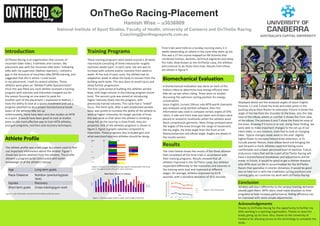
OnTheGo Racing is an organisation that consists of
mountain biker riders, triathletes and runners. My
placement was with the mountain bike team. Following
talks with my supervisor (Nathan Spencer), I noticed a
gap in the structure of mountain bike (MTB) training, and
suggested that this is where I could assist.
In my placement, I took on several athletes. These
athletes were given an “Athlete Profile Questionnaire”.
Once this was filled out, each athlete received a training
program with volumes and intensities mapped out for
the season focusing on one event to peak for.
Another part of the placement, I explained to Nathan, I
have the ability to look at a sports movement and use a
program (dartfish) to do a proper biomechanical break
down of the athletes bike set up.
Unfortunately, there have been very few studies on MTB
as a sport. It would have been great to look at studies
done on the most effective way to train MTB athletes,
and gym programs, nutrition and recovery techniques.

These training programs were based around a 20 week
macrocycle consisting of three mesocycles roughly
six/seven weeks each. In each cycle, the aim was to
increase both volume and/or intensity from week to
week. At the end of each cycle, the athlete had an
adaptation week to allow the body to recover from the
building work loads. This was done to avoid injury and
allow further progression.
The first cycle aimed at building the athletes aerobic
base, with large volume in the training program (more
kms). The second cycle was aimed at introducing
higher intensity levels into the program, with
previously trained volumes. This cycle had a “mixed”
focus. The third cycle, after a well established aerobic
base, was purely to increase the ability of the athlete to
work at higher intensities for longer periods of time,
this was done so that when the athlete is climbing a
steep hill, or the race has a close finish, they are
prepared. One of the athletes programs is shown in
figure 2, figure 3 graphs volumes compared to
intensities. These programs also included gym and
what exercises/reps/sets athletes should be doing.

Age
Race Distance

Injuries
Short term goals

Long term goals
Nutrition (pre/during/post
race)
Recovery
Cross-training/gym work

WEEK

June

CYCLE

1
2
3
4
5
6
7
8
9
10
11
12
13
14
15
16
17
18
19
20

July

August

September

OCTOBER

A biomechanical evaluation was done on each of the
Enduro riders to determine how energy efficient their
bike set up was when riding. There were no studies
discussing the optimum cycling position for energy
conservation.
Jason English, current 24hour solo MTB world champion
was analysed using dartfish software, then this
information was used to compare certain angles of OTG
riders. A side and front view was taken and stickers were
placed on anatomic landmarks whilst the athletes wore
black compression garments. Main things analysed were
the angles of the knee through the range of movement,
the hip angle, the knee angle from the front at full
flexion/extension and elbow angle. Angles are shown in
the results section.

EVENT

Results

TT

AEROBIC FOCUS
INTENSTY FOCUS
MIXED
TAPER
ADAPTATION
Time Trial
Race

TT
ADATION

TT
TT
ADAPTION
TT
TT

WEMBO

Figure 2. Example of an athletes training program showing where time trials
occur. The legend shows what each colour represents.
Week-Week: Volume vs Intensity
10
9

The chart below shows the results of the three athletes
that completed all the time trials in accordance with
their training programs. Results showed that all
athletes improved in the OnTheGo Loop, but athletes
responded differently to the intensities and volumes in
the training work load and improved at different
stages. On average, athletes improved my 67.8
seconds, with a standard deviation of 35.6 seconds.

1

4

2

3

5

6

7

Displayed above are the analysed angles of Jason English.
Pictures 1,2 and 3 show the knee and ankle joints in the
pushing phase from flexion to extension. Picture 4 shows the
angle of the hip from the shoulder to the knee, also the side
view of the elbow, where as number 5 shows the front view
of the elbow. The pictures 6 and 7 show the front-on view of
the knee, showing if it turns in or out. Using these finding, we
were able to make important changes to the set up of our
riders bikes, in one instance, even had to look at changing
bikes. Typical changes made were to the seat: slightly
higher/lower to increase/reduce knee extension, or to
include plantar flexion, more elbow bend and bringing the
seat forward or back. Athletes reported feeling more
comfortable and a lower perceived level of exertion. Future
endurance riders that will be a part of OnTheGo Racing will
have a biomechanical breakdown and adjustments will be
made. In future, it would be good to get a shorter distance
elite MTB racer on file to accommodate for the OnTheGo
Racers that specialise in shorter distances. It would be good
also to help out in with the triathletes cycling positions and
running gaits as I continue my work with OnTheGo Racing .

8
7

Conclusion

56

6
5
4

Volume

3

Intensity

2
1
0

Figure 1: main information sourced from the athlete profile document

Biomechanical Evaluation

1

2

3

4

5

6

7

8

9

10

11

12

13

14

15

16

17

18

19

20

Week

Figure 3. Training program week to week, volume against intensity

Time recorded (minutes: seconds)

The athlete profile was a two page document used to find
out important information about the athlete. Figure 1
shows key points attained from the athletes. The profile
allowed a program to be constructed with better
knowledge of of the athlete’s history.

MONTH

Rating

Athlete Profile

Time trials were held on a Sunday morning every 2-3
weeks (depending on where in the cycle they were up to).
This was a 27 km course mapped on Mt Stromlo that
combined inclines, declines, technical segments and steep
fire trails. Now known as the OnTheGo Loop, the athletes
will continue to do these time trials. Results from these
are shown in figure 4.

55
54
53
52
51

1

50

2

49

3

48
47
46
Jun-30

Jul-14

Aug-04

Aug-18

Date of TT

Sep-01

Sep-15

Figure 4. Time Trial results

Athletes will react differently to the various training demands
placed upon them. MTB riders need more structure to their
programs to help increase performance. Riding efficiency can
be improved with some simple adjustments.

Acknowledgements
Thanks to OnTheGo Racing for the opportunity to further my
skills working in a sporting organisation. Thanks to Jason for
kindly giving up his time. Also, thanks to the University of
Canberra for allowing access to the technology to complete the
study.

CRICOS #00212K

Sss poster

  • 1.
    OnTheGo Racing-Placement Hamish Wise– u3036809 National Institute of Sport Studies, Faculty of Health, University of Canberra and OnTheGo Racing Coaching@onthegosports.com.au Introduction Training Programs OnTheGo Racing is an organisation that consists of mountain biker riders, triathletes and runners. My placement was with the mountain bike team. Following talks with my supervisor (Nathan Spencer), I noticed a gap in the structure of mountain bike (MTB) training, and suggested that this is where I could assist. In my placement, I took on several athletes. These athletes were given an “Athlete Profile Questionnaire”. Once this was filled out, each athlete received a training program with volumes and intensities mapped out for the season focusing on one event to peak for. Another part of the placement, I explained to Nathan, I have the ability to look at a sports movement and use a program (dartfish) to do a proper biomechanical break down of the athletes bike set up. Unfortunately, there have been very few studies on MTB as a sport. It would have been great to look at studies done on the most effective way to train MTB athletes, and gym programs, nutrition and recovery techniques. These training programs were based around a 20 week macrocycle consisting of three mesocycles roughly six/seven weeks each. In each cycle, the aim was to increase both volume and/or intensity from week to week. At the end of each cycle, the athlete had an adaptation week to allow the body to recover from the building work loads. This was done to avoid injury and allow further progression. The first cycle aimed at building the athletes aerobic base, with large volume in the training program (more kms). The second cycle was aimed at introducing higher intensity levels into the program, with previously trained volumes. This cycle had a “mixed” focus. The third cycle, after a well established aerobic base, was purely to increase the ability of the athlete to work at higher intensities for longer periods of time, this was done so that when the athlete is climbing a steep hill, or the race has a close finish, they are prepared. One of the athletes programs is shown in figure 2, figure 3 graphs volumes compared to intensities. These programs also included gym and what exercises/reps/sets athletes should be doing. Age Race Distance Injuries Short term goals Long term goals Nutrition (pre/during/post race) Recovery Cross-training/gym work WEEK June CYCLE 1 2 3 4 5 6 7 8 9 10 11 12 13 14 15 16 17 18 19 20 July August September OCTOBER A biomechanical evaluation was done on each of the Enduro riders to determine how energy efficient their bike set up was when riding. There were no studies discussing the optimum cycling position for energy conservation. Jason English, current 24hour solo MTB world champion was analysed using dartfish software, then this information was used to compare certain angles of OTG riders. A side and front view was taken and stickers were placed on anatomic landmarks whilst the athletes wore black compression garments. Main things analysed were the angles of the knee through the range of movement, the hip angle, the knee angle from the front at full flexion/extension and elbow angle. Angles are shown in the results section. EVENT Results TT AEROBIC FOCUS INTENSTY FOCUS MIXED TAPER ADAPTATION Time Trial Race TT ADATION TT TT ADAPTION TT TT WEMBO Figure 2. Example of an athletes training program showing where time trials occur. The legend shows what each colour represents. Week-Week: Volume vs Intensity 10 9 The chart below shows the results of the three athletes that completed all the time trials in accordance with their training programs. Results showed that all athletes improved in the OnTheGo Loop, but athletes responded differently to the intensities and volumes in the training work load and improved at different stages. On average, athletes improved my 67.8 seconds, with a standard deviation of 35.6 seconds. 1 4 2 3 5 6 7 Displayed above are the analysed angles of Jason English. Pictures 1,2 and 3 show the knee and ankle joints in the pushing phase from flexion to extension. Picture 4 shows the angle of the hip from the shoulder to the knee, also the side view of the elbow, where as number 5 shows the front view of the elbow. The pictures 6 and 7 show the front-on view of the knee, showing if it turns in or out. Using these finding, we were able to make important changes to the set up of our riders bikes, in one instance, even had to look at changing bikes. Typical changes made were to the seat: slightly higher/lower to increase/reduce knee extension, or to include plantar flexion, more elbow bend and bringing the seat forward or back. Athletes reported feeling more comfortable and a lower perceived level of exertion. Future endurance riders that will be a part of OnTheGo Racing will have a biomechanical breakdown and adjustments will be made. In future, it would be good to get a shorter distance elite MTB racer on file to accommodate for the OnTheGo Racers that specialise in shorter distances. It would be good also to help out in with the triathletes cycling positions and running gaits as I continue my work with OnTheGo Racing . 8 7 Conclusion 56 6 5 4 Volume 3 Intensity 2 1 0 Figure 1: main information sourced from the athlete profile document Biomechanical Evaluation 1 2 3 4 5 6 7 8 9 10 11 12 13 14 15 16 17 18 19 20 Week Figure 3. Training program week to week, volume against intensity Time recorded (minutes: seconds) The athlete profile was a two page document used to find out important information about the athlete. Figure 1 shows key points attained from the athletes. The profile allowed a program to be constructed with better knowledge of of the athlete’s history. MONTH Rating Athlete Profile Time trials were held on a Sunday morning every 2-3 weeks (depending on where in the cycle they were up to). This was a 27 km course mapped on Mt Stromlo that combined inclines, declines, technical segments and steep fire trails. Now known as the OnTheGo Loop, the athletes will continue to do these time trials. Results from these are shown in figure 4. 55 54 53 52 51 1 50 2 49 3 48 47 46 Jun-30 Jul-14 Aug-04 Aug-18 Date of TT Sep-01 Sep-15 Figure 4. Time Trial results Athletes will react differently to the various training demands placed upon them. MTB riders need more structure to their programs to help increase performance. Riding efficiency can be improved with some simple adjustments. Acknowledgements Thanks to OnTheGo Racing for the opportunity to further my skills working in a sporting organisation. Thanks to Jason for kindly giving up his time. Also, thanks to the University of Canberra for allowing access to the technology to complete the study. CRICOS #00212K