The Effects of Running Mechanics and Knee Joint Reaction Forces When Running With and Without
Weight
Christopher Bentajado, Daniel Martinez, Michelle Perez, Patrick Skoll
California State University of Long Beach, Long Beach, CA, USA
INTRODUCTION
The act of rucking has no set definition, but at its
most basic level, it is traveling on foot while
carrying weight. It is seen in the military,
recreational backpacking, and endurance events that
have recently become popular in the fitness world.
The word “rucking” has a militaristic connotation to
it, and is most often observed when an individual
hikes with a weighted backpack for several miles, or
when military personnel or outdoorsmen and
women train with a backpack loaded with their gear,
such as medical equipment, water, communication
gear, clothing, and personal items. The ruck itself
can weigh anywhere from featherweight to 100+
lbs. This is an important component of a soldier’s
and other elite athlete’s training regimen as the
original purpose of rucking is to develop the ability
to travel with all of their essentials in case a motor
vehicle is unavailable or impractical in a real life
situation.
The purpose of this experiment is to examine how
joint reaction forces in the knee differ when running
with and without a ruck. It is also worth noting that
the weight of the ruck requires that gait mechanics
change to alleviate stress on the knees. Lower
extremity injuries are a common occurrence as a
consequence of backpack usage (Castro, M., 2013).
We hypothesize that the joint reaction forces at the
knee will increase when running with the ruck by
27.3%, which is the percentage of weight added by
the ruck when compared to the subject’s body
weight.
METHODS
To calculate the joint reaction forces at the knee for
both running and rucking, a sagittal view of both
running and rucking was recorded by a JVC camera
at 60 frames per second and digitized using Logger
Pro software. Ground reaction forces were
measured and recorded using the treadmill with
integrated force plates. Using this data, joint
reaction force for the ankle was calculated, and the
resulting force was used to solve for joint reaction
forces in the knee.
The subject performed a warm up at a comfortable
pace, and then began running at 3.35 meters per
second on the treadmill while wearing “normal”
running attire. The forces and video started and
stopped recording at the same time, to ensure
continuity in the data. After data collection for
running was completed, the test was repeated while
the subject wore the weighted ruck, and moved at
1.79 meters per second.
The clothing and footwear that the subject wore, the
time of movement, the running environment, the
warm up, and the cool down were all the same for
both exercises.
Given the militaristic nature of rucking, we decided
to use velocities and weights that are given as the
standard for the Upper Body Round Robin, which is
a fitness test that is commonly given to Army
Special Forces soldiers. This translates to an 8-
minute per mile (3.35 meters per second) running
pace, and a 15-minute per mile (1.79 meters per
second) rucking pace while carrying a 45 lb (20.43
kg) ruck.
RESULTS AND DISCUSSION
Taking the calculated ground reaction forces (GRF)
at the foot and solving for the joint reaction forces
(JRF), we were given a resultant joint reaction force
at the ankle. This resultant force was then used as
the new ground reaction force when solving for the
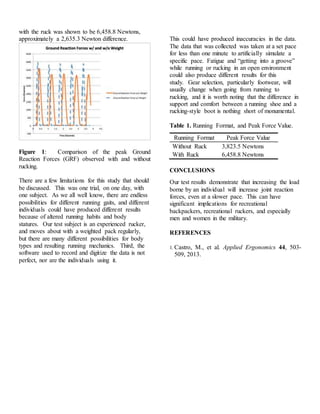
knee joint reaction forces. The calculated peak joint
reaction force at the knee when running without the
ruck was shown to be 3,823.5 Newtons and the
calculated peak joint reaction force when running
with the ruck was shown to be 6,458.8 Newtons,
approximately a 2,635.3 Newton difference.
Figure 1: Comparison of the peak Ground
Reaction Forces (GRF) observed with and without
rucking.
There are a few limitations for this study that should
be discussed. This was one trial, on one day, with
one subject. As we all well know, there are endless
possibilities for different running gaits, and different
individuals could have produced different results
because of altered running habits and body
statures. Our test subject is an experienced rucker,
and moves about with a weighted pack regularly,
but there are many different possibilities for body
types and resulting running mechanics. Third, the
software used to record and digitize the data is not
perfect, nor are the individuals using it.
This could have produced inaccuracies in the data.
The data that was collected was taken at a set pace
for less than one minute to artificially simulate a
specific pace. Fatigue and “getting into a groove”
while running or rucking in an open environment
could also produce different results for this
study. Gear selection, particularly footwear, will
usually change when going from running to
rucking, and it is worth noting that the difference in
support and comfort between a running shoe and a
rucking-style boot is nothing short of monumental.
Table 1. Running Format, and Peak Force Value.
Running Format Peak Force Value
Without Ruck 3,823.5 Newtons
With Ruck 6,458.8 Newtons
CONCLUSIONS
Our test results demonstrate that increasing the load
borne by an individual will increase joint reaction
forces, even at a slower pace. This can have
significant implications for recreational
backpackers, recreational ruckers, and especially
men and women in the military.
REFERENCES
1. Castro, M., et al. Applied Ergonomics 44, 503-
509, 2013.

Final Project Template - FINAL EDIT

  • 1.
    The Effects ofRunning Mechanics and Knee Joint Reaction Forces When Running With and Without Weight Christopher Bentajado, Daniel Martinez, Michelle Perez, Patrick Skoll California State University of Long Beach, Long Beach, CA, USA INTRODUCTION The act of rucking has no set definition, but at its most basic level, it is traveling on foot while carrying weight. It is seen in the military, recreational backpacking, and endurance events that have recently become popular in the fitness world. The word “rucking” has a militaristic connotation to it, and is most often observed when an individual hikes with a weighted backpack for several miles, or when military personnel or outdoorsmen and women train with a backpack loaded with their gear, such as medical equipment, water, communication gear, clothing, and personal items. The ruck itself can weigh anywhere from featherweight to 100+ lbs. This is an important component of a soldier’s and other elite athlete’s training regimen as the original purpose of rucking is to develop the ability to travel with all of their essentials in case a motor vehicle is unavailable or impractical in a real life situation. The purpose of this experiment is to examine how joint reaction forces in the knee differ when running with and without a ruck. It is also worth noting that the weight of the ruck requires that gait mechanics change to alleviate stress on the knees. Lower extremity injuries are a common occurrence as a consequence of backpack usage (Castro, M., 2013). We hypothesize that the joint reaction forces at the knee will increase when running with the ruck by 27.3%, which is the percentage of weight added by the ruck when compared to the subject’s body weight. METHODS To calculate the joint reaction forces at the knee for both running and rucking, a sagittal view of both running and rucking was recorded by a JVC camera at 60 frames per second and digitized using Logger Pro software. Ground reaction forces were measured and recorded using the treadmill with integrated force plates. Using this data, joint reaction force for the ankle was calculated, and the resulting force was used to solve for joint reaction forces in the knee. The subject performed a warm up at a comfortable pace, and then began running at 3.35 meters per second on the treadmill while wearing “normal” running attire. The forces and video started and stopped recording at the same time, to ensure continuity in the data. After data collection for running was completed, the test was repeated while the subject wore the weighted ruck, and moved at 1.79 meters per second. The clothing and footwear that the subject wore, the time of movement, the running environment, the warm up, and the cool down were all the same for both exercises. Given the militaristic nature of rucking, we decided to use velocities and weights that are given as the standard for the Upper Body Round Robin, which is a fitness test that is commonly given to Army Special Forces soldiers. This translates to an 8- minute per mile (3.35 meters per second) running pace, and a 15-minute per mile (1.79 meters per second) rucking pace while carrying a 45 lb (20.43 kg) ruck. RESULTS AND DISCUSSION Taking the calculated ground reaction forces (GRF) at the foot and solving for the joint reaction forces (JRF), we were given a resultant joint reaction force at the ankle. This resultant force was then used as the new ground reaction force when solving for the knee joint reaction forces. The calculated peak joint reaction force at the knee when running without the ruck was shown to be 3,823.5 Newtons and the calculated peak joint reaction force when running
  • 2.
    with the ruckwas shown to be 6,458.8 Newtons, approximately a 2,635.3 Newton difference. Figure 1: Comparison of the peak Ground Reaction Forces (GRF) observed with and without rucking. There are a few limitations for this study that should be discussed. This was one trial, on one day, with one subject. As we all well know, there are endless possibilities for different running gaits, and different individuals could have produced different results because of altered running habits and body statures. Our test subject is an experienced rucker, and moves about with a weighted pack regularly, but there are many different possibilities for body types and resulting running mechanics. Third, the software used to record and digitize the data is not perfect, nor are the individuals using it. This could have produced inaccuracies in the data. The data that was collected was taken at a set pace for less than one minute to artificially simulate a specific pace. Fatigue and “getting into a groove” while running or rucking in an open environment could also produce different results for this study. Gear selection, particularly footwear, will usually change when going from running to rucking, and it is worth noting that the difference in support and comfort between a running shoe and a rucking-style boot is nothing short of monumental. Table 1. Running Format, and Peak Force Value. Running Format Peak Force Value Without Ruck 3,823.5 Newtons With Ruck 6,458.8 Newtons CONCLUSIONS Our test results demonstrate that increasing the load borne by an individual will increase joint reaction forces, even at a slower pace. This can have significant implications for recreational backpackers, recreational ruckers, and especially men and women in the military. REFERENCES 1. Castro, M., et al. Applied Ergonomics 44, 503- 509, 2013.