SOCIAL
LEGISLATION
SOCIAL SECURITY
SYSTEM
RA1161 as amended by RA
8282
DEFINITION OF TERMS
EMPLOYER
Any person natural or juridical,
domestic or foreign, who carries on in
the Philippines, any trade business,
industry undertaking or activity of any
kind and uses the services of another
person who is under his orders as
regards the employment except the
Government and any of its political
subdivisions, branches or
EMPLOYEE
Any person who performs services for
an employer in which either or both
mental and physical efforts are used
and who receives compensation for
such services, where there is an
employer- employee relationship.
SELF-EMPLOYED
 Shall be both the employer and
employee at the same time.
DEPENDENTS
1. The legal spouse entitled by law to
receive support from the member.
2. The legitimate, legitimated or legally
adopted and illegitimate child who is
unmarried, not gainfully employed and
has not reached 21 years of age or if 21
years of age, he is congenitally
incapacitated or while still a minor has
been permanently incapacitated and
incapable of self- support, physically and
mentally, and
COMPENSATION
 All actual remuneration for
employment, including the mandated
cost-of-living allowance, as well as
the cash value of any remuneration
paid in any medium other than cash
except that part of the remuneration
in excess of the maximum salary
credit.
EMPLOYMENT
 Any service performed by an
BENEFICIARIES
 The dependent spouse until he or she
remarries, the dependent legitimate,
legitimated or legally adopted and
illegitimate children who shall be the
primary beneficiaries of the member;
a.) PROVIDED that the dependent
illegitimate children shall be entitled to
50% of the share of the legitimate,
legitimated or legally adopted children.
b.) PROVIDED FURTHER in the absence
of the legitimated, legally adopted or
c.)IN THEIR ABSENCE, the
dependent parents who shall be
the secondary beneficiaries.
d.) IN THE ABSENCE OF ALL of
the foregoing, any person
designated by the covered
employee as secondary
beneficiary.
CONTINGENCY
COVERAGE
 A. COMPULSORY (Sec. 9)
1. All employees not over 60 years of
age and their employers;
2. Domestic helpers with monthly
income of not less than one
thousand pesos (1,000.00) a month;
Limitation:
a.)Any benefit earned by the employees
under private benefit plans existing at
the time of the approval of the Act shall
b.) Such private plans shall be
integrated with the SSS but if the
employer under such plan is
contributing more than what is
required by this Act, he shall pay
to the SSS the amount required to
him, and he shall continue with his
contributions less the amount paid
to SSS;
c.)Any changes, adjustments,
modifications, eliminations or
d.) The private benefit plan which
the employer shall continue for
his employees shall remain under
the employer’s management and
control unless there is an existing
agreement to the contrary.
3.) Upon such self- employed persons as
may be determined by the Commission
including but not limited to the following
(Sec. 9-A): (APAPI)
1.All self employed professionals;
2.Partners and single proprietors;
3.Actors and actresses directors,
scriptwriters and news correspondents
who do not fall within the definition of
the term employee in Section 8 (d) of
this Act;
4.Professional athletes, coaches,
B. VOLUNTARY
1. Spouses who devote full time to
managing the household and family
affairs.
2. Filipinos employed abroad
recruited by foreign-based employers.
3. Persons separated from
employment to maintain his right to
full benefits (Sec. 11).
4. Self-employed, who realizes no
C. BY AGREEMENT [Sec. 8 (j)
(4)]
Any foreign government,
international organization, or their
wholly-owned instrumentality
employing workers in the
Philippines, may enter into an
agreement with the Philippine
government for the inclusion of
such employees in the SSS
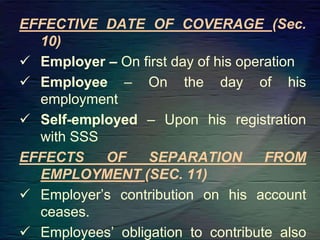
EFFECTIVE DATE OF COVERAGE (Sec.
10)
 Employer – On first day of his operation
 Employee – On the day of his
employment
 Self-employed – Upon his registration
with SSS
EFFECTS OF SEPARATION FROM
EMPLOYMENT (SEC. 11)
 Employer’s contribution on his account
ceases.
 Employees’ obligation to contribute also
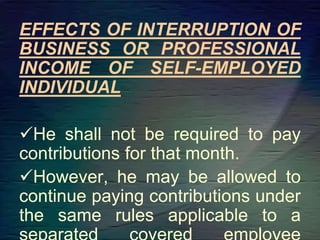
EFFECTS OF INTERRUPTION OF
BUSINESS OR PROFESSIONAL
INCOME OF SELF-EMPLOYED
INDIVIDUAL
He shall not be required to pay
contributions for that month.
However, he may be allowed to
continue paying contributions under
the same rules applicable to a
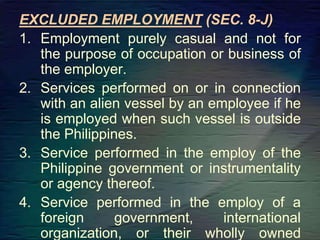
EXCLUDED EMPLOYMENT (SEC. 8-J)
1. Employment purely casual and not for
the purpose of occupation or business of
the employer.
2. Services performed on or in connection
with an alien vessel by an employee if he
is employed when such vessel is outside
the Philippines.
3. Service performed in the employ of the
Philippine government or instrumentality
or agency thereof.
4. Service performed in the employ of a
foreign government, international
organization, or their wholly owned
BENEFITS
1. MONTHLY PENSION (Sec. 12)
A.] Monthly pension shall be the highest of
the following:
 P300.00 plus
20% of Ave. monthly salary credit plus
2% of Ave. monthly salary credit for
each credited year of service in
excess of 10 years.
 40% of monthly salary credit
 P1, 000.00, provided that the monthly
B.]For members with at least 10 years
credited service, the minimum
pension shall be P1, 200.00.
C.]For members with at least 20 years
credited service, the minimum
pension shall be P2, 400.00.
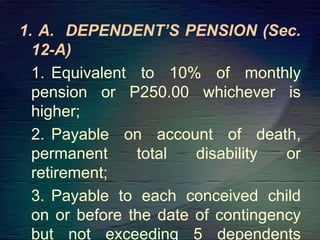
1. A. DEPENDENT’S PENSION (Sec.
12-A)
1. Equivalent to 10% of monthly
pension or P250.00 whichever is
higher;
2. Payable on account of death,
permanent total disability or
retirement;
3. Payable to each conceived child
on or before the date of contingency
but not exceeding 5 dependents
1. B. RETIREMENT BENEFITS (Sec.
12-B)
1.) A member who has paid at least 120
monthly contributions prior to the
semester of retirement shall be
entitled to MONTHLY PENSION AS
LONG AS HE LIVES, provided that:
a.) He has reached the age of 60
years and is already separated from
employment or has ceased to be self-
employed; or
b.) He has reached the age of 65
years.
2.)A covered member who is 60
years old but was not able to
contribute at least 120 monthly
contribution prior to the semester
of his retirement shall still be
entitled to a lump sum benefit
equal to the total contribution
paid by him and on his behalf,
PROVIDED, he is separated
from employment and is not
UPON DEATH OF RETIRED MEMBER
[Sec. 12-B (d)]
1.] His primary beneficiaries as of the date
of his retirement shall be entitled to
receive the monthly pension.
2.] If he has no primary beneficiaries and he
dies within 60 months from the start of
his monthly pension secondary
beneficiaries shall be entitled to a lump
sum benefit equivalent to the total
monthly pensions corresponding to the
balance of the five-year guaranteed
period, excluding the dependents’
pension.
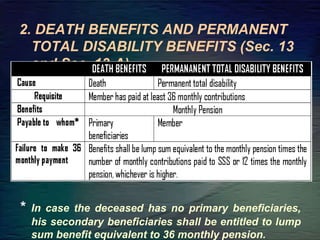
2. DEATH BENEFITS AND PERMANENT
TOTAL DISABILITY BENEFITS (Sec. 13
and Sec. 13-A)
* In case the deceased has no primary beneficiaries,
his secondary beneficiaries shall be entitled to lump
sum benefit equivalent to 36 monthly pension.
DEATH OF PERMANENT TOTAL
DISABILITY
PENSIONER
1.] His primary beneficiaries shall be
entitled to the monthly pension; or
2.] If he has no primary beneficiaries
and he dies within sixty (60) months
from the start of his monthly
pension, his secondary beneficiaries
shall be entitled to a lump sum
benefit equivalent to the total
THE FOLLOWING ARE DEEMED
PERMANENT DISABILITY
 Complete loss of sight of both eyes;
 Loss of two limbs at or above the ankle
or wrists;
 Permanent complete paralysis of two
limbs;
 Brain injury resulting to incurable
imbecility or insanity; and
 Such cases as determined and approved
by the SSS.
3. FUNERAL BENEFIT (Sec. 13-B)
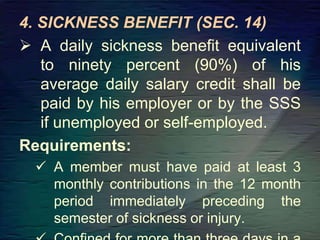
4. SICKNESS BENEFIT (SEC. 14)
 A daily sickness benefit equivalent
to ninety percent (90%) of his
average daily salary credit shall be
paid by his employer or by the SSS
if unemployed or self-employed.
Requirements:
 A member must have paid at least 3
monthly contributions in the 12 month
period immediately preceding the
semester of sickness or injury.
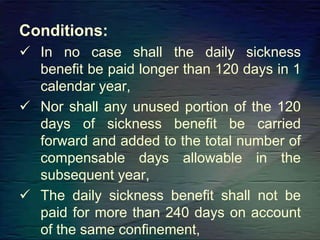
Conditions:
 In no case shall the daily sickness
benefit be paid longer than 120 days in 1
calendar year,
 Nor shall any unused portion of the 120
days of sickness benefit be carried
forward and added to the total number of
compensable days allowable in the
subsequent year,
 The daily sickness benefit shall not be
paid for more than 240 days on account
of the same confinement,
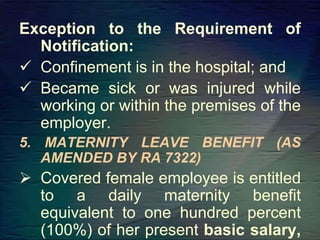
Exception to the Requirement of
Notification:
 Confinement is in the hospital; and
 Became sick or was injured while
working or within the premises of the
employer.
5. MATERNITY LEAVE BENEFIT (AS
AMENDED BY RA 7322)
 Covered female employee is entitled
to a daily maternity benefit
equivalent to one hundred percent
(100%) of her present basic salary,
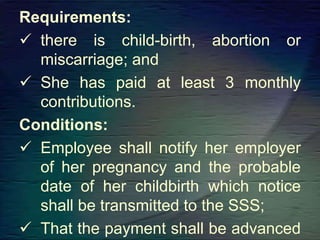
Requirements:
 there is child-birth, abortion or
miscarriage; and
 She has paid at least 3 monthly
contributions.
Conditions:
 Employee shall notify her employer
of her pregnancy and the probable
date of her childbirth which notice
shall be transmitted to the SSS;
 That the payment shall be advanced
 That payment of daily maternity
benefits shall be a bar to the recovery
of sickness benefits for the same
compensable period of 60 days for the
same childbirth, abortion, or
miscarriage;
 That the maternity benefits provided
under this Section shall be paid only
for the first 4 deliveries after March
13, 1973;
 That the SSS shall immediately
reimburse the employer of one
 That if an employee should give
birth or suffer abortion or
miscarriage without the required
contributions having been remitted
for her by her employer to the SSS,
or without the latter having been
previously notified by the employer
of the time of the pregnancy, the
employer shall pay to the SSS
damages equivalent to the benefits
which said employee would
5. LOAN
Salary loan, educational loan,
housing loan and community hospital
loan.
Reserve Fund - All revenues of SSS
accumulated in a fund not needed to
meet the current administrative and
operational expenses incidental to the
carrying out of this Act.
Investment Reserve Fund - Such
portions of the Reserve Fund as are
The Commission through such
Funds may:
1. Finance housing loans of members;
2. Long-term direct individual or group
housing loans giving priority to the
low-income groups, up to a
maximum of 90% of the appraised
value of the properties to be
mortgaged by the borrowers; and
3. In short and medium term loans to
members such as salary,
NON-TRANSFERABILITY OF
BENEFITS (Sec. 15)
Such benefits are not transferable
and no power of attorney or other
document executed by those
entitled thereto, in favor of any
agent, attorney or any other
person for the collection thereof
on their behalf shall be
recognized, except when they are
EXEMPTION FROM TAX, LEGAL
PROCESS AND LIEN
1. The SSS and all its assets and properties,
all contributions collected and all accruals
thereto and income or investment
earnings therefrom as well as all supplies,
equipment, papers or documents shall be
exempt from any tax, assessment, fee,
charge, or customs or import duty.
2. All benefit payments made by the SSS
shall likewise be exempt from all kinds of
taxes, fees or charges, and shall not liable
to attachments, garnishments, levy or
REMITTANCE OF
CONTRIBUTIONS
 The contributions imposed under
this Act shall be remitted to the SSS
within the first 10 days of each
calendar month following the month
for which they are applicable or
within such time as the Commission
may prescribe.
 Self-employed members shall
REMEDIES FOR FAILURE TO PAY
REQUIRED CONTRIBUTION
1. It shall be collected by the SSS in the same
manner as taxes are made collectible under
the National Internal Revenue Code.
2. By an action in court, which shall hear and
dispose of the case in preference to any
other civil action.
3. By issuing a warrant to the Sheriff of any
province or city commanding him to levy
upon and sell any real and personal
property of the debtor. The Sheriff’s sale by
virtue of said warrant shall be governed by
DUTIES OF THE EMPLOYER
1. To pay employer’s contribution in
accordance with the schedule provided in
this Act;
2. To deduct and to remit employees’
contributions;
3. To immediately report to the SSS the
names, ages, civil status, occupations,
salaries and dependents of all his
employees who are subject to compulsory
coverage;
4. To keep true and accurate work records for
such period and containing such
information as the Commission may
prescribe;
6. To notify the SSS of the confinement
within five (5) calendar days after receipt
of the notification from the employee
member;
7. To advance into two equal monthly
installments the maternity leave benefits
within 30 days from the filing of the
maternity leave application.
LIABILITIES OF EMPLOYERS
1. The employer shall pay to the SSS
damages equivalent to the benefits, which
said employee member would otherwise
have been entitled to, for his failure to
remit the required contributions;
3. To pay to the SSS damages equivalent to the
benefits to which said employee member
would have been entitled had his name been
reported on time by the employer to the SSS
for failure top report matters required upon
him to report to the SSS;
4. To pay to the SSS damages equivalent to the
difference between the amount of benefit to
which the employee member or his
beneficiary is entitled had the proper
contributions been remitted to the SSS and
the amount payable on the basis of
contributions actually remitted for
misrepresentation of the true date of
NOTE: The right of the employee to
institute the necessary action against
the employer who refuses or neglects
to remit contributions may be
commenced within twenty (20) years
from the time the delinquency is
known or the assessment is made by
the SSS, or from the time the benefit
accrues, as the case may be. The
prescriptive period does not
commence when the obligation to pay
SETTLEMENT OF DISPUTES (Sec. 5)
JURISDICTION: Social Security
Commission
CASES COVERED: Any dispute
arising under this act
with respect to:
• 1. Coverage
• 2. Benefits
• 3. Contributions
• 4. Penalty
PROCEDURE:
1. Filing, determination and settlement of
disputes shall be governed by the rules
and regulations promulgated by the
Commission.
2. Shall be heard by:
a) The Commission; or
b) Any of its members; or
c) Hearing officers duly authorized by the
Commission
3. Shall be decided within 20 days after the
submission of evidence.
JUDICIAL REVIEW
1. Permitted only when all administrative
remedy has been exhausted.
2. Court of Appeals has jurisdiction to
review decisions both on questions of
facts and law but if only questions of
law are involved, Supreme Court has
the jurisdiction.
3. Commission is deemed to be a party.
4. Heard in summary manner.
5. Take precedence over any cases
GOVERNMENT
SERVICE
INSURANCE
SYSTEM LAW
RA 8291
COVERAGE
 Compulsory upon all employees
receiving compensation who have
not reached the compulsory
retirement age irrespective of
employment status.
EXCEPTIONS TO THE
COMPULSORY COVERAGE
1. Members of the Armed Forces of
the Philippines;
COMPUTATION OF SERVICE
Computed from the date of
original appointment/election
including period of service at
different times under one or more
employer, those performed
overseas under the authority of
the Republic of the Philippines,
and those that may be prescribed
DEFINITION OF TERMS
EMPLOYER
The national government, its political
subdivisions, branches, agencies or
instrumentalities including GOCC’s
and financial institutions with original
charters, the constitutional
commissions and the judiciary.
EMPLOYEE OR MEMBER
Any person receiving compensation
while in the service of an employer
DEPENDENTS
1. The legitimate spouse dependent for
support upon the member or pensioner.
2. The legitimate, legitimated legally adopted
child, including the illegitimate child who
is:
 unmarried,
 not gainfully employed,
 not over the age of majority,
 or is over the age of majority but
incapacitated and incapable of self-
support due to a mental or physical
defect acquired prior to age of majority.
PRIMARY BENEFICIARY
The legal dependent spouse until he/she
remarries and the dependent children.
SECONDARY BENEFICIARY
The dependent parents and subject to the
restrictions on dependent children, the
legitimate descendants.
COMPENSATION
The basic pay or salary received by an
employee, pursuant to his
election/appointment, excluding per diems,
bonuses, overtime pay, honoraria,
DISABILITY
Any loss or impairment of the normal
functions of the physical and/or mental faculty
of a member which reduces or eliminates
his/her capacity to continue with his/her
current gainful occupation or engage in any
other gainful occupation.
TOTAL DISABILITY
Complete incapacity to continue with his
present employment or engage in any gainful
occupation due to the loss or impairment of
the normal functions of the physical and/or
mental faculties of the member.
PERMANENT TOTAL DISABILITY
TEMPORARY TOTAL DISABILITY
Accrues or arises when impaired
physical and/or mental faculties can
be rehabilitated and/or restored to
their normal functions.
PERMANENT PARTIAL DISABILITY
Accrues or arises upon the
irrevocable loss or impairment of
certain portion/s of the physical
faculties, despite which the member
is able to pursue a gainful occupation.
BENEFITS
General Rule – all members of the
GSIS shall have life insurance,
retirement, and all other social
security protections such as
disability, survivorship,
separation, and unemployment
benefits.
Exception – Members of the
judiciary and the constitutional
1. MONTHLY PENSIONS (Sec. 9)
a) 37.5% of the revalued average
monthly compensation; plus
b) 2.5% of said revalued average
monthly compensation for each
year of service in excess of 15
years: Provided, that the basic
monthly pension shall not
exceed 90% of the average
monthly compensation.
2. SEPARATION BENEFITS (Sec.
11)
1. Cash payment equivalent to 100%
of average monthly compensation
for each year of service he paid
contributions but not less than P12,
000.00.
Conditions:
– Payable upon reaching the age of
60;
Or
2. Cash payment equivalent to 18
times his basic monthly pension
at the time of resignation or
separation, plus an old age
pension benefit equal to basic
monthly pension.
Conditions:
 Payable monthly upon reaching
the age of 60;
3.
UNEMPLOYMENT/INVOLUNTARY
SEPARATION BENEFITS (Sec. 12)
 Monthly cash payments of
equivalent to 50% of the average
monthly compensation.
Conditions:
 Employee is separated from service
due to the abolition of his office or
position.
4. RETIREMENT BENEFITS (Sec.
13)
1. Lump sum payment, payable
upon retirement plus an old-age
pension benefit payable monthly
for life, upon expiration of the 5
year guaranteed period covered
by the lump sum; or
2. Cash payment equivalent to 18
moths of his basic monthly
Conditions:
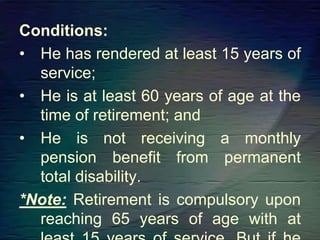
• He has rendered at least 15 years of
service;
• He is at least 60 years of age at the
time of retirement; and
• He is not receiving a monthly
pension benefit from permanent
total disability.
*Note: Retirement is compulsory upon
reaching 65 years of age with at
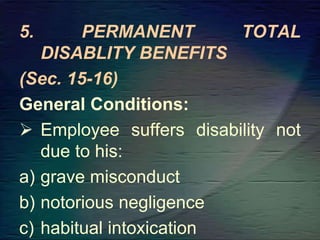
5. PERMANENT TOTAL
DISABLITY BENEFITS
(Sec. 15-16)
General Conditions:
 Employee suffers disability not
due to his:
a) grave misconduct
b) notorious negligence
c) habitual intoxication
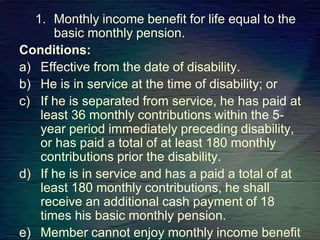
1. Monthly income benefit for life equal to the
basic monthly pension.
Conditions:
a) Effective from the date of disability.
b) He is in service at the time of disability; or
c) If he is separated from service, he has paid at
least 36 monthly contributions within the 5-
year period immediately preceding disability,
or has paid a total of at least 180 monthly
contributions prior the disability.
d) If he is in service and has a paid a total of at
least 180 monthly contributions, he shall
receive an additional cash payment of 18
times his basic monthly pension.
e) Member cannot enjoy monthly income benefit
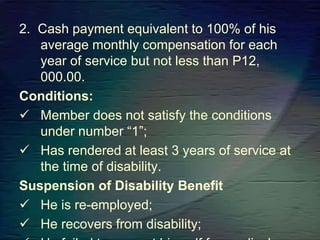
2. Cash payment equivalent to 100% of his
average monthly compensation for each
year of service but not less than P12,
000.00.
Conditions:
 Member does not satisfy the conditions
under number “1”;
 Has rendered at least 3 years of service at
the time of disability.
Suspension of Disability Benefit
 He is re-employed;
 He recovers from disability;
6. PERMANENT PARTIAL DISABILILTY
BENEFITS (Sec. 17)
Cash payment in accordance with the
scheduled prescribed by the GSIS.
Condition:
• Employee satisfies either of the two
conditions under permanent total
disability.
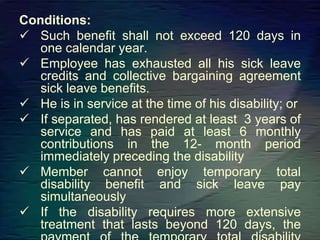
7. TEMPORARY TOTAL DISABILITY
BENEFITS (Sec. 18)
75% of the current daily compensation
Conditions:
 Such benefit shall not exceed 120 days in
one calendar year.
 Employee has exhausted all his sick leave
credits and collective bargaining agreement
sick leave benefits.
 He is in service at the time of his disability; or
 If separated, has rendered at least 3 years of
service and has paid at least 6 monthly
contributions in the 12- month period
immediately preceding the disability
 Member cannot enjoy temporary total
disability benefit and sick leave pay
simultaneously
 If the disability requires more extensive
treatment that lasts beyond 120 days, the
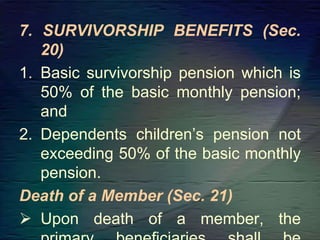
7. SURVIVORSHIP BENEFITS (Sec.
20)
1. Basic survivorship pension which is
50% of the basic monthly pension;
and
2. Dependents children’s pension not
exceeding 50% of the basic monthly
pension.
Death of a Member (Sec. 21)
 Upon death of a member, the
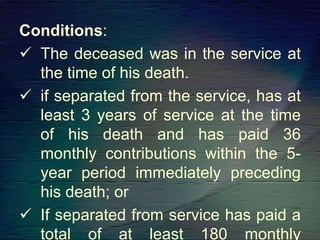
Conditions:
 The deceased was in the service at
the time of his death.
 if separated from the service, has at
least 3 years of service at the time
of his death and has paid 36
monthly contributions within the 5-
year period immediately preceding
his death; or
 If separated from service has paid a
total of at least 180 monthly
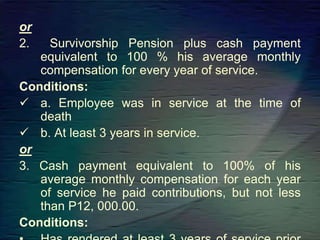
or
2. Survivorship Pension plus cash payment
equivalent to 100 % his average monthly
compensation for every year of service.
Conditions:
 a. Employee was in service at the time of
death
 b. At least 3 years in service.
or
3. Cash payment equivalent to 100% of his
average monthly compensation for each year
of service he paid contributions, but not less
than P12, 000.00.
Conditions:
*NOTE: If no primary beneficiaries,
secondary beneficiaries are
entitled to:
–Cash payment 100% of his average
monthly compensation for each
year of service he paid
contributions, but not less than
P12,000.00, provided that the
member is in the service at the time
of his death and has at least 3
years of service;
9. FUNERAL BENEFITS (Sec. 23)
 In an amount fixed by the GSIS rules and
regulations but should not be less than
P12,000.00, to be increased to at least
18,000.00 after 5 years, payable upon
the death of:
a) An active member;
b) A member who has been separated from
the service, but who may be entitled to
future benefit;
c) A pensioner;
d) A retiree who at the time of his retirement
10. LIFE INSURANCE BENEFITS (Sec. 24)
Compulsory upon all employees except
members of the AFP and the PNP.
11. LOAN GRANT (Sec. 36)
GSIS funds maybe invested:
a.) In direct housing loans to members and
group housing projects secured by first
mortgage, giving priority to the low income
groups.
b. In short and medium term loans to
members such as salary, policy,
educational, emergency stock purchase
ADJUDICATION OF CLAIMS AND
DISPUTES
Prescription of Claims (Sec. 28)
4 years from date of contingency except
life and retirement benefits.
Jurisdiction (Sec. 30)
GSIS has original and exclusive
jurisdiction.
Appeal (Sec. 31)
a. Under Rule 43 and 45 of the Rules of
Court of 1997.
*Note: Appeal shall not stay the execution of
the order or award unless ordered by the
Board, by CA, or by SC, and the appeal
shall be without prejudice to the special
civil action of certiorari when proper.
Execution (Sec. 32)
Any decision or award shall be executed in
the same manner as decisions of RTC.
EXEMPTION FROM TAX, LEGAL
PROCESS, LIEN
The GSIS, its assets, revenues
and benefits paid shall be exempt
_END_

SSS & GSIS PRESENTATION Social legislation

  • 1.
  • 2.
  • 3.
    DEFINITION OF TERMS EMPLOYER Anyperson natural or juridical, domestic or foreign, who carries on in the Philippines, any trade business, industry undertaking or activity of any kind and uses the services of another person who is under his orders as regards the employment except the Government and any of its political subdivisions, branches or
  • 4.
    EMPLOYEE Any person whoperforms services for an employer in which either or both mental and physical efforts are used and who receives compensation for such services, where there is an employer- employee relationship. SELF-EMPLOYED  Shall be both the employer and employee at the same time.
  • 5.
    DEPENDENTS 1. The legalspouse entitled by law to receive support from the member. 2. The legitimate, legitimated or legally adopted and illegitimate child who is unmarried, not gainfully employed and has not reached 21 years of age or if 21 years of age, he is congenitally incapacitated or while still a minor has been permanently incapacitated and incapable of self- support, physically and mentally, and
  • 6.
    COMPENSATION  All actualremuneration for employment, including the mandated cost-of-living allowance, as well as the cash value of any remuneration paid in any medium other than cash except that part of the remuneration in excess of the maximum salary credit. EMPLOYMENT  Any service performed by an
  • 7.
    BENEFICIARIES  The dependentspouse until he or she remarries, the dependent legitimate, legitimated or legally adopted and illegitimate children who shall be the primary beneficiaries of the member; a.) PROVIDED that the dependent illegitimate children shall be entitled to 50% of the share of the legitimate, legitimated or legally adopted children. b.) PROVIDED FURTHER in the absence of the legitimated, legally adopted or
  • 8.
    c.)IN THEIR ABSENCE,the dependent parents who shall be the secondary beneficiaries. d.) IN THE ABSENCE OF ALL of the foregoing, any person designated by the covered employee as secondary beneficiary. CONTINGENCY
  • 9.
    COVERAGE  A. COMPULSORY(Sec. 9) 1. All employees not over 60 years of age and their employers; 2. Domestic helpers with monthly income of not less than one thousand pesos (1,000.00) a month; Limitation: a.)Any benefit earned by the employees under private benefit plans existing at the time of the approval of the Act shall
  • 10.
    b.) Such privateplans shall be integrated with the SSS but if the employer under such plan is contributing more than what is required by this Act, he shall pay to the SSS the amount required to him, and he shall continue with his contributions less the amount paid to SSS; c.)Any changes, adjustments, modifications, eliminations or
  • 11.
    d.) The privatebenefit plan which the employer shall continue for his employees shall remain under the employer’s management and control unless there is an existing agreement to the contrary.
  • 12.
    3.) Upon suchself- employed persons as may be determined by the Commission including but not limited to the following (Sec. 9-A): (APAPI) 1.All self employed professionals; 2.Partners and single proprietors; 3.Actors and actresses directors, scriptwriters and news correspondents who do not fall within the definition of the term employee in Section 8 (d) of this Act; 4.Professional athletes, coaches,
  • 13.
    B. VOLUNTARY 1. Spouseswho devote full time to managing the household and family affairs. 2. Filipinos employed abroad recruited by foreign-based employers. 3. Persons separated from employment to maintain his right to full benefits (Sec. 11). 4. Self-employed, who realizes no
  • 14.
    C. BY AGREEMENT[Sec. 8 (j) (4)] Any foreign government, international organization, or their wholly-owned instrumentality employing workers in the Philippines, may enter into an agreement with the Philippine government for the inclusion of such employees in the SSS
  • 15.
    EFFECTIVE DATE OFCOVERAGE (Sec. 10)  Employer – On first day of his operation  Employee – On the day of his employment  Self-employed – Upon his registration with SSS EFFECTS OF SEPARATION FROM EMPLOYMENT (SEC. 11)  Employer’s contribution on his account ceases.  Employees’ obligation to contribute also
  • 16.
    EFFECTS OF INTERRUPTIONOF BUSINESS OR PROFESSIONAL INCOME OF SELF-EMPLOYED INDIVIDUAL He shall not be required to pay contributions for that month. However, he may be allowed to continue paying contributions under the same rules applicable to a
  • 17.
    EXCLUDED EMPLOYMENT (SEC.8-J) 1. Employment purely casual and not for the purpose of occupation or business of the employer. 2. Services performed on or in connection with an alien vessel by an employee if he is employed when such vessel is outside the Philippines. 3. Service performed in the employ of the Philippine government or instrumentality or agency thereof. 4. Service performed in the employ of a foreign government, international organization, or their wholly owned
  • 18.
    BENEFITS 1. MONTHLY PENSION(Sec. 12) A.] Monthly pension shall be the highest of the following:  P300.00 plus 20% of Ave. monthly salary credit plus 2% of Ave. monthly salary credit for each credited year of service in excess of 10 years.  40% of monthly salary credit  P1, 000.00, provided that the monthly
  • 19.
    B.]For members withat least 10 years credited service, the minimum pension shall be P1, 200.00. C.]For members with at least 20 years credited service, the minimum pension shall be P2, 400.00.
  • 20.
    1. A. DEPENDENT’SPENSION (Sec. 12-A) 1. Equivalent to 10% of monthly pension or P250.00 whichever is higher; 2. Payable on account of death, permanent total disability or retirement; 3. Payable to each conceived child on or before the date of contingency but not exceeding 5 dependents
  • 21.
    1. B. RETIREMENTBENEFITS (Sec. 12-B) 1.) A member who has paid at least 120 monthly contributions prior to the semester of retirement shall be entitled to MONTHLY PENSION AS LONG AS HE LIVES, provided that: a.) He has reached the age of 60 years and is already separated from employment or has ceased to be self- employed; or b.) He has reached the age of 65 years.
  • 22.
    2.)A covered memberwho is 60 years old but was not able to contribute at least 120 monthly contribution prior to the semester of his retirement shall still be entitled to a lump sum benefit equal to the total contribution paid by him and on his behalf, PROVIDED, he is separated from employment and is not
  • 23.
    UPON DEATH OFRETIRED MEMBER [Sec. 12-B (d)] 1.] His primary beneficiaries as of the date of his retirement shall be entitled to receive the monthly pension. 2.] If he has no primary beneficiaries and he dies within 60 months from the start of his monthly pension secondary beneficiaries shall be entitled to a lump sum benefit equivalent to the total monthly pensions corresponding to the balance of the five-year guaranteed period, excluding the dependents’ pension.
  • 24.
    2. DEATH BENEFITSAND PERMANENT TOTAL DISABILITY BENEFITS (Sec. 13 and Sec. 13-A) * In case the deceased has no primary beneficiaries, his secondary beneficiaries shall be entitled to lump sum benefit equivalent to 36 monthly pension.
  • 25.
    DEATH OF PERMANENTTOTAL DISABILITY PENSIONER 1.] His primary beneficiaries shall be entitled to the monthly pension; or 2.] If he has no primary beneficiaries and he dies within sixty (60) months from the start of his monthly pension, his secondary beneficiaries shall be entitled to a lump sum benefit equivalent to the total
  • 26.
    THE FOLLOWING AREDEEMED PERMANENT DISABILITY  Complete loss of sight of both eyes;  Loss of two limbs at or above the ankle or wrists;  Permanent complete paralysis of two limbs;  Brain injury resulting to incurable imbecility or insanity; and  Such cases as determined and approved by the SSS. 3. FUNERAL BENEFIT (Sec. 13-B)
  • 27.
    4. SICKNESS BENEFIT(SEC. 14)  A daily sickness benefit equivalent to ninety percent (90%) of his average daily salary credit shall be paid by his employer or by the SSS if unemployed or self-employed. Requirements:  A member must have paid at least 3 monthly contributions in the 12 month period immediately preceding the semester of sickness or injury.
  • 28.
    Conditions:  In nocase shall the daily sickness benefit be paid longer than 120 days in 1 calendar year,  Nor shall any unused portion of the 120 days of sickness benefit be carried forward and added to the total number of compensable days allowable in the subsequent year,  The daily sickness benefit shall not be paid for more than 240 days on account of the same confinement,
  • 29.
    Exception to theRequirement of Notification:  Confinement is in the hospital; and  Became sick or was injured while working or within the premises of the employer. 5. MATERNITY LEAVE BENEFIT (AS AMENDED BY RA 7322)  Covered female employee is entitled to a daily maternity benefit equivalent to one hundred percent (100%) of her present basic salary,
  • 30.
    Requirements:  there ischild-birth, abortion or miscarriage; and  She has paid at least 3 monthly contributions. Conditions:  Employee shall notify her employer of her pregnancy and the probable date of her childbirth which notice shall be transmitted to the SSS;  That the payment shall be advanced
  • 31.
     That paymentof daily maternity benefits shall be a bar to the recovery of sickness benefits for the same compensable period of 60 days for the same childbirth, abortion, or miscarriage;  That the maternity benefits provided under this Section shall be paid only for the first 4 deliveries after March 13, 1973;  That the SSS shall immediately reimburse the employer of one
  • 32.
     That ifan employee should give birth or suffer abortion or miscarriage without the required contributions having been remitted for her by her employer to the SSS, or without the latter having been previously notified by the employer of the time of the pregnancy, the employer shall pay to the SSS damages equivalent to the benefits which said employee would
  • 33.
    5. LOAN Salary loan,educational loan, housing loan and community hospital loan. Reserve Fund - All revenues of SSS accumulated in a fund not needed to meet the current administrative and operational expenses incidental to the carrying out of this Act. Investment Reserve Fund - Such portions of the Reserve Fund as are
  • 34.
    The Commission throughsuch Funds may: 1. Finance housing loans of members; 2. Long-term direct individual or group housing loans giving priority to the low-income groups, up to a maximum of 90% of the appraised value of the properties to be mortgaged by the borrowers; and 3. In short and medium term loans to members such as salary,
  • 35.
    NON-TRANSFERABILITY OF BENEFITS (Sec.15) Such benefits are not transferable and no power of attorney or other document executed by those entitled thereto, in favor of any agent, attorney or any other person for the collection thereof on their behalf shall be recognized, except when they are
  • 36.
    EXEMPTION FROM TAX,LEGAL PROCESS AND LIEN 1. The SSS and all its assets and properties, all contributions collected and all accruals thereto and income or investment earnings therefrom as well as all supplies, equipment, papers or documents shall be exempt from any tax, assessment, fee, charge, or customs or import duty. 2. All benefit payments made by the SSS shall likewise be exempt from all kinds of taxes, fees or charges, and shall not liable to attachments, garnishments, levy or
  • 37.
    REMITTANCE OF CONTRIBUTIONS  Thecontributions imposed under this Act shall be remitted to the SSS within the first 10 days of each calendar month following the month for which they are applicable or within such time as the Commission may prescribe.  Self-employed members shall
  • 38.
    REMEDIES FOR FAILURETO PAY REQUIRED CONTRIBUTION 1. It shall be collected by the SSS in the same manner as taxes are made collectible under the National Internal Revenue Code. 2. By an action in court, which shall hear and dispose of the case in preference to any other civil action. 3. By issuing a warrant to the Sheriff of any province or city commanding him to levy upon and sell any real and personal property of the debtor. The Sheriff’s sale by virtue of said warrant shall be governed by
  • 39.
    DUTIES OF THEEMPLOYER 1. To pay employer’s contribution in accordance with the schedule provided in this Act; 2. To deduct and to remit employees’ contributions; 3. To immediately report to the SSS the names, ages, civil status, occupations, salaries and dependents of all his employees who are subject to compulsory coverage; 4. To keep true and accurate work records for such period and containing such information as the Commission may prescribe;
  • 40.
    6. To notifythe SSS of the confinement within five (5) calendar days after receipt of the notification from the employee member; 7. To advance into two equal monthly installments the maternity leave benefits within 30 days from the filing of the maternity leave application. LIABILITIES OF EMPLOYERS 1. The employer shall pay to the SSS damages equivalent to the benefits, which said employee member would otherwise have been entitled to, for his failure to remit the required contributions;
  • 41.
    3. To payto the SSS damages equivalent to the benefits to which said employee member would have been entitled had his name been reported on time by the employer to the SSS for failure top report matters required upon him to report to the SSS; 4. To pay to the SSS damages equivalent to the difference between the amount of benefit to which the employee member or his beneficiary is entitled had the proper contributions been remitted to the SSS and the amount payable on the basis of contributions actually remitted for misrepresentation of the true date of
  • 42.
    NOTE: The rightof the employee to institute the necessary action against the employer who refuses or neglects to remit contributions may be commenced within twenty (20) years from the time the delinquency is known or the assessment is made by the SSS, or from the time the benefit accrues, as the case may be. The prescriptive period does not commence when the obligation to pay
  • 43.
    SETTLEMENT OF DISPUTES(Sec. 5) JURISDICTION: Social Security Commission CASES COVERED: Any dispute arising under this act with respect to: • 1. Coverage • 2. Benefits • 3. Contributions • 4. Penalty
  • 44.
    PROCEDURE: 1. Filing, determinationand settlement of disputes shall be governed by the rules and regulations promulgated by the Commission. 2. Shall be heard by: a) The Commission; or b) Any of its members; or c) Hearing officers duly authorized by the Commission 3. Shall be decided within 20 days after the submission of evidence.
  • 45.
    JUDICIAL REVIEW 1. Permittedonly when all administrative remedy has been exhausted. 2. Court of Appeals has jurisdiction to review decisions both on questions of facts and law but if only questions of law are involved, Supreme Court has the jurisdiction. 3. Commission is deemed to be a party. 4. Heard in summary manner. 5. Take precedence over any cases
  • 46.
  • 47.
    COVERAGE  Compulsory uponall employees receiving compensation who have not reached the compulsory retirement age irrespective of employment status. EXCEPTIONS TO THE COMPULSORY COVERAGE 1. Members of the Armed Forces of the Philippines;
  • 48.
    COMPUTATION OF SERVICE Computedfrom the date of original appointment/election including period of service at different times under one or more employer, those performed overseas under the authority of the Republic of the Philippines, and those that may be prescribed
  • 49.
    DEFINITION OF TERMS EMPLOYER Thenational government, its political subdivisions, branches, agencies or instrumentalities including GOCC’s and financial institutions with original charters, the constitutional commissions and the judiciary. EMPLOYEE OR MEMBER Any person receiving compensation while in the service of an employer
  • 50.
    DEPENDENTS 1. The legitimatespouse dependent for support upon the member or pensioner. 2. The legitimate, legitimated legally adopted child, including the illegitimate child who is:  unmarried,  not gainfully employed,  not over the age of majority,  or is over the age of majority but incapacitated and incapable of self- support due to a mental or physical defect acquired prior to age of majority.
  • 51.
    PRIMARY BENEFICIARY The legaldependent spouse until he/she remarries and the dependent children. SECONDARY BENEFICIARY The dependent parents and subject to the restrictions on dependent children, the legitimate descendants. COMPENSATION The basic pay or salary received by an employee, pursuant to his election/appointment, excluding per diems, bonuses, overtime pay, honoraria,
  • 52.
    DISABILITY Any loss orimpairment of the normal functions of the physical and/or mental faculty of a member which reduces or eliminates his/her capacity to continue with his/her current gainful occupation or engage in any other gainful occupation. TOTAL DISABILITY Complete incapacity to continue with his present employment or engage in any gainful occupation due to the loss or impairment of the normal functions of the physical and/or mental faculties of the member. PERMANENT TOTAL DISABILITY
  • 53.
    TEMPORARY TOTAL DISABILITY Accruesor arises when impaired physical and/or mental faculties can be rehabilitated and/or restored to their normal functions. PERMANENT PARTIAL DISABILITY Accrues or arises upon the irrevocable loss or impairment of certain portion/s of the physical faculties, despite which the member is able to pursue a gainful occupation.
  • 54.
    BENEFITS General Rule –all members of the GSIS shall have life insurance, retirement, and all other social security protections such as disability, survivorship, separation, and unemployment benefits. Exception – Members of the judiciary and the constitutional
  • 55.
    1. MONTHLY PENSIONS(Sec. 9) a) 37.5% of the revalued average monthly compensation; plus b) 2.5% of said revalued average monthly compensation for each year of service in excess of 15 years: Provided, that the basic monthly pension shall not exceed 90% of the average monthly compensation.
  • 56.
    2. SEPARATION BENEFITS(Sec. 11) 1. Cash payment equivalent to 100% of average monthly compensation for each year of service he paid contributions but not less than P12, 000.00. Conditions: – Payable upon reaching the age of 60;
  • 57.
    Or 2. Cash paymentequivalent to 18 times his basic monthly pension at the time of resignation or separation, plus an old age pension benefit equal to basic monthly pension. Conditions:  Payable monthly upon reaching the age of 60;
  • 58.
    3. UNEMPLOYMENT/INVOLUNTARY SEPARATION BENEFITS (Sec.12)  Monthly cash payments of equivalent to 50% of the average monthly compensation. Conditions:  Employee is separated from service due to the abolition of his office or position.
  • 59.
    4. RETIREMENT BENEFITS(Sec. 13) 1. Lump sum payment, payable upon retirement plus an old-age pension benefit payable monthly for life, upon expiration of the 5 year guaranteed period covered by the lump sum; or 2. Cash payment equivalent to 18 moths of his basic monthly
  • 60.
    Conditions: • He hasrendered at least 15 years of service; • He is at least 60 years of age at the time of retirement; and • He is not receiving a monthly pension benefit from permanent total disability. *Note: Retirement is compulsory upon reaching 65 years of age with at
  • 61.
    5. PERMANENT TOTAL DISABLITYBENEFITS (Sec. 15-16) General Conditions:  Employee suffers disability not due to his: a) grave misconduct b) notorious negligence c) habitual intoxication
  • 62.
    1. Monthly incomebenefit for life equal to the basic monthly pension. Conditions: a) Effective from the date of disability. b) He is in service at the time of disability; or c) If he is separated from service, he has paid at least 36 monthly contributions within the 5- year period immediately preceding disability, or has paid a total of at least 180 monthly contributions prior the disability. d) If he is in service and has a paid a total of at least 180 monthly contributions, he shall receive an additional cash payment of 18 times his basic monthly pension. e) Member cannot enjoy monthly income benefit
  • 63.
    2. Cash paymentequivalent to 100% of his average monthly compensation for each year of service but not less than P12, 000.00. Conditions:  Member does not satisfy the conditions under number “1”;  Has rendered at least 3 years of service at the time of disability. Suspension of Disability Benefit  He is re-employed;  He recovers from disability;
  • 64.
    6. PERMANENT PARTIALDISABILILTY BENEFITS (Sec. 17) Cash payment in accordance with the scheduled prescribed by the GSIS. Condition: • Employee satisfies either of the two conditions under permanent total disability. 7. TEMPORARY TOTAL DISABILITY BENEFITS (Sec. 18) 75% of the current daily compensation
  • 65.
    Conditions:  Such benefitshall not exceed 120 days in one calendar year.  Employee has exhausted all his sick leave credits and collective bargaining agreement sick leave benefits.  He is in service at the time of his disability; or  If separated, has rendered at least 3 years of service and has paid at least 6 monthly contributions in the 12- month period immediately preceding the disability  Member cannot enjoy temporary total disability benefit and sick leave pay simultaneously  If the disability requires more extensive treatment that lasts beyond 120 days, the
  • 66.
    7. SURVIVORSHIP BENEFITS(Sec. 20) 1. Basic survivorship pension which is 50% of the basic monthly pension; and 2. Dependents children’s pension not exceeding 50% of the basic monthly pension. Death of a Member (Sec. 21)  Upon death of a member, the
  • 67.
    Conditions:  The deceasedwas in the service at the time of his death.  if separated from the service, has at least 3 years of service at the time of his death and has paid 36 monthly contributions within the 5- year period immediately preceding his death; or  If separated from service has paid a total of at least 180 monthly
  • 68.
    or 2. Survivorship Pensionplus cash payment equivalent to 100 % his average monthly compensation for every year of service. Conditions:  a. Employee was in service at the time of death  b. At least 3 years in service. or 3. Cash payment equivalent to 100% of his average monthly compensation for each year of service he paid contributions, but not less than P12, 000.00. Conditions:
  • 69.
    *NOTE: If noprimary beneficiaries, secondary beneficiaries are entitled to: –Cash payment 100% of his average monthly compensation for each year of service he paid contributions, but not less than P12,000.00, provided that the member is in the service at the time of his death and has at least 3 years of service;
  • 70.
    9. FUNERAL BENEFITS(Sec. 23)  In an amount fixed by the GSIS rules and regulations but should not be less than P12,000.00, to be increased to at least 18,000.00 after 5 years, payable upon the death of: a) An active member; b) A member who has been separated from the service, but who may be entitled to future benefit; c) A pensioner; d) A retiree who at the time of his retirement
  • 71.
    10. LIFE INSURANCEBENEFITS (Sec. 24) Compulsory upon all employees except members of the AFP and the PNP. 11. LOAN GRANT (Sec. 36) GSIS funds maybe invested: a.) In direct housing loans to members and group housing projects secured by first mortgage, giving priority to the low income groups. b. In short and medium term loans to members such as salary, policy, educational, emergency stock purchase
  • 72.
    ADJUDICATION OF CLAIMSAND DISPUTES Prescription of Claims (Sec. 28) 4 years from date of contingency except life and retirement benefits. Jurisdiction (Sec. 30) GSIS has original and exclusive jurisdiction. Appeal (Sec. 31) a. Under Rule 43 and 45 of the Rules of Court of 1997.
  • 73.
    *Note: Appeal shallnot stay the execution of the order or award unless ordered by the Board, by CA, or by SC, and the appeal shall be without prejudice to the special civil action of certiorari when proper. Execution (Sec. 32) Any decision or award shall be executed in the same manner as decisions of RTC. EXEMPTION FROM TAX, LEGAL PROCESS, LIEN The GSIS, its assets, revenues and benefits paid shall be exempt
  • 74.