TANAUAN INSTITUTE
June 1, 2023
Mendoza, Marjorie R.
Thursday
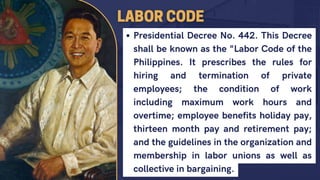
Presidential Decree No. 442. This Decree
shall be known as the "Labor Code of the
Philippines. It prescribes the rules for
hiring and termination of private
employees; the condition of work
including maximum work hours and
overtime; employee benefits holiday pay,
thirteen month pay and retirement pay;
and the guidelines in the organization and
membership in labor unions as well as
collective in bargaining.
Regular
Employment
Fixed period
or Term-
based
Employment
Casual
Employment
Probationary
Employment
Project-
Based
Employment
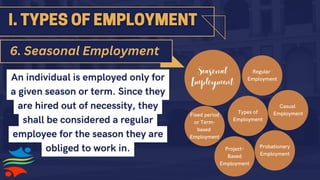
Seasonal
Employment
Types of
Employment
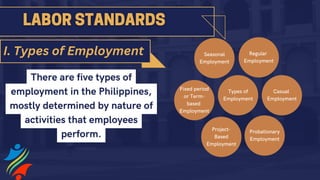
There are five types of
employment in the Philippines,
mostly determined by nature of
activities that employees
perform.
I. Types of Employment
Regular
Employment
Fixed period
or Term-
based
Employment
Casual
Employment
Probationary
Employment
Project-
Based
Employment
Seasonal
Employment
Types of
Employment
An individual’s role and
responsibility with the employer
is deemed necessary with the
business operations and trade.
Employees under this type of
employment are employed for an
indefinite period.
I.Regular employment
Regular
Employment
Fixed period
or Term-
based
Employment
Casual
Employment
Probationary
Employment
Project-
Based
Employment
Seasonal
Employment
Types of
Employment
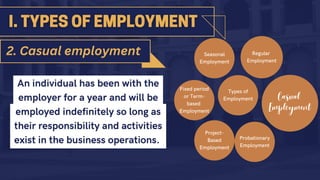
An individual has been with the
employer for a year and will be
employed indefinitely so long as
their responsibility and activities
exist in the business operations.
2. Casual employment
Regular
Employment
Fixed period
or Term-
based
Employment
Casual
Employment
Probationary
Employment
Project-
Based
Employment
Seasonal
Employment
Types of
Employment
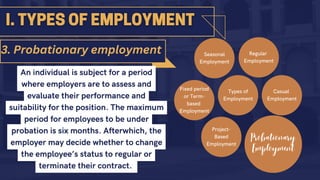
An individual is subject for a period
where employers are to assess and
evaluate their performance and
suitability for the position. The maximum
period for employees to be under
probation is six months. Afterwhich, the
employer may decide whether to change
the employee’s status to regular or
terminate their contract.
3. Probationary employment
Regular
Employment
Fixed period
or Term-
based
Employment
Casual
Employment
Probationary
Employment
Project-
Based
Employment
Seasonal
Employment
Types of
Employment
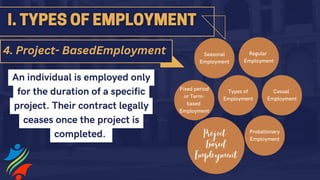
An individual is employed only
for the duration of a specific
project. Their contract legally
ceases once the project is
completed.
4. Project- BasedEmployment
Regular
Employment
Fixed period or
Term-based
Employment
Casual
Employment
Probationary
Employment
Project-
Based
Employment
Seasonal
Employment
Types of
Employment
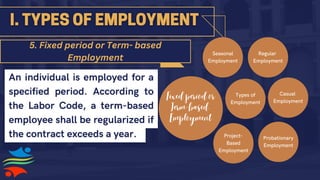
An individual is employed for a
specified period. According to
the Labor Code, a term-based
employee shall be regularized if
the contract exceeds a year.
5. Fixed period or Term- based
Employment
Regular
Employment
Fixed period
or Term-
based
Employment
Casual
Employment
Probationary
Employment
Project-
Based
Employment
Seasonal
Employment
Types of
Employment
An individual is employed only for
a given season or term. Since they
are hired out of necessity, they
shall be considered a regular
employee for the season they are
obliged to work in.
6. Seasonal Employment
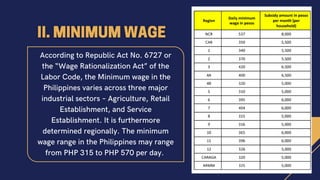
According to Republic Act No. 6727 or
the “Wage Rationalization Act” of the
Labor Code, the Minimum wage in the
Philippines varies across three major
industrial sectors – Agriculture, Retail
Establishment, and Service
Establishment. It is furthermore
determined regionally. The minimum
wage range in the Philippines may range
from PHP 315 to PHP 570 per day.
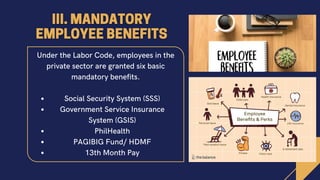
Social Security System (SSS)
Government Service Insurance
System (GSIS)
PhilHealth
PAGIBIG Fund/ HDMF
13th Month Pay
Under the Labor Code, employees in the
private sector are granted six basic
mandatory benefits.
NORMAL WORK HOURS: The regular
working hours in the Philippines are 8
hours. However, meal/break periods of
an hour are inserted in between these
hours. However, there are instances
where employee breaks are shortened to
20 minutes due to the nature of work or
urgent tasks.
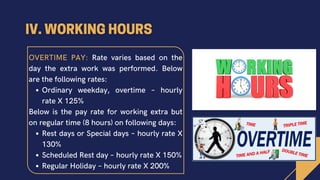
Ordinary weekday, overtime – hourly
rate X 125%
Rest days or Special days – hourly rate X
130%
Scheduled Rest day – hourly rate X 150%
Regular Holiday – hourly rate X 200%
OVERTIME PAY: Rate varies based on the
day the extra work was performed. Below
are the following rates:
Below is the pay rate for working extra but
on regular time (8 hours) on following days:
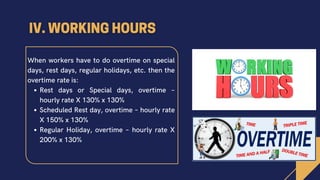
Rest days or Special days, overtime –
hourly rate X 130% x 130%
Scheduled Rest day, overtime – hourly rate
X 150% x 130%
Regular Holiday, overtime – hourly rate X
200% x 130%
When workers have to do overtime on special
days, rest days, regular holidays, etc. then the
overtime rate is:
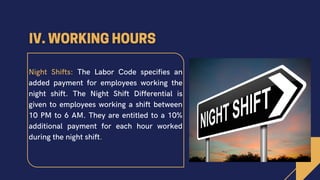
Night Shifts: The Labor Code specifies an
added payment for employees working the
night shift. The Night Shift Differential is
given to employees working a shift between
10 PM to 6 AM. They are entitled to a 10%
additional payment for each hour worked
during the night shift.
Right to Weekly Rest Day. Employees a right to a weekly rest period of
not less than 24 consecutive hours after every 6 consecutive normal
work days.
Right to Holiday Pay. An employee shall be paid his regular daily wage
during regular holidays, except in retail and service establishment
regularly employing less than 10 workers.
Right to Seperation Pay. Employees dismissed from work due to
business closure, reduction of costs or other reasons that are beyond
their control.
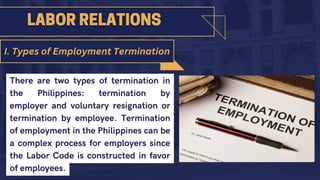
There are two types of termination in
the Philippines: termination by
employer and voluntary resignation or
termination by employee. Termination
of employment in the Philippines can be
a complex process for employers since
the Labor Code is constructed in favor
of employees.
I. Types of Employment Termination
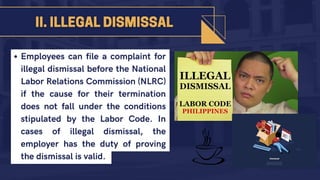
Employees can file a complaint for
illegal dismissal before the National
Labor Relations Commission (NLRC)
if the cause for their termination
does not fall under the conditions
stipulated by the Labor Code. In
cases of illegal dismissal, the
employer has the duty of proving
the dismissal is valid.
Employees who are unjustly dismissed are entitled to any or all of the
following:
reinstatement without loss of seniority rights
separation pay equivalent to one (1) month salary for every year of
service if reinstatement cannot be provided.
full back wages, inclusive of allowances and other benefits of their
monetary equivalent from the time compensation was withheld up to
the time of of reinstatement.
payment of damages and/or attorney's fees (if the dismissal was done
in bad faith)
PUBLIC SECTOR UNION or PUBLIC EMPLOYEES' ORGANIZATION
which refers to any organization, union, or association of employees in
the agencies of government which exists in whole or in part for the
purpose of collective negotiations or mutual aid, interests, cooperation
and protection.
PRIVATE SECTOR UNION or LABOR ORGANIZATION refers to any
union or associationof employees in the private sector which exist in
whole or in part for the purpose of collective bargaining or mutual aid,
interest, cooperation, protection or other lawful purposes.
A labor union is an organization formed by workers in a particular
trade, industry, or company for the purpose of improving pay,
benefits, and working conditions. Officially known as a “labor
organization,” and also called a “trade union” or a “workers union,” a
labor union selects representatives to negotiate with employers in a
process known as collective bargaining.
Collective bargaining is the heart and soul of the labor union.
https://www.gsis.gov.ph
G.R. No. 221411 (lawphil.net)
https://blr.dole.gov.ph/wp-content/up...
https://www.sss.gov.ph
https://blr.dole.gov.ph/2014/12/11/pr...
https://bwc.dole.gov.ph/faqs-on-13th-...
uwua.et Labor, Employment, and HR
Consulting in Philippines | InCorp Philippines
(kittelsoncarpo.com)
https://www.pagibigfund.gov.ph
https://www.philhealth.gov.ph

Labor Code.pdf

  • 1.
    TANAUAN INSTITUTE June 1,2023 Mendoza, Marjorie R. Thursday
  • 2.
    Presidential Decree No.442. This Decree shall be known as the "Labor Code of the Philippines. It prescribes the rules for hiring and termination of private employees; the condition of work including maximum work hours and overtime; employee benefits holiday pay, thirteen month pay and retirement pay; and the guidelines in the organization and membership in labor unions as well as collective in bargaining.
  • 3.
    Regular Employment Fixed period or Term- based Employment Casual Employment Probationary Employment Project- Based Employment Seasonal Employment Typesof Employment There are five types of employment in the Philippines, mostly determined by nature of activities that employees perform. I. Types of Employment
  • 4.
    Regular Employment Fixed period or Term- based Employment Casual Employment Probationary Employment Project- Based Employment Seasonal Employment Typesof Employment An individual’s role and responsibility with the employer is deemed necessary with the business operations and trade. Employees under this type of employment are employed for an indefinite period. I.Regular employment
  • 5.
    Regular Employment Fixed period or Term- based Employment Casual Employment Probationary Employment Project- Based Employment Seasonal Employment Typesof Employment An individual has been with the employer for a year and will be employed indefinitely so long as their responsibility and activities exist in the business operations. 2. Casual employment
  • 6.
    Regular Employment Fixed period or Term- based Employment Casual Employment Probationary Employment Project- Based Employment Seasonal Employment Typesof Employment An individual is subject for a period where employers are to assess and evaluate their performance and suitability for the position. The maximum period for employees to be under probation is six months. Afterwhich, the employer may decide whether to change the employee’s status to regular or terminate their contract. 3. Probationary employment
  • 7.
    Regular Employment Fixed period or Term- based Employment Casual Employment Probationary Employment Project- Based Employment Seasonal Employment Typesof Employment An individual is employed only for the duration of a specific project. Their contract legally ceases once the project is completed. 4. Project- BasedEmployment
  • 8.
    Regular Employment Fixed period or Term-based Employment Casual Employment Probationary Employment Project- Based Employment Seasonal Employment Typesof Employment An individual is employed for a specified period. According to the Labor Code, a term-based employee shall be regularized if the contract exceeds a year. 5. Fixed period or Term- based Employment
  • 9.
    Regular Employment Fixed period or Term- based Employment Casual Employment Probationary Employment Project- Based Employment Seasonal Employment Typesof Employment An individual is employed only for a given season or term. Since they are hired out of necessity, they shall be considered a regular employee for the season they are obliged to work in. 6. Seasonal Employment
  • 10.
    According to RepublicAct No. 6727 or the “Wage Rationalization Act” of the Labor Code, the Minimum wage in the Philippines varies across three major industrial sectors – Agriculture, Retail Establishment, and Service Establishment. It is furthermore determined regionally. The minimum wage range in the Philippines may range from PHP 315 to PHP 570 per day.
  • 11.
    Social Security System(SSS) Government Service Insurance System (GSIS) PhilHealth PAGIBIG Fund/ HDMF 13th Month Pay Under the Labor Code, employees in the private sector are granted six basic mandatory benefits.
  • 12.
    NORMAL WORK HOURS:The regular working hours in the Philippines are 8 hours. However, meal/break periods of an hour are inserted in between these hours. However, there are instances where employee breaks are shortened to 20 minutes due to the nature of work or urgent tasks.
  • 13.
    Ordinary weekday, overtime– hourly rate X 125% Rest days or Special days – hourly rate X 130% Scheduled Rest day – hourly rate X 150% Regular Holiday – hourly rate X 200% OVERTIME PAY: Rate varies based on the day the extra work was performed. Below are the following rates: Below is the pay rate for working extra but on regular time (8 hours) on following days:
  • 14.
    Rest days orSpecial days, overtime – hourly rate X 130% x 130% Scheduled Rest day, overtime – hourly rate X 150% x 130% Regular Holiday, overtime – hourly rate X 200% x 130% When workers have to do overtime on special days, rest days, regular holidays, etc. then the overtime rate is:
  • 15.
    Night Shifts: TheLabor Code specifies an added payment for employees working the night shift. The Night Shift Differential is given to employees working a shift between 10 PM to 6 AM. They are entitled to a 10% additional payment for each hour worked during the night shift.
  • 16.
    Right to WeeklyRest Day. Employees a right to a weekly rest period of not less than 24 consecutive hours after every 6 consecutive normal work days. Right to Holiday Pay. An employee shall be paid his regular daily wage during regular holidays, except in retail and service establishment regularly employing less than 10 workers. Right to Seperation Pay. Employees dismissed from work due to business closure, reduction of costs or other reasons that are beyond their control.
  • 17.
    There are twotypes of termination in the Philippines: termination by employer and voluntary resignation or termination by employee. Termination of employment in the Philippines can be a complex process for employers since the Labor Code is constructed in favor of employees. I. Types of Employment Termination
  • 18.
    Employees can filea complaint for illegal dismissal before the National Labor Relations Commission (NLRC) if the cause for their termination does not fall under the conditions stipulated by the Labor Code. In cases of illegal dismissal, the employer has the duty of proving the dismissal is valid.
  • 19.
    Employees who areunjustly dismissed are entitled to any or all of the following: reinstatement without loss of seniority rights separation pay equivalent to one (1) month salary for every year of service if reinstatement cannot be provided. full back wages, inclusive of allowances and other benefits of their monetary equivalent from the time compensation was withheld up to the time of of reinstatement. payment of damages and/or attorney's fees (if the dismissal was done in bad faith)
  • 20.
    PUBLIC SECTOR UNIONor PUBLIC EMPLOYEES' ORGANIZATION which refers to any organization, union, or association of employees in the agencies of government which exists in whole or in part for the purpose of collective negotiations or mutual aid, interests, cooperation and protection. PRIVATE SECTOR UNION or LABOR ORGANIZATION refers to any union or associationof employees in the private sector which exist in whole or in part for the purpose of collective bargaining or mutual aid, interest, cooperation, protection or other lawful purposes.
  • 21.
    A labor unionis an organization formed by workers in a particular trade, industry, or company for the purpose of improving pay, benefits, and working conditions. Officially known as a “labor organization,” and also called a “trade union” or a “workers union,” a labor union selects representatives to negotiate with employers in a process known as collective bargaining. Collective bargaining is the heart and soul of the labor union.
  • 22.
    https://www.gsis.gov.ph G.R. No. 221411(lawphil.net) https://blr.dole.gov.ph/wp-content/up... https://www.sss.gov.ph https://blr.dole.gov.ph/2014/12/11/pr... https://bwc.dole.gov.ph/faqs-on-13th-... uwua.et Labor, Employment, and HR Consulting in Philippines | InCorp Philippines (kittelsoncarpo.com) https://www.pagibigfund.gov.ph https://www.philhealth.gov.ph