SSL/TLS for MortalsSSL/TLS for Mortals
@mthmuldersmaartenm@infosupport.com
Troubleshooting time...Troubleshooting time...
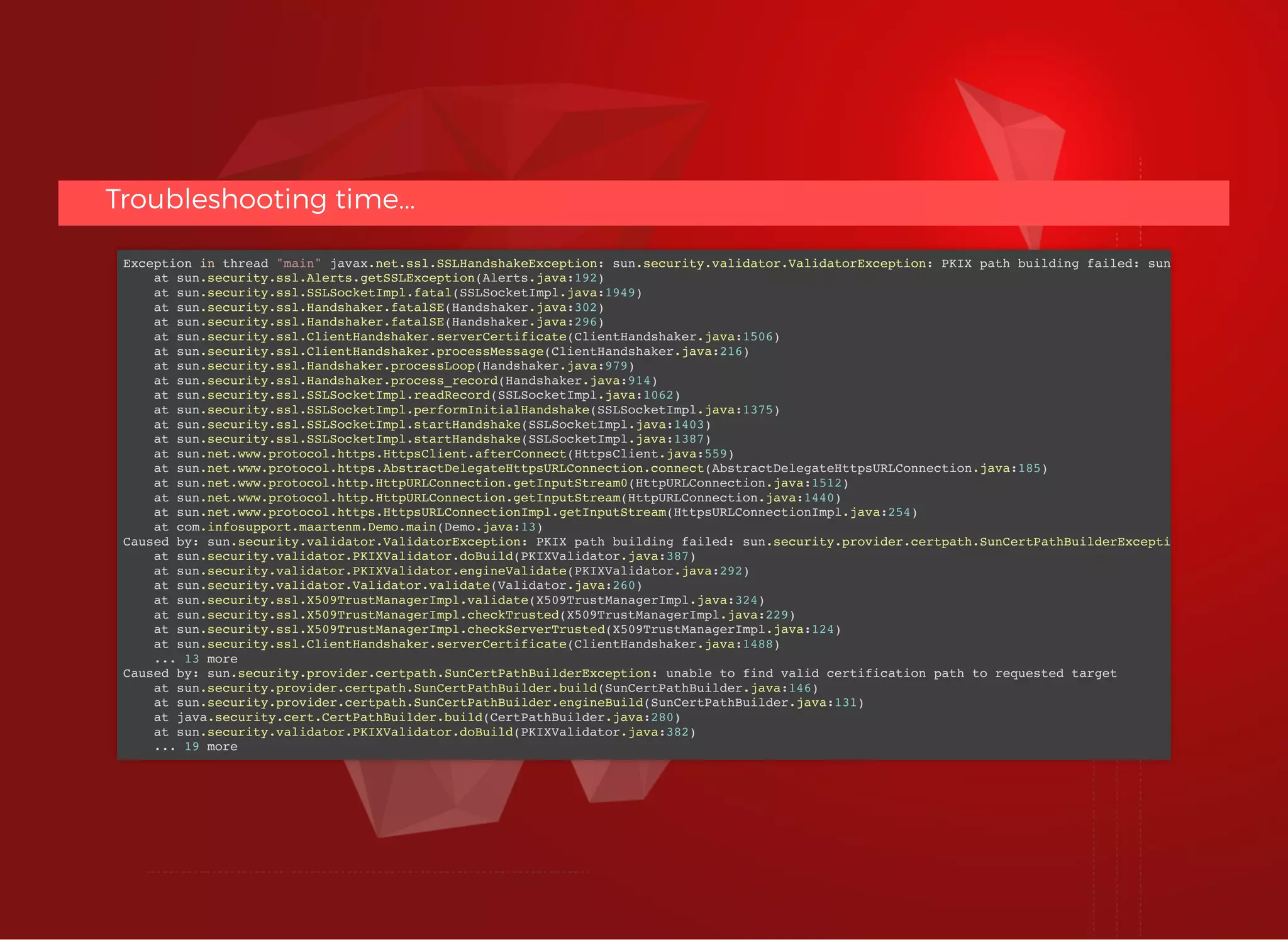
Exception in thread "main" javax.net.ssl.SSLHandshakeException: sun.security.validator.ValidatorException: PKIX path building failed: sun
at sun.security.ssl.Alerts.getSSLException(Alerts.java:192)
at sun.security.ssl.SSLSocketImpl.fatal(SSLSocketImpl.java:1949)
at sun.security.ssl.Handshaker.fatalSE(Handshaker.java:302)
at sun.security.ssl.Handshaker.fatalSE(Handshaker.java:296)
at sun.security.ssl.ClientHandshaker.serverCertificate(ClientHandshaker.java:1506)
at sun.security.ssl.ClientHandshaker.processMessage(ClientHandshaker.java:216)
at sun.security.ssl.Handshaker.processLoop(Handshaker.java:979)
at sun.security.ssl.Handshaker.process_record(Handshaker.java:914)
at sun.security.ssl.SSLSocketImpl.readRecord(SSLSocketImpl.java:1062)
at sun.security.ssl.SSLSocketImpl.performInitialHandshake(SSLSocketImpl.java:1375)
at sun.security.ssl.SSLSocketImpl.startHandshake(SSLSocketImpl.java:1403)
at sun.security.ssl.SSLSocketImpl.startHandshake(SSLSocketImpl.java:1387)
at sun.net.www.protocol.https.HttpsClient.afterConnect(HttpsClient.java:559)
at sun.net.www.protocol.https.AbstractDelegateHttpsURLConnection.connect(AbstractDelegateHttpsURLConnection.java:185)
at sun.net.www.protocol.http.HttpURLConnection.getInputStream0(HttpURLConnection.java:1512)
at sun.net.www.protocol.http.HttpURLConnection.getInputStream(HttpURLConnection.java:1440)
at sun.net.www.protocol.https.HttpsURLConnectionImpl.getInputStream(HttpsURLConnectionImpl.java:254)
at com.infosupport.maartenm.Demo.main(Demo.java:13)
Caused by: sun.security.validator.ValidatorException: PKIX path building failed: sun.security.provider.certpath.SunCertPathBuilderExcepti
at sun.security.validator.PKIXValidator.doBuild(PKIXValidator.java:387)
at sun.security.validator.PKIXValidator.engineValidate(PKIXValidator.java:292)
at sun.security.validator.Validator.validate(Validator.java:260)
at sun.security.ssl.X509TrustManagerImpl.validate(X509TrustManagerImpl.java:324)
at sun.security.ssl.X509TrustManagerImpl.checkTrusted(X509TrustManagerImpl.java:229)
at sun.security.ssl.X509TrustManagerImpl.checkServerTrusted(X509TrustManagerImpl.java:124)
at sun.security.ssl.ClientHandshaker.serverCertificate(ClientHandshaker.java:1488)
... 13 more
Caused by: sun.security.provider.certpath.SunCertPathBuilderException: unable to find valid certification path to requested target
at sun.security.provider.certpath.SunCertPathBuilder.build(SunCertPathBuilder.java:146)
at sun.security.provider.certpath.SunCertPathBuilder.engineBuild(SunCertPathBuilder.java:131)
at java.security.cert.CertPathBuilder.build(CertPathBuilder.java:280)
at sun.security.validator.PKIXValidator.doBuild(PKIXValidator.java:382)
... 19 more
Why bother?Why bother?
Using SSL/TLS correctly is o en hard to achieve
...and understand!
Crucial for secure connection between systems
Globally deployed (intra-)cloud applications
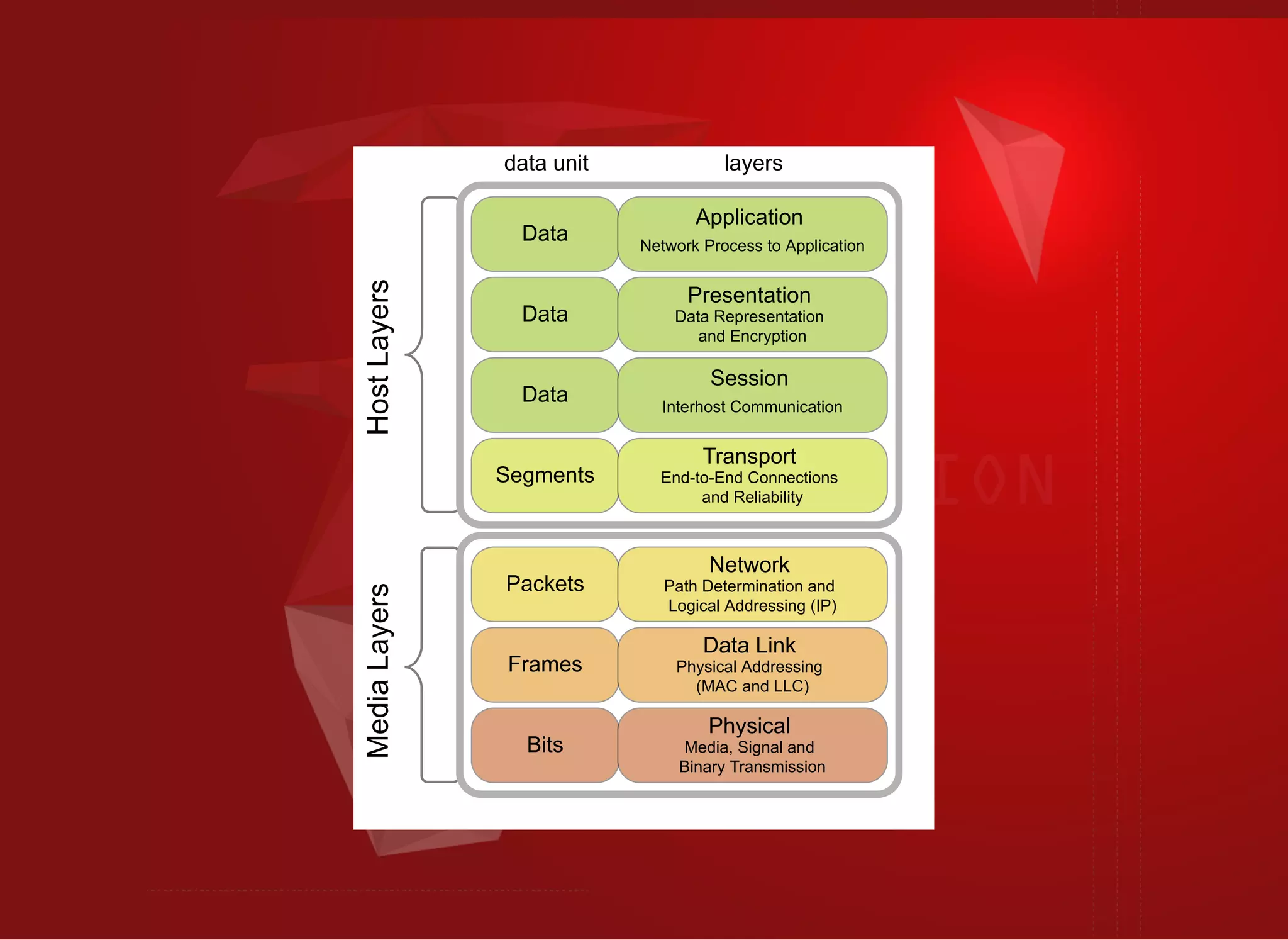
data unit layers
Data
Data
Data
Segments
Packets
Frames
Bits
Application 
Network Process to Application
Presentation 
Data Representation 
and Encryption
Session 
Interhost Communication
Transport 
End­to­End Connections 
and Reliability
Network 
Path Determination and 
Logical Addressing (IP)
Data Link 
Physical Addressing 
(MAC and LLC)
Physical 
Media, Signal and 
Binary Transmission
Host LayersMedia Layers
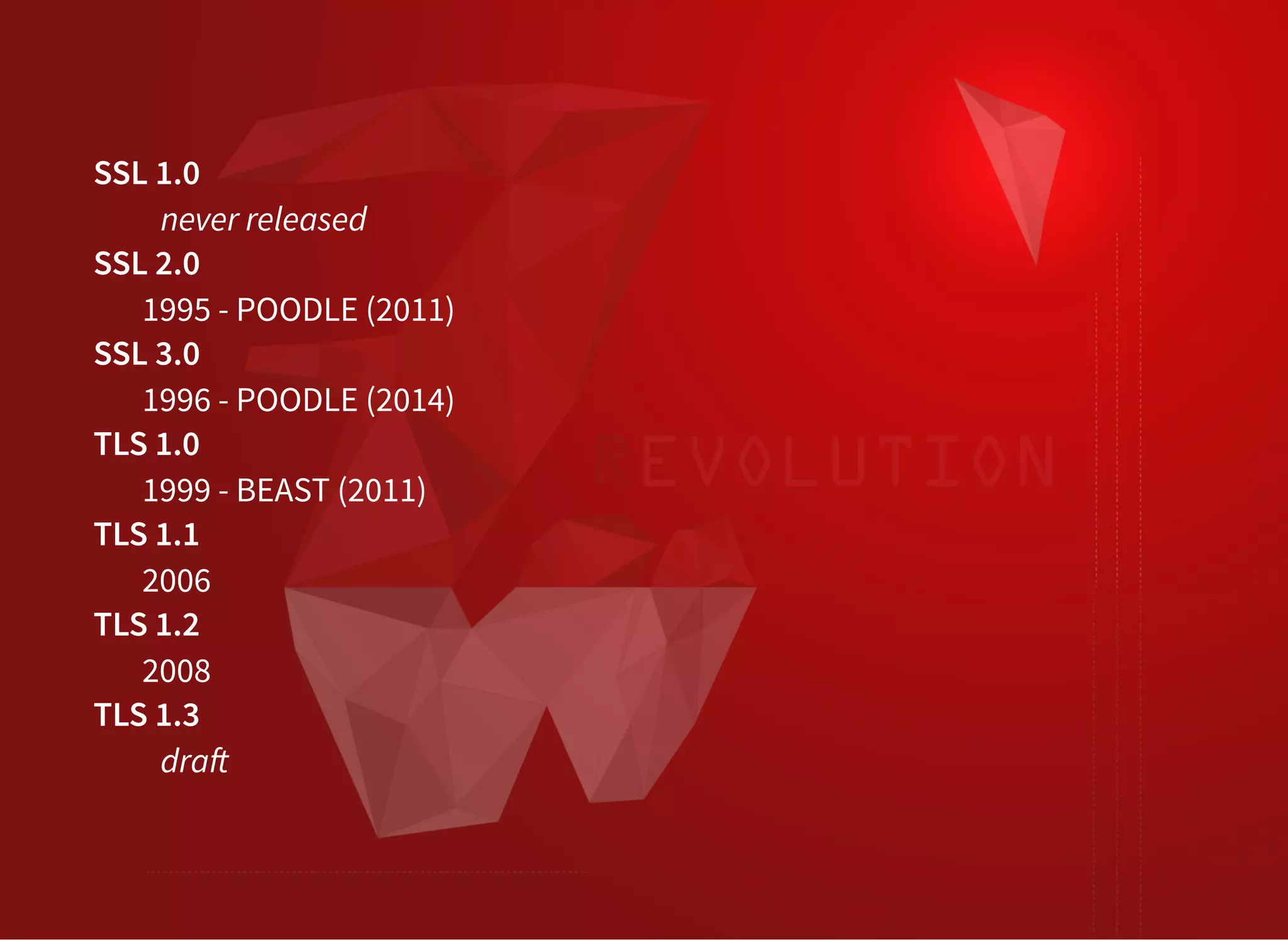
SSL 1.0
never released
SSL 2.0
1995 - POODLE (2011)
SSL 3.0
1996 - POODLE (2014)
TLS 1.0
1999 - BEAST (2011)
TLS 1.1
2006
TLS 1.2
2008
TLS 1.3
dra
Demo time!Demo time!
What's the issue?
How to prevent this?How to prevent this?
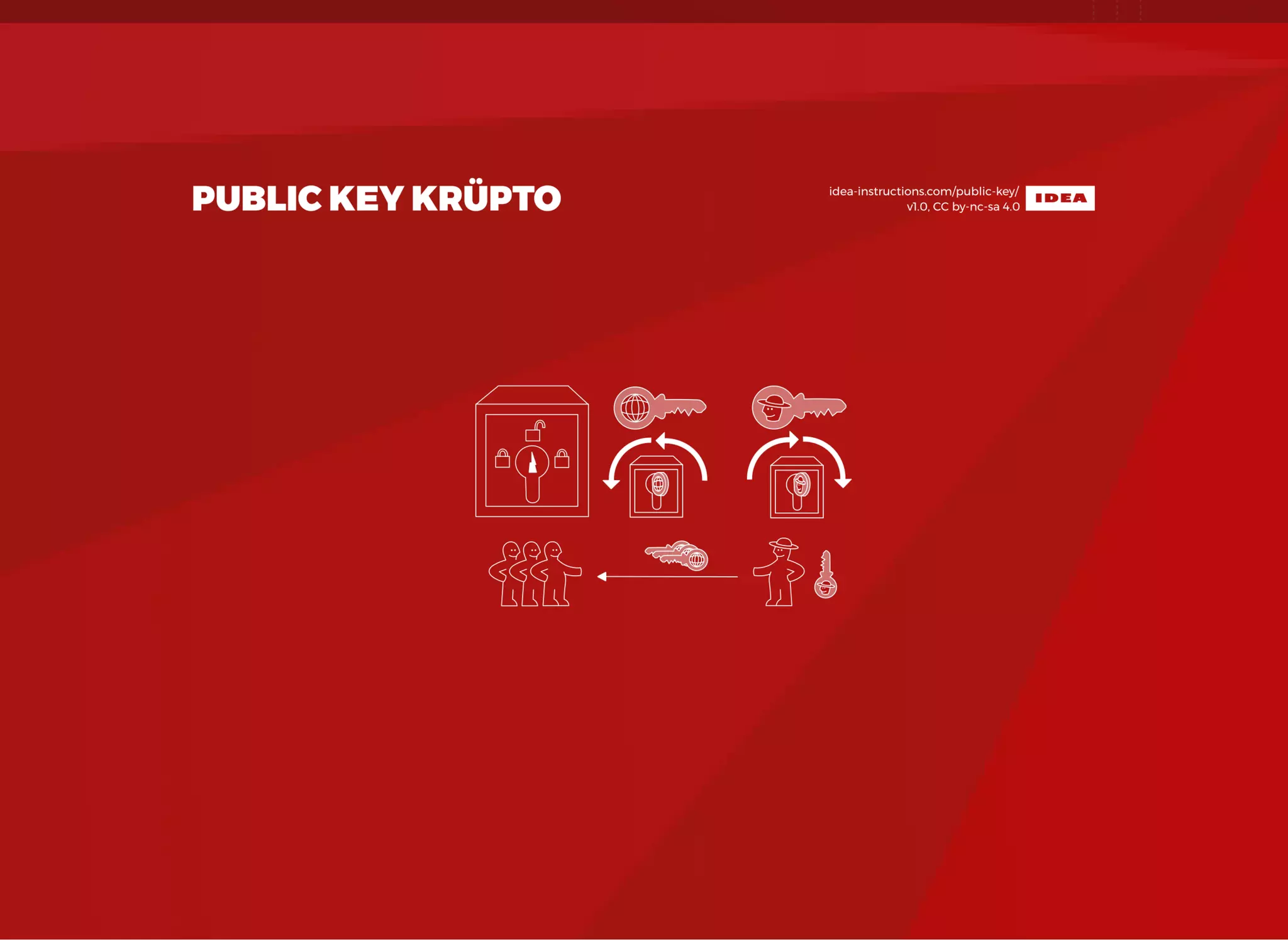
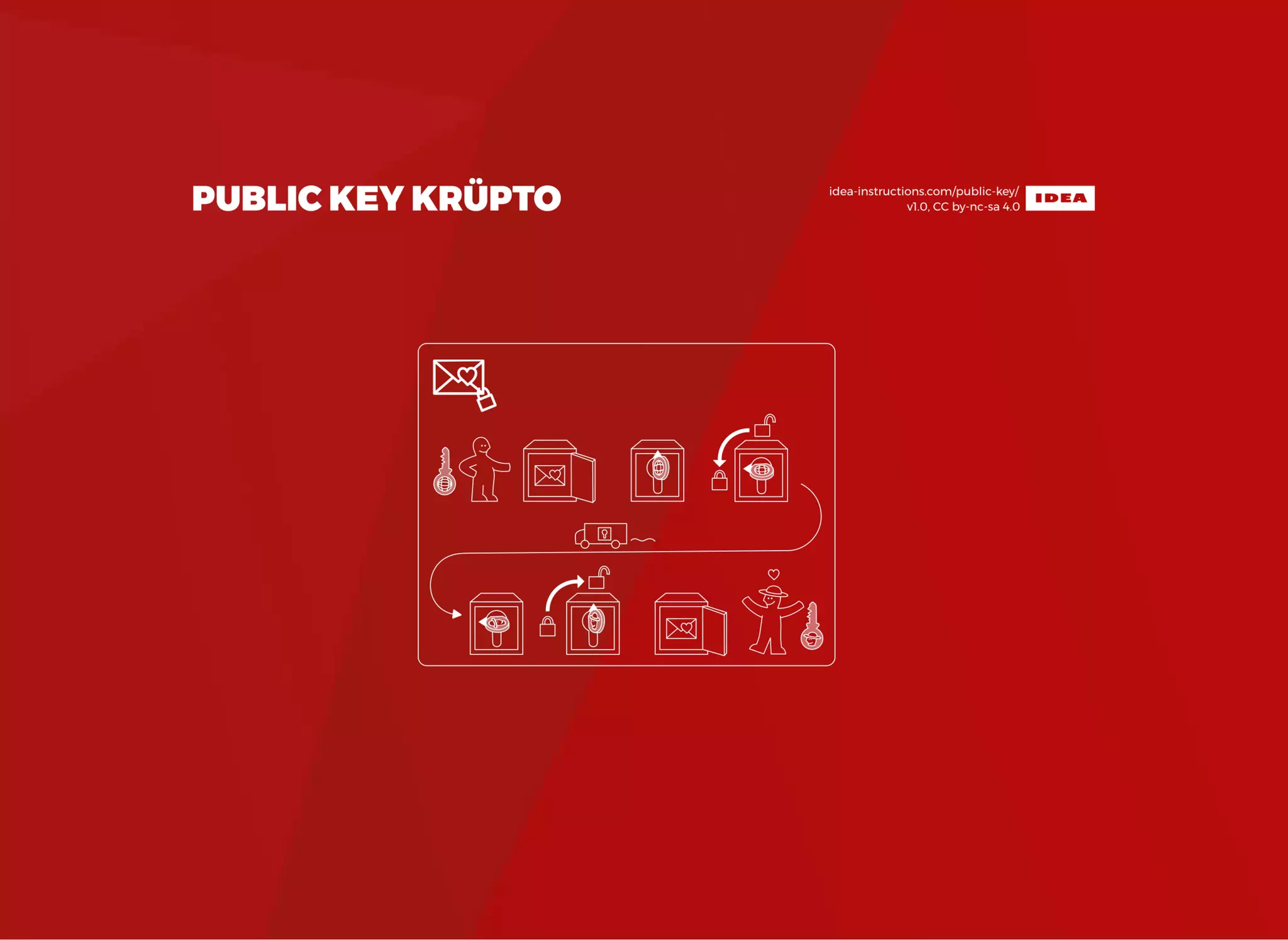
1. public/private key encryption
2. signed certificates
3. certificate authorities
1. public/private key1. public/private key
encryptionencryption
 
 
Math time!Math time!
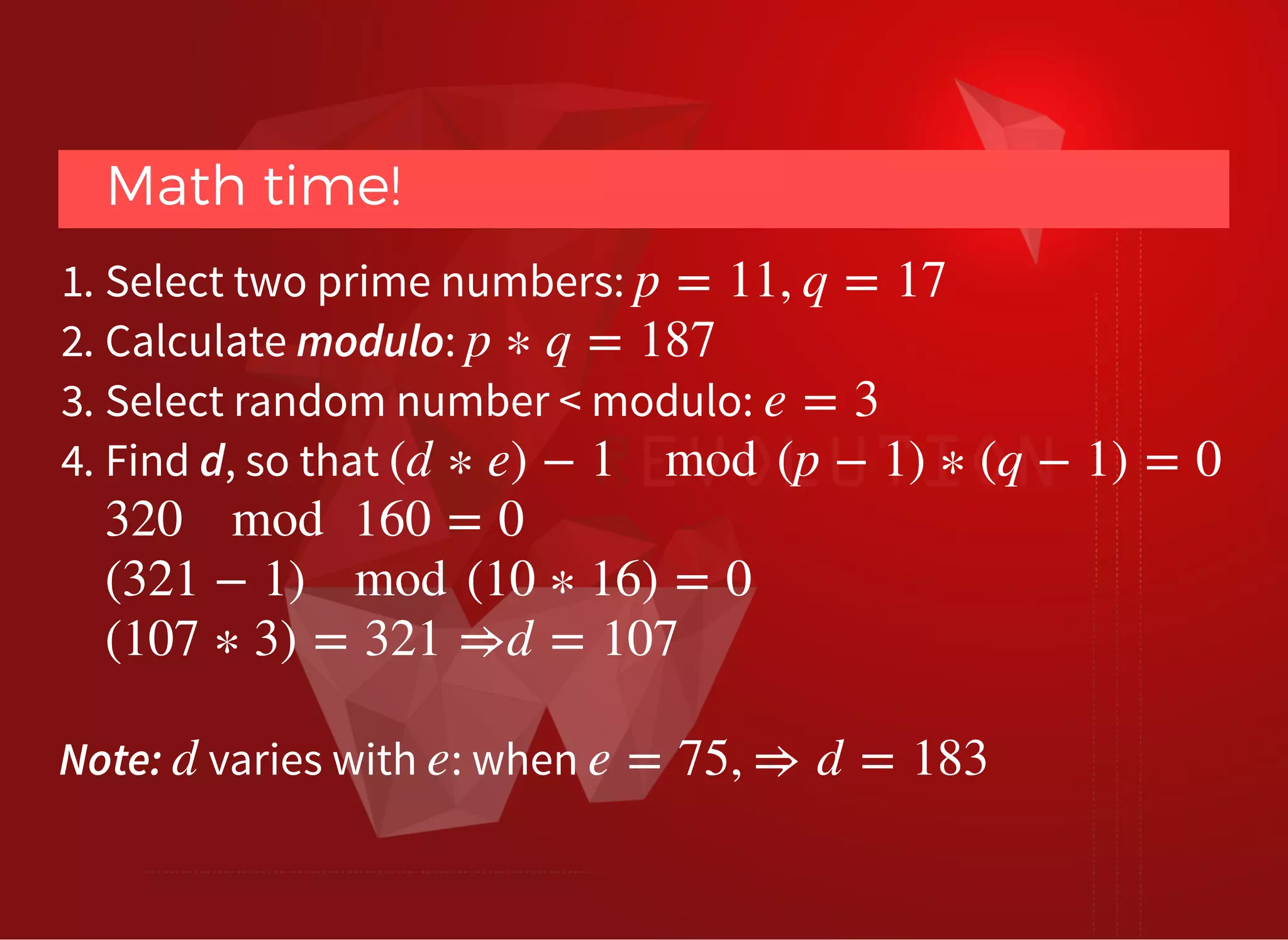
1. Select two prime numbers:
2. Calculate modulo:
3. Select random number < modulo:
4. Find d, so that
p = 11, q = 17
p ∗ q = 187
e = 3
(d ∗ e) − 1 mod (p − 1) ∗ (q − 1) = 0
320 mod 160 = 0
(321 − 1) mod (10 ∗ 16) = 0
(107 ∗ 3) = 321 ⇒d = 107
Note: varies with : whend e e = 75, ⇒ d = 183
Now, what if P and Q are unknown?Now, what if P and Q are unknown?
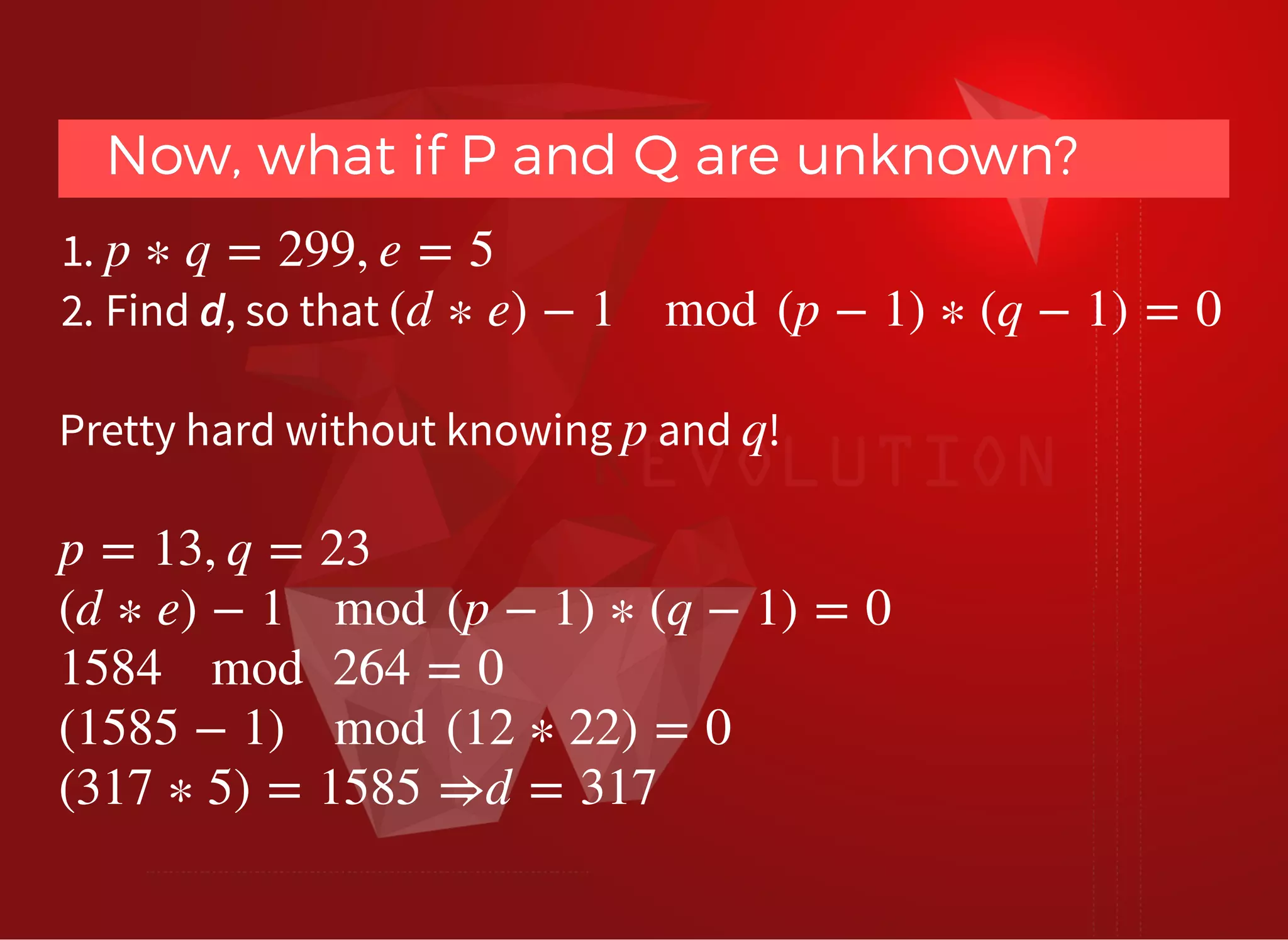
1.
2. Find d, so that
p ∗ q = 299, e = 5
(d ∗ e) − 1 mod (p − 1) ∗ (q − 1) = 0
Pretty hard without knowing and !p q
 
p = 13, q = 23
(d ∗ e) − 1 mod (p − 1) ∗ (q − 1) = 0
1584 mod 264 = 0
(1585 − 1) mod (12 ∗ 22) = 0
(317 ∗ 5) = 1585 ⇒d = 317
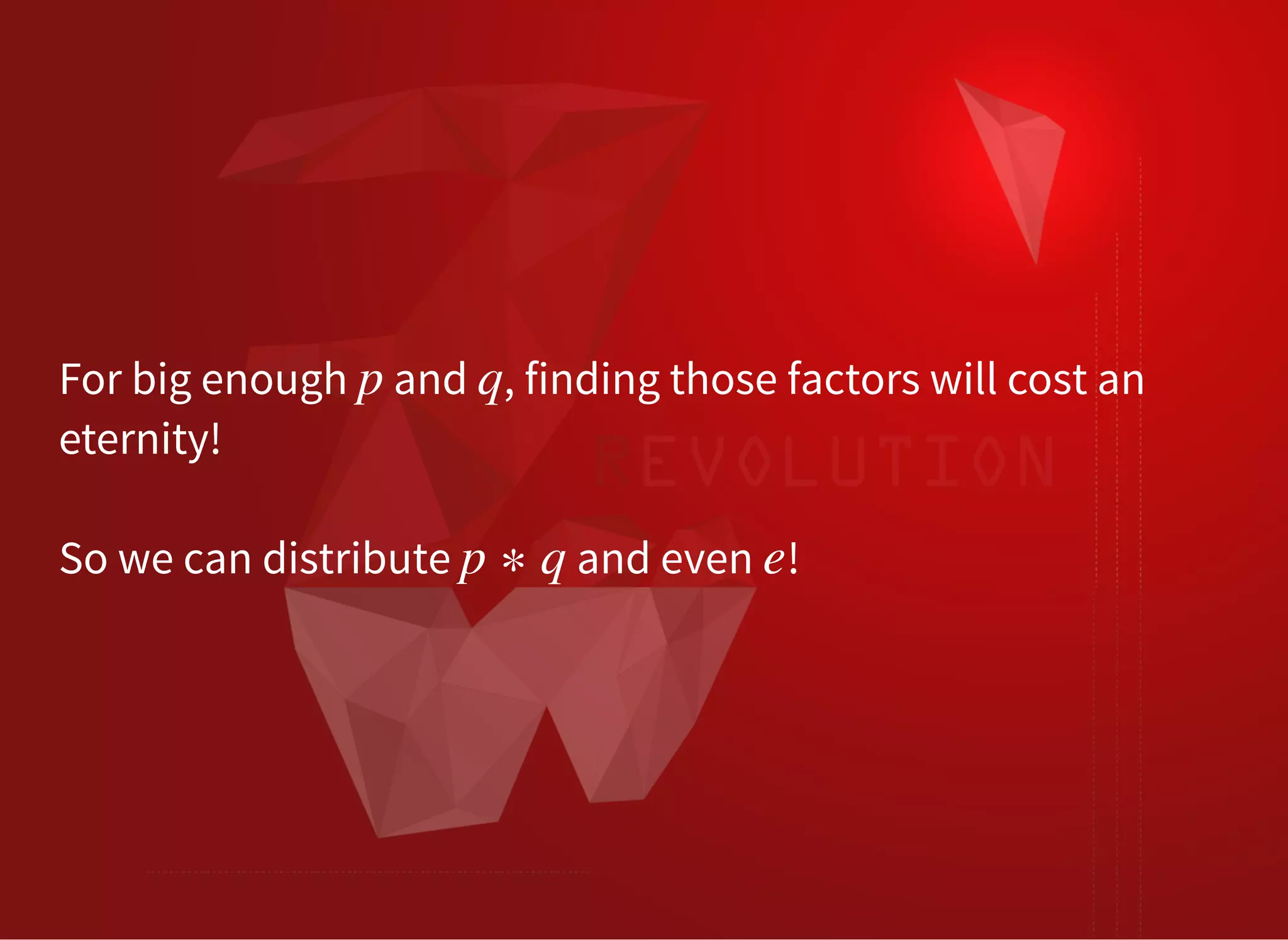
For big enough and , finding those factors will cost an
eternity!
p q
So we can distribute p ∗ q and even !e
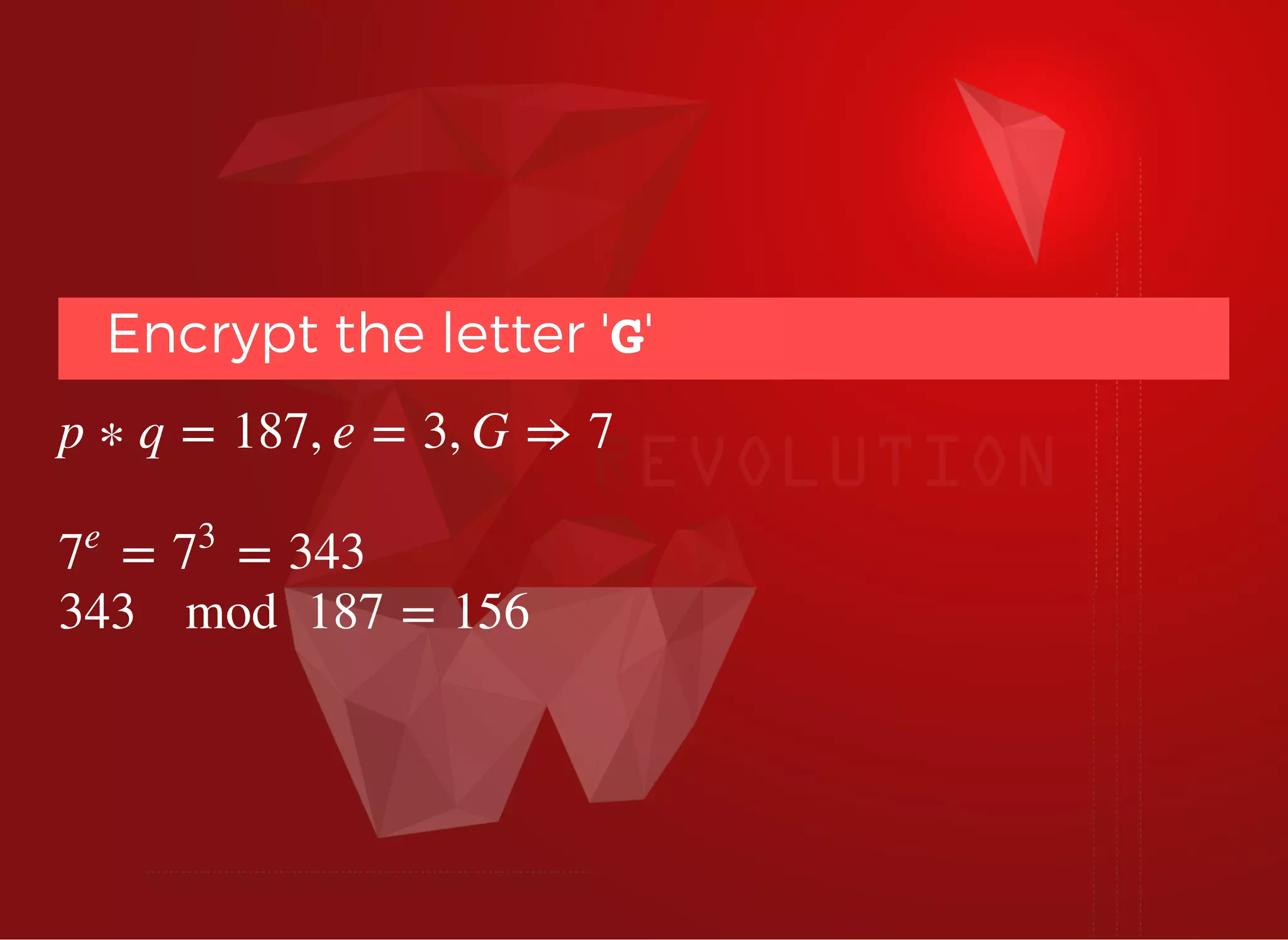
Encrypt the letter 'Encrypt the letter 'GG''
 
p ∗ q = 187, e = 3, G ⇒ 7
= = 3437
e
7
3
343 mod 187 = 156
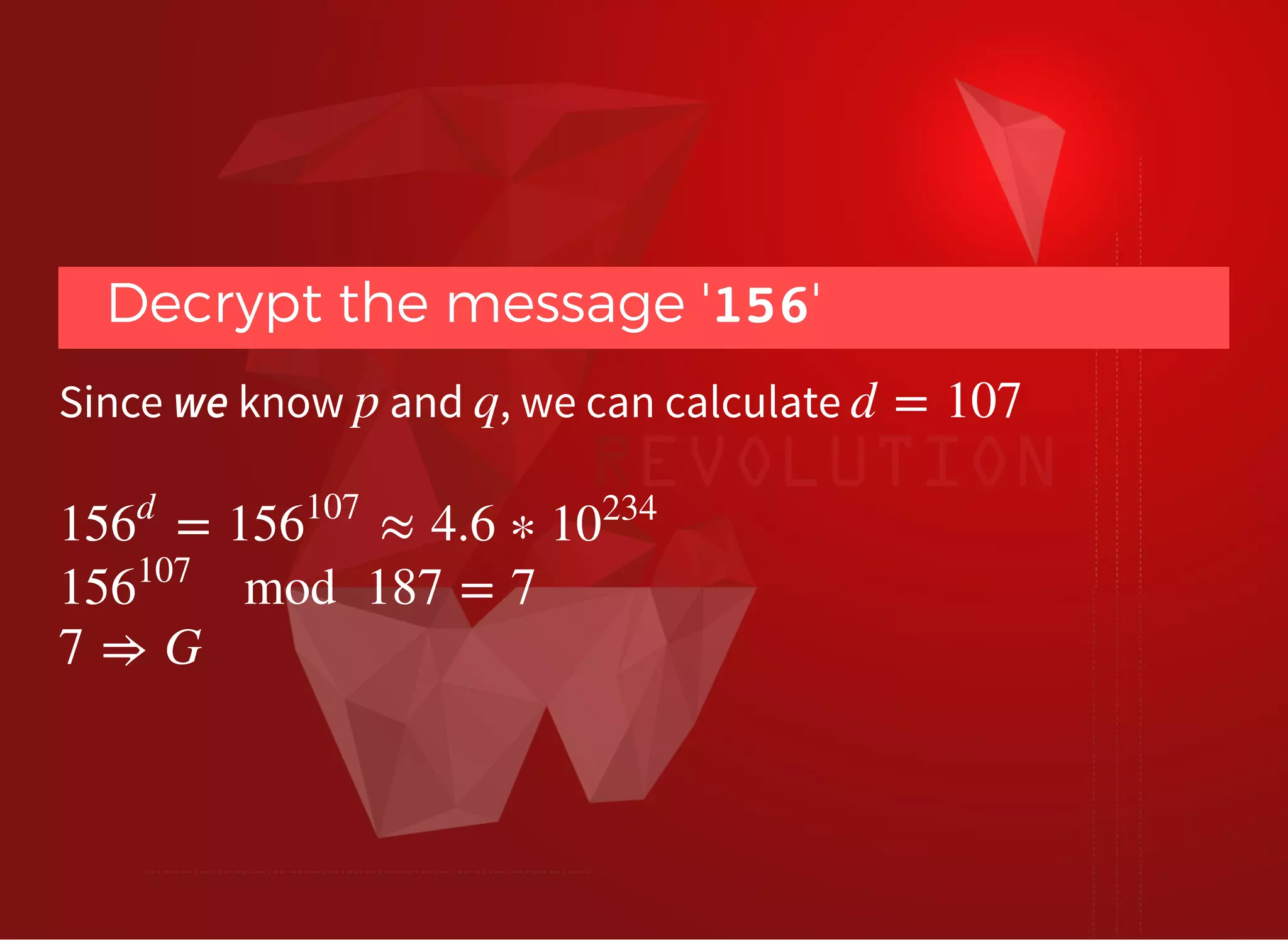
Decrypt the message 'Decrypt the message '156156''
Since we know and , we can calculate
 
p q d = 107
= ≈ 4.6 ∗156
d
156
107
10
234
mod 187 = 7156
107
7 ⇒ G
 
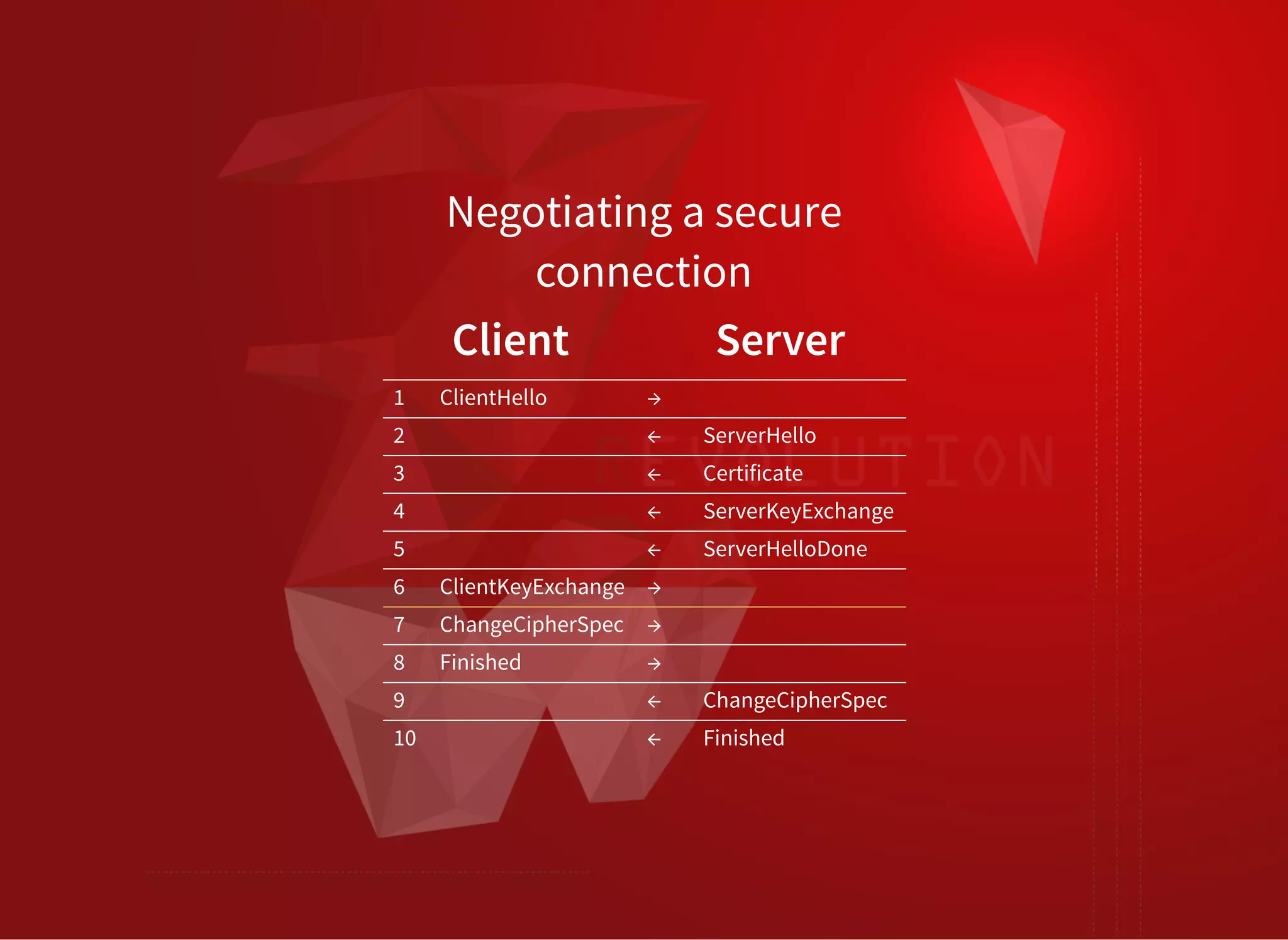
Negotiating a secure
connection
Client   Server
1 ClientHello →  
2   ← ServerHello
3   ← Certificate
4   ← ServerKeyExchange
5   ← ServerHelloDone
6 ClientKeyExchange →  
7 ChangeCipherSpec →  
8 Finished →  
9   ← ChangeCipherSpec
10   ← Finished
Demo time!Demo time!
No-one is eavesdropping!
2. signed certificates2. signed certificates
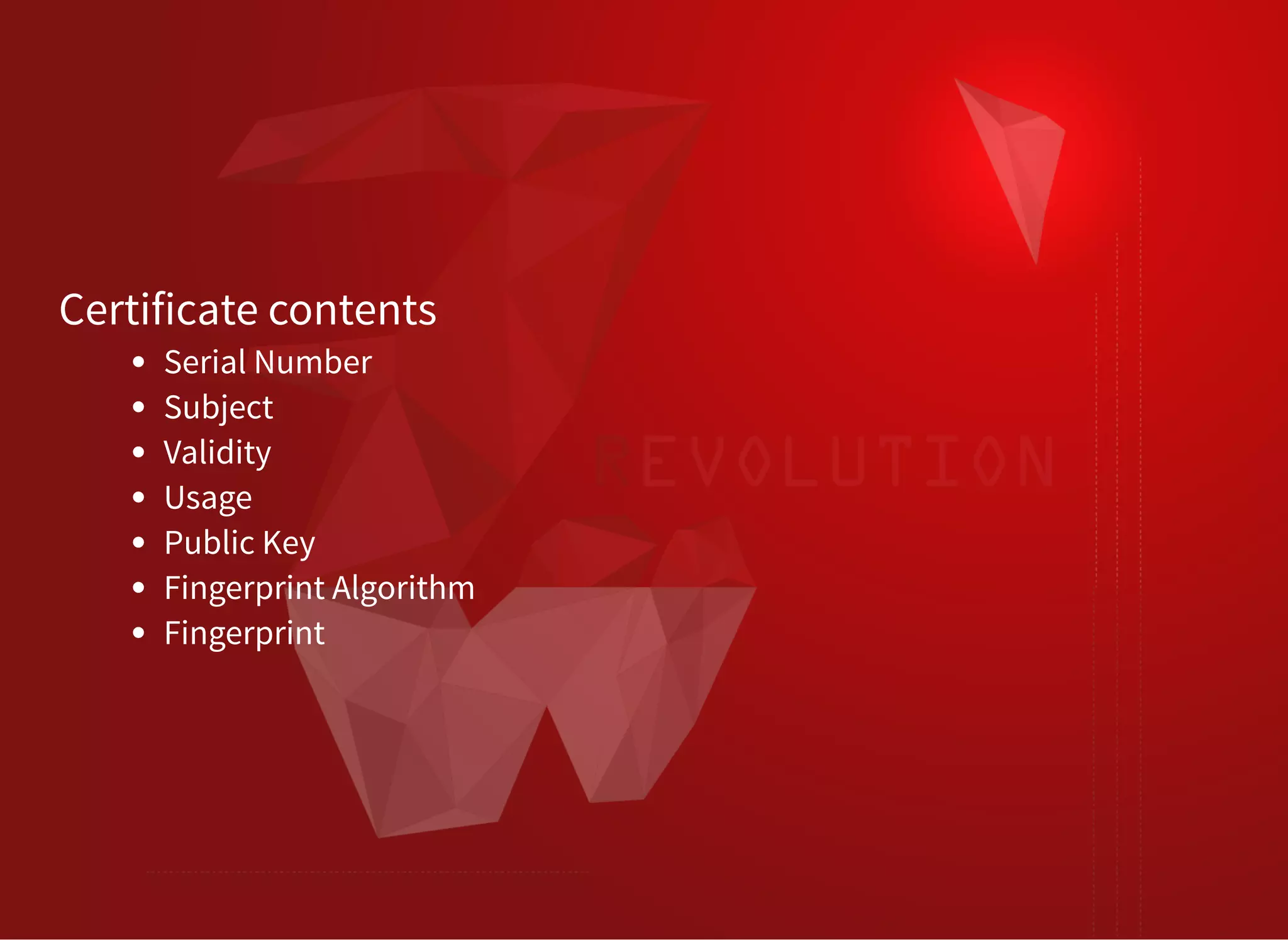
Certificate contents
Serial Number
Subject
Validity
Usage
Public Key
Fingerprint Algorithm
Fingerprint
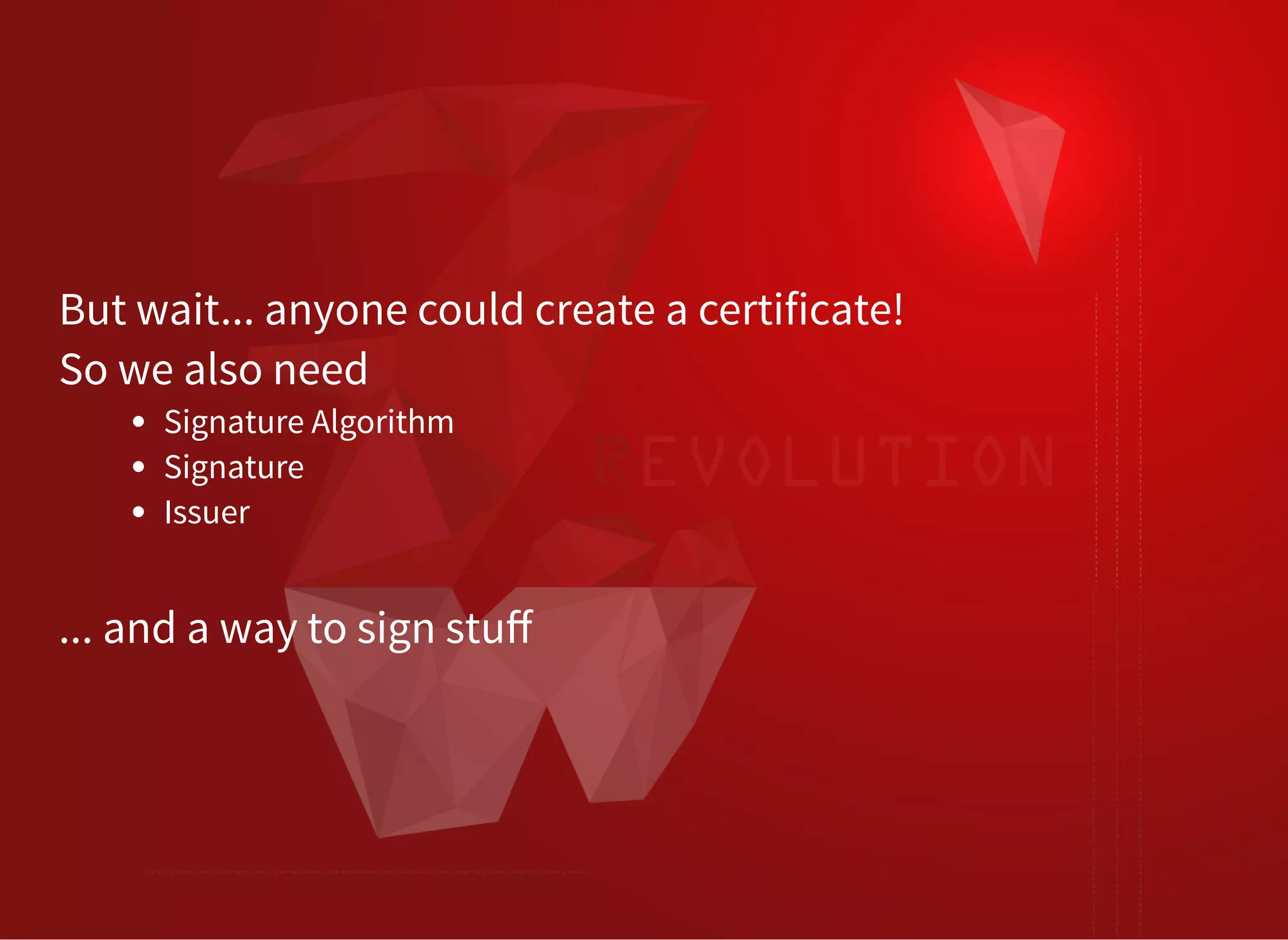
But wait... anyone could create a certificate!
So we also need
Signature Algorithm
Signature
Issuer
... and a way to sign stuff
 
A is a mathematical relationship between a
message , a private key and a public key .
signature
x sk pk
 
It consists of two functions:
1. signing function
2. verifying function
t = f (sk, x)
[accept, reject] = g(pk, t, x)
 
So, given and and knowing ,
we can tell if is indeed signed by .
x t pk
x sk
3. certificate authorities3. certificate authorities
An entity that issues digital certificates, certifying the
ownership of a public key by the subject of the certificate.
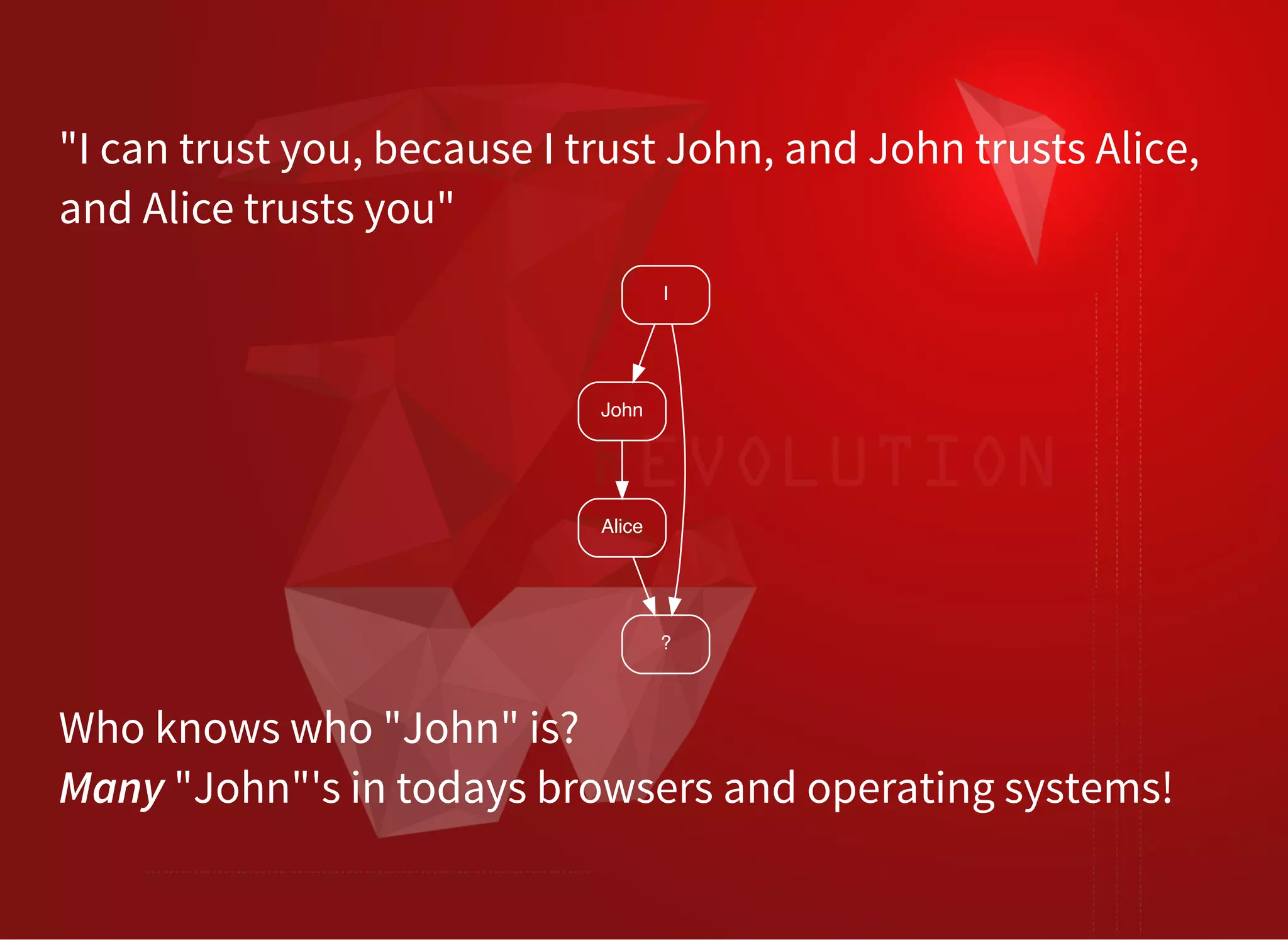
"I can trust you, because I trust John, and John trusts Alice,
and Alice trusts you"
I
John
?
Alice
Who knows who "John" is?
Many "John"'s in todays browsers and operating systems!
Top-notch security procedures, including "key ceremonies"
And yet...
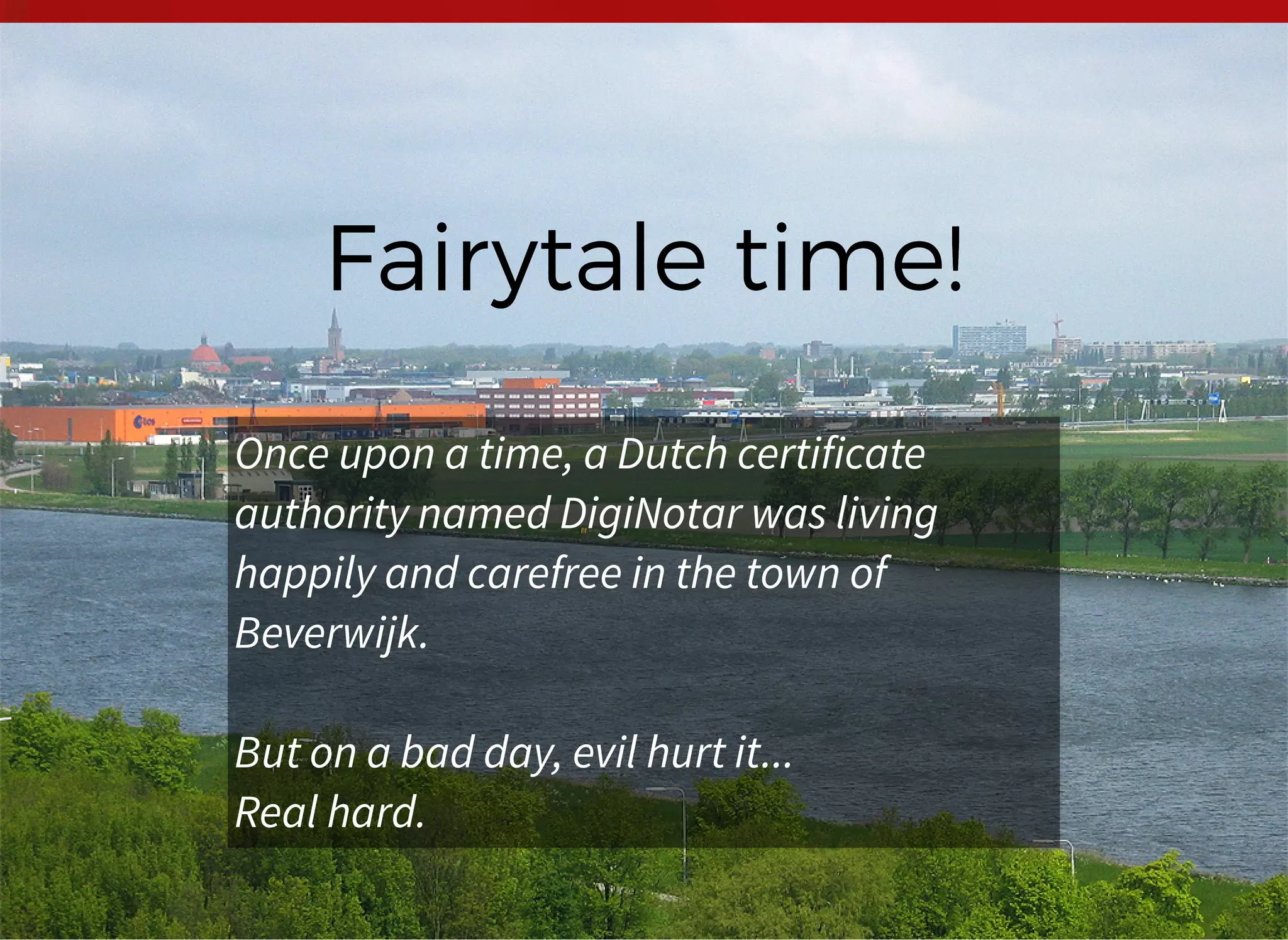
Fairytale time!Fairytale time!
Once upon a time, a Dutch certificate
authority named DigiNotar was living
happily and carefree in the town of
Beverwijk.
But on a bad day, evil hurt it...
Real hard.
An attacker compromised a webserver of
DigiNotar due to a vulnerability that is
present within the DotNetNuke so ware.
DotNetNuke version 4.8.2.0 is installed on
host winsrv119. This version is affected by a
file upload vulnerability.
Due to the weak security of Windows
passwords it must be assumed that the
attacker was able to compromise the
passwords [...] of the accounts found on the
system. On the system, [...] the domain
administrator account [...] is present.
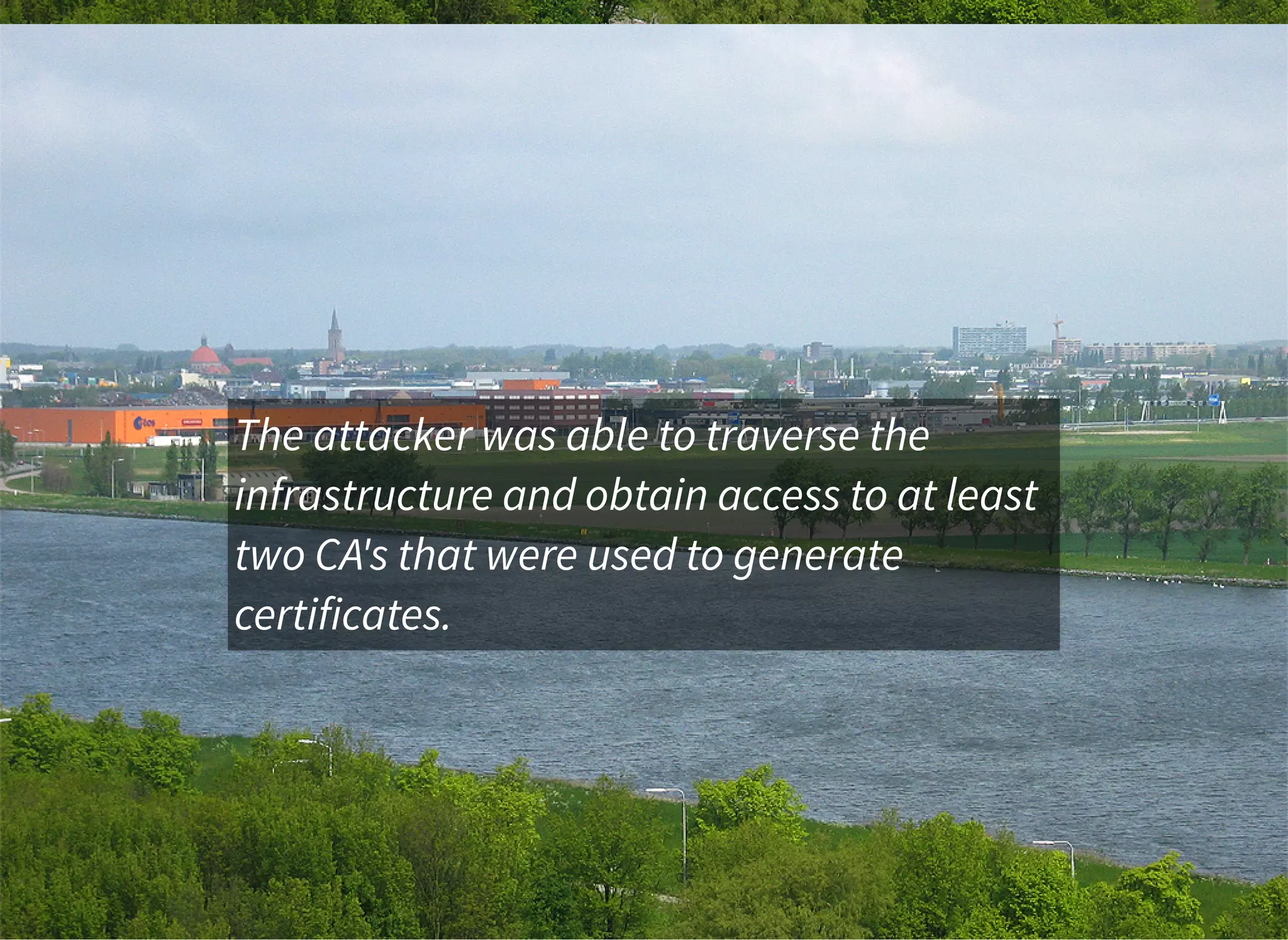
The attacker was able to traverse the
infrastructure and obtain access to at least
two CA's that were used to generate
certificates.
/** intentionally le blank */
Google blacklists 247 certificates in Chromium
Microso removes the DigiNotar root certificate
from all supported Windows-releases *
Mozilla revokes trust in the DigiNotar root
certificate in all supported versions
Apple issued Security Update 2011-005
 
Update Certificate Revocation Lists (except these
are self-signed)
Demo time!Demo time!
Trust (for what it's worth)
ToolsTools
curl -v -k <address>
openssl s_client -showcerts -servername
<address> -connect <address>:443
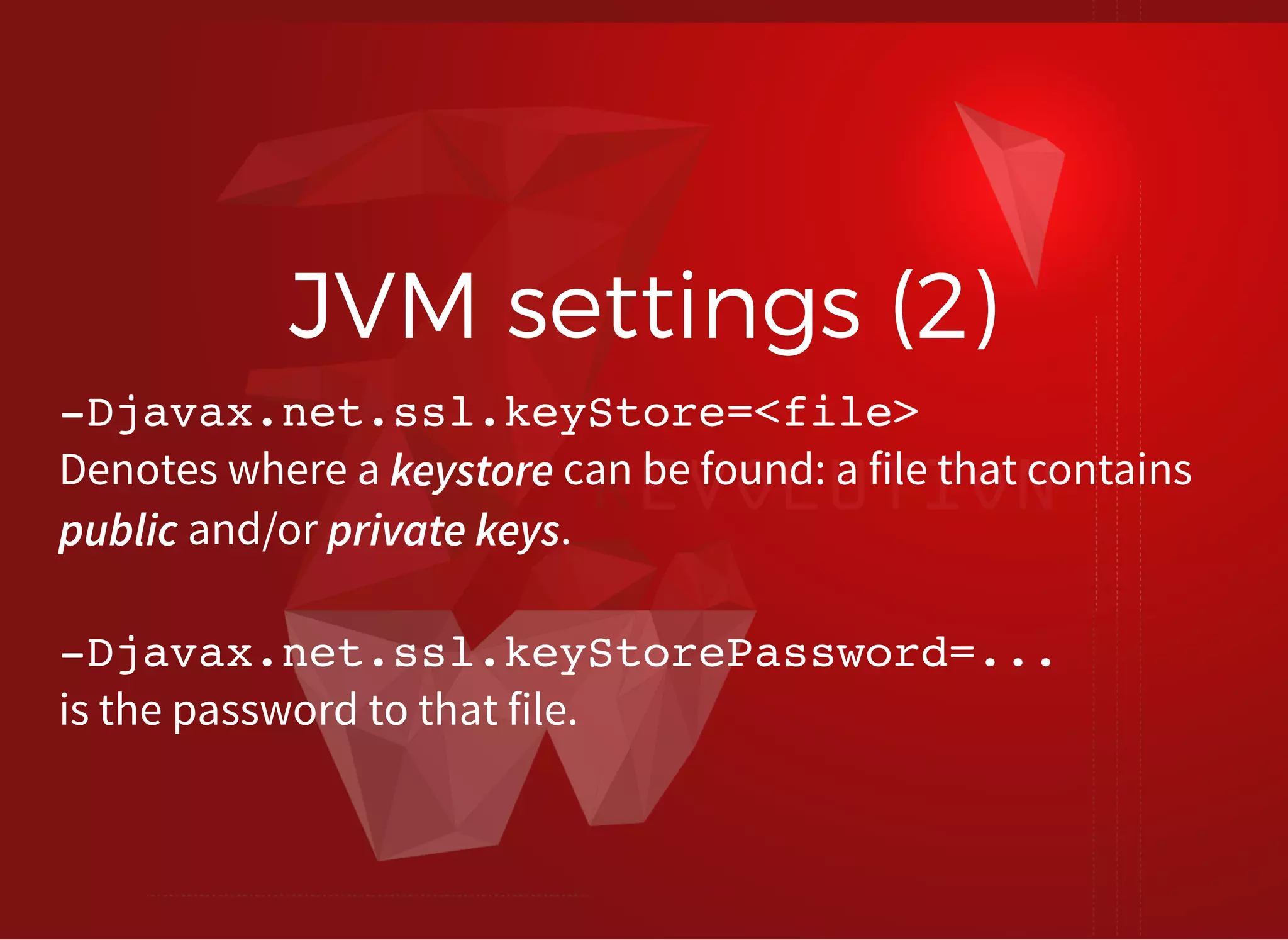
Denotes where a can be found: a file that contains
.
is the password to that file.
JVM settings (1)JVM settings (1)
-Djavax.net.ssl.trustStore=<file>
truststore
trusted certs
-Djavax.net.ssl.trustStorePassword=...
Denotes where a can be found: a file that contains
and/or .
is the password to that file.
JVM settings (2)JVM settings (2)
-Djavax.net.ssl.keyStore=<file>
keystore
public private keys
-Djavax.net.ssl.keyStorePassword=...
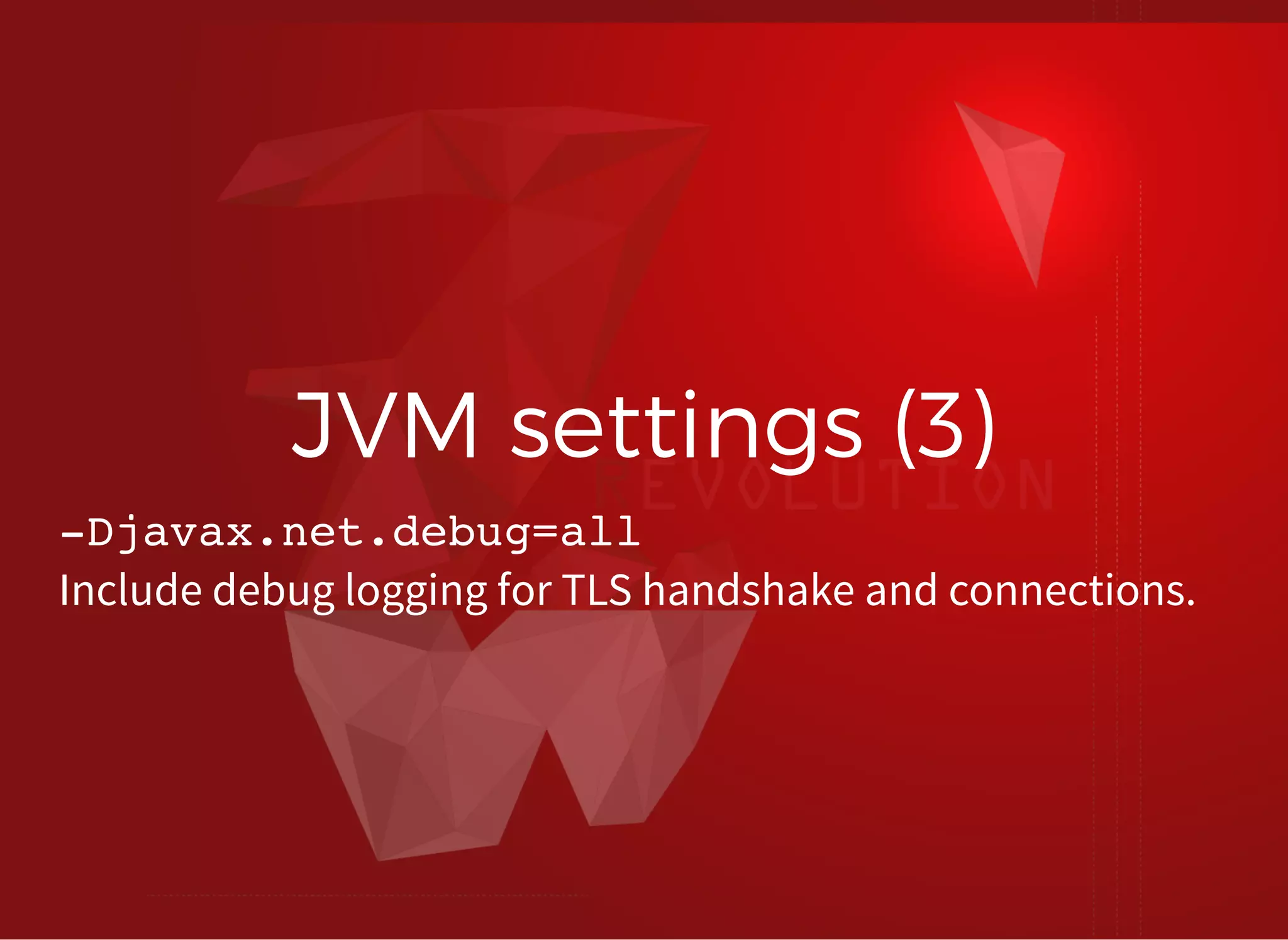
Include debug logging for TLS handshake and connections.
JVM settings (3)JVM settings (3)
-Djavax.net.debug=all
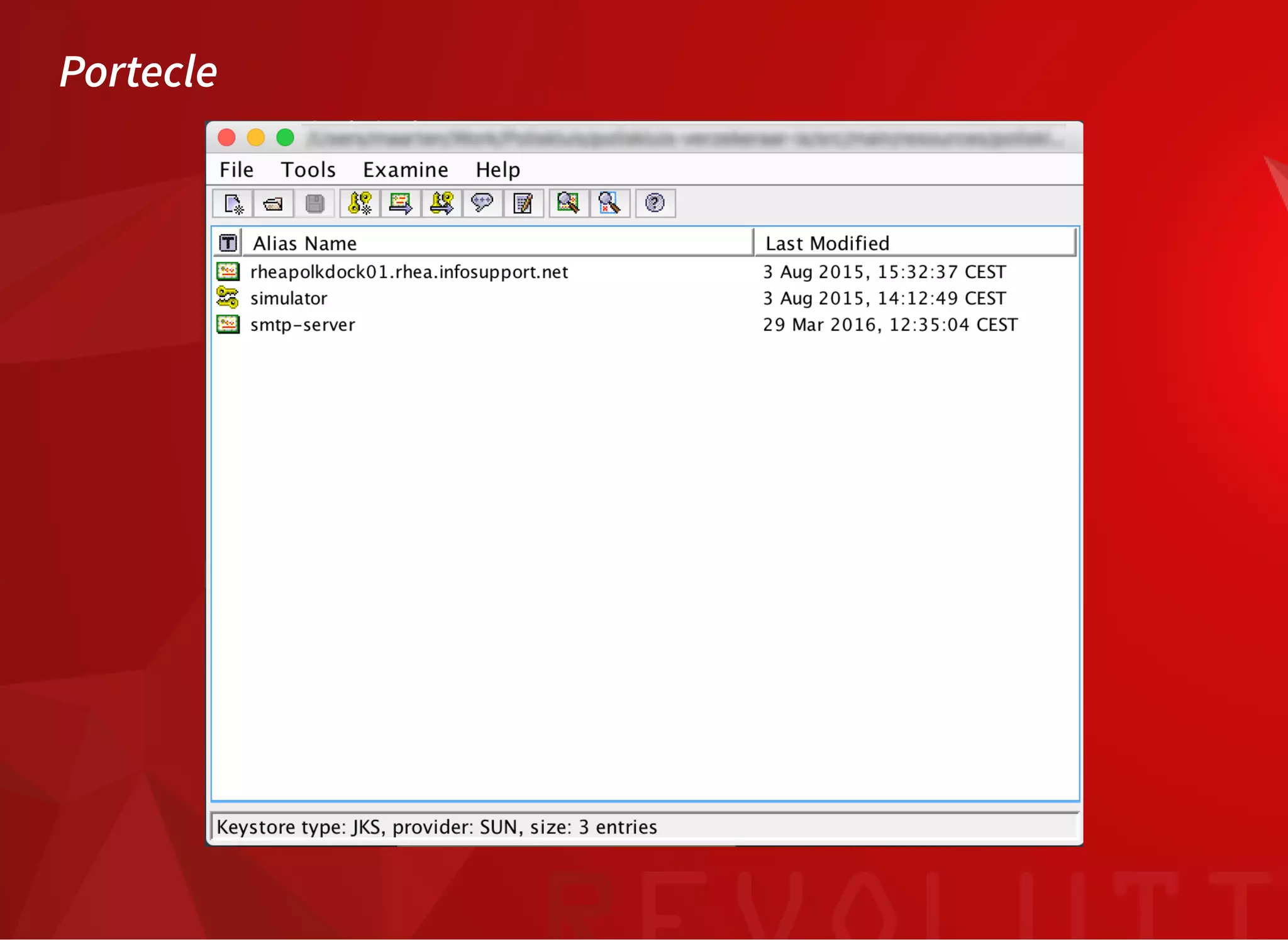
Portecle
#DevoxxFR
So longSo long
and thanks for all the fishand thanks for all the fish
Image attributionsImage attributions
Beverwijk by @ .
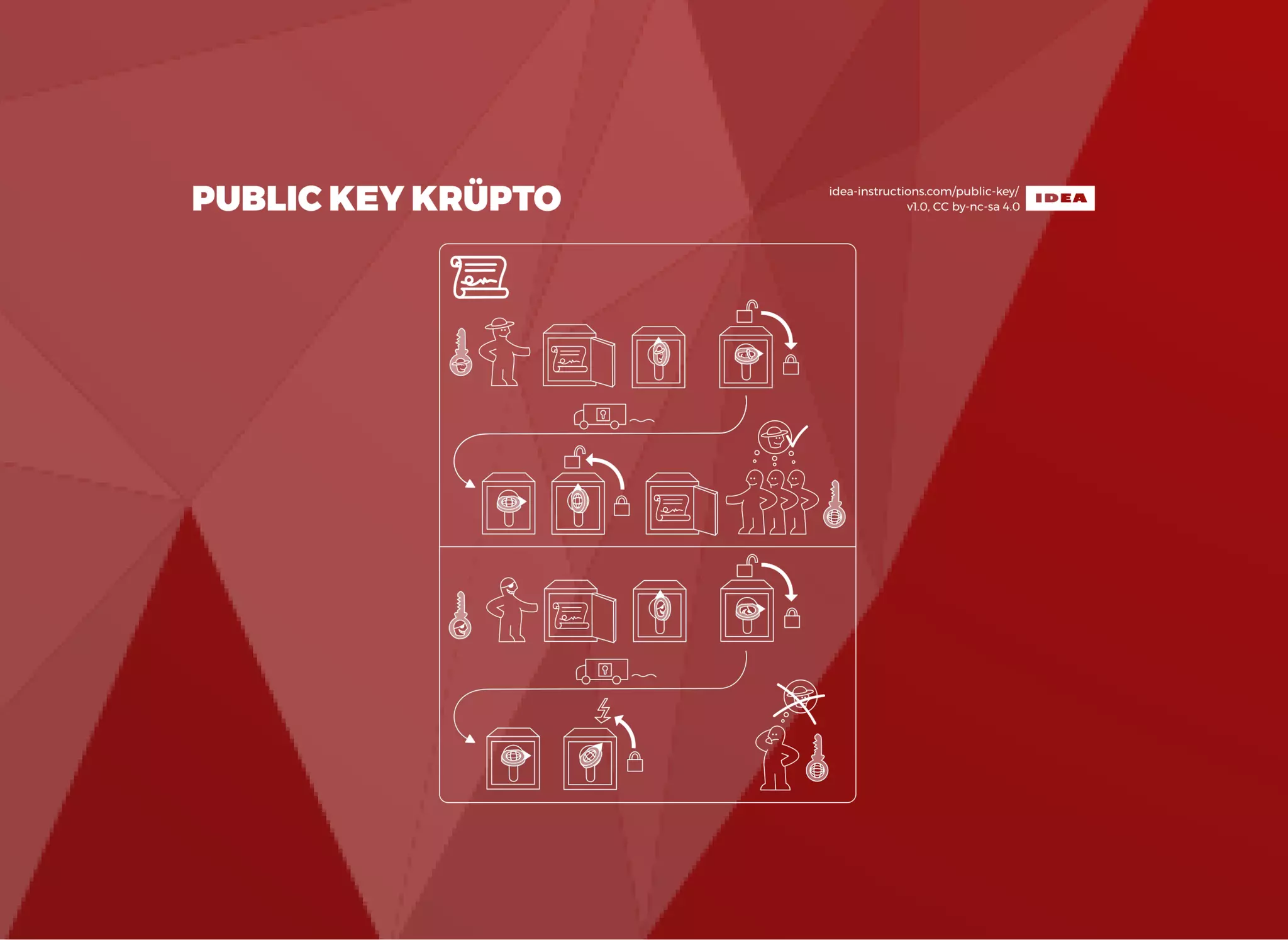
Public Key Krüpto by , , and ( )
Gerard Hogervorst Wikimedia Commons
Sándor P. Fekete Sebastian Morr Sebastian Stiller @ideainstruction

SSL/TLS for Mortals (Devoxx FR 2018)

  • 1.
    SSL/TLS for MortalsSSL/TLSfor Mortals @mthmuldersmaartenm@infosupport.com
  • 2.
    Troubleshooting time...Troubleshooting time... Exceptionin thread "main" javax.net.ssl.SSLHandshakeException: sun.security.validator.ValidatorException: PKIX path building failed: sun at sun.security.ssl.Alerts.getSSLException(Alerts.java:192) at sun.security.ssl.SSLSocketImpl.fatal(SSLSocketImpl.java:1949) at sun.security.ssl.Handshaker.fatalSE(Handshaker.java:302) at sun.security.ssl.Handshaker.fatalSE(Handshaker.java:296) at sun.security.ssl.ClientHandshaker.serverCertificate(ClientHandshaker.java:1506) at sun.security.ssl.ClientHandshaker.processMessage(ClientHandshaker.java:216) at sun.security.ssl.Handshaker.processLoop(Handshaker.java:979) at sun.security.ssl.Handshaker.process_record(Handshaker.java:914) at sun.security.ssl.SSLSocketImpl.readRecord(SSLSocketImpl.java:1062) at sun.security.ssl.SSLSocketImpl.performInitialHandshake(SSLSocketImpl.java:1375) at sun.security.ssl.SSLSocketImpl.startHandshake(SSLSocketImpl.java:1403) at sun.security.ssl.SSLSocketImpl.startHandshake(SSLSocketImpl.java:1387) at sun.net.www.protocol.https.HttpsClient.afterConnect(HttpsClient.java:559) at sun.net.www.protocol.https.AbstractDelegateHttpsURLConnection.connect(AbstractDelegateHttpsURLConnection.java:185) at sun.net.www.protocol.http.HttpURLConnection.getInputStream0(HttpURLConnection.java:1512) at sun.net.www.protocol.http.HttpURLConnection.getInputStream(HttpURLConnection.java:1440) at sun.net.www.protocol.https.HttpsURLConnectionImpl.getInputStream(HttpsURLConnectionImpl.java:254) at com.infosupport.maartenm.Demo.main(Demo.java:13) Caused by: sun.security.validator.ValidatorException: PKIX path building failed: sun.security.provider.certpath.SunCertPathBuilderExcepti at sun.security.validator.PKIXValidator.doBuild(PKIXValidator.java:387) at sun.security.validator.PKIXValidator.engineValidate(PKIXValidator.java:292) at sun.security.validator.Validator.validate(Validator.java:260) at sun.security.ssl.X509TrustManagerImpl.validate(X509TrustManagerImpl.java:324) at sun.security.ssl.X509TrustManagerImpl.checkTrusted(X509TrustManagerImpl.java:229) at sun.security.ssl.X509TrustManagerImpl.checkServerTrusted(X509TrustManagerImpl.java:124) at sun.security.ssl.ClientHandshaker.serverCertificate(ClientHandshaker.java:1488) ... 13 more Caused by: sun.security.provider.certpath.SunCertPathBuilderException: unable to find valid certification path to requested target at sun.security.provider.certpath.SunCertPathBuilder.build(SunCertPathBuilder.java:146) at sun.security.provider.certpath.SunCertPathBuilder.engineBuild(SunCertPathBuilder.java:131) at java.security.cert.CertPathBuilder.build(CertPathBuilder.java:280) at sun.security.validator.PKIXValidator.doBuild(PKIXValidator.java:382) ... 19 more
  • 3.
    Why bother?Why bother? UsingSSL/TLS correctly is o en hard to achieve ...and understand! Crucial for secure connection between systems Globally deployed (intra-)cloud applications
  • 4.
  • 5.
    SSL 1.0 never released SSL2.0 1995 - POODLE (2011) SSL 3.0 1996 - POODLE (2014) TLS 1.0 1999 - BEAST (2011) TLS 1.1 2006 TLS 1.2 2008 TLS 1.3 dra
  • 6.
  • 7.
    How to preventthis?How to prevent this? 1. public/private key encryption 2. signed certificates 3. certificate authorities
  • 8.
    1. public/private key1.public/private key encryptionencryption
  • 9.
  • 10.
  • 11.
    Math time!Math time! 1.Select two prime numbers: 2. Calculate modulo: 3. Select random number < modulo: 4. Find d, so that p = 11, q = 17 p ∗ q = 187 e = 3 (d ∗ e) − 1 mod (p − 1) ∗ (q − 1) = 0 320 mod 160 = 0 (321 − 1) mod (10 ∗ 16) = 0 (107 ∗ 3) = 321 ⇒d = 107 Note: varies with : whend e e = 75, ⇒ d = 183
  • 12.
    Now, what ifP and Q are unknown?Now, what if P and Q are unknown? 1. 2. Find d, so that p ∗ q = 299, e = 5 (d ∗ e) − 1 mod (p − 1) ∗ (q − 1) = 0 Pretty hard without knowing and !p q   p = 13, q = 23 (d ∗ e) − 1 mod (p − 1) ∗ (q − 1) = 0 1584 mod 264 = 0 (1585 − 1) mod (12 ∗ 22) = 0 (317 ∗ 5) = 1585 ⇒d = 317
  • 13.
    For big enoughand , finding those factors will cost an eternity! p q So we can distribute p ∗ q and even !e
  • 14.
    Encrypt the letter'Encrypt the letter 'GG''   p ∗ q = 187, e = 3, G ⇒ 7 = = 3437 e 7 3 343 mod 187 = 156
  • 15.
    Decrypt the message'Decrypt the message '156156'' Since we know and , we can calculate   p q d = 107 = ≈ 4.6 ∗156 d 156 107 10 234 mod 187 = 7156 107 7 ⇒ G
  • 16.
  • 17.
    Negotiating a secure connection Client  Server 1 ClientHello →   2   ← ServerHello 3   ← Certificate 4   ← ServerKeyExchange 5   ← ServerHelloDone 6 ClientKeyExchange →   7 ChangeCipherSpec →   8 Finished →   9   ← ChangeCipherSpec 10   ← Finished
  • 18.
    Demo time!Demo time! No-oneis eavesdropping!
  • 19.
    2. signed certificates2.signed certificates
  • 20.
  • 21.
    But wait... anyonecould create a certificate! So we also need Signature Algorithm Signature Issuer ... and a way to sign stuff
  • 22.
  • 23.
    A is amathematical relationship between a message , a private key and a public key . signature x sk pk   It consists of two functions: 1. signing function 2. verifying function t = f (sk, x) [accept, reject] = g(pk, t, x)   So, given and and knowing , we can tell if is indeed signed by . x t pk x sk
  • 24.
    3. certificate authorities3.certificate authorities
  • 25.
    An entity thatissues digital certificates, certifying the ownership of a public key by the subject of the certificate.
  • 26.
    "I can trustyou, because I trust John, and John trusts Alice, and Alice trusts you" I John ? Alice Who knows who "John" is? Many "John"'s in todays browsers and operating systems!
  • 27.
    Top-notch security procedures,including "key ceremonies" And yet...
  • 28.
    Fairytale time!Fairytale time! Onceupon a time, a Dutch certificate authority named DigiNotar was living happily and carefree in the town of Beverwijk. But on a bad day, evil hurt it... Real hard.
  • 29.
    An attacker compromiseda webserver of DigiNotar due to a vulnerability that is present within the DotNetNuke so ware. DotNetNuke version 4.8.2.0 is installed on host winsrv119. This version is affected by a file upload vulnerability.
  • 30.
    Due to theweak security of Windows passwords it must be assumed that the attacker was able to compromise the passwords [...] of the accounts found on the system. On the system, [...] the domain administrator account [...] is present.
  • 31.
    The attacker wasable to traverse the infrastructure and obtain access to at least two CA's that were used to generate certificates.
  • 32.
  • 33.
    Google blacklists 247certificates in Chromium Microso removes the DigiNotar root certificate from all supported Windows-releases * Mozilla revokes trust in the DigiNotar root certificate in all supported versions Apple issued Security Update 2011-005   Update Certificate Revocation Lists (except these are self-signed)
  • 34.
    Demo time!Demo time! Trust(for what it's worth)
  • 35.
    ToolsTools curl -v -k<address> openssl s_client -showcerts -servername <address> -connect <address>:443
  • 36.
    Denotes where acan be found: a file that contains . is the password to that file. JVM settings (1)JVM settings (1) -Djavax.net.ssl.trustStore=<file> truststore trusted certs -Djavax.net.ssl.trustStorePassword=...
  • 37.
    Denotes where acan be found: a file that contains and/or . is the password to that file. JVM settings (2)JVM settings (2) -Djavax.net.ssl.keyStore=<file> keystore public private keys -Djavax.net.ssl.keyStorePassword=...
  • 38.
    Include debug loggingfor TLS handshake and connections. JVM settings (3)JVM settings (3) -Djavax.net.debug=all
  • 39.
  • 40.
    #DevoxxFR So longSo long andthanks for all the fishand thanks for all the fish Image attributionsImage attributions Beverwijk by @ . Public Key Krüpto by , , and ( ) Gerard Hogervorst Wikimedia Commons Sándor P. Fekete Sebastian Morr Sebastian Stiller @ideainstruction