
© 2013 IBM Corporation
IBM Rational Solution for Systems and
Software Engineering
Embedded Software (ESW) Engineering Practices Introduction
© 2013 IBM Corporation
2
Product and System Innovation
Process Management and Enactment
The engine of lifecycle management
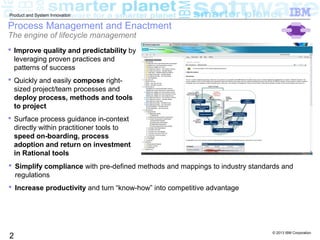
 Improve quality and predictability by
leveraging proven practices and
patterns of success
 Quickly and easily compose right-
sized project/team processes and
deploy process, methods and tools
to project
 Surface process guidance in-context
directly within practitioner tools to
speed on-boarding, process
adoption and return on investment
in Rational tools
 Simplify compliance with pre-defined methods and mappings to industry standards and
regulations
 Increase productivity and turn “know-how” into competitive advantage
© 2013 IBM Corporation
3
Product and System Innovation
Practices - modular solution components
Guidance for software & systems development, management, governance, and
more
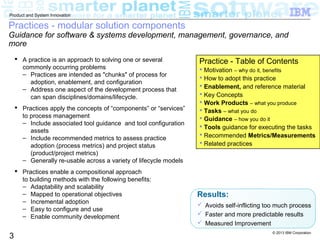
 A practice is an approach to solving one or several
commonly occurring problems
– Practices are intended as "chunks" of process for
adoption, enablement, and configuration
– Address one aspect of the development process that
can span disciplines/domains/lifecycle.
 Practices apply the concepts of “components” or “services”
to process management
– Include associated tool guidance and tool configuration
assets
– Include recommended metrics to assess practice
adoption (process metrics) and project status
(product/project metrics)
– Generally re-usable across a variety of lifecycle models
 Practices enable a compositional approach
to building methods with the following benefits:
– Adaptability and scalability
– Mapped to operational objectives
– Incremental adoption
– Easy to configure and use
– Enable community development
Results:
 Avoids self-inflicting too much process
 Faster and more predictable results
 Measured Improvement
Practice - Table of Contents
 Motivation – why do it, benefits
 How to adopt this practice
 Enablement, and reference material
 Key Concepts
 Work Products – what you produce
 Tasks – what you do
 Guidance – how you do it
 Tools guidance for executing the tasks
 Recommended Metrics/Measurements
 Related practices
© 2013 IBM Corporation
4
Product and System Innovation
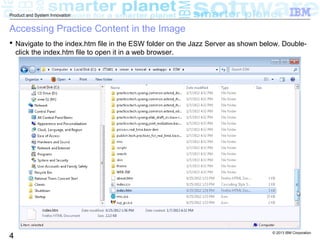
Accessing Practice Content in the Image
 Navigate to the index.htm file in the ESW folder on the Jazz Server as shown below. Double-
click the index.htm file to open it in a web browser.
© 2013 IBM Corporation
5
Product and System Innovation
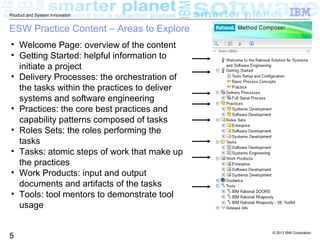
ESW Practice Content – Areas to Explore
• Welcome Page: overview of the content
• Getting Started: helpful information to
initiate a project
• Delivery Processes: the orchestration of
the tasks within the practices to deliver
systems and software engineering
• Practices: the core best practices and
capability patterns composed of tasks
• Roles Sets: the roles performing the
tasks
• Tasks: atomic steps of work that make up
the practices
• Work Products: input and output
documents and artifacts of the tasks
• Tools: tool mentors to demonstrate tool
usage
© 2013 IBM Corporation
6
Product and System Innovation
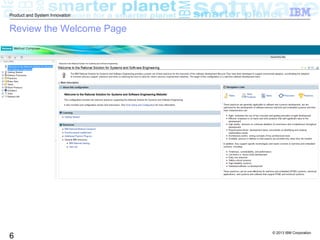
Review the Welcome Page
© 2013 IBM Corporation
7
Product and System Innovation
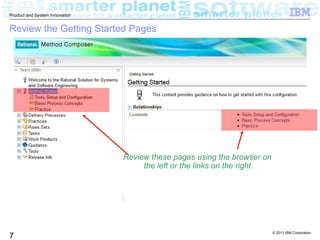
Review the Getting Started Pages
Review these pages using the browser on
the left or the links on the right
© 2013 IBM Corporation
8
Product and System Innovation
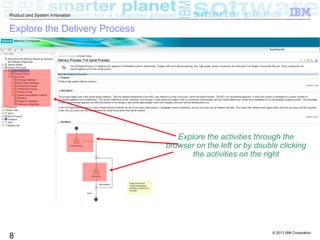
Explore the Delivery Process
Explore the activities through the
browser on the left or by double clicking
the activities on the right
© 2013 IBM Corporation
9
Product and System Innovation
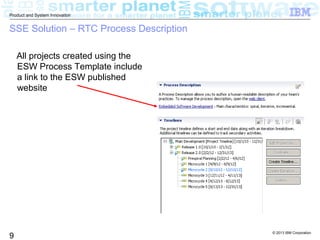
SSE Solution – RTC Process Description
All projects created using the
ESW Process Template include
a link to the ESW published
website
© 2013 IBM Corporation
10
Product and System Innovation
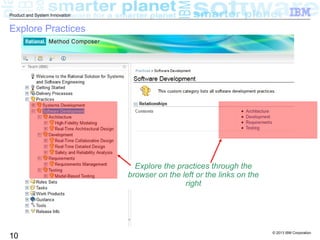
Explore Practices
Explore the practices through the
browser on the left or the links on the
right
© 2013 IBM Corporation
11
Product and System Innovation
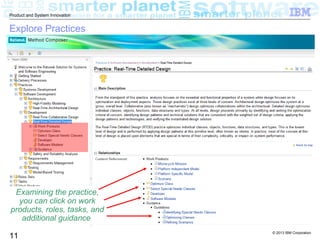
Explore Practices
Examining the practice,
you can click on work
products, roles, tasks, and
additional guidance
© 2013 IBM Corporation
12
Product and System Innovation
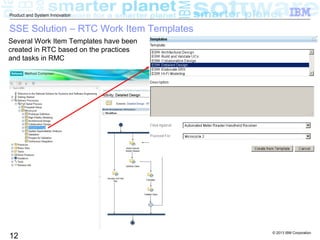
SSE Solution – RTC Work Item Templates
Several Work Item Templates have been
created in RTC based on the practices
and tasks in RMC
© 2013 IBM Corporation
13
Product and System Innovation
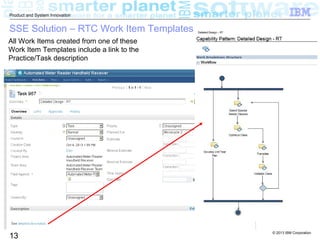
SSE Solution – RTC Work Item Templates
All Work Items created from one of these
Work Item Templates include a link to the
Practice/Task description
© 2013 IBM Corporation
14
Product and System Innovation
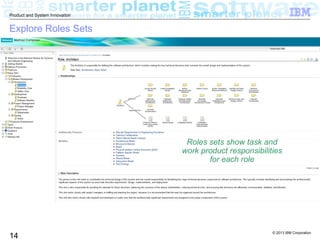
Explore Roles Sets
Roles sets show task and
work product responsibilities
for each role
© 2013 IBM Corporation
15
Product and System Innovation
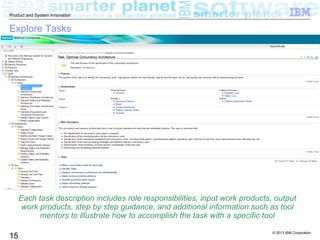
Explore Tasks
Each task description includes role responsibilities, input work products, output
work products, step by step guidance, and additional information such as tool
mentors to illustrate how to accomplish the task with a specific tool
© 2013 IBM Corporation
16
Product and System Innovation
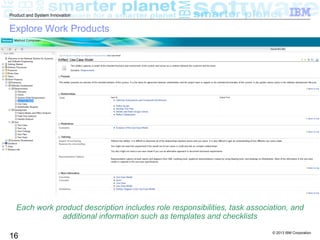
Explore Work Products
Each work product description includes role responsibilities, task association, and
additional information such as templates and checklists
© 2013 IBM Corporation
17
Product and System Innovation
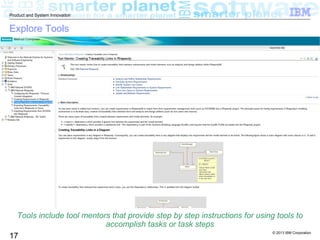
Explore Tools
Tools include tool mentors that provide step by step instructions for using tools to
accomplish tasks or task steps
© 2013 IBM Corporation
18
Product and System Innovation
© Copyright IBM Corporation 2011. All rights reserved. The information contained in these materials is provided for informational purposes only, and is provided AS IS without warranty of any kind,
express or implied. IBM shall not be responsible for any damages arising out of the use of, or otherwise related to, these materials. Nothing contained in these materials is intended to, nor shall have
the effect of, creating any warranties or representations from IBM or its suppliers or licensors, or altering the terms and conditions of the applicable license agreement governing the use of IBM
software. References in these materials to IBM products, programs, or services do not imply that they will be available in all countries in which IBM operates. Product release dates and/or capabilities
referenced in these materials may change at any time at IBM’s sole discretion based on market opportunities or other factors, and are not intended to be a commitment to future product or feature
availability in any way. IBM, the IBM logo, Rational, the Rational logo, Telelogic, the Telelogic logo, and other IBM products and services are trademarks of the International Business Machines
Corporation, in the United States, other countries or both. Other company, product, or service names may be trademarks or service marks of others.

SSE ESW Practices Introduction

  • 1.
    © 2013 IBMCorporation IBM Rational Solution for Systems and Software Engineering Embedded Software (ESW) Engineering Practices Introduction
  • 2.
    © 2013 IBMCorporation 2 Product and System Innovation Process Management and Enactment The engine of lifecycle management  Improve quality and predictability by leveraging proven practices and patterns of success  Quickly and easily compose right- sized project/team processes and deploy process, methods and tools to project  Surface process guidance in-context directly within practitioner tools to speed on-boarding, process adoption and return on investment in Rational tools  Simplify compliance with pre-defined methods and mappings to industry standards and regulations  Increase productivity and turn “know-how” into competitive advantage
  • 3.
    © 2013 IBMCorporation 3 Product and System Innovation Practices - modular solution components Guidance for software & systems development, management, governance, and more  A practice is an approach to solving one or several commonly occurring problems – Practices are intended as "chunks" of process for adoption, enablement, and configuration – Address one aspect of the development process that can span disciplines/domains/lifecycle.  Practices apply the concepts of “components” or “services” to process management – Include associated tool guidance and tool configuration assets – Include recommended metrics to assess practice adoption (process metrics) and project status (product/project metrics) – Generally re-usable across a variety of lifecycle models  Practices enable a compositional approach to building methods with the following benefits: – Adaptability and scalability – Mapped to operational objectives – Incremental adoption – Easy to configure and use – Enable community development Results:  Avoids self-inflicting too much process  Faster and more predictable results  Measured Improvement Practice - Table of Contents  Motivation – why do it, benefits  How to adopt this practice  Enablement, and reference material  Key Concepts  Work Products – what you produce  Tasks – what you do  Guidance – how you do it  Tools guidance for executing the tasks  Recommended Metrics/Measurements  Related practices
  • 4.
    © 2013 IBMCorporation 4 Product and System Innovation Accessing Practice Content in the Image  Navigate to the index.htm file in the ESW folder on the Jazz Server as shown below. Double- click the index.htm file to open it in a web browser.
  • 5.
    © 2013 IBMCorporation 5 Product and System Innovation ESW Practice Content – Areas to Explore • Welcome Page: overview of the content • Getting Started: helpful information to initiate a project • Delivery Processes: the orchestration of the tasks within the practices to deliver systems and software engineering • Practices: the core best practices and capability patterns composed of tasks • Roles Sets: the roles performing the tasks • Tasks: atomic steps of work that make up the practices • Work Products: input and output documents and artifacts of the tasks • Tools: tool mentors to demonstrate tool usage
  • 6.
    © 2013 IBMCorporation 6 Product and System Innovation Review the Welcome Page
  • 7.
    © 2013 IBMCorporation 7 Product and System Innovation Review the Getting Started Pages Review these pages using the browser on the left or the links on the right
  • 8.
    © 2013 IBMCorporation 8 Product and System Innovation Explore the Delivery Process Explore the activities through the browser on the left or by double clicking the activities on the right
  • 9.
    © 2013 IBMCorporation 9 Product and System Innovation SSE Solution – RTC Process Description All projects created using the ESW Process Template include a link to the ESW published website
  • 10.
    © 2013 IBMCorporation 10 Product and System Innovation Explore Practices Explore the practices through the browser on the left or the links on the right
  • 11.
    © 2013 IBMCorporation 11 Product and System Innovation Explore Practices Examining the practice, you can click on work products, roles, tasks, and additional guidance
  • 12.
    © 2013 IBMCorporation 12 Product and System Innovation SSE Solution – RTC Work Item Templates Several Work Item Templates have been created in RTC based on the practices and tasks in RMC
  • 13.
    © 2013 IBMCorporation 13 Product and System Innovation SSE Solution – RTC Work Item Templates All Work Items created from one of these Work Item Templates include a link to the Practice/Task description
  • 14.
    © 2013 IBMCorporation 14 Product and System Innovation Explore Roles Sets Roles sets show task and work product responsibilities for each role
  • 15.
    © 2013 IBMCorporation 15 Product and System Innovation Explore Tasks Each task description includes role responsibilities, input work products, output work products, step by step guidance, and additional information such as tool mentors to illustrate how to accomplish the task with a specific tool
  • 16.
    © 2013 IBMCorporation 16 Product and System Innovation Explore Work Products Each work product description includes role responsibilities, task association, and additional information such as templates and checklists
  • 17.
    © 2013 IBMCorporation 17 Product and System Innovation Explore Tools Tools include tool mentors that provide step by step instructions for using tools to accomplish tasks or task steps
  • 18.
    © 2013 IBMCorporation 18 Product and System Innovation © Copyright IBM Corporation 2011. All rights reserved. The information contained in these materials is provided for informational purposes only, and is provided AS IS without warranty of any kind, express or implied. IBM shall not be responsible for any damages arising out of the use of, or otherwise related to, these materials. Nothing contained in these materials is intended to, nor shall have the effect of, creating any warranties or representations from IBM or its suppliers or licensors, or altering the terms and conditions of the applicable license agreement governing the use of IBM software. References in these materials to IBM products, programs, or services do not imply that they will be available in all countries in which IBM operates. Product release dates and/or capabilities referenced in these materials may change at any time at IBM’s sole discretion based on market opportunities or other factors, and are not intended to be a commitment to future product or feature availability in any way. IBM, the IBM logo, Rational, the Rational logo, Telelogic, the Telelogic logo, and other IBM products and services are trademarks of the International Business Machines Corporation, in the United States, other countries or both. Other company, product, or service names may be trademarks or service marks of others.