Dr.Rupali Ahluwalia
(Dept. Of Commerce)
St.Aloysius College(Auto.) Jabalpur
Dr.Rupali Ahluwalia
(Dept. Of Commerce)
St.Aloysius College(Auto.) Jabalpur
IntroductionIntroduction
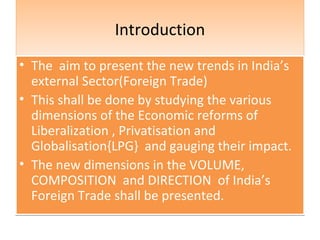
• The aim to present the new trends in India’s
external Sector(Foreign Trade)
• This shall be done by studying the various
dimensions of the Economic reforms of
Liberalization , Privatisation and
Globalisation{LPG} and gauging their impact.
• The new dimensions in the VOLUME,
COMPOSITION and DIRECTION of India’s
Foreign Trade shall be presented.
• The aim to present the new trends in India’s
external Sector(Foreign Trade)
• This shall be done by studying the various
dimensions of the Economic reforms of
Liberalization , Privatisation and
Globalisation{LPG} and gauging their impact.
• The new dimensions in the VOLUME,
COMPOSITION and DIRECTION of India’s
Foreign Trade shall be presented.
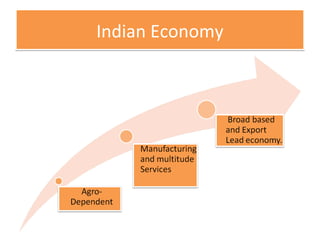
Indian EconomyIndian Economy
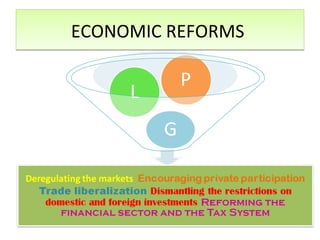
ECONOMIC REFORMSECONOMIC REFORMS
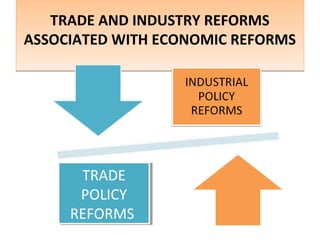
TRADE AND INDUSTRY REFORMS
ASSOCIATED WITH ECONOMIC REFORMS
TRADE AND INDUSTRY REFORMS
ASSOCIATED WITH ECONOMIC REFORMS
TRADE
POLICY
REFORMS
TRADE
POLICY
REFORMS
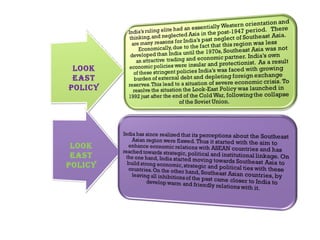
LOOK
EAST
POLICY
LOOK
EAST
POLICY
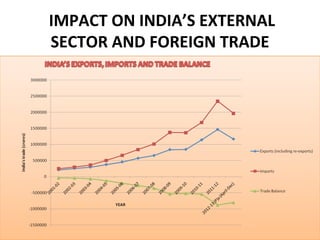
IMPACT ON INDIA’S EXTERNAL
SECTOR AND FOREIGN TRADE
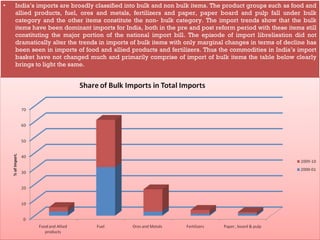
• India’s imports are broadly classified into bulk and non bulk items. The product groups such as food and
allied products, fuel, ores and metals, fertilizers and paper, paper board and pulp fall under bulk
category and the other items constitute the non- bulk category. The import trends show that the bulk
items have been dominant imports for India, both in the pre and post reform period with these items still
constituting the major portion of the national import bill. The episode of import librelisation did not
dramatically alter the trends in imports of bulk items with only marginal changes in terms of decline has
been seen in imports of food and allied products and fertilizers. Thus the commodities in India’s import
basket have not changed much and primarily comprise of import of bulk items the table below clearly
brings to light the same.
• India’s imports are broadly classified into bulk and non bulk items. The product groups such as food and
allied products, fuel, ores and metals, fertilizers and paper, paper board and pulp fall under bulk
category and the other items constitute the non- bulk category. The import trends show that the bulk
items have been dominant imports for India, both in the pre and post reform period with these items still
constituting the major portion of the national import bill. The episode of import librelisation did not
dramatically alter the trends in imports of bulk items with only marginal changes in terms of decline has
been seen in imports of food and allied products and fertilizers. Thus the commodities in India’s import
basket have not changed much and primarily comprise of import of bulk items the table below clearly
brings to light the same.
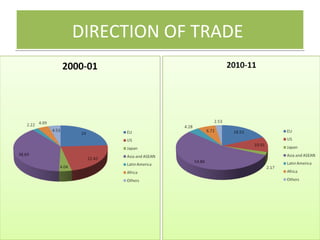
DIRECTION OF TRADEDIRECTION OF TRADE
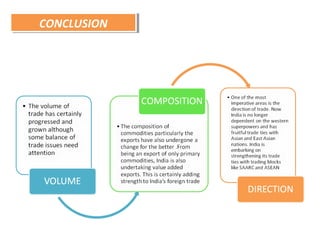
CONCLUSIONCONCLUSION
HAVE A GREAT DAY
GOD BLESS

Ss lpg economic reforms in india –

  • 1.
    Dr.Rupali Ahluwalia (Dept. OfCommerce) St.Aloysius College(Auto.) Jabalpur Dr.Rupali Ahluwalia (Dept. Of Commerce) St.Aloysius College(Auto.) Jabalpur
  • 2.
    IntroductionIntroduction • The aimto present the new trends in India’s external Sector(Foreign Trade) • This shall be done by studying the various dimensions of the Economic reforms of Liberalization , Privatisation and Globalisation{LPG} and gauging their impact. • The new dimensions in the VOLUME, COMPOSITION and DIRECTION of India’s Foreign Trade shall be presented. • The aim to present the new trends in India’s external Sector(Foreign Trade) • This shall be done by studying the various dimensions of the Economic reforms of Liberalization , Privatisation and Globalisation{LPG} and gauging their impact. • The new dimensions in the VOLUME, COMPOSITION and DIRECTION of India’s Foreign Trade shall be presented.
  • 3.
  • 4.
  • 5.
    TRADE AND INDUSTRYREFORMS ASSOCIATED WITH ECONOMIC REFORMS TRADE AND INDUSTRY REFORMS ASSOCIATED WITH ECONOMIC REFORMS TRADE POLICY REFORMS TRADE POLICY REFORMS
  • 10.
  • 13.
    IMPACT ON INDIA’SEXTERNAL SECTOR AND FOREIGN TRADE
  • 15.
    • India’s importsare broadly classified into bulk and non bulk items. The product groups such as food and allied products, fuel, ores and metals, fertilizers and paper, paper board and pulp fall under bulk category and the other items constitute the non- bulk category. The import trends show that the bulk items have been dominant imports for India, both in the pre and post reform period with these items still constituting the major portion of the national import bill. The episode of import librelisation did not dramatically alter the trends in imports of bulk items with only marginal changes in terms of decline has been seen in imports of food and allied products and fertilizers. Thus the commodities in India’s import basket have not changed much and primarily comprise of import of bulk items the table below clearly brings to light the same. • India’s imports are broadly classified into bulk and non bulk items. The product groups such as food and allied products, fuel, ores and metals, fertilizers and paper, paper board and pulp fall under bulk category and the other items constitute the non- bulk category. The import trends show that the bulk items have been dominant imports for India, both in the pre and post reform period with these items still constituting the major portion of the national import bill. The episode of import librelisation did not dramatically alter the trends in imports of bulk items with only marginal changes in terms of decline has been seen in imports of food and allied products and fertilizers. Thus the commodities in India’s import basket have not changed much and primarily comprise of import of bulk items the table below clearly brings to light the same.
  • 16.
  • 17.
  • 18.
    HAVE A GREATDAY GOD BLESS