4 S March 2014 www.retailbankerinternational.com
INTERVIEW: SANJOY SEN, ANZ Retail Banker International
O
ver five years ago, at the start of
the 2008 financial year, Australia’s
fourth-largest bank by assets, ANZ,
embarked on a strategic transfor-
mation which recognised that there was
a unique opportunity to create value for
shareholders by becoming a super region-
al bank: a bank of global quality with a
regional focus.
The move recognised that a once-in-a-
century shift was underway in the global
economy as growth opportunities moved
from the developed economies of the West
to Asian economies and China in particular.
The transformative initiative was adopt-
ed at the wake of the 2008 crisis with the
aim of indicating to customers its global
standard but regional focus. This has prov-
en to be a successful strategy, building the
bank’s credibility in the industry.
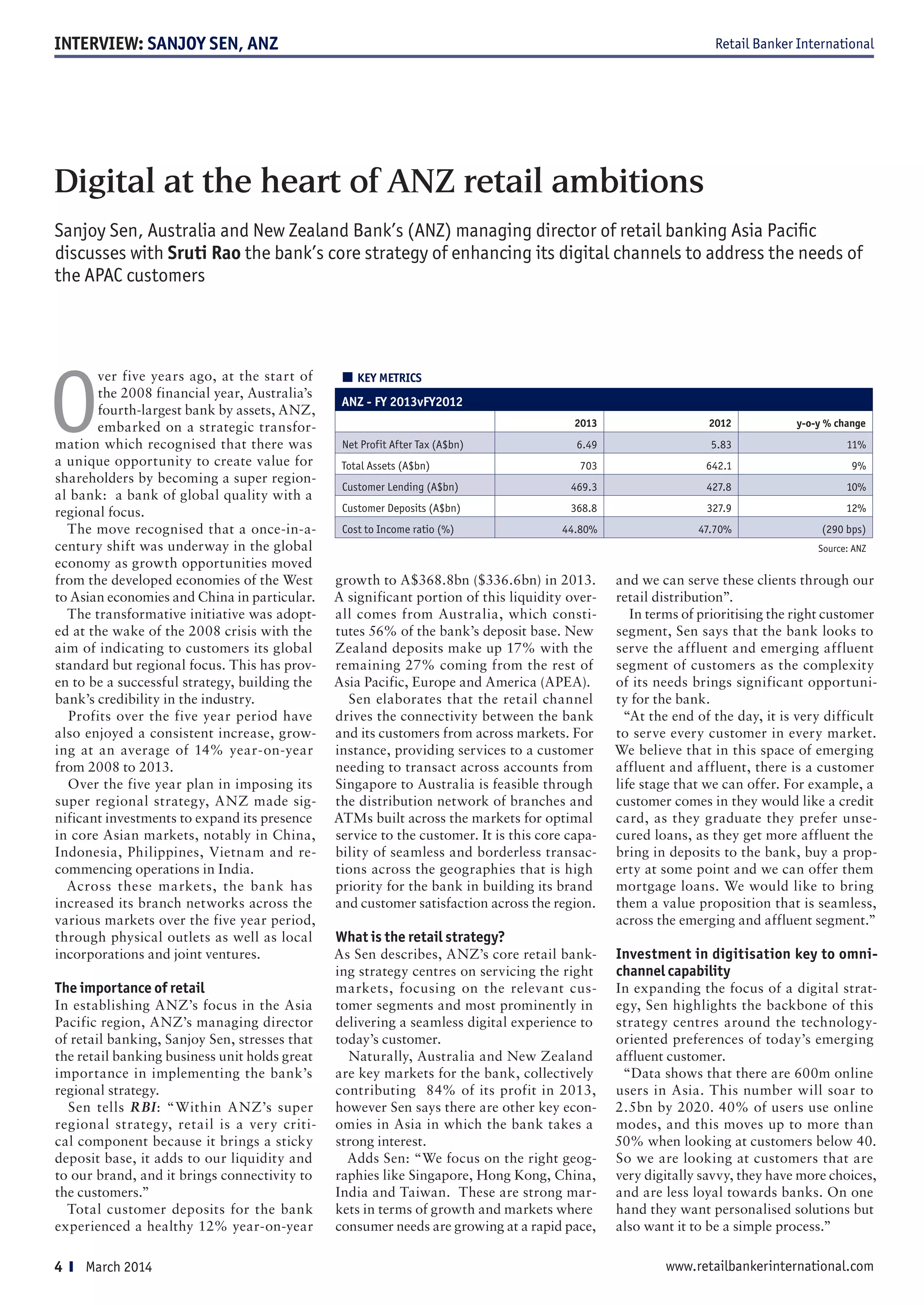
Profits over the five year period have
also enjoyed a consistent increase, grow-
ing at an average of 14% year-on-year
from 2008 to 2013.
Over the five year plan in imposing its
super regional strategy, ANZ made sig-
nificant investments to expand its presence
in core Asian markets, notably in China,
Indonesia, Philippines, Vietnam and re-
commencing operations in India.
Across these markets, the bank has
increased its branch networks across the
various markets over the five year period,
through physical outlets as well as local
incorporations and joint ventures.
The importance of retail
In establishing ANZ’s focus in the Asia
Pacific region, ANZ’s managing director
of retail banking, Sanjoy Sen, stresses that
the retail banking business unit holds great
importance in implementing the bank’s
regional strategy.
Sen tells RBI: “Within ANZ’s super
regional strategy, retail is a very criti-
cal component because it brings a sticky
deposit base, it adds to our liquidity and
to our brand, and it brings connectivity to
the customers.”
Total customer deposits for the bank
experienced a healthy 12% year-on-year
growth to A$368.8bn ($336.6bn) in 2013.
A significant portion of this liquidity over-
all comes from Australia, which consti-
tutes 56% of the bank’s deposit base. New
Zealand deposits make up 17% with the
remaining 27% coming from the rest of
Asia Pacific, Europe and America (APEA).
Sen elaborates that the retail channel
drives the connectivity between the bank
and its customers from across markets. For
instance, providing services to a customer
needing to transact across accounts from
Singapore to Australia is feasible through
the distribution network of branches and
ATMs built across the markets for optimal
service to the customer. It is this core capa-
bility of seamless and borderless transac-
tions across the geographies that is high
priority for the bank in building its brand
and customer satisfaction across the region.
What is the retail strategy?
As Sen describes, ANZ’s core retail bank-
ing strategy centres on servicing the right
markets, focusing on the relevant cus-
tomer segments and most prominently in
delivering a seamless digital experience to
today’s customer.
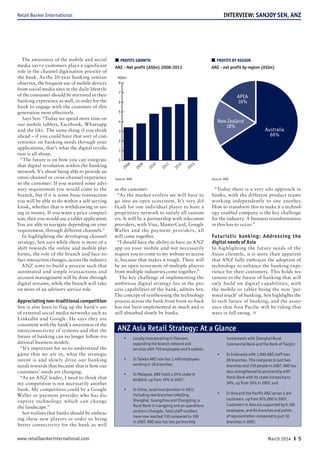
Naturally, Australia and New Zealand
are key markets for the bank, collectively
contributing 84% of its profit in 2013,
however Sen says there are other key econ-
omies in Asia in which the bank takes a
strong interest.
Adds Sen: “We focus on the right geog-
raphies like Singapore, Hong Kong, China,
India and Taiwan. These are strong mar-
kets in terms of growth and markets where
consumer needs are growing at a rapid pace,
and we can serve these clients through our
retail distribution”.
In terms of prioritising the right customer
segment, Sen says that the bank looks to
serve the affluent and emerging affluent
segment of customers as the complexity
of its needs brings significant opportuni-
ty for the bank.
“At the end of the day, it is very difficult
to serve every customer in every market.
We believe that in this space of emerging
affluent and affluent, there is a customer
life stage that we can offer. For example, a
customer comes in they would like a credit
card, as they graduate they prefer unse-
cured loans, as they get more affluent the
bring in deposits to the bank, buy a prop-
erty at some point and we can offer them
mortgage loans. We would like to bring
them a value proposition that is seamless,
across the emerging and affluent segment.”
Investment in digitisation key to omni-
channel capability
In expanding the focus of a digital strat-
egy, Sen highlights the backbone of this
strategy centres around the technology-
oriented preferences of today’s emerging
affluent customer.
“Data shows that there are 600m online
users in Asia. This number will soar to
2.5bn by 2020. 40% of users use online
modes, and this moves up to more than
50% when looking at customers below 40.
So we are looking at customers that are
very digitally savvy, they have more choices,
and are less loyal towards banks. On one
hand they want personalised solutions but
also want it to be a simple process.”
Digital at the heart of ANZ retail ambitions
Sanjoy Sen, Australia and New Zealand Bank’s (ANZ) managing director of retail banking Asia Pacific
discusses with Sruti Rao the bank’s core strategy of enhancing its digital channels to address the needs of
the APAC customers
I KEY METRICS
ANZ - FY 2013vFY2012
2013 2012 y-o-y % change
Net Profit After Tax (A$bn) 6.49 5.83 11%
Total Assets (A$bn) 703 642.1 9%
Customer Lending (A$bn) 469.3 427.8 10%
Customer Deposits (A$bn) 368.8 327.9 12%
Cost to Income ratio (%) 44.80% 47.70% (290 bps)
Source: ANZ
RBI 699(2).indd 4 19/03/2014 14:14:47
March 2014 S 5www.retailbankerinternational.com
INTERVIEW: SANJOY SEN, ANZRetail Banker International
The awareness of the mobile and social
media savvy customers plays a significant
role in the channel digitisation priority of
the bank. As the 20-year banking veteran
observes, the frequent use of mobile devices
from social media sites in the daily lifestyle
of the consumer should be mirrored in their
banking experience as well, in order for the
bank to engage with the customer of this
generation most effectively.
Says Sen: “Today we spend more time on
our mobile tablets, Facebook, Whatsapp
and the like. The same thing if you think
ahead – if you could have that sort of con-
venience on banking needs through your
applications, that’s what the digital revolu-
tion is all about.
“The future is on how you can integrate
that digital revolution within the banking
network. It’s about being able to provide an
omni-channel or cross-channel experience
to the customer. If you wanted some advi-
sory requirement you would come to the
branch, but if it is some basic transaction
you will be able to do within a self-serving
kiosk, whether that is withdrawing or sav-
ing in money. If you want a price compari-
son, then you would use a tablet application.
You are able to navigate depending on your
requirement, through different channels.“
In highlighting the developing channel
strategy, Sen says while there is more of a
shift towards the online and mobile plat-
forms, the role of the branch and face-to-
face interaction changes, across the industry.
ANZ aims to build a process such that
automated and simple transactions and
account management will be done through
digital streams, while the branch will take
on more of an advisory service role.
Appreciating non-traditional competition
Sen is also keen to flag up the bank’s use
of external social media networks such as
LinkedIn and Google. He says they are
consistent with the bank’s awareness of the
interconnectivity of systems and that the
future of banking can no longer follow tra-
ditional business models.
“It’s important for us to understand the
game that we are in, what the strategic
intent is and slowly drive our banking
needs towards that because that is how our
customers’ needs are changing.
“As an ANZ leader, I need to think that
my competition is not necessarily another
bank. My competition could be a Google
Wallet or payment provider who has dis-
ruptive technology which can change
the landscape.”
Sen realises that banks should be embrac-
ing these new players in order to bring
better connectivity for the bank as well
as the customer.
“As the market evolves we will have to
go into an open ecosystem. It’s very dif-
ficult for one individual player to have a
proprietary network to satisfy all custom-
ers. It will be a partnership with telecomm
providers, with Visa, MasterCard, Google
Wallet and the payment providers, all
will come together.
“I should have the ability to have an ANZ
app on your mobile and not necessarily
require you to come to my website to access
it, because that makes it tough. There will
be an open ecosystem of multiple players
from multiple industries come together.”
The key challenge of implementing the
ambitious digital strategy lies in the pro-
cess capabilities of the bank, admits Sen.
The concept of synthesising the technology
process across the bank from front-to-back
has not been implemented as much and is
still absorbed slowly by banks.
“Today there is a very silo approach in
banks, with the different product teams
working independently to one another.
How to transform this to make it a technol-
ogy enabled company is the key challenge
for the industry. A business transformation
in this has to occur.”
Futuristic banking: Addressing the
digital needs of Asia
In highlighting the future needs of the
Asian clientele, it is more than apparent
that ANZ fully embraces the adoption of
technology to enhance the banking expe-
rience for their customers. This holds tes-
tament to the future of banking that will
only build on digital capabilities, with
the mobile or tablet being the new ‘per-
sonal touch’ of banking. Sen highlights the
hi-tech future of banking, and the assur-
ance that Asia Pacific will be riding that
wave in full swing. <
ANZ Asia Retail Strategy: At a Glance
• Locally incorporating in Vietnam,
expanding the branch network and
services with 750 employees and 9 outlets;
• In Taiwan ANZ now has 1,400 employees
working in 18 branches;
• In Malaysia, ANZ holds a 24% stake in
AmBank, up from 19% in 2007;
• In China, local incorporation in 2011
including new branches inBeijing,
Shanghai, Guangzhou and Chongqing, a
Rural Bank in Liangping and an operations
centre in Chengdu. Total staff numbers
have now reached 700 compared to 100
in 2007. ANZ also has two partnership
investments with Shanghai Rural
Commercial Bank and the Bank of Tianjin;
• In Indonesia with 1,900 ANZ staff man
28 branches. This compares to just two
branches and 150 people in 2007. ANZ has
also strengthened its partnership with
Panin Bank with its stake increasing to
39%, up from 30% in 2007, and
• In Asia and the Pacific ANZ serves 2.6m
customers, up from 925,000 in 2007.
Customers in Asia are supported by 9,100
employees, and 94 branches and points
of representation compared to just 30
branches in 2007.
0
1
2
3
4
5
6
7
8
2008
2009
2011
2012
2010
A$bn
2013
I PROFITS GROWTH
ANZ - Net profit (A$bn) 2008-2013
Source: AMZ
Australia
66%
APEA
16%
New Zealand
18%
I PROFITS BY REGION
ANZ - net profit by region (A$bn)
Source: AMZ
RBI 699(2).indd 5 19/03/2014 14:14:49

Digital Bank - April 2014

  • 1.
    4 S March2014 www.retailbankerinternational.com INTERVIEW: SANJOY SEN, ANZ Retail Banker International O ver five years ago, at the start of the 2008 financial year, Australia’s fourth-largest bank by assets, ANZ, embarked on a strategic transfor- mation which recognised that there was a unique opportunity to create value for shareholders by becoming a super region- al bank: a bank of global quality with a regional focus. The move recognised that a once-in-a- century shift was underway in the global economy as growth opportunities moved from the developed economies of the West to Asian economies and China in particular. The transformative initiative was adopt- ed at the wake of the 2008 crisis with the aim of indicating to customers its global standard but regional focus. This has prov- en to be a successful strategy, building the bank’s credibility in the industry. Profits over the five year period have also enjoyed a consistent increase, grow- ing at an average of 14% year-on-year from 2008 to 2013. Over the five year plan in imposing its super regional strategy, ANZ made sig- nificant investments to expand its presence in core Asian markets, notably in China, Indonesia, Philippines, Vietnam and re- commencing operations in India. Across these markets, the bank has increased its branch networks across the various markets over the five year period, through physical outlets as well as local incorporations and joint ventures. The importance of retail In establishing ANZ’s focus in the Asia Pacific region, ANZ’s managing director of retail banking, Sanjoy Sen, stresses that the retail banking business unit holds great importance in implementing the bank’s regional strategy. Sen tells RBI: “Within ANZ’s super regional strategy, retail is a very criti- cal component because it brings a sticky deposit base, it adds to our liquidity and to our brand, and it brings connectivity to the customers.” Total customer deposits for the bank experienced a healthy 12% year-on-year growth to A$368.8bn ($336.6bn) in 2013. A significant portion of this liquidity over- all comes from Australia, which consti- tutes 56% of the bank’s deposit base. New Zealand deposits make up 17% with the remaining 27% coming from the rest of Asia Pacific, Europe and America (APEA). Sen elaborates that the retail channel drives the connectivity between the bank and its customers from across markets. For instance, providing services to a customer needing to transact across accounts from Singapore to Australia is feasible through the distribution network of branches and ATMs built across the markets for optimal service to the customer. It is this core capa- bility of seamless and borderless transac- tions across the geographies that is high priority for the bank in building its brand and customer satisfaction across the region. What is the retail strategy? As Sen describes, ANZ’s core retail bank- ing strategy centres on servicing the right markets, focusing on the relevant cus- tomer segments and most prominently in delivering a seamless digital experience to today’s customer. Naturally, Australia and New Zealand are key markets for the bank, collectively contributing 84% of its profit in 2013, however Sen says there are other key econ- omies in Asia in which the bank takes a strong interest. Adds Sen: “We focus on the right geog- raphies like Singapore, Hong Kong, China, India and Taiwan. These are strong mar- kets in terms of growth and markets where consumer needs are growing at a rapid pace, and we can serve these clients through our retail distribution”. In terms of prioritising the right customer segment, Sen says that the bank looks to serve the affluent and emerging affluent segment of customers as the complexity of its needs brings significant opportuni- ty for the bank. “At the end of the day, it is very difficult to serve every customer in every market. We believe that in this space of emerging affluent and affluent, there is a customer life stage that we can offer. For example, a customer comes in they would like a credit card, as they graduate they prefer unse- cured loans, as they get more affluent the bring in deposits to the bank, buy a prop- erty at some point and we can offer them mortgage loans. We would like to bring them a value proposition that is seamless, across the emerging and affluent segment.” Investment in digitisation key to omni- channel capability In expanding the focus of a digital strat- egy, Sen highlights the backbone of this strategy centres around the technology- oriented preferences of today’s emerging affluent customer. “Data shows that there are 600m online users in Asia. This number will soar to 2.5bn by 2020. 40% of users use online modes, and this moves up to more than 50% when looking at customers below 40. So we are looking at customers that are very digitally savvy, they have more choices, and are less loyal towards banks. On one hand they want personalised solutions but also want it to be a simple process.” Digital at the heart of ANZ retail ambitions Sanjoy Sen, Australia and New Zealand Bank’s (ANZ) managing director of retail banking Asia Pacific discusses with Sruti Rao the bank’s core strategy of enhancing its digital channels to address the needs of the APAC customers I KEY METRICS ANZ - FY 2013vFY2012 2013 2012 y-o-y % change Net Profit After Tax (A$bn) 6.49 5.83 11% Total Assets (A$bn) 703 642.1 9% Customer Lending (A$bn) 469.3 427.8 10% Customer Deposits (A$bn) 368.8 327.9 12% Cost to Income ratio (%) 44.80% 47.70% (290 bps) Source: ANZ RBI 699(2).indd 4 19/03/2014 14:14:47
  • 2.
    March 2014 S5www.retailbankerinternational.com INTERVIEW: SANJOY SEN, ANZRetail Banker International The awareness of the mobile and social media savvy customers plays a significant role in the channel digitisation priority of the bank. As the 20-year banking veteran observes, the frequent use of mobile devices from social media sites in the daily lifestyle of the consumer should be mirrored in their banking experience as well, in order for the bank to engage with the customer of this generation most effectively. Says Sen: “Today we spend more time on our mobile tablets, Facebook, Whatsapp and the like. The same thing if you think ahead – if you could have that sort of con- venience on banking needs through your applications, that’s what the digital revolu- tion is all about. “The future is on how you can integrate that digital revolution within the banking network. It’s about being able to provide an omni-channel or cross-channel experience to the customer. If you wanted some advi- sory requirement you would come to the branch, but if it is some basic transaction you will be able to do within a self-serving kiosk, whether that is withdrawing or sav- ing in money. If you want a price compari- son, then you would use a tablet application. You are able to navigate depending on your requirement, through different channels.“ In highlighting the developing channel strategy, Sen says while there is more of a shift towards the online and mobile plat- forms, the role of the branch and face-to- face interaction changes, across the industry. ANZ aims to build a process such that automated and simple transactions and account management will be done through digital streams, while the branch will take on more of an advisory service role. Appreciating non-traditional competition Sen is also keen to flag up the bank’s use of external social media networks such as LinkedIn and Google. He says they are consistent with the bank’s awareness of the interconnectivity of systems and that the future of banking can no longer follow tra- ditional business models. “It’s important for us to understand the game that we are in, what the strategic intent is and slowly drive our banking needs towards that because that is how our customers’ needs are changing. “As an ANZ leader, I need to think that my competition is not necessarily another bank. My competition could be a Google Wallet or payment provider who has dis- ruptive technology which can change the landscape.” Sen realises that banks should be embrac- ing these new players in order to bring better connectivity for the bank as well as the customer. “As the market evolves we will have to go into an open ecosystem. It’s very dif- ficult for one individual player to have a proprietary network to satisfy all custom- ers. It will be a partnership with telecomm providers, with Visa, MasterCard, Google Wallet and the payment providers, all will come together. “I should have the ability to have an ANZ app on your mobile and not necessarily require you to come to my website to access it, because that makes it tough. There will be an open ecosystem of multiple players from multiple industries come together.” The key challenge of implementing the ambitious digital strategy lies in the pro- cess capabilities of the bank, admits Sen. The concept of synthesising the technology process across the bank from front-to-back has not been implemented as much and is still absorbed slowly by banks. “Today there is a very silo approach in banks, with the different product teams working independently to one another. How to transform this to make it a technol- ogy enabled company is the key challenge for the industry. A business transformation in this has to occur.” Futuristic banking: Addressing the digital needs of Asia In highlighting the future needs of the Asian clientele, it is more than apparent that ANZ fully embraces the adoption of technology to enhance the banking expe- rience for their customers. This holds tes- tament to the future of banking that will only build on digital capabilities, with the mobile or tablet being the new ‘per- sonal touch’ of banking. Sen highlights the hi-tech future of banking, and the assur- ance that Asia Pacific will be riding that wave in full swing. < ANZ Asia Retail Strategy: At a Glance • Locally incorporating in Vietnam, expanding the branch network and services with 750 employees and 9 outlets; • In Taiwan ANZ now has 1,400 employees working in 18 branches; • In Malaysia, ANZ holds a 24% stake in AmBank, up from 19% in 2007; • In China, local incorporation in 2011 including new branches inBeijing, Shanghai, Guangzhou and Chongqing, a Rural Bank in Liangping and an operations centre in Chengdu. Total staff numbers have now reached 700 compared to 100 in 2007. ANZ also has two partnership investments with Shanghai Rural Commercial Bank and the Bank of Tianjin; • In Indonesia with 1,900 ANZ staff man 28 branches. This compares to just two branches and 150 people in 2007. ANZ has also strengthened its partnership with Panin Bank with its stake increasing to 39%, up from 30% in 2007, and • In Asia and the Pacific ANZ serves 2.6m customers, up from 925,000 in 2007. Customers in Asia are supported by 9,100 employees, and 94 branches and points of representation compared to just 30 branches in 2007. 0 1 2 3 4 5 6 7 8 2008 2009 2011 2012 2010 A$bn 2013 I PROFITS GROWTH ANZ - Net profit (A$bn) 2008-2013 Source: AMZ Australia 66% APEA 16% New Zealand 18% I PROFITS BY REGION ANZ - net profit by region (A$bn) Source: AMZ RBI 699(2).indd 5 19/03/2014 14:14:49