
The Future of Retail Banking
In China
Multi Channel Strategies
In an Era of Rapid Growth
Sanjoy Sen
Chief Operating Officer
Global Consumer Group
Citibank, N.A.,China
Financial Services in China
The growth story
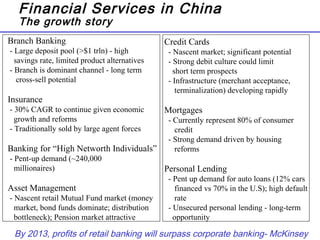
By 2013, profits of retail banking will surpass corporate banking- McKinsey
Branch Banking
- Large deposit pool (>$1 trln) - high
savings rate, limited product alternatives
- Branch is dominant channel - long term
cross-sell potential
Insurance
- 30% CAGR to continue given economic
growth and reforms
- Traditionally sold by large agent forces
Banking for “High Networth Individuals”
- Pent-up demand (~240,000
millionaires)
Asset Management
- Nascent retail Mutual Fund market (money
market, bond funds dominate; distribution
bottleneck); Pension market attractive
Credit Cards
- Nascent market; significant potential
- Strong debit culture could limit
short term prospects
- Infrastructure (merchant acceptance,
terminalization) developing rapidly
Mortgages
- Currently represent 80% of consumer
credit
- Strong demand driven by housing
reforms
Personal Lending
- Pent up demand for auto loans (12% cars
financed vs 70% in the U.S); high default
rate
- Unsecured personal lending - long-term
opportunity
Retail Banking in China
The Challenges
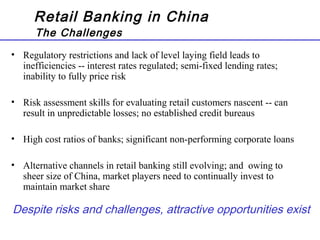
• Regulatory restrictions and lack of level laying field leads to
inefficiencies -- interest rates regulated; semi-fixed lending rates;
inability to fully price risk
• Risk assessment skills for evaluating retail customers nascent -- can
result in unpredictable losses; no established credit bureaus
• High cost ratios of banks; significant non-performing corporate loans
• Alternative channels in retail banking still evolving; and owing to
sheer size of China, market players need to continually invest to
maintain market share
Despite risks and challenges, attractive opportunities exist
Changing Nature of Retail Banking in China
Increased
Competition
Deconstruction
of financial services
( Information, Transaction,
Processing Services )
Customer driven
business model
Greater use of
technology
Greater pressure
on operations
Supporting multiple delivery channels is now critical
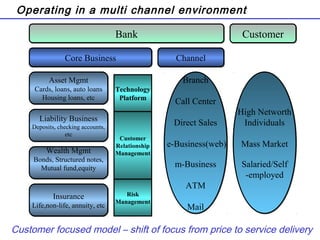
Operating in a multi channel environment
BankBank
Core BusinessCore Business ChannelChannel
CustomerCustomer
Asset Mgmt
Cards, loans, auto loans
Housing loans, etc
Asset Mgmt
Cards, loans, auto loans
Housing loans, etc
Liability Business
Deposits, checking accounts,
etc
Liability Business
Deposits, checking accounts,
etc
Wealth Mgmt
Bonds, Structured notes,
Mutual fund,equity
Wealth Mgmt
Bonds, Structured notes,
Mutual fund,equity
Insurance
Life,non-life, annuity, etc
Insurance
Life,non-life, annuity, etc
Branch
Call Center
Direct Sales
e-Business(web)
m-Business
ATM
Mail
Branch
Call Center
Direct Sales
e-Business(web)
m-Business
ATM
Mail
High Networth
Individuals
Mass Market
Salaried/Self
-employed
High Networth
Individuals
Mass Market
Salaried/Self
-employed
Technology
Platform
Risk
Management
Customer
Relationship
Management
Customer focused model – shift of focus from price to service delivery
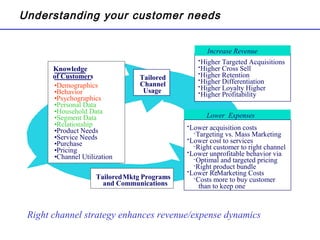
Understanding your customer needs
Tailored
Channel
Usage
TailoredMktg Programs
and Communications
Knowledge
of Customers
•Demographics
•Behavior
•Psychographics
•Personal Data
•Household Data
•Segment Data
•Relationship
•Product Needs
•Service Needs
•Purchase
•Pricing
•Channel Utilization
•Higher Targeted Acquisitions
•Higher Cross Sell
•Higher Retention
•Higher Differentiation
•Higher Loyalty Higher
•Higher Profitability
Lower Expenses
Increase Revenue
•Lower acquisition costs
-Targeting vs. Mass Marketing
•Lower cost to services
-Right customer to right channel
•Lower unprofitable behavior via
-Optimal and targeted pricing
-Right product bundle
•Lower Re-Marketing Costs
-Costs more to buy customer
than to keep one
Right channel strategy enhances revenue/expense dynamics
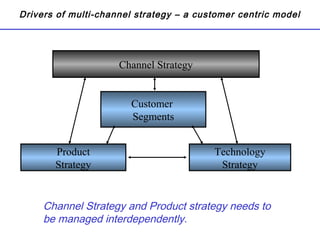
Drivers of multi-channel strategy – a customer centric model
Channel Strategy
Customer
Segments
Product
Strategy
Technology
Strategy
Channel Strategy and Product strategy needs to
be managed interdependently.
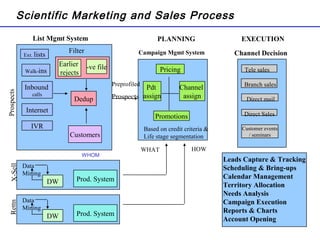
Scientific Marketing and Sales Process
Ext. lists
Walk-ins
Inbound
calls
Internet
IVR
Earlier
rejects
-ve file
Filter
Customers
Dedup
List Mgmt System
Campaign Mgmt System
Pricing
Pdt
assign
Channel
assign
Promotions
Preprofiled
Prospects
X-Sell
Data
Mining
DW Prod. System
Data
Mining
DW Prod. System
Rettn
PLANNING
Based on credit criteria &
Life stage segmentation
EXECUTION
Channel Decision
Tele sales
Branch sales
Direct mail
Direct Sales
Leads Capture & Tracking
Scheduling & Bring-ups
Calendar Management
Territory Allocation
Needs Analysis
Campaign Execution
Reports & Charts
Account Opening
Prospects
WHOM
WHAT HOW
Customer events
/ seminars
Branch renewals
Key element of multi channel delivery strategy
• Changed design, greater functionality, better efficiency; and the
technology inside them is revolutionary
• Focus shifting from transactions to selling; branches now slotted into a
multi-channel delivery strategy
• New branch technology - client server or web based - allows
integration of customer information across all channels; quicker
transaction processing; more effective cross-selling
• Self Service Terminals and ATMs dispensing cash and providing basic
account information – but also accepting cheque/ cash deposits;
carrying advertising; selling bank products; and allowing people to
load up mobile phone cards
Branch revenues rising and costs falling –and
customers like the new branch experience
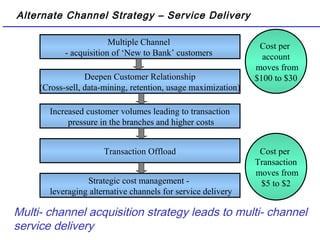
Alternate Channel Strategy – Service Delivery
Multiple Channel
- acquisition of ‘New to Bank’ customers
Strategic cost management -
leveraging alternative channels for service delivery
Deepen Customer Relationship
(Cross-sell, data-mining, retention, usage maximization)
Increased customer volumes leading to transaction
pressure in the branches and higher costs
Transaction Offload
Cost per
account
moves from
$100 to $30
Cost per
Transaction
moves from
$5 to $2
Multi- channel acquisition strategy leads to multi- channel
service delivery
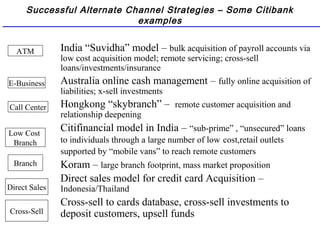
Successful Alternate Channel Strategies – Some Citibank
examples
India “Suvidha” model – bulk acquisition of payroll accounts via
low cost acquisition model; remote servicing; cross-sell
loans/investments/insurance
Australia online cash management – fully online acquisition of
liabilities; x-sell investments
Hongkong “skybranch” – remote customer acquisition and
relationship deepening
Citifinancial model in India – “sub-prime” , “unsecured” loans
to individuals through a large number of low cost,retail outlets
supported by “mobile vans” to reach remote customers
Koram – large branch footprint, mass market proposition
Direct sales model for credit card Acquisition –
Indonesia/Thailand
Cross-sell to cards database, cross-sell investments to
deposit customers, upsell funds
Branch
Direct Sales
Cross-Sell
Low Cost
Branch
Call Center
E-Business
ATM
Thank You !

Sanjoy Sen - Asia Pacific Retail Banking Conference - The future banking in china

  • 1.
    The Future ofRetail Banking In China Multi Channel Strategies In an Era of Rapid Growth Sanjoy Sen Chief Operating Officer Global Consumer Group Citibank, N.A.,China
  • 2.
    Financial Services inChina The growth story By 2013, profits of retail banking will surpass corporate banking- McKinsey Branch Banking - Large deposit pool (>$1 trln) - high savings rate, limited product alternatives - Branch is dominant channel - long term cross-sell potential Insurance - 30% CAGR to continue given economic growth and reforms - Traditionally sold by large agent forces Banking for “High Networth Individuals” - Pent-up demand (~240,000 millionaires) Asset Management - Nascent retail Mutual Fund market (money market, bond funds dominate; distribution bottleneck); Pension market attractive Credit Cards - Nascent market; significant potential - Strong debit culture could limit short term prospects - Infrastructure (merchant acceptance, terminalization) developing rapidly Mortgages - Currently represent 80% of consumer credit - Strong demand driven by housing reforms Personal Lending - Pent up demand for auto loans (12% cars financed vs 70% in the U.S); high default rate - Unsecured personal lending - long-term opportunity
  • 3.
    Retail Banking inChina The Challenges • Regulatory restrictions and lack of level laying field leads to inefficiencies -- interest rates regulated; semi-fixed lending rates; inability to fully price risk • Risk assessment skills for evaluating retail customers nascent -- can result in unpredictable losses; no established credit bureaus • High cost ratios of banks; significant non-performing corporate loans • Alternative channels in retail banking still evolving; and owing to sheer size of China, market players need to continually invest to maintain market share Despite risks and challenges, attractive opportunities exist
  • 4.
    Changing Nature ofRetail Banking in China Increased Competition Deconstruction of financial services ( Information, Transaction, Processing Services ) Customer driven business model Greater use of technology Greater pressure on operations Supporting multiple delivery channels is now critical
  • 5.
    Operating in amulti channel environment BankBank Core BusinessCore Business ChannelChannel CustomerCustomer Asset Mgmt Cards, loans, auto loans Housing loans, etc Asset Mgmt Cards, loans, auto loans Housing loans, etc Liability Business Deposits, checking accounts, etc Liability Business Deposits, checking accounts, etc Wealth Mgmt Bonds, Structured notes, Mutual fund,equity Wealth Mgmt Bonds, Structured notes, Mutual fund,equity Insurance Life,non-life, annuity, etc Insurance Life,non-life, annuity, etc Branch Call Center Direct Sales e-Business(web) m-Business ATM Mail Branch Call Center Direct Sales e-Business(web) m-Business ATM Mail High Networth Individuals Mass Market Salaried/Self -employed High Networth Individuals Mass Market Salaried/Self -employed Technology Platform Risk Management Customer Relationship Management Customer focused model – shift of focus from price to service delivery
  • 6.
    Understanding your customerneeds Tailored Channel Usage TailoredMktg Programs and Communications Knowledge of Customers •Demographics •Behavior •Psychographics •Personal Data •Household Data •Segment Data •Relationship •Product Needs •Service Needs •Purchase •Pricing •Channel Utilization •Higher Targeted Acquisitions •Higher Cross Sell •Higher Retention •Higher Differentiation •Higher Loyalty Higher •Higher Profitability Lower Expenses Increase Revenue •Lower acquisition costs -Targeting vs. Mass Marketing •Lower cost to services -Right customer to right channel •Lower unprofitable behavior via -Optimal and targeted pricing -Right product bundle •Lower Re-Marketing Costs -Costs more to buy customer than to keep one Right channel strategy enhances revenue/expense dynamics
  • 7.
    Drivers of multi-channelstrategy – a customer centric model Channel Strategy Customer Segments Product Strategy Technology Strategy Channel Strategy and Product strategy needs to be managed interdependently.
  • 8.
    Scientific Marketing andSales Process Ext. lists Walk-ins Inbound calls Internet IVR Earlier rejects -ve file Filter Customers Dedup List Mgmt System Campaign Mgmt System Pricing Pdt assign Channel assign Promotions Preprofiled Prospects X-Sell Data Mining DW Prod. System Data Mining DW Prod. System Rettn PLANNING Based on credit criteria & Life stage segmentation EXECUTION Channel Decision Tele sales Branch sales Direct mail Direct Sales Leads Capture & Tracking Scheduling & Bring-ups Calendar Management Territory Allocation Needs Analysis Campaign Execution Reports & Charts Account Opening Prospects WHOM WHAT HOW Customer events / seminars
  • 9.
    Branch renewals Key elementof multi channel delivery strategy • Changed design, greater functionality, better efficiency; and the technology inside them is revolutionary • Focus shifting from transactions to selling; branches now slotted into a multi-channel delivery strategy • New branch technology - client server or web based - allows integration of customer information across all channels; quicker transaction processing; more effective cross-selling • Self Service Terminals and ATMs dispensing cash and providing basic account information – but also accepting cheque/ cash deposits; carrying advertising; selling bank products; and allowing people to load up mobile phone cards Branch revenues rising and costs falling –and customers like the new branch experience
  • 10.
    Alternate Channel Strategy– Service Delivery Multiple Channel - acquisition of ‘New to Bank’ customers Strategic cost management - leveraging alternative channels for service delivery Deepen Customer Relationship (Cross-sell, data-mining, retention, usage maximization) Increased customer volumes leading to transaction pressure in the branches and higher costs Transaction Offload Cost per account moves from $100 to $30 Cost per Transaction moves from $5 to $2 Multi- channel acquisition strategy leads to multi- channel service delivery
  • 11.
    Successful Alternate ChannelStrategies – Some Citibank examples India “Suvidha” model – bulk acquisition of payroll accounts via low cost acquisition model; remote servicing; cross-sell loans/investments/insurance Australia online cash management – fully online acquisition of liabilities; x-sell investments Hongkong “skybranch” – remote customer acquisition and relationship deepening Citifinancial model in India – “sub-prime” , “unsecured” loans to individuals through a large number of low cost,retail outlets supported by “mobile vans” to reach remote customers Koram – large branch footprint, mass market proposition Direct sales model for credit card Acquisition – Indonesia/Thailand Cross-sell to cards database, cross-sell investments to deposit customers, upsell funds Branch Direct Sales Cross-Sell Low Cost Branch Call Center E-Business ATM
  • 12.

Editor's Notes

  • #3 General-increasingly consumption driven GDP growth (7-9% p.a) Branch Banking-15 million urban Chinese earn $4500-$9000 p.a;segment doubling every year, the man affluent have $118 bn to invest or save - Although only 4% of Chinese have household, income of more than $20M, still that translates into a market of more than 50 million, who are spending increasing amounts of money on services Credit cards – Consumer credit culture is evolving, only 0.5% of China’s consumers hold credit cards (63% in Taiwan) Mortgage – fast economic growth will put home ownership within reach of hundreds of million people-in the past 5 years, more than 5 million homes have been sold.
  • #7 Different customers may use different channels Key is to maintain great and consistent customer experience across all channels Maintain customer trust and loyalty Same customers may use different channels for different part of transaction or buying cycle Discover when banking customers”wears” himself from the human contact to online/remote channels
  • #8 Customer needs will drive channel strategy and therefore also the organizational, technology and marketing strategies.
  • #10 Whether it is a self-service terminal, a bank clerk conducting a transaction on a computer terminal or invisible offsite processing, branch customers are being dealt in a whole new way. Traditional branch banking systems consist of a variety of platforms and applications for data, teller transactions, lending and call centers, all of which have to be accessed separately. These were sufficient when the branch¡¯s role was transaction focused, but as branches become a key element of multi-channel delivery they are no longer up to the task.