

Analysis of Energy Depletion
Attacks:
Wireless Device Cases
Vasily Desnitsky
Laboratory of Computer Security Problems, SPIIRAS,
The Bonch-Bruevich Saint-Petersburg State
University of Telecommunications
Vladislav Aleksandrov
University ITMO,
Positive Technologies
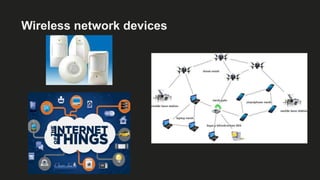
Wireless network devices
Objectives
o State-of-the-art
o Analysis of energy depletion attacks
o Modeling energy depletion attacks on two use cases
• Smartphone
• ZigBee-based network
o Experiments
o Conclusions
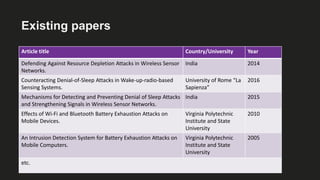
Existing papers
Article title Country/University Year
Defending Against Resource Depletion Attacks in Wireless Sensor
Networks.
India 2014
Counteracting Denial-of-Sleep Attacks in Wake-up-radio-based
Sensing Systems.
University of Rome “La
Sapienza”
2016
Mechanisms for Detecting and Preventing Denial of Sleep Attacks
and Strengthening Signals in Wireless Sensor Networks.
India 2015
Effects of Wi-Fi and Bluetooth Battery Exhaustion Attacks on
Mobile Devices.
Virginia Polytechnic
Institute and State
University
2010
An Intrusion Detection System for Battery Exhaustion Attacks on
Mobile Computers.
Virginia Polytechnic
Institute and State
University
2005
etc.
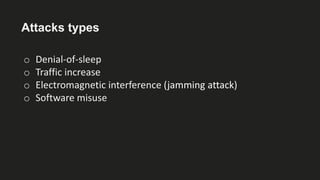
Attacks types
o Denial-of-sleep
o Traffic increase
o Electromagnetic interference (jamming attack)
o Software misuse
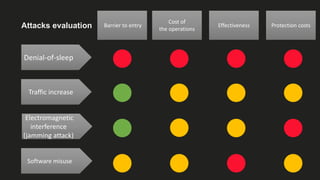
Attacks evaluation
Denial-of-sleep
Traffic increase
Electromagnetic
interference
(jamming attack)
Software misuse
Barrier to entry
Cost of
the operations
Effectiveness Protection costs
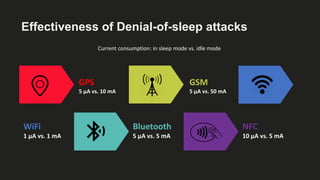
Effectiveness of Denial-of-sleep attacks
GPS
5 µA vs. 10 mA
WiFi
1 µA vs. 1 mA
Bluetooth
5 µA vs. 5 mA
GSM
5 µA vs. 50 mA
NFC
10 µA vs. 5 mA
Current consumption: in sleep mode vs. idle mode
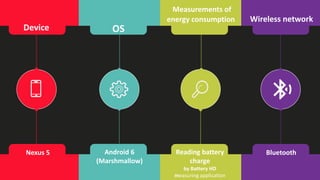
Use case 1: Smartphone
Device OS
Measurements of
energy consumption Wireless network
Nexus 5 Android 6
(Marshmallow)
Reading battery
charge
by Battery HD
measuring application
Bluetooth
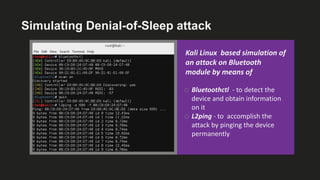
Simulating Denial-of-Sleep attack
Kali Linux based simulation of
an attack on Bluetooth
module by means of
o Bluetoothctl - to detect the
device and obtain information
on it
o L2ping - to accomplish the
attack by pinging the device
permanently
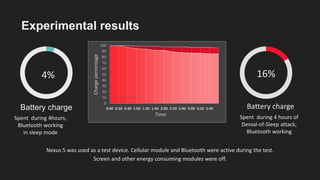
Experimental results
Battery charge
Spent during 4hours,
Bluetooth working
in sleep mode
4%
Nexus 5 was used as a test device. Cellular module and Bluetooth were active during the test.
Screen and other energy consuming modules were off.
Battery charge
Spent during 4 hours of
Denial-of-Sleep attack,
Bluetooth working
16%
0
10
20
30
40
50
60
70
80
90
100
0:00 0:20 0:40 1:00 1:20 1:40 2:00 2:20 2:40 3:00 3:20 3:40
Chargepercentage
Time
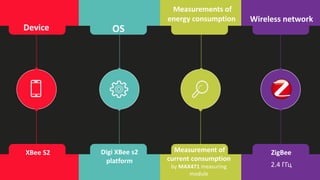
Use case 2: ZigBee-based network
Device OS
Measurements of
energy consumption
XBee S2 Digi XBee s2
platform
Measurement of
current consumption
by MAX471 measuring
module
ZigBee
2.4 ГГц
Wireless network
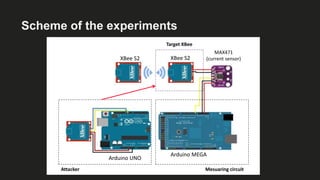
Scheme of the experiments
MAX471
(current sensor)
Arduino MEGA
XBee S2XBee S2
Arduino UNO
Attacker Mesuaring circuit
Target XBee
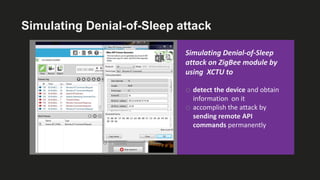
Simulating Denial-of-Sleep attack
Simulating Denial-of-Sleep
attack on ZigBee module by
using XCTU to
o detect the device and obtain
information on it
o accomplish the attack by
sending remote API
commands permanently
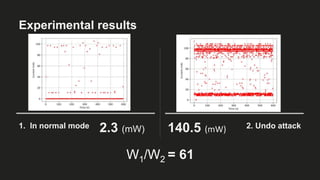
Experimental results
1. In normal mode 2. Undo attack2.3 (mW) 140.5 (mW)
W1/W2 = 61
Conclusions
o Energy depletion attack
• effective
• easy to implement
o Protection tools
Thank you for your attention!
Vasily Desnitsky, desnitsky@comsec.spb.ru
Contact

Анализ атак на исчерпание энергоресурсов на примере устройств беспроводных сетей

  • 1.
    Analysis of EnergyDepletion Attacks: Wireless Device Cases Vasily Desnitsky Laboratory of Computer Security Problems, SPIIRAS, The Bonch-Bruevich Saint-Petersburg State University of Telecommunications Vladislav Aleksandrov University ITMO, Positive Technologies
  • 2.
  • 3.
    Objectives o State-of-the-art o Analysisof energy depletion attacks o Modeling energy depletion attacks on two use cases • Smartphone • ZigBee-based network o Experiments o Conclusions
  • 4.
    Existing papers Article titleCountry/University Year Defending Against Resource Depletion Attacks in Wireless Sensor Networks. India 2014 Counteracting Denial-of-Sleep Attacks in Wake-up-radio-based Sensing Systems. University of Rome “La Sapienza” 2016 Mechanisms for Detecting and Preventing Denial of Sleep Attacks and Strengthening Signals in Wireless Sensor Networks. India 2015 Effects of Wi-Fi and Bluetooth Battery Exhaustion Attacks on Mobile Devices. Virginia Polytechnic Institute and State University 2010 An Intrusion Detection System for Battery Exhaustion Attacks on Mobile Computers. Virginia Polytechnic Institute and State University 2005 etc.
  • 5.
    Attacks types o Denial-of-sleep oTraffic increase o Electromagnetic interference (jamming attack) o Software misuse
  • 6.
    Attacks evaluation Denial-of-sleep Traffic increase Electromagnetic interference (jammingattack) Software misuse Barrier to entry Cost of the operations Effectiveness Protection costs
  • 7.
    Effectiveness of Denial-of-sleepattacks GPS 5 µA vs. 10 mA WiFi 1 µA vs. 1 mA Bluetooth 5 µA vs. 5 mA GSM 5 µA vs. 50 mA NFC 10 µA vs. 5 mA Current consumption: in sleep mode vs. idle mode
  • 8.
    Use case 1:Smartphone
  • 9.
    Device OS Measurements of energyconsumption Wireless network Nexus 5 Android 6 (Marshmallow) Reading battery charge by Battery HD measuring application Bluetooth
  • 10.
    Simulating Denial-of-Sleep attack KaliLinux based simulation of an attack on Bluetooth module by means of o Bluetoothctl - to detect the device and obtain information on it o L2ping - to accomplish the attack by pinging the device permanently
  • 11.
    Experimental results Battery charge Spentduring 4hours, Bluetooth working in sleep mode 4% Nexus 5 was used as a test device. Cellular module and Bluetooth were active during the test. Screen and other energy consuming modules were off. Battery charge Spent during 4 hours of Denial-of-Sleep attack, Bluetooth working 16% 0 10 20 30 40 50 60 70 80 90 100 0:00 0:20 0:40 1:00 1:20 1:40 2:00 2:20 2:40 3:00 3:20 3:40 Chargepercentage Time
  • 12.
    Use case 2:ZigBee-based network
  • 13.
    Device OS Measurements of energyconsumption XBee S2 Digi XBee s2 platform Measurement of current consumption by MAX471 measuring module ZigBee 2.4 ГГц Wireless network
  • 14.
    Scheme of theexperiments MAX471 (current sensor) Arduino MEGA XBee S2XBee S2 Arduino UNO Attacker Mesuaring circuit Target XBee
  • 15.
    Simulating Denial-of-Sleep attack SimulatingDenial-of-Sleep attack on ZigBee module by using XCTU to o detect the device and obtain information on it o accomplish the attack by sending remote API commands permanently
  • 16.
    Experimental results 1. Innormal mode 2. Undo attack2.3 (mW) 140.5 (mW) W1/W2 = 61
  • 17.
    Conclusions o Energy depletionattack • effective • easy to implement o Protection tools
  • 18.
    Thank you foryour attention! Vasily Desnitsky, desnitsky@comsec.spb.ru Contact