Recommender System:
Algorithms & Architecture
     xiangliang@hulu.com
Outline
    Problem
    Data
•

    Algorithms
•

    Cold start
•

    Architecture
•
•
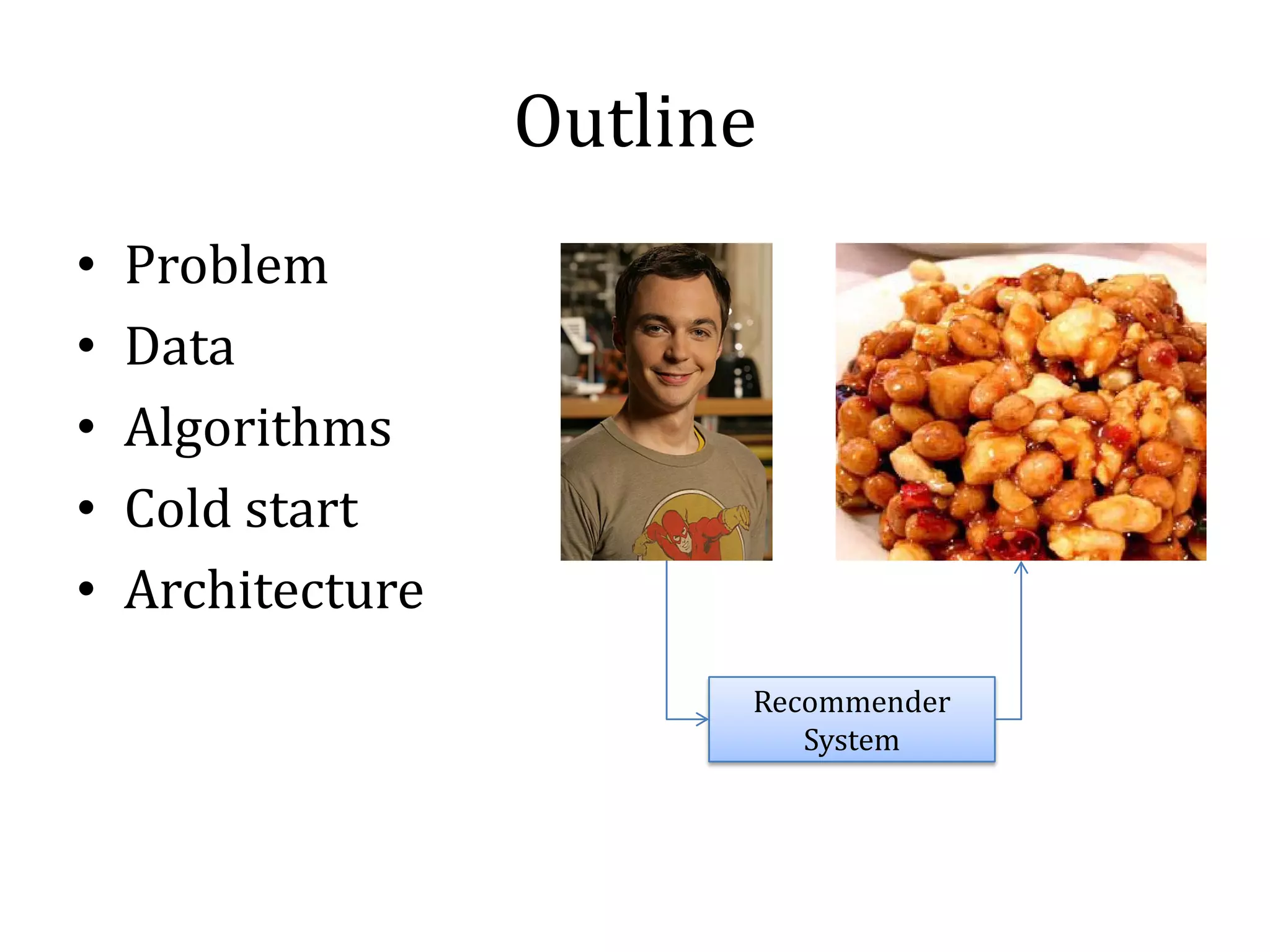
                         Recommender
                            System
Problem
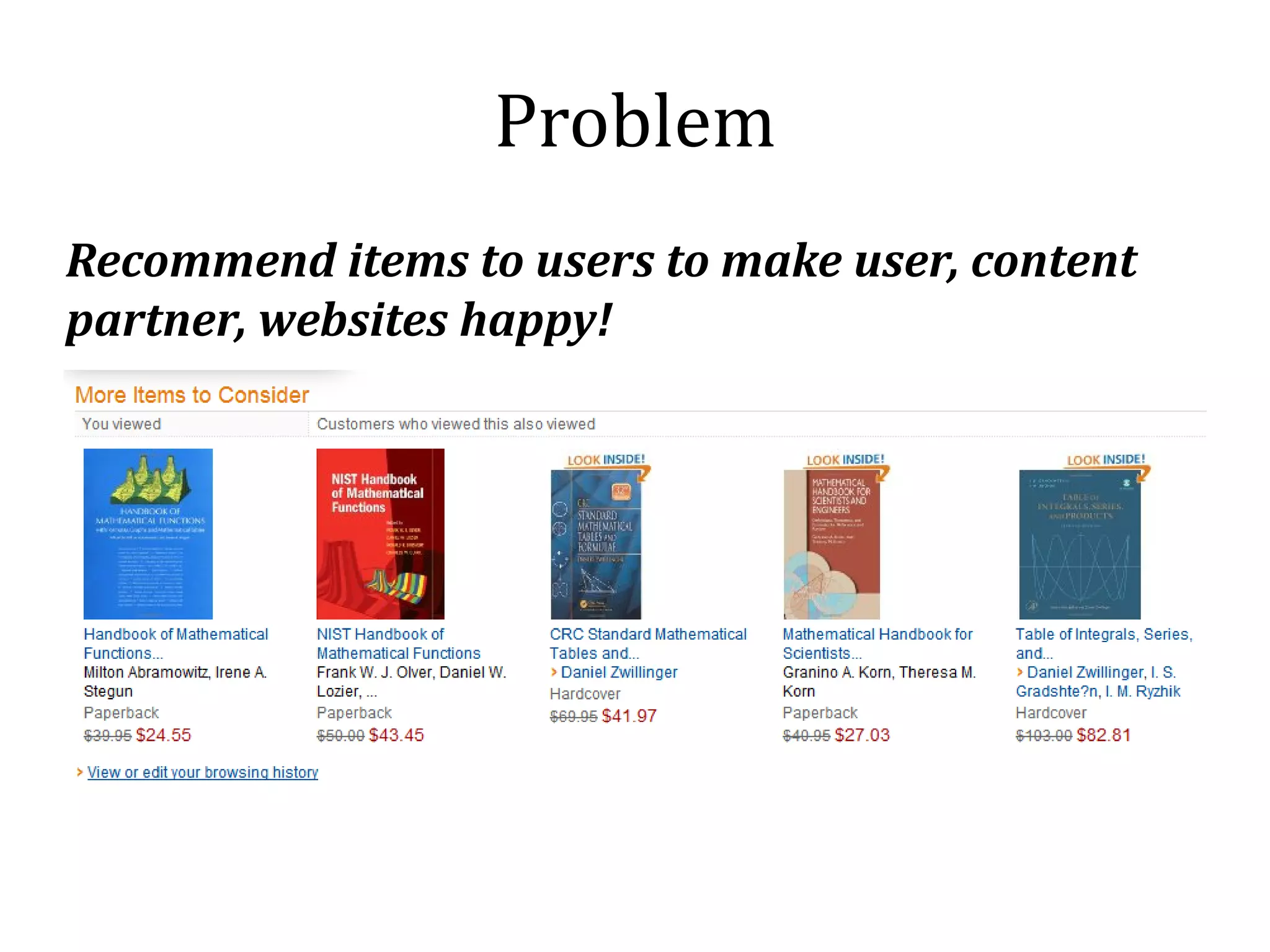
Recommend items to users to make user, content
partner, websites happy!
Data
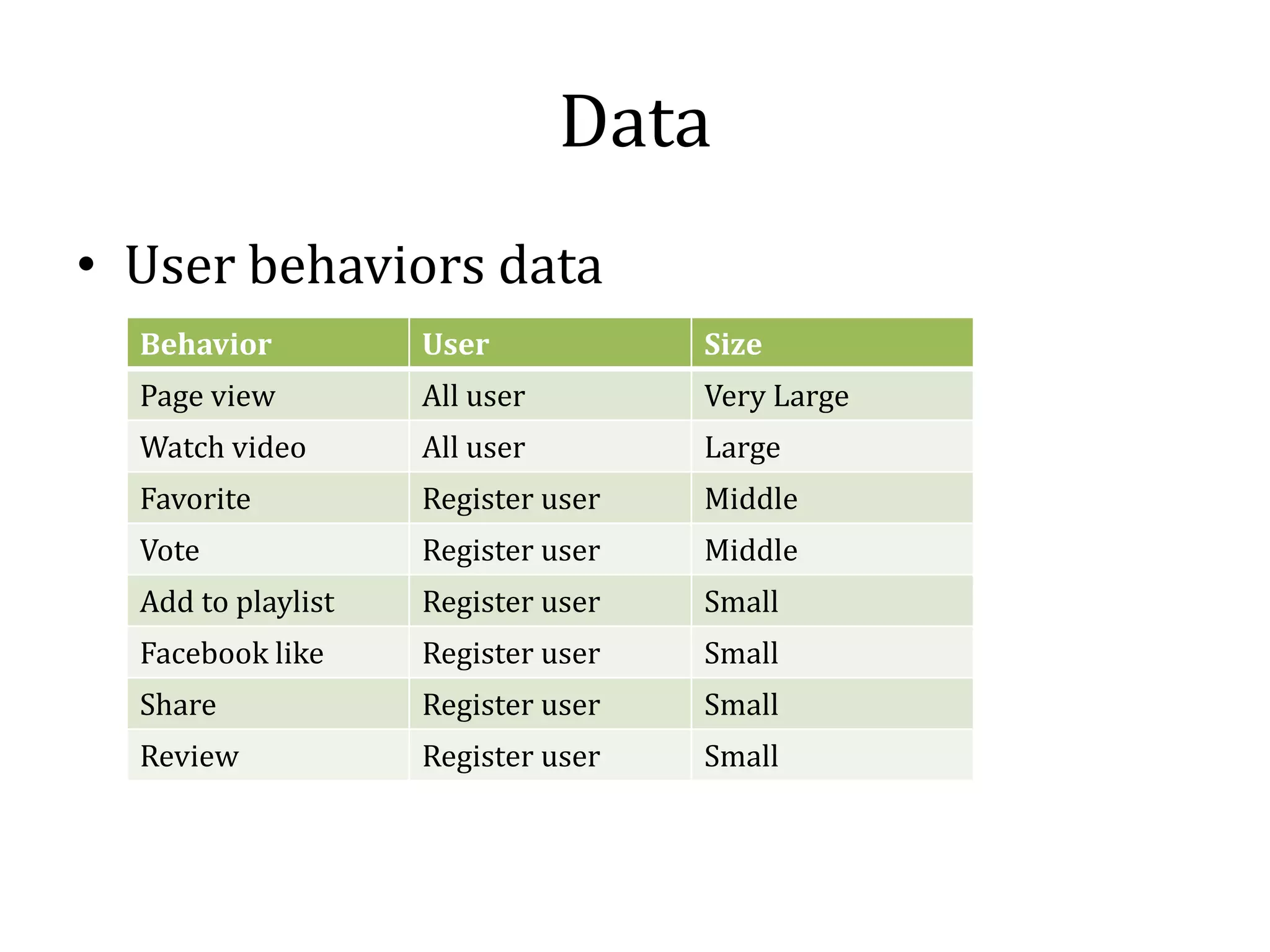
• User behaviors data

  Page view         All user        Very Large
  Behavior          User            Size


  Watch video       All user        Large
  Favorite          Register user   Middle
  Vote              Register user   Middle
  Add to playlist   Register user   Small
  Facebook like     Register user   Small
  Share             Register user   Small
  Review            Register user   Small
Data
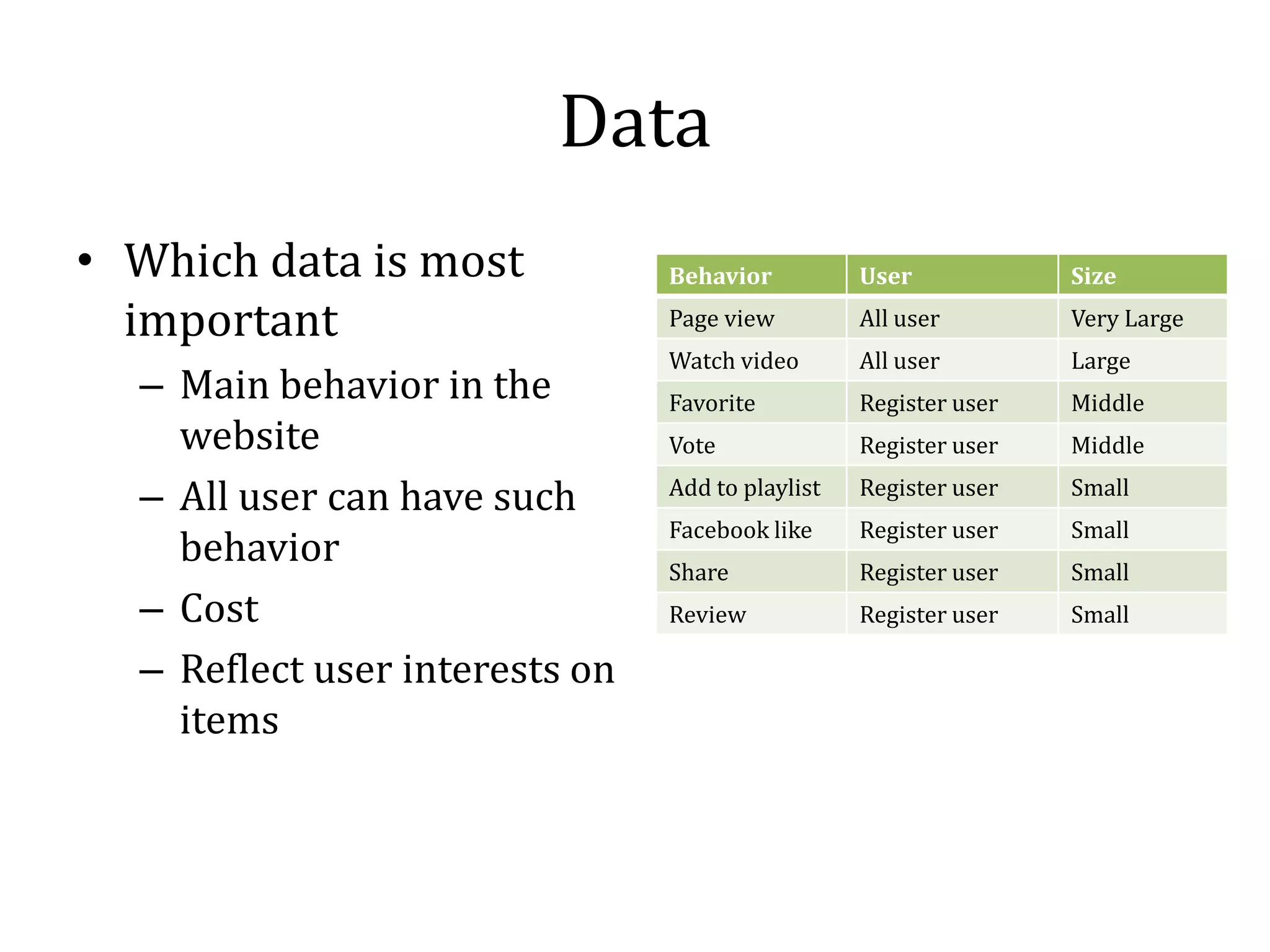
• Which data is most
  important                     Page view         All user        Very Large
                                Behavior          User            Size


  – Main behavior in the
                                Watch video       All user        Large


    website
                                Favorite          Register user   Middle
                                Vote              Register user   Middle

  – All user can have such      Add to playlist   Register user   Small

    behavior
                                Facebook like     Register user   Small


  – Cost
                                Share             Register user   Small
                                Review            Register user   Small

  – Reflect user interests on
    items
Data
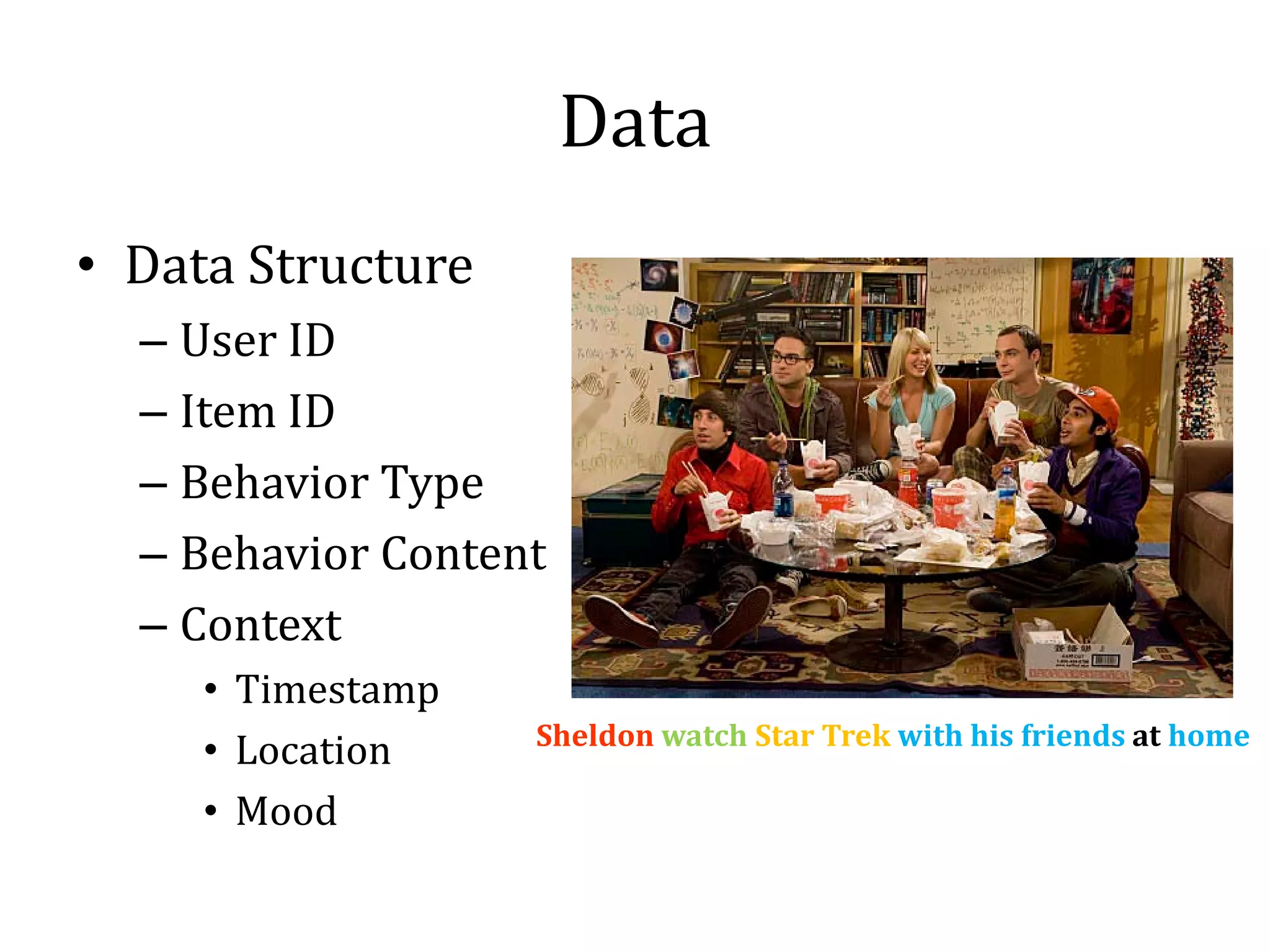
• Data Structure
  – User ID
  – Item ID
  – Behavior Type
  – Behavior Content
  – Context
     • Timestamp
     • Location
     • Mood
                   Sheldon watch Star Trek with his friends at home
Algorithms
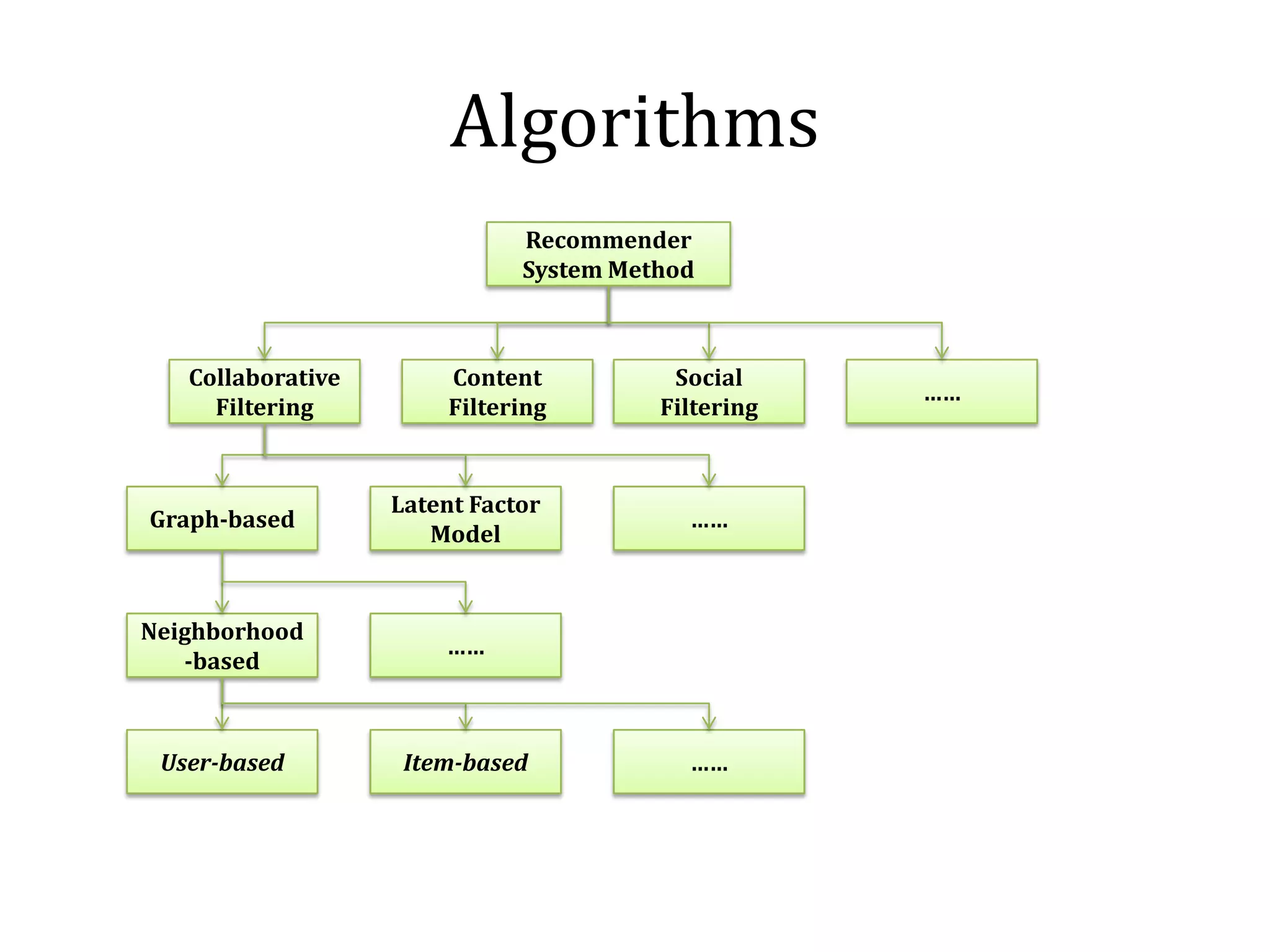
                              Recommender
                              System Method


   Collaborative        Content          Social
                                                    ……
     Filtering          Filtering       Filtering


                   Latent Factor
Graph-based                               ……
                      Model


Neighborhood
                       ……
   -based


 User-based         Item-based            ……
Neighborhood-based
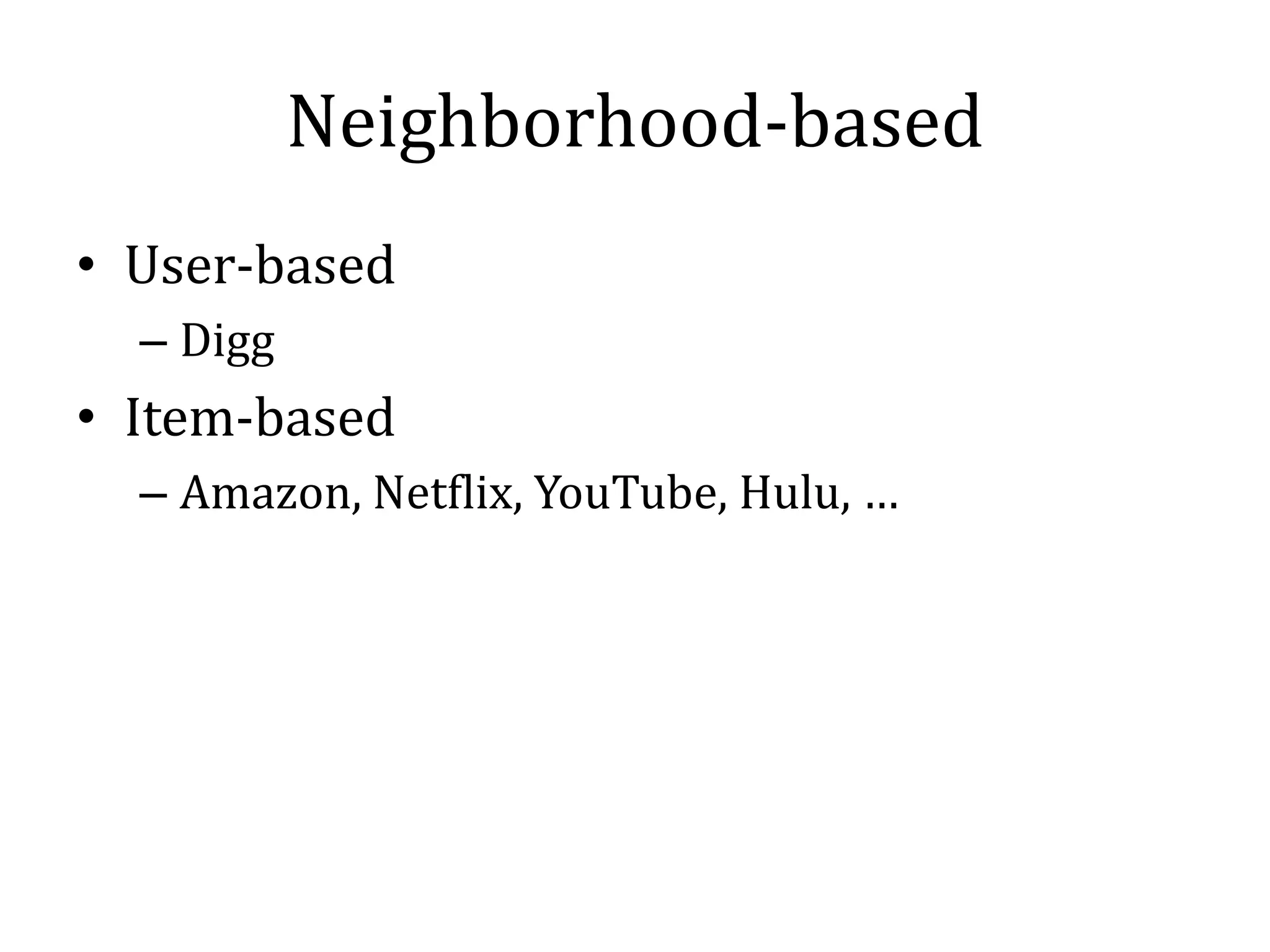
• User-based
  – Digg
• Item-based
  – Amazon, Netflix, YouTube, Hulu, …
User-based
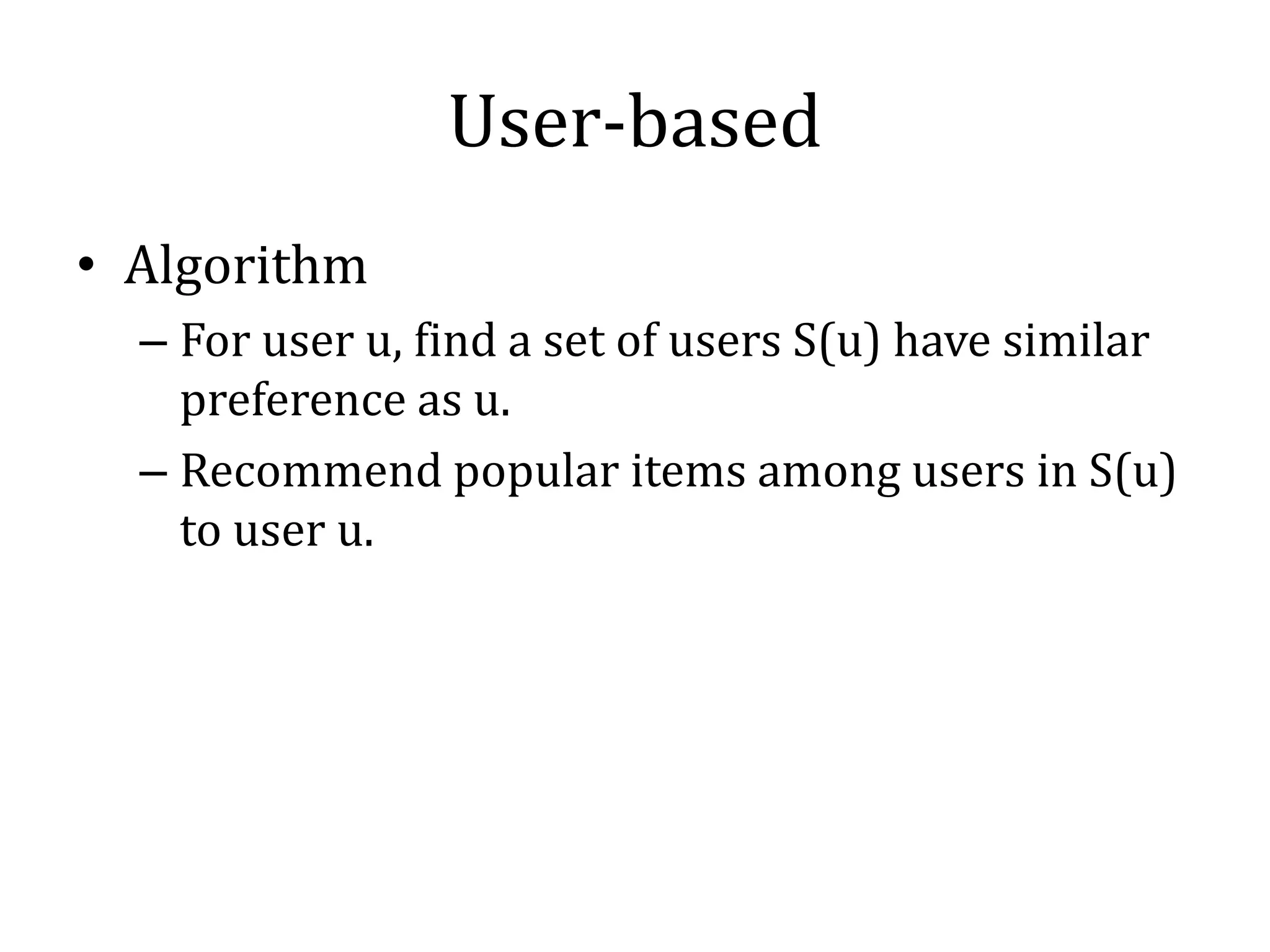
• Algorithm
  – For user u, find a set of users S(u) have similar
    preference as u.
  – Recommend popular items among users in S(u)
    to user u.
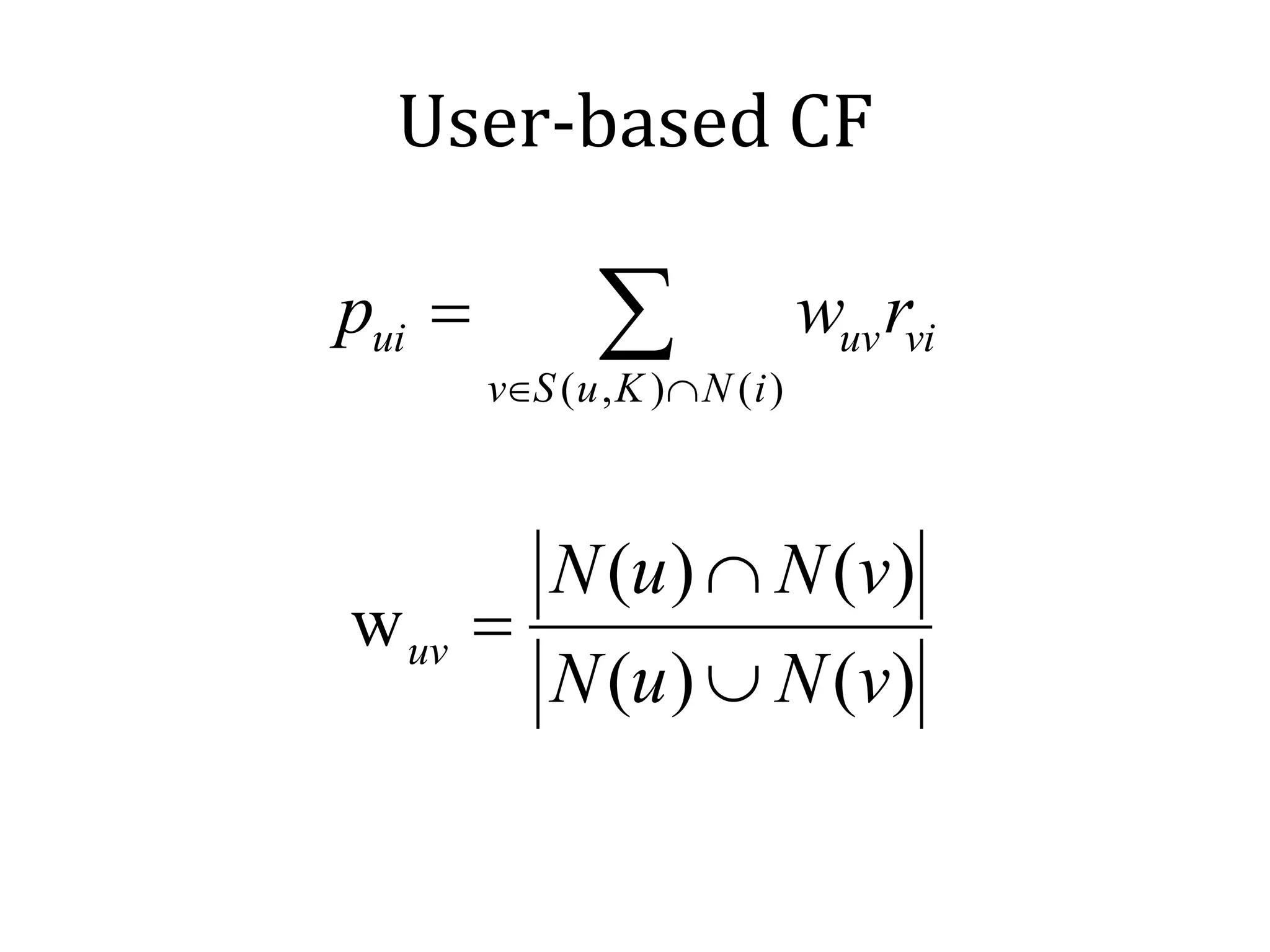
User-based CF

pui =           ∑
        v∈S ( u , K ) ∩ N ( i )
                                  wuv rvi


            N (u ) ∩ N (v)
w uv =
            N (u ) ∪ N (v)
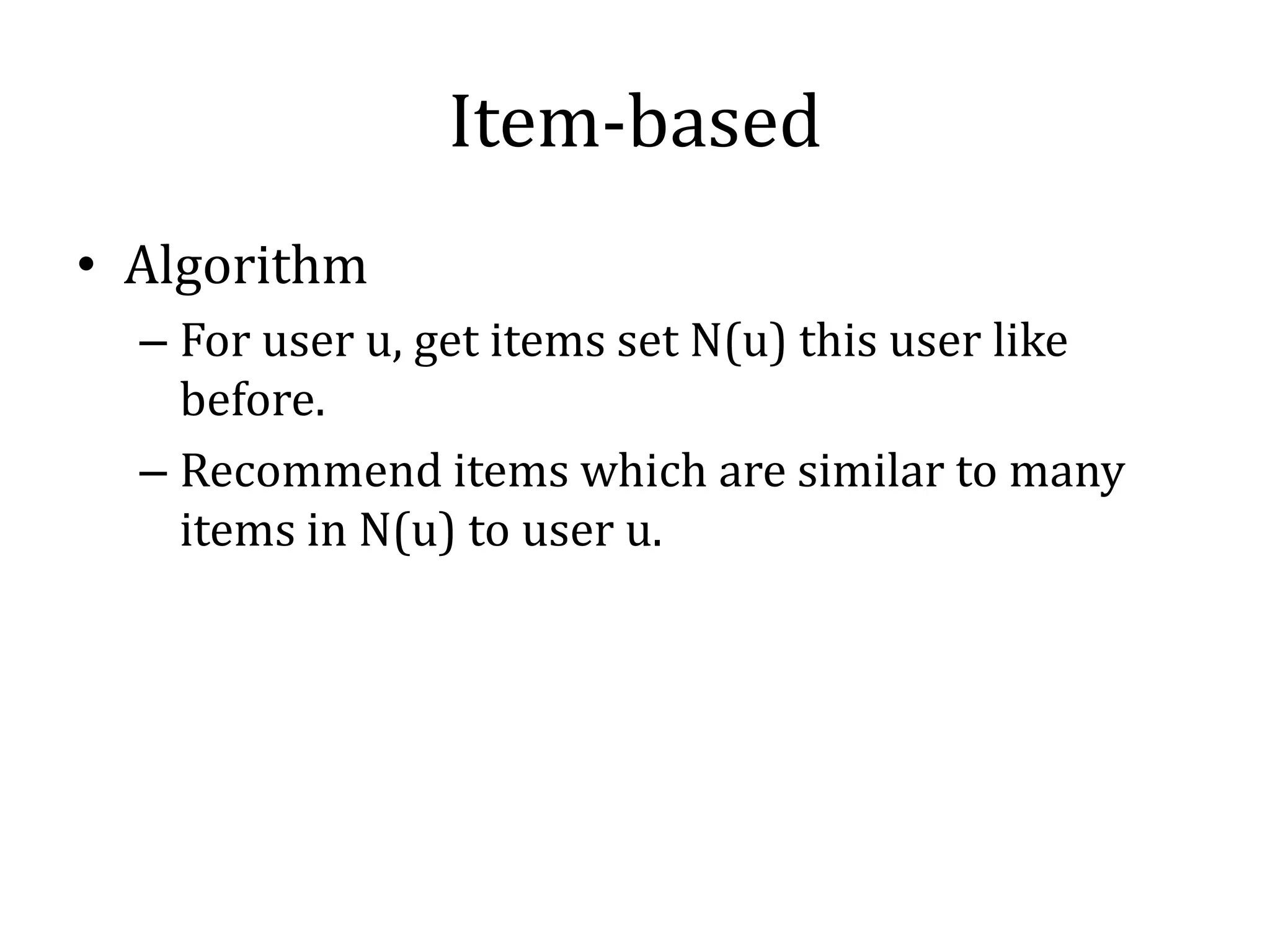
Item-based
• Algorithm
  – For user u, get items set N(u) this user like
    before.
  – Recommend items which are similar to many
    items in N(u) to user u.
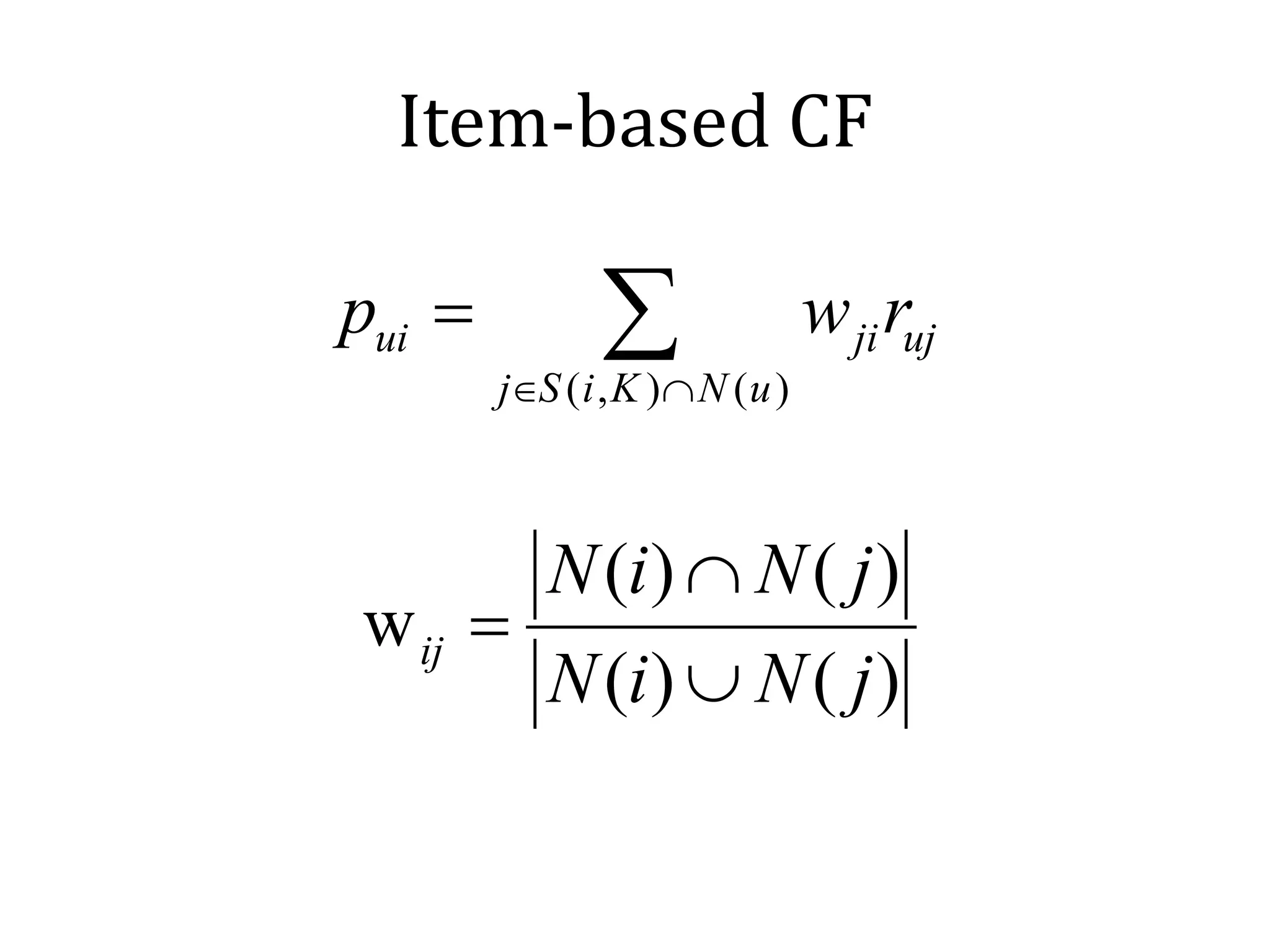
Item-based CF

pui =           ∑
        j∈S ( i , K ) ∩ N ( u )
                                  w ji ruj


           N (i ) ∩ N ( j )
w ij =
           N (i ) ∪ N ( j )
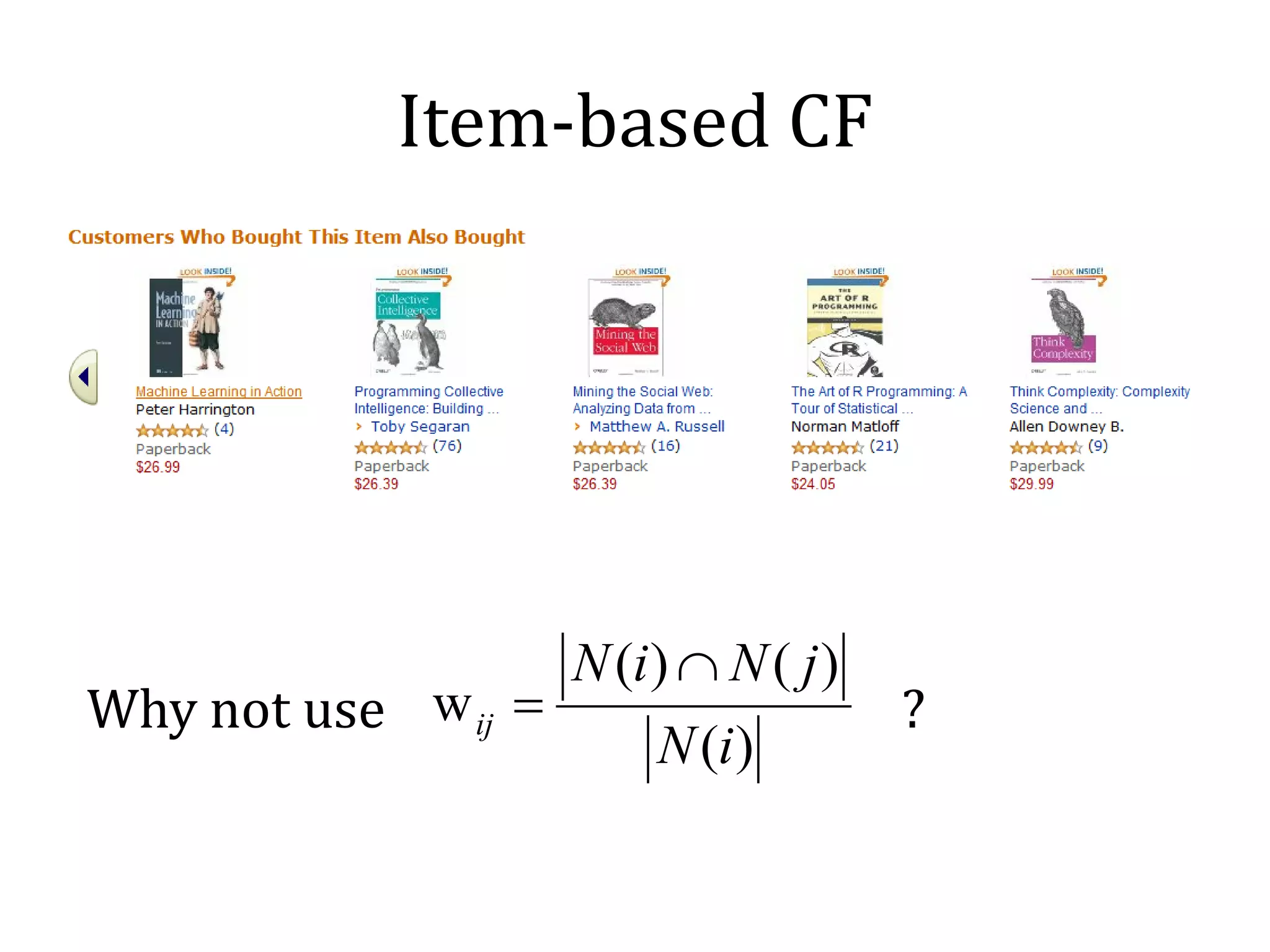
Item-based CF


Why not use w ij =                      ?
                     N (i ) ∩ N ( j )
                          N (i )
Neighborhood-based
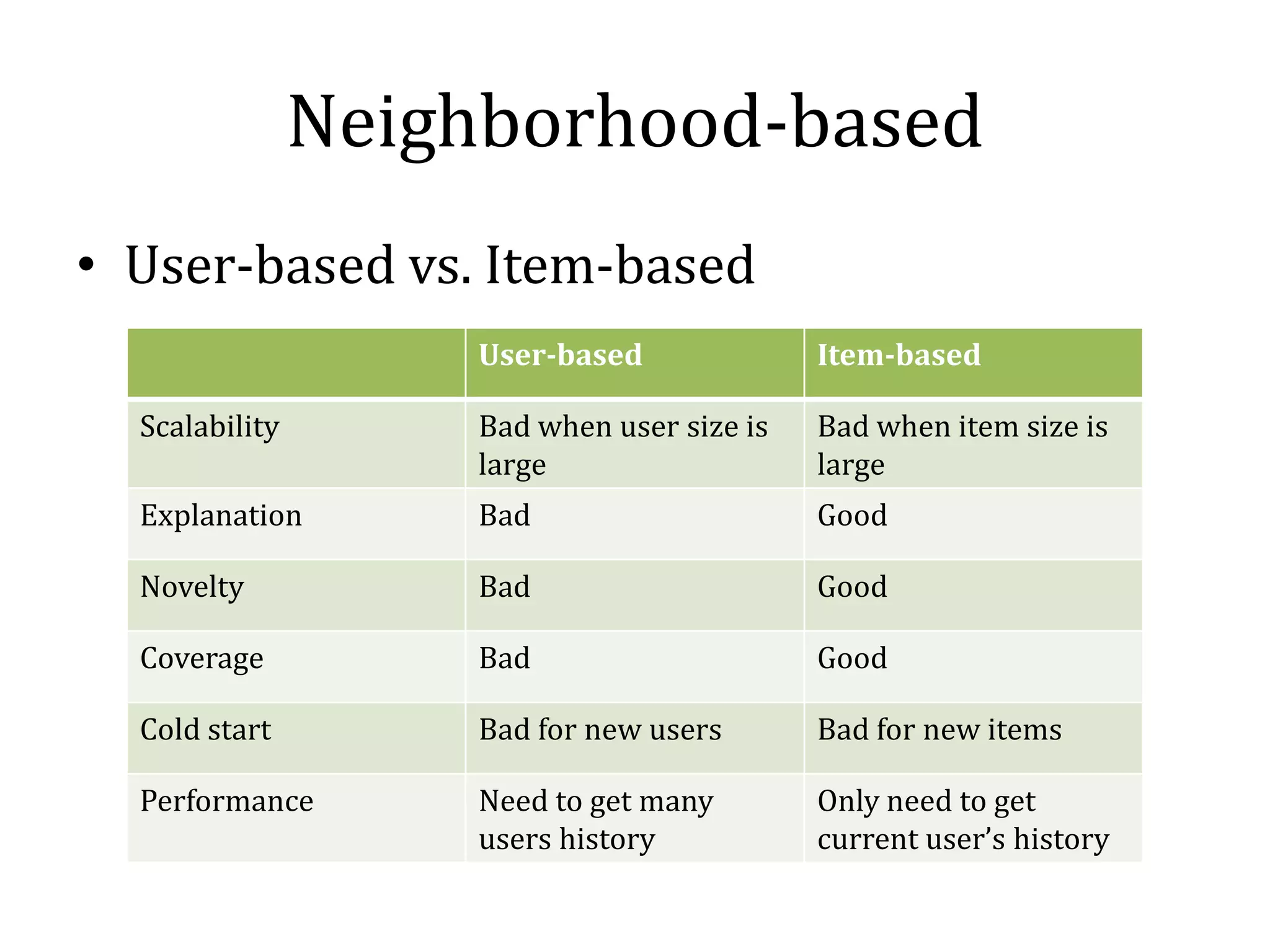
• User-based vs. Item-based
                    User-based              Item-based

  Scalability       Bad when user size is   Bad when item size is
                    large                   large
  Explanation       Bad                     Good

  Novelty           Bad                     Good

  Coverage          Bad                     Good

  Cold start        Bad for new users       Bad for new items

  Performance       Need to get many        Only need to get
                    users history           current user’s history
References
• Amazon.com Recommendations item-to-
  item Collaborative Filtering.

• Empirical Analysis of Predictive Algorithms
  for Collaborative Filtering.
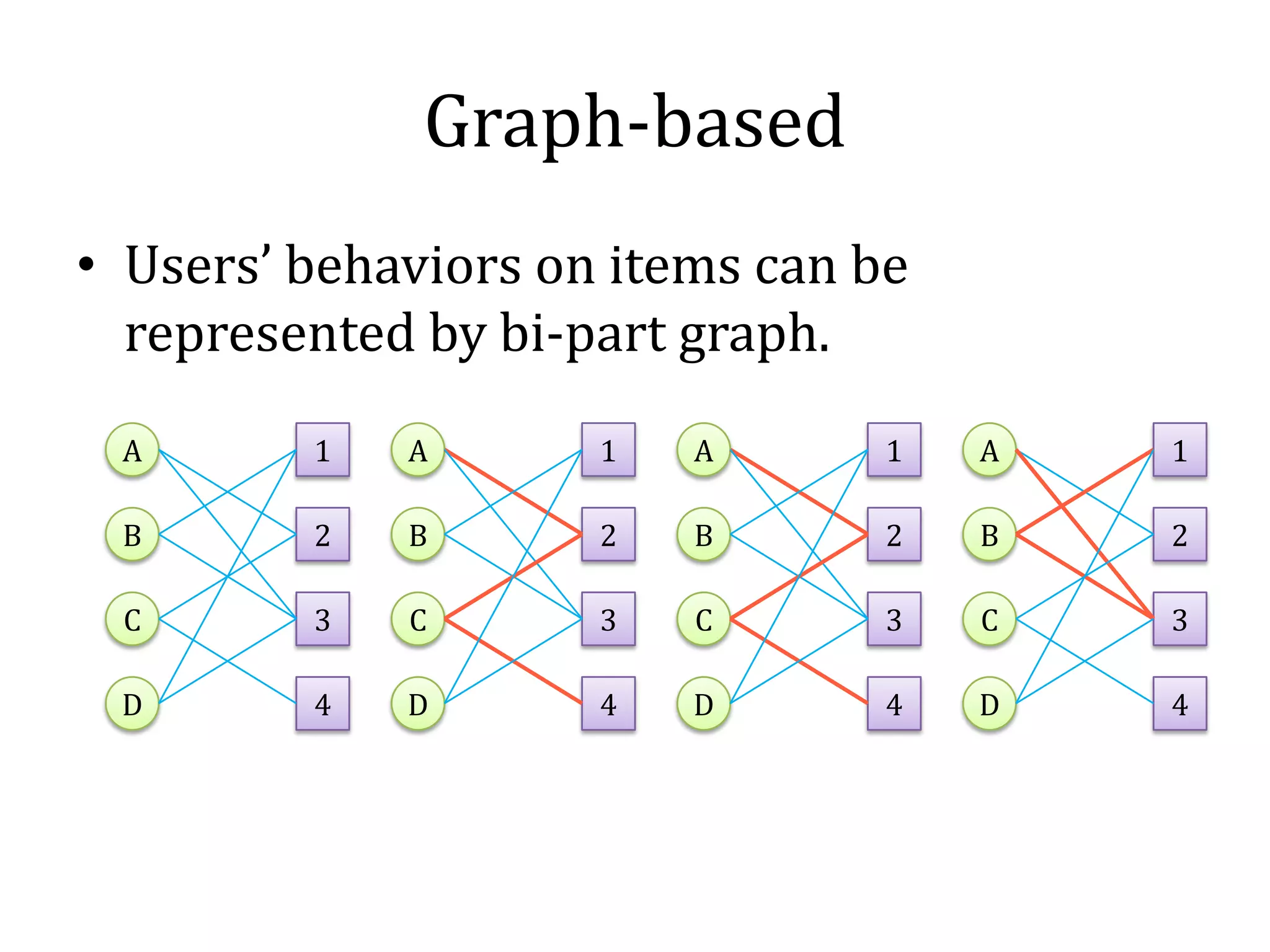
Graph-based
• Users’ behaviors on items can be
  represented by bi-part graph.
 A       1   A       1   A       1   A   1

 B       2   B       2   B       2   B   2

 C       3   C       3   C       3   C   3

 D       4   D       4   D       4   D   4
Graph-based
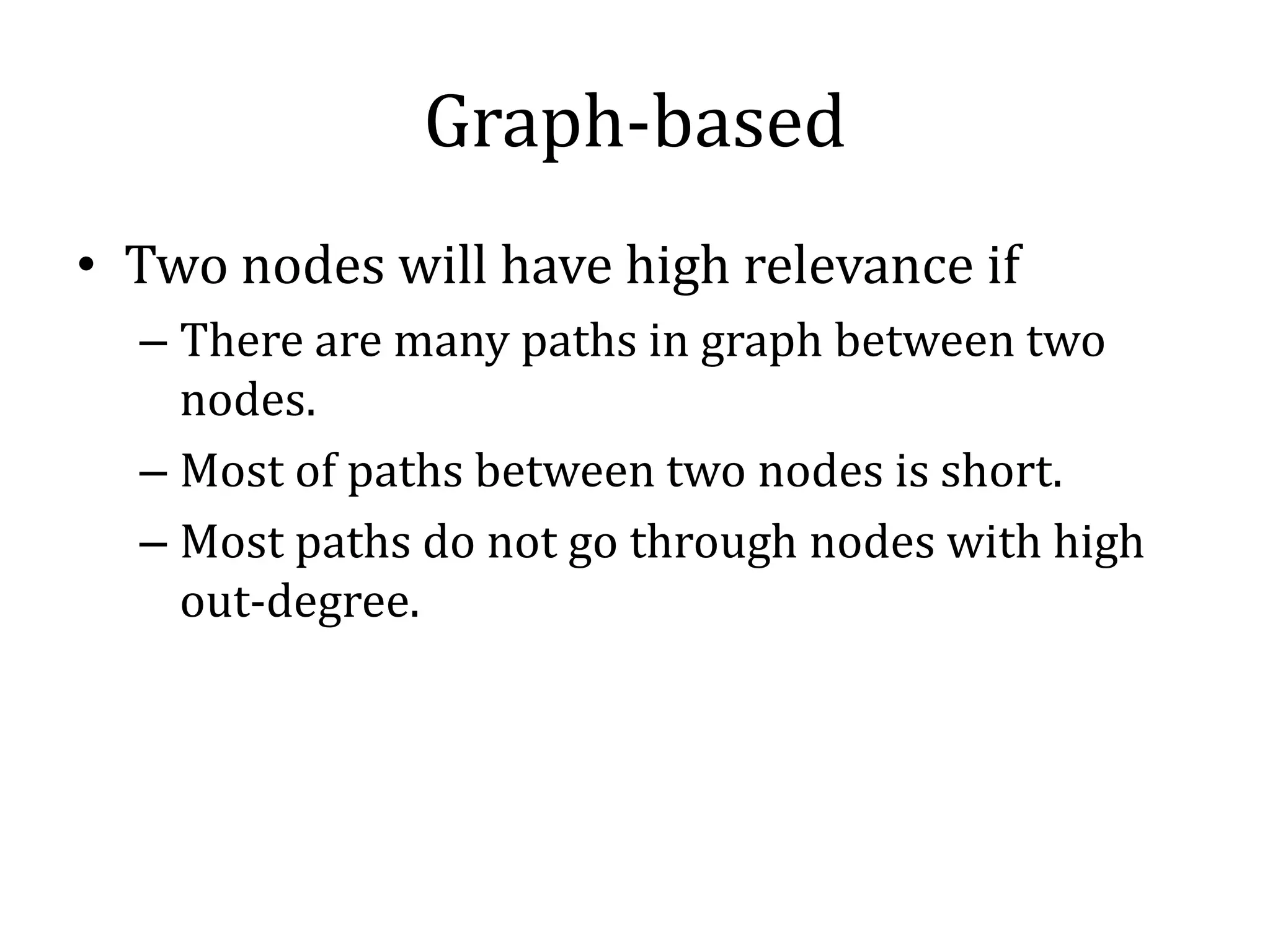
• Two nodes will have high relevance if
  – There are many paths in graph between two
    nodes.
  – Most of paths between two nodes is short.
  – Most paths do not go through nodes with high
    out-degree.
Graph-based
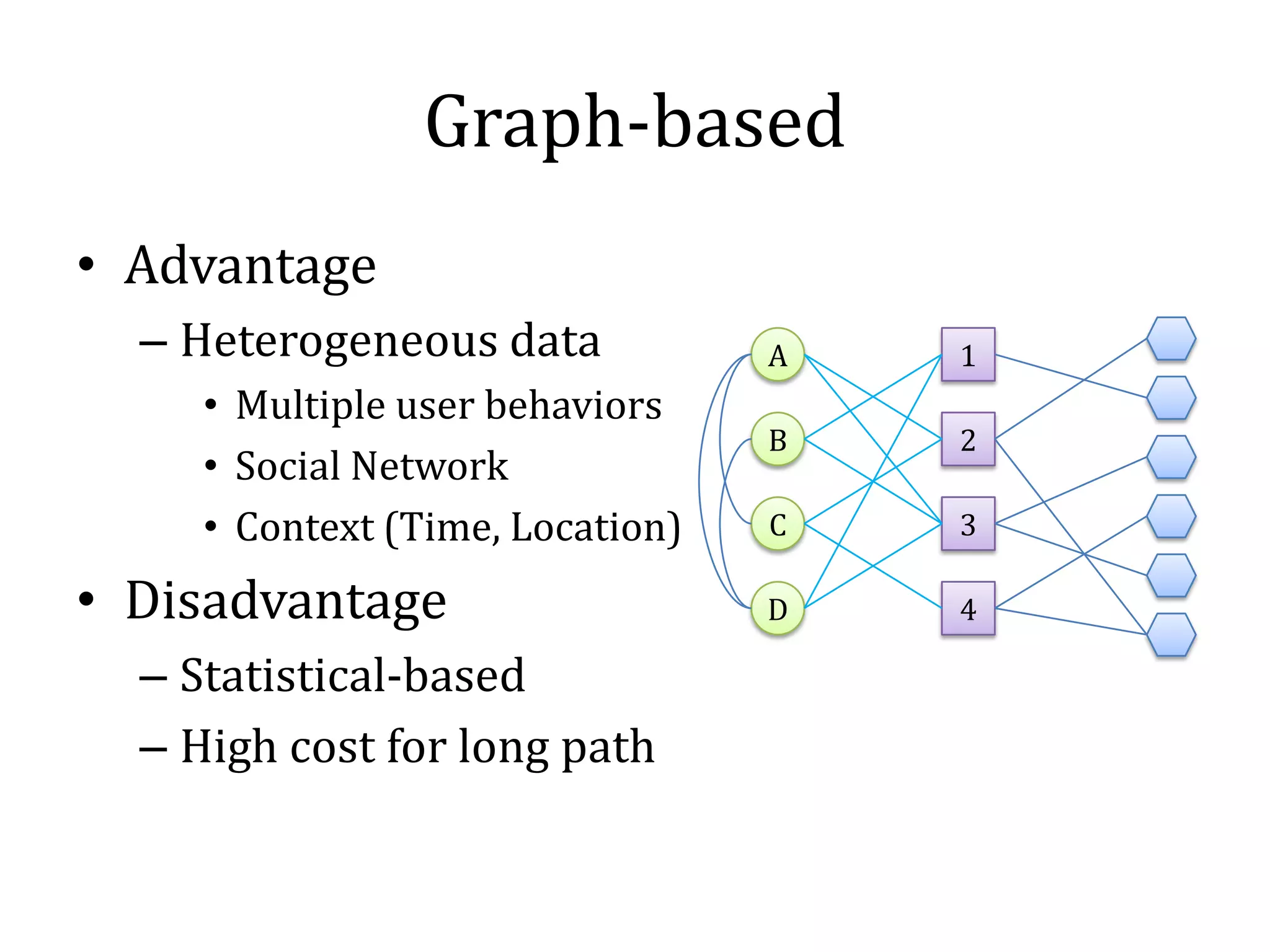
• Advantage
  – Heterogeneous data            A   1
     • Multiple user behaviors
     • Social Network
                                  B   2

     • Context (Time, Location)   C   3

• Disadvantage                    D   4

  – Statistical-based
  – High cost for long path
References
• A Graph-based Recommender System for
  Digital Library.
• Random-walk computation of similarities
  between nodes of a graph with application
  to collaborative recommendation.
Latent Factor Model
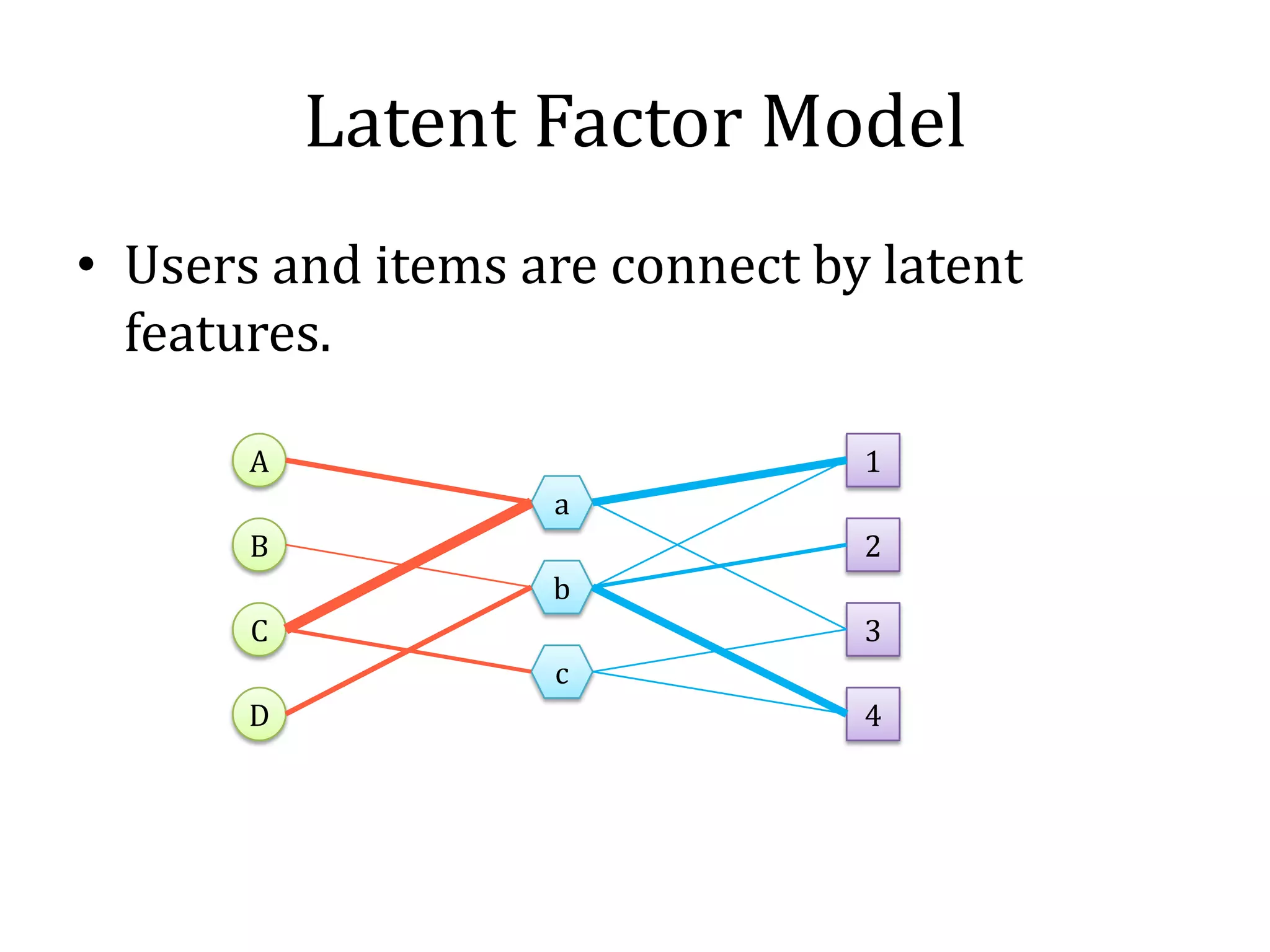
• Users and items are connect by latent
  features.

       A                        1
                   a
       B                        2
                   b
       C                        3
                   c
       D                        4
Latent Factor Model
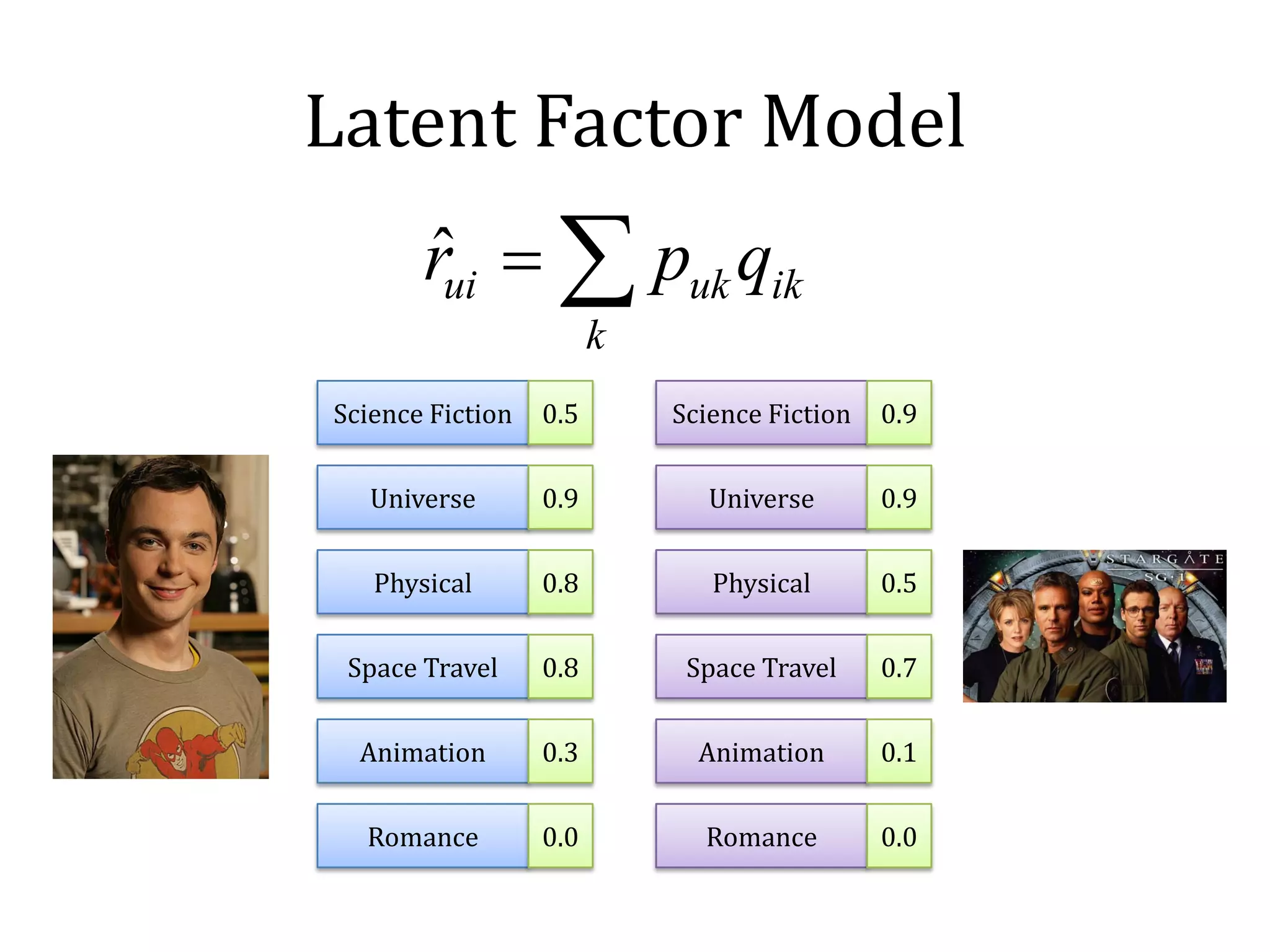
       rui = ∑ puk qik
       ˆ
                        k
Science Fiction   0.5       Science Fiction   0.9


   Universe       0.9          Universe       0.9


   Physical       0.8          Physical       0.5


 Space Travel     0.8        Space Travel     0.7


  Animation       0.3         Animation       0.1


  Romance         0.0         Romance         0.0
Latent Factor Model
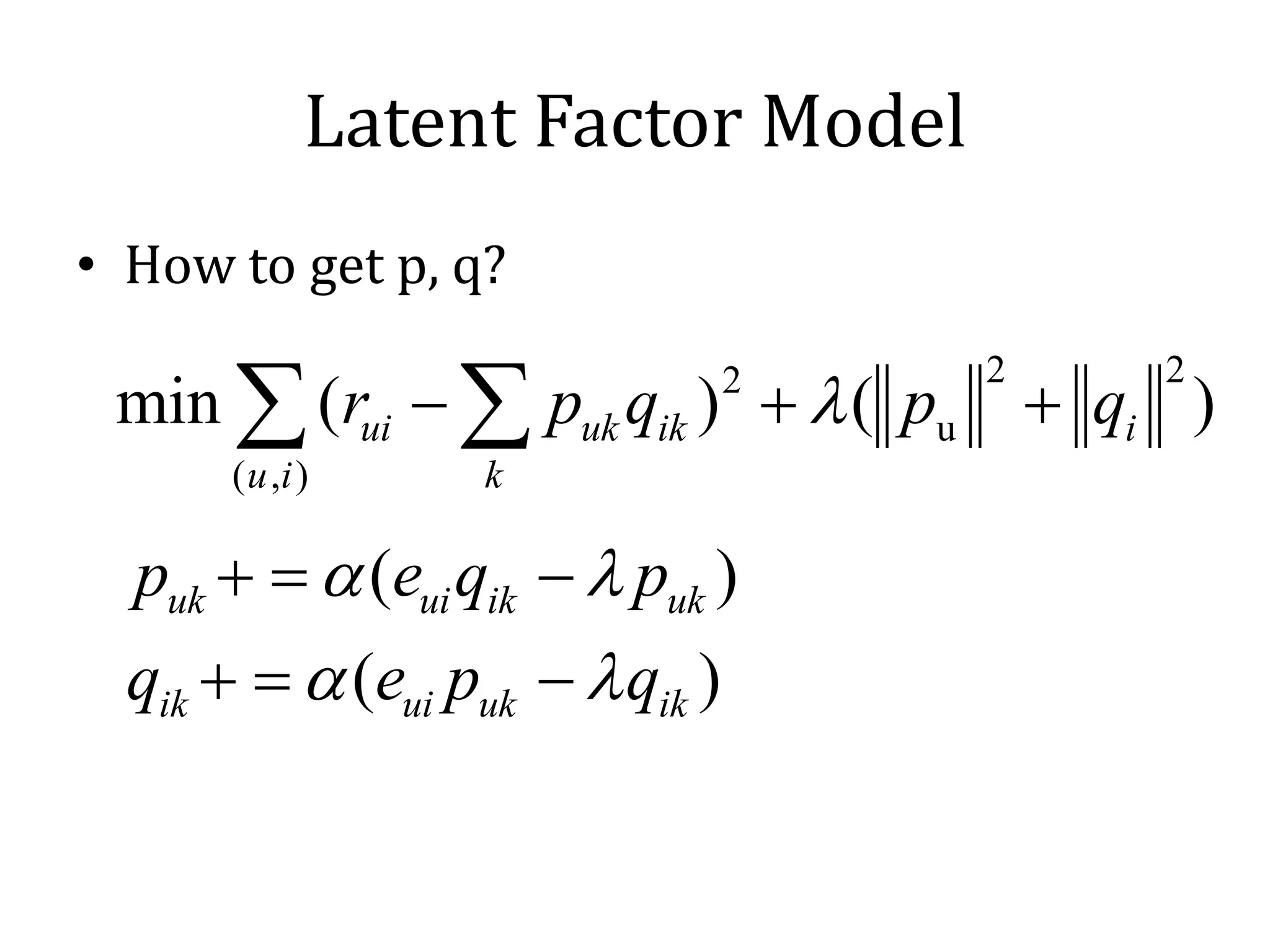
• How to get p, q?

 min ∑ (rui − ∑ puk qik ) + λ ( pu       + qi )
                         2           2       2

      ( u ,i )    k

 = α (eui qik − λ puk )
 puk +
= α (eui puk − λ qik )
qik +
Latent Factor Model
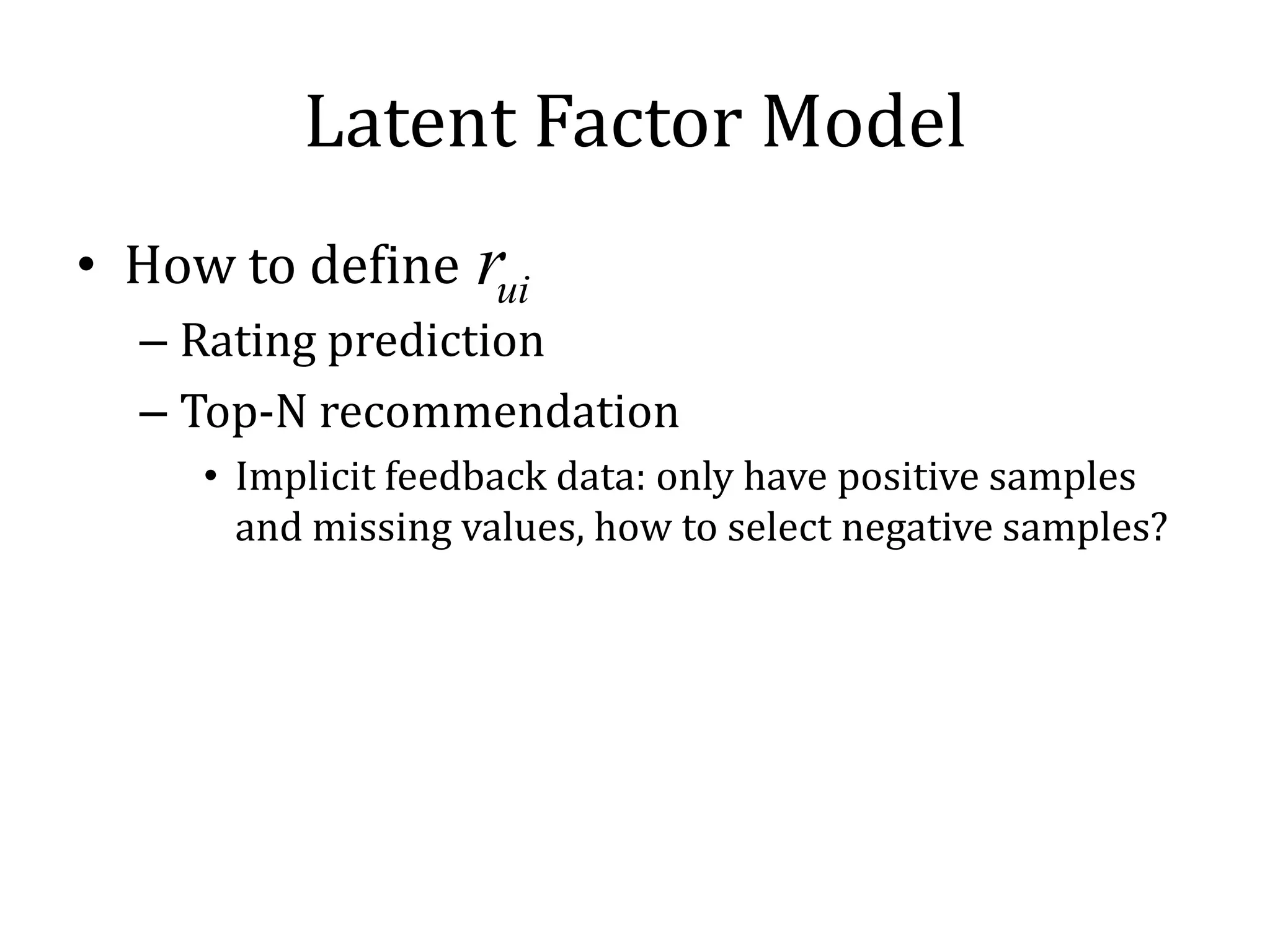
• How to define rui
  – Rating prediction
  – Top-N recommendation
     • Implicit feedback data: only have positive samples
       and missing values, how to select negative samples?
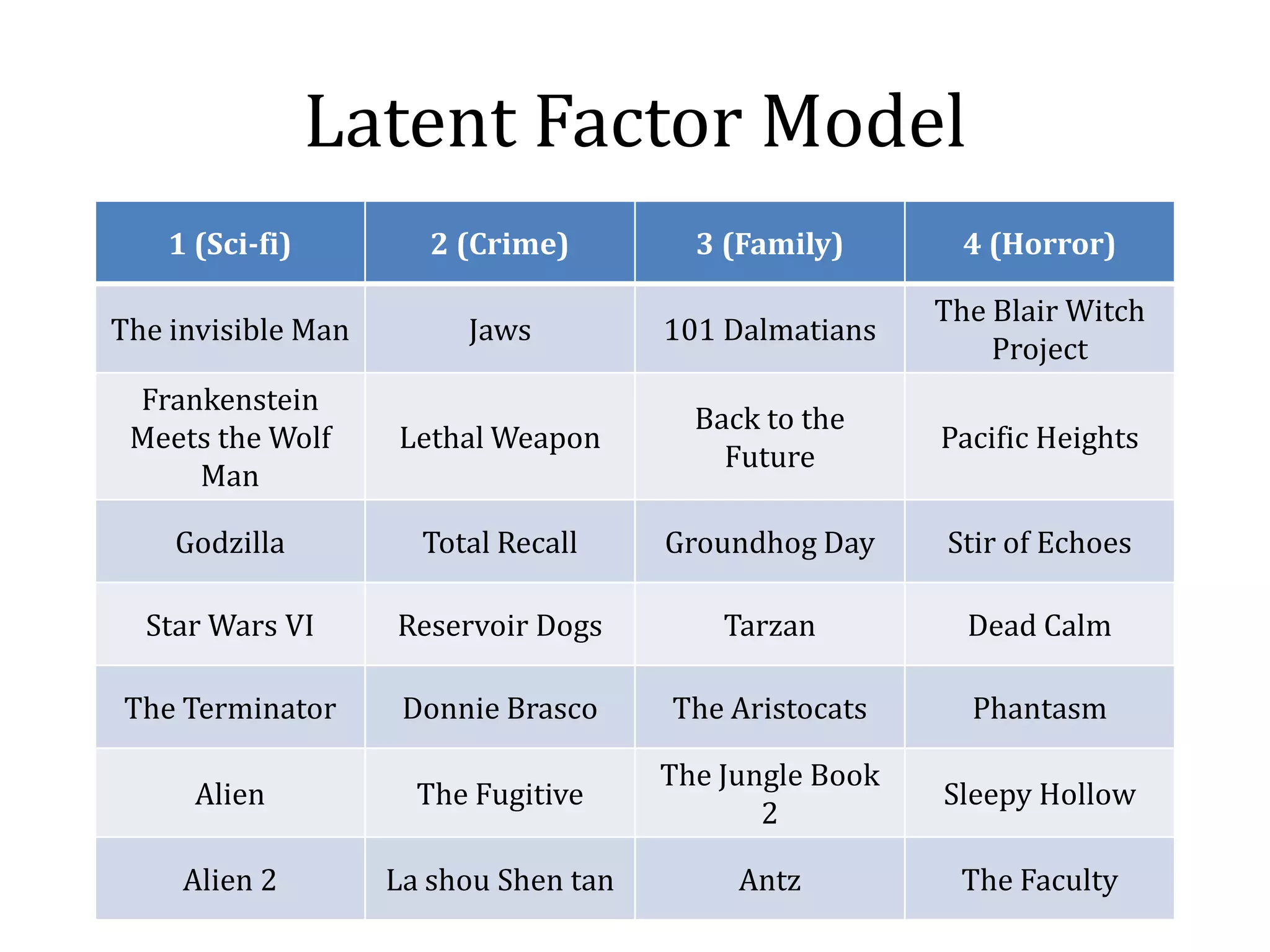
Latent Factor Model
    1 (Sci-fi)         2 (Crime)         3 (Family)        4 (Horror)

                                                         The Blair Witch
The invisible Man        Jaws          101 Dalmatians
                                                             Project
 Frankenstein
                                         Back to the
 Meets the Wolf     Lethal Weapon                        Pacific Heights
                                           Future
     Man

    Godzilla          Total Recall     Groundhog Day     Stir of Echoes

  Star Wars VI      Reservoir Dogs         Tarzan          Dead Calm

The Terminator       Donnie Brasco     The Aristocats      Phantasm

                                       The Jungle Book
      Alien           The Fugitive                       Sleepy Hollow
                                              2

     Alien 2        La shou Shen tan        Antz          The Faculty
Latent Factor Model
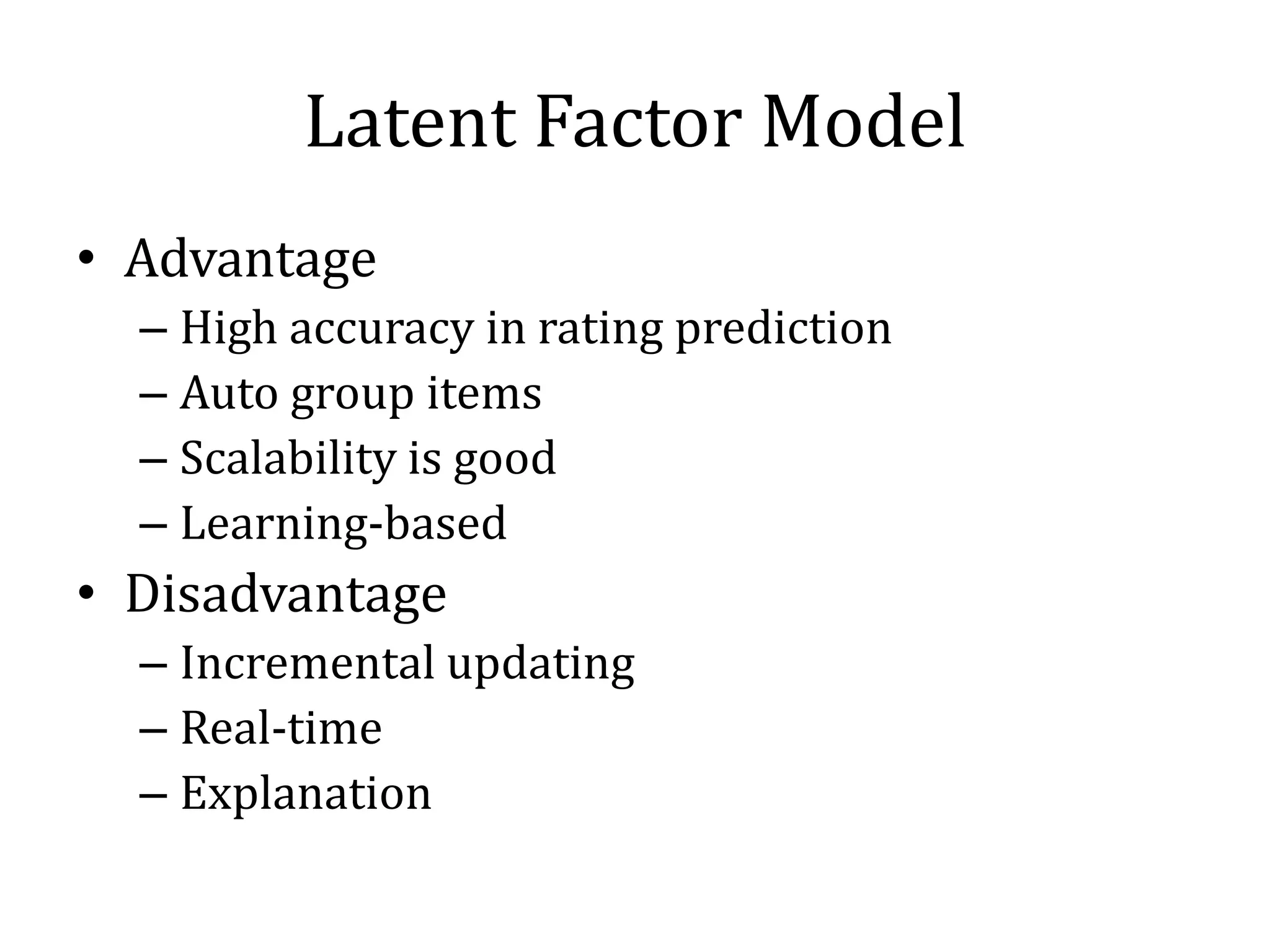
• Advantage
  – High accuracy in rating prediction
  – Auto group items
  – Scalability is good
  – Learning-based
• Disadvantage
  – Incremental updating
  – Real-time
  – Explanation
References
• http://www.informatik.uni-
  trier.de/~ley/db/indices/a-
  tree/k/Koren:Yehuda.html
Cold Start
• Problems
  – User cold start : new users
  – Item cold start : new items
  – System cold start : new systems
User Cold Start
• How to recommend items to new users?
  – Non-personalization recommendation
     • Most popular items
     • Highly Rated items
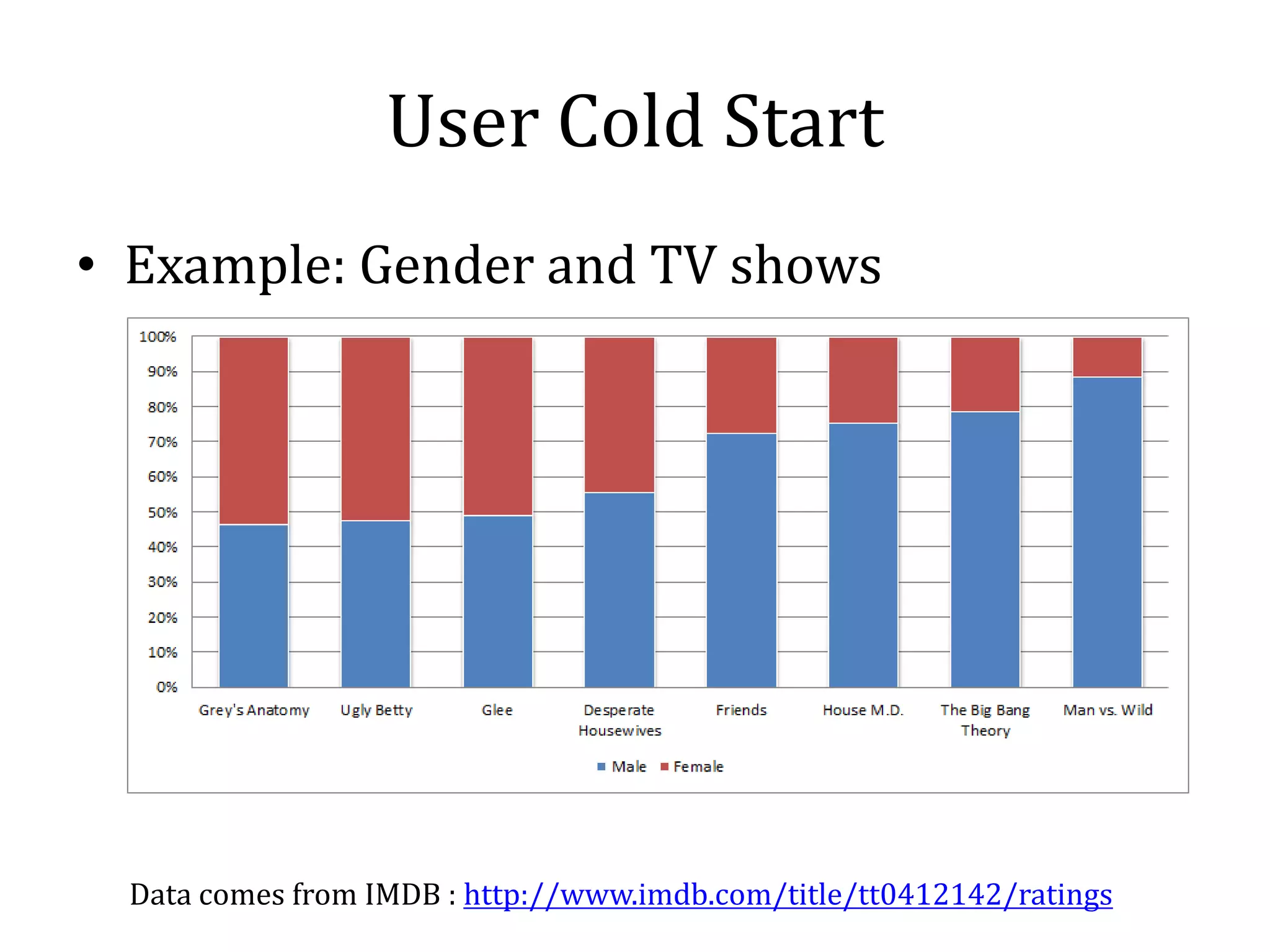
  – Using user register profile (Age, Gender, …)
User Cold Start
• Example: Gender and TV shows


 Data comes from IMDB : http://www.imdb.com/title/tt0412142/ratings
User Cold Start

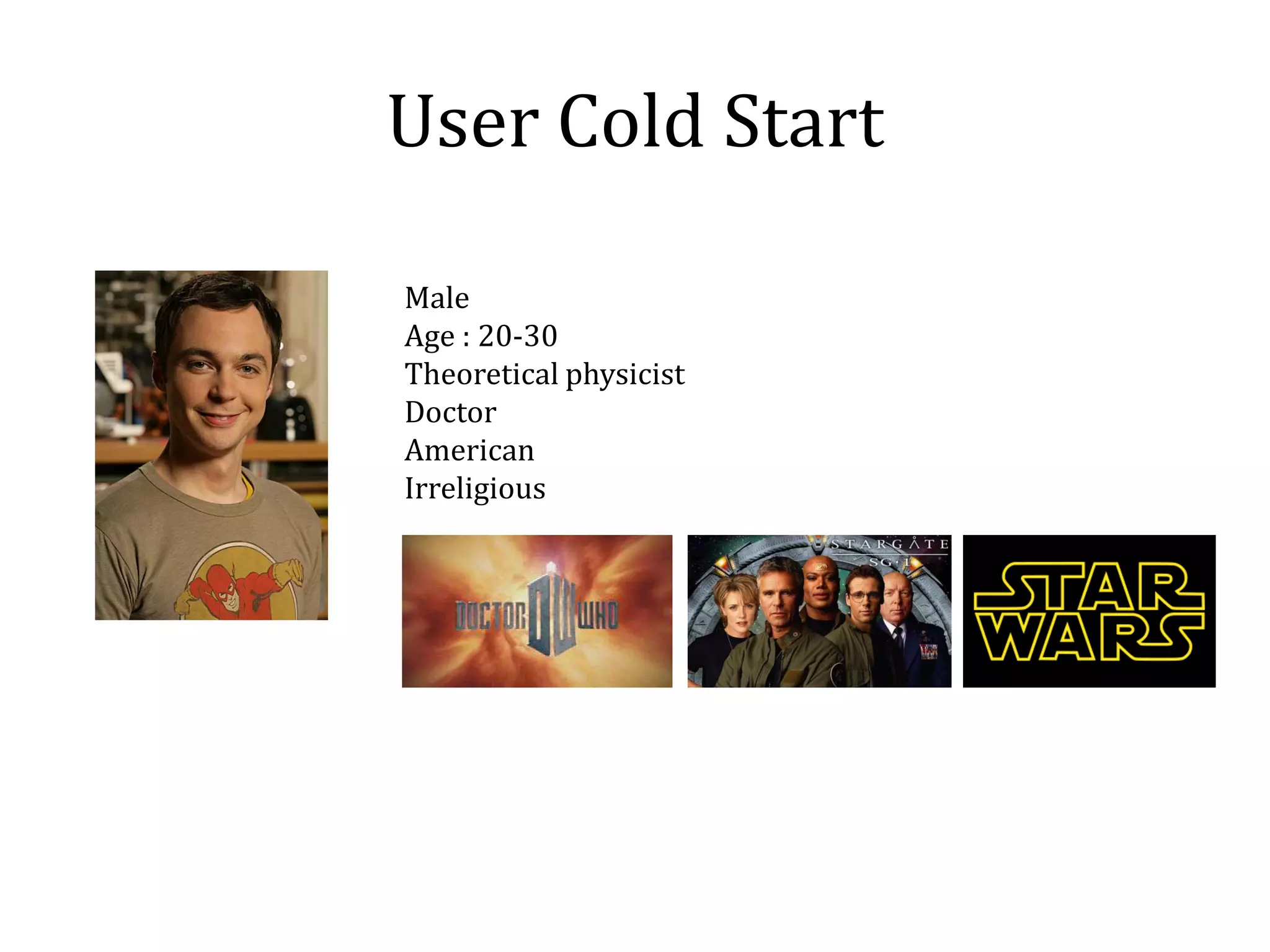
Male
Age : 20-30
Theoretical physicist
Doctor
American
Irreligious
How to get user interest quickly
• When new user comes, his feedback on
  what items can help us better understand
  his interest?
  – Not very popular
  – Can represent a group of items
  – Users who like this item have different
    preference with users who dislike this item
Item Cold Start
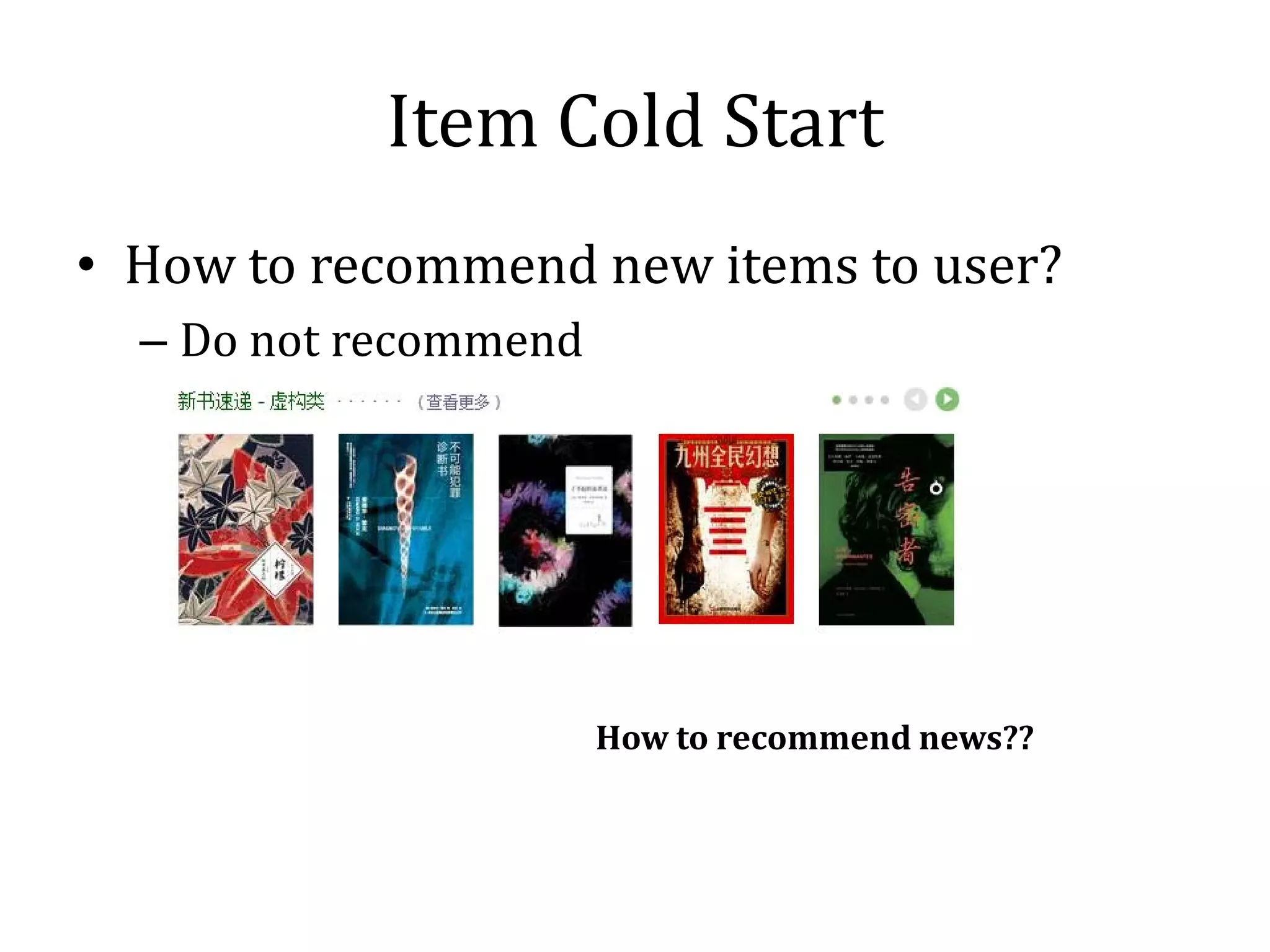
• How to recommend new items to user?
  – Do not recommend


                       How to recommend news??
Item Cold Start
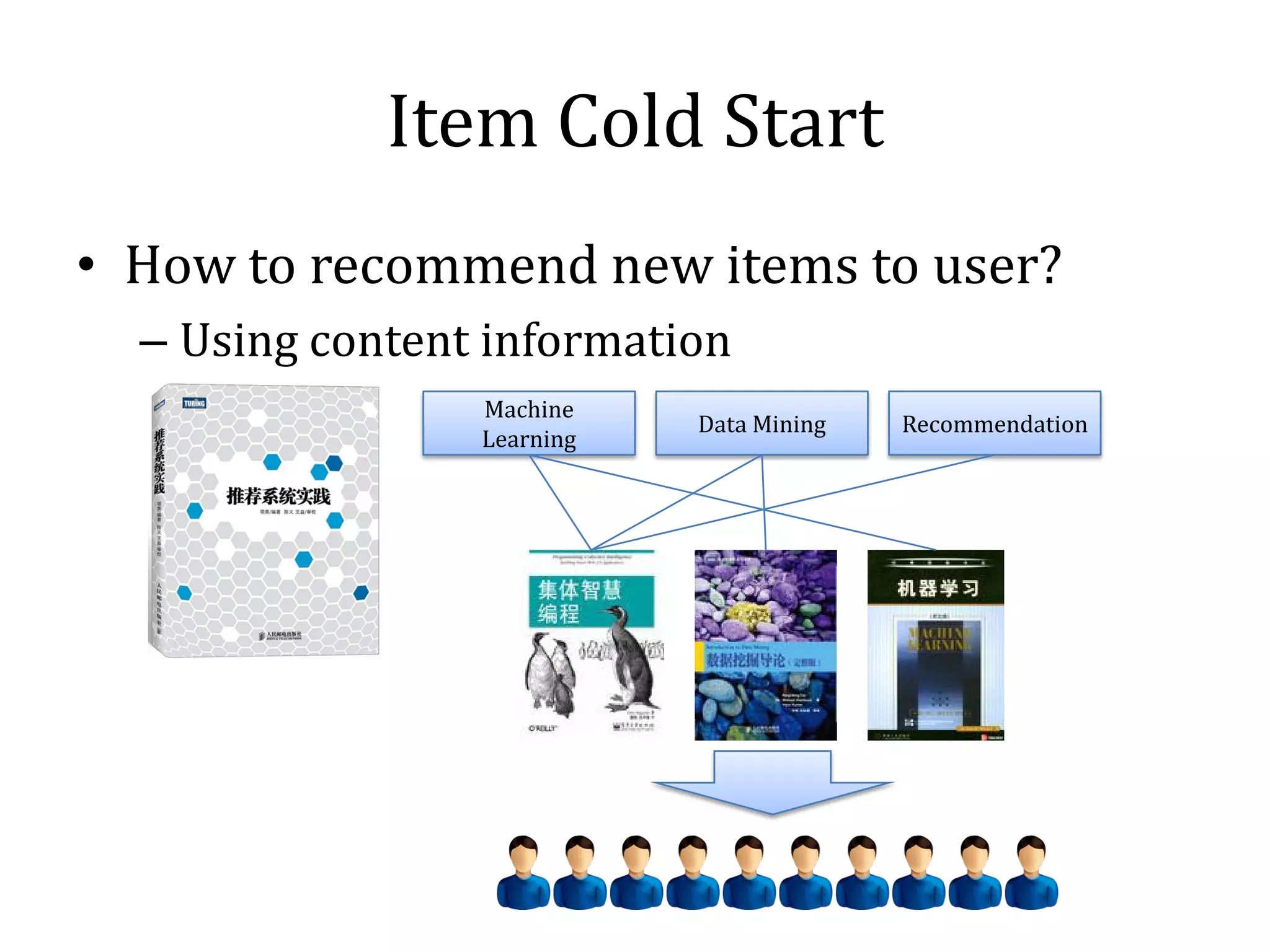
• How to recommend new items to user?
  – Using content information
                 Machine
                            Data Mining   Recommendation
                 Learning
System Cold Start
• How to design recommender system when
  there is no user?
  – Pandora : Music Genome Project
  – Jinni : Movie Genome Project
Architecture
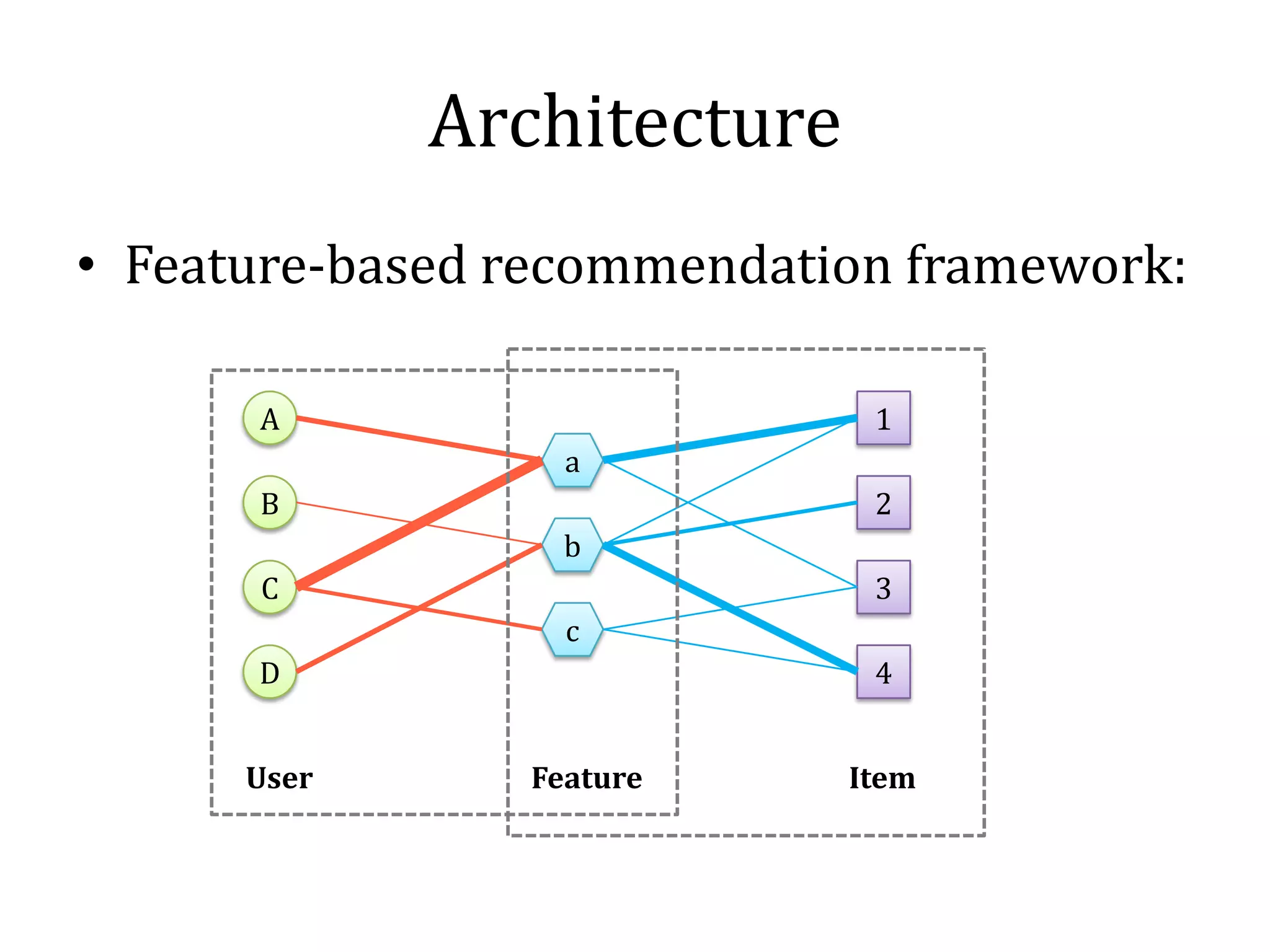
• Feature-based recommendation framework:

      A                      1
                  a
      B                      2
                  b
      C                      3
                  c
      D                      4


      User      Feature     Item
Architecture


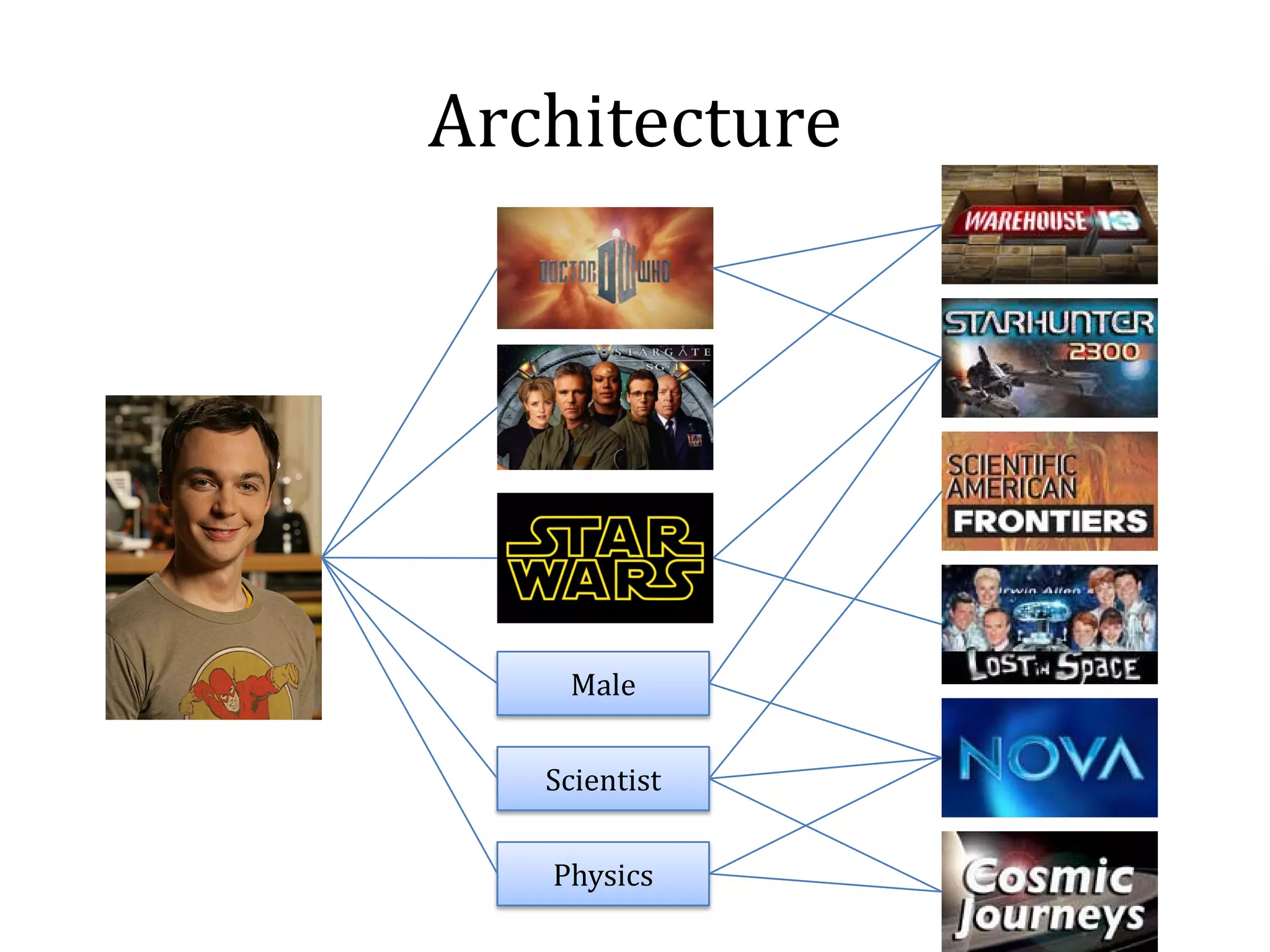
    Male


   Scientist


   Physics
Architecture
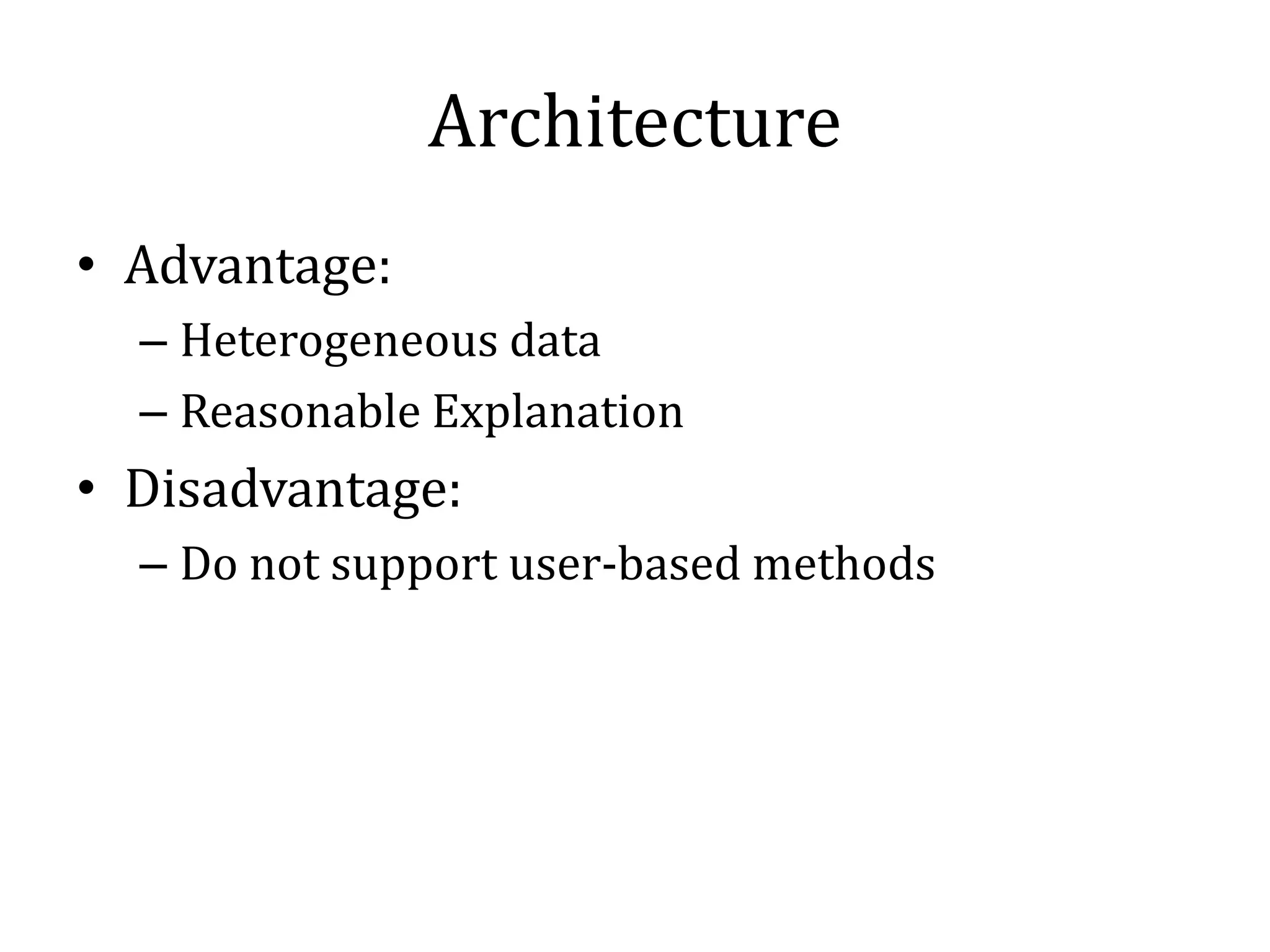
• Advantage:
  – Heterogeneous data
  – Reasonable Explanation
• Disadvantage:
  – Do not support user-based methods
Open Questions
• How to weight multiple behaviors?
• How to improve diversity, novelty?
• How to build feedback loop?
Thanks!

项亮 推荐系统实践 从入门到精通

  • 1.
    Recommender System: Algorithms &Architecture xiangliang@hulu.com
  • 2.
    Outline Problem Data • Algorithms • Cold start • Architecture • • Recommender System
  • 3.
    Problem Recommend items tousers to make user, content partner, websites happy!
  • 4.
    Data • User behaviorsdata Page view All user Very Large Behavior User Size Watch video All user Large Favorite Register user Middle Vote Register user Middle Add to playlist Register user Small Facebook like Register user Small Share Register user Small Review Register user Small
  • 5.
    Data • Which datais most important Page view All user Very Large Behavior User Size – Main behavior in the Watch video All user Large website Favorite Register user Middle Vote Register user Middle – All user can have such Add to playlist Register user Small behavior Facebook like Register user Small – Cost Share Register user Small Review Register user Small – Reflect user interests on items
  • 6.
    Data • Data Structure – User ID – Item ID – Behavior Type – Behavior Content – Context • Timestamp • Location • Mood Sheldon watch Star Trek with his friends at home
  • 7.
    Algorithms Recommender System Method Collaborative Content Social …… Filtering Filtering Filtering Latent Factor Graph-based …… Model Neighborhood …… -based User-based Item-based ……
  • 8.
    Neighborhood-based • User-based – Digg • Item-based – Amazon, Netflix, YouTube, Hulu, …
  • 9.
    User-based • Algorithm – For user u, find a set of users S(u) have similar preference as u. – Recommend popular items among users in S(u) to user u.
  • 10.
    User-based CF pui = ∑ v∈S ( u , K ) ∩ N ( i ) wuv rvi N (u ) ∩ N (v) w uv = N (u ) ∪ N (v)
  • 11.
    Item-based • Algorithm – For user u, get items set N(u) this user like before. – Recommend items which are similar to many items in N(u) to user u.
  • 12.
    Item-based CF pui = ∑ j∈S ( i , K ) ∩ N ( u ) w ji ruj N (i ) ∩ N ( j ) w ij = N (i ) ∪ N ( j )
  • 13.
    Item-based CF Why notuse w ij = ? N (i ) ∩ N ( j ) N (i )
  • 14.
    Neighborhood-based • User-based vs.Item-based User-based Item-based Scalability Bad when user size is Bad when item size is large large Explanation Bad Good Novelty Bad Good Coverage Bad Good Cold start Bad for new users Bad for new items Performance Need to get many Only need to get users history current user’s history
  • 15.
    References • Amazon.com Recommendationsitem-to- item Collaborative Filtering. • Empirical Analysis of Predictive Algorithms for Collaborative Filtering.
  • 16.
    Graph-based • Users’ behaviorson items can be represented by bi-part graph. A 1 A 1 A 1 A 1 B 2 B 2 B 2 B 2 C 3 C 3 C 3 C 3 D 4 D 4 D 4 D 4
  • 17.
    Graph-based • Two nodeswill have high relevance if – There are many paths in graph between two nodes. – Most of paths between two nodes is short. – Most paths do not go through nodes with high out-degree.
  • 18.
    Graph-based • Advantage – Heterogeneous data A 1 • Multiple user behaviors • Social Network B 2 • Context (Time, Location) C 3 • Disadvantage D 4 – Statistical-based – High cost for long path
  • 19.
    References • A Graph-basedRecommender System for Digital Library. • Random-walk computation of similarities between nodes of a graph with application to collaborative recommendation.
  • 20.
    Latent Factor Model •Users and items are connect by latent features. A 1 a B 2 b C 3 c D 4
  • 21.
    Latent Factor Model rui = ∑ puk qik ˆ k Science Fiction 0.5 Science Fiction 0.9 Universe 0.9 Universe 0.9 Physical 0.8 Physical 0.5 Space Travel 0.8 Space Travel 0.7 Animation 0.3 Animation 0.1 Romance 0.0 Romance 0.0
  • 22.
    Latent Factor Model •How to get p, q? min ∑ (rui − ∑ puk qik ) + λ ( pu + qi ) 2 2 2 ( u ,i ) k = α (eui qik − λ puk ) puk + = α (eui puk − λ qik ) qik +
  • 23.
    Latent Factor Model •How to define rui – Rating prediction – Top-N recommendation • Implicit feedback data: only have positive samples and missing values, how to select negative samples?
  • 24.
    Latent Factor Model 1 (Sci-fi) 2 (Crime) 3 (Family) 4 (Horror) The Blair Witch The invisible Man Jaws 101 Dalmatians Project Frankenstein Back to the Meets the Wolf Lethal Weapon Pacific Heights Future Man Godzilla Total Recall Groundhog Day Stir of Echoes Star Wars VI Reservoir Dogs Tarzan Dead Calm The Terminator Donnie Brasco The Aristocats Phantasm The Jungle Book Alien The Fugitive Sleepy Hollow 2 Alien 2 La shou Shen tan Antz The Faculty
  • 25.
    Latent Factor Model •Advantage – High accuracy in rating prediction – Auto group items – Scalability is good – Learning-based • Disadvantage – Incremental updating – Real-time – Explanation
  • 26.
    References • http://www.informatik.uni- trier.de/~ley/db/indices/a- tree/k/Koren:Yehuda.html
  • 27.
    Cold Start • Problems – User cold start : new users – Item cold start : new items – System cold start : new systems
  • 28.
    User Cold Start •How to recommend items to new users? – Non-personalization recommendation • Most popular items • Highly Rated items – Using user register profile (Age, Gender, …)
  • 29.
    User Cold Start •Example: Gender and TV shows Data comes from IMDB : http://www.imdb.com/title/tt0412142/ratings
  • 30.
    User Cold Start Male Age: 20-30 Theoretical physicist Doctor American Irreligious
  • 31.
    How to getuser interest quickly • When new user comes, his feedback on what items can help us better understand his interest? – Not very popular – Can represent a group of items – Users who like this item have different preference with users who dislike this item
  • 32.
    Item Cold Start •How to recommend new items to user? – Do not recommend How to recommend news??
  • 33.
    Item Cold Start •How to recommend new items to user? – Using content information Machine Data Mining Recommendation Learning
  • 34.
    System Cold Start •How to design recommender system when there is no user? – Pandora : Music Genome Project – Jinni : Movie Genome Project
  • 35.
    Architecture • Feature-based recommendationframework: A 1 a B 2 b C 3 c D 4 User Feature Item
  • 36.
    Architecture Male Scientist Physics
  • 37.
    Architecture • Advantage: – Heterogeneous data – Reasonable Explanation • Disadvantage: – Do not support user-based methods
  • 38.
    Open Questions • Howto weight multiple behaviors? • How to improve diversity, novelty? • How to build feedback loop?
  • 39.