The relationship between Social Return On Investment (SROI) and Social
Accounting and Audit (SAA)
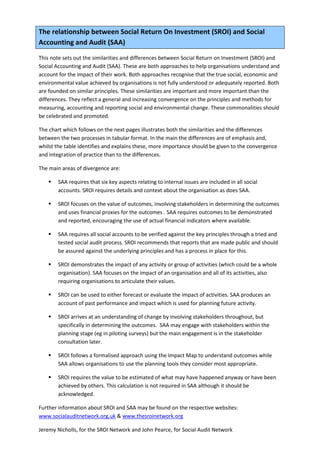
This note sets out the similarities and differences between Social Return on Investment (SROI) and
Social Accounting and Audit (SAA). These are both approaches to help organisations understand and
account for the impact of their work. Both approaches recognise that the true social, economic and
environmental value achieved by organisations is not fully understood or adequately reported. Both
are founded on similar principles. These similarities are important and more important than the
differences. They reflect a general and increasing convergence on the principles and methods for
measuring, accounting and reporting social and environmental change. These commonalities should
be celebrated and promoted.
The chart which follows on the next pages illustrates both the similarities and the differences
between the two processes in tabular format. In the main the differences are of emphasis and,
whilst the table identifies and explains these, more importance should be given to the convergence
and integration of practice than to the differences.
The main areas of divergence are:
SAA requires that six key aspects relating to internal issues are included in all social
accounts. SROI requires details and context about the organisation as does SAA.
SROI focuses on the value of outcomes, involving stakeholders in determining the outcomes
and uses financial proxies for the outcomes . SAA requires outcomes to be demonstrated
and reported, encouraging the use of actual financial indicators where available.
SAA requires all social accounts to be verified against the key principles through a tried and
tested social audit process. SROI recommends that reports that are made public and should
be assured against the underlying principles and has a process in place for this.
SROI demonstrates the impact of any activity or group of activities (which could be a whole
organisation). SAA focuses on the impact of an organisation and all of its activities, also
requiring organisations to articulate their values.
SROI can be used to either forecast or evaluate the impact of activities. SAA produces an
account of past performance and impact which is used for planning future activity.
SROI arrives at an understanding of change by involving stakeholders throughout, but
specifically in determining the outcomes. SAA may engage with stakeholders within the
planning stage (eg in piloting surveys) but the main engagement is in the stakeholder
consultation later.
SROI follows a formalised approach using the Impact Map to understand outcomes while
SAA allows organisations to use the planning tools they consider most appropriate.
SROI requires the value to be estimated of what may have happened anyway or have been
achieved by others. This calculation is not required in SAA although it should be
acknowledged.
Further information about SROI and SAA may be found on the respective websites:
www.socialauditnetwork.org.uk & www.thesroinetwork.org
Jeremy Nicholls, for the SROI Network and John Pearce, for Social Audit Network
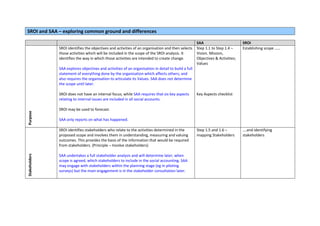
SROI and SAA – exploring common ground and differences
SROI identifies the objectives and activities of an organisation and then selects
those activities which will be included in the scope of the SROI analysis. It
identifies the way in which those activities are intended to create change.

SAA
Step 1.1 to Step 1.4 –
Vision. Mission,
Objectives & Activities;
Values

SROI
Establishing scope ……

SAA explores objectives and activities of an organisation in detail to build a full
statement of everything done by the organisation which affects others; and
also requires the organisation to articulate its Values. SAA does not determine
the scope until later.

Purpose

SROI does not have an internal focus; while SAA requires that six key aspects
relating to internal issues are included in all social accounts.
SROI may be used to forecast.
SAA only reports on what has happened.
SROI identifies stakeholders who relate to the activities determined in the
proposed scope and involves them in understanding, measuring and valuing
outcomes. This provides the basis of the information that would be required
from stakeholders. (Principle – Involve stakeholders)
Stakeholders

Key Aspects checklist

SAA undertakes a full stakeholder analysis and will determine later, when
scope is agreed, which stakeholders to include in the social accounting. SAA
may engage with stakeholders within the planning stage (eg in piloting
surveys) but the main engagement is in the stakeholder consultation later.

Step 1.5 and 1.6 –
mapping Stakeholders

….and identifying
stakeholders
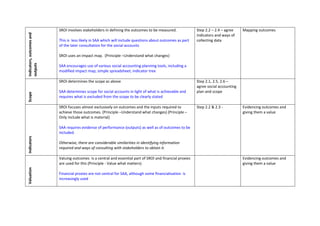
Indicators, outcomes and
outputs

SROI involves stakeholders in defining the outcomes to be measured.
This is less likely in SAA which will include questions about outcomes as part
of the later consultation for the social accounts

Mapping outcomes

SROI uses an impact map. (Principle –Understand what changes)
SAA encourages use of various social accounting planning tools, including a
modified impact map; simple spreadsheet; indicator tree
SROI determines the scope as above

Scope

Step 2.2 – 2.4 – agree
indicators and ways of
collecting data

SAA determines scope for social accounts in light of what is achievable and
requires what is excluded from the scope to be clearly stated
SROI focuses almost exclusively on outcomes and the inputs required to
achieve those outcomes. (Principle –Understand what changes) (Principle –
Only include what is material)

Step 2.1, 2.5, 2.6 –
agree social accounting
plan and scope

Step 2.2 & 2.3 -

Evidencing outcomes and
giving them a value

Indicators

SAA requires evidence of performance (outputs) as well as of outcomes to be
included.
Otherwise, there are considerable similarities in identifying information
required and ways of consulting with stakeholders to obtain it.

Valuation

Valuing outcomes is a central and essential part of SROI and financial proxies
are used for this (Principle - Value what matters)
Financial proxies are not central for SAA, although some financialisation is
increasingly used

Evidencing outcomes and
giving them a value
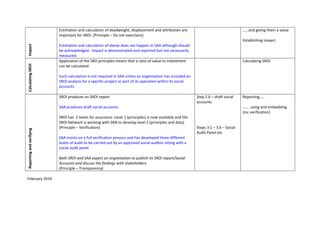
Estimation and calculation of deadweight, displacement and attribution are
important for SROI. (Principle – Do not overclaim)

……and giving them a value

Calculating SROI

Impact

Establishing impact
Estimation and calculation of above does not happen in SAA although should
be acknowledged. Impact is demonstrated and reported but not necessarily
measured.
Application of the SRO principles means that a ratio of value to investment
can be calculated

Calculating SROI

Such calculation is not required in SAA unless an organisation has included an
SROI analysis for a specific project or part of its operation within its social
accounts
SROI produces an SROI report

Step 2.6 – draft social
accounts

Reporting and verifying

SAA produces draft social accounts

February 2010

SROI has 2 levels for assurance. Level 1 (principles) is now available and the
SROI Network is working with SAN to develop level 2 (principles and data)
(Principle – Verification)
SAA insists on a full verification process and has developed three different
levels of audit to be carried out by an approved social auditor sitting with a
social audit panel
Both SROI and SAA expect an organisation to publish its SROI report/Social
Accounts and discuss the findings with stakeholders
(Principle – Transparency)

Reporting…..
……. using and embedding
(inc verification)

Steps 3.1 – 3.6 – Social
Audit Panel etc

Sroi,

  • 1.
    The relationship betweenSocial Return On Investment (SROI) and Social Accounting and Audit (SAA) This note sets out the similarities and differences between Social Return on Investment (SROI) and Social Accounting and Audit (SAA). These are both approaches to help organisations understand and account for the impact of their work. Both approaches recognise that the true social, economic and environmental value achieved by organisations is not fully understood or adequately reported. Both are founded on similar principles. These similarities are important and more important than the differences. They reflect a general and increasing convergence on the principles and methods for measuring, accounting and reporting social and environmental change. These commonalities should be celebrated and promoted. The chart which follows on the next pages illustrates both the similarities and the differences between the two processes in tabular format. In the main the differences are of emphasis and, whilst the table identifies and explains these, more importance should be given to the convergence and integration of practice than to the differences. The main areas of divergence are: SAA requires that six key aspects relating to internal issues are included in all social accounts. SROI requires details and context about the organisation as does SAA. SROI focuses on the value of outcomes, involving stakeholders in determining the outcomes and uses financial proxies for the outcomes . SAA requires outcomes to be demonstrated and reported, encouraging the use of actual financial indicators where available. SAA requires all social accounts to be verified against the key principles through a tried and tested social audit process. SROI recommends that reports that are made public and should be assured against the underlying principles and has a process in place for this. SROI demonstrates the impact of any activity or group of activities (which could be a whole organisation). SAA focuses on the impact of an organisation and all of its activities, also requiring organisations to articulate their values. SROI can be used to either forecast or evaluate the impact of activities. SAA produces an account of past performance and impact which is used for planning future activity. SROI arrives at an understanding of change by involving stakeholders throughout, but specifically in determining the outcomes. SAA may engage with stakeholders within the planning stage (eg in piloting surveys) but the main engagement is in the stakeholder consultation later. SROI follows a formalised approach using the Impact Map to understand outcomes while SAA allows organisations to use the planning tools they consider most appropriate. SROI requires the value to be estimated of what may have happened anyway or have been achieved by others. This calculation is not required in SAA although it should be acknowledged. Further information about SROI and SAA may be found on the respective websites: www.socialauditnetwork.org.uk & www.thesroinetwork.org Jeremy Nicholls, for the SROI Network and John Pearce, for Social Audit Network
  • 2.
    SROI and SAA– exploring common ground and differences SROI identifies the objectives and activities of an organisation and then selects those activities which will be included in the scope of the SROI analysis. It identifies the way in which those activities are intended to create change. SAA Step 1.1 to Step 1.4 – Vision. Mission, Objectives & Activities; Values SROI Establishing scope …… SAA explores objectives and activities of an organisation in detail to build a full statement of everything done by the organisation which affects others; and also requires the organisation to articulate its Values. SAA does not determine the scope until later. Purpose SROI does not have an internal focus; while SAA requires that six key aspects relating to internal issues are included in all social accounts. SROI may be used to forecast. SAA only reports on what has happened. SROI identifies stakeholders who relate to the activities determined in the proposed scope and involves them in understanding, measuring and valuing outcomes. This provides the basis of the information that would be required from stakeholders. (Principle – Involve stakeholders) Stakeholders Key Aspects checklist SAA undertakes a full stakeholder analysis and will determine later, when scope is agreed, which stakeholders to include in the social accounting. SAA may engage with stakeholders within the planning stage (eg in piloting surveys) but the main engagement is in the stakeholder consultation later. Step 1.5 and 1.6 – mapping Stakeholders ….and identifying stakeholders
  • 3.
    Indicators, outcomes and outputs SROIinvolves stakeholders in defining the outcomes to be measured. This is less likely in SAA which will include questions about outcomes as part of the later consultation for the social accounts Mapping outcomes SROI uses an impact map. (Principle –Understand what changes) SAA encourages use of various social accounting planning tools, including a modified impact map; simple spreadsheet; indicator tree SROI determines the scope as above Scope Step 2.2 – 2.4 – agree indicators and ways of collecting data SAA determines scope for social accounts in light of what is achievable and requires what is excluded from the scope to be clearly stated SROI focuses almost exclusively on outcomes and the inputs required to achieve those outcomes. (Principle –Understand what changes) (Principle – Only include what is material) Step 2.1, 2.5, 2.6 – agree social accounting plan and scope Step 2.2 & 2.3 - Evidencing outcomes and giving them a value Indicators SAA requires evidence of performance (outputs) as well as of outcomes to be included. Otherwise, there are considerable similarities in identifying information required and ways of consulting with stakeholders to obtain it. Valuation Valuing outcomes is a central and essential part of SROI and financial proxies are used for this (Principle - Value what matters) Financial proxies are not central for SAA, although some financialisation is increasingly used Evidencing outcomes and giving them a value
  • 4.
    Estimation and calculationof deadweight, displacement and attribution are important for SROI. (Principle – Do not overclaim) ……and giving them a value Calculating SROI Impact Establishing impact Estimation and calculation of above does not happen in SAA although should be acknowledged. Impact is demonstrated and reported but not necessarily measured. Application of the SRO principles means that a ratio of value to investment can be calculated Calculating SROI Such calculation is not required in SAA unless an organisation has included an SROI analysis for a specific project or part of its operation within its social accounts SROI produces an SROI report Step 2.6 – draft social accounts Reporting and verifying SAA produces draft social accounts February 2010 SROI has 2 levels for assurance. Level 1 (principles) is now available and the SROI Network is working with SAN to develop level 2 (principles and data) (Principle – Verification) SAA insists on a full verification process and has developed three different levels of audit to be carried out by an approved social auditor sitting with a social audit panel Both SROI and SAA expect an organisation to publish its SROI report/Social Accounts and discuss the findings with stakeholders (Principle – Transparency) Reporting….. ……. using and embedding (inc verification) Steps 3.1 – 3.6 – Social Audit Panel etc