Introduction to .NET
1
Gaurav Singh ,CSE dept., SRIIT BANMORE
.NET Framework
• Microsoft .NET (pronounced “dot net”) is a software component
that runs on the Windows operating system.
• .NET provides tools and libraries that enable developers to
create Windows software much faster and easier.
• The .NET Framework must be installed on a user’s PC to run
.NET applications.
2
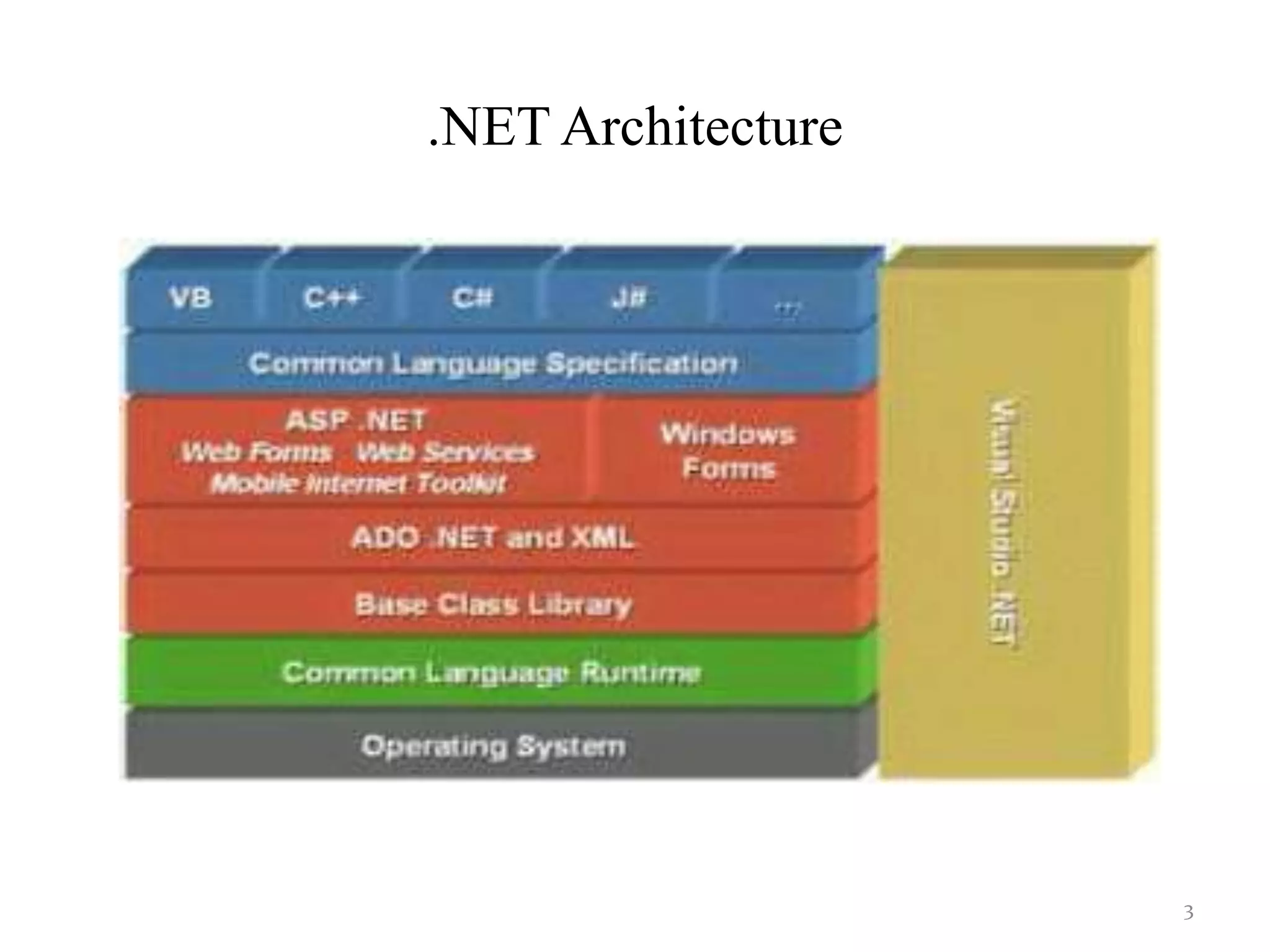
.NET Architecture
3
Components of .NET Architecture
•Microsoft .NET consists of four Major Components:
• Common Language Specification (CLS) – blue in the diagram
below
• Framework Class Library (FCL) – red
• Common Language Runtime (CLR) – green
• .NET Tools – yellow
4
Operating System : windows
At the base of the diagram in gray is the operating system,
which technically can be any platform but typically is
Microsoft Windows 2000 or greater, accessed through
the Win32 API (Application Programming Interface).
5
Common Language Specification (CLS)
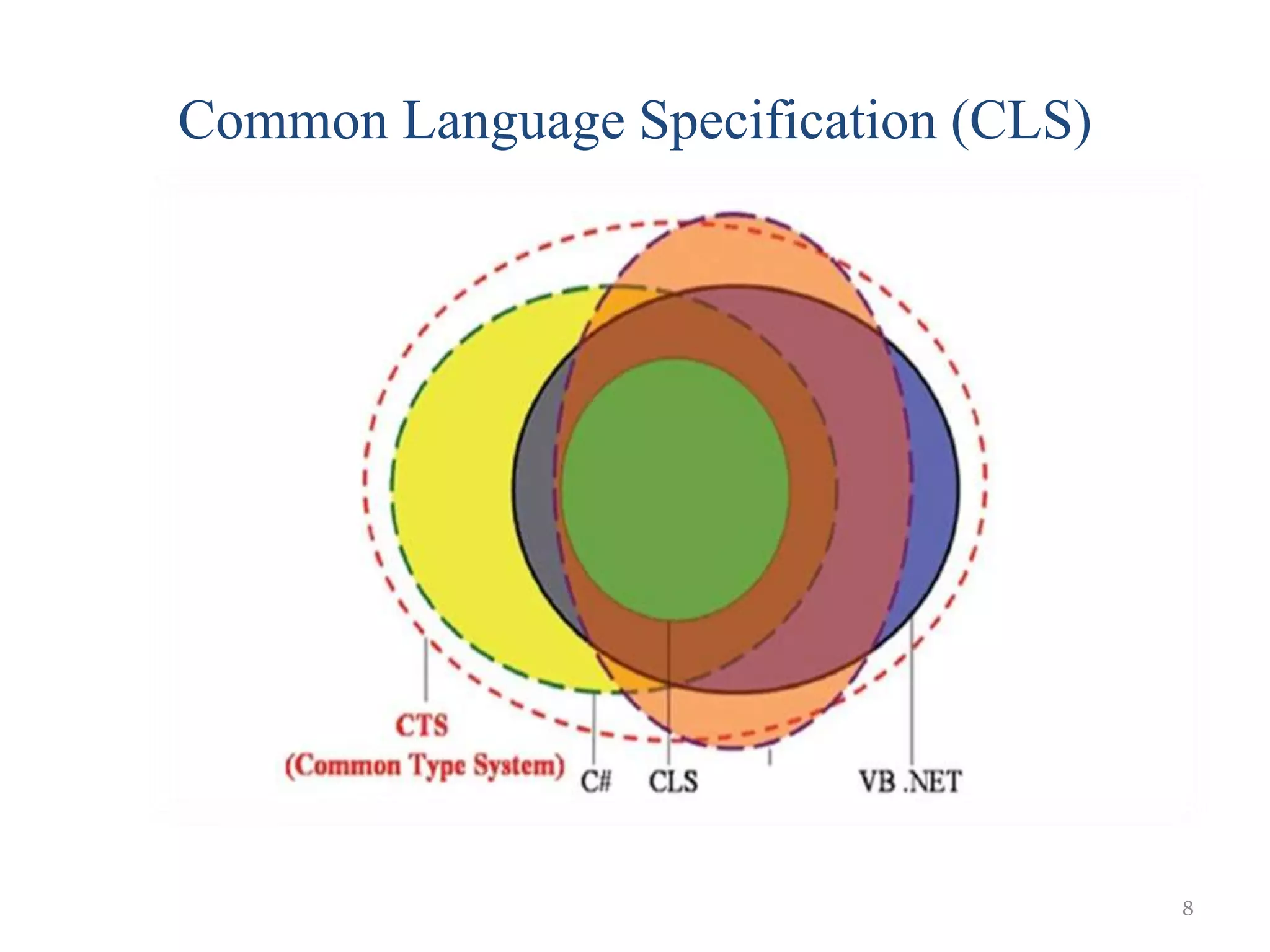
• The CLS is a common platform that integrates code and
components from multiple .NET programming languages.
• In other words, a .NET application can be written in multiple
programming languages with no extra work by the developer
6
.NET Languages
• .NET includes new object-oriented programming languages
such as C#, Visual Basic .NET, J# (a Java clone) and Managed
C++.
• These languages, plus other experimental languages like F#,
all compile to the Common Language Specification and can
work together in the same application.
7
Common Language Specification (CLS)
8
Framework Class Library (FCL)
• The FCL is a collection of over 7000 classes and data types that
enable .NET applications to read and write files, access
databases, process XML, display a graphical user interface, draw
graphics, use Web services, etc.
• The FCL wraps much of the massive, complex Win32 API into
more simple .NET objects that can be used by C# and other
.NET programming languages.
9
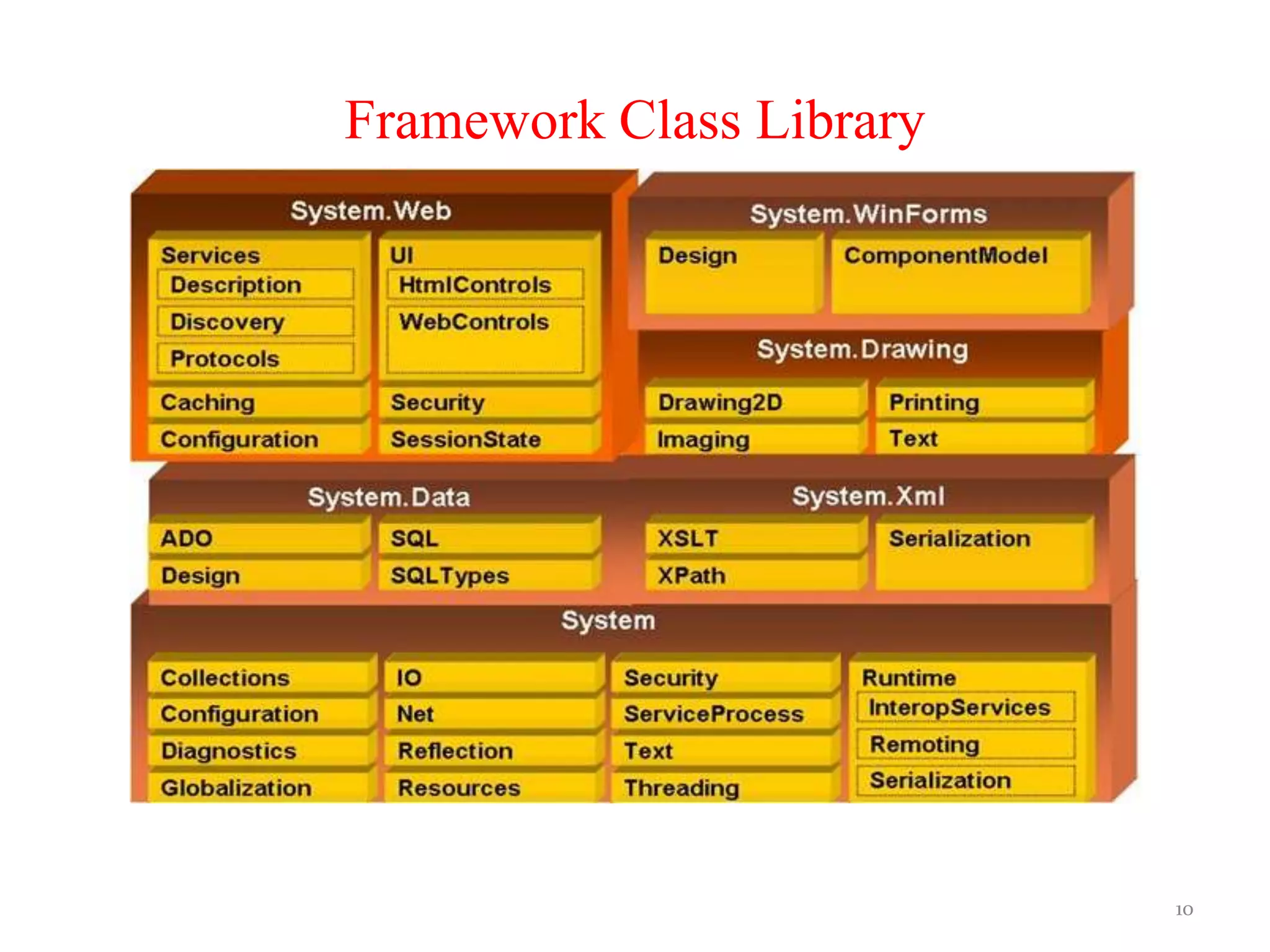
Framework Class Library
10
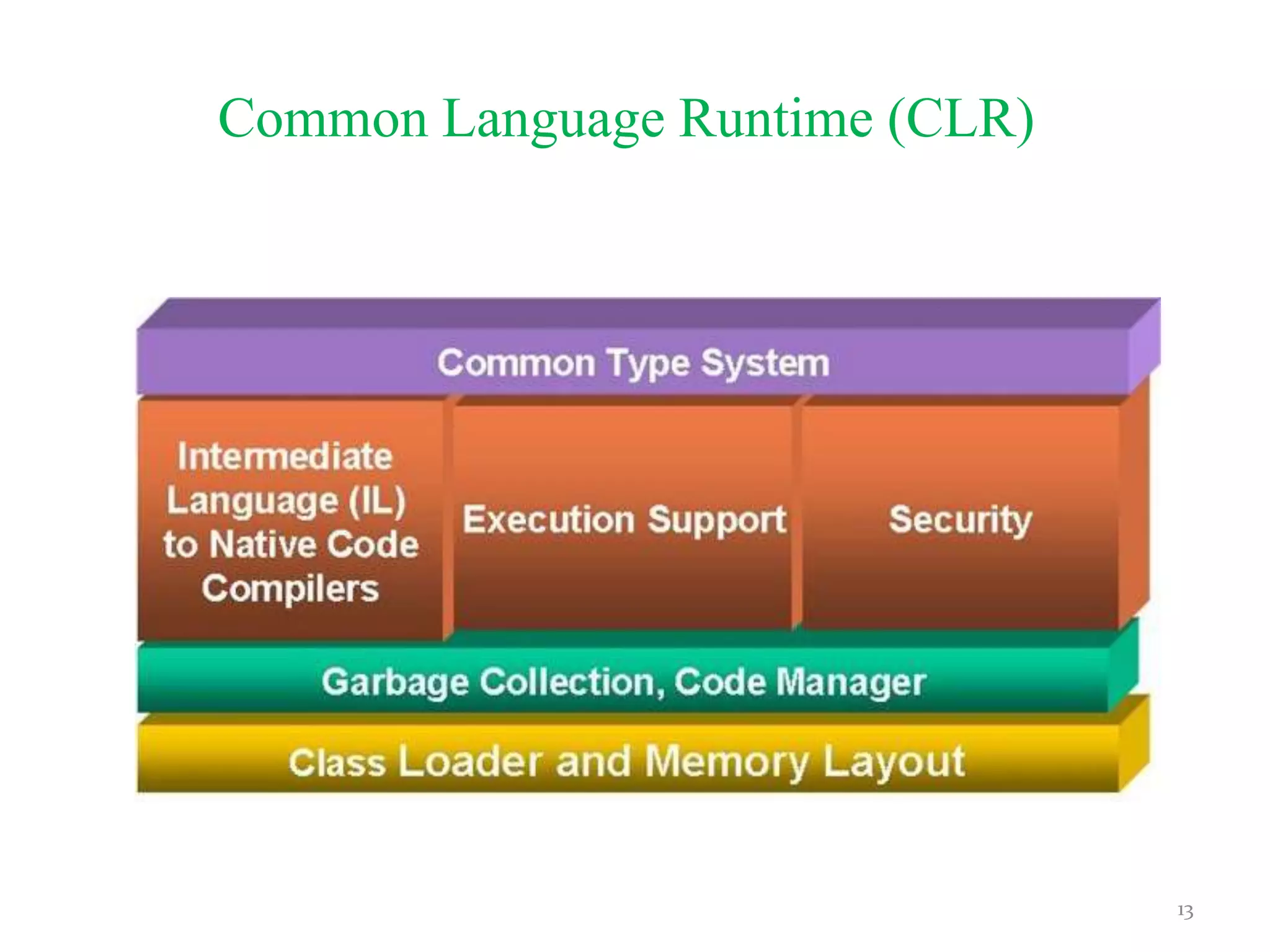
Common Language Runtime (CLR)
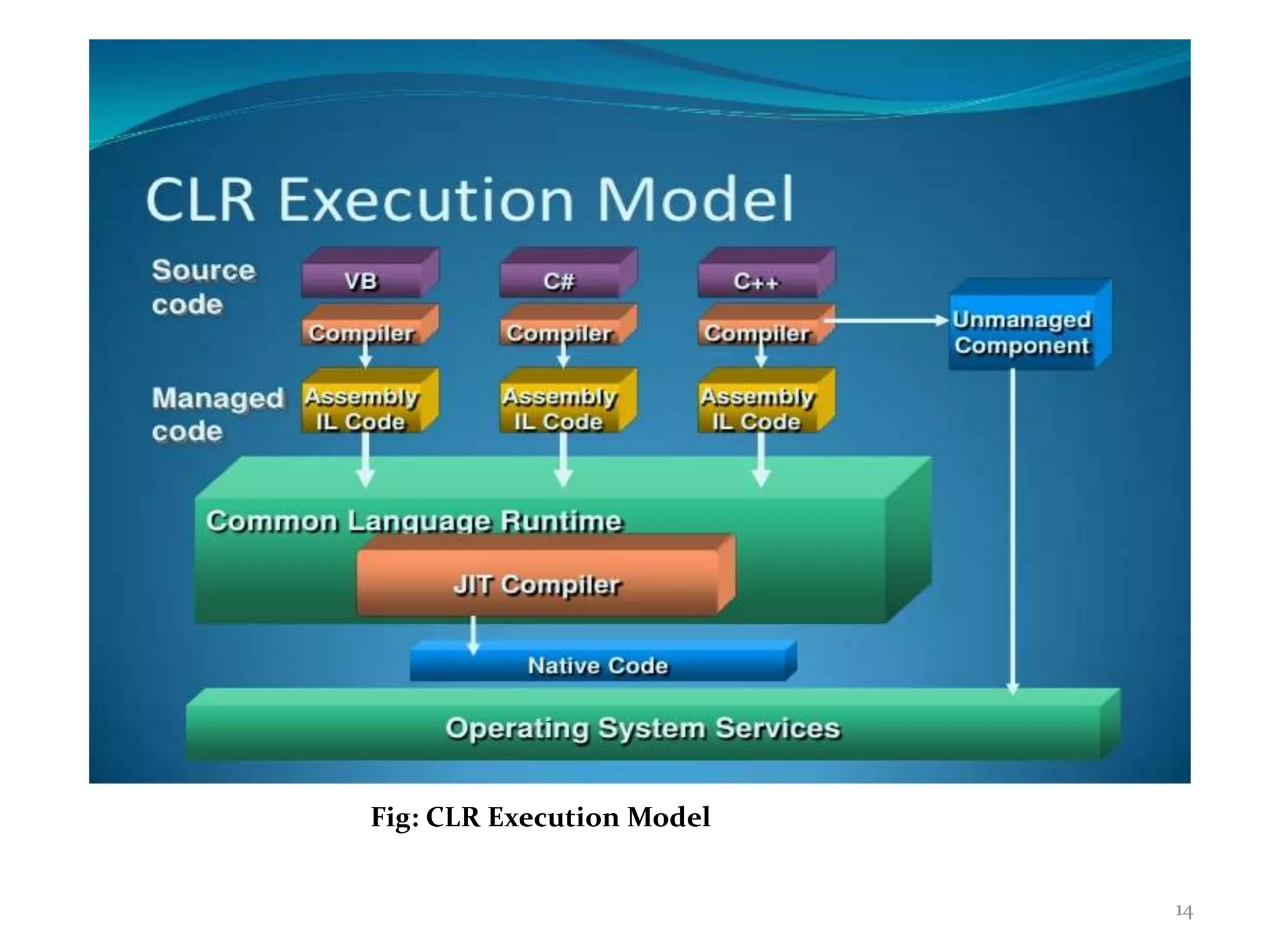
• The CLR is the execution engine for .NET applications and serves
as the interface between .NET applications and the operating system.
• The CLR provides many services such as:
• Loads and executes code
• Converts intermediate language to native machine code
• Separates processes and memory
• Manages memory and objects
11
• Enforces code and access security
• Handles exceptions
• Interfaces between managed code, COM objects, and
DLLs
• Provides type-checking
• Provides code meta data (Reflection)
• Provides profiling, debugging, etc.
12
Common Language Runtime (CLR)
13
14
Fig: CLR Execution Model
.NET Tools
• Visual Studio .NET is Microsoft’s flagship tool for developing
Windows software.
• Visual Studio provides an integrated development environment
(IDE) for developers to create standalone Windows applications,
interactive Web sites, Web applications, and Web services
running on any platform that supports .NET.
15
.NET Tools
• In addition, there are many .NET Framework tools designed to
help developers create, configure, deploy, manage and
secure .NET applications and components.
16
…… Thank You ……
17
Gaurav Singh ,CSE dept., SRIIT
BANMORE

srgoc dotnet_ppt

  • 1.
    Introduction to .NET 1 GauravSingh ,CSE dept., SRIIT BANMORE
  • 2.
    .NET Framework • Microsoft.NET (pronounced “dot net”) is a software component that runs on the Windows operating system. • .NET provides tools and libraries that enable developers to create Windows software much faster and easier. • The .NET Framework must be installed on a user’s PC to run .NET applications. 2
  • 3.
  • 4.
    Components of .NETArchitecture •Microsoft .NET consists of four Major Components: • Common Language Specification (CLS) – blue in the diagram below • Framework Class Library (FCL) – red • Common Language Runtime (CLR) – green • .NET Tools – yellow 4
  • 5.
    Operating System :windows At the base of the diagram in gray is the operating system, which technically can be any platform but typically is Microsoft Windows 2000 or greater, accessed through the Win32 API (Application Programming Interface). 5
  • 6.
    Common Language Specification(CLS) • The CLS is a common platform that integrates code and components from multiple .NET programming languages. • In other words, a .NET application can be written in multiple programming languages with no extra work by the developer 6
  • 7.
    .NET Languages • .NETincludes new object-oriented programming languages such as C#, Visual Basic .NET, J# (a Java clone) and Managed C++. • These languages, plus other experimental languages like F#, all compile to the Common Language Specification and can work together in the same application. 7
  • 8.
  • 9.
    Framework Class Library(FCL) • The FCL is a collection of over 7000 classes and data types that enable .NET applications to read and write files, access databases, process XML, display a graphical user interface, draw graphics, use Web services, etc. • The FCL wraps much of the massive, complex Win32 API into more simple .NET objects that can be used by C# and other .NET programming languages. 9
  • 10.
  • 11.
    Common Language Runtime(CLR) • The CLR is the execution engine for .NET applications and serves as the interface between .NET applications and the operating system. • The CLR provides many services such as: • Loads and executes code • Converts intermediate language to native machine code • Separates processes and memory • Manages memory and objects 11
  • 12.
    • Enforces codeand access security • Handles exceptions • Interfaces between managed code, COM objects, and DLLs • Provides type-checking • Provides code meta data (Reflection) • Provides profiling, debugging, etc. 12
  • 13.
  • 14.
  • 15.
    .NET Tools • VisualStudio .NET is Microsoft’s flagship tool for developing Windows software. • Visual Studio provides an integrated development environment (IDE) for developers to create standalone Windows applications, interactive Web sites, Web applications, and Web services running on any platform that supports .NET. 15
  • 16.
    .NET Tools • Inaddition, there are many .NET Framework tools designed to help developers create, configure, deploy, manage and secure .NET applications and components. 16
  • 17.
    …… Thank You…… 17 Gaurav Singh ,CSE dept., SRIIT BANMORE

Editor's Notes

  • #3 1.Design for windows ,run on windows. 2.Provide tools and libraries, 3.dotnet framework installed then run .net appli.
  • #4 CLS (blue) common language specification, :multiple language combine in to one platform FCL(red) Framework Class Library :store 7000 class & data types. it read and write and access via .NET application CLR(green): common language runtime: execution engine ,interface between os & .NET application, compiler, MSIL, Jit Compiler, Native code .NET tools (yellow):Visual Studio ,create standalone Windows applications, interactive Web sites, Web applications, and Web services