
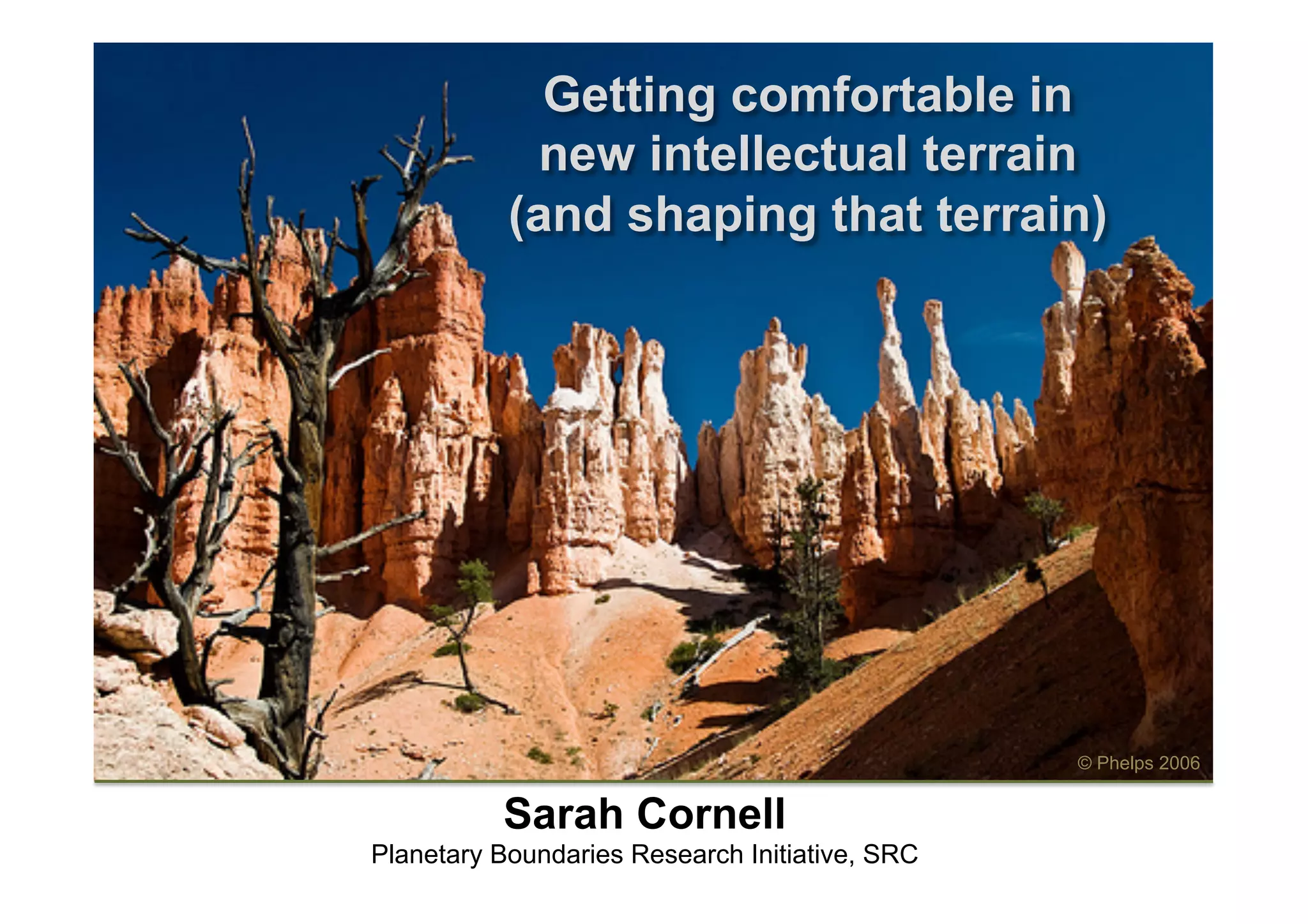

Getting comfortable in
            new intellectual terrain
           (and shaping that terrain)


                                                © Phelps 2006


          Sarah Cornell
Planetary Boundaries Research Initiative, SRC
Interdisciplinary knowledge and research are important because:
1.  Creativity often requires interdisciplinary knowledge.
2.  Immigrants often make important contributions to their new field.
3.  Disciplinarians often commit errors which can be best detected by people familiar
    with two or more disciplines.
4.  Some worthwhile topics of research fall in the interstices among the traditional
    disciplines.
5.  Many intellectual, social, and practical problems require interdisciplinary approaches.
6.  Interdisciplinary knowledge and research serve to remind us of the unity-of-
    knowledge ideal.
7.  Interdisciplinarians enjoy greater flexibility in their research.

8.  More so than narrow disciplinarians, interdisciplinarians
    often treat themselves to the intellectual equivalent of
    traveling in new lands.
9.  Interdisciplinarians may help breach communication gaps in the modern academy,
    thereby helping to mobilize its enormous intellectual resources in the cause of greater
    social rationality and justice.
10. By bridging fragmented disciplines, interdisciplinarians might play a role in the
    defense of academic freedom.

       Nissani, M. (1997) Ten Cheers for Interdisciplinarity. Social Science Journal 34 (2) 201-216
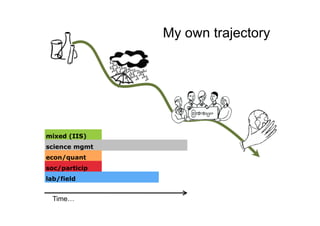
My own trajectory


Time…
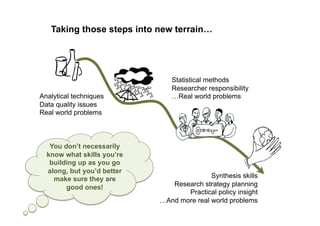
Taking those steps into new terrain…


                               Statistical methods
                               Researcher responsibility
Analytical techniques          …Real world problems
Data quality issues
Real world problems


   You don’t necessarily
  know what skills you’re
   building up as you go
  along, but you’d better
    make sure they are                     Synthesis skills
        good ones!             Research strategy planning
                                   Practical policy insight
                            …And more real world problems
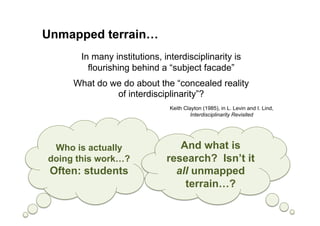
Unmapped terrain…
       In many institutions, interdisciplinarity is
         flourishing behind a “subject facade”
     What do we do about the “concealed reality
              of interdisciplinarity”?
                               Keith Clayton (1985), in L. Levin and I. Lind,
                                        Interdisciplinarity Revisited


 Who is actually                 And what is
doing this work…?             research? Isn’t it
 Often: students                all unmapped
                                  terrain…?
Piece of advice No. 1…
•  Have fun – enjoy being undisciplined
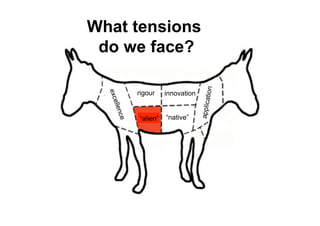
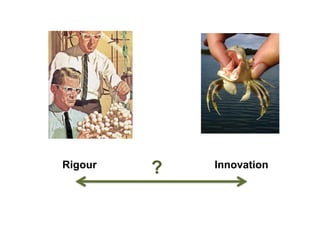
What tensions
 do we face?

     rigour     innovation


      “alien”   “native”
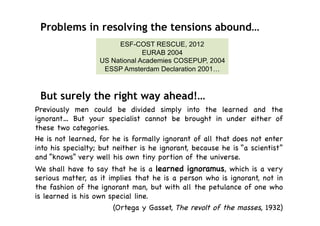
Problems in resolving the tensions abound…
                        ESF-COST RESCUE, 2012
                                EURAB 2004
                   US National Academies COSEPUP, 2004
                    ESSP Amsterdam Declaration 2001…


 But surely the right way ahead!…
Previously men could be divided simply into the learned             and the
ignorant… But your specialist cannot be brought in under           either of
these two categories.
He is not learned, for he is formally ignorant of all that does    not enter
into his specialty; but neither is he ignorant, because he is “a   scientist”
and “knows” very well his own tiny portion of the universe.
We shall have to say that he is a learned ignoramus, which is a very
serious matter, as it implies that he is a person who is ignorant, not in
the fashion of the ignorant man, but with all the petulance of one who
is learned is his own special line.
                       (Ortega y Gasset, The revolt of the masses, 1932)
Rigour   ?   Innovation
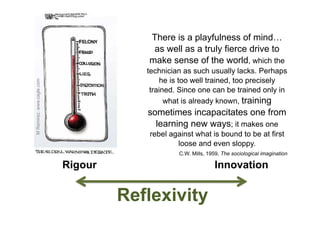
There is a playfulness of mind…
                                        as well as a truly fierce drive to
                                       make sense of the world, which the
                                       technician as such usually lacks. Perhaps
                                            he is too well trained, too precisely
M Ramirez, www.cagle.com


                                        trained. Since one can be trained only in
                                             what is already known, training
                                       sometimes incapacitates one from
                                         learning new ways; it makes one
                                       rebel against what is bound to be at first
                                               loose and even sloppy.
                                                C.W. Mills, 1959, The sociological imagination

                           Rigour                              Innovation


                                    Reflexivity
Piece of advice No. 2…
•  Have fun – enjoy being undisciplined
•  Whatever you do, do it well
“Deep interdisciplinarity” =
    Earth system science’s research relationships
         with the human and social sciences

What have I learnt about research relationships?

•  Some are easier to promote than others
      but there’s no telling in advance which will work!
•  ‘Ambience’ matters
•  So does serendipity
    opportunities for serendipity can be planned
•  A sense of collaborative endeavour grows with time
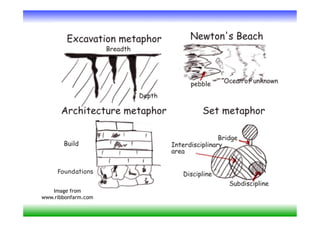
Foundations

   Image from
www.ribbonfarm.com
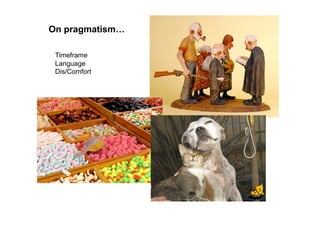
On pragmatism…

 Timeframe
 Language
 Dis/Comfort
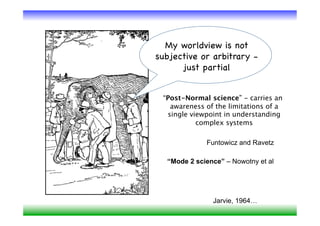
My worldview is not
subjective or arbitrary -
      just partial


 “Post-Normal science” - carries an
   awareness of the limitations of a
  single viewpoint in understanding
           complex systems

             Funtowicz and Ravetz

  “Mode 2 science” – Nowotny et al


               Jarvie, 1964…
Piece of advice No. 3…
•  Have fun – enjoy being undisciplined
•  Whatever you do, do it well
•  Read – write – THINK
SRC interdisciplinary terrain

SRC interdisciplinary terrain

  • 1.
    Getting comfortable in new intellectual terrain (and shaping that terrain) © Phelps 2006 Sarah Cornell Planetary Boundaries Research Initiative, SRC
  • 2.
    Interdisciplinary knowledge andresearch are important because: 1.  Creativity often requires interdisciplinary knowledge. 2.  Immigrants often make important contributions to their new field. 3.  Disciplinarians often commit errors which can be best detected by people familiar with two or more disciplines. 4.  Some worthwhile topics of research fall in the interstices among the traditional disciplines. 5.  Many intellectual, social, and practical problems require interdisciplinary approaches. 6.  Interdisciplinary knowledge and research serve to remind us of the unity-of- knowledge ideal. 7.  Interdisciplinarians enjoy greater flexibility in their research. 8.  More so than narrow disciplinarians, interdisciplinarians often treat themselves to the intellectual equivalent of traveling in new lands. 9.  Interdisciplinarians may help breach communication gaps in the modern academy, thereby helping to mobilize its enormous intellectual resources in the cause of greater social rationality and justice. 10. By bridging fragmented disciplines, interdisciplinarians might play a role in the defense of academic freedom. Nissani, M. (1997) Ten Cheers for Interdisciplinarity. Social Science Journal 34 (2) 201-216
  • 3.
  • 4.
    Taking those stepsinto new terrain… Statistical methods Researcher responsibility Analytical techniques …Real world problems Data quality issues Real world problems You don’t necessarily know what skills you’re building up as you go along, but you’d better make sure they are Synthesis skills good ones! Research strategy planning Practical policy insight …And more real world problems
  • 5.
    Unmapped terrain… In many institutions, interdisciplinarity is flourishing behind a “subject facade” What do we do about the “concealed reality of interdisciplinarity”? Keith Clayton (1985), in L. Levin and I. Lind, Interdisciplinarity Revisited Who is actually And what is doing this work…? research? Isn’t it Often: students all unmapped terrain…?
  • 6.
    Piece of adviceNo. 1… •  Have fun – enjoy being undisciplined
  • 7.
    What tensions dowe face? rigour innovation “alien” “native”
  • 8.
    Problems in resolvingthe tensions abound… ESF-COST RESCUE, 2012 EURAB 2004 US National Academies COSEPUP, 2004 ESSP Amsterdam Declaration 2001… But surely the right way ahead!… Previously men could be divided simply into the learned and the ignorant… But your specialist cannot be brought in under either of these two categories. He is not learned, for he is formally ignorant of all that does not enter into his specialty; but neither is he ignorant, because he is “a scientist” and “knows” very well his own tiny portion of the universe. We shall have to say that he is a learned ignoramus, which is a very serious matter, as it implies that he is a person who is ignorant, not in the fashion of the ignorant man, but with all the petulance of one who is learned is his own special line. (Ortega y Gasset, The revolt of the masses, 1932)
  • 9.
    Rigour ? Innovation
  • 10.
    There is aplayfulness of mind… as well as a truly fierce drive to make sense of the world, which the technician as such usually lacks. Perhaps he is too well trained, too precisely M Ramirez, www.cagle.com trained. Since one can be trained only in what is already known, training sometimes incapacitates one from learning new ways; it makes one rebel against what is bound to be at first loose and even sloppy. C.W. Mills, 1959, The sociological imagination Rigour Innovation Reflexivity
  • 11.
    Piece of adviceNo. 2… •  Have fun – enjoy being undisciplined •  Whatever you do, do it well
  • 12.
    “Deep interdisciplinarity” = Earth system science’s research relationships with the human and social sciences What have I learnt about research relationships? •  Some are easier to promote than others   but there’s no telling in advance which will work! •  ‘Ambience’ matters •  So does serendipity   opportunities for serendipity can be planned •  A sense of collaborative endeavour grows with time
  • 13.
    Foundations Image from www.ribbonfarm.com
  • 14.
    On pragmatism… Timeframe Language Dis/Comfort
  • 16.
    My worldview isnot subjective or arbitrary - just partial “Post-Normal science” - carries an awareness of the limitations of a single viewpoint in understanding complex systems Funtowicz and Ravetz “Mode 2 science” – Nowotny et al Jarvie, 1964…
  • 17.
    Piece of adviceNo. 3… •  Have fun – enjoy being undisciplined •  Whatever you do, do it well •  Read – write – THINK