Introduction to SoftwareTesting
What is Software Testing?
Importance of Testing in SDLC/STLC
Roles and responsibilities of a Tester
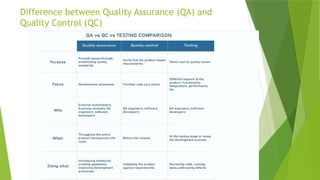
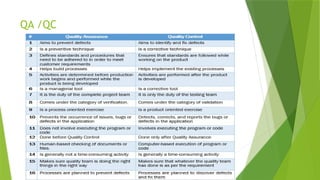
QA vs QC vs Testing
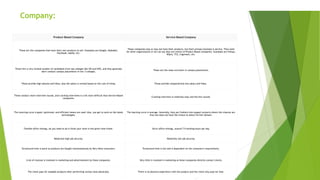
Types of companies: Product vs Service
2.
What is SoftwareTesting?
Software testing is an important process in the Software Development
Lifecycle(SDLC). It involves verifying and validating that a Software
Application is free of bugs, meets the technical requirements set by
its Design and Development, and satisfies user requirements efficiently and
effectively.
Software Testing is a process of verifying and validating whether the Software
Product or Application is working as expected or not. The complete testing
includes identifying errors and bugs that cause future problems for the
performance of an application.
3.
Software Testing Canbe Divided into Two Steps:
Software testing mainly divides into the two parts, which is used in the
Software Development Process:
Verification: This step involves checking if the software is doing what is
supposed to do. Its like asking, "Are we building the product the right way?"
Validation: This step verifies that the software actually meets the customer's
needs and requirements. Its like asking, "Are we building the right product?"
4.
Difference between Projectand Product
What is Project?
Also known as a software project comprises the steps involved in making a product before
it is actually available to the market. The project can be handled by people which are as
less as one person to the involvement of a lot of people (over 100). These are usually
assigned by an enterprise and are undertaken to form a new product that has not already
been made.
What is Product?
The study of products is a part of Software engineering. The software is built by
developers on requests from the customer. After the customer is satisfied with the
development process, he launches the software by manufacturing it. This can be a
problem-solving software or computer based system. This is the result of a project. The
software project, when completed, is called a product after it is available to the market
for usage.
5.
Need for SoftwareTesting
Software bugs can cause potential monetary and human loss. There are many examples in history
that clearly depicts that without the testing phase in software development lot of damage was
incurred. Below are some examples:
1985: Canada's Therac-25 radiation therapy malfunctioned due to a software bug and resulted in
lethal radiation doses to patients leaving 3 injured and 3 people dead.
1994: China Airlines Airbus A300 crashed due to a software bug killing 264 people.
1996: A software bug caused U.S. bank accounts of 823 customers to be credited with 920 million
US dollars.
1999: A software bug caused the failure of a $1.2 billion military satellite launch.
2015: A software bug in fighter plane F-35 resulted in making it unable to detect targets correctly.
2015: Bloomberg terminal in London crashed due to a software bug affecting 300,000 traders on
the financial market and forcing the government to postpone the 3bn pound debt sale.
Starbucks was forced to close more than 60% of its outlet in the U.S. and Canada due to a software
failure in its POS system.
Nissan cars were forced to recall 1 million cars from the market due to a software failure in the
car's airbag sensory detectors.
6.
Bugs in SoftwareTesting
What is a Bug
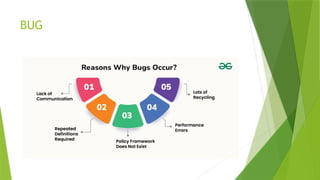
A malfunction in the software/system is an error that may cause components or the system to fail to
perform its required functions. In other words, an error encountered during the test can cause
malfunction. For example, incorrect data description, statements, input data, design, etc.
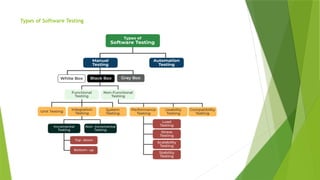
There are many different types of software testing, each with specific goals and strategies. Some of
them are below:
Acceptance Testing: Ensuring that the whole system works as intended.
Integration Testing: Ensuring that software components or functions work together.
Unit Testing: To ensure that each software unit operates as expected. The unit is a testable
component of the application.
Functional Testing: Evaluating activities by imitating business conditions, based on operational
requirements. Checking the black box is a common way to confirm tasks.
Performance Testing: A test of how the software works under various operating loads. Load testing,
for example, is used to assess performance under real-life load conditions.
Re-testing: To test whether new features are broken or degraded. Hygiene checks can be used to
verify menus, functions, and commands at the highest level when there is no time for a full reversal
test.
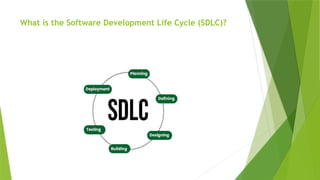
Software Development LifeCycle (SDLC)
Software development life cycle (SDLC) is a structured process that is used
to design, develop, and test good-quality software. SDLC, or software
development life cycle, is a methodology that defines the entire procedure of
software development step-by-step.
The goal of the SDLC life cycle model is to deliver high-quality, maintainable
software that meets the user's requirements. SDLC in software engineering
models outlines the plan for each stage so that each stage of the software
development model can perform its task efficiently to deliver the software at
a low cost within a given time frame that meets users requirements.
9.
What is theSoftware Development Life Cycle (SDLC)?
10.
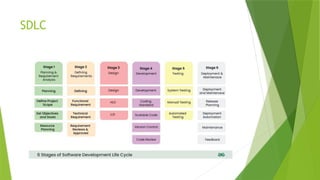
Stages of theSoftware Development Life Cycle
SDLC specifies the task(s) to be performed at various stages by a software
engineer or developer. It ensures that the end product is able to meet the
customer's expectations and fits within the overall budget. Hence, it's vital
for a software developer to have prior knowledge of this software
development process. SDLC is a collection of these six stages, and the stages
of SDLC are as follows:
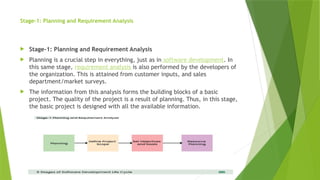
Stage-1: Planning andRequirement Analysis
Stage-1: Planning and Requirement Analysis
Planning is a crucial step in everything, just as in software development. In
this same stage, requirement analysis is also performed by the developers of
the organization. This is attained from customer inputs, and sales
department/market surveys.
The information from this analysis forms the building blocks of a basic
project. The quality of the project is a result of planning. Thus, in this stage,
the basic project is designed with all the available information.
13.
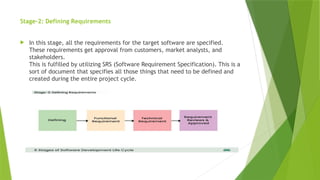
Stage-2: Defining Requirements
In this stage, all the requirements for the target software are specified.
These requirements get approval from customers, market analysts, and
stakeholders.
This is fulfilled by utilizing SRS (Software Requirement Specification). This is a
sort of document that specifies all those things that need to be defined and
created during the entire project cycle.
14.
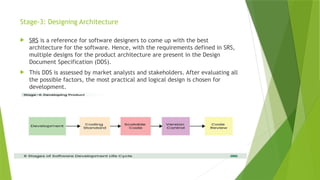
Stage-3: Designing Architecture
SRS is a reference for software designers to come up with the best
architecture for the software. Hence, with the requirements defined in SRS,
multiple designs for the product architecture are present in the Design
Document Specification (DDS).
This DDS is assessed by market analysts and stakeholders. After evaluating all
the possible factors, the most practical and logical design is chosen for
development.
15.
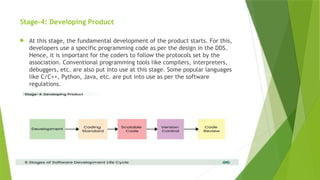
Stage-4: Developing Product
At this stage, the fundamental development of the product starts. For this,
developers use a specific programming code as per the design in the DDS.
Hence, it is important for the coders to follow the protocols set by the
association. Conventional programming tools like compilers, interpreters,
debuggers, etc. are also put into use at this stage. Some popular languages
like C/C++, Python, Java, etc. are put into use as per the software
regulations.
16.
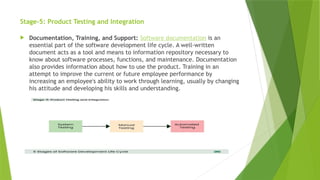
Stage-5: Product Testingand Integration
Documentation, Training, and Support: Software documentation is an
essential part of the software development life cycle. A well-written
document acts as a tool and means to information repository necessary to
know about software processes, functions, and maintenance. Documentation
also provides information about how to use the product. Training in an
attempt to improve the current or future employee performance by
increasing an employee's ability to work through learning, usually by changing
his attitude and developing his skills and understanding.
17.
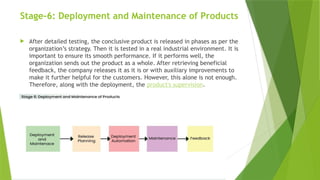
Stage-6: Deployment andMaintenance of Products
After detailed testing, the conclusive product is released in phases as per the
organization’s strategy. Then it is tested in a real industrial environment. It is
important to ensure its smooth performance. If it performs well, the
organization sends out the product as a whole. After retrieving beneficial
feedback, the company releases it as it is or with auxiliary improvements to
make it further helpful for the customers. However, this alone is not enough.
Therefore, along with the deployment, the product's supervision.
18.
Software Testing LifeCycle (STLC)
The Software Testing Life Cycle (STLC) in which a process to verify whether the
Software Quality meets to the expectations or not.
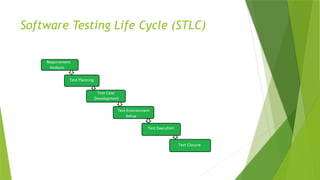
Phases of STLC
There are the six major phases of the Software Testing Life Cycle (STLC) in which we
are discussing here in detail.
Table of Content
1. Requirement Analysis
2. Test Planning
3. Test Case Development
4. Test Environment Setup
5. Test Execution
6. Test Closure
1. Requirement Analysis
Requirement Analysis is the first step of the Software Testing Life Cycle (STLC). In this
phase quality assurance team understands the requirements like what is to be tested. If
anything is missing or not understandable then the quality assurance team meets with the
stakeholders to better understand the detailed knowledge of requirements.
The activities that take place during the Requirement Analysis stage include:
Reviewing the software requirements document (SRD) and other related documents
Interviewing stakeholders to gather additional information
Identifying any ambiguities or inconsistencies in the requirements
Identifying any missing or incomplete requirements
Identifying any potential risks or issues that may impact the testing process
Creating a requirement traceability matrix (RTM) to map requirements to test cases
At the end of this stage, the testing team should have a clear understanding of the
software requirements and should have identified any potential issues that may impact
the testing process. This will help to ensure that the testing process is focused on the
most important areas of the software and that the testing team is able to deliver high-
quality results.
21.
2. Test Planning
Test Planning is the most efficient phase of the software testing life cycle where all
testing plans are defined. In this phase manager of the testing, team calculates the
estimated effort and cost for the testing work. This phase gets started once the
requirement-gathering phase is completed.
The activities that take place during the Test Planning stage include:
Identifying the testing objectives and scope
Developing a test strategy: selecting the testing methods and techniques that will be
used
Identifying the testing environment and resources needed
Identifying the test cases that will be executed and the test data that will be used
Estimating the time and cost required for testing
Identifying the test deliverables and milestones
Assigning roles and responsibilities to the testing team
Reviewing and approving the test plan
22.
Test Case Development
The Test Case Development phase gets started once the test planning phase is
completed. In this phase testing team notes down the detailed test cases. The testing
team also prepares the required test data for the testing. When the test cases are
prepared then they are reviewed by the quality assurance team.
The activities that take place during the Test Case Development stage include:
Identifying the test cases that will be developed
Writing test cases that are clear, concise, and easy to understand
Creating test data and test scenarios that will be used in the test cases
Identifying the expected results for each test case
Reviewing and validating the test cases
Updating the requirement traceability matrix (RTM) to map requirements to test cases
23.
4. Test EnvironmentSetup
Test Environment Setup is an important part of the STLC. Basically, the test environment decides the conditions on
which software is tested. This is independent activity and can be started along with test case development. In this
process, the testing team is not involved. either the developer or the customer creates the testing environment.
5. Test Execution
In Test Execution, after the test case development and test environment setup test execution phase gets started. In
this phase testing team starts executing test cases based on prepared test cases in the earlier step.
The activities that take place during the test execution stage of the Software Testing Life Cycle (STLC) include:
Test execution: The test cases and scripts created in the test design stage are run against the software application to
identify any defects or issues.
Defect logging: Any defects or issues that are found during test execution are logged in a defect tracking system,
along with details such as the severity, priority, and description of the issue.
Test data preparation: Test data is prepared and loaded into the system for test execution
Test environment setup: The necessary hardware, software, and network configurations are set up for test execution
Test execution: The test cases and scripts are run, and the results are collected and analyzed.
Test result analysis: The results of the test execution are analyzed to determine the software's performance and
identify any defects or issues.
Defect retesting: Any defects that are identified during test execution are retested to ensure that they have been
fixed correctly.
Test Reporting: Test results are documented and reported to the relevant stakeholders.
24.
6. Test Closure
Test Closure is the final stage of the Software Testing Life Cycle (STLC) where all testing-related activities are
completed and documented. The main objective of the test closure stage is to ensure that all testing-related
activities have been completed and that the software is ready for release.
At the end of the test closure stage, the testing team should have a clear understanding of the software's quality
and reliability, and any defects or issues that were identified during testing should have been resolved. The test
closure stage also includes documenting the testing process and any lessons learned so that they can be used to
improve future testing processes
Test closure is the final stage of the Software Testing Life Cycle (STLC) where all testing-related activities are
completed and documented. The main activities that take place during the test closure stage include:
Test summary report: A report is created that summarizes the overall testing process, including the number of
test cases executed, the number of defects found, and the overall pass/fail rate.
Defect tracking: All defects that were identified during testing are tracked and managed until they are resolved.
Test environment clean-up: The test environment is cleaned up, and all test data and test artifacts are archived.
Test closure report: A report is created that documents all the testing-related activities that took place, including
the testing objectives, scope, schedule, and resources used.
Knowledge transfer: Knowledge about the software and testing process is shared with the rest of the team and
any stakeholders who may need to maintain or support the software in the future.
Feedback and improvements: Feedback from the testing process is collected and used to improve future testing
processes
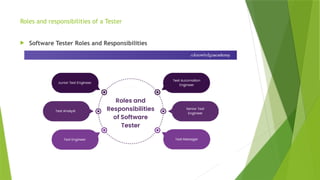
Roles and responsibilitiesof a Tester
Junior Test Engineers generally work under the guidance of senior members of the testing team. Their primary role involves carrying out
test cases, recording the outcomes of these tests, and pinpointing any issues or defects that arise during testing. Additionally, they might
be involved in the initial phases of test planning and offer insights to improve testing procedures. Overall, they support the senior
members in ensuring the quality and effectiveness of the testing process.
2) Test Analyst
Test Analysts are responsible for analyzing software requirements, designing test cases, and executing tests to ensure that software
products meet specified requirements. They also play a crucial role in identifying defects and collaborating with development teams to
resolve issues.
3) Test Engineer
Test Engineers are involved in the design, development, and execution of test cases to evaluate the functionality and performance of
software applications. They work closely with developers to understand product requirements and ensure comprehensive test coverage.
4) Test Automation Engineer
Test Automation Engineers specialize in developing automated test scripts and frameworks to streamline the testing process and improve
efficiency. They are proficient in scripting languages and automation tools and play a crucial role in continuous integration and delivery
pipelines.
Unlock your potential with ISTQB Software Testing certification! Gain recognized skills and advance your career in software testing today!
5) Senior Test Engineer
Senior Test Engineers lead testing efforts, develop test strategies, and mentor junior members of the testing team. They possess
extensive knowledge of testing methodologies and tools and are responsible for ensuring the overall quality of software products.
6) Test Manager
Test Managers oversee testing activities, allocate resources, and define testing strategies to meet project objectives. They collaborate
with stakeholders to prioritise testing efforts and ensure that testing processes align with project timelines and goals.
testing
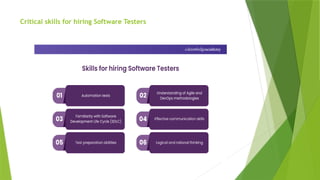
1) Automationtests
Automation tests, facilitated by mastery of test automation tools and frameworks,
streamline testing processes and broaden test coverage. They expedite repetitive
test execution, relieving testers of manual tasks to focus on complex scenarios.
This accelerates testing cycles, ensuring thorough examination of critical software
aspects for higher-quality releases.
2) Understanding of Agile and DevOps methodologies
Testers need a strong understanding of Agile and DevOps methodologies to
collaborate effectively with development teams. This involves active participation
in sprint planning and stand-up meetings, as well as seamless integration of testing
into the continuous delivery pipeline. By aligning with Agile and DevOps principles,
testers promote collaboration and rapid delivery of quality software.
3) Familiarity with Software Development Life Cycle (SDLC)
Testers must grasp the Software Development Life Cycle (SDLC) phases,
encompassing requirements analysis, design, implementation, testing, and
maintenance. Understanding testing alignment with each phase ensures
comprehensive coverage and early defect detection. This knowledge fosters
collaboration with developers and stakeholders, facilitating smoother project
execution and delivery of high-quality software products.
29.
4) Effective communicationskills
4) Effective communication skills
Effective communication skills are vital for testers to engage with team members, stakeholders, and clients
proficiently. Clear and concise communication ensures accurate transmission of testing status, defect reports, and
resolutions. This fosters collaboration and alignment among project stakeholders, facilitating smoother project
execution.
Testers need to convey complex technical information in a manner understandable to non-technical stakeholders,
fostering transparency and trust in the testing process. Strong communication abilities enable testers to articulate
testing strategies, discuss findings, and address concerns promptly.
Dive into essential software testing principles to ensure top-notch product quality. Build your expertise and enhance
software reliability today!
5) Test preparation abilities
Testers need the capability to craft thorough test plans, cases, and scenarios aligned with software requirements and
user stories. This entails a deep understanding of the application's functionality and goals, enabling testers to define
precise test objectives. They must design test cases encompassing diverse usage scenarios and edge cases to ensure
robust software validation.
This rigorous method ensures thorough test coverage and assists in identifying possible problems early in the
development phase. Testers significantly enhance the overall quality of the product by contributing to the software's
reliability and customer satisfaction through rigorous testing planning.
30.
6) Logical andrational thinking
Logical and rational thinking are essential attributes for Software Testers.
They entail the ability to methodically analyse intricate systems, discern
potential risks, and devise effective test strategies. These skills are essential
when crafting a Software Tester Resume, as testers must critically evaluate
software requirements to ensure they align with system functionalities.
Understanding how various components interact within the system aids in
identifying vulnerabilities and potential failure points. By formulating
comprehensive test strategies, testers can proactively mitigate risks and
uphold the overall quality of the software product. This approach fosters a
systematic and thorough testing process, eventually improving the
performance and dependability of the software.
31.
Advantages of SoftwareTesting
Software testing offers several advantages, including:
1) Identification of defects and issues before software deployment.
2) Assurance of software quality and reliability.
3) Validation of software functionality and compliance with specified requirements.
4) Reduction of overall development costs by detecting and fixing defects early in the
development process.
5) Improved customer satisfaction through the delivery of high-quality software products.
6) Minimisation of business risks associated with software failures, such as financial
consequences as well as reputational harm.
7) Enhancement of product competitiveness by ensuring superior quality and performance
compared to competitors.
8) Facilitate regulatory compliance by ensuring adherence to industry standards and
regulations.
9) Optimisation of software performance and scalability through thorough testing of
various usage scenarios and load conditions.
32.
Disadvantages of SoftwareTesting
Disadvantages of Software Testing
Despite its benefits, Software Testing also has some limitations, such as:
1) Time and resource limitations might limit the depth and scope of testing.
2) Over-reliance on automated testing may cause certain aspects of software behaviour to
be overlooked.
3) Testing cannot guarantee the absence of defects; it can only reduce their likelihood.
4) Increased complexity of software systems may lead to challenges in test case design and
execution.
5) Inadequate documentation or incomplete requirements may hinder the effectiveness of
testing efforts.
6) Limited access to real-world testing environments may impact the accuracy of test
results.
Master your skills with Certified Software Testing Manager (CSTM) Training. Sign up now to
become a certified testing manager!
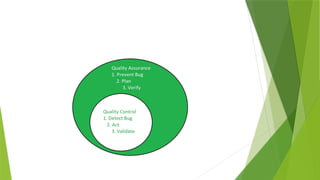
What is QualityAssurance (QA)?
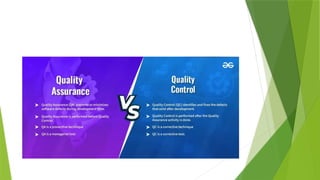
Quality assurance is a method of making the software application with fewer defects and mistakes
when it is finally released to the end users. Quality Assurance is defined as an activity that ensures the
approaches, techniques, methods, and processes designed for the projects are implemented correctly.
It recognizes defects in the process. Quality Assurance is completed before Quality Control.
It focuses on preventing defects.
It is a proactive process and is preventive in nature.
It helps to recognize flaws in the process.
These activities monitor and verify that the processes used to manage and create deliverables have
been followed.
Characteristics of Quality Assurance
Process-Oriented: To guarantee constant product quality, it places a strong emphasis on the creation
and application of reliable procedures and standards.
Proactive Process: Quality Assurance (QA) tries to prevent errors by enhancing procedures,
guaranteeing that quality is integrated into the product from the start.
Continuous Improvement: To improve quality over time, QA includes constant process assessment and
improvement.
36.
What is QualityControl?
What is Quality Control?
Quality Control is a software engineering process that is used to ensure that
the approaches, techniques, methods, and processes designed for the project
are followed correctly. Quality control activities operate and verify that the
application meet the defined quality standards.
It focuses on an examination of the quality of the end products and the final
outcome rather than focusing on the processes used to create a product.
It is a reactive process and is detection in nature.
These activities monitor and verify that the project deliverables meet the
defined quality standards
38.
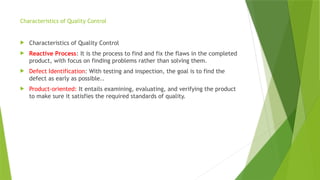
Characteristics of QualityControl
Characteristics of Quality Control
Reactive Process: It is the process to find and fix the flaws in the completed
product, with focus on finding problems rather than solving them.
Defect Identification: With testing and inspection, the goal is to find the
defect as early as possible..
Product-oriented: It entails examining, evaluating, and verifying the product
to make sure it satisfies the required standards of quality.
Key Differences BetweenProduct-Based and Service-Based
Company:
Product-Based Company Service-Based Company
These are the companies that have their own products to sell. Examples are Google, Alphabet,
Facebook, Adobe, etc.
These companies may or may not have their products, but their primary business is service. They work
for other organizations or we can say they are clients of Product Based companies. Examples are Infosys,
Wipro, TCS, Cognizant, etc.
These hire a very limited number of candidates from top colleges like IITs and NITs, and they generally
don't conduct campus placements in tier 3 colleges.
These are the mass recruiters in campus placements.
These provide high salaries and hikes, also the salary is revised based on the cost of living. These provide comparatively less salary and hikes.
These conduct more interview rounds, and cracking interviews is a bit more difficult than Service-Based
companies.
Cracking interview is relatively easy and has few rounds.
The Learning curve is good, optimized, and efficient means are used. Also, you get to work on the latest
technologies.
The learning curve is average. Generally, they put freshers into support projects where the chances are
that one does not have the choice to select his/her domain.
Flexible office timings, all you need to do is finish your work in the given time frame. Strict office timings, around 7-9 working hours per day.
Relatively high job security. Relatively low job security.
Turnaround time is quick as products are bought instantaneously by Very hikes consumers. Turnaround time is low and is dependent on the consumer's requirements.
A lot of revenue is invested in marketing and advertisement by these companies. Very little is invested in marketing as these companies directly contact clients.
The client pays for tangible products after performing various tests physically. There is no physical experience with the product and the client only pays for that.
1. Manual Testing
ManualTesting is a technique to test the software that is carried out using the functions and features of an application. Which means
manual testing will check the defect manually with trying one by one function is working as expected.
43.
2. Automation Testing
Automation Testing It is a technique where the Tester writes scripts
independently and uses suitable Software or Automation Tools to test the
software. It is an Automation Process of a Manual Process. It allows for
executing repetitive tasks without the use of a Manual Tester.
44.
Types of ManualTesting
Manual testing will be divided into further types which is following:
1. White Box Testing
White Box Testing is a software testing technique that involves testing the internal structure
and workings of a software application. The tester has access to the source code and uses this
knowledge to design test cases that can verify the correctness of the software at the code level.
2. Black Box Testing
Black-Box Testing is a type of software testing in which the tester is not concerned with the
internal knowledge or implementation details of the software but rather focuses on validating
the functionality based on the provided specifications or requirements.
3. Gray Box Testing
Gray Box Testing is a software testing technique that is a combination of the Black Box
Testing technique and the White Box Testing technique. In the Black Box Testing technique, the
tester is unaware of the internal structure of the item being tested and in White Box Testing the
internal structure is known to the tester.