SQL Tuning in Oracle 10g:
The Do’s and Don’ts
Mughees A. Minhas
Group Product Manager
Database Manageability
Oracle Corp.
Outline
y Introduction
y Manual Tuning Challenges
y SQL Tuning & Access Advisor Overview
y SQL Tuning Advisor
– Automatic SQL Tuning
– Usage scenarios
– User interface
y SQL Access Advisor
– Usage scenarios
– User interface
y Tips, Do’s, Don’ts
y Conclusion
Introduction
y Automatic SQL Tuning solution consists of
– SQL Tuning Advisor
– SQL Access Advisor
y Provides comprehensive, automatic, and cost-
effective solution for application tuning
y Reduces SQL tuning time by up to 80%
y Reduces management cost
Manual Tuning Challenges
y Requires expertise in several domains
– SQL optimization: adjust the execution plan
– Access design: provide fast data access
– SQL design: use appropriate SQL constructs
y Time consuming
– Each SQL statement is unique
– Potentially large number of statements to tune
y Never ending task
– SQL workload always evolving
– Plan regressions
Manual Tuning Example
Packaged App Tuning Scenario
Manual Tuning
1. Get explain plan
2. Examine query objects and their sizes
3. Review and compare explain plan statistics with execution
statistics (stored in V$SQL view)
4. Identify the problem, e.g., “first rows” issue because only recent
data is ever displayed despite large history being queried
5. Contact application vendor
6. Produce test case for vendor
7. Get a patch with appropriate code modifications from the
vendor
8. Install the patch in next maintenance cycle
SQL Tuning & Access Advisor
Overview
How do I tune
my SQL
workload?
SQL Tuning &
Access Advisors
Solution
Component
of CBO
Provides
implementation
script
No expert
required
DBA
SQL
Workload
SQL Tuning Advisor
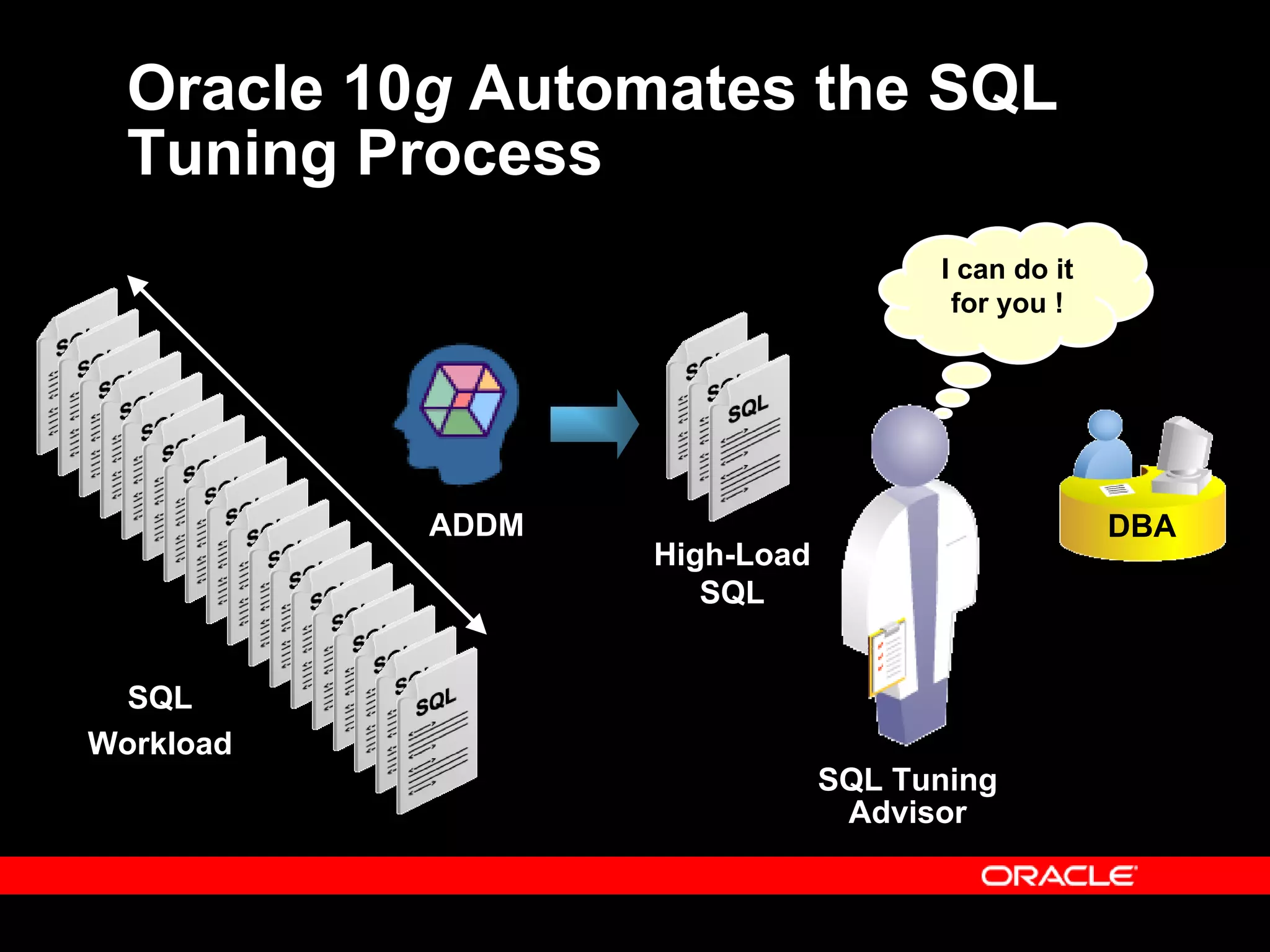
Oracle 10g Automates the SQL
Tuning Process
I can do it
for you !
SQL Tuning
Advisor
DBA
High-Load
SQL
ADDM
SQL
Workload
Automatic SQL Tuning Overview
Add Missing
Indexes
Modify SQL
Constructs
Create a SQL
Profile
Automatic Tuning Optimizer
SQL Structure
Analysis
Access Path
Analysis
SQL
Profiling
Statistics
Analysis
Gather Missing or
Stale Statistics
DBA
SQL Tuning
Recommendations
SQL Tuning
Advisor
Automatic Tuning Optimizer (ATO)
y It is the query optimizer running in tuning mode
– Uses same plan generation process but performs
additional steps that require significantly more time
y It performs verification steps
– To validate statistics and its own estimates
y Uses dynamic sampling and partial executions to validate
y It performs exploratory steps
– To investigate the use of new indexes that could
provide significant speed-up
– To analyze SQL constructs that led to expensive
plan operators
Statistics Analysis
Add Missing
Indexes
Modify SQL
Constructs
Create a SQL
Profile
Automatic Tuning Optimizer
SQL Structure
Analysis
Access Path
Analysis
SQL
Profiling
Statistics
Analysis
Gather Missing or
Stale Statistics
DBA
SQL Tuning
Recommendations
SQL Tuning
Advisor
Statistics Analysis
y Motivation
– Statistics are key input to the query optimizer
y Their availability and accuracy is very important
y In Oracle10g, the Automatic Statistics
Collection maintains statistics up to date…
– But it may not be enabled or properly configured!
y The ATO verifies statistics that it needs/uses
– Generates auxiliary information to compensate for
missing or stale statistics
– Generates recommendations to gather statistics
where appropriate
SQL Profiling
Add Missing
Indexes
Modify SQL
Constructs
Create a SQL
Profile
Automatic Tuning Optimizer
SQL Structure
Analysis
Access Path
Analysis
SQL
Profiling
Statistics
Analysis
Gather Missing or
Stale Statistics
DBA
SQL Tuning
Recommendations
SQL Tuning
Advisor
SQL Profiling
y Motivation
– Empower query optimizer to find better plan by
gathering additional information on query behavior
y The query optimizer has time constraints
– Makes compromises while finding right plan
y The ATO is allowed a lot more time
– Uses the time to gather customized information
about the SQL statement, known as SQL Profile
– Builds a SQL Profile and recommends it
– Once implemented, SQL Profile is used by the
query optimizer to generate a well-tuned plan
SQL Profile
y Contains auxiliary information collected by the
ATO for a SQL statement
– Customized optimizer settings
y Based on past execution history (e.g., first_rows vs. all_rows)
– Compensation for missing or stale statistics
– Compensation for errors in optimizer estimates
y Estimation errors occur due to data skews and correlations,
complex filters and joins
y Doesn’t require any change to the SQL text
– Ideal for Packaged Apps
y Persistence: Works across shutdowns & upgrades
y Transportable across databases (10.2)
SQL Profiling Flow
Optimizer
(Tuning Mode)
create
submit
SQL Profiling
Optimizer
(Normal Mode)
output
submit
SQL
Profile
SQL Tuning
Advisor
Database
Users
Well-Tuned
Plan
After …
use
Access Path Analysis
Add Missing
Indexes
Modify SQL
Constructs
Create a SQL
Profile
Automatic Tuning Optimizer
SQL Structure
Analysis
Access Path
Analysis
SQL
Profiling
Statistics
Analysis
Gather Missing or
Stale Statistics
DBA
SQL Tuning
Recommendations
SQL Tuning
Advisor
Access Path Analysis
y Motivation
– Adding an index may significantly improve the
performance of a SQL statement
y Problem: A critical access path is missing
– Index not created or mistakenly dropped
y ATO explores the use of new indexes
– Recommends index if major performance boost
provided
– Also recommends running SQL Access Advisor to get
comprehensive index analysis for entire workload
y SQL Access Advisor also uses this analysis mode
SQL Structure Analysis
Add Missing
Indexes
Modify SQL
Constructs
Create a SQL
Profile
Automatic Tuning Optimizer
SQL Structure
Analysis
Access Path
Analysis
SQL
Profiling
Statistics
Analysis
Gather Missing or
Stale Statistics
DBA
SQL Tuning
Recommendations
SQL Tuning
Advisor
SQL Structure Analysis
y Motivation
– Help application developers identify poorly written
SQL statements
– Suggest restructuring of SQL for efficiency
y Problem categories
– Semantic changes of SQL operators (e.g., use
UNION ALL instead of UNION)
y Subject to user acceptance of new result
– Syntactic changes to predicates on indexed columns
(e.g., remove type mismatch in column = :bind)
– SQL design issues (e.g., add missing join predicate
to eliminate a large Cartesian join)
SQL Tuning Usage Scenarios
SQL Tuning
Advisor
ADDM High-load SQL
Cursor Cache
AWR
SQL Tuning Set
(STS)
User-defined
Filter / Rank
SQL Sources Manual Selection
Automatic Selection
AWR
SQL Tuning Set (STS)
y Motivation
– Enable user to tune custom set of SQL statements
y New object in Oracle10g for capturing and
managing SQL workload
y Stores SQL statements along with:
– Execution context: parsing user, bind values, etc.
– Execution statistics: buffer gets, CPU time, elapse
time, number of executions, etc.
y Transportable across databases (10.2)
y Created from any SQL source
– AWR, cursor cache, user-defined workload, STS
SQL Tuning Set Benefits
y Allows selective, on-demand, custom SQL
workload tuning
y Simplifies tuning of large number of SQL
statements
y Is persistent
y Facilitates workload capture/management
y Provides a common infrastructure for dealing
with SQL workloads
– Can be used as a source for different tuning tasks
SQL Tuning Advisor User
Interface
y GUI: Enterprise Manager
y Launch SQL Tuning Advisor from a SQL
Source page
– ADDM Finding page, or
– Top SQL page, or
– SQL Tuning Set (STS) page
y View/Implement SQL Tuning
Recommendations
y Command line: DBMS_SQLTUNE package
SQL Source: ADDM Finding
SQL Source: Top SQL
SQL Source: SQL Tuning Set
Enterprise Manager Interface
y Launch SQL Tuning Advisor from a SQL
Source page
– ADDM Finding page, or
– Top SQL page, or
– SQL Tuning Set (STS) page
y View/Implement SQL Tuning
Recommendations
SQL Tuning Recommendations — Overview
DBMS_SQLTUNE PL/SQL Package
y Contains API for SQL Tuning
– Create Tuning Task
– Execute Tuning Task
– Display Advisor
Recommendations
– Drop Tuning Task
– Create STS
– Populate STS
– Query STS Contents
– Drop STS
– Accept SQL Profile
– Drop SQL Profile
– Alter SQL Profile
Attribute
Tuning Task Management STS Management
SQL Profile Management
Automatic vs. Manual SQL Tuning
Manual Tuning
1. Get explain plan
2. Examine query objects and their sizes
3. Review and compare explain plan statistics with
execution statistics (stored in V$SQL view)
4. Identify the problem, e.g., “first rows” issue because
only recent data is ever displayed despite large history
being queried
5. Contact application vendor
6. Produce test case for vendor
7. Get a patch with appropriate code modifications from
the vendor
8. Install the patch in next maintenance cycle
Automatic Tuning
1. Run SQL Tuning
Advisor
2. Implement
recommendations.
SQL Access Advisor
SQL Access Advisor
Workload
Indexes Materialized Views
Materialized View Logs
SQL Access
Advisor
SQL Access Advisor Features
y De-mystifies access structure design for optimal
application performance
y Recommends indexes, materialized views, and
materialized view logs to create and/or drop for
faster performance
y Analyzes entire workload and not just independent
SQL statements
y Takes into account impact of new access
structures on DML operations
y Considers storage, creation and maintenance
costs
SQL Access Advisor Features
y Simultaneously considers
– index solutions
– materialized view solutions
– combinations of both
y Optimizes materialized views for
– maximum query rewrite usage
– fast refresh
y Recommends materialized view logs for fast refresh
y Combines similar indexes into single index
y Impact of new access structures on DML considered
y Considers storage, creation & maintenance costs
Usage Scenarios
Workload
User Defined
Hypothetical
Cursor Cache
Filter
Options
STS
SQL Access
Advisor
Filter Options
y Don’t have to use the entire workload
y Filter by
– Application or module name
– Number of SQL statements
– Queries during a specified time window
– Username
– Tables
y must be in this list
y not in this list
SQL Access Advisor User
Interface
y GUI: Enterprise Manager
– Launch SQL Access Advisor from Advisor Central
– Select workload source
– Set options
y Workload
y Recommendation
y Advanced
– Schedule job
– Review job and submit
– Monitor job
– View Recommendations
– Implement Recommendations
y Command line: DBMS_ADVISOR package
Launch SQL Access Advisor
Select Workload Source
Set Workload Options
Set Recommendation Options
Advanced Options
Advanced Tuning Options
y SQL statements will be tuned
according to the resources they use
Schedule Job
Review & Submit
Monitor the Job
View Recommendations
Implement Recommendations
Tips, Do’s, Dont’s
Capturing SQL Workload
y Use cursor cache capture capability of STS
– Run workload
– Capture workload in STS simultaneously
DBMS_SQLTUNE.CAPTURE_CURSOR_CACHE_SQLSET(
sqlset_name => ‘MY_STS’,
time_limit => 3600,
repeat_interval => 60,
sqlset_owner => own);
SQL Profile Cursor Sharing
y Cursor sharing can be enforced at database
or SQL level
– Database level: CURSOR_SHARING=FORCE
– SQL level: Set SQL Profile attribute
FORCE_MATCH=TRUE
DBMS_SQLTUNE.ACCEPT_SQL_PROFILE (
task_name => 'my_sql_tuning_task',
name => 'my_sql_profile',)
force_match => TRUE);
Tuning Considerations
y Resource consumption
– Running SQL advisors consumes CPU, I/O, memory and can
affect system performance
y Potential negative impact of recommendation
– Implementing recommendations may impact system
negatively, e.g., optimizer stats refresh
• Before initiating tuning, answer the following
questions
• How much resources will be consumed by tuning activity?
• Can the system spare resources needed for tuning?
• How can the production system be shielded from possible
negative impact of tuning actions?
Resource Consumption of SQL
Advisors
y SQL Tuning Advisor
– Limited mode: Resource consumption minimal
y Stats, index and SQL restructure analysis is cheap
y Average is less than 1 second per SQL statement
– Comprehensive mode: Resource consumption may be
significant
y SQL Profiling can potentially consume non-trivial resources
y Roughly comparable to amount of resources/time consumed
when executing SQL statement(s)
• SQL Access Advisor
• Resource consumption depends on size of SQL workload
• For small number of SQL, resource consumption not very high
Tuning Options
y Options
– Direct tuning of live system
– Remote tuning
y Live system tuning
– Run SQL Tuning Advisor in Comprehensive mode
– Run SQL Tuning Advisor in Limited mode only if …
y System does not have spare resources to tune SQL
– Run SQL Access Advisor for few SQL at a time
y Perform remote tuning, if …
– Cumulative resources/time consumed by all SQL
statements being tuned significant
– System cannot spare resources
Live System Tuning Tips
1. Ensure tables referenced in SQL have representative
optimizer stats
2. Run SQL Access Advisor
– For individual SQL, set “Recommendation Type” to indexes
– MV not suitable for tuning individual statements
3. Run SQL Tuning Advisor
– Test profile before making it PUBLIC
DBMS_SQLTUNE.ACCEPT_SQL_PROFILE (
task_name => ‘<tuning task name>’,
category => ‘MY_CATEGORY’);
ALTER SESSION SET SQLTUNE_CATEGORY=‘MY_CATEGORY’ ;
– Once satisfied with results set category to DEFAULT
DBMS_SQLTUNE.ALTER_SQL_PROFILE()
Remote Tuning Tips
1. Move SQL to Test
Production System Test System
2. Tune SQL
3. Apply recomm. on production
• Performed to shield production system from
performance impact of running SQL advisors
Remote Tuning Tips
y Move SQL to test
– Use Transportable STS
y DBMS_SQLTUNE.XXX_STGTAB_SQLSET
y Apply recommendation on production
– Use Transportable SQL Profiles
y DBMS_SQLTUNE.XXX_STGTAB_SQLPROF
Automatic SQL Tuning
Summary
SQL Access Advisor
Access Path: Materialized View Logs
SQL Access Advisor
Access Path: Materialized Views
SQL Tuning/Access
Advisor
Access Path: Indexes
SQL Tuning Advisor
SQL Structure
SQL Tuning Advisor
SQL Profile
SQL Tuning Advisor
Statistics
Performed By
Analysis Types
SQL Tuning Advisor and SQL Access Advisor
together completely automate SQL tuning
Conclusion
y SQL Advisors help address critical SQL tuning
challenges
y Provides targeted and automated tuning
y Makes possible comprehensive tuning of
packaged applications
y Eliminates need for highly skilled performance
experts
Thank You!
Q U E S T I O N S
Q U E S T I O N S
A N S W E R S
A N S W E R S
SQL_Tuning_Oracle_10g.pdf

SQL_Tuning_Oracle_10g.pdf

  • 2.
    SQL Tuning inOracle 10g: The Do’s and Don’ts Mughees A. Minhas Group Product Manager Database Manageability Oracle Corp.
  • 3.
    Outline y Introduction y ManualTuning Challenges y SQL Tuning & Access Advisor Overview y SQL Tuning Advisor – Automatic SQL Tuning – Usage scenarios – User interface y SQL Access Advisor – Usage scenarios – User interface y Tips, Do’s, Don’ts y Conclusion
  • 4.
    Introduction y Automatic SQLTuning solution consists of – SQL Tuning Advisor – SQL Access Advisor y Provides comprehensive, automatic, and cost- effective solution for application tuning y Reduces SQL tuning time by up to 80% y Reduces management cost
  • 5.
    Manual Tuning Challenges yRequires expertise in several domains – SQL optimization: adjust the execution plan – Access design: provide fast data access – SQL design: use appropriate SQL constructs y Time consuming – Each SQL statement is unique – Potentially large number of statements to tune y Never ending task – SQL workload always evolving – Plan regressions
  • 6.
    Manual Tuning Example PackagedApp Tuning Scenario Manual Tuning 1. Get explain plan 2. Examine query objects and their sizes 3. Review and compare explain plan statistics with execution statistics (stored in V$SQL view) 4. Identify the problem, e.g., “first rows” issue because only recent data is ever displayed despite large history being queried 5. Contact application vendor 6. Produce test case for vendor 7. Get a patch with appropriate code modifications from the vendor 8. Install the patch in next maintenance cycle
  • 7.
    SQL Tuning &Access Advisor Overview How do I tune my SQL workload? SQL Tuning & Access Advisors Solution Component of CBO Provides implementation script No expert required DBA SQL Workload
  • 8.
  • 9.
    Oracle 10g Automatesthe SQL Tuning Process I can do it for you ! SQL Tuning Advisor DBA High-Load SQL ADDM SQL Workload
  • 10.
    Automatic SQL TuningOverview Add Missing Indexes Modify SQL Constructs Create a SQL Profile Automatic Tuning Optimizer SQL Structure Analysis Access Path Analysis SQL Profiling Statistics Analysis Gather Missing or Stale Statistics DBA SQL Tuning Recommendations SQL Tuning Advisor
  • 11.
    Automatic Tuning Optimizer(ATO) y It is the query optimizer running in tuning mode – Uses same plan generation process but performs additional steps that require significantly more time y It performs verification steps – To validate statistics and its own estimates y Uses dynamic sampling and partial executions to validate y It performs exploratory steps – To investigate the use of new indexes that could provide significant speed-up – To analyze SQL constructs that led to expensive plan operators
  • 12.
    Statistics Analysis Add Missing Indexes ModifySQL Constructs Create a SQL Profile Automatic Tuning Optimizer SQL Structure Analysis Access Path Analysis SQL Profiling Statistics Analysis Gather Missing or Stale Statistics DBA SQL Tuning Recommendations SQL Tuning Advisor
  • 13.
    Statistics Analysis y Motivation –Statistics are key input to the query optimizer y Their availability and accuracy is very important y In Oracle10g, the Automatic Statistics Collection maintains statistics up to date… – But it may not be enabled or properly configured! y The ATO verifies statistics that it needs/uses – Generates auxiliary information to compensate for missing or stale statistics – Generates recommendations to gather statistics where appropriate
  • 14.
    SQL Profiling Add Missing Indexes ModifySQL Constructs Create a SQL Profile Automatic Tuning Optimizer SQL Structure Analysis Access Path Analysis SQL Profiling Statistics Analysis Gather Missing or Stale Statistics DBA SQL Tuning Recommendations SQL Tuning Advisor
  • 15.
    SQL Profiling y Motivation –Empower query optimizer to find better plan by gathering additional information on query behavior y The query optimizer has time constraints – Makes compromises while finding right plan y The ATO is allowed a lot more time – Uses the time to gather customized information about the SQL statement, known as SQL Profile – Builds a SQL Profile and recommends it – Once implemented, SQL Profile is used by the query optimizer to generate a well-tuned plan
  • 16.
    SQL Profile y Containsauxiliary information collected by the ATO for a SQL statement – Customized optimizer settings y Based on past execution history (e.g., first_rows vs. all_rows) – Compensation for missing or stale statistics – Compensation for errors in optimizer estimates y Estimation errors occur due to data skews and correlations, complex filters and joins y Doesn’t require any change to the SQL text – Ideal for Packaged Apps y Persistence: Works across shutdowns & upgrades y Transportable across databases (10.2)
  • 17.
    SQL Profiling Flow Optimizer (TuningMode) create submit SQL Profiling Optimizer (Normal Mode) output submit SQL Profile SQL Tuning Advisor Database Users Well-Tuned Plan After … use
  • 18.
    Access Path Analysis AddMissing Indexes Modify SQL Constructs Create a SQL Profile Automatic Tuning Optimizer SQL Structure Analysis Access Path Analysis SQL Profiling Statistics Analysis Gather Missing or Stale Statistics DBA SQL Tuning Recommendations SQL Tuning Advisor
  • 19.
    Access Path Analysis yMotivation – Adding an index may significantly improve the performance of a SQL statement y Problem: A critical access path is missing – Index not created or mistakenly dropped y ATO explores the use of new indexes – Recommends index if major performance boost provided – Also recommends running SQL Access Advisor to get comprehensive index analysis for entire workload y SQL Access Advisor also uses this analysis mode
  • 20.
    SQL Structure Analysis AddMissing Indexes Modify SQL Constructs Create a SQL Profile Automatic Tuning Optimizer SQL Structure Analysis Access Path Analysis SQL Profiling Statistics Analysis Gather Missing or Stale Statistics DBA SQL Tuning Recommendations SQL Tuning Advisor
  • 21.
    SQL Structure Analysis yMotivation – Help application developers identify poorly written SQL statements – Suggest restructuring of SQL for efficiency y Problem categories – Semantic changes of SQL operators (e.g., use UNION ALL instead of UNION) y Subject to user acceptance of new result – Syntactic changes to predicates on indexed columns (e.g., remove type mismatch in column = :bind) – SQL design issues (e.g., add missing join predicate to eliminate a large Cartesian join)
  • 22.
    SQL Tuning UsageScenarios SQL Tuning Advisor ADDM High-load SQL Cursor Cache AWR SQL Tuning Set (STS) User-defined Filter / Rank SQL Sources Manual Selection Automatic Selection AWR
  • 23.
    SQL Tuning Set(STS) y Motivation – Enable user to tune custom set of SQL statements y New object in Oracle10g for capturing and managing SQL workload y Stores SQL statements along with: – Execution context: parsing user, bind values, etc. – Execution statistics: buffer gets, CPU time, elapse time, number of executions, etc. y Transportable across databases (10.2) y Created from any SQL source – AWR, cursor cache, user-defined workload, STS
  • 24.
    SQL Tuning SetBenefits y Allows selective, on-demand, custom SQL workload tuning y Simplifies tuning of large number of SQL statements y Is persistent y Facilitates workload capture/management y Provides a common infrastructure for dealing with SQL workloads – Can be used as a source for different tuning tasks
  • 25.
    SQL Tuning AdvisorUser Interface y GUI: Enterprise Manager y Launch SQL Tuning Advisor from a SQL Source page – ADDM Finding page, or – Top SQL page, or – SQL Tuning Set (STS) page y View/Implement SQL Tuning Recommendations y Command line: DBMS_SQLTUNE package
  • 26.
  • 27.
  • 28.
    SQL Source: SQLTuning Set
  • 29.
    Enterprise Manager Interface yLaunch SQL Tuning Advisor from a SQL Source page – ADDM Finding page, or – Top SQL page, or – SQL Tuning Set (STS) page y View/Implement SQL Tuning Recommendations
  • 30.
  • 31.
    DBMS_SQLTUNE PL/SQL Package yContains API for SQL Tuning – Create Tuning Task – Execute Tuning Task – Display Advisor Recommendations – Drop Tuning Task – Create STS – Populate STS – Query STS Contents – Drop STS – Accept SQL Profile – Drop SQL Profile – Alter SQL Profile Attribute Tuning Task Management STS Management SQL Profile Management
  • 32.
    Automatic vs. ManualSQL Tuning Manual Tuning 1. Get explain plan 2. Examine query objects and their sizes 3. Review and compare explain plan statistics with execution statistics (stored in V$SQL view) 4. Identify the problem, e.g., “first rows” issue because only recent data is ever displayed despite large history being queried 5. Contact application vendor 6. Produce test case for vendor 7. Get a patch with appropriate code modifications from the vendor 8. Install the patch in next maintenance cycle Automatic Tuning 1. Run SQL Tuning Advisor 2. Implement recommendations.
  • 33.
  • 34.
    SQL Access Advisor Workload IndexesMaterialized Views Materialized View Logs SQL Access Advisor
  • 35.
    SQL Access AdvisorFeatures y De-mystifies access structure design for optimal application performance y Recommends indexes, materialized views, and materialized view logs to create and/or drop for faster performance y Analyzes entire workload and not just independent SQL statements y Takes into account impact of new access structures on DML operations y Considers storage, creation and maintenance costs
  • 36.
    SQL Access AdvisorFeatures y Simultaneously considers – index solutions – materialized view solutions – combinations of both y Optimizes materialized views for – maximum query rewrite usage – fast refresh y Recommends materialized view logs for fast refresh y Combines similar indexes into single index y Impact of new access structures on DML considered y Considers storage, creation & maintenance costs
  • 37.
    Usage Scenarios Workload User Defined Hypothetical CursorCache Filter Options STS SQL Access Advisor
  • 38.
    Filter Options y Don’thave to use the entire workload y Filter by – Application or module name – Number of SQL statements – Queries during a specified time window – Username – Tables y must be in this list y not in this list
  • 39.
    SQL Access AdvisorUser Interface y GUI: Enterprise Manager – Launch SQL Access Advisor from Advisor Central – Select workload source – Set options y Workload y Recommendation y Advanced – Schedule job – Review job and submit – Monitor job – View Recommendations – Implement Recommendations y Command line: DBMS_ADVISOR package
  • 40.
  • 41.
  • 42.
  • 43.
  • 44.
  • 45.
    Advanced Tuning Options ySQL statements will be tuned according to the resources they use
  • 46.
  • 47.
  • 48.
  • 49.
  • 50.
  • 51.
  • 52.
    Capturing SQL Workload yUse cursor cache capture capability of STS – Run workload – Capture workload in STS simultaneously DBMS_SQLTUNE.CAPTURE_CURSOR_CACHE_SQLSET( sqlset_name => ‘MY_STS’, time_limit => 3600, repeat_interval => 60, sqlset_owner => own);
  • 53.
    SQL Profile CursorSharing y Cursor sharing can be enforced at database or SQL level – Database level: CURSOR_SHARING=FORCE – SQL level: Set SQL Profile attribute FORCE_MATCH=TRUE DBMS_SQLTUNE.ACCEPT_SQL_PROFILE ( task_name => 'my_sql_tuning_task', name => 'my_sql_profile',) force_match => TRUE);
  • 54.
    Tuning Considerations y Resourceconsumption – Running SQL advisors consumes CPU, I/O, memory and can affect system performance y Potential negative impact of recommendation – Implementing recommendations may impact system negatively, e.g., optimizer stats refresh • Before initiating tuning, answer the following questions • How much resources will be consumed by tuning activity? • Can the system spare resources needed for tuning? • How can the production system be shielded from possible negative impact of tuning actions?
  • 55.
    Resource Consumption ofSQL Advisors y SQL Tuning Advisor – Limited mode: Resource consumption minimal y Stats, index and SQL restructure analysis is cheap y Average is less than 1 second per SQL statement – Comprehensive mode: Resource consumption may be significant y SQL Profiling can potentially consume non-trivial resources y Roughly comparable to amount of resources/time consumed when executing SQL statement(s) • SQL Access Advisor • Resource consumption depends on size of SQL workload • For small number of SQL, resource consumption not very high
  • 56.
    Tuning Options y Options –Direct tuning of live system – Remote tuning y Live system tuning – Run SQL Tuning Advisor in Comprehensive mode – Run SQL Tuning Advisor in Limited mode only if … y System does not have spare resources to tune SQL – Run SQL Access Advisor for few SQL at a time y Perform remote tuning, if … – Cumulative resources/time consumed by all SQL statements being tuned significant – System cannot spare resources
  • 57.
    Live System TuningTips 1. Ensure tables referenced in SQL have representative optimizer stats 2. Run SQL Access Advisor – For individual SQL, set “Recommendation Type” to indexes – MV not suitable for tuning individual statements 3. Run SQL Tuning Advisor – Test profile before making it PUBLIC DBMS_SQLTUNE.ACCEPT_SQL_PROFILE ( task_name => ‘<tuning task name>’, category => ‘MY_CATEGORY’); ALTER SESSION SET SQLTUNE_CATEGORY=‘MY_CATEGORY’ ; – Once satisfied with results set category to DEFAULT DBMS_SQLTUNE.ALTER_SQL_PROFILE()
  • 58.
    Remote Tuning Tips 1.Move SQL to Test Production System Test System 2. Tune SQL 3. Apply recomm. on production • Performed to shield production system from performance impact of running SQL advisors
  • 59.
    Remote Tuning Tips yMove SQL to test – Use Transportable STS y DBMS_SQLTUNE.XXX_STGTAB_SQLSET y Apply recommendation on production – Use Transportable SQL Profiles y DBMS_SQLTUNE.XXX_STGTAB_SQLPROF
  • 60.
    Automatic SQL Tuning Summary SQLAccess Advisor Access Path: Materialized View Logs SQL Access Advisor Access Path: Materialized Views SQL Tuning/Access Advisor Access Path: Indexes SQL Tuning Advisor SQL Structure SQL Tuning Advisor SQL Profile SQL Tuning Advisor Statistics Performed By Analysis Types SQL Tuning Advisor and SQL Access Advisor together completely automate SQL tuning
  • 61.
    Conclusion y SQL Advisorshelp address critical SQL tuning challenges y Provides targeted and automated tuning y Makes possible comprehensive tuning of packaged applications y Eliminates need for highly skilled performance experts
  • 62.
  • 63.
    Q U ES T I O N S Q U E S T I O N S A N S W E R S A N S W E R S