BANANI VISTA
J U N E 2 0 1 9
Delivering a delectable slice of India to the world
Travel
Guide to Enjoying
a Long Weekend
in Jim Corbett
Recipe
Shahi
Gulkand
Gulab
Jamun
Knowing the
Indian Chef:
Sabyasachi Gorai
Chef Saby
talks about his
restaurants
and restaurant
business in
India
This June we bring to you some amazing
culinary experiences and pioneers from the
industry. Chef Sabyasachi, the award winning
Indian chef graces our cover. He shares his
learning and passion about his unique
restaurants and cuisines all over the world.
Also, Chef Reetu shares the secret of making
delicious Gulab Jamun.
The June edition also speaks about creativity
and fashion. Don't miss to read our fashion
stories this month. We have covered some of
the coolest things from the town.
I'm sure you will get some of the nicest stories
to read this month!
E d i t o r ' s L e t t e r
01
08
13
17
23
28
32
37
Creativity Unlimited
Knowing the Indian
Chef: Sabyasachi Gorai
The Dynamic
Enterpriser and Fashion
Designer
Frozen Food
Market 2019 Trends
Fashion Forward
Here’s Your Guide to
Enjoying a Long
Weekend in Jim Corbett
Recipe: Shahi Gulkand
Gulab Jamun
How Is WWI Coping Up
With The Constant
Change In Terms Of
Technological
Advancement In The
Industry?
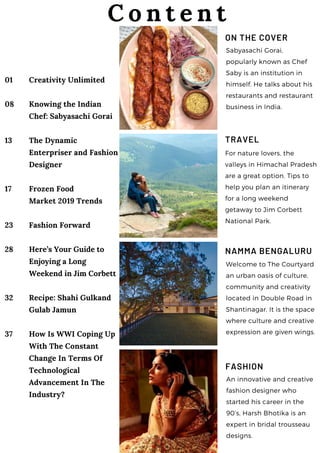
ON THE COVER
Sabyasachi Gorai,
popularly known as Chef
Saby is an institution in
himself. He talks about his
restaurants and restaurant
business in India.
C o n t e n t
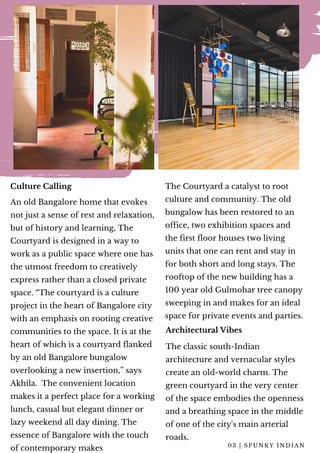
TRAVEL
For nature lovers, the
valleys in Himachal Pradesh
are a great option. Tips to
help you plan an itinerary
for a long weekend
getaway to Jim Corbett
National Park.
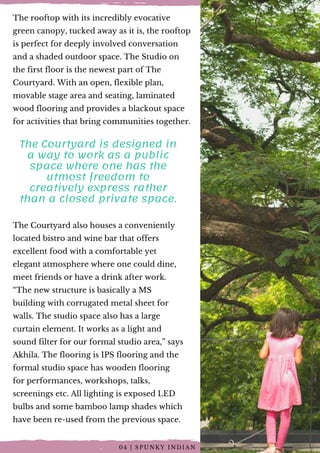
NAMMA BENGALURU
Welcome to The Courtyard
an urban oasis of culture,
community and creativity
located in Double Road in
Shantinagar. It is the space
where culture and creative
expression are given wings.
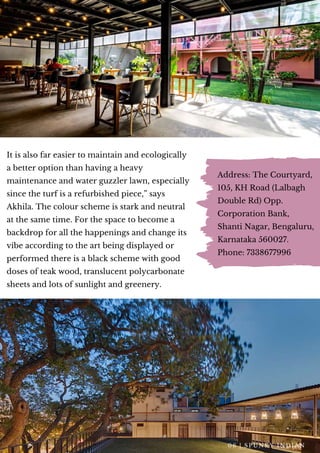
FASHION
An innovative and creative
fashion designer who
started his career in the
90’s, Harsh Bhotika is an
expert in bridal trousseau
designs.
Creativity
Unlimited
T H E C O U R T Y A R D I S T H E
S P A C E W H E R E C U L T U R E
A N D C R E A T I V E E X P R E S S I O N
A R E G I V E N W I N G S .
B I N D U G O P A L R A O
0 1 | S P U N K Y I N D I A N
0 2 | S P U N K Y I N D I A N
As a city that merges the contemporary with the traditional, Bengaluru is
a hands down winner. And making this possible in its own way is an
interactive space located in the midst of the city that is slowly but surely
becoming a hub of crafts, arts, culture, food and more. Welcome to The
Courtyard an urban oasis of culture, community and creativity located in
Double Road in Shantinagar. 
Conceptualised and designed by Akhila Srinivas, a trained architect and
urban designer along with the team from M9 design studio this is a
contemporary urban space to nurture and influence the creative mind of
artists, chefs, musicians, students and fitness enthusiasts.
Culture Calling
An old Bangalore home that evokes
not just a sense of rest and relaxation,
but of history and learning, The
Courtyard is designed in a way to
work as a public space where one has
the utmost freedom to creatively
express rather than a closed private
space. “The courtyard is a culture
project in the heart of Bangalore city
with an emphasis on rooting creative
communities to the space. It is at the
heart of which is a courtyard flanked
by an old Bangalore bungalow
overlooking a new insertion,” says
Akhila.  The convenient location
makes it a perfect place for a working
lunch, casual but elegant dinner or
lazy weekend all day dining. The
essence of Bangalore with the touch
of contemporary makes
The Courtyard a catalyst to root
culture and community. The old
bungalow has been restored to an
office, two exhibition spaces and
the first floor houses two living
units that one can rent and stay in
for both short and long stays. The
rooftop of the new building has a
100 year old Gulmohar tree canopy
sweeping in and makes for an ideal
space for private events and parties.
0 3 | S P U N K Y I N D I A N
Architectural Vibes
The classic south-Indian
architecture and vernacular styles
create an old-world charm. The
green courtyard in the very center
of the space embodies the openness
and a breathing space in the middle
of one of the city's main arterial
roads.
The rooftop with its incredibly evocative
green canopy, tucked away as it is, the rooftop
is perfect for deeply involved conversation
and a shaded outdoor space. The Studio on
the first floor is the newest part of The
Courtyard. With an open, flexible plan,
movable stage area and seating, laminated
wood flooring and provides a blackout space
for activities that bring communities together.
The Courtyard is designed in
a way to work as a public
space where one has the
utmost freedom to
creatively express rather
than a closed private space.
The Courtyard also houses a conveniently
located bistro and wine bar that offers
excellent food with a comfortable yet
elegant atmosphere where one could dine,
meet friends or have a drink after work.
“The new structure is basically a MS
building with corrugated metal sheet for
walls. The studio space also has a large
curtain element. It works as a light and
sound filter for our formal studio area,” says
Akhila. The flooring is IPS flooring and the
formal studio space has wooden flooring
for performances, workshops, talks,
screenings etc. All lighting is exposed LED
bulbs and some bamboo lamp shades which
have been re-used from the previous space.
0 4 | S P U N K Y I N D I A N
Décor Mantra
Being an old building that was being
refurbished, structural integrity was of
paramount importance when it was
being renovated. “It is almost an 80
year old bubble with 18” walls with
lime plaster. Though strong in its
construction, fragility does creep in.
We also made a conscious effort to
not really re-do much but just restore
to its original condition. The approach
was to keep it true to its anatomy of
simplicity and not dramatise just to
achieve a certain look or feel,” says
Akhila.
The bistro space is furnished with
restored old furniture and lamp shades.
The finish is of black metal against teal
wood furniture and lots of green. The
studio space is again a combination of
black painted MS structure and a skin 
of polycarbonate sheet with black
Aluminium frames and a large
expansive black curtain to control
sound and light. The flooring in the
studio is that of light wood. The
courtyard space is an open area with
lots of green and some very old trees.
“We have used repurposed turf for
this area to make it child friendly and
generally comfortable to just sit on it
or just roll about if you chose to.
The approach was to
keep it true to its
anatomy of
simplicity and not
dramatise just to
achieve a certain
look or feel, says
Akhila.
0 5 | S P U N K Y I N D I A N
It is also far easier to maintain and ecologically
a better option than having a heavy
maintenance and water guzzler lawn, especially
since the turf is a refurbished piece,” says
Akhila. The colour scheme is stark and neutral
at the same time. For the space to become a
backdrop for all the happenings and change its
vibe according to the art being displayed or
performed there is a black scheme with good
doses of teak wood, translucent polycarbonate
sheets and lots of sunlight and greenery.
Address: The Courtyard,
105, KH Road (Lalbagh
Double Rd) Opp.
Corporation Bank,
Shanti Nagar, Bengaluru,
Karnataka 560027.
Phone: 7338677996
0 6 | S P U N K Y I N D I A N
0 7 | S P U N K Y I N D I A N
Sabyasachi Gorai, popularly known as
Chef Saby is an institution in himself.
He needs no introduction. The whole
culinary world knows him for his
brilliant master creations. He has
bagged many Chef of the Year awards
and is the first chef to receive the “Best
Chef Award”  from the president of
India. He has cooked for some of the
famous dignitaries- Bachchans,
Ambanis, F1 teams and is at the helm of
affairs at Fabrica by Saby, a boutique
restaurant consultancy venture.
Knowing the Indian Chef:
Sabyasachi Gorai
C H E F S A B Y T A L K S A B O U T H I S R E S T A U R A N T S A N D
R E S T A U R A N T B U S I N E S S I N I N D I A
The Choices Made:
Chef Saby didn’t aim to be a chef. He
was a good athlete, good in sports. What
he always wanted to do was to serve the
nation through defense services. The
second pre-university grades were not
great for him and he couldn’t clear the
entrance exams for either naval or
army.
Saby was fascinated by his cousin
sister’s profile who was working in Taj.
He wrote the exams for hotel
management and fortunately got
through IHM, Calcutta. “My dad was
not keen at all either for naval nor
army. However, he was a bit okay for
hotel management as my cousin sister
was already into it”.
He has bagged many Chef of
the Year awards and is the
first chef to receive the “Best
Chef Award” from the
president of India.
Food is an expression:
0 8 | S P U N K Y I N D I A N
Saby always had an interest in design, always
drawn and paint as a kid. He did his schooling
from Pondicherry Art School. He also learned
music from BHU.
"Expression of art is always a part of
me either through music or through
paint.  So when I got into food or the
hotel industry I realized that food is an
expression and secondly, I got a
chance to enter into the kitchen. I felt
good as I get to eat a lot (as a teen), and
also I could do a lot of creativity with
food. That’s when my mind changed
that I wanted to be in the kitchen”, he
informed.
The food reflects his memoir:
Many chefs make lives in the
restaurants, for him, he has restaurants
which depict his life. “SodaBottle is the
first restaurant that I consulted. The
food depicts my life story in Bombay
where I grew up.  The first few years I
was living in a coal mining area in
Asansol and one can get to know the
place through my restaurant,
Mineority, Pune. This restaurant is
also inspired by my dad’s second book
that talks about the mining history of
India. In mineority, we serve food
from minor parts of India- Northeast,
Bihar and West Bengal.
Another restaurant, Lavaash by Saby is
based out of my school friends who
were Anglo Indians from the
Armenian community. This restaurant
too has its inspiration from my dad’s
book that educates about Armenian
settlement in India.  Every time he
writes a book, I open a restaurant”, he
smiled.
“Expression of art is
always a part of me
either through music
or through paint. So
when I got into food or
the hotel industry I
realized that food is
an expression." 0 9 | S P U N K Y I N D I A N
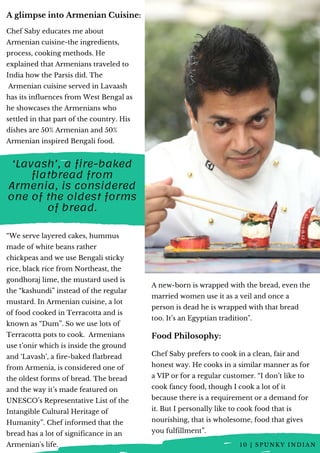
Chef Saby educates me about
Armenian cuisine-the ingredients,
process, cooking methods. He
explained that Armenians traveled to
India how the Parsis did. The
 Armenian cuisine served in Lavaash
has its influences from West Bengal as
he showcases the Armenians who
settled in that part of the country. His
dishes are 50% Armenian and 50%
Armenian inspired Bengali food.
“We serve layered cakes, hummus
made of white beans rather
chickpeas and we use Bengali sticky
rice, black rice from Northeast, the
gondhoraj lime, the mustard used is
the “kashundi” instead of the regular
mustard. In Armenian cuisine, a lot
of food cooked in Terracotta and is
known as “Dum”. So we use lots of
Terracotta pots to cook.  Armenians
use t’onir which is inside the ground
and ‘Lavash’, a fire-baked flatbread
from Armenia, is considered one of
the oldest forms of bread. The bread
and the way it’s made featured on
UNESCO’s Representative List of the
Intangible Cultural Heritage of
Humanity”. Chef informed that the
bread has a lot of significance in an
Armenian's life. 
A glimpse into Armenian Cuisine:
‘Lavash’, a fire-baked
flatbread from
Armenia, is considered
one of the oldest forms
of bread.
Food Philosophy:
Chef Saby prefers to cook in a clean, fair and
honest way. He cooks in a similar manner as for
a VIP or for a regular customer. “I don’t like to
cook fancy food, though I cook a lot of it
because there is a requirement or a demand for
it. But I personally like to cook food that is
nourishing, that is wholesome, food that gives
you fulfillment”.
A new-born is wrapped with the bread, even the
married women use it as a veil and once a
person is dead he is wrapped with that bread
too. It’s an Egyptian tradition".
1 0 | S P U N K Y I N D I A N
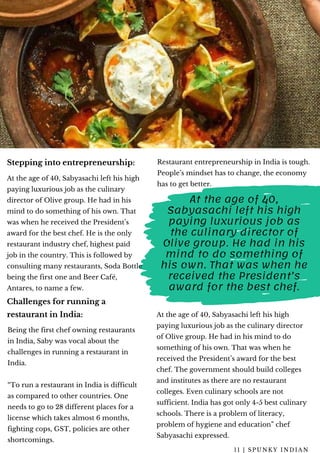
At the age of 40, Sabyasachi left his high
paying luxurious job as the culinary
director of Olive group. He had in his
mind to do something of his own. That
was when he received the President’s
award for the best chef. He is the only
restaurant industry chef, highest paid
job in the country. This is followed by
consulting many restaurants, Soda Bottle
being the first one and Beer Café,
Antares, to name a few.
Restaurant entrepreneurship in India is tough.
People’s mindset has to change, the economy
has to get better.
1 1 | S P U N K Y I N D I A N
Stepping into entrepreneurship:
Challenges for running a
restaurant in India:
Being the first chef owning restaurants
in India, Saby was vocal about the
challenges in running a restaurant in
India.
“To run a restaurant in India is difficult
as compared to other countries. One
needs to go to 28 different places for a
license which takes almost 6 months,
fighting cops, GST, policies are other
shortcomings.
At the age of 40,
Sabyasachi left his high
paying luxurious job as
the culinary director of
Olive group. He had in his
mind to do something of
his own. That was when he
received the President’s
award for the best chef.
At the age of 40, Sabyasachi left his high
paying luxurious job as the culinary director
of Olive group. He had in his mind to do
something of his own. That was when he
received the President’s award for the best
chef. The government should build colleges
and institutes as there are no restaurant
colleges. Even culinary schools are not
sufficient. India has got only 4-5 best culinary
schools. There is a problem of literacy,
problem of hygiene and education” chef
Sabyasachi expressed.
1 2 | S P U N K Y I N D I A N
Give back to the society:
Chef Saby works towards various
causes. He runs a Delhi- NCR food
bank and helps support the cause. He
is also the president of the young
chef’s forum of IFCA. He grooms and
inspires 40,000-50,000 young chefs
passing out every year. He does guest
lectures, workshops, motivational
speeches, training classes, and
mentoring.
Chef Sabyasachi runs various social
projects and works towards the
betterment of society. One of them is
helping the Muslim girls residing in the
slums of Nizamuddin. The girls have
little or no education as their families
don’t send them to colleges. He works
in collaboration with NGO, trains them
and helps the girls to get proper
employment.
Chef Saby expressed that he has to
prove every time through his creations.
“Right attitude, fire in the belly,
conviction and positive energy is all
that you need to achieve what one
desires”, he signed off.
Chef Sabyasachi is
helping the Muslim
girls residing in the
slums of Nizamuddin.
He works in
collaboration with
NGO, trains them and
helps the girls to get
proper employment.
1 3 | S P U N K Y I N D I A N
The Dynamic
Enterpriser and
Fashion Designer
H A R S H B H O T I K A , D I R E C T O R , W A R P N W E F T ( W N W )
An innovative and creative fashion
designer who started his career in the
90’s, Harsh Bhotika is an expert in bridal
trousseau designs. Initiating with a small
shop and converting it into a sprawling
manufacturing unit of 27,000 sq ft, is a
result of 10 years of tough grind and
dedication. The versatile entrepreneur
stepped into the fashion world by adding
core values and passion to his repertoire
of work. His innovative and creative
instincts has led him carve a niche in the
world of fashion.
WNW is redefining designer ethnic wear
in India, making it available to patrons
who are connoisseurs of fine designs, but
shy away due to the pricey designer tags,
hence the label aims to be affordable too.
A perfectionist by nature, Harsh has
grounded Warp N Weft (WNW) on the
twin pillars of excellence and innovation.
Through his vast experience in the fashion
world, the entrepreneur aims at
revolutionising the ethnic wear women’s
wear in India with a firm focus on
craftsmanship, quality and customer
experience. With an aim to elevate the
brand, Harsh aims WNW to be the most
preferred Indian Ethnic Bridal Trousseau
destination for the elite and affluent Indian
brides in time to come. Guided by a
sophisticated yet dramatic sensibility, the
dynamic enterpriser combines unique
elements with inventive design to create his
collections. His ensembles are for the women
who meander between the contemporary
and the traditional; she who respects the
values of the land, the craftsmanship of the
weave and yet has a global outlook. The label
currently has its own flagships stores in
Kolkata, Delhi and Chennai. In conversation
with Harsh Bhotika to understand more
about the brand.
1 4 | S P U N K Y I N D I A N
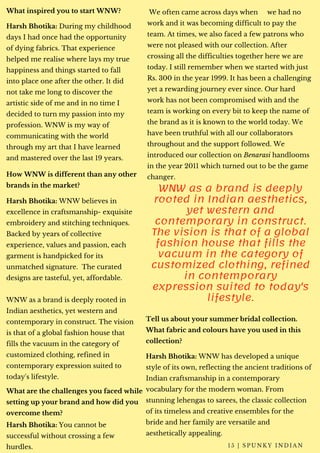
What inspired you to start WNW?
Harsh Bhotika: During my childhood
days I had once had the opportunity
of dying fabrics. That experience
helped me realise where lays my true
happiness and things started to fall
into place one after the other. It did
not take me long to discover the
artistic side of me and in no time I
decided to turn my passion into my
profession. WNW is my way of
communicating with the world
through my art that I have learned
and mastered over the last 19 years.
How WNW is different than any other
brands in the market?
Harsh Bhotika: WNW believes in
excellence in craftsmanship- exquisite
embroidery and stitching techniques.
Backed by years of collective
experience, values and passion, each
garment is handpicked for its
unmatched signature.  The curated
designs are tasteful, yet, affordable.
WNW as a brand is deeply rooted in
Indian aesthetics, yet western and
contemporary in construct. The vision
is that of a global fashion house that
fills the vacuum in the category of
customized clothing, refined in
contemporary expression suited to
today's lifestyle.
What are the challenges you faced while
setting up your brand and how did you
overcome them?
 We often came across days when     we had no
work and it was becoming difficult to pay the
team. At times, we also faced a few patrons who
were not pleased with our collection. After
crossing all the difficulties together here we are
today. I still remember when we started with just
Rs. 300 in the year 1999. It has been a challenging
yet a rewarding journey ever since. Our hard
work has not been compromised with and the
team is working on every bit to keep the name of
the brand as it is known to the world today. We
have been truthful with all our collaborators
throughout and the support followed. We
introduced our collection on Benarasi handlooms
in the year 2011 which turned out to be the game
changer.
WNW as a brand is deeply
rooted in Indian aesthetics,
yet western and
contemporary in construct.
The vision is that of a global
fashion house that fills the
vacuum in the category of
customized clothing, refined
in contemporary
expression suited to today's
lifestyle.
Tell us about your summer bridal collection.
What fabric and colours have you used in this
collection?
Harsh Bhotika: WNW has developed a unique
style of its own, reflecting the ancient traditions of
Indian craftsmanship in a contemporary
vocabulary for the modern woman. From
stunning lehengas to sarees, the classic collection
of its timeless and creative ensembles for the
bride and her family are versatile and
aesthetically appealing.
1 5 | S P U N K Y I N D I A N
Harsh Bhotika: You cannot be
successful without crossing a few
hurdles.
Any recognitions or awards you would like to
share with us?
From stunning lehengas to sarees, the classic collection
of its timeless and creative ensembles for the bride and
her family are versatile and aesthetically appealing.
The ensembles have a touch of fabrics like rich silk,
georgette, satin embellished with intricate embroideries
and gloriously rich Indian aesthetics and rich brocades
enamoured with everlasting grace & elegance. The
premium fabrics are personally procured from various
places around the globe.
Harsh Bhotika: It feels really good when your hard work
gets recognized, so I would proudly like to share the list
of awards as well as recognitions that we have received:
Best Participant Award, KFE 2016
Times Retail Icon Award , 2017
Dr Ujjwal Patni Best Business Process Implementor
Award, 2017
Best Participant Award, KFE 2017
Times Power Women Award, 2018 to Mrs Rita Bhotika
Best Participant Award, KFE 2018
Harsh Bhotika: As they say,
patience is a virtue. Believe
in your dreams and work
hard for it. Don’t keep any
stone unturned. Also, one
must not compromise with
their ethics and values in
order to fulfill their dreams.
We live in a country with
more than 1.36 billion
people residing here, there
will be a day when you come
across people who will like
and appreciate your designs.
So, don’t let small failures
pull down your confidence
today instead turn them as
your stepping stones in your
journey to success.
A message for the young
designers.
Believe in your dreams and
work hard for it.
1 6 | S P U N K Y I N D I A N
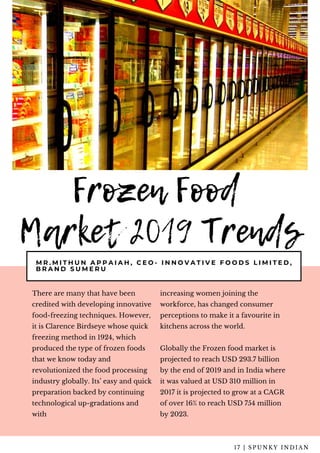
Frozen Food
Market 2019 Trends
M R . M I T H U N A P P A I A H , C E O - I N N O V A T I V E F O O D S L I M I T E D ,
B R A N D S U M E R U
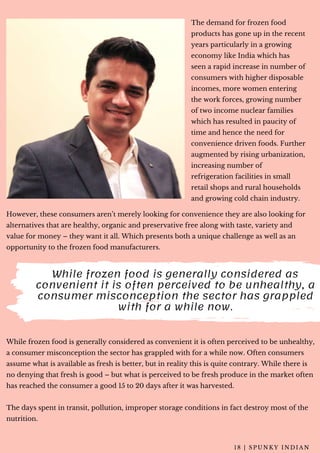
There are many that have been
credited with developing innovative
food-freezing techniques. However,
it is Clarence Birdseye whose quick
freezing method in 1924, which
produced the type of frozen foods
that we know today and
revolutionized the food processing
industry globally. Its’ easy and quick
preparation backed by continuing
technological up-gradations and
with  
increasing women joining the
workforce, has changed consumer
perceptions to make it a favourite in
kitchens across the world.
Globally the Frozen food market is
projected to reach USD 293.7 billion
by the end of 2019 and in India where
it was valued at USD 310 million in
2017 it is projected to grow at a CAGR
of over 16% to reach USD 754 million
by 2023.
1 7 | S P U N K Y I N D I A N
The demand for frozen food
products has gone up in the recent
years particularly in a growing
economy like India which has
seen a rapid increase in number of
consumers with higher disposable
incomes, more women entering
the work forces, growing number
of two income nuclear families
which has resulted in paucity of
time and hence the need for
convenience driven foods. Further
augmented by rising urbanization,
increasing number of
refrigeration facilities in small
retail shops and rural households
and growing cold chain industry.
1 8 | S P U N K Y I N D I A N
While frozen food is generally considered as
convenient it is often perceived to be unhealthy, a
consumer misconception the sector has grappled
with for a while now.
While frozen food is generally considered as convenient it is often perceived to be unhealthy,
a consumer misconception the sector has grappled with for a while now. Often consumers
assume what is available as fresh is better, but in reality this is quite contrary. While there is
no denying that fresh is good – but what is perceived to be fresh produce in the market often
has reached the consumer a good 15 to 20 days after it was harvested.
The days spent in transit, pollution, improper storage conditions in fact destroy most of the
nutrition.
However, these consumers aren’t merely looking for convenience they are also looking for
alternatives that are healthy, organic and preservative free along with taste, variety and
value for money – they want it all. Which presents both a unique challenge as well as an
opportunity to the frozen food manufacturers.
Whereas most freezing units
across the country are
located with 100 kilometres
of where the produce is
sourced meaning the your
fresh peas in the Uttaranchal
belt reaches the
manufacturing unit within
hours where it is cleaned
and flash frozen at its peak
nutritional state and then
stored and transported in a
controlled environment
where the temperature is
consistently maintained
under -18 degree Celsius to
prevent enzyme activity that
might further cause
nutritional loss. 
1 9 | S P U N K Y I N D I A N
Fresh peas in the
Uttaranchal belt
reaches the
manufacturing unit
within hours where it
is cleaned and flash
frozen at its peak
nutritional state and
then stored and
transported in a
controlled
environment to
prevent enzyme
activity that might
further cause
nutritional loss.
Freezing as a process in fact involves
minimal processing, has high retention of
nutrients, taste, texture and freshness
making it one of the best and safest
methods of food preservation without the
addition of any preservatives.
The Frozen food industry is also
witnessing an increase in demand for
more premium, sustainable and healthier
products. The today high expectation in
terms of quality, taste, origin of produce
and ethic brand practices is high as well. A
recent Nielsen study found that 81% of
Millennials and 78% Generation Z are
willing to pay more for foods with
benefits. Millennials are more likely to
spend on sustainable brands that offers
products that are organic, high protein
and follow fair trade / souring practices.
To meet these needs frozen
2 0 | S P U N K Y I N D I A N
Another major challenge that Frozen food manufacturers need to address is the
growing consumer demand for variety and novelty in this segment. The consumers
today are seeking more innovative products, Sumeru’s primary research data shows
a marked rise in demand for mainline products like Pizza, Biriyani in the Indian
frozen segment and not just snacks. Frozen desserts (non ice-cream segment) is
gaining traction and consumers have started accepting those products.
The frozen food sector overall is witnessing lot more disruption than ever before.
To address this disruption frozen food manufacturers need to significantly invest on
R&D and innovation, and develop products that address the consumer concerns
around health, nutrition and origin.
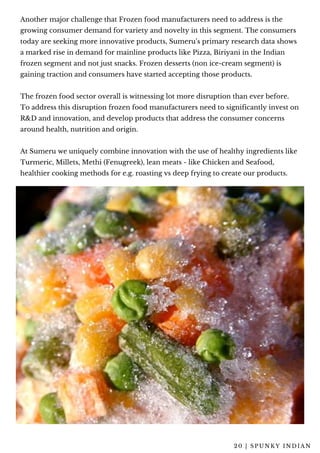
At Sumeru we uniquely combine innovation with the use of healthy ingredients like
Turmeric, Millets, Methi (Fenugreek), lean meats - like Chicken and Seafood,
healthier cooking methods for e.g. roasting vs deep frying to create our products.
This is reflected in our newly launched
range of Gourmet Premium Products
created in collaboration with 13 time
Michelin starred Chef, Chef Alfred
Prasad (this is a first of its collaboration
in the Indian Food Industry), Kebab and
Paratha range - curated by Master Chef
India Judge Chef Ajay Chopra.
2 1 | S P U N K Y I N D I A N
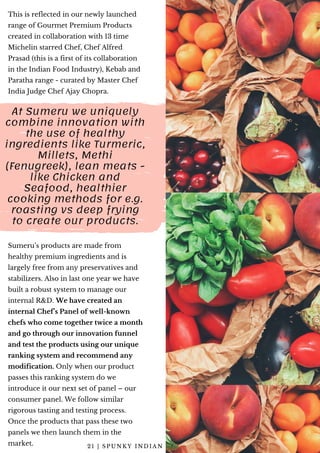
At Sumeru we uniquely
combine innovation with
the use of healthy
ingredients like Turmeric,
Millets, Methi
(Fenugreek), lean meats -
like Chicken and
Seafood, healthier
cooking methods for e.g.
roasting vs deep frying
to create our products.
Sumeru’s products are made from
healthy premium ingredients and is
largely free from any preservatives and
stabilizers. Also in last one year we have
built a robust system to manage our
internal R&D. We have created an
internal Chef’s Panel of well-known
chefs who come together twice a month
and go through our innovation funnel
and test the products using our unique
ranking system and recommend any
modification. Only when our product
passes this ranking system do we
introduce it our next set of panel – our
consumer panel. We follow similar
rigorous tasting and testing process. 
Once the products that pass these two
panels we then launch them in the
market.
Other trends that we see emerging in the
industry apart from premiumization of frozen
food is that of private label brands is another
factor that is boosting the growth of the
market. Private-label products are relatively
low-priced as compared to mainstream
brands, which makes them a popular option
among consumers who are budget conscious.
The market share of private-label players is
increasing in all the segments of the global
frozen food market.
In order to succeed in the current market
scenario we believe, the players in the market
need to introduce new products that can tap
into the potential offered by the growing
demand for premium, healthy and novel
frozen food products in the country.
2 2 | S P U N K Y I N D I A N
Fashion Forward
B I N D U G O P A L R A O
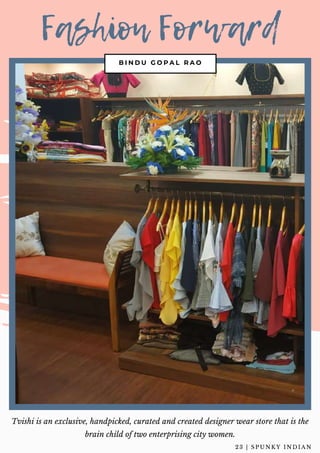
Tvishi is an exclusive, handpicked, curated and created designer wear store that is the
brain child of two enterprising city women.
2 3 | S P U N K Y I N D I A N
Tvishi is an unusual name. But has a
lovely meaning. It means ray of light,
energy and brilliance. Meet Shaleen
Subbaiah and Varsha Venkatesh Co-
founders and Partners of ‘tvishi’ a new
designer store in Bengaluru. Varsha
was born and raised in Bangalore and
was always inspired by her father who
is into Government Service. Shaleen
was born and raised in Coorg by her
maternal grandparents and she moved
to Bangalore for her high school and
resided with her aunt and completed
her law from Bangalore University.
The common connection with them
was fashion.
Shaleen admits that fashion is in her genes.
“During my early childhood I always
admired my aunt who was a beautiful
woman. She was an author and a film
artist. I always admired her sense of style.
She designed her clothes and as a child I
always accompanied her to the tailors.
Perhaps I was unaware that fashion struck
me in those days itself. I was so passionate
about my start up Panache The boutique. I
put in my heart and soul into it and today
it is an established and well known
boutique in Bangalore.”
Fashion Matters
2 4 | S P U N K Y I N D I A N
My was an author and a
film artist. She designed
her clothes and as a child
I always accompanied
her to the tailors. Perhaps
I was unaware that
fashion struck me in
those days itself.
The approach was to
keep it true to its
anatomy of simplicity
and not dramatise just
to achieve a certain look
or feel, says Akhila.
Varsha has been a model and designer so this
naturally drew her to fashion. Varsha was
Shaleen’s client since 2010 at Panache and
even worked as an intern with her for a few
months. Her regular visits to the store got
them talking leading to setting up the
designer store tvishi. The store has exclusive
handpicked curated and created designer
wear by tvishi and has been positioned as the
coolest one-stop destination for mid-priced
to premium designer wear.
The tvishi brand blends the essence of India
with a touch of the West and tvishi’s designs
radiate elegance and class and appeal to
everyone whether it is teens who are
discovering fashion to independent women
who know what they want. Sarees, Ethnic,
Indo western and accessories for formal,
casual, party, festive and bridal wear
occasions are displayed at the store.
Women on Top
While Varsha is always
inspired by her father she
always had a passion for
books on Indian History. For
Shaleen her aunt (who is no
more now) was her biggest
inspiration when she was a
child. “I feel every day is an
inspiration. I get inspired by
so many things every day.
The colours, the fabrics, every other app
which helps you make your life easy
these days.  Rather than inspiration I
would say dreaming, visualising and
executing things at the right time in the
right positive way makes things work,”
admits Shaleen. Being young women
entrepreneurs they admit that there is
always stiff competition.
2 5 | S P U N K Y I N D I A N
“There are defying social expectations,
women are not taken seriously, balancing
business and family life  is also a challenge
and the thought of coping fear of failure
always arises.  But we don’t want to let all
this get to our head. We want to strive hard
to overcome all these hurdles and prove to
the society that women are here to stay,”
says Varsha.
Contemporary Cues
Quiz them on what are some have haves in a
women’s wardrobe they are clear that each
woman is different and one woman's ‘must
have’ might not be another’s. Rather this
depends on different age groups, the kind of
work and many more aspects.
 “A must for all below forties according to us
include denims with a decent semi casual
top and a black dress. For Indian women
above 40 we believe that a saree is a must
have as is a comfortable kurta,” say the duo.
And as far as apparel trends for 2019 are
concerned they see comfortable long and
short dresses becoming very common these
days. “Skirts and Palazzos, Linen and
handloom sarees highly trend. Floral and
geometric patterns are trending,” say the
duo. And as far as apparel trends for 2019
are concerned they see comfortable long
and short dresses becoming very common
these days.
2 6 | S P U N K Y I N D I A N
“Skirts and Palazzos, Linen and
handloom sarees highly trend. Floral
and geometric patterns are trending,”
say the duo. Their advice to women
who want to be entrepreneurs is
simple. “Stay focused and never be
deterred by anyone or anything. Trust
yourself and never try to rationalise
your decision. Always think it is your
idea of this business and you are solely
responsible for the results.
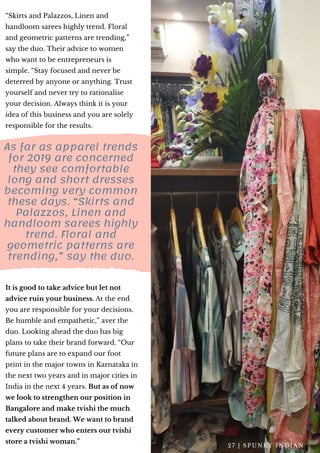
As far as apparel trends
for 2019 are concerned
they see comfortable
long and short dresses
becoming very common
these days. “Skirts and
Palazzos, Linen and
handloom sarees highly
trend. Floral and
geometric patterns are
trending,” say the duo.
It is good to take advice but let not
advice ruin your business. At the end
you are responsible for your decisions.
Be humble and empathetic,” aver the
duo. Looking ahead the duo has big
plans to take their brand forward. “Our
future plans are to expand our foot
print in the major towns in Karnataka in
the next two years and in major cities in
India in the next 4 years. But as of now
we look to strengthen our position in
Bangalore and make tvishi the much
talked about brand. We want to brand
every customer who enters our tvishi
store a tvishi woman.”
2 7 | S P U N K Y I N D I A N
Here’s Your Guide to
Enjoying a Long Weekend in
Jim Corbett
P R O T I M A T I W A R Y
If you’re a travelholic, living in Delhi
will leave you spoilt for choice. With
over 50 weekend getaway options
around the capital, the sense of
wanderlust can be easily satisfied, no
matter what your mood. For those
who love the cold winters, one can
head to the snow-capped Himalayas
in Himachal Pradesh. For nature
lovers, the valleys in Himachal
Pradesh are a great option.
For those who wish to enjoy time away from the
hustle bustle of city life, quaint towns in the
Himalayas are perfect to enjoy that evening stroll
(with piping hot jalebis to keep you company!)
Similarly, for adventure lovers there are various
options for treks and safaris. If you’re in the mood
for an adventure in the wild, a wildlife safari in
India’s oldest national park and tiger reserve, Jim
Corbett, is a wonderful idea. In this post we will
help you plan an itinerary for a long weekend
getaway to Jim Corbett National Park.
2 8 | S P U N K Y I N D I A N
THE NEWEST TECH & GEAR OF 2019
FOR YOUR NEXT OUTDOOR ADVENTURE
How to get there
Driving down is the best option for those in Delhi.
If you live in another city, flying down to Delhi
and continuing by road is the best way to
approach Jim Corbett National Park.
A direct train to Ramnagar is also another way to
get here. Taxis are available from Ramnagar to
accommodation inside the national park.
Where to stay
Jim Corbett National Park has some beautiful resorts that offer great views and hospitality
and a  comfortable stay. You can choose from a plethora of resorts depending upon your
budget.
Taj Corbett Resort & Spa, Corbett Tusker Trail, The Solluna Resort, Sterling Corbett are
some of the names that come highly recommended.
What to do there
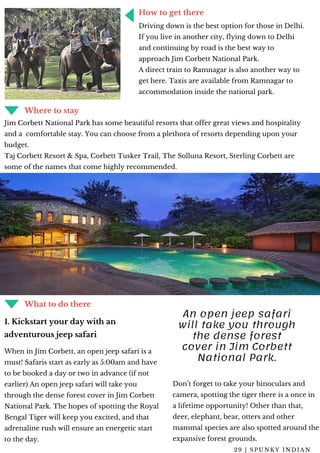
When in Jim Corbett, an open jeep safari is a
must! Safaris start as early as 5:00am and have
to be booked a day or two in advance (if not
earlier) An open jeep safari will take you
through the dense forest cover in Jim Corbett
National Park. The hopes of spotting the Royal
Bengal Tiger will keep you excited, and that
adrenaline rush will ensure an energetic start
to the day.
1. Kickstart your day with an
adventurous jeep safari
Don’t forget to take your binoculars and
camera, spotting the tiger there is a once in
a lifetime opportunity! Other than that,
deer, elephant, bear, otters and other
mammal species are also spotted around the
expansive forest grounds.
An open jeep safari
will take you through
the dense forest
cover in Jim Corbett
National Park.
2 9 | S P U N K Y I N D I A N
Only tourism zones allow safaris and residential properties. The tourism zones are as follows:
Dhikala Zone Canter Safari
(no jeep safari)
32km from Ramnagar station
Entry Gate- Dhangadi Gate
Bijrani Zone
Day Jeep Safari
2km from Ramnagar
Entry Gate- Amdanda Gate
Jhirna Zone
Day Jeep Safari,
Elephant Safari
15 km from Ramnagar 
Entry Gate: Dhela Gate
Durga Devi Zone
Day Jeep Safari
28km from Ramnagar
Entry Gate: Durga Devi
Gate
Sitabani forest Zone 
Day Jeep Safari, Elephant
Safari
4km from Ramnagar 
Entry Gate: :Near Teda Village
(Private Vehicle Allowed)
This also consists of the Forest
Rest House which has to be
booked months in advance.
2. Enjoy a walk by the river
The Kosi river flows through the national park, and a walk by the
rocky banks can be best enjoyed in the afternoon or early evening.
Make sure you come back to your resort before sunset since this is the
time the wild animals start making their way down to the river and the
darkness is all-consuming once the sun sets.
Carry a pair of closed shoes/sports shoes to enjoy a walk along the
river. Sit back, watch the river flow down calmly, read a book or even
take a swim if the weather permits.  You can also go fishing in the
river!
3. End the day with a bon-fire
A bon-fire in this forest landscape is a perfect
way to end the day. If possible, even get your
own grills and enjoy a barbecue in the chilly
night air! Don’t forget to ask your resort for
permissions and safety precautions before
heading out to light the bon-fire.
Days Required: 2 Nights 3 Days
Time for travel: 6 hours from Delhi
Best time to visit: March to June
3 0 | S P U N K Y I N D I A N
3 1 | S P U N K Y I N D I A N
Shahi Gulkand Gulab
Jamun A S T E P - B Y - S T E P R E C I P E B Y
C H E F R E E T U U D A Y K U G A J I
Chef, Culinary Expert, Mentor, Food
Blogger & Author, Hospitality and
Food Consultant.
Chef Reetu Uday Kugaji
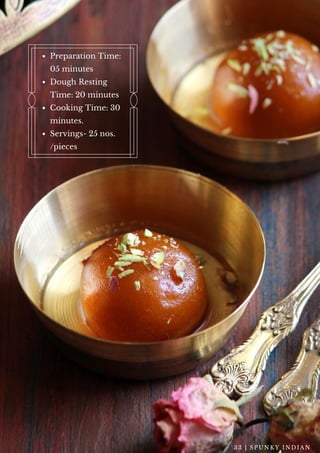
Recipe is the traditional gulab jamun
recipe with the twist of gulkand,
saffron and sugar candy.
Deep fried sweet dumplings filled
with gulkand, pistachio nuts , broiled
saffron and sugar candy, stewed in
flavoured sugar syrup.
3 2 | S P U N K Y I N D I A N
Preparation Time:
05 minutes
Dough Resting
Time: 20 minutes
Cooking Time: 30
minutes.
Servings- 25 nos.
/pieces
3 3 | S P U N K Y I N D I A N
Ingredients and Quantity:
Haryali Mawa- 250 gm.
Refined flour- 50 gm.
Soda Bicarb- a pinch
Salt – a pinch
Green Cardamom
Powder- 04 gm
Water, Chillied- As
required to mix
For covering the dough:
Muslin cloth- ½ metre
For the filling / stuffing:
Gulkand- 50 gm.
Pistachio nuts, blanched ,
peeled and cut into
halves- 25 nos.
Saffron strands, broiled /
lightly dry roasted – 01
gm.
Sugar candy (Mishri)- 25
nos.
For the Sugar Syrup:
Sugar: 3 ½ cups
Water: 1 ¾ th cups
Rose water- 10 ml
Green Cardamom powder very fine-
05 gm
Muslin cloth for straining sugar syrup-
½ metre
Saffron strands – 01 gm.
For clarifying the sugar syrup:
Milk OR Lemon juice- 05 ml.
For deep frying:
Oil / Pure ghee- as required
For the Garnishing:
Silver leaf- 02 sheets
Pistachio nuts, blanched, peeled and
slivered- 15 gm
Almond blanched, peeled and
slivered- 10 gm
Saffron strands, broiled / lightly dry
roasted – 01 gm.
3 4 | S P U N K Y I N D I A N
3 5 | S P U N K Y I N D I A N
Grate the mawa, add sieved refined flour, cardamom powder and a pinch
of salt.
Mix soda bicarb with chilled water.
Mix into the mawa mixture.
With the help of your fingertips, prepare a dough. DO NOT KNEAD, as
the friction will cause the mawa to become warm and loose its actual
texture.
Keep the dough covered with a moist muslin cloth for 20 minutes.
Divide into equal portions.
Shape into round balls, press them , place a pinch of gulkand, the
pistachio nut halves, broiled saffron and sugar candy in the centre and
carefully reshape to ensure that there are no cracks in the balls.
Method:
Deep fry on a slow flame in hot oil / ghee till golden brown.
While frying the gulab jamuns, keep stirring the oil / ghee not the gulab
jamuns.
Separately make sugar syrup of one string consistency by taking water,
adding the sugar continuously stirring to make sure that the sugar is
dissolved.
Now switch on the flame, let it boil and reach to one string consistency.
Add milk OR lemon juice to clarify the sugar syrup, remove the scum
from the top and discard the scum.
Add finely powdered cardamom powder and rose water.
Strain through a muslin cloth. Add 01 gm saffron stands to the sugar
syrup.
Add warm gulab jamun to warm sugar syrup.
Soak gulab jamun at least 10 minutes before serving so that it can absorb
the sugar syrup.
Just before service apply silver sheet, garnish with slivered pistachio nuts,
slivered almonds and broiled / lightly dry roasted saffron strands.
Chef Tips:
1.    The reason for putting salt in the mawa mixture is, that salt has the
tendency to enhance and bring out the sweetness in the gulab jamuns /
sweets prepared.
2.    Haryali mawa is a special kind of mawa used especially for making
gulab jamuns.
3.    Make sure the oil / ghee is not too hot while you deep fry them, as they
will only obtain the colour and remain uncooked from inside.
4.    Do not soak gulab jamun more than 10 minutes before serving, as they
tend to become soggy and loses its original texture and shape.
5.    Ratio of sugar to water may be varied from 2:1 i.e. two parts of sugar to
one part of water to 1:1 One part of sugar to one part of water. 3 ½ cups of
sugar to 3 ½ cups of water.
6.    You may add Kewra water to the sugar syrup to enhance the aroma and
flavor.
3 6 | S P U N K Y I N D I A N
How Is WWI Coping Up With
The Constant Change In
Terms Of Technological
Advancement In The
Industry?
M E G H N A G H A I P U R I , P R E S I D E N T , W H I S T L I N G W O O D S
I N T E R N A T I O N A L
3 7 | S P U N K Y I N D I A N
Change is the only constant in life. This saying holds true and more so in today's fast-paced,
rapidly evolving world. Over the past several decades, the world has witnessed enormous
changes in every sphere of life, from the social to the cultural and political. But, ultimately it
is the field of technology that has seen the greatest upheaval and advancement, ultimately
serving to reshape the world, in unimaginable ways.
It was with this knowledge in mind that my father and filmmaker, Subhash Ghai, founded
Whistling Woods International (WWI) in 2006. From the beginning, my father was
determined that WWI be a state-of-the-art academic institution, capable of setting new
standards for a global education in film, communication, and creative arts. Naturally, this
didn’t happen overnight. 
Ultimately it is the field of technology that has seen
the greatest upheaval and advancement, ultimately
serving to reshape the world, in unimaginable ways.
3 8 | S P U N K Y I N D I A N
A never-ending quest for innovation
From our very first year, WWI has
committed itself to providing its students
with a holistic teaching and learning
environment, prioritising on hands-on
education with the latest tools and
technologies available. WWI always strives
to give our students the latest and best
when it comes to technology, often times
before the industry has it. To that end, we
have constantly sought to acquire and
incorporate the latest developments in any
field, and thereby stay abreast of the rapid
changes sweeping through the media and
entertainment industry.
Technological progress is constantly pushing the boundaries of what is possible, and tools
are constantly evolving to offer even more innovative features. Since its inception, WWI’s
goal has been to be ahead of the industry when it comes to technology. We have also kept a
close eye on upcoming tech innovations and have taken the extra step to become both early
adopters and in most cases, contributors to the development of such technological
innovation in India. Today we stand as Asia’s premier Film, Communication, and Creative
Arts Institute. The pillars of our success rest on the following factors:
Since its inception,
WWI’s goal has been to
be ahead of the
industry when it comes
to technology. We have
also kept a close eye on
upcoming tech
innovations and have
taken the extra step to
become both early
adopters and in most
cases, contributors to
the development of
such technological
innovation in India.
Today we stand as
Asia’s premier Film,
Communication, and
Creative Arts Institute.
The best minds in the field
WWI has always prided itself on providing
its students with the opportunity to learn
from and work alongside the finest minds
in every creative field. Our faculty is
comprised of veterans of their respective
areas of expertise, whether they are
directors, editors, or cinematographers.
Many of them are still working
professionals, which ensure that our
curriculums are constantly updated to
reflect the latest industry trends and
methodologies. Student learning is further
reinforced by a plethora of events held over
the course of the year, catering to our
various schools and departments. 3 9 | S P U N K Y I N D I A N
Wisdom of the experts
In addition to our veteran teaching staff,
our students’ learning is further
reinforced by a series of ‘masterclasses’
and ‘workshops’. Conducted on a weekly
basis, these widely-anticipated sessions see
experts across the varied domains of
entertainment, technology,
communications, and creative arts closely
interact with our students and share
valuable insights on their respective
industries. This serves to provide a
window into the latest technological
developments in any given industry.
Alumni contributing to the
education system
The final link in our educational network
comes through our alumni, who
frequently revisit their alma mater in
order to pass on their learnings to the
next generation of media aspirants. From
our very first batch, the students of WWI
have been highly recruited and always
made a mark in the industry owing to
their advanced technical knowledge.
Today there are more than 1900 highly
successful alumni playing key roles in
India’s burgeoning media,
entertainment and creative industries.
Globe-spanning partnerships
In order to capitalise on our students’
learning opportunities and produce
industry-ready graduates for India’s
growing media and entertainment
industry, WWI has constantly sought
collaborative associations with a vast
array of institutions and businesses.
education
This has seen WWI partner with a number of
global partners: Google, to establish the
YouTube Space and the YouTube Educator
Lab in Mumbai; Reliance Jio for the launch of
WWI JIO VR Lab, a development lab
dedicated to researching Virtual Reality and
Augmented Reality; and Sony for the relaunch
of the Sony Media Technology Centre
(SMTC), which equips our campus with 4K
and HDR production equipment. In 2015, Red
Digital Cinema partnered with Whistling
Woods International to set up Asia’s first
RedEducation platform. Over the years, we
have also associated with various technology
partners, including Adobe, Foxconn, Apple,
and Canon, to name a few, with whom we
have carried out various workshops and
projects.
In order to succeed in today’s highly
competitive, cut-throat environment, it is
imperative that businesses keep abreast of the
latest technological developments in their
chosen field. To that end, Whistling Woods
International has been tireless in its efforts to
incorporate the world’s most advanced
technology in its curriculum, ultimately
ensuring that its students stand as a beacon of
India’s capabilities to the world.
4 0 | S P U N K Y I N D I A N
LIVE
LAUGH
LOVE
MAY, 2019 EDITION
Designed by www.lonelycanopy.com

Spunky indian-june-2019

  • 1.
    BANANI VISTA J UN E 2 0 1 9 Delivering a delectable slice of India to the world Travel Guide to Enjoying a Long Weekend in Jim Corbett Recipe Shahi Gulkand Gulab Jamun Knowing the Indian Chef: Sabyasachi Gorai Chef Saby talks about his restaurants and restaurant business in India
  • 2.
    This June webring to you some amazing culinary experiences and pioneers from the industry. Chef Sabyasachi, the award winning Indian chef graces our cover. He shares his learning and passion about his unique restaurants and cuisines all over the world. Also, Chef Reetu shares the secret of making delicious Gulab Jamun. The June edition also speaks about creativity and fashion. Don't miss to read our fashion stories this month. We have covered some of the coolest things from the town. I'm sure you will get some of the nicest stories to read this month! E d i t o r ' s L e t t e r
  • 3.
    01 08 13 17 23 28 32 37 Creativity Unlimited Knowing theIndian Chef: Sabyasachi Gorai The Dynamic Enterpriser and Fashion Designer Frozen Food Market 2019 Trends Fashion Forward Here’s Your Guide to Enjoying a Long Weekend in Jim Corbett Recipe: Shahi Gulkand Gulab Jamun How Is WWI Coping Up With The Constant Change In Terms Of Technological Advancement In The Industry? ON THE COVER Sabyasachi Gorai, popularly known as Chef Saby is an institution in himself. He talks about his restaurants and restaurant business in India. C o n t e n t TRAVEL For nature lovers, the valleys in Himachal Pradesh are a great option. Tips to help you plan an itinerary for a long weekend getaway to Jim Corbett National Park. NAMMA BENGALURU Welcome to The Courtyard an urban oasis of culture, community and creativity located in Double Road in Shantinagar. It is the space where culture and creative expression are given wings. FASHION An innovative and creative fashion designer who started his career in the 90’s, Harsh Bhotika is an expert in bridal trousseau designs.
  • 4.
    Creativity Unlimited T H EC O U R T Y A R D I S T H E S P A C E W H E R E C U L T U R E A N D C R E A T I V E E X P R E S S I O N A R E G I V E N W I N G S . B I N D U G O P A L R A O 0 1 | S P U N K Y I N D I A N
  • 5.
    0 2 |S P U N K Y I N D I A N As a city that merges the contemporary with the traditional, Bengaluru is a hands down winner. And making this possible in its own way is an interactive space located in the midst of the city that is slowly but surely becoming a hub of crafts, arts, culture, food and more. Welcome to The Courtyard an urban oasis of culture, community and creativity located in Double Road in Shantinagar.  Conceptualised and designed by Akhila Srinivas, a trained architect and urban designer along with the team from M9 design studio this is a contemporary urban space to nurture and influence the creative mind of artists, chefs, musicians, students and fitness enthusiasts.
  • 6.
    Culture Calling An oldBangalore home that evokes not just a sense of rest and relaxation, but of history and learning, The Courtyard is designed in a way to work as a public space where one has the utmost freedom to creatively express rather than a closed private space. “The courtyard is a culture project in the heart of Bangalore city with an emphasis on rooting creative communities to the space. It is at the heart of which is a courtyard flanked by an old Bangalore bungalow overlooking a new insertion,” says Akhila.  The convenient location makes it a perfect place for a working lunch, casual but elegant dinner or lazy weekend all day dining. The essence of Bangalore with the touch of contemporary makes The Courtyard a catalyst to root culture and community. The old bungalow has been restored to an office, two exhibition spaces and the first floor houses two living units that one can rent and stay in for both short and long stays. The rooftop of the new building has a 100 year old Gulmohar tree canopy sweeping in and makes for an ideal space for private events and parties. 0 3 | S P U N K Y I N D I A N Architectural Vibes The classic south-Indian architecture and vernacular styles create an old-world charm. The green courtyard in the very center of the space embodies the openness and a breathing space in the middle of one of the city's main arterial roads.
  • 7.
    The rooftop withits incredibly evocative green canopy, tucked away as it is, the rooftop is perfect for deeply involved conversation and a shaded outdoor space. The Studio on the first floor is the newest part of The Courtyard. With an open, flexible plan, movable stage area and seating, laminated wood flooring and provides a blackout space for activities that bring communities together. The Courtyard is designed in a way to work as a public space where one has the utmost freedom to creatively express rather than a closed private space. The Courtyard also houses a conveniently located bistro and wine bar that offers excellent food with a comfortable yet elegant atmosphere where one could dine, meet friends or have a drink after work. “The new structure is basically a MS building with corrugated metal sheet for walls. The studio space also has a large curtain element. It works as a light and sound filter for our formal studio area,” says Akhila. The flooring is IPS flooring and the formal studio space has wooden flooring for performances, workshops, talks, screenings etc. All lighting is exposed LED bulbs and some bamboo lamp shades which have been re-used from the previous space. 0 4 | S P U N K Y I N D I A N
  • 8.
    Décor Mantra Being anold building that was being refurbished, structural integrity was of paramount importance when it was being renovated. “It is almost an 80 year old bubble with 18” walls with lime plaster. Though strong in its construction, fragility does creep in. We also made a conscious effort to not really re-do much but just restore to its original condition. The approach was to keep it true to its anatomy of simplicity and not dramatise just to achieve a certain look or feel,” says Akhila. The bistro space is furnished with restored old furniture and lamp shades. The finish is of black metal against teal wood furniture and lots of green. The studio space is again a combination of black painted MS structure and a skin  of polycarbonate sheet with black Aluminium frames and a large expansive black curtain to control sound and light. The flooring in the studio is that of light wood. The courtyard space is an open area with lots of green and some very old trees. “We have used repurposed turf for this area to make it child friendly and generally comfortable to just sit on it or just roll about if you chose to. The approach was to keep it true to its anatomy of simplicity and not dramatise just to achieve a certain look or feel, says Akhila. 0 5 | S P U N K Y I N D I A N
  • 9.
    It is alsofar easier to maintain and ecologically a better option than having a heavy maintenance and water guzzler lawn, especially since the turf is a refurbished piece,” says Akhila. The colour scheme is stark and neutral at the same time. For the space to become a backdrop for all the happenings and change its vibe according to the art being displayed or performed there is a black scheme with good doses of teak wood, translucent polycarbonate sheets and lots of sunlight and greenery. Address: The Courtyard, 105, KH Road (Lalbagh Double Rd) Opp. Corporation Bank, Shanti Nagar, Bengaluru, Karnataka 560027. Phone: 7338677996 0 6 | S P U N K Y I N D I A N
  • 10.
    0 7 |S P U N K Y I N D I A N
  • 11.
    Sabyasachi Gorai, popularlyknown as Chef Saby is an institution in himself. He needs no introduction. The whole culinary world knows him for his brilliant master creations. He has bagged many Chef of the Year awards and is the first chef to receive the “Best Chef Award”  from the president of India. He has cooked for some of the famous dignitaries- Bachchans, Ambanis, F1 teams and is at the helm of affairs at Fabrica by Saby, a boutique restaurant consultancy venture. Knowing the Indian Chef: Sabyasachi Gorai C H E F S A B Y T A L K S A B O U T H I S R E S T A U R A N T S A N D R E S T A U R A N T B U S I N E S S I N I N D I A The Choices Made: Chef Saby didn’t aim to be a chef. He was a good athlete, good in sports. What he always wanted to do was to serve the nation through defense services. The second pre-university grades were not great for him and he couldn’t clear the entrance exams for either naval or army. Saby was fascinated by his cousin sister’s profile who was working in Taj. He wrote the exams for hotel management and fortunately got through IHM, Calcutta. “My dad was not keen at all either for naval nor army. However, he was a bit okay for hotel management as my cousin sister was already into it”. He has bagged many Chef of the Year awards and is the first chef to receive the “Best Chef Award” from the president of India. Food is an expression: 0 8 | S P U N K Y I N D I A N Saby always had an interest in design, always drawn and paint as a kid. He did his schooling from Pondicherry Art School. He also learned music from BHU.
  • 12.
    "Expression of artis always a part of me either through music or through paint.  So when I got into food or the hotel industry I realized that food is an expression and secondly, I got a chance to enter into the kitchen. I felt good as I get to eat a lot (as a teen), and also I could do a lot of creativity with food. That’s when my mind changed that I wanted to be in the kitchen”, he informed. The food reflects his memoir: Many chefs make lives in the restaurants, for him, he has restaurants which depict his life. “SodaBottle is the first restaurant that I consulted. The food depicts my life story in Bombay where I grew up.  The first few years I was living in a coal mining area in Asansol and one can get to know the place through my restaurant, Mineority, Pune. This restaurant is also inspired by my dad’s second book that talks about the mining history of India. In mineority, we serve food from minor parts of India- Northeast, Bihar and West Bengal. Another restaurant, Lavaash by Saby is based out of my school friends who were Anglo Indians from the Armenian community. This restaurant too has its inspiration from my dad’s book that educates about Armenian settlement in India.  Every time he writes a book, I open a restaurant”, he smiled. “Expression of art is always a part of me either through music or through paint. So when I got into food or the hotel industry I realized that food is an expression." 0 9 | S P U N K Y I N D I A N
  • 13.
    Chef Saby educatesme about Armenian cuisine-the ingredients, process, cooking methods. He explained that Armenians traveled to India how the Parsis did. The  Armenian cuisine served in Lavaash has its influences from West Bengal as he showcases the Armenians who settled in that part of the country. His dishes are 50% Armenian and 50% Armenian inspired Bengali food. “We serve layered cakes, hummus made of white beans rather chickpeas and we use Bengali sticky rice, black rice from Northeast, the gondhoraj lime, the mustard used is the “kashundi” instead of the regular mustard. In Armenian cuisine, a lot of food cooked in Terracotta and is known as “Dum”. So we use lots of Terracotta pots to cook.  Armenians use t’onir which is inside the ground and ‘Lavash’, a fire-baked flatbread from Armenia, is considered one of the oldest forms of bread. The bread and the way it’s made featured on UNESCO’s Representative List of the Intangible Cultural Heritage of Humanity”. Chef informed that the bread has a lot of significance in an Armenian's life.  A glimpse into Armenian Cuisine: ‘Lavash’, a fire-baked flatbread from Armenia, is considered one of the oldest forms of bread. Food Philosophy: Chef Saby prefers to cook in a clean, fair and honest way. He cooks in a similar manner as for a VIP or for a regular customer. “I don’t like to cook fancy food, though I cook a lot of it because there is a requirement or a demand for it. But I personally like to cook food that is nourishing, that is wholesome, food that gives you fulfillment”. A new-born is wrapped with the bread, even the married women use it as a veil and once a person is dead he is wrapped with that bread too. It’s an Egyptian tradition". 1 0 | S P U N K Y I N D I A N
  • 14.
    At the ageof 40, Sabyasachi left his high paying luxurious job as the culinary director of Olive group. He had in his mind to do something of his own. That was when he received the President’s award for the best chef. He is the only restaurant industry chef, highest paid job in the country. This is followed by consulting many restaurants, Soda Bottle being the first one and Beer Café, Antares, to name a few. Restaurant entrepreneurship in India is tough. People’s mindset has to change, the economy has to get better. 1 1 | S P U N K Y I N D I A N Stepping into entrepreneurship: Challenges for running a restaurant in India: Being the first chef owning restaurants in India, Saby was vocal about the challenges in running a restaurant in India. “To run a restaurant in India is difficult as compared to other countries. One needs to go to 28 different places for a license which takes almost 6 months, fighting cops, GST, policies are other shortcomings. At the age of 40, Sabyasachi left his high paying luxurious job as the culinary director of Olive group. He had in his mind to do something of his own. That was when he received the President’s award for the best chef. At the age of 40, Sabyasachi left his high paying luxurious job as the culinary director of Olive group. He had in his mind to do something of his own. That was when he received the President’s award for the best chef. The government should build colleges and institutes as there are no restaurant colleges. Even culinary schools are not sufficient. India has got only 4-5 best culinary schools. There is a problem of literacy, problem of hygiene and education” chef Sabyasachi expressed.
  • 15.
    1 2 |S P U N K Y I N D I A N Give back to the society: Chef Saby works towards various causes. He runs a Delhi- NCR food bank and helps support the cause. He is also the president of the young chef’s forum of IFCA. He grooms and inspires 40,000-50,000 young chefs passing out every year. He does guest lectures, workshops, motivational speeches, training classes, and mentoring. Chef Sabyasachi runs various social projects and works towards the betterment of society. One of them is helping the Muslim girls residing in the slums of Nizamuddin. The girls have little or no education as their families don’t send them to colleges. He works in collaboration with NGO, trains them and helps the girls to get proper employment. Chef Saby expressed that he has to prove every time through his creations. “Right attitude, fire in the belly, conviction and positive energy is all that you need to achieve what one desires”, he signed off. Chef Sabyasachi is helping the Muslim girls residing in the slums of Nizamuddin. He works in collaboration with NGO, trains them and helps the girls to get proper employment.
  • 16.
    1 3 |S P U N K Y I N D I A N The Dynamic Enterpriser and Fashion Designer H A R S H B H O T I K A , D I R E C T O R , W A R P N W E F T ( W N W )
  • 17.
    An innovative andcreative fashion designer who started his career in the 90’s, Harsh Bhotika is an expert in bridal trousseau designs. Initiating with a small shop and converting it into a sprawling manufacturing unit of 27,000 sq ft, is a result of 10 years of tough grind and dedication. The versatile entrepreneur stepped into the fashion world by adding core values and passion to his repertoire of work. His innovative and creative instincts has led him carve a niche in the world of fashion. WNW is redefining designer ethnic wear in India, making it available to patrons who are connoisseurs of fine designs, but shy away due to the pricey designer tags, hence the label aims to be affordable too. A perfectionist by nature, Harsh has grounded Warp N Weft (WNW) on the twin pillars of excellence and innovation. Through his vast experience in the fashion world, the entrepreneur aims at revolutionising the ethnic wear women’s wear in India with a firm focus on craftsmanship, quality and customer experience. With an aim to elevate the brand, Harsh aims WNW to be the most preferred Indian Ethnic Bridal Trousseau destination for the elite and affluent Indian brides in time to come. Guided by a sophisticated yet dramatic sensibility, the dynamic enterpriser combines unique elements with inventive design to create his collections. His ensembles are for the women who meander between the contemporary and the traditional; she who respects the values of the land, the craftsmanship of the weave and yet has a global outlook. The label currently has its own flagships stores in Kolkata, Delhi and Chennai. In conversation with Harsh Bhotika to understand more about the brand. 1 4 | S P U N K Y I N D I A N
  • 18.
    What inspired youto start WNW? Harsh Bhotika: During my childhood days I had once had the opportunity of dying fabrics. That experience helped me realise where lays my true happiness and things started to fall into place one after the other. It did not take me long to discover the artistic side of me and in no time I decided to turn my passion into my profession. WNW is my way of communicating with the world through my art that I have learned and mastered over the last 19 years. How WNW is different than any other brands in the market? Harsh Bhotika: WNW believes in excellence in craftsmanship- exquisite embroidery and stitching techniques. Backed by years of collective experience, values and passion, each garment is handpicked for its unmatched signature.  The curated designs are tasteful, yet, affordable. WNW as a brand is deeply rooted in Indian aesthetics, yet western and contemporary in construct. The vision is that of a global fashion house that fills the vacuum in the category of customized clothing, refined in contemporary expression suited to today's lifestyle. What are the challenges you faced while setting up your brand and how did you overcome them?  We often came across days when     we had no work and it was becoming difficult to pay the team. At times, we also faced a few patrons who were not pleased with our collection. After crossing all the difficulties together here we are today. I still remember when we started with just Rs. 300 in the year 1999. It has been a challenging yet a rewarding journey ever since. Our hard work has not been compromised with and the team is working on every bit to keep the name of the brand as it is known to the world today. We have been truthful with all our collaborators throughout and the support followed. We introduced our collection on Benarasi handlooms in the year 2011 which turned out to be the game changer. WNW as a brand is deeply rooted in Indian aesthetics, yet western and contemporary in construct. The vision is that of a global fashion house that fills the vacuum in the category of customized clothing, refined in contemporary expression suited to today's lifestyle. Tell us about your summer bridal collection. What fabric and colours have you used in this collection? Harsh Bhotika: WNW has developed a unique style of its own, reflecting the ancient traditions of Indian craftsmanship in a contemporary vocabulary for the modern woman. From stunning lehengas to sarees, the classic collection of its timeless and creative ensembles for the bride and her family are versatile and aesthetically appealing. 1 5 | S P U N K Y I N D I A N Harsh Bhotika: You cannot be successful without crossing a few hurdles.
  • 19.
    Any recognitions orawards you would like to share with us? From stunning lehengas to sarees, the classic collection of its timeless and creative ensembles for the bride and her family are versatile and aesthetically appealing. The ensembles have a touch of fabrics like rich silk, georgette, satin embellished with intricate embroideries and gloriously rich Indian aesthetics and rich brocades enamoured with everlasting grace & elegance. The premium fabrics are personally procured from various places around the globe. Harsh Bhotika: It feels really good when your hard work gets recognized, so I would proudly like to share the list of awards as well as recognitions that we have received: Best Participant Award, KFE 2016 Times Retail Icon Award , 2017 Dr Ujjwal Patni Best Business Process Implementor Award, 2017 Best Participant Award, KFE 2017 Times Power Women Award, 2018 to Mrs Rita Bhotika Best Participant Award, KFE 2018 Harsh Bhotika: As they say, patience is a virtue. Believe in your dreams and work hard for it. Don’t keep any stone unturned. Also, one must not compromise with their ethics and values in order to fulfill their dreams. We live in a country with more than 1.36 billion people residing here, there will be a day when you come across people who will like and appreciate your designs. So, don’t let small failures pull down your confidence today instead turn them as your stepping stones in your journey to success. A message for the young designers. Believe in your dreams and work hard for it. 1 6 | S P U N K Y I N D I A N
  • 20.
    Frozen Food Market 2019Trends M R . M I T H U N A P P A I A H , C E O - I N N O V A T I V E F O O D S L I M I T E D , B R A N D S U M E R U There are many that have been credited with developing innovative food-freezing techniques. However, it is Clarence Birdseye whose quick freezing method in 1924, which produced the type of frozen foods that we know today and revolutionized the food processing industry globally. Its’ easy and quick preparation backed by continuing technological up-gradations and with   increasing women joining the workforce, has changed consumer perceptions to make it a favourite in kitchens across the world. Globally the Frozen food market is projected to reach USD 293.7 billion by the end of 2019 and in India where it was valued at USD 310 million in 2017 it is projected to grow at a CAGR of over 16% to reach USD 754 million by 2023. 1 7 | S P U N K Y I N D I A N
  • 21.
    The demand forfrozen food products has gone up in the recent years particularly in a growing economy like India which has seen a rapid increase in number of consumers with higher disposable incomes, more women entering the work forces, growing number of two income nuclear families which has resulted in paucity of time and hence the need for convenience driven foods. Further augmented by rising urbanization, increasing number of refrigeration facilities in small retail shops and rural households and growing cold chain industry. 1 8 | S P U N K Y I N D I A N While frozen food is generally considered as convenient it is often perceived to be unhealthy, a consumer misconception the sector has grappled with for a while now. While frozen food is generally considered as convenient it is often perceived to be unhealthy, a consumer misconception the sector has grappled with for a while now. Often consumers assume what is available as fresh is better, but in reality this is quite contrary. While there is no denying that fresh is good – but what is perceived to be fresh produce in the market often has reached the consumer a good 15 to 20 days after it was harvested. The days spent in transit, pollution, improper storage conditions in fact destroy most of the nutrition. However, these consumers aren’t merely looking for convenience they are also looking for alternatives that are healthy, organic and preservative free along with taste, variety and value for money – they want it all. Which presents both a unique challenge as well as an opportunity to the frozen food manufacturers.
  • 22.
    Whereas most freezingunits across the country are located with 100 kilometres of where the produce is sourced meaning the your fresh peas in the Uttaranchal belt reaches the manufacturing unit within hours where it is cleaned and flash frozen at its peak nutritional state and then stored and transported in a controlled environment where the temperature is consistently maintained under -18 degree Celsius to prevent enzyme activity that might further cause nutritional loss.  1 9 | S P U N K Y I N D I A N Fresh peas in the Uttaranchal belt reaches the manufacturing unit within hours where it is cleaned and flash frozen at its peak nutritional state and then stored and transported in a controlled environment to prevent enzyme activity that might further cause nutritional loss. Freezing as a process in fact involves minimal processing, has high retention of nutrients, taste, texture and freshness making it one of the best and safest methods of food preservation without the addition of any preservatives. The Frozen food industry is also witnessing an increase in demand for more premium, sustainable and healthier products. The today high expectation in terms of quality, taste, origin of produce and ethic brand practices is high as well. A recent Nielsen study found that 81% of Millennials and 78% Generation Z are willing to pay more for foods with benefits. Millennials are more likely to spend on sustainable brands that offers products that are organic, high protein and follow fair trade / souring practices. To meet these needs frozen
  • 23.
    2 0 |S P U N K Y I N D I A N Another major challenge that Frozen food manufacturers need to address is the growing consumer demand for variety and novelty in this segment. The consumers today are seeking more innovative products, Sumeru’s primary research data shows a marked rise in demand for mainline products like Pizza, Biriyani in the Indian frozen segment and not just snacks. Frozen desserts (non ice-cream segment) is gaining traction and consumers have started accepting those products. The frozen food sector overall is witnessing lot more disruption than ever before. To address this disruption frozen food manufacturers need to significantly invest on R&D and innovation, and develop products that address the consumer concerns around health, nutrition and origin. At Sumeru we uniquely combine innovation with the use of healthy ingredients like Turmeric, Millets, Methi (Fenugreek), lean meats - like Chicken and Seafood, healthier cooking methods for e.g. roasting vs deep frying to create our products.
  • 24.
    This is reflectedin our newly launched range of Gourmet Premium Products created in collaboration with 13 time Michelin starred Chef, Chef Alfred Prasad (this is a first of its collaboration in the Indian Food Industry), Kebab and Paratha range - curated by Master Chef India Judge Chef Ajay Chopra. 2 1 | S P U N K Y I N D I A N At Sumeru we uniquely combine innovation with the use of healthy ingredients like Turmeric, Millets, Methi (Fenugreek), lean meats - like Chicken and Seafood, healthier cooking methods for e.g. roasting vs deep frying to create our products. Sumeru’s products are made from healthy premium ingredients and is largely free from any preservatives and stabilizers. Also in last one year we have built a robust system to manage our internal R&D. We have created an internal Chef’s Panel of well-known chefs who come together twice a month and go through our innovation funnel and test the products using our unique ranking system and recommend any modification. Only when our product passes this ranking system do we introduce it our next set of panel – our consumer panel. We follow similar rigorous tasting and testing process.  Once the products that pass these two panels we then launch them in the market.
  • 25.
    Other trends thatwe see emerging in the industry apart from premiumization of frozen food is that of private label brands is another factor that is boosting the growth of the market. Private-label products are relatively low-priced as compared to mainstream brands, which makes them a popular option among consumers who are budget conscious. The market share of private-label players is increasing in all the segments of the global frozen food market. In order to succeed in the current market scenario we believe, the players in the market need to introduce new products that can tap into the potential offered by the growing demand for premium, healthy and novel frozen food products in the country. 2 2 | S P U N K Y I N D I A N
  • 26.
    Fashion Forward B IN D U G O P A L R A O Tvishi is an exclusive, handpicked, curated and created designer wear store that is the brain child of two enterprising city women. 2 3 | S P U N K Y I N D I A N
  • 27.
    Tvishi is anunusual name. But has a lovely meaning. It means ray of light, energy and brilliance. Meet Shaleen Subbaiah and Varsha Venkatesh Co- founders and Partners of ‘tvishi’ a new designer store in Bengaluru. Varsha was born and raised in Bangalore and was always inspired by her father who is into Government Service. Shaleen was born and raised in Coorg by her maternal grandparents and she moved to Bangalore for her high school and resided with her aunt and completed her law from Bangalore University. The common connection with them was fashion. Shaleen admits that fashion is in her genes. “During my early childhood I always admired my aunt who was a beautiful woman. She was an author and a film artist. I always admired her sense of style. She designed her clothes and as a child I always accompanied her to the tailors. Perhaps I was unaware that fashion struck me in those days itself. I was so passionate about my start up Panache The boutique. I put in my heart and soul into it and today it is an established and well known boutique in Bangalore.” Fashion Matters 2 4 | S P U N K Y I N D I A N My was an author and a film artist. She designed her clothes and as a child I always accompanied her to the tailors. Perhaps I was unaware that fashion struck me in those days itself.
  • 28.
    The approach wasto keep it true to its anatomy of simplicity and not dramatise just to achieve a certain look or feel, says Akhila. Varsha has been a model and designer so this naturally drew her to fashion. Varsha was Shaleen’s client since 2010 at Panache and even worked as an intern with her for a few months. Her regular visits to the store got them talking leading to setting up the designer store tvishi. The store has exclusive handpicked curated and created designer wear by tvishi and has been positioned as the coolest one-stop destination for mid-priced to premium designer wear. The tvishi brand blends the essence of India with a touch of the West and tvishi’s designs radiate elegance and class and appeal to everyone whether it is teens who are discovering fashion to independent women who know what they want. Sarees, Ethnic, Indo western and accessories for formal, casual, party, festive and bridal wear occasions are displayed at the store. Women on Top While Varsha is always inspired by her father she always had a passion for books on Indian History. For Shaleen her aunt (who is no more now) was her biggest inspiration when she was a child. “I feel every day is an inspiration. I get inspired by so many things every day. The colours, the fabrics, every other app which helps you make your life easy these days.  Rather than inspiration I would say dreaming, visualising and executing things at the right time in the right positive way makes things work,” admits Shaleen. Being young women entrepreneurs they admit that there is always stiff competition. 2 5 | S P U N K Y I N D I A N
  • 29.
    “There are defyingsocial expectations, women are not taken seriously, balancing business and family life  is also a challenge and the thought of coping fear of failure always arises.  But we don’t want to let all this get to our head. We want to strive hard to overcome all these hurdles and prove to the society that women are here to stay,” says Varsha. Contemporary Cues Quiz them on what are some have haves in a women’s wardrobe they are clear that each woman is different and one woman's ‘must have’ might not be another’s. Rather this depends on different age groups, the kind of work and many more aspects.  “A must for all below forties according to us include denims with a decent semi casual top and a black dress. For Indian women above 40 we believe that a saree is a must have as is a comfortable kurta,” say the duo. And as far as apparel trends for 2019 are concerned they see comfortable long and short dresses becoming very common these days. “Skirts and Palazzos, Linen and handloom sarees highly trend. Floral and geometric patterns are trending,” say the duo. And as far as apparel trends for 2019 are concerned they see comfortable long and short dresses becoming very common these days. 2 6 | S P U N K Y I N D I A N
  • 30.
    “Skirts and Palazzos,Linen and handloom sarees highly trend. Floral and geometric patterns are trending,” say the duo. Their advice to women who want to be entrepreneurs is simple. “Stay focused and never be deterred by anyone or anything. Trust yourself and never try to rationalise your decision. Always think it is your idea of this business and you are solely responsible for the results. As far as apparel trends for 2019 are concerned they see comfortable long and short dresses becoming very common these days. “Skirts and Palazzos, Linen and handloom sarees highly trend. Floral and geometric patterns are trending,” say the duo. It is good to take advice but let not advice ruin your business. At the end you are responsible for your decisions. Be humble and empathetic,” aver the duo. Looking ahead the duo has big plans to take their brand forward. “Our future plans are to expand our foot print in the major towns in Karnataka in the next two years and in major cities in India in the next 4 years. But as of now we look to strengthen our position in Bangalore and make tvishi the much talked about brand. We want to brand every customer who enters our tvishi store a tvishi woman.” 2 7 | S P U N K Y I N D I A N
  • 31.
    Here’s Your Guideto Enjoying a Long Weekend in Jim Corbett P R O T I M A T I W A R Y If you’re a travelholic, living in Delhi will leave you spoilt for choice. With over 50 weekend getaway options around the capital, the sense of wanderlust can be easily satisfied, no matter what your mood. For those who love the cold winters, one can head to the snow-capped Himalayas in Himachal Pradesh. For nature lovers, the valleys in Himachal Pradesh are a great option. For those who wish to enjoy time away from the hustle bustle of city life, quaint towns in the Himalayas are perfect to enjoy that evening stroll (with piping hot jalebis to keep you company!) Similarly, for adventure lovers there are various options for treks and safaris. If you’re in the mood for an adventure in the wild, a wildlife safari in India’s oldest national park and tiger reserve, Jim Corbett, is a wonderful idea. In this post we will help you plan an itinerary for a long weekend getaway to Jim Corbett National Park. 2 8 | S P U N K Y I N D I A N
  • 32.
    THE NEWEST TECH& GEAR OF 2019 FOR YOUR NEXT OUTDOOR ADVENTURE How to get there Driving down is the best option for those in Delhi. If you live in another city, flying down to Delhi and continuing by road is the best way to approach Jim Corbett National Park. A direct train to Ramnagar is also another way to get here. Taxis are available from Ramnagar to accommodation inside the national park. Where to stay Jim Corbett National Park has some beautiful resorts that offer great views and hospitality and a  comfortable stay. You can choose from a plethora of resorts depending upon your budget. Taj Corbett Resort & Spa, Corbett Tusker Trail, The Solluna Resort, Sterling Corbett are some of the names that come highly recommended. What to do there When in Jim Corbett, an open jeep safari is a must! Safaris start as early as 5:00am and have to be booked a day or two in advance (if not earlier) An open jeep safari will take you through the dense forest cover in Jim Corbett National Park. The hopes of spotting the Royal Bengal Tiger will keep you excited, and that adrenaline rush will ensure an energetic start to the day. 1. Kickstart your day with an adventurous jeep safari Don’t forget to take your binoculars and camera, spotting the tiger there is a once in a lifetime opportunity! Other than that, deer, elephant, bear, otters and other mammal species are also spotted around the expansive forest grounds. An open jeep safari will take you through the dense forest cover in Jim Corbett National Park. 2 9 | S P U N K Y I N D I A N
  • 33.
    Only tourism zonesallow safaris and residential properties. The tourism zones are as follows: Dhikala Zone Canter Safari (no jeep safari) 32km from Ramnagar station Entry Gate- Dhangadi Gate Bijrani Zone Day Jeep Safari 2km from Ramnagar Entry Gate- Amdanda Gate Jhirna Zone Day Jeep Safari, Elephant Safari 15 km from Ramnagar  Entry Gate: Dhela Gate Durga Devi Zone Day Jeep Safari 28km from Ramnagar Entry Gate: Durga Devi Gate Sitabani forest Zone  Day Jeep Safari, Elephant Safari 4km from Ramnagar  Entry Gate: :Near Teda Village (Private Vehicle Allowed) This also consists of the Forest Rest House which has to be booked months in advance. 2. Enjoy a walk by the river The Kosi river flows through the national park, and a walk by the rocky banks can be best enjoyed in the afternoon or early evening. Make sure you come back to your resort before sunset since this is the time the wild animals start making their way down to the river and the darkness is all-consuming once the sun sets. Carry a pair of closed shoes/sports shoes to enjoy a walk along the river. Sit back, watch the river flow down calmly, read a book or even take a swim if the weather permits.  You can also go fishing in the river! 3. End the day with a bon-fire A bon-fire in this forest landscape is a perfect way to end the day. If possible, even get your own grills and enjoy a barbecue in the chilly night air! Don’t forget to ask your resort for permissions and safety precautions before heading out to light the bon-fire. Days Required: 2 Nights 3 Days Time for travel: 6 hours from Delhi Best time to visit: March to June 3 0 | S P U N K Y I N D I A N
  • 34.
    3 1 |S P U N K Y I N D I A N
  • 35.
    Shahi Gulkand Gulab JamunA S T E P - B Y - S T E P R E C I P E B Y C H E F R E E T U U D A Y K U G A J I Chef, Culinary Expert, Mentor, Food Blogger & Author, Hospitality and Food Consultant. Chef Reetu Uday Kugaji Recipe is the traditional gulab jamun recipe with the twist of gulkand, saffron and sugar candy. Deep fried sweet dumplings filled with gulkand, pistachio nuts , broiled saffron and sugar candy, stewed in flavoured sugar syrup. 3 2 | S P U N K Y I N D I A N
  • 36.
    Preparation Time: 05 minutes DoughResting Time: 20 minutes Cooking Time: 30 minutes. Servings- 25 nos. /pieces 3 3 | S P U N K Y I N D I A N
  • 37.
    Ingredients and Quantity: HaryaliMawa- 250 gm. Refined flour- 50 gm. Soda Bicarb- a pinch Salt – a pinch Green Cardamom Powder- 04 gm Water, Chillied- As required to mix For covering the dough: Muslin cloth- ½ metre For the filling / stuffing: Gulkand- 50 gm. Pistachio nuts, blanched , peeled and cut into halves- 25 nos. Saffron strands, broiled / lightly dry roasted – 01 gm. Sugar candy (Mishri)- 25 nos. For the Sugar Syrup: Sugar: 3 ½ cups Water: 1 ¾ th cups Rose water- 10 ml Green Cardamom powder very fine- 05 gm Muslin cloth for straining sugar syrup- ½ metre Saffron strands – 01 gm. For clarifying the sugar syrup: Milk OR Lemon juice- 05 ml. For deep frying: Oil / Pure ghee- as required For the Garnishing: Silver leaf- 02 sheets Pistachio nuts, blanched, peeled and slivered- 15 gm Almond blanched, peeled and slivered- 10 gm Saffron strands, broiled / lightly dry roasted – 01 gm. 3 4 | S P U N K Y I N D I A N
  • 38.
    3 5 |S P U N K Y I N D I A N Grate the mawa, add sieved refined flour, cardamom powder and a pinch of salt. Mix soda bicarb with chilled water. Mix into the mawa mixture. With the help of your fingertips, prepare a dough. DO NOT KNEAD, as the friction will cause the mawa to become warm and loose its actual texture. Keep the dough covered with a moist muslin cloth for 20 minutes. Divide into equal portions. Shape into round balls, press them , place a pinch of gulkand, the pistachio nut halves, broiled saffron and sugar candy in the centre and carefully reshape to ensure that there are no cracks in the balls. Method:
  • 39.
    Deep fry ona slow flame in hot oil / ghee till golden brown. While frying the gulab jamuns, keep stirring the oil / ghee not the gulab jamuns. Separately make sugar syrup of one string consistency by taking water, adding the sugar continuously stirring to make sure that the sugar is dissolved. Now switch on the flame, let it boil and reach to one string consistency. Add milk OR lemon juice to clarify the sugar syrup, remove the scum from the top and discard the scum. Add finely powdered cardamom powder and rose water. Strain through a muslin cloth. Add 01 gm saffron stands to the sugar syrup. Add warm gulab jamun to warm sugar syrup. Soak gulab jamun at least 10 minutes before serving so that it can absorb the sugar syrup. Just before service apply silver sheet, garnish with slivered pistachio nuts, slivered almonds and broiled / lightly dry roasted saffron strands. Chef Tips: 1.    The reason for putting salt in the mawa mixture is, that salt has the tendency to enhance and bring out the sweetness in the gulab jamuns / sweets prepared. 2.    Haryali mawa is a special kind of mawa used especially for making gulab jamuns. 3.    Make sure the oil / ghee is not too hot while you deep fry them, as they will only obtain the colour and remain uncooked from inside. 4.    Do not soak gulab jamun more than 10 minutes before serving, as they tend to become soggy and loses its original texture and shape. 5.    Ratio of sugar to water may be varied from 2:1 i.e. two parts of sugar to one part of water to 1:1 One part of sugar to one part of water. 3 ½ cups of sugar to 3 ½ cups of water. 6.    You may add Kewra water to the sugar syrup to enhance the aroma and flavor. 3 6 | S P U N K Y I N D I A N
  • 40.
    How Is WWICoping Up With The Constant Change In Terms Of Technological Advancement In The Industry? M E G H N A G H A I P U R I , P R E S I D E N T , W H I S T L I N G W O O D S I N T E R N A T I O N A L 3 7 | S P U N K Y I N D I A N
  • 41.
    Change is theonly constant in life. This saying holds true and more so in today's fast-paced, rapidly evolving world. Over the past several decades, the world has witnessed enormous changes in every sphere of life, from the social to the cultural and political. But, ultimately it is the field of technology that has seen the greatest upheaval and advancement, ultimately serving to reshape the world, in unimaginable ways. It was with this knowledge in mind that my father and filmmaker, Subhash Ghai, founded Whistling Woods International (WWI) in 2006. From the beginning, my father was determined that WWI be a state-of-the-art academic institution, capable of setting new standards for a global education in film, communication, and creative arts. Naturally, this didn’t happen overnight.  Ultimately it is the field of technology that has seen the greatest upheaval and advancement, ultimately serving to reshape the world, in unimaginable ways. 3 8 | S P U N K Y I N D I A N
  • 42.
    A never-ending questfor innovation From our very first year, WWI has committed itself to providing its students with a holistic teaching and learning environment, prioritising on hands-on education with the latest tools and technologies available. WWI always strives to give our students the latest and best when it comes to technology, often times before the industry has it. To that end, we have constantly sought to acquire and incorporate the latest developments in any field, and thereby stay abreast of the rapid changes sweeping through the media and entertainment industry. Technological progress is constantly pushing the boundaries of what is possible, and tools are constantly evolving to offer even more innovative features. Since its inception, WWI’s goal has been to be ahead of the industry when it comes to technology. We have also kept a close eye on upcoming tech innovations and have taken the extra step to become both early adopters and in most cases, contributors to the development of such technological innovation in India. Today we stand as Asia’s premier Film, Communication, and Creative Arts Institute. The pillars of our success rest on the following factors: Since its inception, WWI’s goal has been to be ahead of the industry when it comes to technology. We have also kept a close eye on upcoming tech innovations and have taken the extra step to become both early adopters and in most cases, contributors to the development of such technological innovation in India. Today we stand as Asia’s premier Film, Communication, and Creative Arts Institute. The best minds in the field WWI has always prided itself on providing its students with the opportunity to learn from and work alongside the finest minds in every creative field. Our faculty is comprised of veterans of their respective areas of expertise, whether they are directors, editors, or cinematographers. Many of them are still working professionals, which ensure that our curriculums are constantly updated to reflect the latest industry trends and methodologies. Student learning is further reinforced by a plethora of events held over the course of the year, catering to our various schools and departments. 3 9 | S P U N K Y I N D I A N
  • 43.
    Wisdom of theexperts In addition to our veteran teaching staff, our students’ learning is further reinforced by a series of ‘masterclasses’ and ‘workshops’. Conducted on a weekly basis, these widely-anticipated sessions see experts across the varied domains of entertainment, technology, communications, and creative arts closely interact with our students and share valuable insights on their respective industries. This serves to provide a window into the latest technological developments in any given industry. Alumni contributing to the education system The final link in our educational network comes through our alumni, who frequently revisit their alma mater in order to pass on their learnings to the next generation of media aspirants. From our very first batch, the students of WWI have been highly recruited and always made a mark in the industry owing to their advanced technical knowledge. Today there are more than 1900 highly successful alumni playing key roles in India’s burgeoning media, entertainment and creative industries. Globe-spanning partnerships In order to capitalise on our students’ learning opportunities and produce industry-ready graduates for India’s growing media and entertainment industry, WWI has constantly sought collaborative associations with a vast array of institutions and businesses. education This has seen WWI partner with a number of global partners: Google, to establish the YouTube Space and the YouTube Educator Lab in Mumbai; Reliance Jio for the launch of WWI JIO VR Lab, a development lab dedicated to researching Virtual Reality and Augmented Reality; and Sony for the relaunch of the Sony Media Technology Centre (SMTC), which equips our campus with 4K and HDR production equipment. In 2015, Red Digital Cinema partnered with Whistling Woods International to set up Asia’s first RedEducation platform. Over the years, we have also associated with various technology partners, including Adobe, Foxconn, Apple, and Canon, to name a few, with whom we have carried out various workshops and projects. In order to succeed in today’s highly competitive, cut-throat environment, it is imperative that businesses keep abreast of the latest technological developments in their chosen field. To that end, Whistling Woods International has been tireless in its efforts to incorporate the world’s most advanced technology in its curriculum, ultimately ensuring that its students stand as a beacon of India’s capabilities to the world. 4 0 | S P U N K Y I N D I A N
  • 44.