
Foreword The restaurants that stand out among all the others are usually designed with
a certain style of motif or with a characteristic, which is then applied down to
almost every last detail. For the most part, such specially designed restaurants
provide a higher level of experience for the individual. These types of spaces
present a visual experience of a type of atmosphere that is not encountered on
a daily basis and that serves as an escape from our daily life. The difference
between some of today’s best restaurants as opposed to the ones designed
in the past is that they show a level of refinement not commonly seen before.
The selection of the themes or styles gives them a quality that goes beyond
just the mimicking of a physical place or of an object. These restaurants have
evolved and added a new experience that is even one step above and beyond
traditional restaurants.
In retrospect, the development of the first featured restaurants goes to Paris
cafés and cabarets which opened in Montmartre in the later nineteenth century.
These eateries were primarily drinking spots rather than full-scale restaurants,
but they served food as well. In their early years these artistic cafés had a
counter-cultural impetus that in some cases celebrated the revolutionary Paris
Commune of 1871 which had been rooted in Montmartre. The Café du Bagne
(Café of the Penitentiary) was established in 1885 by Maxime Lisbonne, a
member of the Commune. Posters on the wall of his café, which replicated
a prison eating hall, hailed Commune heroes. Waiters were dressed as real
convicts but with fake balls and chains. The place caused an instant sensation
when it opened, with a line of patrons winding all the way around the building,
waiting to get it. After the Café du Bagne, many local imitations arose.
However, in the 1890s the imitators faced decline as this style of restaurant
went out of demand. Then the spirit of Paris’ cafes passed into the US: first in
New York City, later in a couple more restaurants in New York, with a similar
theme adopted in San Francisco as well.
While sitting down in a restaurant to write this article, I try to remember what
the most memorable experience I had anywhere while enjoying a meal was.
What are the things that trigger that memory? Was it the food I ordered,
the quality of the environment, the experimental entertainment experience or
perhaps the service I received or just the company whom I shared that meal
with that day? We all have memories of amazing meals we have enjoyed that
we can still taste in our mouths, but can we always remember the restaurant in
which we enjoyed them? When we encounter a well-designed restaurant that
creates a real impression on us, it is hard to forget.
What unique design characteristics made these restaurants memorable? Was it
the light that created the perfect environment for such a social activity, or was
it the juxtaposition of colors and materials that transformed my perception,
even if it was for a brief moment? Was it the scale and intimacy of the space
that made me feel closer to others; or was it something else that my unconscious
noticed? The answer might be a combination of all these elements used in a
well-crafted, balanced manner with a unique sensibility that made the memory
so special. By provoking all five senses, these memorable experiences are
encouraged by the highest level of engagement possible within a restaurant.
The works introduced in this book represent a large spectrum of some of these
experiences. Such is the case of the Bamboo restaurant in Indonesia built
entirely out of bamboo. It consists of a shelter and a dining space to protect
guests from sun and rain. The interior of the restaurant offers a striking open-
air design, and the combination of the clear lacquer and wooden furniture
makes the restaurant look quite natural and exotic. The Post Script restaurant
in Beijing, with its crisp interior of a variety of greens and whites is arranged
in just such a way as to provide a burst of energy instead of promoting serene
relaxation. Some of the booths of the restaurant are a sleek flat white to
complement the stark white tables and plain place settings. Each booth setting
is separated from its parallel counterpart by a minty glass partition and a thin
piece of white metal that offers an elegant perspective. Another outstanding
example is Dubai’s Switch restaurant, designed to be a strong, symmetrical
vision composed of a continuous, undulating wall that wraps around the space.
The design creates an interesting texture of light and shadow, evoking the
sand dunes in the desert. It is a unique environment of symmetry and balance
that completely envelops the guests. Every experience is composed of views,
smells, tastes and sounds; here, in these restaurants, the senses create individual
backgrounds for a truly amazing dining experience.
Although it might be hard to fully experience these spaces in print form, you
may be able to determine some of the qualities that make them such special
environments to be experienced by all the senses. They might help demonstrate
an understanding of how a restaurant is designed, what the critical design
elements are and how they are combined together to help create a unique
overall experience.
The more complete the experience, the more we can temporarily let go of one
reality and become immersed in another. However, the difference now is that
restaurants are being designed more as mini-destinations with a memorable
experience around every corner. More and more restaurants are being designed
with a theme or with additional entertainment spaces other than just a dining
space in order to meet society’s current demand for escapism. Self-referential,
theme and experiential design begin to appear as distinct areas in restaurant
design.
The interest in restaurants and food has never been so high or intense. It seems
that everywhere we turn we see an image of a chef portrayed as a rock
star or of a restaurant as the ultimate destination that we should not pass
up. While economic conditions affect the profitability of any restaurant, the
relentless media coverage of restaurants, celebrity chefs, and cooking shows
has spurred an interest in food and restaurant operations like never before.
Another noticeable element in today’s restaurant design is the sophisticated use
of technology as well as the constant development of creative concepts that
both deliver operational efficiency and allow for unique innovative designs that
reflect the design directions showcased in this book.
Some of these restaurants express a deep interest in embracing sustainability
principles that go beyond their mere physical space and the need to implement
these principles at the source of where the food is produced. This shift in the
way in which restaurant design is now in closer interaction with its natural
environment can well be an inspirational model for future developments.
As cities across the globe start sharing many similarities in terms of their
architecture and urban environments that sometimes make it harder to clearly
distinguish one from another. Restaurants as unique social hubs of interaction
may start to play a bigger role in providing the commitment to embracing some
of the new environmental and social challenges that we are facing that might
go beyond the mere enjoyment of a meal. With this in mind, I invite you to dip
your senses into this book and enjoy your meal.
Buen Provecho!
186/187
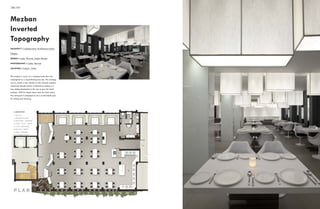
Mezban
Inverted
Topography
ARCHITECT » Collaborative Architecture India
Ningbo
DESIGN » Lalita Tharani, Mujib Ahmed
PHOTOGRAPHY » Lalita Tharani
LOCATION » Calicut , India
The project is a part of a business hotel that was
redesigned as a repositioning exercise. The strategy
was to create a new identity to the already popular
restaurant though interior architecture making it a
new dining destination in the city to spur the hotel
business. With its simple decor and one fold colour,
this restaurant is designed to be a comfortable spot
for dining and relaxing.
188/189
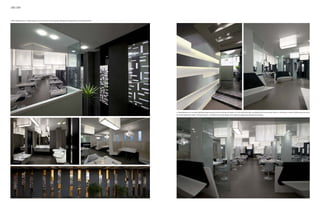
» Characterized by its innovative lightings hanged randomly from the ceiling, the interior is lit with achromatic light, contrasting with the pure white interior; in the exterior, a series of lights along the wall of
the whole façade that create “Thousand Moons”, contribute to the whole design, thus creating an elegant and graceful dining space.
» With a flexible layout, a vibrant lounge is carved out from the dining area, displaying the happenings on the restaurant floor.

Mezban inverted topography- Send Point

  • 2.
    Foreword The restaurantsthat stand out among all the others are usually designed with a certain style of motif or with a characteristic, which is then applied down to almost every last detail. For the most part, such specially designed restaurants provide a higher level of experience for the individual. These types of spaces present a visual experience of a type of atmosphere that is not encountered on a daily basis and that serves as an escape from our daily life. The difference between some of today’s best restaurants as opposed to the ones designed in the past is that they show a level of refinement not commonly seen before. The selection of the themes or styles gives them a quality that goes beyond just the mimicking of a physical place or of an object. These restaurants have evolved and added a new experience that is even one step above and beyond traditional restaurants. In retrospect, the development of the first featured restaurants goes to Paris cafés and cabarets which opened in Montmartre in the later nineteenth century. These eateries were primarily drinking spots rather than full-scale restaurants, but they served food as well. In their early years these artistic cafés had a counter-cultural impetus that in some cases celebrated the revolutionary Paris Commune of 1871 which had been rooted in Montmartre. The Café du Bagne (Café of the Penitentiary) was established in 1885 by Maxime Lisbonne, a member of the Commune. Posters on the wall of his café, which replicated a prison eating hall, hailed Commune heroes. Waiters were dressed as real convicts but with fake balls and chains. The place caused an instant sensation when it opened, with a line of patrons winding all the way around the building, waiting to get it. After the Café du Bagne, many local imitations arose. However, in the 1890s the imitators faced decline as this style of restaurant went out of demand. Then the spirit of Paris’ cafes passed into the US: first in New York City, later in a couple more restaurants in New York, with a similar theme adopted in San Francisco as well. While sitting down in a restaurant to write this article, I try to remember what the most memorable experience I had anywhere while enjoying a meal was. What are the things that trigger that memory? Was it the food I ordered, the quality of the environment, the experimental entertainment experience or perhaps the service I received or just the company whom I shared that meal with that day? We all have memories of amazing meals we have enjoyed that we can still taste in our mouths, but can we always remember the restaurant in which we enjoyed them? When we encounter a well-designed restaurant that creates a real impression on us, it is hard to forget. What unique design characteristics made these restaurants memorable? Was it the light that created the perfect environment for such a social activity, or was it the juxtaposition of colors and materials that transformed my perception, even if it was for a brief moment? Was it the scale and intimacy of the space that made me feel closer to others; or was it something else that my unconscious noticed? The answer might be a combination of all these elements used in a well-crafted, balanced manner with a unique sensibility that made the memory so special. By provoking all five senses, these memorable experiences are encouraged by the highest level of engagement possible within a restaurant. The works introduced in this book represent a large spectrum of some of these experiences. Such is the case of the Bamboo restaurant in Indonesia built entirely out of bamboo. It consists of a shelter and a dining space to protect guests from sun and rain. The interior of the restaurant offers a striking open- air design, and the combination of the clear lacquer and wooden furniture makes the restaurant look quite natural and exotic. The Post Script restaurant in Beijing, with its crisp interior of a variety of greens and whites is arranged in just such a way as to provide a burst of energy instead of promoting serene relaxation. Some of the booths of the restaurant are a sleek flat white to complement the stark white tables and plain place settings. Each booth setting is separated from its parallel counterpart by a minty glass partition and a thin piece of white metal that offers an elegant perspective. Another outstanding example is Dubai’s Switch restaurant, designed to be a strong, symmetrical vision composed of a continuous, undulating wall that wraps around the space. The design creates an interesting texture of light and shadow, evoking the sand dunes in the desert. It is a unique environment of symmetry and balance that completely envelops the guests. Every experience is composed of views, smells, tastes and sounds; here, in these restaurants, the senses create individual backgrounds for a truly amazing dining experience. Although it might be hard to fully experience these spaces in print form, you may be able to determine some of the qualities that make them such special environments to be experienced by all the senses. They might help demonstrate an understanding of how a restaurant is designed, what the critical design elements are and how they are combined together to help create a unique overall experience. The more complete the experience, the more we can temporarily let go of one reality and become immersed in another. However, the difference now is that restaurants are being designed more as mini-destinations with a memorable experience around every corner. More and more restaurants are being designed with a theme or with additional entertainment spaces other than just a dining space in order to meet society’s current demand for escapism. Self-referential, theme and experiential design begin to appear as distinct areas in restaurant design. The interest in restaurants and food has never been so high or intense. It seems that everywhere we turn we see an image of a chef portrayed as a rock star or of a restaurant as the ultimate destination that we should not pass up. While economic conditions affect the profitability of any restaurant, the relentless media coverage of restaurants, celebrity chefs, and cooking shows has spurred an interest in food and restaurant operations like never before. Another noticeable element in today’s restaurant design is the sophisticated use of technology as well as the constant development of creative concepts that both deliver operational efficiency and allow for unique innovative designs that reflect the design directions showcased in this book. Some of these restaurants express a deep interest in embracing sustainability principles that go beyond their mere physical space and the need to implement these principles at the source of where the food is produced. This shift in the way in which restaurant design is now in closer interaction with its natural environment can well be an inspirational model for future developments. As cities across the globe start sharing many similarities in terms of their architecture and urban environments that sometimes make it harder to clearly distinguish one from another. Restaurants as unique social hubs of interaction may start to play a bigger role in providing the commitment to embracing some of the new environmental and social challenges that we are facing that might go beyond the mere enjoyment of a meal. With this in mind, I invite you to dip your senses into this book and enjoy your meal. Buen Provecho!
  • 3.
    186/187 Mezban Inverted Topography ARCHITECT » CollaborativeArchitecture India Ningbo DESIGN » Lalita Tharani, Mujib Ahmed PHOTOGRAPHY » Lalita Tharani LOCATION » Calicut , India The project is a part of a business hotel that was redesigned as a repositioning exercise. The strategy was to create a new identity to the already popular restaurant though interior architecture making it a new dining destination in the city to spur the hotel business. With its simple decor and one fold colour, this restaurant is designed to be a comfortable spot for dining and relaxing.
  • 4.
    188/189 » Characterized byits innovative lightings hanged randomly from the ceiling, the interior is lit with achromatic light, contrasting with the pure white interior; in the exterior, a series of lights along the wall of the whole façade that create “Thousand Moons”, contribute to the whole design, thus creating an elegant and graceful dining space. » With a flexible layout, a vibrant lounge is carved out from the dining area, displaying the happenings on the restaurant floor.