Physical Education
Quarter 1 – Module Module 3:
Introduction to Individual
Sports:
Running and Swimming
Introduction
to Running
What’s In
Directions: Copy the table below in your
notebook. From the list of exercises below
identify which is exercises is for warm-up
(dynamic exercise) and cool-down (static
exercise). Write your answers under the
correct column in the table.
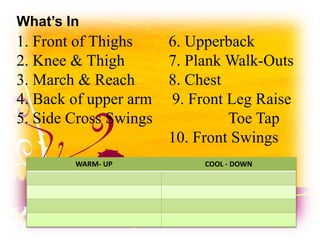
What’s In
1. Front of Thighs 6. Upperback
2. Knee & Thigh 7. Plank Walk-Outs
3. March & Reach 8. Chest
4. Back of upper arm 9. Front Leg Raise
5. Side Cross Swings Toe Tap
10. Front Swings
WARM- UP COOL - DOWN
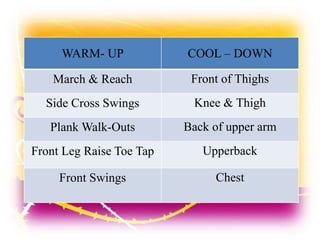
WARM- UP COOL – DOWN
March & Reach Front of Thighs
Side Cross Swings Knee & Thigh
Plank Walk-Outs Back of upper arm
Front Leg Raise Toe Tap Upperback
Front Swings Chest
Activity 1: Personal Check
Directions: Put a check (/) mark in the
Column of YES, if you have
performed the activities listed below
and ( x ) in the NO column if you have
not.
Activity 1: Personal Check
ACTIVITIES YES NO
1. I have joined a running competition
in our barangay.
2. I’m good at playing luksong tinik.
3. I have overtaken a dog barking at
or running after me.
4. I became a runner and jumper in
my elementary grade.
5. I can run fast without getting any injury.
6. I enjoy playing, running, and
jumping with my neighbors.
Activity 1: Personal Check
ACTIVITIES YES NO
7. I can throw a stone to a far
distance.
8. I can jump high without giving
full effort.
9. I enjoy watching different activities
like running, jumping and throwing
competitions.
10. I can run and jump in fun games.
If you have more than five “yes”
answers in this activity it means that
you possess athletic skills. All you
need to do is to develop and enhance
such skills to become a potential
athlete.
The Background of Athletics
TRACK AND FIELD ATHLETICS
- commonly known as athletics or track
and field, is a collection of sports
events that involve running, throwing
and jumping.
- The name "athletics" is derived from
the Greek word "athlos" meaning
"contest"
The Background of Athletics
Dating back to the Ancient Greeks,
athletics was the only competition to be
held in the first Olympic Games which
took place in Athens in 776 BC. At that
time, the single athletic event was known
as the stade, a foot race which covered
the length of the Athenian Olympic
stadium.
The Background of Athletics
In 1896, the first modern Olympic Games were
staged. Although initially of limited appeal, the
Olympics captured the imagination of athletes
and grew steadily, making track and field an
international sport for the first time.
The Background of Athletics
In 1913, the International Amateur
Athletic Federation (IAAF) was formed
by representatives from 16 countries. The
IAAF was charged with establishing
standard rules for the sport, approving
world records, and ensuring that the
amateur code was adhered to; it
continues to carry out these duties today.
TRACK EVENTS
- often involve a field or a running track of
varying measurements. These events are
typically held in a 400-meter track. These
include sprints, middle distance events, long
distance events, hurdles, relays, road
running and race walking.
SHORT DISTANCE OR
SPRINTS
- Sprint is a short running race.
In a track and field competition,
there are generally three different
sprint distances: 100m, 200m,
and 400m.
MIDDLE DISTANCE
- The middle-distance races are 800m, 1500m,
and 3000m. These races require different skills
and tactics to win. They rely more on endurance
and pacing than just pure speed. Also, the
runners don't stay in a single lane for the entire
race. They start out in staggered lanes, to make
the distance the same for each runner, but the
race soon becomes open with no lanes and the
runners must pass around each other to gain the
lead.
LONG DISTANCE
- There are three main long-distance races:
3000m, 5000m, and 10,000m races. These
races are similar to the middle-distance
races, but the emphasis is even more on
correct pacing and endurance.
HURDLES
- it is one in which obstacles are placed at
intervals along the track that the runners must
jump over on their way the finish line. Typical
hurdle races are the 100m and 400m for
women and 110m and 400m for men. Timing,
footwork, and technique are the key in wining
hurdles events.
RELAYS
- where teams of runners compete against each
other. There are typically four runners and four
legs to the race. The first runner starts with the
baton and runs the first leg handing off to the
second runner. The hand off must typically take
place within a given area of the track. The
second then hands off to the third and the third to
the fourth. The fourth runner runs the final, or
anchor, leg to the finish line. Common relay
races are the 4x100m and the 4x400m.
FACILITIES AND EQUIPME
USED IN ATHLETICS
TRACK FACILITY
Track Oval
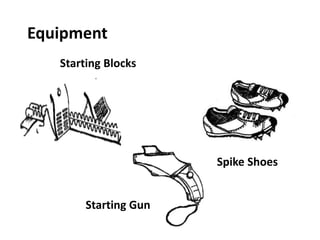
Equipment
Starting Blocks
Starting Gun
Spike Shoes
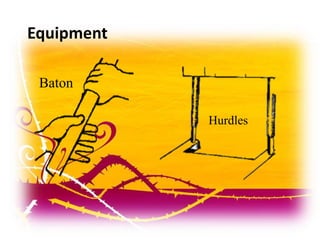
Equipment
Baton
Hurdles
Running Skills
Body Position The head, trunk, and pelvis
should be positioned along a
vertical line, which is
perpendicular to the ground.
This helps to ensure that the
pelvis is in the most efficient
position. Your head should be
up, with eyes focused 20 - 30
yards ahead.
Running Skills
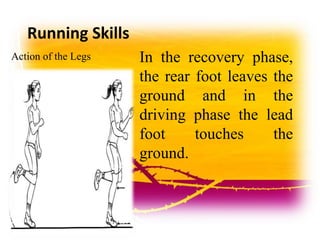
Action of the Legs In the recovery phase,
the rear foot leaves the
ground and in the
driving phase the lead
foot touches the
ground.
Running Skills
ON YOUR MARK
Running Skills
SET
Running Skills
GO
To minimize the risks of activity –
related injuries, here are some
precautions and safety tips that you may
follow:
• Wear comfortable clothing and well –
padded shoes that will protect the heels
and arches of the feet.
• Put on appropriate gear for the activity
such as knee pad and elbow pads.
• Always do warm up exercises before
any physical activity and cool down
afterwards to lower the risk of strains
and sprains.
• Take some break during the activity.
• Do not exercise with an empty
stomach. Eat something light to give
you some stamina, but do not exercise
immediately after a full meal.
• Replenish fluids before, during, and
after a physical activity.
• Be aware of the weather and
environmental conditions. Avoid doing
outdoor vigorous activities in hot or
humid weather.
• Listen to your body. Don’t do
physical activity when you don’t feel
well.
What I Have Learned
Complete the chart below. This will be your exit ticket
showing what you learned in this lesson.
3 Things I
Have Learned
2 Thing I have
Enjoyed
1 Question in
my Mind

pe g7 q1 MODULE 3.pptx

  • 1.
    Physical Education Quarter 1– Module Module 3: Introduction to Individual Sports: Running and Swimming
  • 2.
  • 3.
    What’s In Directions: Copythe table below in your notebook. From the list of exercises below identify which is exercises is for warm-up (dynamic exercise) and cool-down (static exercise). Write your answers under the correct column in the table.
  • 4.
    What’s In 1. Frontof Thighs 6. Upperback 2. Knee & Thigh 7. Plank Walk-Outs 3. March & Reach 8. Chest 4. Back of upper arm 9. Front Leg Raise 5. Side Cross Swings Toe Tap 10. Front Swings WARM- UP COOL - DOWN
  • 5.
    WARM- UP COOL– DOWN March & Reach Front of Thighs Side Cross Swings Knee & Thigh Plank Walk-Outs Back of upper arm Front Leg Raise Toe Tap Upperback Front Swings Chest
  • 6.
    Activity 1: PersonalCheck Directions: Put a check (/) mark in the Column of YES, if you have performed the activities listed below and ( x ) in the NO column if you have not.
  • 7.
    Activity 1: PersonalCheck ACTIVITIES YES NO 1. I have joined a running competition in our barangay. 2. I’m good at playing luksong tinik. 3. I have overtaken a dog barking at or running after me. 4. I became a runner and jumper in my elementary grade. 5. I can run fast without getting any injury. 6. I enjoy playing, running, and jumping with my neighbors.
  • 8.
    Activity 1: PersonalCheck ACTIVITIES YES NO 7. I can throw a stone to a far distance. 8. I can jump high without giving full effort. 9. I enjoy watching different activities like running, jumping and throwing competitions. 10. I can run and jump in fun games.
  • 9.
    If you havemore than five “yes” answers in this activity it means that you possess athletic skills. All you need to do is to develop and enhance such skills to become a potential athlete.
  • 10.
    The Background ofAthletics TRACK AND FIELD ATHLETICS - commonly known as athletics or track and field, is a collection of sports events that involve running, throwing and jumping. - The name "athletics" is derived from the Greek word "athlos" meaning "contest"
  • 11.
    The Background ofAthletics Dating back to the Ancient Greeks, athletics was the only competition to be held in the first Olympic Games which took place in Athens in 776 BC. At that time, the single athletic event was known as the stade, a foot race which covered the length of the Athenian Olympic stadium.
  • 12.
    The Background ofAthletics In 1896, the first modern Olympic Games were staged. Although initially of limited appeal, the Olympics captured the imagination of athletes and grew steadily, making track and field an international sport for the first time.
  • 13.
    The Background ofAthletics In 1913, the International Amateur Athletic Federation (IAAF) was formed by representatives from 16 countries. The IAAF was charged with establishing standard rules for the sport, approving world records, and ensuring that the amateur code was adhered to; it continues to carry out these duties today.
  • 14.
    TRACK EVENTS - ofteninvolve a field or a running track of varying measurements. These events are typically held in a 400-meter track. These include sprints, middle distance events, long distance events, hurdles, relays, road running and race walking.
  • 15.
    SHORT DISTANCE OR SPRINTS -Sprint is a short running race. In a track and field competition, there are generally three different sprint distances: 100m, 200m, and 400m.
  • 16.
    MIDDLE DISTANCE - Themiddle-distance races are 800m, 1500m, and 3000m. These races require different skills and tactics to win. They rely more on endurance and pacing than just pure speed. Also, the runners don't stay in a single lane for the entire race. They start out in staggered lanes, to make the distance the same for each runner, but the race soon becomes open with no lanes and the runners must pass around each other to gain the lead.
  • 17.
    LONG DISTANCE - Thereare three main long-distance races: 3000m, 5000m, and 10,000m races. These races are similar to the middle-distance races, but the emphasis is even more on correct pacing and endurance.
  • 18.
    HURDLES - it isone in which obstacles are placed at intervals along the track that the runners must jump over on their way the finish line. Typical hurdle races are the 100m and 400m for women and 110m and 400m for men. Timing, footwork, and technique are the key in wining hurdles events.
  • 19.
    RELAYS - where teamsof runners compete against each other. There are typically four runners and four legs to the race. The first runner starts with the baton and runs the first leg handing off to the second runner. The hand off must typically take place within a given area of the track. The second then hands off to the third and the third to the fourth. The fourth runner runs the final, or anchor, leg to the finish line. Common relay races are the 4x100m and the 4x400m.
  • 20.
  • 21.
  • 22.
  • 23.
  • 24.
    Running Skills Body PositionThe head, trunk, and pelvis should be positioned along a vertical line, which is perpendicular to the ground. This helps to ensure that the pelvis is in the most efficient position. Your head should be up, with eyes focused 20 - 30 yards ahead.
  • 25.
    Running Skills Action ofthe Legs In the recovery phase, the rear foot leaves the ground and in the driving phase the lead foot touches the ground.
  • 26.
  • 27.
  • 28.
  • 29.
    To minimize therisks of activity – related injuries, here are some precautions and safety tips that you may follow: • Wear comfortable clothing and well – padded shoes that will protect the heels and arches of the feet. • Put on appropriate gear for the activity such as knee pad and elbow pads.
  • 30.
    • Always dowarm up exercises before any physical activity and cool down afterwards to lower the risk of strains and sprains. • Take some break during the activity. • Do not exercise with an empty stomach. Eat something light to give you some stamina, but do not exercise immediately after a full meal.
  • 31.
    • Replenish fluidsbefore, during, and after a physical activity. • Be aware of the weather and environmental conditions. Avoid doing outdoor vigorous activities in hot or humid weather. • Listen to your body. Don’t do physical activity when you don’t feel well.
  • 32.
    What I HaveLearned Complete the chart below. This will be your exit ticket showing what you learned in this lesson. 3 Things I Have Learned 2 Thing I have Enjoyed 1 Question in my Mind