SPRINGS
Presented
by:-
Er.
Bharat
Bansal
Lect.
Deptt.
of
Mech.
Engg.
Govt.
Polytechnic
College
Bathinda
Syllabus
(According
to
PSBTE
Curriculum)
What
is
a
SPRING?
•
Spring
is
an
elastic
member
which
gets
deformed
when
it
is
loaded
and
regain
its
original
shape
when
deforming
force
is
removed.
FUNCTIONS
OF
SPRINGS:-
1.
To
Store
Energy
(For
Eg.
in
Wrist
Watches,
Toys)
2.
To
Absorb
and
Control
Energy
due
to
shock
or
vibrations
(For
Eg.
in
Shock
absorbers,
vibration
dampers)
3.
To
Apply
Force
(For
Eg.
in
Brakes,
Clutches,
Spring
loaded
valves)
4.
To
Measure
Force
(For
Eg.
in
Spring
Balance)
5.
To
Control
Motion
(For
Eg.
in
Cam
and
Follower)
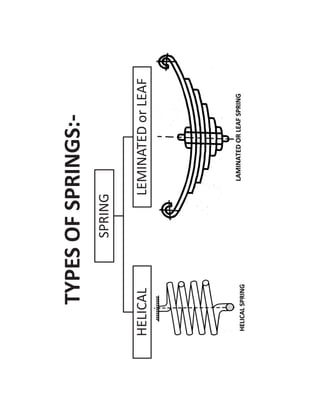
TYPES
OF
SPRINGS:-
SPRING
HELICAL
LEMINATED
or
LEAF
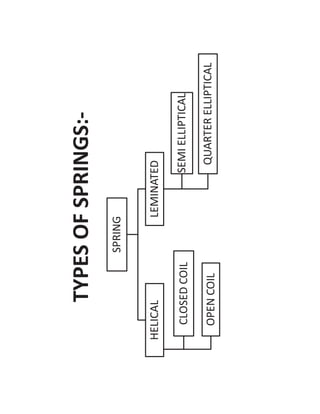
TYPES
OF
SPRINGS:-
SPRING
HELICAL
CLOSED
COIL
OPEN
COIL
LEMINATED
QUARTER
ELLIPTICAL
SEMI
ELLIPTICAL
TYPES
OF
HELICAL
SPRINGS:-
HELICAL
SPRING
CLOSED
COIL
OPEN
COIL
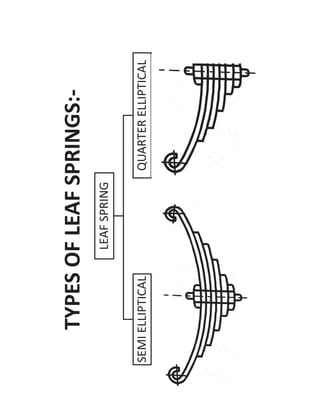
TYPES
OF
LEAF
SPRINGS:-
LEAF
SPRING
SEMI
ELLIPTICAL
QUARTER
ELLIPTICAL
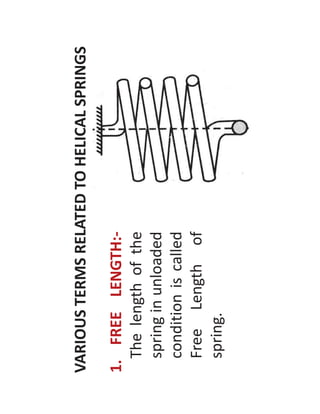
VARIOUS
TERMS
RELATED
TO
HELICAL
SPRINGS
1.
FREE
LENGTH:-
The
length
of
the
spring
in
unloaded
condition
is
called
Free
Length
of
spring.
VARIOUS
TERMS
RELATED
TO
HELICAL
SPRINGS
2.
SOLID
LENGTH:-
The
length
of
the
spring
in
compressed
state
(coils
come
in
contact
with
each
other)
is
called
solid
length
of
the
spring.
VARIOUS
TERMS
RELATED
TO
HELICAL
SPRINGS
3.
SPRING
INDEX:-
The
ratio
of
mean
diameter
of
coil
to
diameter
of
wire
is
called
spring
index.
VARIOUS
TERMS
RELATED
TO
HELICAL
SPRINGS
4.
PITCH:-
The
axial
distance
between
adjacent
coils
in
unloaded
state
is
called
pitch.

SPRINGS[1]3333.pdf