Spotlight on Emerging Technology Online Learning
What is Online Learning? Online learning is where classroom activities and instruction are completed using the internet (Cavanaugh & Clarke, 2007).
Why We Should Use Online Learning Greatly impacts students Allows for participatory learning, authentic learning, and multimodal learning.
Impact on Students Allows students to learn at their own pace Allows us to reach students that do not respond to a traditional classroom setting. Prepares students for the workplace by introducing them to technologies they will need to master in the workplace Makes learning more relevant to students lives since they use technology in every aspect of their lives
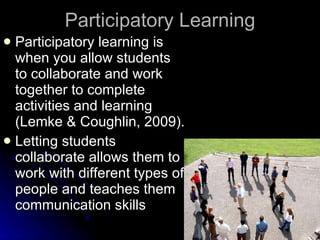
Participatory Learning Participatory learning is when you allow students to collaborate and work together to complete activities and learning (Lemke & Coughlin, 2009). Letting students collaborate allows them to work with different types of people and teaches them communication skills
Collaboration Using Technology Technology allows students to collaborate without being in the same place or working at the same time. Technology allows teachers to monitor student progress at give feedback at various stages during collaboration. There are many technology tools that allow for collaboration such as wikis and blogs.
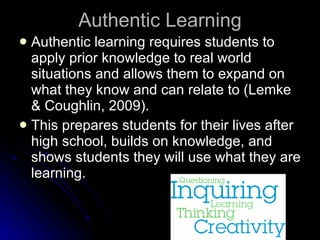
Authentic Learning Authentic learning requires students to apply prior knowledge to real world situations and allows them to expand on what they know and can relate to (Lemke & Coughlin, 2009). This prepares students for their lives after high school, builds on knowledge, and shows students they will use what they are learning.
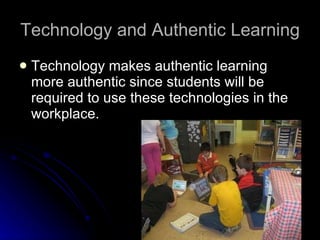
Technology and Authentic Learning Technology makes authentic learning more authentic since students will be required to use these technologies in the workplace.
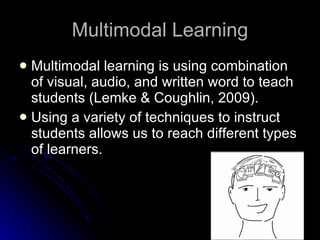
Multimodal Learning Multimodal learning is using combination of visual, audio, and written word to teach students (Lemke & Coughlin, 2009). Using a variety of techniques to instruct students allows us to reach different types of learners.
Technology and Multimodal Learning Technology allows teachers access to many different types of media. Technology allows students to create a variety artifacts to show that they have met the objectives of the lesson.
Arguments Against Online Learning
I do not have enough time. Online learning actually requires less time for the teacher. All of your instructional tools are stored digitally and can be reused and modified with little effort. With online learning there is not time wasted making copies, distributing materials, and collecting work.
We do not have enough money to implement online learning. Online learning requires a computer with internet access. We already have computers with internet access at school. Students can also work on their class from home since many of our students have computer with internet access. If we need additional funds there are grants we can apply for.
How will I monitor student progress? You can give test and quizzes online. All students will turn in projects using the class wiki or blog. You can also check student progress periodically to make sure students are on the right track and give feedback during the learning process.
I am not good with computers. We have training set up to instruct you on how to conduct online learning. Online learning is not hard to do once you get down the basics. We already take roll and keep grades using computer.
Resources Cavanaugh, C., & Clark, T. (2007).  The  Landscape of K-12 Online Learning.  In P.  Adamson, B. Adamson, & N. Clausen-Grace,  et al (Eds.),  What Works in K-12 Online  Learning  (Chapter 1, pp. 5-19).  Eugene,  OR:  International Society for Technology in  Education. Lemke, C., & Coughlin, E. (2009). The change  agents.  Educational Leadership, 67(1), 54- 59.

Spotlight on emerging technology

  • 1.
    Spotlight on EmergingTechnology Online Learning
  • 2.
    What is OnlineLearning? Online learning is where classroom activities and instruction are completed using the internet (Cavanaugh & Clarke, 2007).
  • 3.
    Why We ShouldUse Online Learning Greatly impacts students Allows for participatory learning, authentic learning, and multimodal learning.
  • 4.
    Impact on StudentsAllows students to learn at their own pace Allows us to reach students that do not respond to a traditional classroom setting. Prepares students for the workplace by introducing them to technologies they will need to master in the workplace Makes learning more relevant to students lives since they use technology in every aspect of their lives
  • 5.
    Participatory Learning Participatorylearning is when you allow students to collaborate and work together to complete activities and learning (Lemke & Coughlin, 2009). Letting students collaborate allows them to work with different types of people and teaches them communication skills
  • 6.
    Collaboration Using TechnologyTechnology allows students to collaborate without being in the same place or working at the same time. Technology allows teachers to monitor student progress at give feedback at various stages during collaboration. There are many technology tools that allow for collaboration such as wikis and blogs.
  • 7.
    Authentic Learning Authenticlearning requires students to apply prior knowledge to real world situations and allows them to expand on what they know and can relate to (Lemke & Coughlin, 2009). This prepares students for their lives after high school, builds on knowledge, and shows students they will use what they are learning.
  • 8.
    Technology and AuthenticLearning Technology makes authentic learning more authentic since students will be required to use these technologies in the workplace.
  • 9.
    Multimodal Learning Multimodallearning is using combination of visual, audio, and written word to teach students (Lemke & Coughlin, 2009). Using a variety of techniques to instruct students allows us to reach different types of learners.
  • 10.
    Technology and MultimodalLearning Technology allows teachers access to many different types of media. Technology allows students to create a variety artifacts to show that they have met the objectives of the lesson.
  • 11.
  • 12.
    I do nothave enough time. Online learning actually requires less time for the teacher. All of your instructional tools are stored digitally and can be reused and modified with little effort. With online learning there is not time wasted making copies, distributing materials, and collecting work.
  • 13.
    We do nothave enough money to implement online learning. Online learning requires a computer with internet access. We already have computers with internet access at school. Students can also work on their class from home since many of our students have computer with internet access. If we need additional funds there are grants we can apply for.
  • 14.
    How will Imonitor student progress? You can give test and quizzes online. All students will turn in projects using the class wiki or blog. You can also check student progress periodically to make sure students are on the right track and give feedback during the learning process.
  • 15.
    I am notgood with computers. We have training set up to instruct you on how to conduct online learning. Online learning is not hard to do once you get down the basics. We already take roll and keep grades using computer.
  • 16.
    Resources Cavanaugh, C.,& Clark, T. (2007). The Landscape of K-12 Online Learning. In P. Adamson, B. Adamson, & N. Clausen-Grace, et al (Eds.), What Works in K-12 Online Learning (Chapter 1, pp. 5-19). Eugene, OR: International Society for Technology in Education. Lemke, C., & Coughlin, E. (2009). The change agents. Educational Leadership, 67(1), 54- 59.