
Presented by
Faiza Majid- 1221132
Maria Shahid- 1221138
SZABIST ISLAMABAD
Introduction:
- Strategic Performance Measurement System (SPMS)?
• SPM is a system that focuses the company on those goals and activities that

will make a difference down the road.
• SPMS is important in formulating strategy , implementing it and reformulating

it (if needed).
• SPMS compensate each and every department and individual in

organization.
• PMS is a tool or a technique to measure performance.
Introduction Cont.
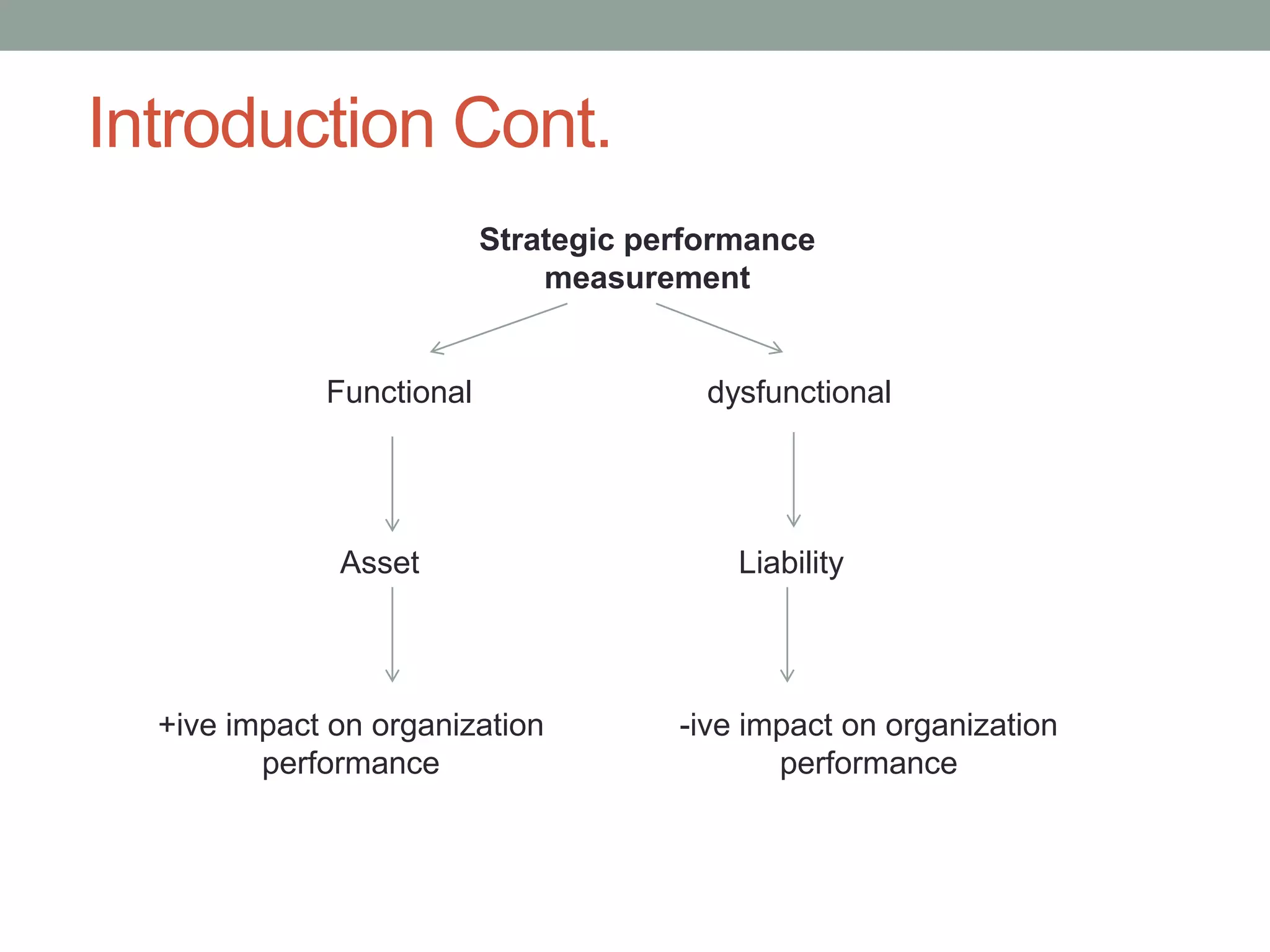
Strategic performance
measurement

Functional

Asset

+ive impact on organization
performance

dysfunctional

Liability

-ive impact on organization
performance
If organizations are to realize value and become
more sustainable, it is crucial to understand how
appropriate SPM practices deliver improved
performance
Article Methodology
• The call for papers attracted 77 extended abstracts; related to

strategy, management accounting and control, and operations.
• Following the review of the abstracts then asked for 25 full

papers. Of these, eight were subsequently selected.
• These 25 articles Presented in a workshop organized at

IMD, Lausanne on 24/25 January 2008. After a further three
rounds of review, four papers were selected for publication.
Paper 1:
Are performance measurement systems mere tools to implement
strategy, or could they play an active role also in strategy
reviews?

SPMS 4 attributes by Gimbert, Bisbe and Mendoza
1. Integration of long term strategy & operational goals.
2. Presence of multi perspective indicators.

3. Inclusion of cause effect linkages.
4. Presence of sequence of goals-target-action plans.
Paper 2:
Through an enhanced use of non-financial
indicators, SPMSs could contribute more effectively to
strategic alignment and organizational
learning
• Establishment of dialogue between headquarter and subsidiary is
important for long term success.
• Non financial indicator is positively associated subsidiary profitability
Paper 3:
Systems which combine alignment
and empowerment, and make appropriate use of performance
targets and indicators over time, could prove an effective means
of implementing changes in strategy and promoting intended
behaviors.

• flexible SPM system for companies operating in dynamic environment.
• high empowerment with high alignment is useful in such environment.
Paper 4:
Non financial indicators are always welcome while
measuring performance but they also build rigidity in the
culture which restrict organizations to move on.

CASE STUDY discussed :
“Large Multinational Home supplies Firm”
Discussion
• Comparability and generalizability of research findings

• The „diagnostic and interactive‟ use of SPMS
• Authors of the selected papers considered SPM as a means to:
• implement and reformulate strategy;
• communicate key objectives and corporate priorities;

• provide strategic alignment; support process improvement; and
• encourage incremental innovation.

• Previous studies have looked at other roles of SPM, such as:
• promoting specific behaviors and attitudes at different organizational levels;

• responding to rules and regulations;
• providing greater accountability within and between organizations;
• communicating financial and non-financial results to key stakeholders,
The different roles of SPM
• SPM can be used to gather data about past

performance, but also to implement strategic objectives.
• Headquarters seeking dialogue with local managers
SPMS: static systems for dynamic
environments?
• Criticism:

SPM can create ‟ossification‟
• When an SPMS is reviewed and redesigned to support a

change in strategy, it can push the organization in a
direction opposite to the one intended
SPMS: A powerful tool or a tool for
power?
• For performance measurement to be used as an effective

‟tool for power‟, it is important that performance indicators
are linked with strategy
Conclusion
The plurality of roles of SPM indicates the importance of
defining from
the outset the roles of every performance indicator and
the SPMS as a whole.
Key questions managers should ask
themselves
• Why is the organization introducing (or reviewing) an SPMS?
• Which roles do we want it to play?
• Will its characteristics be consistent with its aims?
Introduction
• Performance

measurement
has become important for nonprofit
organizations due to competition , all competing for scarce
donor, foundation, and government funding.

• Financial considerations can play an constraining role but will rarely be

the primary objective.
• Profit companies have recently recognized that financial measurements

are inadequate for measuring and managing performance.
• Financial reports measure past performance but communicate little about

long-term value creation.
• Kaplan and Norton (1992, 1996) introduced a new performance

management system called the Balanced Scorecard.
Cont‟d
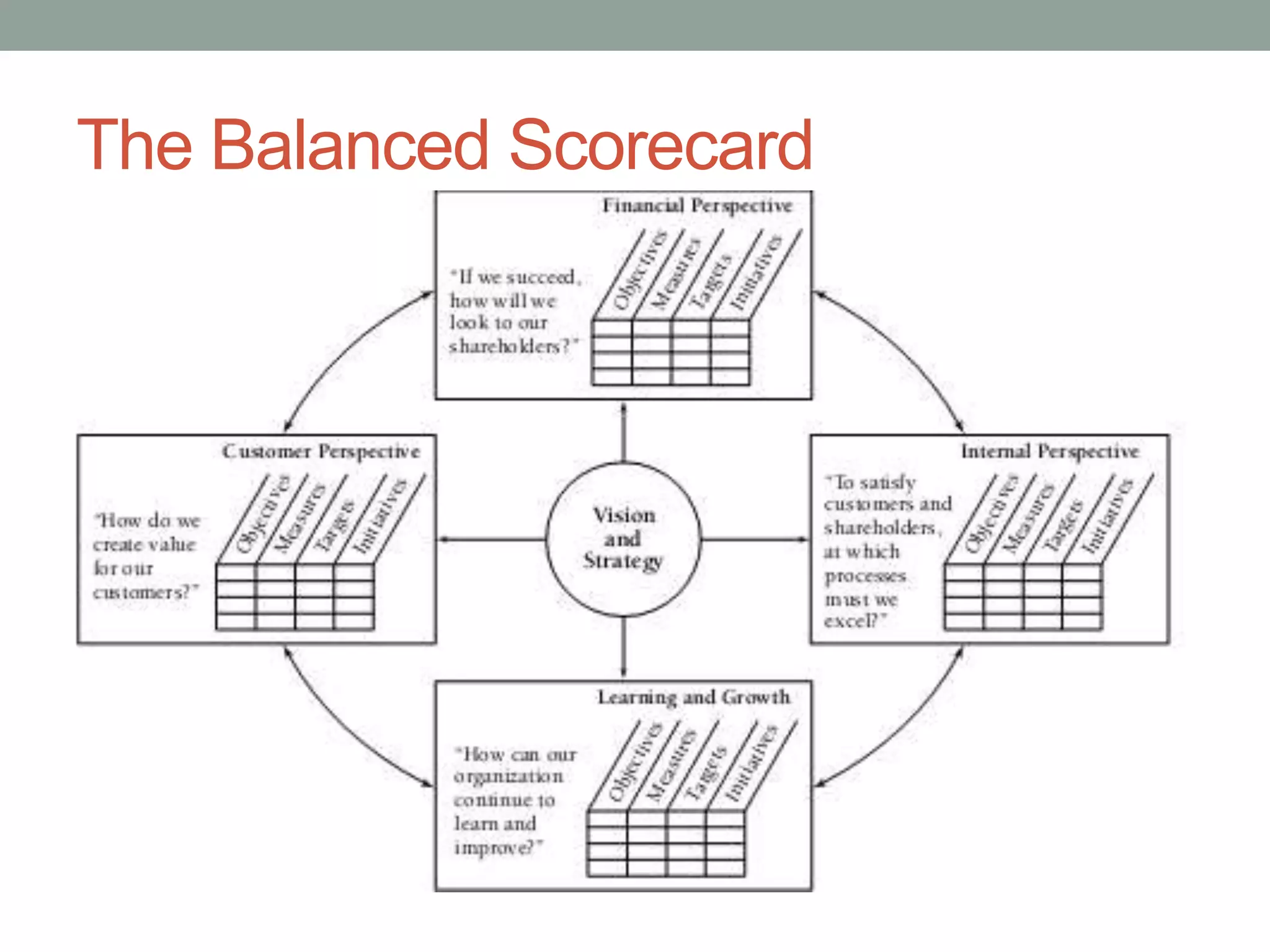
• This system retained financial measurements but complemented these

with measures from three other perspectives: customer, internal
process and learning and growth.
• Its initial focus and application was the profit (private) sector. But the

opportunity was to improve the management of nonprofits.
• In this article the results from a multiyear action research program to

apply the Balanced Scorecard to several nonprofit organizations has
been discussed.
Literature review
• The subject of performance measurement for nonprofit organizations is

extensive but generally inconclusive (Forbes, 1998).
• Herzlinger (1996) argues that nonprofit organizations should disclose

nonfinancial quantitative measures of services but does not offer guidance of
measures.
• Kanter and Summers (1987) reinforce the importance of reflecting the

outcomes for multiple constituencies and the need to have both long-term
measures (outcomes) and short-term measures (processes and activities
performed).
Cont‟d
• Balanced approach would provide the data to help the organization

know whether it is „ doing well‟ on any of the dimensions of
performance with which an active constituency might be concerned.
• Sheehan (1996) revealed that the organization had an impact on its

mission. In effect, the organizations has no way to distinguish whether
their strategy was succeeding or failing.
• The gap between mission and measures eventually led to the

adoption of a much more balanced set of measures, better linked to its
organizational mission.
The Balanced Scorecard
Research method
• The research agenda on the applicability of the Balanced Scorecard to

the non profit sector was launched in 1996.
• The program conducted a survey and learned that executives and

board members of nonprofits consistently rated performance
measurement as one of their top three management concerns.
• Several

nonprofit organizations in 1996 had multidimensional
measurement systems, derived their measures from strategy and
mission or organized their measures using the multiple Balanced
Scorecard perspectives.
Thank you !

SPMS. Strategic human resource develoment

  • 1.
    Presented by Faiza Majid-1221132 Maria Shahid- 1221138 SZABIST ISLAMABAD
  • 2.
    Introduction: - Strategic PerformanceMeasurement System (SPMS)? • SPM is a system that focuses the company on those goals and activities that will make a difference down the road. • SPMS is important in formulating strategy , implementing it and reformulating it (if needed). • SPMS compensate each and every department and individual in organization. • PMS is a tool or a technique to measure performance.
  • 3.
    Introduction Cont. Strategic performance measurement Functional Asset +iveimpact on organization performance dysfunctional Liability -ive impact on organization performance
  • 4.
    If organizations areto realize value and become more sustainable, it is crucial to understand how appropriate SPM practices deliver improved performance
  • 5.
    Article Methodology • Thecall for papers attracted 77 extended abstracts; related to strategy, management accounting and control, and operations. • Following the review of the abstracts then asked for 25 full papers. Of these, eight were subsequently selected. • These 25 articles Presented in a workshop organized at IMD, Lausanne on 24/25 January 2008. After a further three rounds of review, four papers were selected for publication.
  • 6.
    Paper 1: Are performancemeasurement systems mere tools to implement strategy, or could they play an active role also in strategy reviews? SPMS 4 attributes by Gimbert, Bisbe and Mendoza 1. Integration of long term strategy & operational goals. 2. Presence of multi perspective indicators. 3. Inclusion of cause effect linkages. 4. Presence of sequence of goals-target-action plans.
  • 7.
    Paper 2: Through anenhanced use of non-financial indicators, SPMSs could contribute more effectively to strategic alignment and organizational learning • Establishment of dialogue between headquarter and subsidiary is important for long term success. • Non financial indicator is positively associated subsidiary profitability
  • 8.
    Paper 3: Systems whichcombine alignment and empowerment, and make appropriate use of performance targets and indicators over time, could prove an effective means of implementing changes in strategy and promoting intended behaviors. • flexible SPM system for companies operating in dynamic environment. • high empowerment with high alignment is useful in such environment.
  • 9.
    Paper 4: Non financialindicators are always welcome while measuring performance but they also build rigidity in the culture which restrict organizations to move on. CASE STUDY discussed : “Large Multinational Home supplies Firm”
  • 10.
    Discussion • Comparability andgeneralizability of research findings • The „diagnostic and interactive‟ use of SPMS • Authors of the selected papers considered SPM as a means to: • implement and reformulate strategy; • communicate key objectives and corporate priorities; • provide strategic alignment; support process improvement; and • encourage incremental innovation. • Previous studies have looked at other roles of SPM, such as: • promoting specific behaviors and attitudes at different organizational levels; • responding to rules and regulations; • providing greater accountability within and between organizations; • communicating financial and non-financial results to key stakeholders,
  • 11.
    The different rolesof SPM • SPM can be used to gather data about past performance, but also to implement strategic objectives. • Headquarters seeking dialogue with local managers
  • 12.
    SPMS: static systemsfor dynamic environments? • Criticism: SPM can create ‟ossification‟ • When an SPMS is reviewed and redesigned to support a change in strategy, it can push the organization in a direction opposite to the one intended
  • 13.
    SPMS: A powerfultool or a tool for power? • For performance measurement to be used as an effective ‟tool for power‟, it is important that performance indicators are linked with strategy
  • 14.
    Conclusion The plurality ofroles of SPM indicates the importance of defining from the outset the roles of every performance indicator and the SPMS as a whole.
  • 15.
    Key questions managersshould ask themselves • Why is the organization introducing (or reviewing) an SPMS? • Which roles do we want it to play? • Will its characteristics be consistent with its aims?
  • 17.
    Introduction • Performance measurement has becomeimportant for nonprofit organizations due to competition , all competing for scarce donor, foundation, and government funding. • Financial considerations can play an constraining role but will rarely be the primary objective. • Profit companies have recently recognized that financial measurements are inadequate for measuring and managing performance. • Financial reports measure past performance but communicate little about long-term value creation. • Kaplan and Norton (1992, 1996) introduced a new performance management system called the Balanced Scorecard.
  • 18.
    Cont‟d • This systemretained financial measurements but complemented these with measures from three other perspectives: customer, internal process and learning and growth. • Its initial focus and application was the profit (private) sector. But the opportunity was to improve the management of nonprofits. • In this article the results from a multiyear action research program to apply the Balanced Scorecard to several nonprofit organizations has been discussed.
  • 19.
    Literature review • Thesubject of performance measurement for nonprofit organizations is extensive but generally inconclusive (Forbes, 1998). • Herzlinger (1996) argues that nonprofit organizations should disclose nonfinancial quantitative measures of services but does not offer guidance of measures. • Kanter and Summers (1987) reinforce the importance of reflecting the outcomes for multiple constituencies and the need to have both long-term measures (outcomes) and short-term measures (processes and activities performed).
  • 20.
    Cont‟d • Balanced approachwould provide the data to help the organization know whether it is „ doing well‟ on any of the dimensions of performance with which an active constituency might be concerned. • Sheehan (1996) revealed that the organization had an impact on its mission. In effect, the organizations has no way to distinguish whether their strategy was succeeding or failing. • The gap between mission and measures eventually led to the adoption of a much more balanced set of measures, better linked to its organizational mission.
  • 21.
  • 22.
    Research method • Theresearch agenda on the applicability of the Balanced Scorecard to the non profit sector was launched in 1996. • The program conducted a survey and learned that executives and board members of nonprofits consistently rated performance measurement as one of their top three management concerns. • Several nonprofit organizations in 1996 had multidimensional measurement systems, derived their measures from strategy and mission or organized their measures using the multiple Balanced Scorecard perspectives.
  • 23.