Mike Bailey

Melbourne Ruby Users Group
        July, 2010
Go Faster, Webmaster!
Talks by techies from:

Google, Yahoo, Microsoft, Amazon, Twitter,
Facebook, Firefox, Firebug, Chrome, Internet
Explorer and more!

1200 attendees (sold out)

Mostly technical audience
The Need for Speed
The Need for Speed

"Average load time of a web page is 4.9 seconds"
              - Urs Hölzle, Google
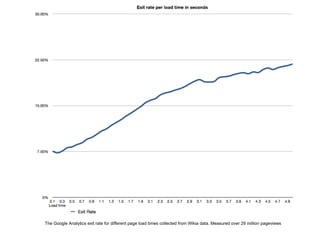
The Google Analytics exit rate for different page load times collected from Wikia data. Measured over 29 million pageviews
The Need for Speed

"Average load time of a web page is 4.9 seconds"
              - Urs Hölzle, Google
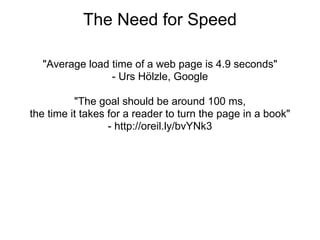
The Need for Speed

  "Average load time of a web page is 4.9 seconds"
                - Urs Hölzle, Google

          "The goal should be around 100 ms,
the time it takes for a reader to turn the page in a book"
                  - http://oreil.ly/bvYNk3
The Need for Speed

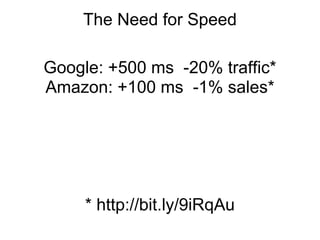
Google: +500 ms -20% traffic*
Amazon: +100 ms -1% sales*


     * http://bit.ly/9iRqAu
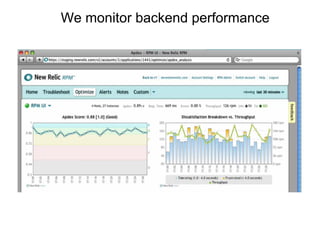
We monitor backend performance
but what about the front end?
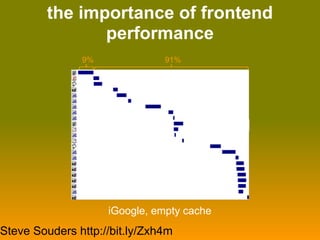
the importance of frontend
               performance
               9%                91%


                 17               83%
                 %


                      iGoogle, primed cache


                      iGoogle, empty cache
Steve Souders http://bit.ly/Zxh4m
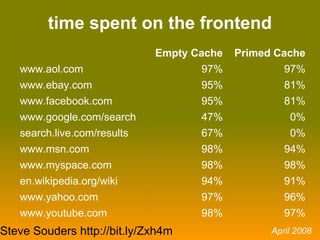
time spent on the frontend
                             Empty Cache   Primed Cache
   www.aol.com                      97%             97%
   www.ebay.com                     95%             81%
   www.facebook.com                 95%             81%
   www.google.com/search            47%              0%
   search.live.com/results          67%              0%
   www.msn.com                      98%             94%
   www.myspace.com                  98%             98%
   en.wikipedia.org/wiki            94%             91%
   www.yahoo.com                    97%             96%
   www.youtube.com                  98%             97%
Steve Souders http://bit.ly/Zxh4m                April 2008
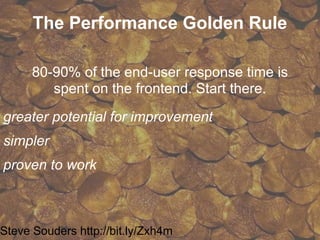
The Performance Golden Rule

      80-90% of the end-user response time is
         spent on the frontend. Start there.
greater potential for improvement
simpler
proven to work


Steve Souders http://bit.ly/Zxh4m
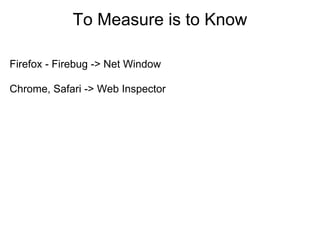
To Measure is to Know

Firefox - Firebug -> Net Window
To Measure is to Know

Firefox - Firebug -> Net Window

Chrome, Safari -> Web Inspector
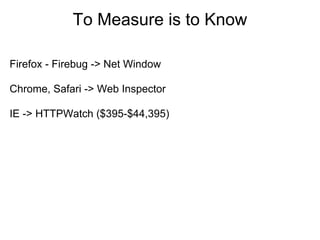
To Measure is to Know

Firefox - Firebug -> Net Window

Chrome, Safari -> Web Inspector

IE -> HTTPWatch ($395-$44,395)
To Measure is to Know

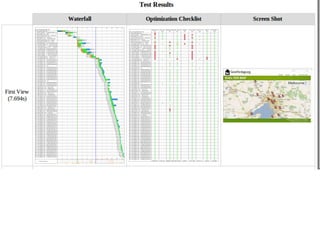
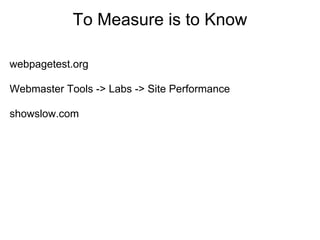
webpagetest.org
To Measure is to Know

webpagetest.org
To Measure is to Know

webpagetest.org

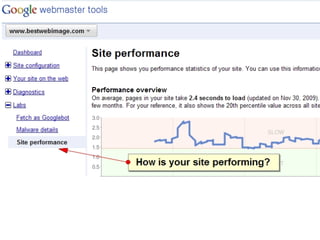
Webmaster Tools -> Labs -> Site Performance
To Measure is to Know

webpagetest.org

Webmaster Tools -> Labs -> Site Performance

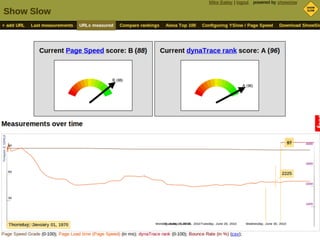
showslow.com
Commercial Monitoring Services

gomez.com

keynote.com

webmetrics.com
How do we speed up our pages?
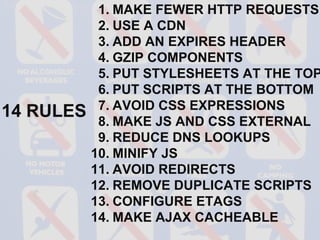
1. MAKE FEWER HTTP REQUESTS
            2. USE A CDN
            3. ADD AN EXPIRES HEADER
            4. GZIP COMPONENTS
            5. PUT STYLESHEETS AT THE TOP
            6. PUT SCRIPTS AT THE BOTTOM
            7. AVOID CSS EXPRESSIONS
14 RULES
            8. MAKE JS AND CSS EXTERNAL
            9. REDUCE DNS LOOKUPS
           10. MINIFY JS
           11. AVOID REDIRECTS
           12. REMOVE DUPLICATE SCRIPTS
           13. CONFIGURE ETAGS
           14. MAKE AJAX CACHEABLE
Analysis Tools
Analysis Tools

YSlow
Analysis Tools

YSlow

Page Speed
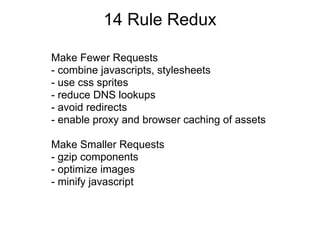
14 Rule Redux

Make Fewer Requests
- combine javascripts, stylesheets
- use css sprites
- reduce DNS lookups
- avoid redirects
- enable proxy and browser caching of assets

Make Smaller Requests
- gzip components
- optimize images
- minify javascript
Tools to Help

http://spriteme.org/

http://smush.it/

http://stevesouders.com/cuzillion/
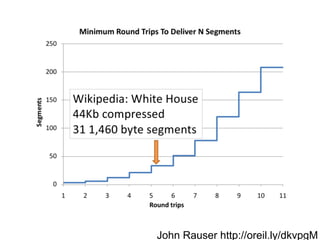
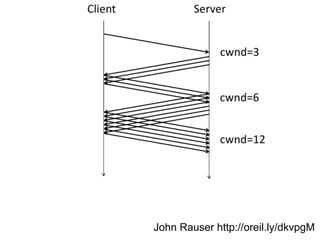
The Problem(s) with TCP

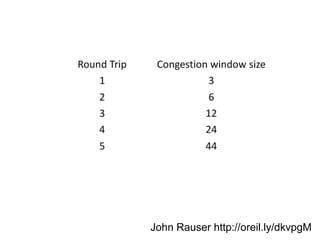
RFC 2581 TCP Congestion Control
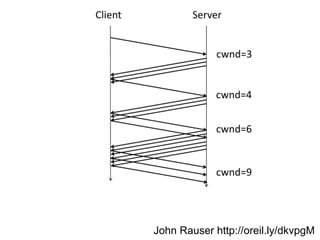
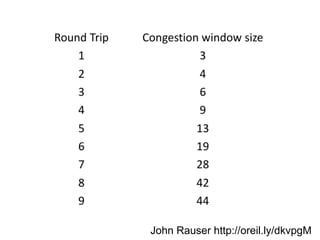
John Rauser http://oreil.ly/dkvpgM
The Problem(s) with TCP

RFC 2581 TCP Congestion Control
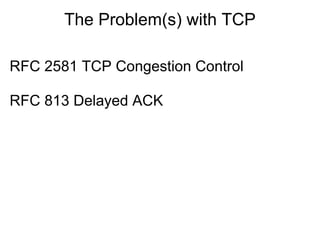
The Problem(s) with TCP

RFC 2581 TCP Congestion Control

RFC 813 Delayed ACK
John Rauser http://oreil.ly/dkvpgM
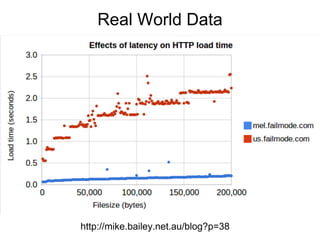
Real World Data


http://mike.bailey.net.au/blog?p=38
The Problem(s) with TCP

RFC 2581 TCP Congestion Control

RFC 813 Delayed ACK
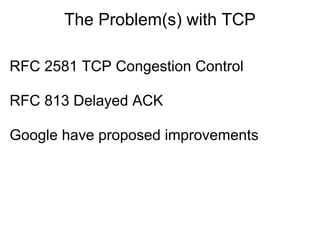
The Problem(s) with TCP

RFC 2581 TCP Congestion Control

RFC 813 Delayed ACK

Google have proposed improvements
Quick wins
Quick wins

Google AJAX Libraries API
Quick wins

Google AJAX Libraries API

GA Async Tracking Code
Want to learn more?

Videos from Velocity 2010 http://bit.ly/bL0Msz

Read Steve Souder's books,

"High Performance Web Sites" & "Even Faster Web Sites"

Go Faster, Webmaster