The Fringe Benefits of Failure Importance of Imagination
Veronica Cherreguine
Speech by J.K. Rowling
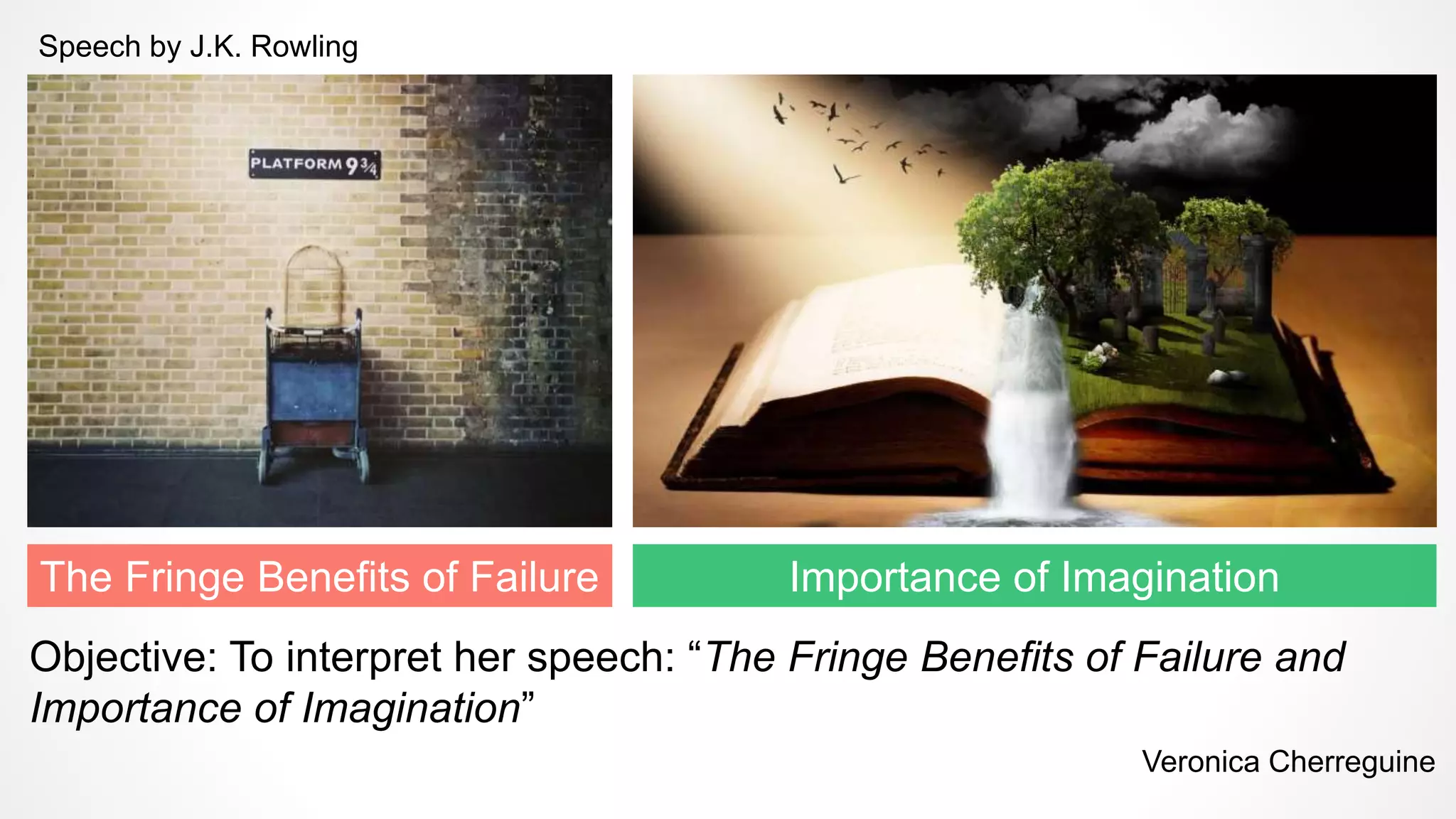
Objective: To interpret her speech: “The Fringe Benefits of Failure and
Importance of Imagination”
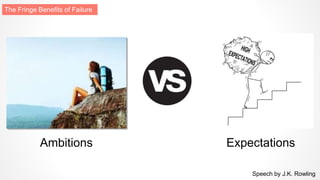
Ambitions Expectations
Speech by J.K. Rowling
The Fringe Benefits of Failure
Overactive
Imagination
Speech by J.K. Rowling
The Fringe Benefits of Failure
Every DECISION
comes with
RESPONSIBILITY
Speech by J.K. Rowling
The Fringe Benefits of Failure
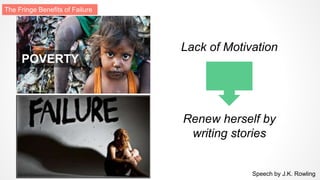
POVERTY
Renew herself by
writing stories
Lack of Motivation
Speech by J.K. Rowling
The Fringe Benefits of Failure
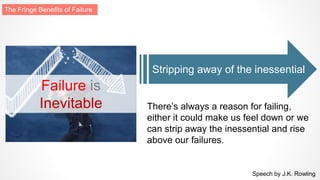
Failure is
Inevitable
Stripping away of the inessential
There’s always a reason for failing,
either it could make us feel down or we
can strip away the inessential and rise
above our failures.
Speech by J.K. Rowling
The Fringe Benefits of Failure
Imagination is not only the uniquely human capacity to
envision that which is not, and therefore the fount of all
invention and innovation.

Speech by J.K. Rowling
Importance of Imagination
It is the power that enables us to empathize with humans
whose experiences we have never shared.
We may prefer
not to exercise
our imaginations
at all
 Intelligence
 Capacity for hard work
 Education we have
earned and received
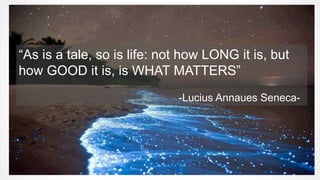
“As is a tale, so is life: not how LONG it is, but
how GOOD it is, is WHAT MATTERS”
-Lucius Annaues Seneca-
Thank you!

Speech presentation of J.K rowling (speech presentation)

Editor's Notes

  • #2 Good afternoon, I am here to present to you the speech of Ms. J.K. Rowling, entitled The Fringe Benefits of Failure and the Importance of Imagination. And maybe you are all thinking, why I chose this speech, it is because it touches the heart of her audiences by sharing her personal experiences and what are her learnings about it.
  • #3 She talked about her ambitions of becoming a novel writer. But it is difficult for her to choose between ambitions and expectations from her.
  • #4 Because both of her parents believed that her overactive imagination can’t never pay a mortgage or secure a pension. She wanted to study English Literature but after compromising with her parents, she ended up studying Modern Languages. But this doesn’t stop her of becoming a novel writer so she shifted in studying Classic Languages and she can’t even remember telling her parents about it.
  • #5 And this is where she said that Responsibility lies in you. And we have to remember that every decision we made comes with responsibility.
  • #6 And at that time, she was not afraid of Poverty, but failure. And when she feels lack of motivation at the university, she renew herself by spending too long in a coffee bar writing stories
  • #7 But Failure is Inevitable. And we almost forgot that there’s always a reason for failing, either it could make us feel down or we can strip away the inessential and rise above our failures.
  • #8 Her next theme is Imagination, she said that Imagination is not only the uniquely human capacity to envision that which is not, and therefore the fount of all invention and innovation. It is the power that enables us to empathize with humans whose experiences we have never shared.
  • #9 An empathy saves lives
  • #10 But we may prefer not to exercise our imaginations at all, but those who willfully unimaginative see more monster. They are more afraid.
  • #11 Once Greek author Plutarch said: What we achieve inwardly, will change outer reality. It is about leading change by example, or to put it another way, truly walking the talk.  A change in how we behave or how we do things has an effect on those around us. The beauty of this is that we are all capable of making change happen. Our being and situation is the manifestation of our mind. Strong mind, strong life. It’s a fundamental principle for success.
  • #12 We do not need magic to change the world, we carry all the power we need inside ourselves already: we have the power to imagine better. Our intelligence, capacity for hard work, education we have earned and received gives us a unique status, unique responsibilities
  • #13 She ended her speech through words of wisdom be Seneca, As is a tale, so is life: not how long it is but how good it is, is what matters.