Speech Enhancer
Listening layer – sound processingSpeech EnhancerSpeech enhancement and noise reduction systemBased on Speech Intelligibility Index (SII) optimisationEnsures optimum SII in all listening environmentsSpeech is heard clearly under noisy conditions
Main points from studiesEfficacy: How well can the ”Speech Enhancer” work:The Speech Enhancer can improve speech intelligibility in noiseOther noise reduction systems do not significantly benefit speech intelligibility in noiseThe Speech Enhancer does not compromise listener comfort in noisy environmentsMeasurements of long-term average gain changes with the Speech Enhancer activated/deactivated confirm that the Speech Enhancer varies with SNR and hearing loss
Effect on speech intelligibilityThe Speech Enhancer can improve speech intelligibilityin noiseHow well can the “Speech Enhancer” workPeeters, et al., 2009
Listening comfort in noiseHow well can the “Speech Enhancer” workThe SE does not compromise listener comfort in noisy environmentsPeeters, et al., 2009
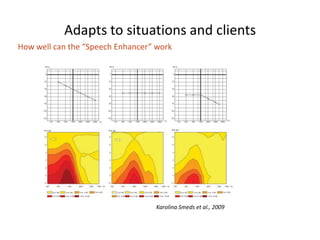
Adapts to situations and clientsHow well can the “Speech Enhancer” workKarolina Smeds et al., 2009
Speech Enhancer studiesPeeters, H., Kuk, F., Lau, C. and Keenan, D. 2009. Subjective and objective evaluation of noise management algorithms.  Journal of the American Academy of Audiology 20: 89-98.Bentler R, Wu YH, Kettel J, Hurtig R. (2008). Digital noise reduction: outcomes from laboratory and field studies. Int J Audiol. Aug;47(8):447-60.Mueller HG, Weber J, Hornsby BW. (2006)  The effects of digital noise reduction on the acceptance of background noise. Trends Amplif. Jun;10(2):83-93.Karolina Smeds, Niklas Bergman, Sofia Hertzman, and Torbjörn Nyman (2009).Noise reduction in modern hearing aids – Long-term average gain measurements using speech.  ISAAR Proceedings.

Speech Enhancer Study For Facebook

  • 1.
  • 2.
    Listening layer –sound processingSpeech EnhancerSpeech enhancement and noise reduction systemBased on Speech Intelligibility Index (SII) optimisationEnsures optimum SII in all listening environmentsSpeech is heard clearly under noisy conditions
  • 3.
    Main points fromstudiesEfficacy: How well can the ”Speech Enhancer” work:The Speech Enhancer can improve speech intelligibility in noiseOther noise reduction systems do not significantly benefit speech intelligibility in noiseThe Speech Enhancer does not compromise listener comfort in noisy environmentsMeasurements of long-term average gain changes with the Speech Enhancer activated/deactivated confirm that the Speech Enhancer varies with SNR and hearing loss
  • 4.
    Effect on speechintelligibilityThe Speech Enhancer can improve speech intelligibilityin noiseHow well can the “Speech Enhancer” workPeeters, et al., 2009
  • 5.
    Listening comfort innoiseHow well can the “Speech Enhancer” workThe SE does not compromise listener comfort in noisy environmentsPeeters, et al., 2009
  • 6.
    Adapts to situationsand clientsHow well can the “Speech Enhancer” workKarolina Smeds et al., 2009
  • 7.
    Speech Enhancer studiesPeeters,H., Kuk, F., Lau, C. and Keenan, D. 2009. Subjective and objective evaluation of noise management algorithms. Journal of the American Academy of Audiology 20: 89-98.Bentler R, Wu YH, Kettel J, Hurtig R. (2008). Digital noise reduction: outcomes from laboratory and field studies. Int J Audiol. Aug;47(8):447-60.Mueller HG, Weber J, Hornsby BW. (2006) The effects of digital noise reduction on the acceptance of background noise. Trends Amplif. Jun;10(2):83-93.Karolina Smeds, Niklas Bergman, Sofia Hertzman, and Torbjörn Nyman (2009).Noise reduction in modern hearing aids – Long-term average gain measurements using speech. ISAAR Proceedings.

Editor's Notes

  • #3 The aim of the Speech Enhancer in mind440 is two-fold: to keep speech above the hearing threshold and to keep background noise below the hearing threshold. These aims are reminiscent of the conditions required to maintain a high Speech Intelligibility Index.The Speech Intelligibility Index is an objective measure that correlates closely with speech understanding. The SII can be calculated if one knows the characteristics of the speech spectrum, the noise spectrum and the hearing thresholds (which in mind440 are the Sensogram thresholds).The Speech Enhancer secure the highest SII through a continuous optimisation algorithm. This means that the SII is calculated continuously and the gain is adjusted on the basis of this calculation. There is also an instant comparison of the new SII to the previous SII when the gain is adjusted. If the SII is higher in the new SII, then the gain is adjusted in the same direction. If the SII is lower than the previous SII then the gain is adjusted in the opposite direction.In this way, mind440’s Speech Enhancer always ensures that the optimum SII is provided in all listening environments – thereby ensuring optimum speech intelligibility.The illustration shows a segment of the spectrum of the sound signal. The speech and the noise level can be seen, and it is obvious how the noise level decreases as the speech enhancer comes to it’s full effect.The sound file gives an example on the speech enhancers effect going from silence to the full effect. The set-up for the recording is: Hearing loss: 10,10,40,50 dB HL711 coupler on KEMAR head35mm tubeSpeech signal at 70dB SPL in one loud-speakerNoise at 58 dB SPL (in 5 loudspeakers around the KEMAR head) (Party noise)
  • #5 The Speech Enhancer has been verified in laboratory experiments. These results suggest that the Speech Enhancer can significantly increase speech intelligibility in noise. In particular, the Speech Enhancer in combination with an omnidirectional microphone gave test participants an average signal-to-noise ratio advantage of 2.5 dB, in a standardised test of their ability to hear in noise.This is revolutionary as previously only directional microphones have been able to improve speech recognition in noise. The significance of these findings is that they confirm that the Speech Enhancer contributes to speech understanding in noise. Graphs: Average SNR for 50 % correct scores on the HINT test with the Speech Enhancer activated in different microphone settings (n=18). The error bars represent one standard deviation (from Peeters et al., 2009).
  • #6 While the Speech Enhancer can significantly increase speech intelligibility in noise, it does not compromise listener comfort in noisy environments. This can be seen in the results of a study that measured the Acceptable Noise Level (ANL, ANL=MostComfortableLevel-BackgroundNoiseLevel) with the Speech Enhancer. The ANL is a metric that reflects a listeners tolerance of challenging conditions. It is therefore not directly related to the understanding of speech in noise, but is an indication of listening comfort.The results from Peeters et al., (2009) indicate that the Speech Enhancer while benefitting speech intelligibility has a positive effect on the listeners’ tolerance of noisy environments. Graph: Figure X showing the decrease in average ANL with the Speech Enhancer activated in different microphone settings (from Peeters et al., 2009). It can be seen that in the omnidirectional microphone setting the decrease is 3.3 dB and in the directional mode the decrease was 2.9 dB. NB, decreases in ANL indicate improved tolerance.
  • #7 In comparative measurements of noise reduction systems it can be seen that many strategies dampen gain according to the ambient noise conditions. This is a valid aim for a strategy as a listener can be expected to move into new listening environments with different background noise levels. Widex’s Speech Enhancer makes use of the SNR, but it also takes the hearing loss of the client into consideration. This sets the Speech Enhancer apart from conventional noise reduction systems that only dampen sound according to the current noise level without any consideration for the hearing loss of the client. Including the hearing loss of the client in a noise reduction algorithm means that competing noise can be dampened so that it is below the client’s hearing threshold, and speech can be amplified so that it is above the client’s hearing threshold.Measurements of long-term average gain changes with the Speech Enhancer activated/deactivated confirm that the Speech Enhancer varies with SNR and hearing loss.Graph: Figure showing the effect of different hearing losses on long-term average measurements of the Speech Enhancer active in different signal-to-noise ratio conditions. It can be seen that as the low frequency thresholds become progressively worse, from hearing loss 1 to hearing loss 3, the amount of low frequency damping also decreases. Darker colouring indicates greater gain reduction. Measurements were made in a testbox with a speech level of 62 dB SPL (adapted from Smeds et. al., 2009).
  • #8 Auriemmo J, Kuk F, Stenger P (2008). Criteria for Evaluating Performance of Linear Frequency Transposition in Children, Hearing Journal, 61(4), 50-54Auriemmo J, Kuk F, Lau C, Marshall S, Thiele N, Pikora M, Quick D, Stenger P (2009). Effect of Linear Frequency Transposition on Speech Recognition and Production of School-Aged Children. Journal of the American Academy of Audiology, 20(5)Kuk F, Korhonen P, Peeters H, Keenan D, Jessen A, Andersen H. (2006). Linear Frequency Transposition: Extending the Audibility of High-Frequency Information, Hear Rev, 13(11), 42, 44-46, 48Kuk F, Keenan D, Peeters H, Korhonen P, Hau O, Andersen H.(2007a). Critical Factors in Ensuring Efficacy of Frequency Transposition. Part 1: Individualizing the Start Frequency, Hear Rev 14(3): 60, 62-64, 66Kuk F, Keenan D, Peeters H, Lau C, Crose, B.(2007b), Critical Factors in Ensuring Efficacy of Frequency Transposition. Part 2: Facilitating initial adjustment, Hearing Review, 14(4), 90, 92,95-96Kuk F, Peeters H, Keenan D, Lau C (2007c), Use of Frequency Transposition in a Tin-Tube Open-Ear Fitting, Hearing Journal, 60(4), 59-63Korhonen P, Kuk F (2008), Use of Linear Frequency Transposition in Simulated Hearing Loss. J Am Acad Audiol, 19(10)Kuk F, Keenan D, Korhonen P, Lau C (2009). Efficacy of Linear, Efficacy of Linear Frequency Transposition on Consonant Identification in Quiet and Noise, J Am Acad Audiol , 20(8)Smith J, Dann M, Brown M (2009), An Evaluation of Frequency Transposition for Hearing-Impaired School-Age Children. Deafness & Education International, 11 (2), 62-82