Speech Acts
Fakultas Keguruan Ilmu Pendidikan – Pendidikan Bahasa Inggris
Universitas Islam Syekh-Yusuf Tangerang - 2022
Aiziyah Amini Idha Nur
Latifah
Sri Mulyani
Rahayu
Noviana
Ikhsana Rambe
Nurul Ayu Fiqih
Sakila
Shofwatun
Najah
• Speech Acts
• Act of Referring
• Act of Assertion
• Descriptive Fallacy
• Performative Utterance
• Constative Utterance
• Performative Verb
• Summary and Quiz
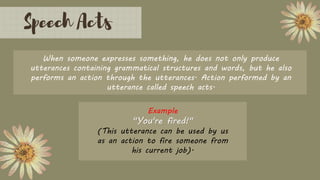
Speech Acts
When someone expresses something, he does not only produce
utterances containing grammatical structures and words, but he also
performs an action through the utterances. Action performed by an
utterance called speech acts.
Example
"You're fired!"
(This utterance can be used by us
as an action to fire someone from
his current job).
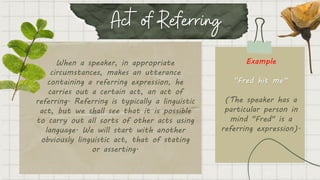
When a speaker, in appropriate
circumstances, makes an utterance
containing a referring expression, he
carries out a certain act, an act of
referring. Referring is typically a linguistic
act, but we shall see that it is possible
to carry out all sorts of other acts using
language. We will start with another
obviously linguistic act, that of stating
or asserting.
Example
"Fred hit me“
(The speaker has a
particular person in
mind "Fred" is a
referring expression).
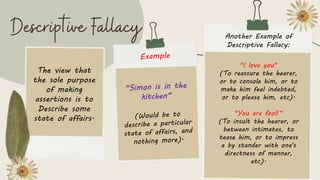
The view that
the sole purpose
of making
assertions is to
Describe some
state of affairs.
Another Example of
Descriptive Fallacy:
"I love you"
(To reassure the hearer,
or to console him, or to
make him feel indebted,
or to please him, etc).
"You are fool!“
(To insult the hearer, or
between intimates, to
tease him, or to impress
a by stander with one's
directness of manner,
etc).
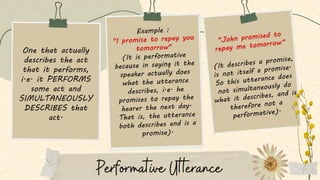
One that actually
describes the act
that it performs,
i.e. it PERFORMS
some act and
SIMULTANEOUSLY
DESCRIBES that
act.
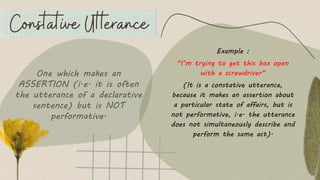
One which makes an
ASSERTION (i.e. it is often
the utterance of a declarative
sentence) but is NOT
performative.
Example :
"I’m trying to get this box open
with a screwdriver“
(It is a constative utterance,
because it makes an assertion about
a particular state of affairs, but is
not performative, i.e. the utterance
does not simultaneously describe and
perform the same act).
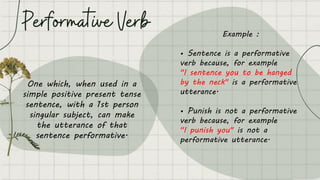
One which, when used in a
simple positive present tense
sentence, with a 1st person
singular subject, can make
the utterance of that
sentence performative.
Example :
• Sentence is a performative
verb because, for example
"I sentence you to be hanged
by the neck" is a performative
utterance.
• Punish is not a performative
verb because, for example
"I punish you" is not a
performative utterance.
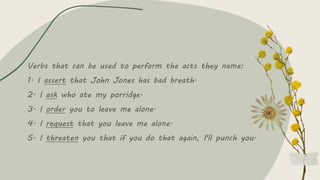
Verbs that can be used to perform the acts they name:
1. I assert that John Jones has bad breath.
2. I ask who ate my porridge.
3. I order you to leave me alone.
4. I request that you leave me alone.
5. I threaten you that if you do that again, I'll punch you.
Words and sentences when uttered are used to do things,
to carry out socially significant acts, in addition to merely
describing aspects of the world. The notion of a
performative illustrates this point in some rather special
cases. In subsequent units, we will analyse in more detail
the various characteristics of speech acts.
• Harford, J, R., Heasley, B., & Smith, M. B. (2007) Semantics A Course Book.
• Mardiatun Nisa "Speech Acts" Slide Share,
https://www.slideshare.net/mardiatunnisa1/speech-acts-67214278
• Janet Tibaldo "Interpersonal meaning" Slide Share,
https://www.slideshare.net/janettie/interpersonal-meaning
• Aza Anis "Interpersonal and non literal meaning: Speech Act" YouTube,
https://youtu.be/AQeIsimE5Vs
SPEECH ACTS - SEMANTICS-.pdf

SPEECH ACTS - SEMANTICS-.pdf

  • 1.
    Speech Acts Fakultas KeguruanIlmu Pendidikan – Pendidikan Bahasa Inggris Universitas Islam Syekh-Yusuf Tangerang - 2022
  • 2.
    Aiziyah Amini IdhaNur Latifah Sri Mulyani Rahayu Noviana Ikhsana Rambe Nurul Ayu Fiqih Sakila Shofwatun Najah
  • 3.
    • Speech Acts •Act of Referring • Act of Assertion • Descriptive Fallacy • Performative Utterance • Constative Utterance • Performative Verb • Summary and Quiz
  • 4.
    Speech Acts When someoneexpresses something, he does not only produce utterances containing grammatical structures and words, but he also performs an action through the utterances. Action performed by an utterance called speech acts. Example "You're fired!" (This utterance can be used by us as an action to fire someone from his current job).
  • 5.
    When a speaker,in appropriate circumstances, makes an utterance containing a referring expression, he carries out a certain act, an act of referring. Referring is typically a linguistic act, but we shall see that it is possible to carry out all sorts of other acts using language. We will start with another obviously linguistic act, that of stating or asserting. Example "Fred hit me“ (The speaker has a particular person in mind "Fred" is a referring expression).
  • 7.
    The view that thesole purpose of making assertions is to Describe some state of affairs. Another Example of Descriptive Fallacy: "I love you" (To reassure the hearer, or to console him, or to make him feel indebted, or to please him, etc). "You are fool!“ (To insult the hearer, or between intimates, to tease him, or to impress a by stander with one's directness of manner, etc).
  • 8.
    One that actually describesthe act that it performs, i.e. it PERFORMS some act and SIMULTANEOUSLY DESCRIBES that act.
  • 9.
    One which makesan ASSERTION (i.e. it is often the utterance of a declarative sentence) but is NOT performative. Example : "I’m trying to get this box open with a screwdriver“ (It is a constative utterance, because it makes an assertion about a particular state of affairs, but is not performative, i.e. the utterance does not simultaneously describe and perform the same act).
  • 10.
    One which, whenused in a simple positive present tense sentence, with a 1st person singular subject, can make the utterance of that sentence performative. Example : • Sentence is a performative verb because, for example "I sentence you to be hanged by the neck" is a performative utterance. • Punish is not a performative verb because, for example "I punish you" is not a performative utterance.
  • 11.
    Verbs that canbe used to perform the acts they name: 1. I assert that John Jones has bad breath. 2. I ask who ate my porridge. 3. I order you to leave me alone. 4. I request that you leave me alone. 5. I threaten you that if you do that again, I'll punch you.
  • 12.
    Words and sentenceswhen uttered are used to do things, to carry out socially significant acts, in addition to merely describing aspects of the world. The notion of a performative illustrates this point in some rather special cases. In subsequent units, we will analyse in more detail the various characteristics of speech acts.
  • 13.
    • Harford, J,R., Heasley, B., & Smith, M. B. (2007) Semantics A Course Book. • Mardiatun Nisa "Speech Acts" Slide Share, https://www.slideshare.net/mardiatunnisa1/speech-acts-67214278 • Janet Tibaldo "Interpersonal meaning" Slide Share, https://www.slideshare.net/janettie/interpersonal-meaning • Aza Anis "Interpersonal and non literal meaning: Speech Act" YouTube, https://youtu.be/AQeIsimE5Vs