

Do you want to be a GOOD SPEAKER ?  Prepared By:  Sheetal Sharma Communication skill trainer
Just Think… Are you a good  Listener? Are you a good  Reader? Are you good  Writer? IF YES! So You Can Be a  FLUENT SPEAKER .
Phases of English Speaking 1.Listening 2. Reading 3.Writing 4.Speaking
Key Areas of Concentration during Listening 1. Actively listen to the comprehension. 2. Notice the Pitch, Tone of voice. 3. Notice the intonation, modulation. 4. Focus on Syllable & rhythm of the word 5. Notice the Pauses. 6. Most important the Pronunciation.
Exercises for Listening 1.Presentation given by The Trainers. 2.Recording by the experts. 3.Listening to the English NEWS, FM, Commentary. 4.Answer the questions related to the comprehension. To judge whether you are a active listener or not?
How to get perfect accent Pronunciation ? What is an  Accent? Accent is the characteristics  pronunciation especially determined by regional or social background of the speaker.; also determined by the phonetic habit of the speaker's  native Language carried over to his/her use of another language. What is the  Pronunciation? Pronunciation is the act or manner of Pronouncing the word in a way is accepted or generally accepted and understood.
So how to improve the Accent? Answer is: LISTENING After That Practicing what we are LISTENING.
What accent should we adopt? Many different forms of English are spoken in UK there are major division are normally classified as Southern English dialects, Northern English Dialects & Scots dialects. Besides these, you also get to hear welsh & Irish forms of English. Each are in own style.  But in Training  Programmers , we will concentrate on recognizing and assimilating the Neutralize form of pronunciation.
What to do? Only the way to know is by speaking English all the Time.
Key Areas of working Test your vocabulary while Listening. Test your Grammar.
Vocabulary Catch the new words while listening.  Find the Meaning. Make your own new sentence of that word. Find the synonyms, antonyms of that word. Prepare the notes. Practice to use those words.
What about Grammar? Important topics in Grammar: Tenses  present, Past, Future. (Overview) Proper Use of Modals (all)  Proper use of Preposition. Direct & indirect speech. Active & passive Voice. Use of Articles. Conjunctions.
Listening game:  Before you begin the debrief ask the listeners and speakers to sit in a row facing each other, the listeners in one row and the speakers in the other.  1.First ask the listeners to respond to the following questions:  How do you feel? What are you learning?  2. You'll hear about all the behaviors and feelings that you noticed while the game was in progress.  3. While the speakers want to share too, try and contain them till it's their turn to respond to the debrief questions.  4. Once again you will hear about the observations that you made earlier.
5. You'll also sense amazement and hear sheepish laughter at the discoveries they have made about themselves.  6. They will express learning like:  'I realize that I have done this with quite a few people and when it happened to me I did not like it at all. I have decided that I will never ignore people again.'  'I felt lousy not being able to listen to my partner especially when she was sharing something so important.‘ 7. Some of the other learning that you need to gently bring home to them  It is not every time people have something earth shattering to share. Yet whatever they do want to share is important to them and so worth listening to.
It is also insensitive for speakers to go ahead and share whatever they want to even if the listener is not paying attention to them. It would be more fruitful if speakers listen to the body language of the listeners and deal with that first, sensitively of course. They need to take time to find out what's keeping the listener from listening. Not listening (either to the verbal message or the non-verbal message) is the malaise that has affected society. This malaise has resulted in competing relationships rather than in collaborative synergistic relationships.
Lets Start with second Phase READING: What? Why? How?
What should we read to improve? Tongue Twisters Newspapers Reading comprehension Books………etc .
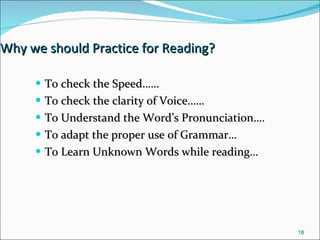
Why we should Practice for Reading? To check the Speed…… To check the clarity of Voice…… To Understand the Word’s Pronunciation…. To adapt the proper use of Grammar…  To Learn Unknown Words while reading…
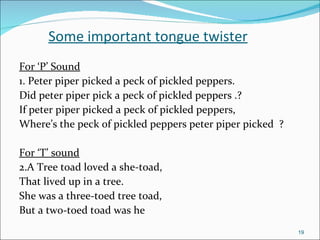
Some important tongue twister For ‘P’ Sound 1. Peter piper picked a peck of pickled peppers.  Did peter piper pick a peck of pickled peppers .? If peter piper picked a peck of pickled peppers, Where’s the peck of pickled peppers peter piper picked  ? For ‘T’ sound 2.A Tree toad loved a she-toad, That lived up in a tree. She was a three-toed tree toad, But a two-toed toad was he
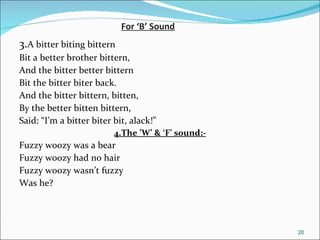
For ‘B’ Sound 3. A bitter biting bittern Bit a better brother bittern, And the bitter better bittern Bit the bitter biter back. And the bitter bittern, bitten, By the better bitten bittern, Said: “I’m a bitter biter bit, alack!” 4.The ’W’ & ‘F’ sound:- Fuzzy woozy was a bear Fuzzy woozy had no hair Fuzzy woozy wasn’t fuzzy Was he?
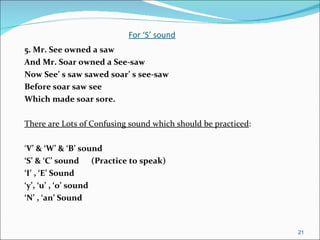
For ‘S’ sound 5. Mr. See owned a saw  And Mr. Soar owned a See-saw  Now See’ s saw sawed soar’ s see-saw Before soar saw see Which made soar sore. There are Lots of Confusing sound which should be practiced : ‘ V’ & ‘W’ & ‘B’ sound ‘ S’ & ‘C’ sound  (Practice to speak) ‘ I’ , ‘E’ Sound ‘ y’, ‘u’ , ‘o’ sound ‘ N’ , ‘an’ Sound
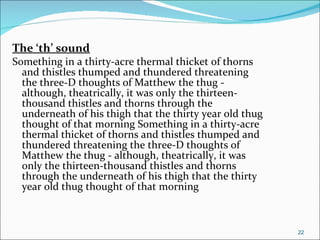
The ‘th’ sound Something in a thirty-acre thermal thicket of thorns and thistles thumped and thundered threatening the three-D thoughts of Matthew the thug - although, theatrically, it was only the thirteen-thousand thistles and thorns through the underneath of his thigh that the thirty year old thug thought of that morning Something in a thirty-acre thermal thicket of thorns and thistles thumped and thundered threatening the three-D thoughts of Matthew the thug - although, theatrically, it was only the thirteen-thousand thistles and thorns through the underneath of his thigh that the thirty year old thug thought of that morning
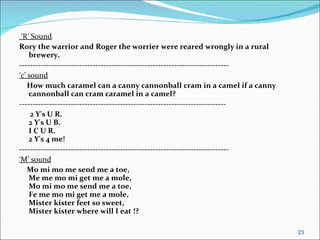
‘ R’ Sound Rory the warrior and Roger the worrier were reared wrongly in a rural brewery. ----------------------------------------------------------------------------- ‘ c’ sound How much caramel can a canny cannonball cram in a camel if a canny cannonball can cram caramel in a camel? ----------------------------------------------------------------------------  2 Y's U R. 2 Y's U B. I C U R. 2 Y's 4 me! ----------------------------------------------------------------------------- ‘ M’ sound Mo mi mo me send me a toe, Me me mo mi get me a mole, Mo mi mo me send me a toe, Fe me mo mi get me a mole, Mister kister feet so sweet, Mister kister where will I eat !?
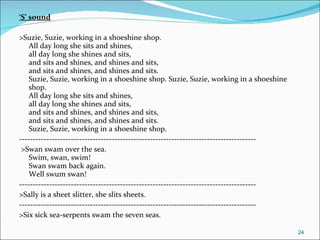
‘ S’ sound >Suzie, Suzie, working in a shoeshine shop. All day long she sits and shines, all day long she shines and sits, and sits and shines, and shines and sits, and sits and shines, and shines and sits. Suzie, Suzie, working in a shoeshine shop. Suzie, Suzie, working in a shoeshine shop. All day long she sits and shines, all day long she shines and sits, and sits and shines, and shines and sits, and sits and shines, and shines and sits. Suzie, Suzie, working in a shoeshine shop.  --------------------------------------------------------------------------------------- >Swan swam over the sea. Swim, swan, swim! Swan swam back again. Well swum swan! --------------------------------------------------------------------------------------- >Sally is a sheet slitter, she slits sheets. --------------------------------------------------------------------------------------- >Six sick sea-serpents swam the seven seas.
That is: Writing { Practice for writing which is Required }
SPEAKING
SPEAKING { SPEAK AS MUCH YOU CAN } WHY?------HOW?------WHAT?
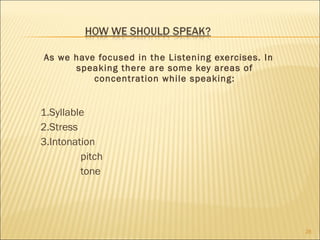
As we have focused in the Listening exercises. In speaking there are some key areas of concentration while speaking: 1.Syllable 2.Stress 3.Intonation pitch tone
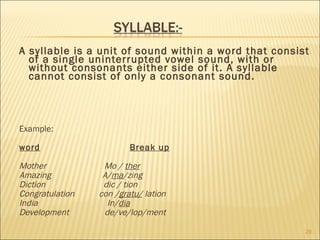
A syllable is a unit of sound within a word that consist of a single uninterrupted vowel sound, with or without consonants either side of it. A syllable cannot consist of only a consonant sound. Example: word   Break up Mother  Mo /  ther Amazing  A/ ma /zing Diction  dic / tion Congratulation  con / gratu/  lation  India  In/ dia   Development  de/ve/lop/ment
Intonation  can be defined as the sound changes produced by the rise and fall of the voice when speaking, especially when this has an effect on the meaning of what has been said. Pitch  is the degree to which a sound is high or low. Tone  is the quality of voice which express the speakers feeling or thoughts.
>What ever you talk in your daily life, Try to talk in English. >Analyze where you find the problem while speaking. >Take out the unknown word, Find out their meaning then implement while speaking. >Practice ------practice--------practice. It can only help to make you perfect.
Learn English by practice       So the most important thing you have to remember is:   The more you practice, the more fluent your English speaking is :)

Speaking2

  • 1.
    Doyou want to be a GOOD SPEAKER ? Prepared By: Sheetal Sharma Communication skill trainer
  • 2.
    Just Think… Areyou a good Listener? Are you a good Reader? Are you good Writer? IF YES! So You Can Be a FLUENT SPEAKER .
  • 3.
    Phases of EnglishSpeaking 1.Listening 2. Reading 3.Writing 4.Speaking
  • 4.
    Key Areas ofConcentration during Listening 1. Actively listen to the comprehension. 2. Notice the Pitch, Tone of voice. 3. Notice the intonation, modulation. 4. Focus on Syllable & rhythm of the word 5. Notice the Pauses. 6. Most important the Pronunciation.
  • 5.
    Exercises for Listening1.Presentation given by The Trainers. 2.Recording by the experts. 3.Listening to the English NEWS, FM, Commentary. 4.Answer the questions related to the comprehension. To judge whether you are a active listener or not?
  • 6.
    How to getperfect accent Pronunciation ? What is an Accent? Accent is the characteristics pronunciation especially determined by regional or social background of the speaker.; also determined by the phonetic habit of the speaker's native Language carried over to his/her use of another language. What is the Pronunciation? Pronunciation is the act or manner of Pronouncing the word in a way is accepted or generally accepted and understood.
  • 7.
    So how toimprove the Accent? Answer is: LISTENING After That Practicing what we are LISTENING.
  • 8.
    What accent shouldwe adopt? Many different forms of English are spoken in UK there are major division are normally classified as Southern English dialects, Northern English Dialects & Scots dialects. Besides these, you also get to hear welsh & Irish forms of English. Each are in own style. But in Training Programmers , we will concentrate on recognizing and assimilating the Neutralize form of pronunciation.
  • 9.
    What to do?Only the way to know is by speaking English all the Time.
  • 10.
    Key Areas ofworking Test your vocabulary while Listening. Test your Grammar.
  • 11.
    Vocabulary Catch thenew words while listening. Find the Meaning. Make your own new sentence of that word. Find the synonyms, antonyms of that word. Prepare the notes. Practice to use those words.
  • 12.
    What about Grammar?Important topics in Grammar: Tenses  present, Past, Future. (Overview) Proper Use of Modals (all) Proper use of Preposition. Direct & indirect speech. Active & passive Voice. Use of Articles. Conjunctions.
  • 13.
    Listening game: Before you begin the debrief ask the listeners and speakers to sit in a row facing each other, the listeners in one row and the speakers in the other. 1.First ask the listeners to respond to the following questions: How do you feel? What are you learning? 2. You'll hear about all the behaviors and feelings that you noticed while the game was in progress. 3. While the speakers want to share too, try and contain them till it's their turn to respond to the debrief questions. 4. Once again you will hear about the observations that you made earlier.
  • 14.
    5. You'll alsosense amazement and hear sheepish laughter at the discoveries they have made about themselves. 6. They will express learning like: 'I realize that I have done this with quite a few people and when it happened to me I did not like it at all. I have decided that I will never ignore people again.' 'I felt lousy not being able to listen to my partner especially when she was sharing something so important.‘ 7. Some of the other learning that you need to gently bring home to them It is not every time people have something earth shattering to share. Yet whatever they do want to share is important to them and so worth listening to.
  • 15.
    It is alsoinsensitive for speakers to go ahead and share whatever they want to even if the listener is not paying attention to them. It would be more fruitful if speakers listen to the body language of the listeners and deal with that first, sensitively of course. They need to take time to find out what's keeping the listener from listening. Not listening (either to the verbal message or the non-verbal message) is the malaise that has affected society. This malaise has resulted in competing relationships rather than in collaborative synergistic relationships.
  • 16.
    Lets Start withsecond Phase READING: What? Why? How?
  • 17.
    What should weread to improve? Tongue Twisters Newspapers Reading comprehension Books………etc .
  • 18.
    Why we shouldPractice for Reading? To check the Speed…… To check the clarity of Voice…… To Understand the Word’s Pronunciation…. To adapt the proper use of Grammar… To Learn Unknown Words while reading…
  • 19.
    Some important tonguetwister For ‘P’ Sound 1. Peter piper picked a peck of pickled peppers. Did peter piper pick a peck of pickled peppers .? If peter piper picked a peck of pickled peppers, Where’s the peck of pickled peppers peter piper picked ? For ‘T’ sound 2.A Tree toad loved a she-toad, That lived up in a tree. She was a three-toed tree toad, But a two-toed toad was he
  • 20.
    For ‘B’ Sound3. A bitter biting bittern Bit a better brother bittern, And the bitter better bittern Bit the bitter biter back. And the bitter bittern, bitten, By the better bitten bittern, Said: “I’m a bitter biter bit, alack!” 4.The ’W’ & ‘F’ sound:- Fuzzy woozy was a bear Fuzzy woozy had no hair Fuzzy woozy wasn’t fuzzy Was he?
  • 21.
    For ‘S’ sound5. Mr. See owned a saw And Mr. Soar owned a See-saw Now See’ s saw sawed soar’ s see-saw Before soar saw see Which made soar sore. There are Lots of Confusing sound which should be practiced : ‘ V’ & ‘W’ & ‘B’ sound ‘ S’ & ‘C’ sound (Practice to speak) ‘ I’ , ‘E’ Sound ‘ y’, ‘u’ , ‘o’ sound ‘ N’ , ‘an’ Sound
  • 22.
    The ‘th’ soundSomething in a thirty-acre thermal thicket of thorns and thistles thumped and thundered threatening the three-D thoughts of Matthew the thug - although, theatrically, it was only the thirteen-thousand thistles and thorns through the underneath of his thigh that the thirty year old thug thought of that morning Something in a thirty-acre thermal thicket of thorns and thistles thumped and thundered threatening the three-D thoughts of Matthew the thug - although, theatrically, it was only the thirteen-thousand thistles and thorns through the underneath of his thigh that the thirty year old thug thought of that morning
  • 23.
    ‘ R’ SoundRory the warrior and Roger the worrier were reared wrongly in a rural brewery. ----------------------------------------------------------------------------- ‘ c’ sound How much caramel can a canny cannonball cram in a camel if a canny cannonball can cram caramel in a camel? ---------------------------------------------------------------------------- 2 Y's U R. 2 Y's U B. I C U R. 2 Y's 4 me! ----------------------------------------------------------------------------- ‘ M’ sound Mo mi mo me send me a toe, Me me mo mi get me a mole, Mo mi mo me send me a toe, Fe me mo mi get me a mole, Mister kister feet so sweet, Mister kister where will I eat !?
  • 24.
    ‘ S’ sound>Suzie, Suzie, working in a shoeshine shop. All day long she sits and shines, all day long she shines and sits, and sits and shines, and shines and sits, and sits and shines, and shines and sits. Suzie, Suzie, working in a shoeshine shop. Suzie, Suzie, working in a shoeshine shop. All day long she sits and shines, all day long she shines and sits, and sits and shines, and shines and sits, and sits and shines, and shines and sits. Suzie, Suzie, working in a shoeshine shop. --------------------------------------------------------------------------------------- >Swan swam over the sea. Swim, swan, swim! Swan swam back again. Well swum swan! --------------------------------------------------------------------------------------- >Sally is a sheet slitter, she slits sheets. --------------------------------------------------------------------------------------- >Six sick sea-serpents swam the seven seas.
  • 25.
    That is: Writing{ Practice for writing which is Required }
  • 26.
  • 27.
    SPEAKING { SPEAKAS MUCH YOU CAN } WHY?------HOW?------WHAT?
  • 28.
    As we havefocused in the Listening exercises. In speaking there are some key areas of concentration while speaking: 1.Syllable 2.Stress 3.Intonation pitch tone
  • 29.
    A syllable isa unit of sound within a word that consist of a single uninterrupted vowel sound, with or without consonants either side of it. A syllable cannot consist of only a consonant sound. Example: word Break up Mother Mo / ther Amazing A/ ma /zing Diction dic / tion Congratulation con / gratu/ lation India In/ dia Development de/ve/lop/ment
  • 30.
    Intonation canbe defined as the sound changes produced by the rise and fall of the voice when speaking, especially when this has an effect on the meaning of what has been said. Pitch is the degree to which a sound is high or low. Tone is the quality of voice which express the speakers feeling or thoughts.
  • 31.
    >What ever youtalk in your daily life, Try to talk in English. >Analyze where you find the problem while speaking. >Take out the unknown word, Find out their meaning then implement while speaking. >Practice ------practice--------practice. It can only help to make you perfect.
  • 32.
    Learn English bypractice       So the most important thing you have to remember is: The more you practice, the more fluent your English speaking is :)