Spatial
Interpolatio
n
Techniques
Presenter : GOPAL S Chhetri
ELEMENTS OF SPATIAL INTERPOLATION 17489318
What is Spatial Interpolation?
 It is the process of using points with known values to estimate
values at other points.
 Turns raw data into useful information by adding greater
informative content and vales.
 Reveals patterns, tends which is been missed.
ELEMENTS OF SPATIAL INTERPOLATION 17489318
Why interpolate to raster?
 Visiting every location in a study areas to measure the height
,magnitude or concentration of a phenomenon is usually
difficult or expensive.
 Instead input points locations can be selected and a predicted
values can be assigned to other locations.
 Input points can be either randomly or regularly spaced points
containing height, concentration or magnitude measurements.
ELEMENTS OF SPATIAL INTERPOLATION 17489318
Tobler’s law of Geography
Statement: Observations or
points which are close together
in space are more likely to have
similar values than the points
which are far apart.
ELEMENTS OF SPATIAL INTERPOLATION 17489318
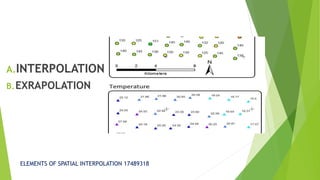
A.INTERPOLATION
B.EXRAPOLATION
ELEMENTS OF SPATIAL INTERPOLATION 17489318
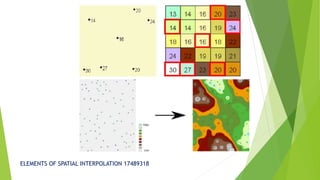
 Interpolation predicts values for a cell in a raster from a
limited number of samples data points.
 It can be used to predict unknown values for any
geographic point data , such as elevation , rainfall ,
chemical concentration etc.
 The interpolation cannot be done for : cyclic data,
counts and amounts, nominal data.
 One must have interval or ratio data for interpolation.
ELEMENTS OF SPATIAL INTERPOLATION 17489318
Spatial interpolation may be used in GIS:
 To calculate some property of the surface at a given
point.
 To provide contour for displaying data graphically.
 Frequently used in spatial decision making process
like terrain analysis , hydrology , mineral
prospecting etc
ELEMENTS OF SPATIAL INTERPOLATION 17489318
A classification of interpolation
methods:
 Global versus Local
 Exact versus Approximate
 Stochastic versus Deterministic
 Abrupt versus Smooth
ELEMENTS OF SPATIAL INTERPOLATION 17489318

spatial interoplation in GIS

  • 1.
    Spatial Interpolatio n Techniques Presenter : GOPALS Chhetri ELEMENTS OF SPATIAL INTERPOLATION 17489318
  • 2.
    What is SpatialInterpolation?  It is the process of using points with known values to estimate values at other points.  Turns raw data into useful information by adding greater informative content and vales.  Reveals patterns, tends which is been missed. ELEMENTS OF SPATIAL INTERPOLATION 17489318
  • 3.
    Why interpolate toraster?  Visiting every location in a study areas to measure the height ,magnitude or concentration of a phenomenon is usually difficult or expensive.  Instead input points locations can be selected and a predicted values can be assigned to other locations.  Input points can be either randomly or regularly spaced points containing height, concentration or magnitude measurements. ELEMENTS OF SPATIAL INTERPOLATION 17489318
  • 4.
    Tobler’s law ofGeography Statement: Observations or points which are close together in space are more likely to have similar values than the points which are far apart. ELEMENTS OF SPATIAL INTERPOLATION 17489318
  • 5.
  • 6.
     Interpolation predictsvalues for a cell in a raster from a limited number of samples data points.  It can be used to predict unknown values for any geographic point data , such as elevation , rainfall , chemical concentration etc.  The interpolation cannot be done for : cyclic data, counts and amounts, nominal data.  One must have interval or ratio data for interpolation. ELEMENTS OF SPATIAL INTERPOLATION 17489318
  • 7.
    ELEMENTS OF SPATIALINTERPOLATION 17489318
  • 8.
    Spatial interpolation maybe used in GIS:  To calculate some property of the surface at a given point.  To provide contour for displaying data graphically.  Frequently used in spatial decision making process like terrain analysis , hydrology , mineral prospecting etc ELEMENTS OF SPATIAL INTERPOLATION 17489318
  • 9.
    A classification ofinterpolation methods:  Global versus Local  Exact versus Approximate  Stochastic versus Deterministic  Abrupt versus Smooth ELEMENTS OF SPATIAL INTERPOLATION 17489318