SPARKLIS: Expressive Semantic Search
on Top of SPARQL Endpoints
for (Almost) Everybody
Sébastien Ferré
Team LIS, Data and Knowledge Management, Irisa, Univ. Rennes 1
SemWeb.Pro, 5 November 2015, Paris
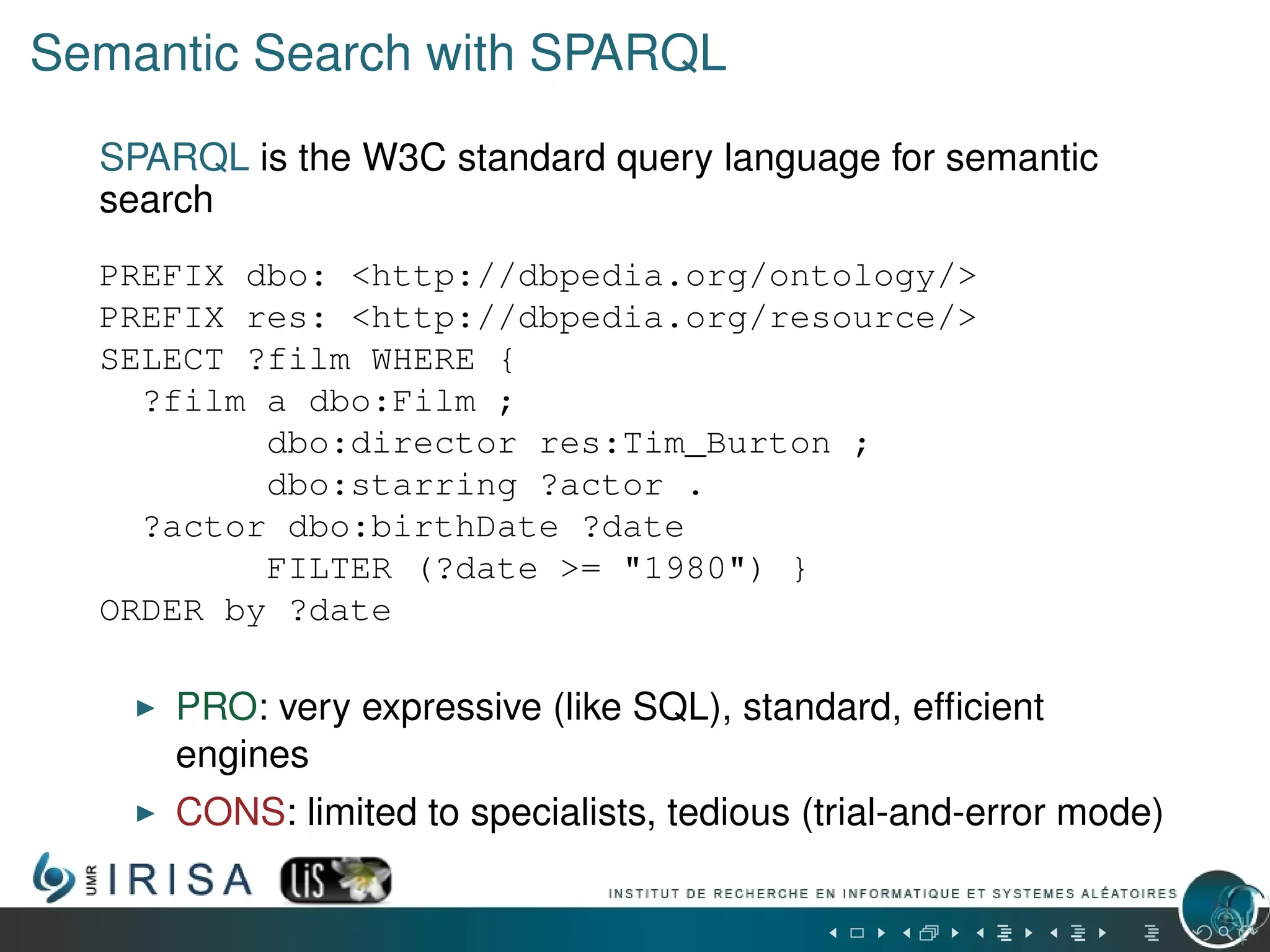
Semantic Search with SPARQL
SPARQL is the W3C standard query language for semantic
search
PREFIX dbo: <http://dbpedia.org/ontology/>
PREFIX res: <http://dbpedia.org/resource/>
SELECT ?film WHERE {
?film a dbo:Film ;
dbo:director res:Tim_Burton ;
dbo:starring ?actor .
?actor dbo:birthDate ?date
FILTER (?date >= "1980") }
ORDER by ?date
PRO: very expressive (like SQL), standard, efficient
engines
CONS: limited to specialists, tedious (trial-and-error mode)
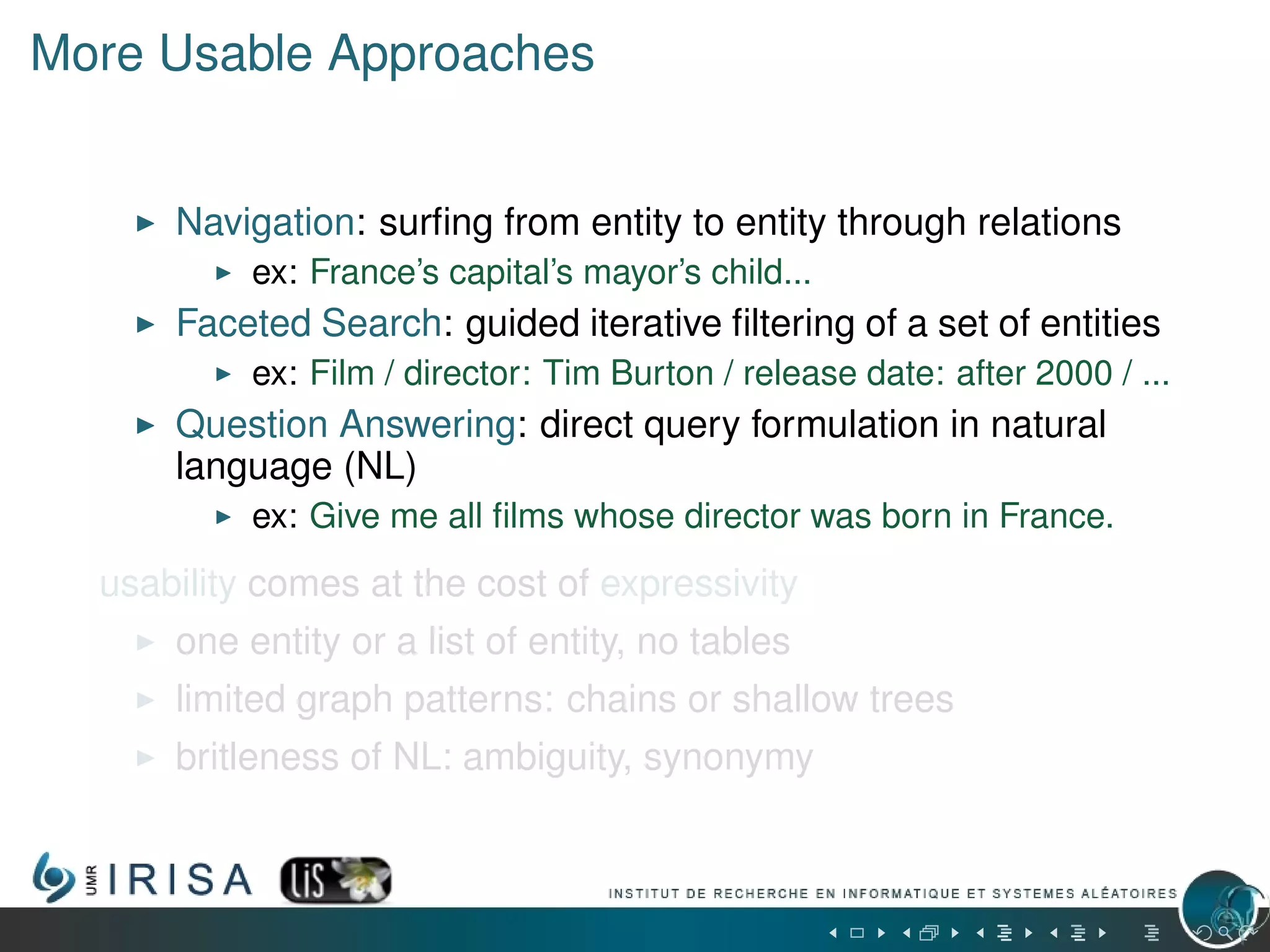
More Usable Approaches
Navigation: surfing from entity to entity through relations
ex: France’s capital’s mayor’s child...
Faceted Search: guided iterative filtering of a set of entities
ex: Film / director: Tim Burton / release date: after 2000 / ...
Question Answering: direct query formulation in natural
language (NL)
ex: Give me all films whose director was born in France.
usability comes at the cost of expressivity
one entity or a list of entity, no tables
limited graph patterns: chains or shallow trees
britleness of NL: ambiguity, synonymy
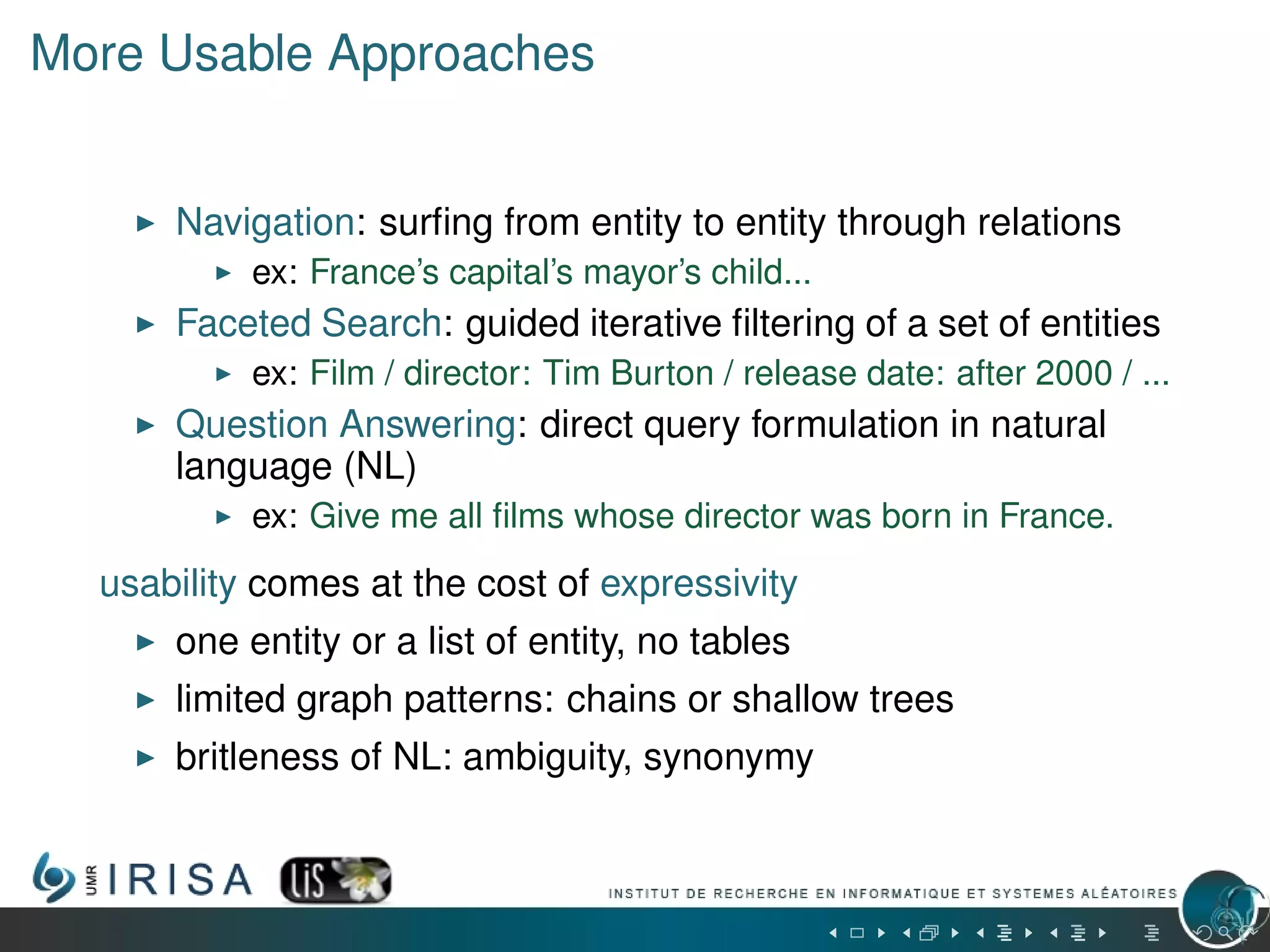
More Usable Approaches
Navigation: surfing from entity to entity through relations
ex: France’s capital’s mayor’s child...
Faceted Search: guided iterative filtering of a set of entities
ex: Film / director: Tim Burton / release date: after 2000 / ...
Question Answering: direct query formulation in natural
language (NL)
ex: Give me all films whose director was born in France.
usability comes at the cost of expressivity
one entity or a list of entity, no tables
limited graph patterns: chains or shallow trees
britleness of NL: ambiguity, synonymy
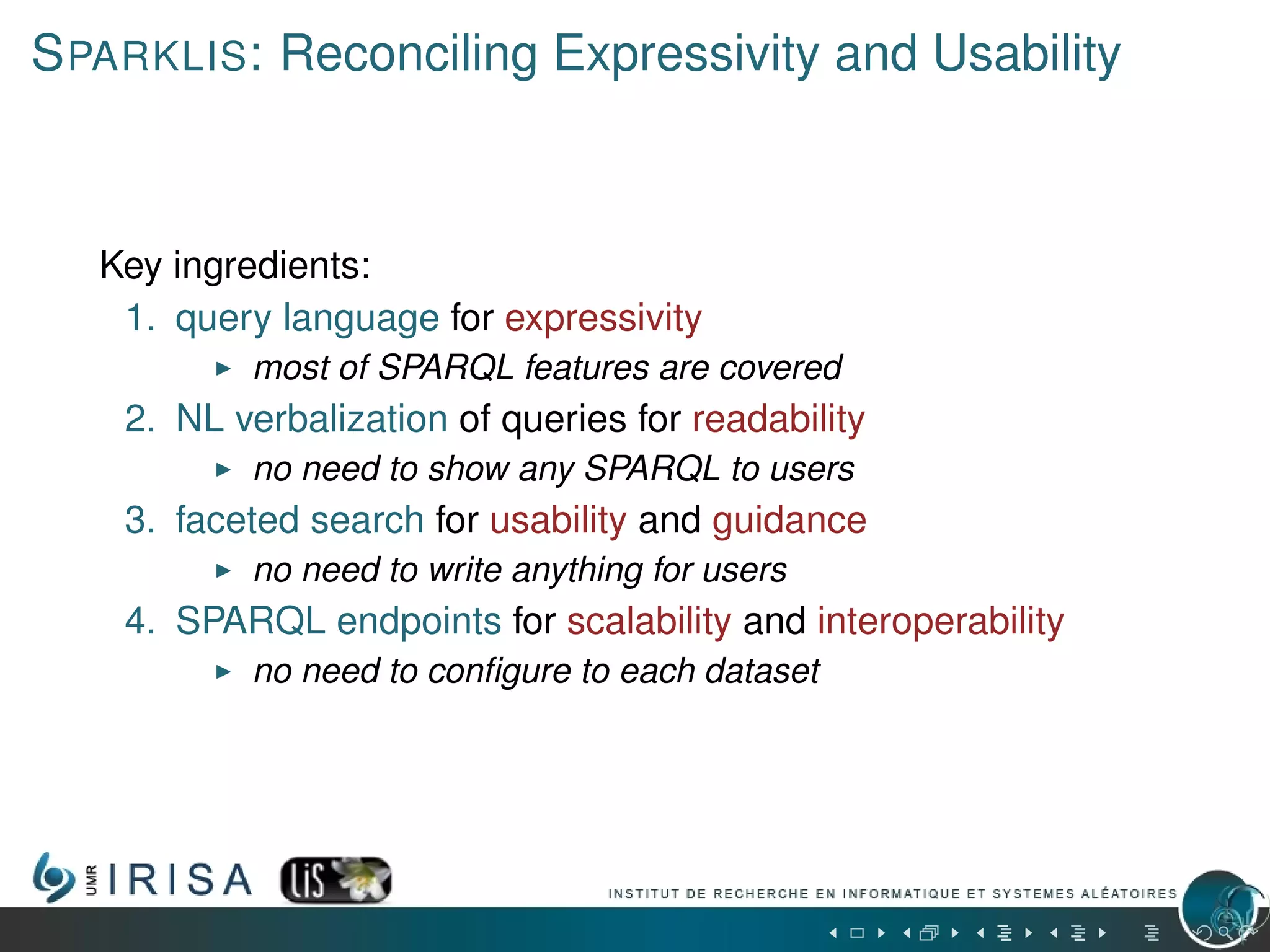
SPARKLIS: Reconciling Expressivity and Usability
Key ingredients:
1. query language for expressivity
most of SPARQL features are covered
2. NL verbalization of queries for readability
no need to show any SPARQL to users
3. faceted search for usability and guidance
no need to write anything for users
4. SPARQL endpoints for scalability and interoperability
no need to configure to each dataset
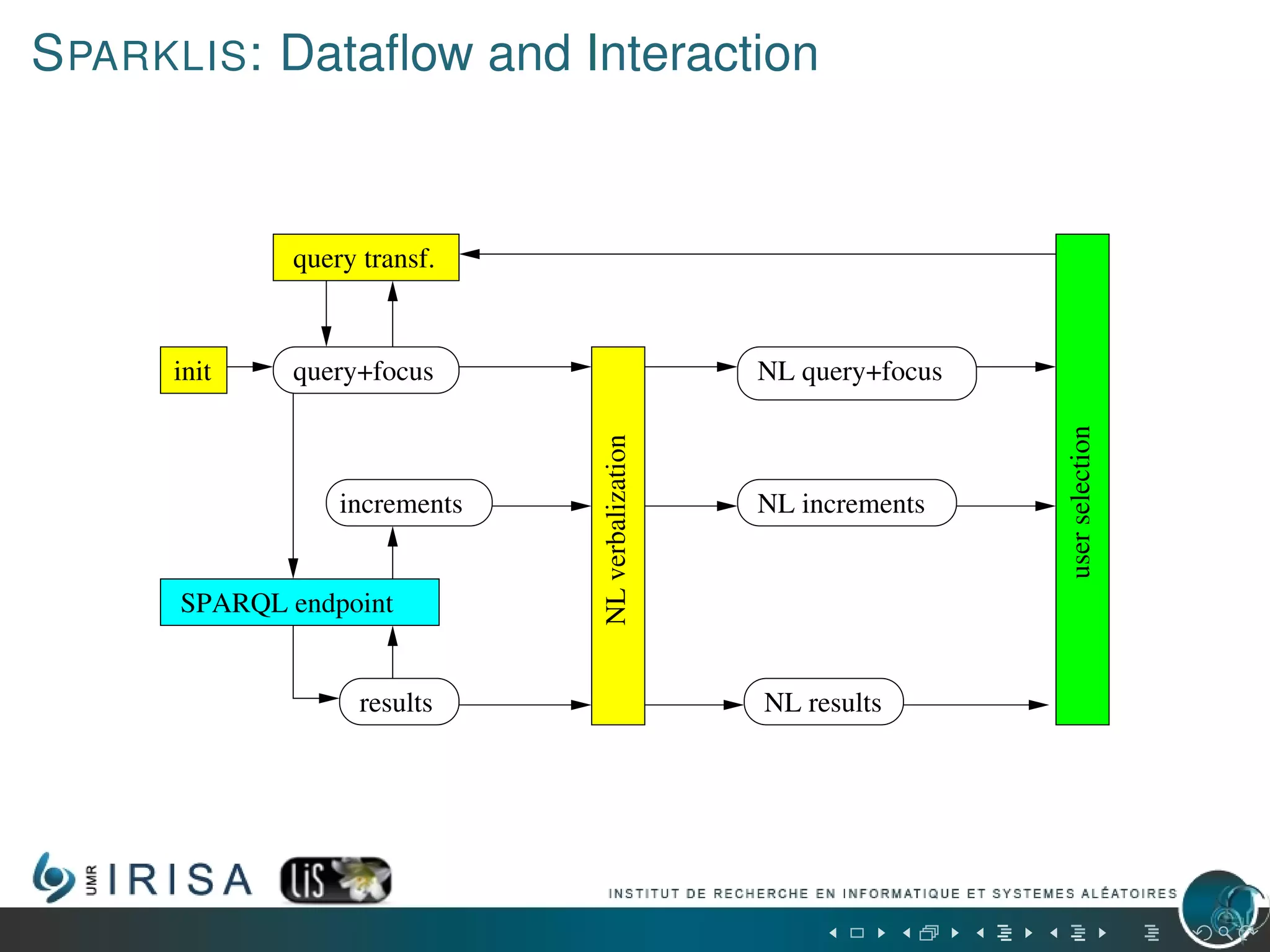
SPARKLIS: Dataflow and Interaction
NLverbalization
NL increments
NL results
SPARQL endpoint
userselection
query transf.
results
increments
query+focusinit NL query+focus
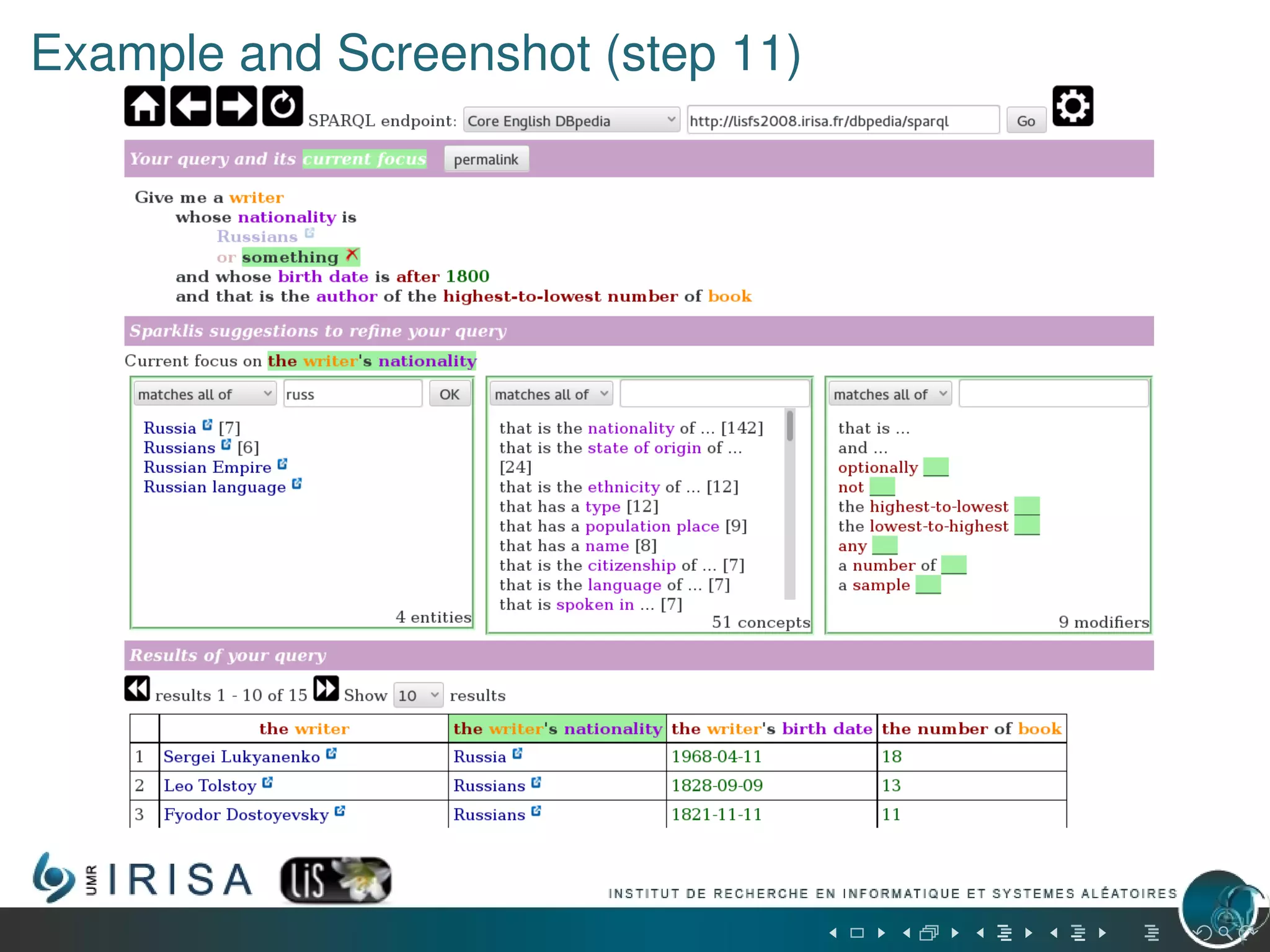
Example and Screenshot (step 11)
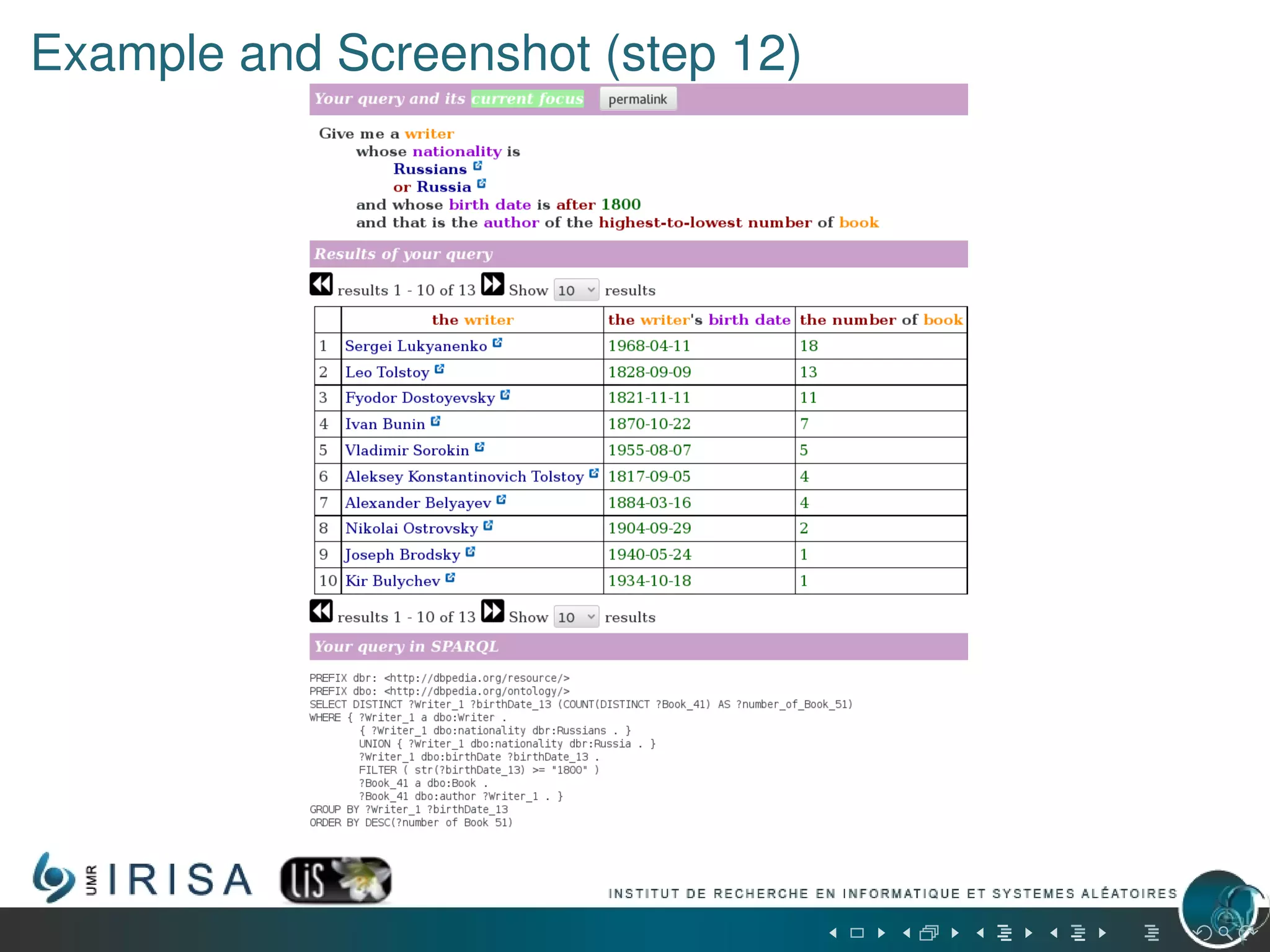
Example and Screenshot (step 12)
Demo
SPARKLIS is a Web application (no setup, no login)
http://www.irisa.fr/LIS/ferre/sparklis/
QALD-challenge questions over DBpedia
QALD = Question Answering over Linked Data
DBpedia = Semantic version of Wikipedia
Examples:
Give me all films directed by Tim Burton, and starring some
actor born since 1980. [YouTube]
Which rivers flow into a German lake? [YouTube]
How many languages are spoken in Colombia? [YouTube]
Give me all films produced by Steven Spielberg with a
budget of at least $80 million. [YouTube]
Usage
Online since April 2014
about 10 sessions per day
by about 1000 unique users
on more than 170 different endpoints (public and local)
in various domains: encyclopedic, bioinformatics, ...
with queries having sizes up to 29
Work in Progress and Future Work
expressivity: full SPARQL coverage
1. nested aggregations
the [ average [ number of actors per film ] per director ]
2. computations (like spreadsheet formulas)
age = now - the birth date
3. RDF graphs as results ⇒ updates
every person whose age is higher than 18 is an adult
usability
1. visualization: generation of charts, maps, timelines
2. use of lexicons (Wordnet?):
better verbalization and filtering (synonyms)
Thanks! Questions?
Useful links:
SPARKLIS at
http://www.irisa.fr/LIS/ferre/sparklis/
Demo/Tutorial at http://youtu.be/O999FVXn8Qc
Usability Survey at http://tinyurl.com/kxozx9r
Papers at ISWC’14, SWJ (under revision)
SPARKLIS: Expressivity compared to SPARQL (1/2)
Covered features:
triple patterns: entities/values, classes/properties
graph patterns (join): and, that, is
cyclic graph patterns: anaphors (ex: the film’s director)
simple filters: matching, higher than, after, ...
logic/algebra: or, not, optionally
solution modifiers (projection, ordering): any, the
highest-to-lowest, the lowest-to-highest
aggregation: number of, average, total
SPARKLIS: Expressivity compared to SPARQL (2/2)
Missing features:
expressions: +, sqrt(), concat(), now()
nested aggregations:
the [ average [ number of actors per film ] per director ]
named graphs = querying on the source of knowledge
transitive closures of property paths:
ancestor = (father | mother)+
federated search = querying over several SPARQL
endpoints at once
DESCRIBE and CONSTRUCT queries = returning RDF
graphs as results (instead of tables)

Sparklis exploration et interrogation de points d'accès sparql par interaction et langue naturelle

  • 1.
    SPARKLIS: Expressive SemanticSearch on Top of SPARQL Endpoints for (Almost) Everybody Sébastien Ferré Team LIS, Data and Knowledge Management, Irisa, Univ. Rennes 1 SemWeb.Pro, 5 November 2015, Paris
  • 2.
    Semantic Search withSPARQL SPARQL is the W3C standard query language for semantic search PREFIX dbo: <http://dbpedia.org/ontology/> PREFIX res: <http://dbpedia.org/resource/> SELECT ?film WHERE { ?film a dbo:Film ; dbo:director res:Tim_Burton ; dbo:starring ?actor . ?actor dbo:birthDate ?date FILTER (?date >= "1980") } ORDER by ?date PRO: very expressive (like SQL), standard, efficient engines CONS: limited to specialists, tedious (trial-and-error mode)
  • 3.
    More Usable Approaches Navigation:surfing from entity to entity through relations ex: France’s capital’s mayor’s child... Faceted Search: guided iterative filtering of a set of entities ex: Film / director: Tim Burton / release date: after 2000 / ... Question Answering: direct query formulation in natural language (NL) ex: Give me all films whose director was born in France. usability comes at the cost of expressivity one entity or a list of entity, no tables limited graph patterns: chains or shallow trees britleness of NL: ambiguity, synonymy
  • 4.
    More Usable Approaches Navigation:surfing from entity to entity through relations ex: France’s capital’s mayor’s child... Faceted Search: guided iterative filtering of a set of entities ex: Film / director: Tim Burton / release date: after 2000 / ... Question Answering: direct query formulation in natural language (NL) ex: Give me all films whose director was born in France. usability comes at the cost of expressivity one entity or a list of entity, no tables limited graph patterns: chains or shallow trees britleness of NL: ambiguity, synonymy
  • 5.
    SPARKLIS: Reconciling Expressivityand Usability Key ingredients: 1. query language for expressivity most of SPARQL features are covered 2. NL verbalization of queries for readability no need to show any SPARQL to users 3. faceted search for usability and guidance no need to write anything for users 4. SPARQL endpoints for scalability and interoperability no need to configure to each dataset
  • 6.
    SPARKLIS: Dataflow andInteraction NLverbalization NL increments NL results SPARQL endpoint userselection query transf. results increments query+focusinit NL query+focus
  • 7.
  • 8.
  • 9.
    Demo SPARKLIS is aWeb application (no setup, no login) http://www.irisa.fr/LIS/ferre/sparklis/ QALD-challenge questions over DBpedia QALD = Question Answering over Linked Data DBpedia = Semantic version of Wikipedia Examples: Give me all films directed by Tim Burton, and starring some actor born since 1980. [YouTube] Which rivers flow into a German lake? [YouTube] How many languages are spoken in Colombia? [YouTube] Give me all films produced by Steven Spielberg with a budget of at least $80 million. [YouTube]
  • 10.
    Usage Online since April2014 about 10 sessions per day by about 1000 unique users on more than 170 different endpoints (public and local) in various domains: encyclopedic, bioinformatics, ... with queries having sizes up to 29
  • 11.
    Work in Progressand Future Work expressivity: full SPARQL coverage 1. nested aggregations the [ average [ number of actors per film ] per director ] 2. computations (like spreadsheet formulas) age = now - the birth date 3. RDF graphs as results ⇒ updates every person whose age is higher than 18 is an adult usability 1. visualization: generation of charts, maps, timelines 2. use of lexicons (Wordnet?): better verbalization and filtering (synonyms)
  • 12.
    Thanks! Questions? Useful links: SPARKLISat http://www.irisa.fr/LIS/ferre/sparklis/ Demo/Tutorial at http://youtu.be/O999FVXn8Qc Usability Survey at http://tinyurl.com/kxozx9r Papers at ISWC’14, SWJ (under revision)
  • 13.
    SPARKLIS: Expressivity comparedto SPARQL (1/2) Covered features: triple patterns: entities/values, classes/properties graph patterns (join): and, that, is cyclic graph patterns: anaphors (ex: the film’s director) simple filters: matching, higher than, after, ... logic/algebra: or, not, optionally solution modifiers (projection, ordering): any, the highest-to-lowest, the lowest-to-highest aggregation: number of, average, total
  • 14.
    SPARKLIS: Expressivity comparedto SPARQL (2/2) Missing features: expressions: +, sqrt(), concat(), now() nested aggregations: the [ average [ number of actors per film ] per director ] named graphs = querying on the source of knowledge transitive closures of property paths: ancestor = (father | mother)+ federated search = querying over several SPARQL endpoints at once DESCRIBE and CONSTRUCT queries = returning RDF graphs as results (instead of tables)