•
•
•
•
•
•
•
•
•
•
•
•
•
•
•
•
•
•
•
•
•
•
•
•
What I KNOW What I WANT to know What I LEARNED
Spain
United States
World Communities pages 44-45
Spain is located on in the southwestern part of the
continent of Europe. Spain borders Portugal, France,
and Andorra.
World Communities pages 46-47
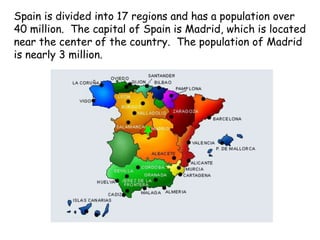
Spain is divided into 17 regions and has a population over
40 million. The capital of Spain is Madrid, which is located
near the center of the country. The population of Madrid
is nearly 3 million.
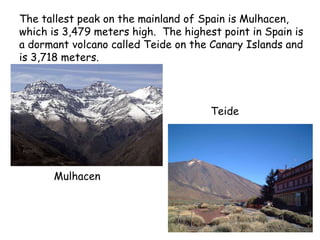
The tallest peak on the mainland of Spain is Mulhacen,
which is 3,479 meters high. The highest point in Spain is
a dormant volcano called Teide on the Canary Islands and
is 3,718 meters.
Mulhacen
Teide
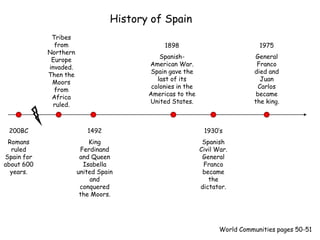
History of Spain
World Communities pages 50-51
200BC
Romans
ruled
Spain for
about 600
years.
Tribes
from
Northern
Europe
invaded.
Then the
Moors
from
Africa
ruled.
1492
King
Ferdinand
and Queen
Isabella
united Spain
and
conquered
the Moors.
1898
Spanish-
American War.
Spain gave the
last of its
colonies in the
Americas to the
United States.
1930’s
Spanish
Civil War.
General
Franco
became
the
dictator.
1975
General
Franco
died and
Juan
Carlos
became
the king.
GOVERNMENT
United States Spain
World Communities pages 52-53
Flag of Spain
The Spanish flag is mostly red and yellow with a picture of
the Spanish coat of arms on the yellow band. On the coat
of arms are a three towered castle and a lion.
World Communities page 53
World Communities pages 54-55
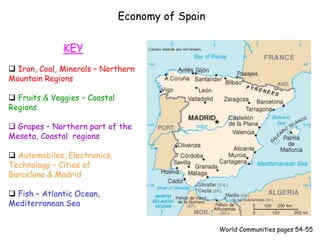
Economy of Spain
KEY
 Iron, Coal, Minerals – Northern
Mountain Regions
 Fruits & Veggies – Coastal
Regions
 Grapes – Northern part of the
Meseta, Coastal regions
 Automobiles, Electronics,
Technology – Cities of
Barcelona & Madrid
 Fish – Atlantic Ocean,
Mediterranean Sea
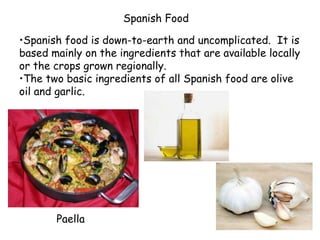
Spanish Food
•Spanish food is down-to-earth and uncomplicated. It is
based mainly on the ingredients that are available locally
or the crops grown regionally.
•The two basic ingredients of all Spanish food are olive
oil and garlic.
Paella
Flamenco
•Flamenco is a folk art around 200 years old. It is from
Southern Spain.
•Song, dance, and guitar are blended into rhythms that
are often improvised and spontaneous.
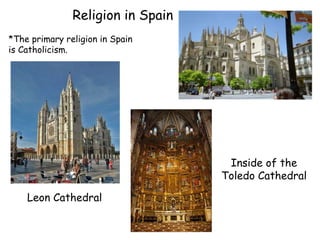
Religion in Spain
Leon Cathedral
*The primary religion in Spain
is Catholicism.
Inside of the
Toledo Cathedral
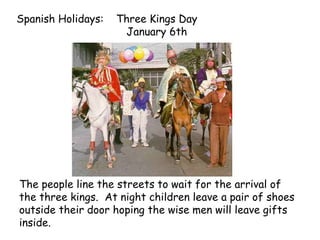
Spanish Holidays: Three Kings Day
January 6th
The people line the streets to wait for the arrival of
the three kings. At night children leave a pair of shoes
outside their door hoping the wise men will leave gifts
inside.
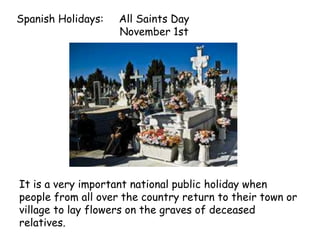
Spanish Holidays: All Saints Day
November 1st
It is a very important national public holiday when
people from all over the country return to their town or
village to lay flowers on the graves of deceased
relatives.
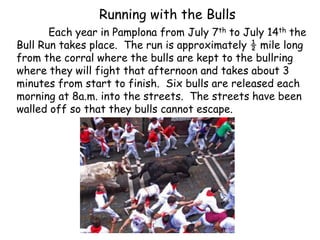
Running with the Bulls
Each year in Pamplona from July 7th to July 14th the
Bull Run takes place. The run is approximately ½ mile long
from the corral where the bulls are kept to the bullring
where they will fight that afternoon and takes about 3
minutes from start to finish. Six bulls are released each
morning at 8a.m. into the streets. The streets have been
walled off so that they bulls cannot escape.
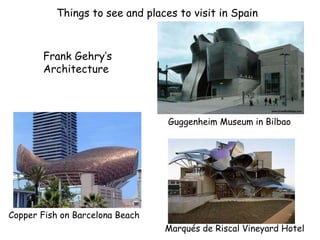
Things to see and places to visit in Spain
Copper Fish on Barcelona Beach
Guggenheim Museum in Bilbao
Frank Gehry’s
Architecture
Marqués de Riscal Vineyard Hotel
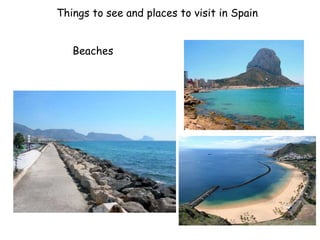
Things to see and places to visit in Spain
Beaches
Things to see and places to visit in Japan
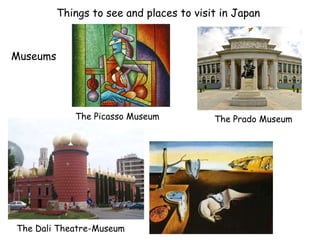
The Dali Theatre-Museum
Museums
The Prado Museum
The Picasso Museum
Things to see and places to visit in Japan
International Music and Dance
Festival of Granada
Merida Theatre
Festival
Local Village
Festivals
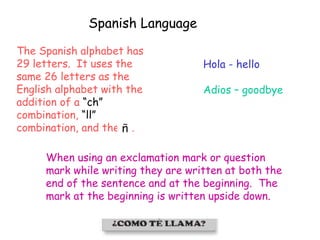
Spanish Language
Hola - hello
Adios – goodbye
The Spanish alphabet has
29 letters. It uses the
same 26 letters as the
English alphabet with the
addition of a “ch”
combination, “ll”
combination, and the .
When using an exclamation mark or question
mark while writing they are written at both the
end of the sentence and at the beginning. The
mark at the beginning is written upside down.

Spain.ppt

  • 3.
  • 4.
  • 5.
    Spain is locatedon in the southwestern part of the continent of Europe. Spain borders Portugal, France, and Andorra. World Communities pages 46-47
  • 6.
    Spain is dividedinto 17 regions and has a population over 40 million. The capital of Spain is Madrid, which is located near the center of the country. The population of Madrid is nearly 3 million.
  • 7.
    The tallest peakon the mainland of Spain is Mulhacen, which is 3,479 meters high. The highest point in Spain is a dormant volcano called Teide on the Canary Islands and is 3,718 meters. Mulhacen Teide
  • 8.
    History of Spain WorldCommunities pages 50-51 200BC Romans ruled Spain for about 600 years. Tribes from Northern Europe invaded. Then the Moors from Africa ruled. 1492 King Ferdinand and Queen Isabella united Spain and conquered the Moors. 1898 Spanish- American War. Spain gave the last of its colonies in the Americas to the United States. 1930’s Spanish Civil War. General Franco became the dictator. 1975 General Franco died and Juan Carlos became the king.
  • 9.
    GOVERNMENT United States Spain WorldCommunities pages 52-53
  • 10.
    Flag of Spain TheSpanish flag is mostly red and yellow with a picture of the Spanish coat of arms on the yellow band. On the coat of arms are a three towered castle and a lion. World Communities page 53
  • 11.
    World Communities pages54-55 Economy of Spain KEY  Iron, Coal, Minerals – Northern Mountain Regions  Fruits & Veggies – Coastal Regions  Grapes – Northern part of the Meseta, Coastal regions  Automobiles, Electronics, Technology – Cities of Barcelona & Madrid  Fish – Atlantic Ocean, Mediterranean Sea
  • 12.
    Spanish Food •Spanish foodis down-to-earth and uncomplicated. It is based mainly on the ingredients that are available locally or the crops grown regionally. •The two basic ingredients of all Spanish food are olive oil and garlic. Paella
  • 13.
    Flamenco •Flamenco is afolk art around 200 years old. It is from Southern Spain. •Song, dance, and guitar are blended into rhythms that are often improvised and spontaneous.
  • 14.
    Religion in Spain LeonCathedral *The primary religion in Spain is Catholicism. Inside of the Toledo Cathedral
  • 15.
    Spanish Holidays: ThreeKings Day January 6th The people line the streets to wait for the arrival of the three kings. At night children leave a pair of shoes outside their door hoping the wise men will leave gifts inside.
  • 16.
    Spanish Holidays: AllSaints Day November 1st It is a very important national public holiday when people from all over the country return to their town or village to lay flowers on the graves of deceased relatives.
  • 17.
    Running with theBulls Each year in Pamplona from July 7th to July 14th the Bull Run takes place. The run is approximately ½ mile long from the corral where the bulls are kept to the bullring where they will fight that afternoon and takes about 3 minutes from start to finish. Six bulls are released each morning at 8a.m. into the streets. The streets have been walled off so that they bulls cannot escape.
  • 18.
    Things to seeand places to visit in Spain Copper Fish on Barcelona Beach Guggenheim Museum in Bilbao Frank Gehry’s Architecture Marqués de Riscal Vineyard Hotel
  • 19.
    Things to seeand places to visit in Spain Beaches
  • 20.
    Things to seeand places to visit in Japan The Dali Theatre-Museum Museums The Prado Museum The Picasso Museum
  • 21.
    Things to seeand places to visit in Japan International Music and Dance Festival of Granada Merida Theatre Festival Local Village Festivals
  • 22.
    Spanish Language Hola -hello Adios – goodbye The Spanish alphabet has 29 letters. It uses the same 26 letters as the English alphabet with the addition of a “ch” combination, “ll” combination, and the . When using an exclamation mark or question mark while writing they are written at both the end of the sentence and at the beginning. The mark at the beginning is written upside down.