Spacesuits.
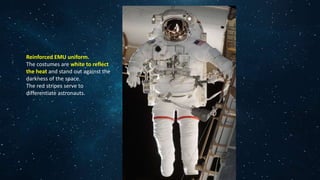
Reinforced EMU uniform.
The costumes are white to reflect
the heat and stand out against the
darkness of the space.
The red stripes serve to
differentiate astronauts.
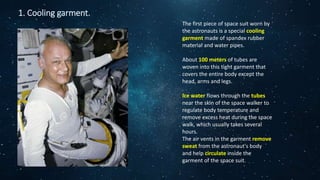
1. Cooling garment.
The first piece of space suit worn by
the astronauts is a special cooling
garment made of spandex rubber
material and water pipes.
About 100 meters of tubes are
woven into this tight garment that
covers the entire body except the
head, arms and legs.
Ice water flows through the tubes
near the skin of the space walker to
regulate body temperature and
remove excess heat during the space
walk, which usually takes several
hours.
The air vents in the garment remove
sweat from the astronaut's body
and help circulate inside the
garment of the space suit.
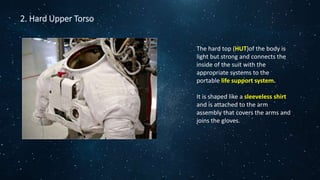
2. Hard Upper Torso
The hard top (HUT)of the body is
light but strong and connects the
inside of the suit with the
appropriate systems to the
portable life support system.
It is shaped like a sleeveless shirt
and is attached to the arm
assembly that covers the arms and
joins the gloves.
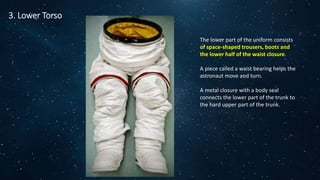
3. Lower Torso
The lower part of the uniform consists
of space-shaped trousers, boots and
the lower half of the waist closure.
A piece called a waist bearing helps the
astronaut move and turn.
A metal closure with a body seal
connects the lower part of the trunk to
the hard upper part of the trunk.
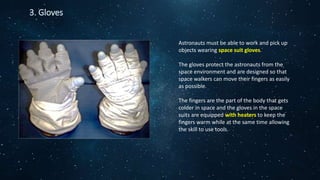
3. Gloves
Astronauts must be able to work and pick up
objects wearing space suit gloves.
The gloves protect the astronauts from the
space environment and are designed so that
space walkers can move their fingers as easily
as possible.
The fingers are the part of the body that gets
colder in space and the gloves in the space
suits are equipped with heaters to keep the
fingers warm while at the same time allowing
the skill to use tools.
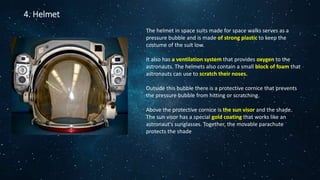
4. Helmet
The helmet in space suits made for space walks serves as a
pressure bubble and is made of strong plastic to keep the
costume of the suit low.
It also has a ventilation system that provides oxygen to the
astronauts. The helmets also contain a small block of foam that
astronauts can use to scratch their noses.
Outside this bubble there is a protective cornice that prevents
the pressure bubble from hitting or scratching.
Above the protective cornice is the sun visor and the shade.
The sun visor has a special gold coating that works like an
astronaut's sunglasses. Together, the movable parachute
protects the shade
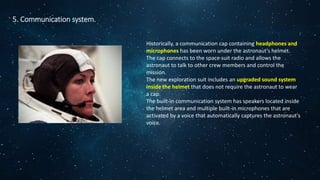
5. Communication system.
Historically, a communication cap containing headphones and
microphones has been worn under the astronaut's helmet.
The cap connects to the space suit radio and allows the
astronaut to talk to other crew members and control the
mission.
The new exploration suit includes an upgraded sound system
inside the helmet that does not require the astronaut to wear
a cap.
The built-in communication system has speakers located inside
the helmet area and multiple built-in microphones that are
activated by a voice that automatically captures the astronaut's
voice.
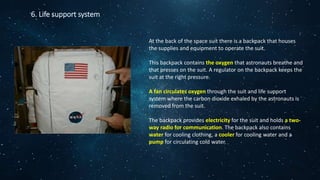
6. Life support system
At the back of the space suit there is a backpack that houses
the supplies and equipment to operate the suit.
This backpack contains the oxygen that astronauts breathe and
that presses on the suit. A regulator on the backpack keeps the
suit at the right pressure.
A fan circulates oxygen through the suit and life support
system where the carbon dioxide exhaled by the astronauts is
removed from the suit.
The backpack provides electricity for the suit and holds a two-
way radio for communication. The backpack also contains
water for cooling clothing, a cooler for cooling water and a
pump for circulating cold water.
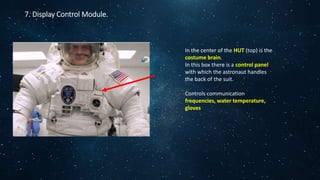
7. Display Control Module.
In the center of the HUT (top) is the
costume brain.
In this box there is a control panel
with which the astronaut handles
the back of the suit.
Controls communication
frequencies, water temperature,
gloves
https://www.youtube.com/watch?v=RWpItu8JGFM
https://www.youtube.com/watch?v=VsdoJy8rzZg
https://www.youtube.com/watch?v=dDw7GDvcV9o
Sources:
https://www.nasa.gov/audience
/foreducators/spacesuits/home/
clickable_suit_nf.html
And the videos below.

Spacesuits.pptx

  • 1.
  • 2.
    Reinforced EMU uniform. Thecostumes are white to reflect the heat and stand out against the darkness of the space. The red stripes serve to differentiate astronauts.
  • 3.
    1. Cooling garment. Thefirst piece of space suit worn by the astronauts is a special cooling garment made of spandex rubber material and water pipes. About 100 meters of tubes are woven into this tight garment that covers the entire body except the head, arms and legs. Ice water flows through the tubes near the skin of the space walker to regulate body temperature and remove excess heat during the space walk, which usually takes several hours. The air vents in the garment remove sweat from the astronaut's body and help circulate inside the garment of the space suit.
  • 4.
    2. Hard UpperTorso The hard top (HUT)of the body is light but strong and connects the inside of the suit with the appropriate systems to the portable life support system. It is shaped like a sleeveless shirt and is attached to the arm assembly that covers the arms and joins the gloves.
  • 5.
    3. Lower Torso Thelower part of the uniform consists of space-shaped trousers, boots and the lower half of the waist closure. A piece called a waist bearing helps the astronaut move and turn. A metal closure with a body seal connects the lower part of the trunk to the hard upper part of the trunk.
  • 6.
    3. Gloves Astronauts mustbe able to work and pick up objects wearing space suit gloves. The gloves protect the astronauts from the space environment and are designed so that space walkers can move their fingers as easily as possible. The fingers are the part of the body that gets colder in space and the gloves in the space suits are equipped with heaters to keep the fingers warm while at the same time allowing the skill to use tools.
  • 7.
    4. Helmet The helmetin space suits made for space walks serves as a pressure bubble and is made of strong plastic to keep the costume of the suit low. It also has a ventilation system that provides oxygen to the astronauts. The helmets also contain a small block of foam that astronauts can use to scratch their noses. Outside this bubble there is a protective cornice that prevents the pressure bubble from hitting or scratching. Above the protective cornice is the sun visor and the shade. The sun visor has a special gold coating that works like an astronaut's sunglasses. Together, the movable parachute protects the shade
  • 8.
    5. Communication system. Historically,a communication cap containing headphones and microphones has been worn under the astronaut's helmet. The cap connects to the space suit radio and allows the astronaut to talk to other crew members and control the mission. The new exploration suit includes an upgraded sound system inside the helmet that does not require the astronaut to wear a cap. The built-in communication system has speakers located inside the helmet area and multiple built-in microphones that are activated by a voice that automatically captures the astronaut's voice.
  • 9.
    6. Life supportsystem At the back of the space suit there is a backpack that houses the supplies and equipment to operate the suit. This backpack contains the oxygen that astronauts breathe and that presses on the suit. A regulator on the backpack keeps the suit at the right pressure. A fan circulates oxygen through the suit and life support system where the carbon dioxide exhaled by the astronauts is removed from the suit. The backpack provides electricity for the suit and holds a two- way radio for communication. The backpack also contains water for cooling clothing, a cooler for cooling water and a pump for circulating cold water.
  • 10.
    7. Display ControlModule. In the center of the HUT (top) is the costume brain. In this box there is a control panel with which the astronaut handles the back of the suit. Controls communication frequencies, water temperature, gloves
  • 11.