Canadian Space Summit
                                          November 21 - 23, 2008
                                         Montreal, Quebec, Canada

   CREATING A ROBUST CANADIAN SPACE RESEARCH, EXPLORATION & DEVELOPMENT
    INDUSTRY - THE CANADIAN MINERAL INDUSTRY FLOW-THROUGH SHARE ANALOG

                       John Chapman, Nadeem Ghafoor, Christian Sallaberger, Frank Teti

Financing of space research, exploration and development in the past has been mainly by governments. To create
a vibrant and sustainable space program, the private sector needs to be aggressively involved, building upon the
foundation established mainly by the USA and Soviet Union governments. There is an analog that could point the
way to rapidly opening space to private enterprise – that is the Canadian flow-through tax incentive for mineral
exploration. The flow-through tax credit program in Canada has facilitated the raising of billions of dollars
annually by mineral exploration companies, mainly from wealthy individuals, and this has kept Canada in the
forefront of world mineral exploration and mine development. In addition, Canada has, through this tax incentive,
developed a large base of experts in science, technology, legal, accounting, finance, etc. for mineral exploration
and mine development world wide. Statistics from the 2005 Canadian intergovernmental working group on the
mineral industry reported:
     1. Canada continues to be the foremost destination for exploration capital globally. In 2004, some 20% of
         the mineral exploration programs planned by the world’s mining companies were expected to be
         conducted in Canada. As for Canadian companies, they were expected to undertake 43% of all the
         exploration programs in the world in 2004, a share that is by far the largest of the global mineral
         exploration market.
     2. In 2003, C$12.7 billion in equity financing was raised for mineral exploration and development projects
         around the world. More than 45% of the new funds were raised by companies listed on Canadian stock
         exchanges.
These are amazing statistics as Canada represents only 7% of the land area on Earth and only 0.5% of the world’s
population. It is important to understand the details of the tax-driven incentive that encourages the exploration
and development of Canadian natural resources. The government allows Canadian natural resource companies to
issue common shares that entitle the holder to certain tax benefits. These shares are called flow-through shares.
Canadian natural resource companies have certain expenses, known as Canadian Exploration Expenses (CEE),
which can be deducted 100% for tax purposes by the purchasers of flow-through shares. The company’s tax
deductions are “flowed through” to the investor. In addition to benefiting a taxpayer in the current taxation year,
these tax deductions can be carried back three years and carried forward seven years. There is also a 15% tax
credit available to Canadian investors for "grass roots" mining exploration expenses incurred in Canada. This
applies only to exploration for metals and minerals and not for extraction of oil and gas. For investors in every
province and territory of Canada, the tax credit is at least 15% as long as the "grass roots" mining exploration
occurs somewhere in Canada. In addition, some (but not all) of the provinces and territories have added their own
tax credit, ranging from 5% in Ontario to 20% in British Columbia. The provincial tax credit only applies if the
investor is resident in the province and the exploration occurs in the same province. In addition to benefiting a
taxpayer in the current taxation year, these tax credits can be carried back three years and carried forward 10
years. Just imagine the impact of countries such as Canada and the USA adopting a similar tax-driven incentive
for space research, exploration and development – tens of billions of private dollars could be raised annually for
space enterprises.

                                                   AUTHORS

John A. Chapman, B.Sc., P.Eng., FCIM, Principal J.A. Chapman Mining Services, is a Professional Mining
Engineer (British Columbia). He has worked for 42 years in the mining industry in mineral exploration, mine
development, operations, and engineering and as an executive. He has been involved in the financing of many
high risk mineral exploration and mine development ventures.
Nadeem Ghafoor, Ph.D., Manager of Planetary Exploration at MDA, Canada’s largest space company. His
background is in both planetary science and spacecraft engineering.

Christian Sallaberger, Ph.D.,Vice President & Director of Space Exploration at MDA. Previously held positions at
the European Space Agency and the Canadian Space Agency, where he initiated Canada's Space Exploration
program.

Frank Teti, P.Eng., MBA, Manager of Autonomous Robotics at MDA. His background includes the development
of manned and unmanned systems for space and terrestrial applications.
CREATING A ROBUST CANADIAN SPACE RESEARCH, 
    EXPLORATION & DEVELOPMENT INDUSTRY

THE CANADIAN MINERAL INDUSTRY FLOW‐THROUGH 
               SHARE ANALOG


        John Chapman, Principal, J.A. Chapman Mining Services
          Frank Teti, Manager of Autonomous Robotics, MDA
       Nadeem Ghafoor, Manager of Planetary Exploration, MDA
     Christian Sallaberger, VP and Director Space Exploration, MDA


                     CANADIAN SPACE SUMMIT 
                      NOVEMBER 21 ‐ 23, 2008
                    MONTREAL, QUEBEC, CANADA 
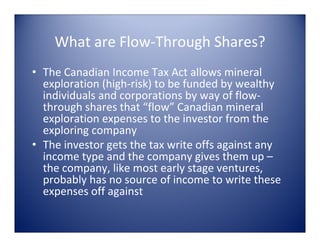
What are Flow‐Through Shares?
• The Canadian Income Tax Act allows mineral 
  exploration (high‐risk) to be funded by wealthy 
  individuals and corporations by way of flow‐
  through shares that “flow” Canadian mineral 
  exploration expenses to the investor from the 
  exploring company  
• The investor gets the tax write offs against any 
  income type and the company gives them up –
  the company, like most early stage ventures, 
  probably has no source of income to write these 
  expenses off against
Proposal
• Canadian government can support space exploration in 
  Canada without need for new funding or budget request
• Apply flow through tax credits to space exploration
• Create whole new set of world‐class industries and 
  capabilities in Canada
   – High tech jobs
   – Spinoffs
   – Tax sources
   – Education
• Canada is a world‐leader in mining 
• Canada can be a world leader in space exploration
High Risk / High Reward Ventures
• Mineral Exploration is probably the riskiest business on 
  the planet
• At very long odds, from time to time, immense wealth is 
  created by a mineral deposit discovery
• The Canadian government for many years has recognized 
  that having a tax incentive for mineral exploration 
  creates great wealth for the country
• Success is related to the: project, team and financing
Spin‐Off Benefits
• The Canadian flow‐through policy has created a 
  World‐Class base, in Canada, of:
  – Mineral finance institutions and stock exchanges
  – A very large base of internationally respected mineral 
    specialists in the fields of:
     •   Geosciences
     •   Mining 
     •   Exploration and Development Financial Analyses
     •   Accounting
     •   Legal
     •   Manufacturing and Supplies
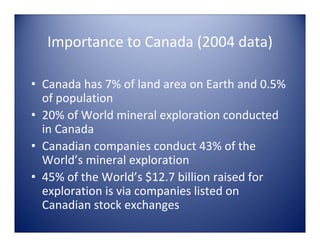
Importance to Canada (2004 data)

• Canada has 7% of land area on Earth and 0.5% 
  of population
• 20% of World mineral exploration conducted 
  in Canada
• Canadian companies conduct 43% of the 
  World’s mineral exploration
• 45% of the World’s $12.7 billion raised for 
  exploration is via companies listed on 
  Canadian stock exchanges
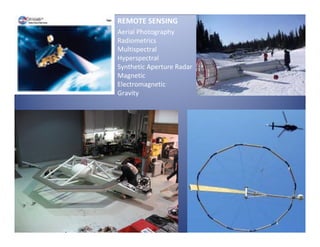
REMOTE SENSING
Aerial Photography
Radiometrics
Multispectral
Hyperspectral
Synthetic Aperture Radar
Magnetic
Electromagnetic
Gravity
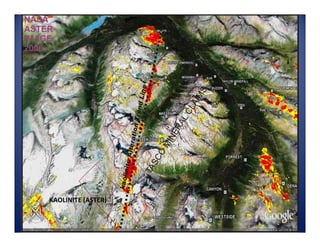
KAOLINITE (ASTER)
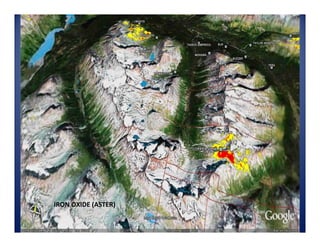
IRON OXIDE (ASTER)
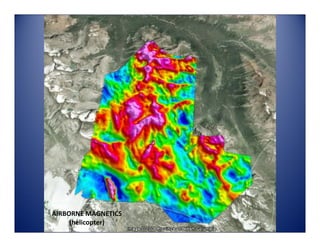
AIRBORNE MAGNETICS
     (helicopter)
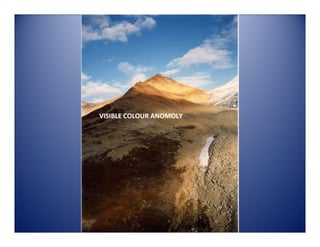
VISIBLE COLOUR ANOMOLY
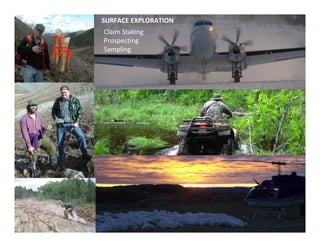
SURFACE EXPLORATION
Claim Staking
Prospecting
Sampling
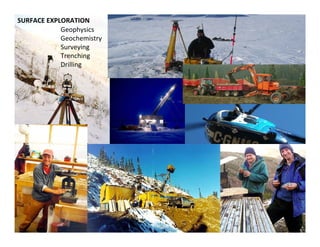
SURFACE EXPLORATION
            Geophysics
            Geochemistry
            Surveying
            Trenching
            Drilling
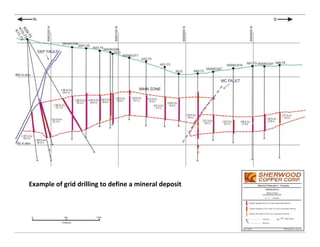
Example of grid drilling to define a mineral deposit
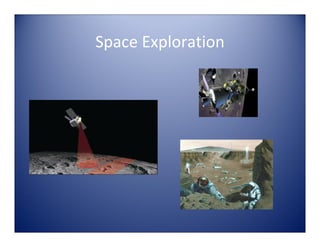
Space Exploration
Degree of Realism
• Any planetary body (Moon, asteroids)
• Already there are existing businesses involved 
  (Shackleton, Lunar Transporation Systems, 
  Jamestown Group, etc)
• MDA is involved  
   – Prime contractor for Odyssey Moon to deliver 5 
     commercial landed mission to moon
   – Prime contractor to another commercial customer for  
     planetary mining mission concept development
• Most large space primes are involved and/or 
  reviewing these opportunities
Planetary Resources
• Use on the Moon
   – Oxygen from Silicon Oxide 
      • for use by humans and for fuel
   – Water (bring up Hydrogen)
   – Methane (fuel source)
   – Silicon to build solar power arrays
• Return to Earth
   – He3 (use in nuclear fusion, extremely rare on Earth)
   – Iron, copper
   – Precious metals (platinum)
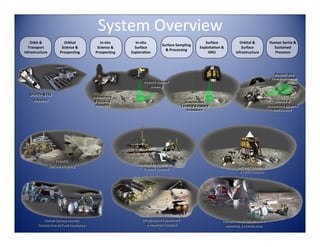
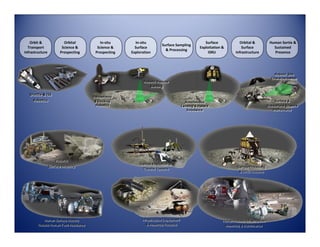
System Overview
    Orbit &              Orbital             In‐situ      In‐situ                                       Surface             Orbital &             Human Sortie & 
                                                                           Surface Sampling 
  Transport             Science &          Science &      Surface                                    Exploitation &           Surface               Sustained 
                                                                             & Processing
infrastructure         Prospecting        Prospecting   Exploration                                       ISRU            Infrastructure            Presence


                                                                                                                                                     Robotic Site
                                                                                                                                                     Robotic Site
                                                                                                                                                   Characterisation
                                                                                                                                                   Characterisation
                                                               Robotic Remote
                                                               Robotic Remote
                                                                  Sensing
                                                                  Sensing

   Shuttle & ISS 
   Shuttle & ISS                         Rendezvous
                                         Rendezvous
     Robotics
     Robotics                             & Docking
                                          & Docking                                          Autonomous                                               Surface &
                                                                                                                                                      Surface &
                                                                                             Autonomous
                                          Robotics
                                           Robotics                                        Landing & Hazard
                                                                                           Landing & Hazard                                      Subsurface Science
                                                                                                                                                 Subsurface Science
                                                                                              Avoidance
                                                                                              Avoidance                                             Instruments
                                                                                                                                                     Instruments


                     Robotic 
                      Robotic 
                                                             Sample Acquisition &
                                                             Sample Acquisition &
                 Surface Mobility
                 Surface Mobility                                                                                          Sample Processing
                                                                                                                           Sample Processing
                                                               Transfer Systems
                                                               Transfer Systems
                                                                                                                            & ISRU Robotics
                                                                                                                            & ISRU Robotics


           Human Surface Mobility
           Human Surface Mobility                             Infrastructure Deployment
                                                               Infrastructure Deployment                          Human-Robotic Infrastructure
                                                                                                                  Human-Robotic Infrastructure
        Robotic Human Field Assistance
        Robotic Human Field Assistance                            & Assembly Robotics
                                                                  & Assembly Robotics                              Assembly & Maintenance
                                                                                                                    Assembly & Maintenance
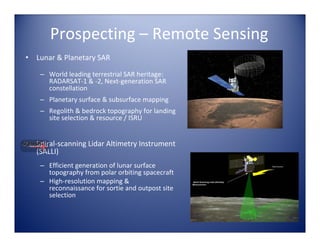
Prospecting – Remote Sensing
•   Lunar & Planetary SAR

     – World leading terrestrial SAR heritage:  
       RADARSAT‐1 & ‐2, Next‐generation SAR 
       constellation
     – Planetary surface & subsurface mapping
     – Regolith & bedrock topography for landing 
       site selection & resource / ISRU


•   Spiral‐scanning Lidar Altimetry Instrument 
    (SALLI)
     – Efficient generation of lunar surface 
       topography from polar orbiting spacecraft
     – High‐resolution mapping & 
       reconnaissance for sortie and outpost site 
       selection
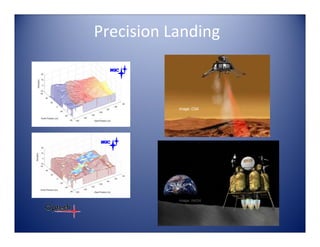
Precision Landing


           Image: CSA


           Image: NASA
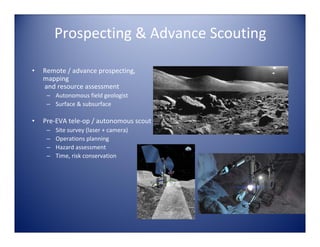
Prospecting & Advance Scouting

•   Remote / advance prospecting, 
    mapping
    and resource assessment
     – Autonomous field geologist
     – Surface & subsurface

•   Pre‐EVA tele‐op / autonomous scout 
     –   Site survey (laser + camera)
     –   Operations planning
     –   Hazard assessment
     –   Time, risk conservation
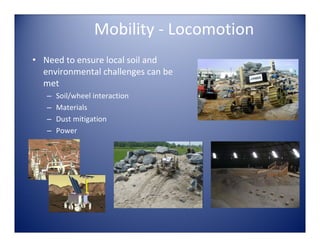
Mobility ‐ Locomotion
• Need to ensure local soil and 
  environmental challenges can be 
  met
   –   Soil/wheel interaction
   –   Materials
   –   Dust mitigation
   –   Power
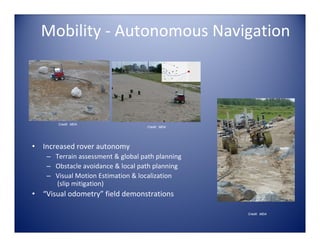
Mobility ‐ Autonomous Navigation


        Credit: MDA
                                     Credit: MDA


•   Increased rover autonomy 
     – Terrain assessment & global path planning
     – Obstacle avoidance & local path planning
     – Visual Motion Estimation & localization
       (slip mitigation)
•   “Visual odometry” field demonstrations

                                                   Credit: MDA
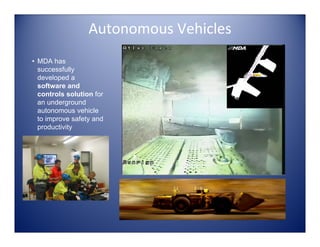
Autonomous Vehicles
• MDA has
  successfully
  developed a
  software and
  controls solution for
  an underground
  autonomous vehicle
  to improve safety and
  productivity
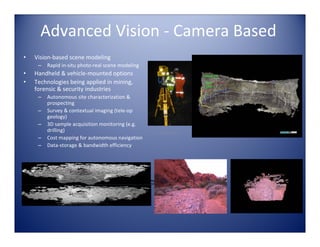
Advanced Vision ‐ Camera Based
•   Vision‐based scene modeling
     –   Rapid in‐situ photo‐real scene modeling
•   Handheld & vehicle‐mounted options
•   Technologies being applied in mining, 
    forensic & security industries
     –   Autonomous site characterization & 
         prospecting
     –   Survey & contextual imaging (tele‐op 
         geology)
     –   3D sample acquisition monitoring (e.g. 
         drilling)                                                    Credit: MDA
     –   Cost mapping for autonomous navigation
     –   Data‐storage & bandwidth efficiency


                                                  Triangular Mesh
                                                                                           QuickTime™ and a                  QuickTime™ and a
                                                       (no texture)                  YUV420 codec decompressor
                                                                                    are needed to see this picture.
                                                                                                                       YUV420 codec decompressor
                                                                                                                      are needed to see this picture.


                                           Triangular Mesh
                                            (texture added)
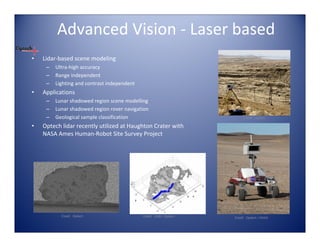
Advanced Vision ‐ Laser based
•   Lidar‐based scene modeling
     –   Ultra‐high accuracy
     –   Range independent
     –   Lighting and contrast independent
•   Applications 
     –   Lunar shadowed region scene modelling
     –   Lunar shadowed region rover navigation
     –   Geological sample classification                                Credit: Optech

•   Optech lidar recently utilized at Haughton Crater with 
    NASA Ames Human‐Robot Site Survey Project
                                                                            Credit: CSA


           Credit: Optech                    Credit: UNB / Optech   Credit: Optech / NASA
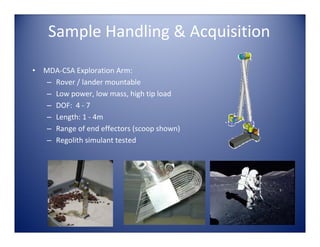
Sample Handling & Acquisition

•   MDA‐CSA Exploration Arm:
     – Rover / lander mountable
     – Low power, low mass, high tip load
     – DOF:  4 ‐ 7 
     – Length: 1 ‐ 4m
     – Range of end effectors (scoop shown)
     – Regolith simulant tested
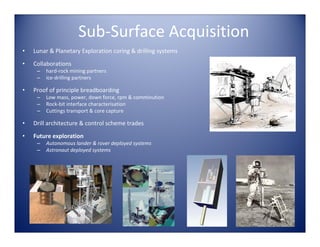
Sub‐Surface Acquisition
•   Lunar & Planetary Exploration coring & drilling systems
•   Collaborations
     –   hard‐rock mining partners
     –   ice‐drilling partners

•   Proof of principle breadboarding
     –   Low mass, power, down force, rpm & comminution
     –   Rock‐bit interface characterisation
     –   Cuttings transport & core capture

•   Drill architecture & control scheme trades
•   Future exploration
     –   Autonomous lander & rover deployed systems
     –   Astronaut deployed systems
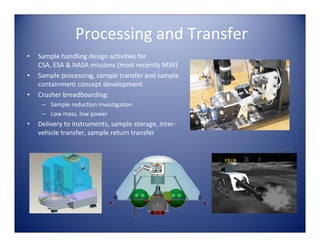
Processing and Transfer
•   Sample handling design activities for 
    CSA, ESA & NASA missions (most recently MSR)
•   Sample processing, sample transfer and sample 
    containment concept development
•   Crusher breadboarding:
     – Sample reduction investigation
     – Low mass, low power
•   Delivery to instruments, sample storage, inter‐
    vehicle transfer, sample return transfer

                                                      Image: NASA
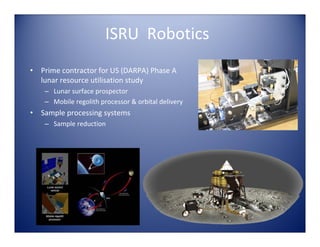
ISRU  Robotics
•   Prime contractor for US (DARPA) Phase A 
    lunar resource utilisation study
     – Lunar surface prospector
     – Mobile regolith processor & orbital delivery
•   Sample processing systems
     – Sample reduction
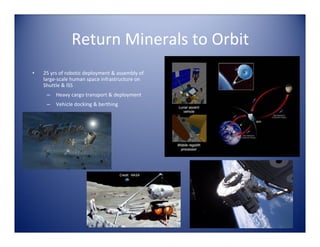
Return Minerals to Orbit
•   25 yrs of robotic deployment & assembly of 
    large‐scale human space infrastructure on 
    Shuttle & ISS
     –   Heavy cargo transport & deployment
     –   Vehicle docking & berthing


                                      Credit: NASA
Orbit &              Orbital             In‐situ      In‐situ                                       Surface             Orbital &             Human Sortie & 
                                                                           Surface Sampling 
  Transport             Science &          Science &      Surface                                    Exploitation &           Surface               Sustained 
                                                                             & Processing
infrastructure         Prospecting        Prospecting   Exploration                                       ISRU            Infrastructure            Presence


                                                                                                                                                     Robotic Site
                                                                                                                                                     Robotic Site
                                                                                                                                                   Characterisation
                                                                                                                                                   Characterisation
                                                               Robotic Remote
                                                               Robotic Remote
                                                                  Sensing
                                                                  Sensing

   Shuttle & ISS 
   Shuttle & ISS                         Rendezvous
                                         Rendezvous
     Robotics
     Robotics                             & Docking
                                          & Docking                                          Autonomous                                               Surface &
                                                                                                                                                      Surface &
                                                                                             Autonomous
                                          Robotics
                                           Robotics                                        Landing & Hazard
                                                                                           Landing & Hazard                                      Subsurface Science
                                                                                                                                                 Subsurface Science
                                                                                              Avoidance
                                                                                              Avoidance                                             Instruments
                                                                                                                                                     Instruments


                     Robotic 
                      Robotic 
                                                             Sample Acquisition &
                                                             Sample Acquisition &
                 Surface Mobility
                 Surface Mobility                                                                                          Sample Processing
                                                                                                                           Sample Processing
                                                               Transfer Systems
                                                               Transfer Systems
                                                                                                                            & ISRU Robotics
                                                                                                                            & ISRU Robotics


           Human Surface Mobility
           Human Surface Mobility                             Infrastructure Deployment
                                                               Infrastructure Deployment                          Human-Robotic Infrastructure
                                                                                                                  Human-Robotic Infrastructure
        Robotic Human Field Assistance
        Robotic Human Field Assistance                            & Assembly Robotics
                                                                  & Assembly Robotics                              Assembly & Maintenance
                                                                                                                    Assembly & Maintenance
Conclusion
• Robotics systems have supported sustainable human 
  space exploration infrastructure for 30 yrs

• Scouts, field‐scientists and prospectors for planetary 
  have been provided by robotic systems

• Many key technologies exist now that will form the 
  basis of the early human‐robotic activities on the lunar 
  surface
RECOMMENDATION
• Canada has a large and successful mineral exploration 
  science, technology and financial base already 
  established, that could be used as a solid foundation 
  for human lunar and planetary mineral exploration and 
  development
• The Canadian federal government should now extend 
  the mineral flow‐through financing tax incentive to 
  space research, exploration and development
• This tax policy would position Canada as a leader in 
  space research, exploration and development, with all 
  its spin‐off benefits, similar to those accrued from the 
  present Canadian mineral industry tax policy
Space financing montreal canada space summit 2008

Space financing montreal canada space summit 2008

  • 1.
    Canadian Space Summit November 21 - 23, 2008 Montreal, Quebec, Canada CREATING A ROBUST CANADIAN SPACE RESEARCH, EXPLORATION & DEVELOPMENT INDUSTRY - THE CANADIAN MINERAL INDUSTRY FLOW-THROUGH SHARE ANALOG John Chapman, Nadeem Ghafoor, Christian Sallaberger, Frank Teti Financing of space research, exploration and development in the past has been mainly by governments. To create a vibrant and sustainable space program, the private sector needs to be aggressively involved, building upon the foundation established mainly by the USA and Soviet Union governments. There is an analog that could point the way to rapidly opening space to private enterprise – that is the Canadian flow-through tax incentive for mineral exploration. The flow-through tax credit program in Canada has facilitated the raising of billions of dollars annually by mineral exploration companies, mainly from wealthy individuals, and this has kept Canada in the forefront of world mineral exploration and mine development. In addition, Canada has, through this tax incentive, developed a large base of experts in science, technology, legal, accounting, finance, etc. for mineral exploration and mine development world wide. Statistics from the 2005 Canadian intergovernmental working group on the mineral industry reported: 1. Canada continues to be the foremost destination for exploration capital globally. In 2004, some 20% of the mineral exploration programs planned by the world’s mining companies were expected to be conducted in Canada. As for Canadian companies, they were expected to undertake 43% of all the exploration programs in the world in 2004, a share that is by far the largest of the global mineral exploration market. 2. In 2003, C$12.7 billion in equity financing was raised for mineral exploration and development projects around the world. More than 45% of the new funds were raised by companies listed on Canadian stock exchanges. These are amazing statistics as Canada represents only 7% of the land area on Earth and only 0.5% of the world’s population. It is important to understand the details of the tax-driven incentive that encourages the exploration and development of Canadian natural resources. The government allows Canadian natural resource companies to issue common shares that entitle the holder to certain tax benefits. These shares are called flow-through shares. Canadian natural resource companies have certain expenses, known as Canadian Exploration Expenses (CEE), which can be deducted 100% for tax purposes by the purchasers of flow-through shares. The company’s tax deductions are “flowed through” to the investor. In addition to benefiting a taxpayer in the current taxation year, these tax deductions can be carried back three years and carried forward seven years. There is also a 15% tax credit available to Canadian investors for "grass roots" mining exploration expenses incurred in Canada. This applies only to exploration for metals and minerals and not for extraction of oil and gas. For investors in every province and territory of Canada, the tax credit is at least 15% as long as the "grass roots" mining exploration occurs somewhere in Canada. In addition, some (but not all) of the provinces and territories have added their own tax credit, ranging from 5% in Ontario to 20% in British Columbia. The provincial tax credit only applies if the investor is resident in the province and the exploration occurs in the same province. In addition to benefiting a taxpayer in the current taxation year, these tax credits can be carried back three years and carried forward 10 years. Just imagine the impact of countries such as Canada and the USA adopting a similar tax-driven incentive for space research, exploration and development – tens of billions of private dollars could be raised annually for space enterprises. AUTHORS John A. Chapman, B.Sc., P.Eng., FCIM, Principal J.A. Chapman Mining Services, is a Professional Mining Engineer (British Columbia). He has worked for 42 years in the mining industry in mineral exploration, mine development, operations, and engineering and as an executive. He has been involved in the financing of many high risk mineral exploration and mine development ventures.
  • 2.
    Nadeem Ghafoor, Ph.D.,Manager of Planetary Exploration at MDA, Canada’s largest space company. His background is in both planetary science and spacecraft engineering. Christian Sallaberger, Ph.D.,Vice President & Director of Space Exploration at MDA. Previously held positions at the European Space Agency and the Canadian Space Agency, where he initiated Canada's Space Exploration program. Frank Teti, P.Eng., MBA, Manager of Autonomous Robotics at MDA. His background includes the development of manned and unmanned systems for space and terrestrial applications.
  • 3.
    CREATING A ROBUST CANADIAN SPACE RESEARCH,  EXPLORATION & DEVELOPMENT INDUSTRY THE CANADIAN MINERAL INDUSTRY FLOW‐THROUGH  SHARE ANALOG John Chapman, Principal, J.A. Chapman Mining Services Frank Teti, Manager of Autonomous Robotics, MDA Nadeem Ghafoor, Manager of Planetary Exploration, MDA Christian Sallaberger, VP and Director Space Exploration, MDA CANADIAN SPACE SUMMIT  NOVEMBER 21 ‐ 23, 2008 MONTREAL, QUEBEC, CANADA 
  • 4.
    What are Flow‐Through Shares? • The Canadian Income Tax Act allows mineral  exploration (high‐risk) to be funded by wealthy  individuals and corporations by way of flow‐ through shares that “flow” Canadian mineral  exploration expenses to the investor from the  exploring company   • The investor gets the tax write offs against any  income type and the company gives them up – the company, like most early stage ventures,  probably has no source of income to write these  expenses off against
  • 5.
    Proposal • Canadian government can support space exploration in  Canada without need for new funding or budget request • Apply flow through tax credits to space exploration • Create whole new set of world‐class industries and  capabilities in Canada – High tech jobs – Spinoffs – Tax sources – Education • Canada is a world‐leader in mining  • Canada can be a world leader in space exploration
  • 6.
    High Risk / High Reward Ventures • Mineral Exploration is probably the riskiest business on  the planet • At very long odds, from time to time, immense wealth is  created by a mineral deposit discovery • The Canadian government for many years has recognized  that having a tax incentive for mineral exploration  creates great wealth for the country • Success is related to the: project, team and financing
  • 7.
    Spin‐Off Benefits • The Canadian flow‐through policy has created a  World‐Class base, in Canada, of: – Mineral finance institutions and stock exchanges – A very large base of internationally respected mineral  specialists in the fields of: • Geosciences • Mining  • Exploration and Development Financial Analyses • Accounting • Legal • Manufacturing and Supplies
  • 8.
    Importance to Canada (2004 data) • Canada has 7% of land area on Earth and 0.5%  of population • 20% of World mineral exploration conducted  in Canada • Canadian companies conduct 43% of the  World’s mineral exploration • 45% of the World’s $12.7 billion raised for  exploration is via companies listed on  Canadian stock exchanges
  • 9.
  • 10.
  • 11.
  • 12.
  • 13.
  • 14.
  • 15.
    SURFACE EXPLORATION Geophysics Geochemistry Surveying Trenching Drilling
  • 16.
  • 17.
  • 18.
    Degree of Realism • Any planetary body (Moon, asteroids) • Already there are existing businesses involved  (Shackleton, Lunar Transporation Systems,  Jamestown Group, etc) • MDA is involved   – Prime contractor for Odyssey Moon to deliver 5  commercial landed mission to moon – Prime contractor to another commercial customer for   planetary mining mission concept development • Most large space primes are involved and/or  reviewing these opportunities
  • 19.
    Planetary Resources • Use on the Moon – Oxygen from Silicon Oxide  • for use by humans and for fuel – Water (bring up Hydrogen) – Methane (fuel source) – Silicon to build solar power arrays • Return to Earth – He3 (use in nuclear fusion, extremely rare on Earth) – Iron, copper – Precious metals (platinum)
  • 20.
    System Overview Orbit &  Orbital  In‐situ  In‐situ Surface  Orbital &  Human Sortie &  Surface Sampling  Transport  Science &  Science &  Surface  Exploitation &  Surface  Sustained  & Processing infrastructure Prospecting Prospecting Exploration ISRU Infrastructure Presence Robotic Site Robotic Site Characterisation Characterisation Robotic Remote Robotic Remote Sensing Sensing Shuttle & ISS  Shuttle & ISS  Rendezvous Rendezvous Robotics Robotics & Docking & Docking Autonomous Surface & Surface & Autonomous Robotics Robotics Landing & Hazard Landing & Hazard Subsurface Science Subsurface Science Avoidance Avoidance Instruments Instruments Robotic  Robotic  Sample Acquisition & Sample Acquisition & Surface Mobility Surface Mobility Sample Processing Sample Processing Transfer Systems Transfer Systems & ISRU Robotics & ISRU Robotics Human Surface Mobility Human Surface Mobility Infrastructure Deployment Infrastructure Deployment Human-Robotic Infrastructure Human-Robotic Infrastructure Robotic Human Field Assistance Robotic Human Field Assistance & Assembly Robotics & Assembly Robotics Assembly & Maintenance Assembly & Maintenance
  • 21.
    Prospecting – Remote Sensing • Lunar & Planetary SAR – World leading terrestrial SAR heritage:   RADARSAT‐1 & ‐2, Next‐generation SAR  constellation – Planetary surface & subsurface mapping – Regolith & bedrock topography for landing  site selection & resource / ISRU • Spiral‐scanning Lidar Altimetry Instrument  (SALLI) – Efficient generation of lunar surface  topography from polar orbiting spacecraft – High‐resolution mapping &  reconnaissance for sortie and outpost site  selection
  • 22.
    Precision Landing Image: CSA Image: NASA
  • 23.
    Prospecting & Advance Scouting • Remote / advance prospecting,  mapping and resource assessment – Autonomous field geologist – Surface & subsurface • Pre‐EVA tele‐op / autonomous scout  – Site survey (laser + camera) – Operations planning – Hazard assessment – Time, risk conservation
  • 24.
    Mobility ‐ Locomotion • Need to ensure local soil and  environmental challenges can be  met – Soil/wheel interaction – Materials – Dust mitigation – Power
  • 25.
    Mobility ‐ Autonomous Navigation Credit: MDA Credit: MDA • Increased rover autonomy  – Terrain assessment & global path planning – Obstacle avoidance & local path planning – Visual Motion Estimation & localization (slip mitigation) • “Visual odometry” field demonstrations Credit: MDA
  • 26.
    Autonomous Vehicles • MDA has successfully developed a software and controls solution for an underground autonomous vehicle to improve safety and productivity
  • 27.
    Advanced Vision ‐ Camera Based • Vision‐based scene modeling – Rapid in‐situ photo‐real scene modeling • Handheld & vehicle‐mounted options • Technologies being applied in mining,  forensic & security industries – Autonomous site characterization &  prospecting – Survey & contextual imaging (tele‐op  geology) – 3D sample acquisition monitoring (e.g.  drilling)  Credit: MDA – Cost mapping for autonomous navigation – Data‐storage & bandwidth efficiency Triangular Mesh QuickTime™ and a QuickTime™ and a (no texture) YUV420 codec decompressor are needed to see this picture. YUV420 codec decompressor are needed to see this picture. Triangular Mesh (texture added)
  • 28.
    Advanced Vision ‐ Laser based • Lidar‐based scene modeling – Ultra‐high accuracy – Range independent – Lighting and contrast independent • Applications  – Lunar shadowed region scene modelling – Lunar shadowed region rover navigation – Geological sample classification Credit: Optech • Optech lidar recently utilized at Haughton Crater with  NASA Ames Human‐Robot Site Survey Project Credit: CSA Credit: Optech Credit: UNB / Optech Credit: Optech / NASA
  • 29.
    Sample Handling & Acquisition • MDA‐CSA Exploration Arm: – Rover / lander mountable – Low power, low mass, high tip load – DOF:  4 ‐ 7  – Length: 1 ‐ 4m – Range of end effectors (scoop shown) – Regolith simulant tested
  • 30.
    Sub‐Surface Acquisition • Lunar & Planetary Exploration coring & drilling systems • Collaborations – hard‐rock mining partners – ice‐drilling partners • Proof of principle breadboarding – Low mass, power, down force, rpm & comminution – Rock‐bit interface characterisation – Cuttings transport & core capture • Drill architecture & control scheme trades • Future exploration – Autonomous lander & rover deployed systems – Astronaut deployed systems
  • 31.
    Processing and Transfer • Sample handling design activities for  CSA, ESA & NASA missions (most recently MSR) • Sample processing, sample transfer and sample  containment concept development • Crusher breadboarding: – Sample reduction investigation – Low mass, low power • Delivery to instruments, sample storage, inter‐ vehicle transfer, sample return transfer Image: NASA
  • 32.
    ISRU  Robotics • Prime contractor for US (DARPA) Phase A  lunar resource utilisation study – Lunar surface prospector – Mobile regolith processor & orbital delivery • Sample processing systems – Sample reduction
  • 33.
    Return Minerals to Orbit • 25 yrs of robotic deployment & assembly of  large‐scale human space infrastructure on  Shuttle & ISS – Heavy cargo transport & deployment – Vehicle docking & berthing Credit: NASA
  • 34.
    Orbit &  Orbital  In‐situ  In‐situ Surface  Orbital &  Human Sortie &  Surface Sampling  Transport  Science &  Science &  Surface  Exploitation &  Surface  Sustained  & Processing infrastructure Prospecting Prospecting Exploration ISRU Infrastructure Presence Robotic Site Robotic Site Characterisation Characterisation Robotic Remote Robotic Remote Sensing Sensing Shuttle & ISS  Shuttle & ISS  Rendezvous Rendezvous Robotics Robotics & Docking & Docking Autonomous Surface & Surface & Autonomous Robotics Robotics Landing & Hazard Landing & Hazard Subsurface Science Subsurface Science Avoidance Avoidance Instruments Instruments Robotic  Robotic  Sample Acquisition & Sample Acquisition & Surface Mobility Surface Mobility Sample Processing Sample Processing Transfer Systems Transfer Systems & ISRU Robotics & ISRU Robotics Human Surface Mobility Human Surface Mobility Infrastructure Deployment Infrastructure Deployment Human-Robotic Infrastructure Human-Robotic Infrastructure Robotic Human Field Assistance Robotic Human Field Assistance & Assembly Robotics & Assembly Robotics Assembly & Maintenance Assembly & Maintenance
  • 35.
    Conclusion • Robotics systems have supported sustainable human  space exploration infrastructure for 30 yrs • Scouts, field‐scientists and prospectors for planetary  have been provided by robotic systems • Many key technologies exist now that will form the  basis of the early human‐robotic activities on the lunar  surface
  • 36.
    RECOMMENDATION • Canada has a large and successful mineral exploration  science, technology and financial base already  established, that could be used as a solid foundation  for human lunar and planetary mineral exploration and  development • The Canadian federal government should now extend  the mineral flow‐through financing tax incentive to  space research, exploration and development • This tax policy would position Canada as a leader in  space research, exploration and development, with all  its spin‐off benefits, similar to those accrued from the  present Canadian mineral industry tax policy