Historical Source
Analysis
A Learning Object designed to help students
analyse and examine sources as evidence.
SourceAnalysis
In History, we study
the facts in order to
piece together our
interpretation of the
past.
SourceAnalysis
In order to
understand the
message conveyed
within a source we
need to look deeply
SourceAnalysis
Historical
Sources are
created for a
Purpose
SourceAnalysis
Sometimes, what
information is missing
from the source is
more important than
what is included
SourceAnalysis
Historical Sources
can be classified as
either Primary or
Secondary source
material
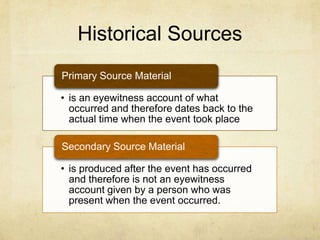
Historical Sources
• is an eyewitness account of what
occurred and therefore dates back to the
actual time when the event took place
Primary Source Material
• is produced after the event has occurred
and therefore is not an eyewitness
account given by a person who was
present when the event occurred.
Secondary Source Material
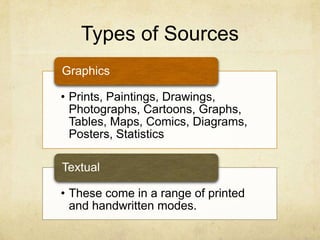
Types of Sources
• Prints, Paintings, Drawings,
Photographs, Cartoons, Graphs,
Tables, Maps, Comics, Diagrams,
Posters, Statistics
Graphics
• These come in a range of printed
and handwritten modes.
Textual
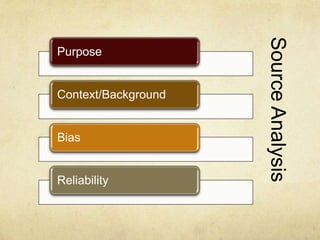
SourceAnalysis
Purpose
Context/Background
Bias
Reliability
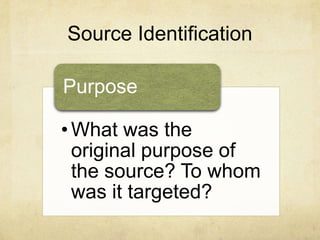
Source Identification
• What was the
original purpose of
the source? To whom
was it targeted?
Purpose
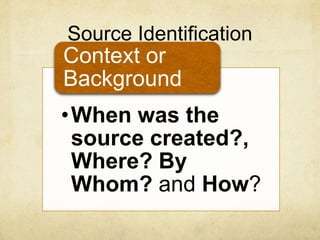
Source Identification
•When was the
source created?,
Where? By
Whom? and How?
Context or
Background
Source Identification
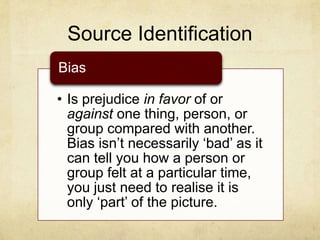
• Is prejudice in favor of or
against one thing, person, or
group compared with another.
Bias isn‟t necessarily „bad‟ as it
can tell you how a person or
group felt at a particular time,
you just need to realise it is
only „part‟ of the picture.
Bias
Source Identification
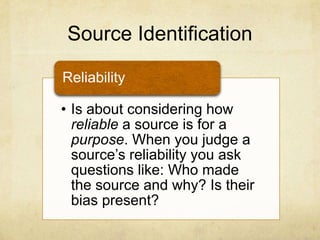
• Is about considering how
reliable a source is for a
purpose. When you judge a
source‟s reliability you ask
questions like: Who made
the source and why? Is their
bias present?
Reliability
• Choose a topic (there
are 5 contained in this
learning object) and in
table format use the
LIST on the next slide
and apply it to the four
sources within the topic.
Task One:
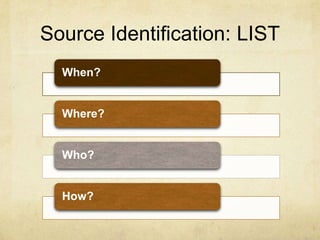
Source Identification: LIST
When?
Where?
Who?
How?
• Choose a topic (there are
5 contained in this
learning object) and in
table format or using
another graphic tool use
the GRID on the next slide
and apply it to the four
sources within the topic.
Task Two:
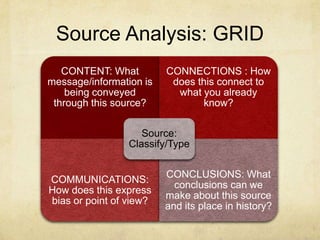
Source Analysis: GRID
CONTENT: What
message/information is
being conveyed
through this source?
CONNECTIONS : How
does this connect to
what you already
know?
COMMUNICATIONS:
How does this express
bias or point of view?
CONCLUSIONS: What
conclusions can we
make about this source
and its place in history?
Source:
Classify/Type
• Choose a topic (there
are 5 contained in this
learning object) and
respond to the
questions on the next
slide in full sentences.
Task Three:
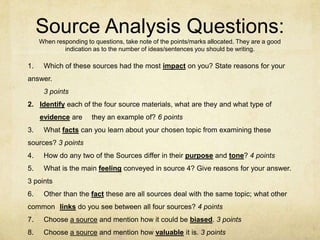
Source Analysis Questions:
When responding to questions, take note of the points/marks allocated. They are a good
indication as to the number of ideas/sentences you should be writing.
1. Which of these sources had the most impact on you? State reasons for your
answer.
3 points
2. Identify each of the four source materials, what are they and what type of
evidence are they an example of? 6 points
3. What facts can you learn about your chosen topic from examining these
sources? 3 points
4. How do any two of the Sources differ in their purpose and tone? 4 points
5. What is the main feeling conveyed in source 4? Give reasons for your answer.
3 points
6. Other than the fact these are all sources deal with the same topic; what other
common links do you see between all four sources? 4 points
7. Choose a source and mention how it could be biased. 3 points
8. Choose a source and mention how valuable it is. 3 points
Source Analysis Topics:
Shogunate Japan
World War I
World War II
The Vietnam War
The Stolen Generation
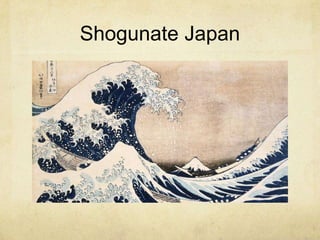
Shogunate Japan
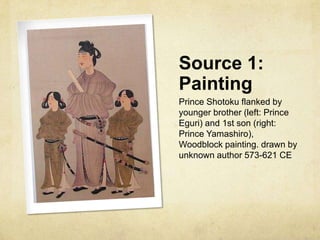
Source 1:
Painting
Prince Shotoku flanked by
younger brother (left: Prince
Eguri) and 1st son (right:
Prince Yamashiro),
Woodblock painting. drawn by
unknown author 573-621 CE
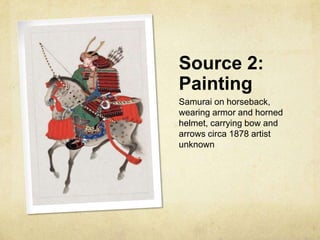
Source 2:
Painting
Samurai on horseback,
wearing armor and horned
helmet, carrying bow and
arrows circa 1878 artist
unknown
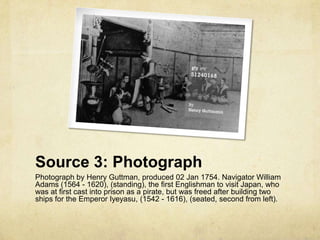
Source 3: Photograph
Photograph by Henry Guttman, produced 02 Jan 1754. Navigator William
Adams (1564 - 1620), (standing), the first Englishman to visit Japan, who
was at first cast into prison as a pirate, but was freed after building two
ships for the Emperor Iyeyasu, (1542 - 1616), (seated, second from left).
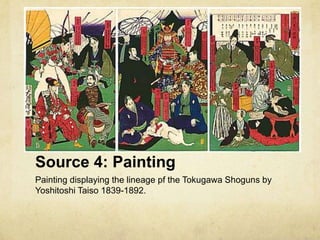
Source 4: Painting
Painting displaying the lineage pf the Tokugawa Shoguns by
Yoshitoshi Taiso 1839-1892.
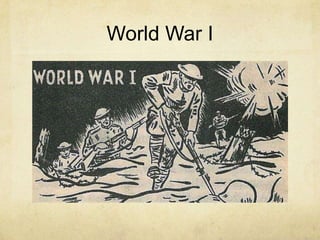
World War I
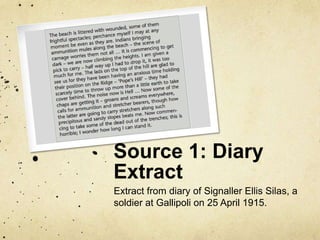
Source 1: Diary
Extract
Extract from diary of Signaller Ellis Silas, a
soldier at Gallipoli on 25 April 1915.
Source 2: Painting
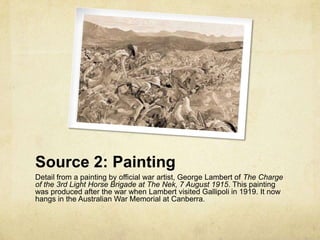
Detail from a painting by official war artist, George Lambert of The Charge
of the 3rd Light Horse Brigade at The Nek, 7 August 1915. This painting
was produced after the war when Lambert visited Gallipoli in 1919. It now
hangs in the Australian War Memorial at Canberra.
Source 3:
Cartoon
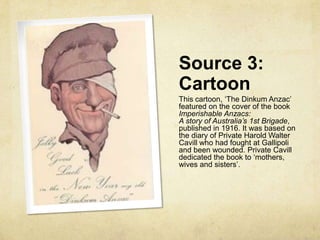
This cartoon, „The Dinkum Anzac‟
featured on the cover of the book
Imperishable Anzacs:
A story of Australia’s 1st Brigade,
published in 1916. It was based on
the diary of Private Harold Walter
Cavill who had fought at Gallipoli
and been wounded. Private Cavill
dedicated the book to „mothers,
wives and sisters‟.
Source 4: Newspaper Article
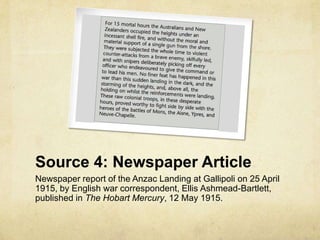
Newspaper report of the Anzac Landing at Gallipoli on 25 April
1915, by English war correspondent, Ellis Ashmead-Bartlett,
published in The Hobart Mercury, 12 May 1915.
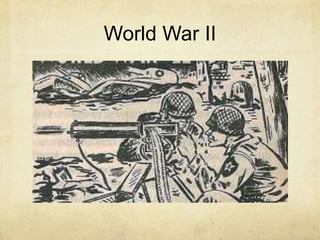
World War II
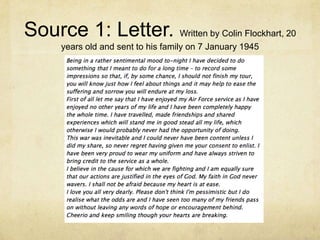
Source 1: Letter. Written by Colin Flockhart, 20
years old and sent to his family on 7 January 1945
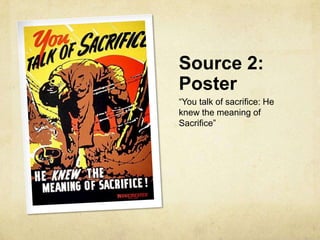
Source 2:
Poster
“You talk of sacrifice: He
knew the meaning of
Sacrifice”
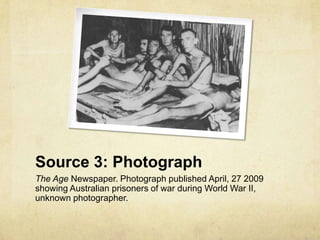
Source 3: Photograph
The Age Newspaper. Photograph published April, 27 2009
showing Australian prisoners of war during World War II,
unknown photographer.
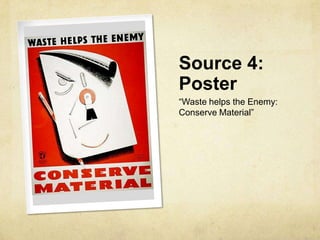
Source 4:
Poster
“Waste helps the Enemy:
Conserve Material”
Vietnam War
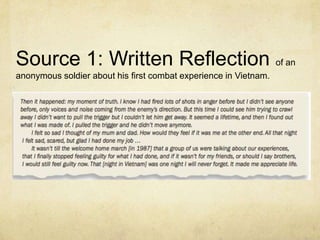
Source 1: Written Reflection of an
anonymous soldier about his first combat experience in Vietnam.
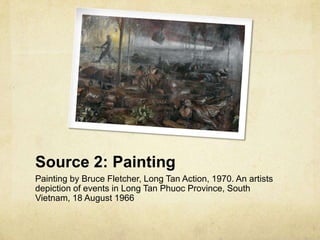
Source 2: Painting
Painting by Bruce Fletcher, Long Tan Action, 1970. An artists
depiction of events in Long Tan Phuoc Province, South
Vietnam, 18 August 1966
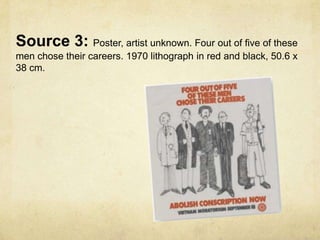
Source 3: Poster, artist unknown. Four out of five of these
men chose their careers. 1970 lithograph in red and black, 50.6 x
38 cm.
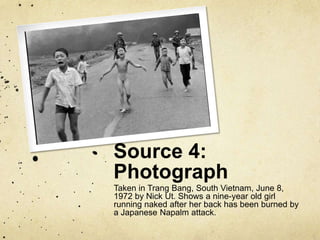
Source 4:
Photograph
Taken in Trang Bang, South Vietnam, June 8,
1972 by Nick Ut. Shows a nine-year old girl
running naked after her back has been burned by
a Japanese Napalm attack.
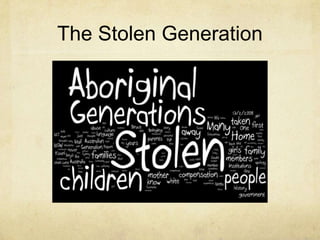
The Stolen Generation
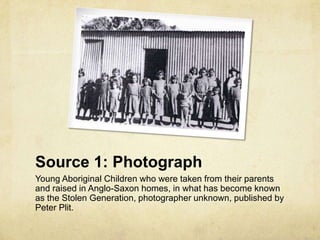
Source 1: Photograph
Young Aboriginal Children who were taken from their parents
and raised in Anglo-Saxon homes, in what has become known
as the Stolen Generation, photographer unknown, published by
Peter Plit.
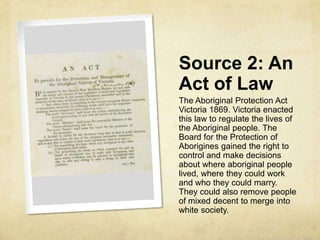
Source 2: An
Act of Law
The Aboriginal Protection Act
Victoria 1869. Victoria enacted
this law to regulate the lives of
the Aboriginal people. The
Board for the Protection of
Aborigines gained the right to
control and make decisions
about where aboriginal people
lived, where they could work
and who they could marry.
They could also remove people
of mixed decent to merge into
white society.
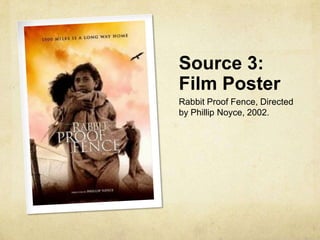
Source 3:
Film Poster
Rabbit Proof Fence, Directed
by Phillip Noyce, 2002.
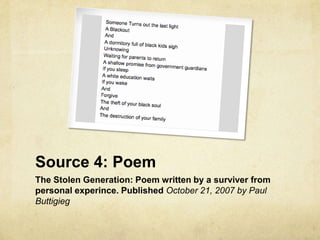
Source 4: Poem
The Stolen Generation: Poem written by a surviver from
personal experince. Published October 21, 2007 by Paul
Buttigieg

A Learning Object created as a homework module on Historical Source Analysis

  • 1.
    Historical Source Analysis A LearningObject designed to help students analyse and examine sources as evidence.
  • 2.
    SourceAnalysis In History, westudy the facts in order to piece together our interpretation of the past.
  • 3.
    SourceAnalysis In order to understandthe message conveyed within a source we need to look deeply
  • 4.
  • 5.
    SourceAnalysis Sometimes, what information ismissing from the source is more important than what is included
  • 6.
    SourceAnalysis Historical Sources can beclassified as either Primary or Secondary source material
  • 7.
    Historical Sources • isan eyewitness account of what occurred and therefore dates back to the actual time when the event took place Primary Source Material • is produced after the event has occurred and therefore is not an eyewitness account given by a person who was present when the event occurred. Secondary Source Material
  • 8.
    Types of Sources •Prints, Paintings, Drawings, Photographs, Cartoons, Graphs, Tables, Maps, Comics, Diagrams, Posters, Statistics Graphics • These come in a range of printed and handwritten modes. Textual
  • 9.
  • 10.
    Source Identification • Whatwas the original purpose of the source? To whom was it targeted? Purpose
  • 11.
    Source Identification •When wasthe source created?, Where? By Whom? and How? Context or Background
  • 12.
    Source Identification • Isprejudice in favor of or against one thing, person, or group compared with another. Bias isn‟t necessarily „bad‟ as it can tell you how a person or group felt at a particular time, you just need to realise it is only „part‟ of the picture. Bias
  • 13.
    Source Identification • Isabout considering how reliable a source is for a purpose. When you judge a source‟s reliability you ask questions like: Who made the source and why? Is their bias present? Reliability
  • 14.
    • Choose atopic (there are 5 contained in this learning object) and in table format use the LIST on the next slide and apply it to the four sources within the topic. Task One:
  • 15.
  • 16.
    • Choose atopic (there are 5 contained in this learning object) and in table format or using another graphic tool use the GRID on the next slide and apply it to the four sources within the topic. Task Two:
  • 17.
    Source Analysis: GRID CONTENT:What message/information is being conveyed through this source? CONNECTIONS : How does this connect to what you already know? COMMUNICATIONS: How does this express bias or point of view? CONCLUSIONS: What conclusions can we make about this source and its place in history? Source: Classify/Type
  • 18.
    • Choose atopic (there are 5 contained in this learning object) and respond to the questions on the next slide in full sentences. Task Three:
  • 19.
    Source Analysis Questions: Whenresponding to questions, take note of the points/marks allocated. They are a good indication as to the number of ideas/sentences you should be writing. 1. Which of these sources had the most impact on you? State reasons for your answer. 3 points 2. Identify each of the four source materials, what are they and what type of evidence are they an example of? 6 points 3. What facts can you learn about your chosen topic from examining these sources? 3 points 4. How do any two of the Sources differ in their purpose and tone? 4 points 5. What is the main feeling conveyed in source 4? Give reasons for your answer. 3 points 6. Other than the fact these are all sources deal with the same topic; what other common links do you see between all four sources? 4 points 7. Choose a source and mention how it could be biased. 3 points 8. Choose a source and mention how valuable it is. 3 points
  • 20.
    Source Analysis Topics: ShogunateJapan World War I World War II The Vietnam War The Stolen Generation
  • 21.
  • 22.
    Source 1: Painting Prince Shotokuflanked by younger brother (left: Prince Eguri) and 1st son (right: Prince Yamashiro), Woodblock painting. drawn by unknown author 573-621 CE
  • 23.
    Source 2: Painting Samurai onhorseback, wearing armor and horned helmet, carrying bow and arrows circa 1878 artist unknown
  • 24.
    Source 3: Photograph Photographby Henry Guttman, produced 02 Jan 1754. Navigator William Adams (1564 - 1620), (standing), the first Englishman to visit Japan, who was at first cast into prison as a pirate, but was freed after building two ships for the Emperor Iyeyasu, (1542 - 1616), (seated, second from left).
  • 25.
    Source 4: Painting Paintingdisplaying the lineage pf the Tokugawa Shoguns by Yoshitoshi Taiso 1839-1892.
  • 26.
  • 27.
    Source 1: Diary Extract Extractfrom diary of Signaller Ellis Silas, a soldier at Gallipoli on 25 April 1915.
  • 28.
    Source 2: Painting Detailfrom a painting by official war artist, George Lambert of The Charge of the 3rd Light Horse Brigade at The Nek, 7 August 1915. This painting was produced after the war when Lambert visited Gallipoli in 1919. It now hangs in the Australian War Memorial at Canberra.
  • 29.
    Source 3: Cartoon This cartoon,„The Dinkum Anzac‟ featured on the cover of the book Imperishable Anzacs: A story of Australia’s 1st Brigade, published in 1916. It was based on the diary of Private Harold Walter Cavill who had fought at Gallipoli and been wounded. Private Cavill dedicated the book to „mothers, wives and sisters‟.
  • 30.
    Source 4: NewspaperArticle Newspaper report of the Anzac Landing at Gallipoli on 25 April 1915, by English war correspondent, Ellis Ashmead-Bartlett, published in The Hobart Mercury, 12 May 1915.
  • 31.
  • 32.
    Source 1: Letter.Written by Colin Flockhart, 20 years old and sent to his family on 7 January 1945
  • 33.
    Source 2: Poster “You talkof sacrifice: He knew the meaning of Sacrifice”
  • 34.
    Source 3: Photograph TheAge Newspaper. Photograph published April, 27 2009 showing Australian prisoners of war during World War II, unknown photographer.
  • 35.
    Source 4: Poster “Waste helpsthe Enemy: Conserve Material”
  • 36.
  • 37.
    Source 1: WrittenReflection of an anonymous soldier about his first combat experience in Vietnam.
  • 38.
    Source 2: Painting Paintingby Bruce Fletcher, Long Tan Action, 1970. An artists depiction of events in Long Tan Phuoc Province, South Vietnam, 18 August 1966
  • 39.
    Source 3: Poster,artist unknown. Four out of five of these men chose their careers. 1970 lithograph in red and black, 50.6 x 38 cm.
  • 40.
    Source 4: Photograph Taken inTrang Bang, South Vietnam, June 8, 1972 by Nick Ut. Shows a nine-year old girl running naked after her back has been burned by a Japanese Napalm attack.
  • 41.
  • 42.
    Source 1: Photograph YoungAboriginal Children who were taken from their parents and raised in Anglo-Saxon homes, in what has become known as the Stolen Generation, photographer unknown, published by Peter Plit.
  • 43.
    Source 2: An Actof Law The Aboriginal Protection Act Victoria 1869. Victoria enacted this law to regulate the lives of the Aboriginal people. The Board for the Protection of Aborigines gained the right to control and make decisions about where aboriginal people lived, where they could work and who they could marry. They could also remove people of mixed decent to merge into white society.
  • 44.
    Source 3: Film Poster RabbitProof Fence, Directed by Phillip Noyce, 2002.
  • 45.
    Source 4: Poem TheStolen Generation: Poem written by a surviver from personal experince. Published October 21, 2007 by Paul Buttigieg