SoundSoftware.ac.uk:
Software sustainability for the audio
and music researcher
            Chris Cannam, Mark Plumbley, Luís Figueira
                              Centre for Digital Music
                     Queen Mary, University of London
Who (and why) are we?
EPSRC-funded four-year project, 2010–2014:

   Run from the Centre for Digital Music at QMUL
   Serving the whole UK audio and music research community

   Supporting the sustainable development and use of software
     and data to enable high quality research

   Better science through better handling of software and data
Reproducible research
Research used to be “reproducible” from the paper alone.
This is no longer possible: too complex, the paper is not enough

Hence “Reproducible Research”:
     The paper       – ideally Open Access
     The software – ideally Open Source
     The data        – ideally Open Data
     all bundled and published together

In audio and music research, few people do this. Why?
Survey 2010–2011
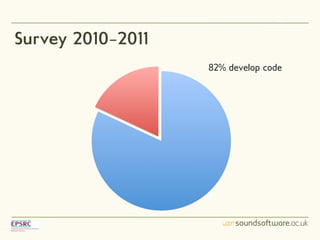
                   82% develop code
Survey 2010–2011
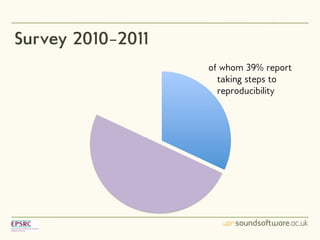
                   of whom 39% report
                     taking steps to
                     reproducibility
Survey 2010–2011
                   of whom 35% report
                     publishing any code
Survey 2010–2011
                   That's 11% of the whole
It's not just us!
McCullough, 2007

Surveying economics journal with a data+code archive policy

9 empirical articles


http://bit.ly/6otJMx
It's not just us!
McCullough, 2007

Surveying economics journal with a data+code archive policy

9 empirical articles
   7 had empty entries in the journal archive


http://bit.ly/6otJMx
It's not just us!
McCullough, 2007

Surveying economics journal with a data+code archive policy

9 empirical articles
   7 had empty entries in the journal archive
   The other two had code, but it didn't work!
   None of them could be replicated without authors' help

http://bit.ly/6otJMx
Why don't we publish code & data?
Our survey suggested:
   – Lack of time
   – Copyright restrictions
   – Potential for future commercial use
Other factors (UK Research Information Network, 2010):
   – Lack of evidence of benefits
   – Culture of independence or competition
   – Quality concerns (self-taught programmers)
Also: it takes effort early in the research cycle;
  hard to find time/motivation after the paper is published
Reasons we don't like to admit?
J M Wicherts, M Bakker and D Molenaar, 2011, Willingness to Share
   Research Data Is Related to the Strength of the Evidence and the
   Quality of Reporting of Statistical Results, PLoS ONE


http://bit.ly/vaU435
Reasons we don't like to admit?
J M Wicherts, M Bakker and D Molenaar, 2011, Willingness to Share
   Research Data Is Related to the Strength of the Evidence and the
   Quality of Reporting of Statistical Results, PLoS ONE

   Does this cut both ways?
   Can we improve quality by helping people prepare to share?


http://bit.ly/vaU435
What can we do to help?
We’re taking a bottom-up approach:
   – aid incremental improvements to development practice
   by
   – identifying specific barriers to publication and reuse,
     that are relatively straightforward to address
So we hope to:
   – increase perception among researchers that code is
     something you can work on together, that can be reused
   – prepare the ground for reproducible publication
Barriers to publication and reuse

 –   Lack of education and confidence with code
 –   Lack of facilities and tools
 –   Lack of incentive for publication
 –   Platform incompatibilities

     These are barriers to publication of code.
     Pilot data-management project at C4DM (to be discussed
     this afternoon) to feed into future work on data.
Barrier: Lack of confidence in code
Issue:
Researchers largely self-trained in software development

Our approach:
  – Training in software development specifically for
      researchers
  – Relatively small amounts of training can pay off

Autumn School, Software Carpentry
Workshops and tutorials around ISMIR and DAFx this year
Barrier: Lack of facilities and tools
Issue:
Researchers don’t use code hosting / version control

Our approach:
  – Code site: http://code.soundsoftware.ac.uk
  – Focus on audio and music research
  – Public and private projects
  – Link publications with code
  – Simplified tools, e.g. EasyMercurial, http://easyhg.org
Projects and users of the code site
Barrier: Lack of incentive
Issue:
Software not well recognised as research output

Our approach:
  – Link publications to code on the code site
  – Increase likelihood of code users discovering your papers
  – Ensure users know how to cite your work
  – Increase take-up / impact of your research
Barrier: Platform incompatibilities
Issue:
Many different platforms and development tools in use
Some are not available to all possible users (e.g. MATLAB)


Our approach:
  – Plugins where possible (e.g. Vamp for SV)
  – Take advantage of existing ecosystems
Suggestions for research groups
Aim at easy training targets; researchers may know less about
  coding than you'd think!
    – Program structure, arranging code across files etc
Insist on use of version control
                code.soundsoftware.ac.uk
    – Use what you have available, or code.soundsoftware.ac.uk
Turn code into plugins or components in modular systems
    – Latch onto the existing ecosystems of popular applications
Encourage collaborative development
    – Papers often co-authored, why not code?
    – Create an environment of confidence about sharing
Links
Our site
       –   http://soundsoftware.ac.uk

Our code site
      – http://code.soundsoftware.ac.uk

These slides, and notes on them
      – http://code.soundsoftware.ac.uk/documents/40

SoundSoftware: Software Sustainability for audio and Music Researchers

  • 1.
    SoundSoftware.ac.uk: Software sustainability forthe audio and music researcher Chris Cannam, Mark Plumbley, Luís Figueira Centre for Digital Music Queen Mary, University of London
  • 2.
    Who (and why)are we? EPSRC-funded four-year project, 2010–2014: Run from the Centre for Digital Music at QMUL Serving the whole UK audio and music research community Supporting the sustainable development and use of software and data to enable high quality research Better science through better handling of software and data
  • 3.
    Reproducible research Research usedto be “reproducible” from the paper alone. This is no longer possible: too complex, the paper is not enough Hence “Reproducible Research”: The paper – ideally Open Access The software – ideally Open Source The data – ideally Open Data all bundled and published together In audio and music research, few people do this. Why?
  • 4.
    Survey 2010–2011 82% develop code
  • 5.
    Survey 2010–2011 of whom 39% report taking steps to reproducibility
  • 6.
    Survey 2010–2011 of whom 35% report publishing any code
  • 7.
    Survey 2010–2011 That's 11% of the whole
  • 8.
    It's not justus! McCullough, 2007 Surveying economics journal with a data+code archive policy 9 empirical articles http://bit.ly/6otJMx
  • 9.
    It's not justus! McCullough, 2007 Surveying economics journal with a data+code archive policy 9 empirical articles 7 had empty entries in the journal archive http://bit.ly/6otJMx
  • 10.
    It's not justus! McCullough, 2007 Surveying economics journal with a data+code archive policy 9 empirical articles 7 had empty entries in the journal archive The other two had code, but it didn't work! None of them could be replicated without authors' help http://bit.ly/6otJMx
  • 11.
    Why don't wepublish code & data? Our survey suggested: – Lack of time – Copyright restrictions – Potential for future commercial use Other factors (UK Research Information Network, 2010): – Lack of evidence of benefits – Culture of independence or competition – Quality concerns (self-taught programmers) Also: it takes effort early in the research cycle; hard to find time/motivation after the paper is published
  • 12.
    Reasons we don'tlike to admit? J M Wicherts, M Bakker and D Molenaar, 2011, Willingness to Share Research Data Is Related to the Strength of the Evidence and the Quality of Reporting of Statistical Results, PLoS ONE http://bit.ly/vaU435
  • 13.
    Reasons we don'tlike to admit? J M Wicherts, M Bakker and D Molenaar, 2011, Willingness to Share Research Data Is Related to the Strength of the Evidence and the Quality of Reporting of Statistical Results, PLoS ONE Does this cut both ways? Can we improve quality by helping people prepare to share? http://bit.ly/vaU435
  • 14.
    What can wedo to help? We’re taking a bottom-up approach: – aid incremental improvements to development practice by – identifying specific barriers to publication and reuse, that are relatively straightforward to address So we hope to: – increase perception among researchers that code is something you can work on together, that can be reused – prepare the ground for reproducible publication
  • 15.
    Barriers to publicationand reuse – Lack of education and confidence with code – Lack of facilities and tools – Lack of incentive for publication – Platform incompatibilities These are barriers to publication of code. Pilot data-management project at C4DM (to be discussed this afternoon) to feed into future work on data.
  • 16.
    Barrier: Lack ofconfidence in code Issue: Researchers largely self-trained in software development Our approach: – Training in software development specifically for researchers – Relatively small amounts of training can pay off Autumn School, Software Carpentry Workshops and tutorials around ISMIR and DAFx this year
  • 17.
    Barrier: Lack offacilities and tools Issue: Researchers don’t use code hosting / version control Our approach: – Code site: http://code.soundsoftware.ac.uk – Focus on audio and music research – Public and private projects – Link publications with code – Simplified tools, e.g. EasyMercurial, http://easyhg.org
  • 19.
    Projects and usersof the code site
  • 20.
    Barrier: Lack ofincentive Issue: Software not well recognised as research output Our approach: – Link publications to code on the code site – Increase likelihood of code users discovering your papers – Ensure users know how to cite your work – Increase take-up / impact of your research
  • 21.
    Barrier: Platform incompatibilities Issue: Manydifferent platforms and development tools in use Some are not available to all possible users (e.g. MATLAB) Our approach: – Plugins where possible (e.g. Vamp for SV) – Take advantage of existing ecosystems
  • 22.
    Suggestions for researchgroups Aim at easy training targets; researchers may know less about coding than you'd think! – Program structure, arranging code across files etc Insist on use of version control code.soundsoftware.ac.uk – Use what you have available, or code.soundsoftware.ac.uk Turn code into plugins or components in modular systems – Latch onto the existing ecosystems of popular applications Encourage collaborative development – Papers often co-authored, why not code? – Create an environment of confidence about sharing
  • 23.
    Links Our site – http://soundsoftware.ac.uk Our code site – http://code.soundsoftware.ac.uk These slides, and notes on them – http://code.soundsoftware.ac.uk/documents/40