SOP FOR AIR COMPRESSORS
PETRONET LNG LTD
RAKESH NIMBALKAR
 SOP – Standard Operating Procedure
 Need– To contribute to the effective functioning of the
task & to maintain quality & consistency in work.
 Types:
a) 3 Monthly PM
b) 6 Monthly PM
c) 12 Monthly PM or OVERHAUL
3 MONTHLY PM
 Ensure electrical isolation.
 Take work permit and confirm that all precautions and isolations
mentioned in the permit are actually done.
 Remove of all instrument air tubing for L.P. (Low pressure) & H.P. (High
pressure) suction valves.
 Remove/check the condition of the valves L.P. & H.P.), service or
replace parts/ assembly if necessary.
 Clean suction valve unloaders.
 Clean suction/discharge valve holder for both L.P. & H.P.
 Check/ clean air filters, replace if necessary.
 Assemble the valves in the cylinders. Check compressor foundation
bolts tightness.
 Check belt condition, replace if necessary & check belt tension.
 Clean the work area and dispose waste materials (metallic scrap,
cotton waste) to bins to avoid land contamination.
 Close work permit & release electrical isolation.
 Take trial run; check for leakages attend if any
6 MONTHLY PM
 Ensure electrical isolation.
 Take work permit and confirm that all precautions and isolations mentioned in
the permit are actually done.
 Remove of all instrument air tubing for L.P. (Low pressure) & H.P. (High
pressure) suction valves.
 Remove/check the condition of the valves (L.P. & H.P.), service or replace
parts/assembly if necessary.
 Clean suction/discharge valve holder for both L.P. & H.P. Clean suction valve
unloaders.
 Remove cylinder end cover; check (wedge) clearance between piston and
cylinder (L.P. & H.P.).
 Check cylinder (L.P. & H.P.) end clearances.
------Note the clearance between the crosshead shoe & guide.
 Remove piston of L.P. & H.P if wedge clearance is not within limits.
 Check the condition of piston rings and rider (wear) rings.
 Dismantle piston assembly L.P. /H.P. if piston/rider (wear) rings to be changed.
 Change piston/rider rings.
 Assemble the piston assembly with new piston/rider (wear) rings.
 Check any abnormality in the cylinders by the way of visual inspection.
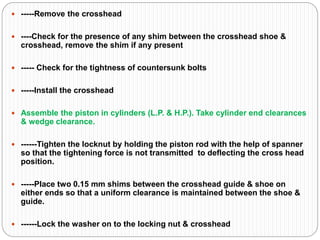
 -----Remove the crosshead
 ----Check for the presence of any shim between the crosshead shoe &
crosshead, remove the shim if any present
 ----- Check for the tightness of countersunk bolts
 -----Install the crosshead
 Assemble the piston in cylinders (L.P. & H.P.). Take cylinder end clearances
& wedge clearance.
 ------Tighten the locknut by holding the piston rod with the help of spanner
so that the tightening force is not transmitted to deflecting the cross head
position.
 -----Place two 0.15 mm shims between the crosshead guide & shoe on
either ends so that a uniform clearance is maintained between the shoe &
guide.
 ------Lock the washer on to the locking nut & crosshead
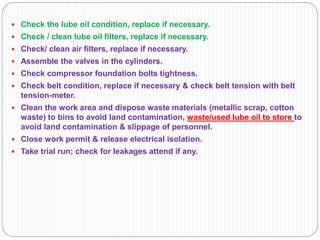
 Check the lube oil condition, replace if necessary.
 Check / clean lube oil filters, replace if necessary.
 Check/ clean air filters, replace if necessary.
 Assemble the valves in the cylinders.
 Check compressor foundation bolts tightness.
 Check belt condition, replace if necessary & check belt tension with belt
tension-meter.
 Clean the work area and dispose waste materials (metallic scrap, cotton
waste) to bins to avoid land contamination, waste/used lube oil to store to
avoid land contamination & slippage of personnel.
 Close work permit & release electrical isolation.
 Take trial run; check for leakages attend if any.
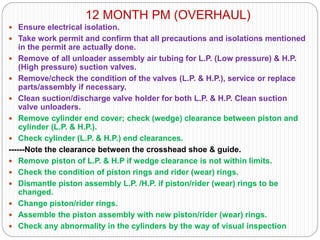
12 MONTH PM (OVERHAUL)
 Ensure electrical isolation.
 Take work permit and confirm that all precautions and isolations mentioned
in the permit are actually done.
 Remove of all unloader assembly air tubing for L.P. (Low pressure) & H.P.
(High pressure) suction valves.
 Remove/check the condition of the valves (L.P. & H.P.), service or replace
parts/assembly if necessary.
 Clean suction/discharge valve holder for both L.P. & H.P. Clean suction
valve unloaders.
 Remove cylinder end cover; check (wedge) clearance between piston and
cylinder (L.P. & H.P.).
 Check cylinder (L.P. & H.P.) end clearances.
------Note the clearance between the crosshead shoe & guide.
 Remove piston of L.P. & H.P if wedge clearance is not within limits.
 Check the condition of piston rings and rider (wear) rings.
 Dismantle piston assembly L.P. /H.P. if piston/rider (wear) rings to be
changed.
 Change piston/rider rings.
 Assemble the piston assembly with new piston/rider (wear) rings.
 Check any abnormality in the cylinders by the way of visual inspection
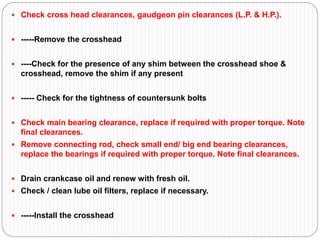
 Check cross head clearances, gaudgeon pin clearances (L.P. & H.P.).
 -----Remove the crosshead
 ----Check for the presence of any shim between the crosshead shoe &
crosshead, remove the shim if any present
 ----- Check for the tightness of countersunk bolts
 Check main bearing clearance, replace if required with proper torque. Note
final clearances.
 Remove connecting rod, check small end/ big end bearing clearances,
replace the bearings if required with proper torque. Note final clearances.
 Drain crankcase oil and renew with fresh oil.
 Check / clean lube oil filters, replace if necessary.
 -----Install the crosshead
 Assemble the piston in cylinders (L.P. & H.P.). Take cylinder end
clearances/wedge clearance.
 ------Tighten the locknut by holding the piston rod with the help of spanner
so that the tightening force is not transmitted on to deflecting the cross
head position.
 -----Place two 0.15 mm shims between the crosshead guide & shoe on
either ends so that a uniform clearance is maintained between the shoe &
guide.
 ------Lock the washer on to the locking nut & crosshead
 Check pressure packings/oil packings, replace if necessary.
 Check/ clean air filters, replace if necessary.
 Assemble the valves in the cylinders.
 Check compressor foundation bolts tightness.
 Check belt condition, replace if necessary & check belt tension with belt
tension-meter.
 Clean the work area and dispose waste materials (metallic scrap, cotton
waste) to bins, used/waste lube oil to store to avoid land contamination &
slippage of personnel.
 Close work permit & release electrical isolation.
 Take trial run; check for leakages attend if any.
THANK YOU

Sop for air compressors

  • 1.
    SOP FOR AIRCOMPRESSORS PETRONET LNG LTD RAKESH NIMBALKAR
  • 2.
     SOP –Standard Operating Procedure  Need– To contribute to the effective functioning of the task & to maintain quality & consistency in work.  Types: a) 3 Monthly PM b) 6 Monthly PM c) 12 Monthly PM or OVERHAUL
  • 3.
    3 MONTHLY PM Ensure electrical isolation.  Take work permit and confirm that all precautions and isolations mentioned in the permit are actually done.  Remove of all instrument air tubing for L.P. (Low pressure) & H.P. (High pressure) suction valves.  Remove/check the condition of the valves L.P. & H.P.), service or replace parts/ assembly if necessary.  Clean suction valve unloaders.  Clean suction/discharge valve holder for both L.P. & H.P.  Check/ clean air filters, replace if necessary.  Assemble the valves in the cylinders. Check compressor foundation bolts tightness.  Check belt condition, replace if necessary & check belt tension.  Clean the work area and dispose waste materials (metallic scrap, cotton waste) to bins to avoid land contamination.  Close work permit & release electrical isolation.  Take trial run; check for leakages attend if any
  • 4.
    6 MONTHLY PM Ensure electrical isolation.  Take work permit and confirm that all precautions and isolations mentioned in the permit are actually done.  Remove of all instrument air tubing for L.P. (Low pressure) & H.P. (High pressure) suction valves.  Remove/check the condition of the valves (L.P. & H.P.), service or replace parts/assembly if necessary.  Clean suction/discharge valve holder for both L.P. & H.P. Clean suction valve unloaders.  Remove cylinder end cover; check (wedge) clearance between piston and cylinder (L.P. & H.P.).  Check cylinder (L.P. & H.P.) end clearances. ------Note the clearance between the crosshead shoe & guide.  Remove piston of L.P. & H.P if wedge clearance is not within limits.  Check the condition of piston rings and rider (wear) rings.  Dismantle piston assembly L.P. /H.P. if piston/rider (wear) rings to be changed.  Change piston/rider rings.  Assemble the piston assembly with new piston/rider (wear) rings.  Check any abnormality in the cylinders by the way of visual inspection.
  • 5.
     -----Remove thecrosshead  ----Check for the presence of any shim between the crosshead shoe & crosshead, remove the shim if any present  ----- Check for the tightness of countersunk bolts  -----Install the crosshead  Assemble the piston in cylinders (L.P. & H.P.). Take cylinder end clearances & wedge clearance.  ------Tighten the locknut by holding the piston rod with the help of spanner so that the tightening force is not transmitted to deflecting the cross head position.  -----Place two 0.15 mm shims between the crosshead guide & shoe on either ends so that a uniform clearance is maintained between the shoe & guide.  ------Lock the washer on to the locking nut & crosshead
  • 6.
     Check thelube oil condition, replace if necessary.  Check / clean lube oil filters, replace if necessary.  Check/ clean air filters, replace if necessary.  Assemble the valves in the cylinders.  Check compressor foundation bolts tightness.  Check belt condition, replace if necessary & check belt tension with belt tension-meter.  Clean the work area and dispose waste materials (metallic scrap, cotton waste) to bins to avoid land contamination, waste/used lube oil to store to avoid land contamination & slippage of personnel.  Close work permit & release electrical isolation.  Take trial run; check for leakages attend if any.
  • 7.
    12 MONTH PM(OVERHAUL)  Ensure electrical isolation.  Take work permit and confirm that all precautions and isolations mentioned in the permit are actually done.  Remove of all unloader assembly air tubing for L.P. (Low pressure) & H.P. (High pressure) suction valves.  Remove/check the condition of the valves (L.P. & H.P.), service or replace parts/assembly if necessary.  Clean suction/discharge valve holder for both L.P. & H.P. Clean suction valve unloaders.  Remove cylinder end cover; check (wedge) clearance between piston and cylinder (L.P. & H.P.).  Check cylinder (L.P. & H.P.) end clearances. ------Note the clearance between the crosshead shoe & guide.  Remove piston of L.P. & H.P if wedge clearance is not within limits.  Check the condition of piston rings and rider (wear) rings.  Dismantle piston assembly L.P. /H.P. if piston/rider (wear) rings to be changed.  Change piston/rider rings.  Assemble the piston assembly with new piston/rider (wear) rings.  Check any abnormality in the cylinders by the way of visual inspection
  • 8.
     Check crosshead clearances, gaudgeon pin clearances (L.P. & H.P.).  -----Remove the crosshead  ----Check for the presence of any shim between the crosshead shoe & crosshead, remove the shim if any present  ----- Check for the tightness of countersunk bolts  Check main bearing clearance, replace if required with proper torque. Note final clearances.  Remove connecting rod, check small end/ big end bearing clearances, replace the bearings if required with proper torque. Note final clearances.  Drain crankcase oil and renew with fresh oil.  Check / clean lube oil filters, replace if necessary.  -----Install the crosshead
  • 9.
     Assemble thepiston in cylinders (L.P. & H.P.). Take cylinder end clearances/wedge clearance.  ------Tighten the locknut by holding the piston rod with the help of spanner so that the tightening force is not transmitted on to deflecting the cross head position.  -----Place two 0.15 mm shims between the crosshead guide & shoe on either ends so that a uniform clearance is maintained between the shoe & guide.  ------Lock the washer on to the locking nut & crosshead
  • 10.
     Check pressurepackings/oil packings, replace if necessary.  Check/ clean air filters, replace if necessary.  Assemble the valves in the cylinders.  Check compressor foundation bolts tightness.  Check belt condition, replace if necessary & check belt tension with belt tension-meter.  Clean the work area and dispose waste materials (metallic scrap, cotton waste) to bins, used/waste lube oil to store to avoid land contamination & slippage of personnel.  Close work permit & release electrical isolation.  Take trial run; check for leakages attend if any.
  • 11.