Sonnet 121

Presentation by Sam Smiley
‘Tis better to be vile
than vile esteemed.
‘Tis better to be vile than vile esteemed,
 When not to be receives reproach of being,
And the just pleasures lost which is so deemed
   Not by our feeling but by others’ seeing.
Weiser’s Inverted Form


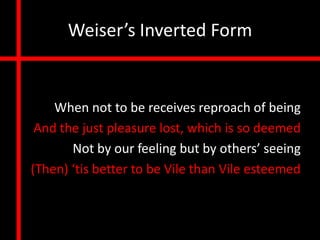
    When not to be receives reproach of being
 And the just pleasure lost, which is so deemed
       Not by our feeling but by others’ seeing
(Then) ‘tis better to be Vile than Vile esteemed
Theme

  Because of this the main theme is not
understood until after the entire sonnet has
                been read.
vile
Definition
Morally despicable or abhorrent


            Disgustingly or utterly bad
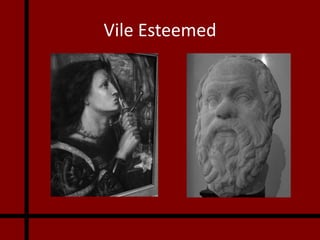
Vile Esteemed
Experts


“Crucial and Difficult”
  - G. Wilson Knight
Hilton Landry

  3 Interpretations

 Rebuttal against Puritans
Rebuttal against the World
     Moral Relativity
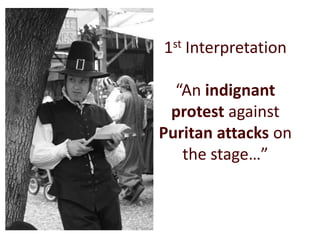
1st Interpretation

  “An indignant
 protest against
Puritan attacks on
   the stage…”
2nd Interpretation
“Directed against all those…who
   judge the poet adversely.”
Hypocrisy

 One of the
 major
 themes of
 the sonnet
3rd Interpretation
“Some kind of beyond-good-
     and-evil claim.”
Works Cited
Flickr, Tehsi, Puritan
http://www.flickr.com/photos/tehsfoto/576739
   6842/sizes/m/in/photostream/

Flickr, @boetter, Thinking RFID
http://www.flickr.com/photos/jakecaptive/3205
   277810/sizes/m/in/photostream/
Flickr, Fresh Conservative, Joseph Gulag Stalin
http://www.flickr.com/photos/freshconservative
   /3882535030/sizes/m/in/photostream/

Flickr, Duke Yearbook, Blue Devil Decal
http://www.flickr.com/photos/dukeyearlook/20
   47205405/sizes/z/in/photostream/
Flickr, radiowood2000, St. Joan of Arc
http://www.flickr.com/photos/radiowood/4240
   323457/sizes/z/in/photostream/

Flickr, thisisbossi, 8993- St. Petersburg
http://www.flickr.com/photos/thisisbossi/30547
   17301/sizes/m/in/photostream/
Flickr, Leo Reynolds, swatsika
http://www.flickr.com/photos/lwr/5064608546/
   sizes/m/in/photostream/

Flickr, Robert Couse-Baker, America, the
   beautiful
http://www.flickr.com/photos/29233640@N07/
   5903222975/sizes/m/in/photostream/
Flickr, Andrew F. Scott, Gavel
http://www.flickr.com/photos/afsart/31908993
   38/sizes/m/in/photostream/

D. Weiser, Theme and Structure in Shakespeare’s
  Sonnet 121. Studies in Philology 75, 142-143,
  146. (1978)
No Fear Shakespeare, Sonnet 121
http://nfs.sparknotes.com/sonnets/sonnet_121.
  html

Davant els esdeveniments a l’Iran, Manuel
http://www.anticapitalistes.net/spip.php?article
  1651

Sonnet 121

  • 1.
  • 2.
    ‘Tis better tobe vile than vile esteemed.
  • 3.
    ‘Tis better tobe vile than vile esteemed, When not to be receives reproach of being, And the just pleasures lost which is so deemed Not by our feeling but by others’ seeing.
  • 4.
    Weiser’s Inverted Form When not to be receives reproach of being And the just pleasure lost, which is so deemed Not by our feeling but by others’ seeing (Then) ‘tis better to be Vile than Vile esteemed
  • 5.
    Theme Becauseof this the main theme is not understood until after the entire sonnet has been read.
  • 6.
  • 7.
    Definition Morally despicable orabhorrent Disgustingly or utterly bad
  • 8.
  • 9.
  • 10.
    Hilton Landry 3 Interpretations Rebuttal against Puritans Rebuttal against the World Moral Relativity
  • 11.
    1st Interpretation “An indignant protest against Puritan attacks on the stage…”
  • 12.
    2nd Interpretation “Directed againstall those…who judge the poet adversely.”
  • 13.
    Hypocrisy One ofthe major themes of the sonnet
  • 14.
    3rd Interpretation “Some kindof beyond-good- and-evil claim.”
  • 15.
    Works Cited Flickr, Tehsi,Puritan http://www.flickr.com/photos/tehsfoto/576739 6842/sizes/m/in/photostream/ Flickr, @boetter, Thinking RFID http://www.flickr.com/photos/jakecaptive/3205 277810/sizes/m/in/photostream/
  • 16.
    Flickr, Fresh Conservative,Joseph Gulag Stalin http://www.flickr.com/photos/freshconservative /3882535030/sizes/m/in/photostream/ Flickr, Duke Yearbook, Blue Devil Decal http://www.flickr.com/photos/dukeyearlook/20 47205405/sizes/z/in/photostream/
  • 17.
    Flickr, radiowood2000, St.Joan of Arc http://www.flickr.com/photos/radiowood/4240 323457/sizes/z/in/photostream/ Flickr, thisisbossi, 8993- St. Petersburg http://www.flickr.com/photos/thisisbossi/30547 17301/sizes/m/in/photostream/
  • 18.
    Flickr, Leo Reynolds,swatsika http://www.flickr.com/photos/lwr/5064608546/ sizes/m/in/photostream/ Flickr, Robert Couse-Baker, America, the beautiful http://www.flickr.com/photos/29233640@N07/ 5903222975/sizes/m/in/photostream/
  • 19.
    Flickr, Andrew F.Scott, Gavel http://www.flickr.com/photos/afsart/31908993 38/sizes/m/in/photostream/ D. Weiser, Theme and Structure in Shakespeare’s Sonnet 121. Studies in Philology 75, 142-143, 146. (1978)
  • 20.
    No Fear Shakespeare,Sonnet 121 http://nfs.sparknotes.com/sonnets/sonnet_121. html Davant els esdeveniments a l’Iran, Manuel http://www.anticapitalistes.net/spip.php?article 1651

Editor's Notes

  • #2 This presentation is on Sonnet 121. It is a part of the Fair Youth Sonnets. It is a major sonnet, but gets less attention than many of the others.
  • #3 The first and most important line of the sonnet is: “’Tis better to be Vile than Vile esteemed.”
  • #4 Most sonnets follow a specific format in the first quatrain:When,When,When,Then.Sonnet 121 does not follow this format. It leads with the then, and then uses the when to explain the situation. This can be very confusing for the reader.
  • #5 Having read the first Quatrain it may be difficult to tell the exact idea of the sonnet. This is the first Quatrain in an Inverted form. It makes much more sense this way. In this sense the speaker shows that when one is doing good, and is not getting credit for it, then it is better to be Vile than Vile esteemed.
  • #6 As with any piece of Shakespeare one will have to read the text several times in order to understand it; however, in this case it is mandatory for one to read the piece multiple times, because one does not really understand the speaker’s theme until the end.
  • #7 Vile is a very strong word. It is stronger than merely saying bad, and is used to bring images to the forefront of the brain when reading. What types of images come to mind when one hears the word vile?Maybe evil political leaders like Ahmadinejad, or Stalin?As UK students, maybe rival sports teams, such as Duke?
  • #8 Even the definition of Vile brings about strong feelings. Look at the words used: despicable, abhorrent, disgustingly, and utterly. Very strong words that the speaker uses to attempt to evoke a response from the listener.
  • #9 Having seen what the speaker means by the term vile, and having evoked certain images in the brain relative to the word, it is now necessary to examine the term vile esteemed. People that come to mind with this term might be Joan of Arc or Socrates. Very good people who were perceived as bad by their government’s and contemporaries. How could it be better to be a Stalin than a Socrates, or a Duke fan than a Joan of Arc. This has something to do with the speaker’s perceived view of morality, which will be examined later.
  • #10 Now that the first, and arguably most important line has been examined, the poem can be looked at in a broader sense. Experts, such as Knight have examined the sonnet and found it, “crucial and difficult.”
  • #11 Hilton Landry is a leading expert on the Shakespearean sonnets. Having examined the sonnet, he made three interpretations. The first two are ideas based upon the attacks on Shakespeare at the time (both from a religious criticism, and from a criticism of his art). The third, which seems most reasonable, is a moral code. It deals with the relativity of the human nature, and how we can only seem bad when compared to others.
  • #12 The first two interpretations are eerily similar, to the point that they could almost be one. They both are a defense of Shakespeare’s profession and art. This first one is from a religious standpoint, in a defense against the Puritans who opposed his profession (many saw his profession as violent and lewd.)
  • #13 Much like the first explanation, this interpretation poses that the speaker is angered at the way the world perceives himself and his profession, rather than just the Puritans. Landry says this viewpoint is more believable than the first.
  • #14 “For why should others’ false adulterate eyesGive salvation to my sportive blood.”“Or on my frailities why are frailer spies,Which in their wills count bad what I think good.”These two interpretations (and even to an extent the third) explain the hypocrisy theme that is so prevalent in the Sonnet. These two quotes exemplify this idea, in that they judge him, when they are unfit to judge. These two ideas are parallel to the Biblical idea of: “First take the plank out of your own eye, and then you will see clearly to remove the speck from your brother’s eye.” (Matthew 7:5)
  • #15 “Protest against any rigidly imposed moral scheme, protest of morality based on the nature of the writer.” –L.C. KnightsAs discussed earlier, with the concept of Vile and Vile esteemed, the poem deals largely with the idea of morality. For this reason this is the most apt interpretation of the Sonnet. Here the speaker sees that the morality of man is basically bad, that is where our nature draws us, and that what is keeping us from moving toward this is society and outside factors, such as religion. Therefore, it is better to be actually bad, then to be good and be blamed to be bad, when you aren’t bad whatsoever.This is why it is better to be Stalin that Socrates, Ahmadinejad than Joan of Arc, and thus, vile than vile esteemed.