This means the tourism activities are developed and operated,
for the most part, by local community members with local
culture, heritage and traditions. Similarly, community-based
tourism implies respect and concern for the natural heritage,
particularly where the environment is one of the attractions
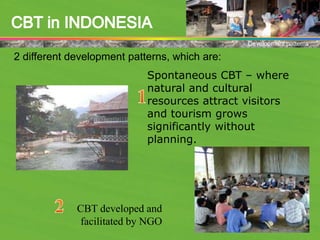
2 different development patterns, which are:
Development patterns
Spontaneous CBT – where
natural and cultural
resources attract visitors
and tourism grows
significantly without
planning.
CBT developed and
facilitated by NGO
The Need to Develop Business Model
• The GAP
– Limited involvement of Private sectors in promoting and
investment in CB ecotourism.
– Lack of understanding in CB ecotourism products by private
sectors.
– Most of NGO’s which act as community facilitator, lack
business vision.
– Lack of private sectors involvement during planning and
product development stage.
– Community is lacking skill and knowledge on approaching
private sector.
– Need to strengthen marketing of community tourism
products.
– Need to strengthen local community organization.
The GAP
The Network
Process of Network establishment
Through series of workshop
and series of training both
for Tour Operators and
Community Institutions.
• Product development
• Marketing
• Capacity building
Principles and Criteria
There are 3(three) principles and criteria in product
development, which are:
Principle 1. Traveler Friendly
The operation should provide an enjoyable experience for
travelers who appreciate nature and local culture.
Criteria for the first principle are:
1. Pristine and Aesthetic
2. Safe, Clean and Comfortable
3. Friendly and Efficient Staff
4. Discovery of local nature and culture.
The need of new Product and standard
Principles and Criteria
Principle2. Nature Friendly
The operation should be designed and managed in a way
that will reduce environmental impact and enhance natural
conservation.
Criteria for the second principle are:
1. Implement environmentally friendly based planning in
policy, management, landscape and building.
2. Low water, energy, and chemicals consumption.
3. Reduce waste and exercise environmentally friendly
disposal mechanism
4. Participate in environmental education and conservation.
Principles and Criteria’s
Principle 3, Community Friendly
The operation should contribute to the welfare of local
people and enhance local culture.
Criteria for the third principle are:
1. Prioritize locals for employees
2. Promote relations with local communities.
3. Increase participation and economic opportunities
4. Support to local culture
Community Based Tourism
Eye-Opening
Thought-Provoking
Soul-Enriching
Life-Changing
Travel Experiences
In Partnership with local people
s
Thai CBT - 3 levels
Stage 1:
Ready To Link
Stage 2:
Need Training
& Experience
Stage 3:
Beginners –
Need basic
Training
•Well Managed & experienced with clear goals
•Fixed products, set prices, promotional materials
•Understanding of marketing, (defined target tourists)
•Trained and experienced staff with clear roles
•CBT Group can work w/ stakeholders & adapt
•Established management & goals but inexperienced
•1 program, rough price, some information available
•Unclear about marketing and target markets
•Trained staff with clear roles but inexperienced
•Inexperienced cooperating, sometimes inflexible
•New group. Need to strengthen management & goals
•Activity ideas but no set program, price, information
•Unclear about marketing and target markets
•Staff require basic clarification of roles / training
•No or very little experience working with partners
CBT products are based on ‘Our
Good Things’ – special elements of
community, culture and nature
which local people feel proud of and
wish to share.
These ‘good things’ are developed
into services and activities:
homestay, nature trails, local
cooking, etc
s
CBT Participatory Process
Project, product, Market,
Monitoring
Marketing
•Community
•Inbound Ops
•Outbound Ops
•Independent Travelers
•Product development
•Price, Promotion
Manageable numbers
of appropriate types
of
tourists
Carefully selected
partners
s
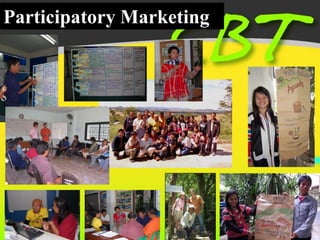
Participatory Marketing
Communties’ needs
/ expectations
from tourists &
tour operators
Empowerment in decision making
Respect and Participation
Share their goals
Share important information with tourists
Help to filter the market
Respect local culture
Help to control volume of visitors
Fair price
Train / inform staff about CBT
Good
Partners
(Defined by 20+ C’s)
•Flexible, friendly, down to earth
•Support the goals of CBT
•Good attitude and actions
•Interested in cultural exchange and
prepared to ‘have a go’ - local activities
•Fair price
•Able to accept – safe and welcoming but
not hotel standards of comfort.
•Prepared to follow cultural guidelines
Good Guests (Defined by 20+ C’s)
s
CBT Target Tourists
2005-6
1,152 Tourists
336, 306 Baht
(10,000 USD+)
800 Hectares of new mangrove
growth
Case Study – Leeled & Intrepid
Case Study – Promloke & Sawadee
T
R
U
S
T
elationship
ime
nderstanding
wo way communication
atisfied
s
Criteria for standards –
1) Sustainability Criteria and
indicators to measure whether the
program supports the goals of CBT.
2) Service Criteria and
indicators to measure quality of services,
program, management
s
CBT Goals
1. Contributes towards community human resource
development and participation.
2. Contributes towards conservation and sustainable natural
resource management.
3. Increases community members’ income.
4. Contributes towards the empowerment of local cultures
and traditional ways of life.
5. Stimulates cultural exchange and mutual respect between
hosts and guests.
s
CBT criteria: by objective
Objective 1: Contributes towards community human resource
development and participation.
•CBT is planned and managed by a community group.
•CBT group members come from a cross-section of community members (e.g.
men / women, youth / elderly, formal / informal groups.
•CBT gives community members the opportunity to develop their knowledge
and skills.
•CBT creates confidence among community members
•CBT supports cooperation among community members and groups
s
Objective 2:Contributes towards conservation and sustainable
natural resource management.
• CBT Group has a Conservation / NRM fund and uses it.
• Conservation / NRM activities are included in the CBT program.
• CBT educates hosts and guests about conservation / NRM, leading to
increased environmental awareness and commitment.
• CBT Club has developed and implements guidelines / rules and regulations
to limit negative impacts of CBT on the environment.
(note: waste management, resource use, seasonal visits, CC, etc)
• CBT staff receive training to reduce environmental impacts of CBT.
CBT criteria: by objective
s
CBT Criteria: Objectiv
Objective 3: Increases community members’ income.
• Community members are satisfied with the prices of CBT services.
• CBT programs generate income for CBT group members.
• Income and the opportunity to earn income from tourism are distributed
fairly and transparently inside the CBT group.
• CBT programs generate income for the wider community.
• Income from tourism is contributed to community funds, used to support
local social, cultural and environmental projects.
CBT criteria: by objective
s
Objective 4: Contributes towards empowerment of local cultures
and traditional ways of life.
• CBT activities are designed based upon aspects of local culture and life
which community members choose to share with guests.
• CBT supports the protection / recovery of local culture.
• CBT development process and activities encourage the transfer of local
knowledge and skills between generations in the community.
• CBT development process and activities encourage community members
to feel proud of their traditional cultures and ways of life.
CBT criteria: by objective
s
Objective 5: Creates cultural exchange and mutual respect
between hosts and guests.
• CBT activities and programs are designed to allow hosts and guests
opportunities to interact and exchange knowledge and experience.
• CBT educates guests about local cultures and lifestyles.
• CBT Club has developed and implements guidelines / rules and
regulations to limit negative impacts of CBT on local culture.
• CBT staff receive training to reduce cultural impacts of CBT.
CBT criteria: by objective
s
Criteria for CBT:
Accommodation
1. Structure of house
2. Local atmosphere
3. Comfort
4. Safety
5. Security
6. Hygiene
7. Hospitality
8. Cultural information
9. Minimum impact on
environment
10. Rotation system
CBT Criteria: Services
Criteria for CBT: Food
1. Opportunity to try local food
2. Use local ingredients
3. Taste of food
4. Variety of food
5. Size of portion
6. Quality of food
7. Hygiene of food
8. Hygiene of utensils
9. Hygiene of drinking water
10. Minimum impact on
environment
CBT criteria: by service
s
Criteria for CBT:
Transport
1. Comfortable
2. On time
3. Safe
4. Varied, creative
5. Minimum impact on
environment
6. Rotation System
Criteria for CBT: Activities
1. Safe
2. Comfortable
3. Enjoyable
4. Educational
5. Direct experience
6. Quality information
7. Minimum impact on
environment
8. Minimum impact on local
culture
CBT criteria: by service
s
Criteria for CBT:
Community Guides
1. Welcoming / Friendly
2. Approachable
3. Safe and responsible
4. Able to interpret all points of
the program and help tourists
understand their meaning to
the community.
5. Able to coordinate services
effectively.
6. Well organized
7. Sensitive to local culture and
the environment
Criteria for CBT: Host
Families
1. Welcoming / Friendly
2. Approachable
3. Safe and responsible
4. Well organized
5. Sensitive to the
environment
6. Provide sufficient
information about do’s
and don’ts in their home
and local food.
CBT criteria: by service
s
Criteria for CBT: Information
1. CBT group has information about
the local environment
2. CBT group has information about
local culture / lifestyle
3. CBT group has pre-arrival
information to prepare guests
4. CBT group has information to
help protect safety of guests
5. CBT group has cultural and
environmental do’s and don’ts
6. CBT group has local language
resources for tourists.
Criteria for CBT: Souvenirs
1. Products are made in the
community
2. Products use traditional local
wisdom
3. Products are good quality
4. Sellers can give appropriate
information (in local language)
5. Products are a fair price and good
value for money
6. Products are sensitive to the
environment (Green Product)
CBT criteria: by service
s
Criteria for CBT:
Communication
•Communication is as rapid as
possible
•Communication is consistently
accurate
•Attitude of coordinating team
is positive and friendly
•Basic communication
equipment is available
Criteria for CBT:
Coordination
•CBT Group has a
nominated coordinator
•Inside group
•Preparation
•Operation
•With tour operators
•Information
•Cooperation
•Team work
•With tourists
•Information
CBT criteria: by service
COMMUNITY_BASED_TOURISM.pptx

COMMUNITY_BASED_TOURISM.pptx

  • 2.
    This means thetourism activities are developed and operated, for the most part, by local community members with local culture, heritage and traditions. Similarly, community-based tourism implies respect and concern for the natural heritage, particularly where the environment is one of the attractions
  • 3.
    2 different developmentpatterns, which are: Development patterns Spontaneous CBT – where natural and cultural resources attract visitors and tourism grows significantly without planning. CBT developed and facilitated by NGO
  • 4.
    The Need toDevelop Business Model • The GAP – Limited involvement of Private sectors in promoting and investment in CB ecotourism. – Lack of understanding in CB ecotourism products by private sectors. – Most of NGO’s which act as community facilitator, lack business vision. – Lack of private sectors involvement during planning and product development stage. – Community is lacking skill and knowledge on approaching private sector. – Need to strengthen marketing of community tourism products. – Need to strengthen local community organization. The GAP
  • 5.
    The Network Process ofNetwork establishment Through series of workshop and series of training both for Tour Operators and Community Institutions. • Product development • Marketing • Capacity building
  • 6.
    Principles and Criteria Thereare 3(three) principles and criteria in product development, which are: Principle 1. Traveler Friendly The operation should provide an enjoyable experience for travelers who appreciate nature and local culture. Criteria for the first principle are: 1. Pristine and Aesthetic 2. Safe, Clean and Comfortable 3. Friendly and Efficient Staff 4. Discovery of local nature and culture. The need of new Product and standard
  • 7.
    Principles and Criteria Principle2.Nature Friendly The operation should be designed and managed in a way that will reduce environmental impact and enhance natural conservation. Criteria for the second principle are: 1. Implement environmentally friendly based planning in policy, management, landscape and building. 2. Low water, energy, and chemicals consumption. 3. Reduce waste and exercise environmentally friendly disposal mechanism 4. Participate in environmental education and conservation.
  • 8.
    Principles and Criteria’s Principle3, Community Friendly The operation should contribute to the welfare of local people and enhance local culture. Criteria for the third principle are: 1. Prioritize locals for employees 2. Promote relations with local communities. 3. Increase participation and economic opportunities 4. Support to local culture
  • 10.
  • 11.
    s Thai CBT -3 levels Stage 1: Ready To Link Stage 2: Need Training & Experience Stage 3: Beginners – Need basic Training •Well Managed & experienced with clear goals •Fixed products, set prices, promotional materials •Understanding of marketing, (defined target tourists) •Trained and experienced staff with clear roles •CBT Group can work w/ stakeholders & adapt •Established management & goals but inexperienced •1 program, rough price, some information available •Unclear about marketing and target markets •Trained staff with clear roles but inexperienced •Inexperienced cooperating, sometimes inflexible •New group. Need to strengthen management & goals •Activity ideas but no set program, price, information •Unclear about marketing and target markets •Staff require basic clarification of roles / training •No or very little experience working with partners
  • 12.
    CBT products arebased on ‘Our Good Things’ – special elements of community, culture and nature which local people feel proud of and wish to share. These ‘good things’ are developed into services and activities: homestay, nature trails, local cooking, etc
  • 13.
    s CBT Participatory Process Project,product, Market, Monitoring
  • 14.
    Marketing •Community •Inbound Ops •Outbound Ops •IndependentTravelers •Product development •Price, Promotion Manageable numbers of appropriate types of tourists Carefully selected partners
  • 15.
  • 16.
    Communties’ needs / expectations fromtourists & tour operators
  • 17.
    Empowerment in decisionmaking Respect and Participation Share their goals Share important information with tourists Help to filter the market Respect local culture Help to control volume of visitors Fair price Train / inform staff about CBT Good Partners (Defined by 20+ C’s)
  • 18.
    •Flexible, friendly, downto earth •Support the goals of CBT •Good attitude and actions •Interested in cultural exchange and prepared to ‘have a go’ - local activities •Fair price •Able to accept – safe and welcoming but not hotel standards of comfort. •Prepared to follow cultural guidelines Good Guests (Defined by 20+ C’s)
  • 19.
  • 20.
    2005-6 1,152 Tourists 336, 306Baht (10,000 USD+) 800 Hectares of new mangrove growth Case Study – Leeled & Intrepid
  • 21.
    Case Study –Promloke & Sawadee
  • 22.
  • 23.
    s Criteria for standards– 1) Sustainability Criteria and indicators to measure whether the program supports the goals of CBT. 2) Service Criteria and indicators to measure quality of services, program, management
  • 24.
    s CBT Goals 1. Contributestowards community human resource development and participation. 2. Contributes towards conservation and sustainable natural resource management. 3. Increases community members’ income. 4. Contributes towards the empowerment of local cultures and traditional ways of life. 5. Stimulates cultural exchange and mutual respect between hosts and guests.
  • 25.
    s CBT criteria: byobjective Objective 1: Contributes towards community human resource development and participation. •CBT is planned and managed by a community group. •CBT group members come from a cross-section of community members (e.g. men / women, youth / elderly, formal / informal groups. •CBT gives community members the opportunity to develop their knowledge and skills. •CBT creates confidence among community members •CBT supports cooperation among community members and groups
  • 26.
    s Objective 2:Contributes towardsconservation and sustainable natural resource management. • CBT Group has a Conservation / NRM fund and uses it. • Conservation / NRM activities are included in the CBT program. • CBT educates hosts and guests about conservation / NRM, leading to increased environmental awareness and commitment. • CBT Club has developed and implements guidelines / rules and regulations to limit negative impacts of CBT on the environment. (note: waste management, resource use, seasonal visits, CC, etc) • CBT staff receive training to reduce environmental impacts of CBT. CBT criteria: by objective
  • 27.
    s CBT Criteria: Objectiv Objective3: Increases community members’ income. • Community members are satisfied with the prices of CBT services. • CBT programs generate income for CBT group members. • Income and the opportunity to earn income from tourism are distributed fairly and transparently inside the CBT group. • CBT programs generate income for the wider community. • Income from tourism is contributed to community funds, used to support local social, cultural and environmental projects. CBT criteria: by objective
  • 28.
    s Objective 4: Contributestowards empowerment of local cultures and traditional ways of life. • CBT activities are designed based upon aspects of local culture and life which community members choose to share with guests. • CBT supports the protection / recovery of local culture. • CBT development process and activities encourage the transfer of local knowledge and skills between generations in the community. • CBT development process and activities encourage community members to feel proud of their traditional cultures and ways of life. CBT criteria: by objective
  • 29.
    s Objective 5: Createscultural exchange and mutual respect between hosts and guests. • CBT activities and programs are designed to allow hosts and guests opportunities to interact and exchange knowledge and experience. • CBT educates guests about local cultures and lifestyles. • CBT Club has developed and implements guidelines / rules and regulations to limit negative impacts of CBT on local culture. • CBT staff receive training to reduce cultural impacts of CBT. CBT criteria: by objective
  • 30.
    s Criteria for CBT: Accommodation 1.Structure of house 2. Local atmosphere 3. Comfort 4. Safety 5. Security 6. Hygiene 7. Hospitality 8. Cultural information 9. Minimum impact on environment 10. Rotation system CBT Criteria: Services Criteria for CBT: Food 1. Opportunity to try local food 2. Use local ingredients 3. Taste of food 4. Variety of food 5. Size of portion 6. Quality of food 7. Hygiene of food 8. Hygiene of utensils 9. Hygiene of drinking water 10. Minimum impact on environment CBT criteria: by service
  • 31.
    s Criteria for CBT: Transport 1.Comfortable 2. On time 3. Safe 4. Varied, creative 5. Minimum impact on environment 6. Rotation System Criteria for CBT: Activities 1. Safe 2. Comfortable 3. Enjoyable 4. Educational 5. Direct experience 6. Quality information 7. Minimum impact on environment 8. Minimum impact on local culture CBT criteria: by service
  • 32.
    s Criteria for CBT: CommunityGuides 1. Welcoming / Friendly 2. Approachable 3. Safe and responsible 4. Able to interpret all points of the program and help tourists understand their meaning to the community. 5. Able to coordinate services effectively. 6. Well organized 7. Sensitive to local culture and the environment Criteria for CBT: Host Families 1. Welcoming / Friendly 2. Approachable 3. Safe and responsible 4. Well organized 5. Sensitive to the environment 6. Provide sufficient information about do’s and don’ts in their home and local food. CBT criteria: by service
  • 33.
    s Criteria for CBT:Information 1. CBT group has information about the local environment 2. CBT group has information about local culture / lifestyle 3. CBT group has pre-arrival information to prepare guests 4. CBT group has information to help protect safety of guests 5. CBT group has cultural and environmental do’s and don’ts 6. CBT group has local language resources for tourists. Criteria for CBT: Souvenirs 1. Products are made in the community 2. Products use traditional local wisdom 3. Products are good quality 4. Sellers can give appropriate information (in local language) 5. Products are a fair price and good value for money 6. Products are sensitive to the environment (Green Product) CBT criteria: by service
  • 34.
    s Criteria for CBT: Communication •Communicationis as rapid as possible •Communication is consistently accurate •Attitude of coordinating team is positive and friendly •Basic communication equipment is available Criteria for CBT: Coordination •CBT Group has a nominated coordinator •Inside group •Preparation •Operation •With tour operators •Information •Cooperation •Team work •With tourists •Information CBT criteria: by service