Solution Manual for Systems Analysis and Design, 12th Edition, Scott Tilley
Solution Manual for Systems Analysis and Design, 12th Edition, Scott Tilley
Solution Manual for Systems Analysis and Design, 12th Edition, Scott Tilley
Solution Manual for Systems Analysis and Design, 12th Edition, Scott Tilley
Solution Manual for Systems Analysis and Design, 12th Edition, Scott Tilley
1.
Download Reliable StudyMaterials and full Test Banks at testbankmall.com
Solution Manual for Systems Analysis and Design,
12th Edition, Scott Tilley
https://testbankmall.com/product/solution-manual-for-
systems-analysis-and-design-12th-edition-scott-tilley/
OR CLICK HERE
DOWLOAD NOW
Visit now to discover comprehensive Test Banks for All Subjects at testbankmall.com
2.
Instant digital products(PDF, ePub, MOBI) ready for you
Download now and discover formats that fit your needs...
Start reading on any device today!
Test Bank for Systems Analysis and Design, 12th Edition,
Scott Tilley
https://testbankmall.com/product/test-bank-for-systems-analysis-and-
design-12th-edition-scott-tilley/
testbankmall.com
Test Bank for Systems Analysis and Design 11th Edition by
Tilley
https://testbankmall.com/product/test-bank-for-systems-analysis-and-
design-11th-edition-by-tilley/
testbankmall.com
Solution Manual for Systems Analysis and Design 8th
Edition by Kendall
https://testbankmall.com/product/solution-manual-for-systems-analysis-
and-design-8th-edition-by-kendall/
testbankmall.com
Solution Manual for Systems Analysis and Design, 7th
Edition, Alan Dennis
https://testbankmall.com/product/solution-manual-for-systems-analysis-
and-design-7th-edition-alan-dennis/
testbankmall.com
3.
Solution Manual forSystems Analysis and Design 9th
Edition by Shelly
https://testbankmall.com/product/solution-manual-for-systems-analysis-
and-design-9th-edition-by-shelly/
testbankmall.com
Solution Manual for Systems Analysis and Design, 10th
Ediiton, Kenneth E. Kendall
https://testbankmall.com/product/solution-manual-for-systems-analysis-
and-design-10th-ediiton-kenneth-e-kendall/
testbankmall.com
Systems Analysis and Design 6th Edition Dennis Solutions
Manual
https://testbankmall.com/product/systems-analysis-and-design-6th-
edition-dennis-solutions-manual/
testbankmall.com
Solutions Manual to accompany Communication Systems:
Analysis and Design 9780130402684
https://testbankmall.com/product/solutions-manual-to-accompany-
communication-systems-analysis-and-design-9780130402684/
testbankmall.com
Solution Manual for Modern Systems Analysis and Design,
9th Edition, Joseph Valacich Joey F. George
https://testbankmall.com/product/solution-manual-for-modern-systems-
analysis-and-design-9th-edition-joseph-valacich-joey-f-george/
testbankmall.com
5.
2
Download full chapterat:
https://testbankbell.com/product/solution-manual-for-
systems-analysis-and-design-12th-edition-scott-tilley/
5
Systems Analysis andDesign (12th
Ed)
End of Chapter Solutions
Notes:
This document contains all the solutions to the end-of-chapter questions for the 12th
edition. This includes any altered or added questions for the 11th edition of the book.
Page number references have been removed from the answers.
The 12th edition of the book contains only end of chapter exercises of three types:
questions, discussion topics, and projects. All other exercises that appeared at the end
of each chapter in previous editions, such as “Apply Your Knowledge” from the 10th
edition, have been removed from the body of the textbook.
9.
6
Chapter 2: Introductionto Systems Analysis and Design
Chapter 1 – Introduction to Systems Analysis and Design: Chapter 1 provides an
introduction to systems analysis and design by describing the role of information technology
in today’s dynamic business environment.
Questions
1. What is information technology and why is it important to society?
Information technology (IT) refers to the combination of hardware, software, and
services that people use to manage, communicate, and share information. More than ever,
business success depends on information technology. The headlines in Error! Reference
source not found. offer dramatic examples of how information technology issues such as
data privacy, mobile devices, and social media affects our society. We live in a world where
we can be traced, analyzed, and surveilled without our knowledge. This raises many
important questions, such as how to secure personal data while still providing useful
functionality and business value.
2. What are the five main components of an information system?
An information system has five key components, as shown in Error! Reference source
not found.: hardware, software, data, processes, and people.
3. Explain how ridesharing services such as Uber and Lyft are disrupting traditional
taxicab business models.
Business today is being shaped by three major trends: rapidly increasing globalization,
technology integration for seamless information access across a wide variety of devices
such as laptops and smartphones, and the rapid growth of cloud-based computing and
software services. These trends are being driven by the immense power of the Internet.
Ridesharing services such as Uber and Lyft are disrupting traditional taxicab business
models through disintermediation: connecting drivers directly to customers, bypassing
the traditional dispatch service. They are also disrupting the traditional limitation on who
can drive a taxicab (medallion owners) to allow anyone with a car and who wants to earn
some extra money to do so, all via mobile apps and cloud-based technology.
4. Describe the business profile of a home improvement store like Home Depot or Lowe’s
and how it is used.
A business profile is an overview of a company’s mission, functions, organization, products,
services, customers, suppliers, competitors, constraints, and future direction. Although
much of this information is readily available, a systems analyst usually needs to do
additional research and fact-finding to fill out missing or incomplete information. A
business profile is the starting point for the modeling process, and a systems analyst can
describe and simplify an information system by using a set of business models and business
process models. Students should be able to understand the business of home improvement
stores, supply the basic information, and fill in the details.
5. What are the seven types of information systems used in business?
The seven types of information systems used in business are: enterprise computing
systems, transaction processing systems, business support systems, knowledge
10.
7
management systems, userproductivity systems, digital assistants, and systems
integration.
6. What types of information do the four organizational levels common to many
businesses need?
A typical organizational model identifies business functions and organizational levels, as
shown in Error! Reference source not found.. A systems analyst must understand the
company’s organizational model to recognize who is responsible for specific processes and
decisions and to be aware of what information is required by whom.
Top managers develop long-range plans, called strategic plans, which define the
company’s overall mission and goals. To plot a future course, top managers ask questions
such as “How much should the company invest in information technology?”, “How much
will Internet sales grow in the next five years?”, or “Should the company build new
factories or contract out production functions?” Top managers focus on the overall
business enterprise and use IT to set the company’s course and direction. To develop a
strategic plan, top managers also need information from outside the company, such as
economic forecasts, technology trends, competitive threats, and governmental issues.
Just below the top management level, most companies have a layer of middle managers
and knowledge workers. Middle managers provide direction, necessary resources, and
performance feedback to supervisors and team leaders. Because they focus on a somewhat
shorter time frame, middle managers need more detailed information than top managers
but somewhat less than supervisors who oversee day-to-day operations.
Knowledge workers include systems analysts, programmers, accountants, researchers,
trainers, human resource specialists, and other professionals. Knowledge workers also use
business support systems, knowledge management systems, and user productivity
systems. Knowledge workers provide support for the organization’s basic functions. Just
as a military unit requires logistical support, a successful company needs knowledge
workers to carry out its mission.
Supervisors, often called team leaders, oversee operational employees and carry out
day-to-day functions. They coordinate operational tasks and people, make necessary
decisions, and ensure that the right tools, materials, and training are available. Like other
managers, supervisors and team leaders need decision support information, knowledge
management systems, and user productivity systems to carry out their responsibilities.
Operational employees include users who rely on transaction processing systems to
enter and receive data they need to perform their jobs. In many companies, operational
users also need information to handle tasks and make decisions that were assigned
previously to supervisors.
7. Compare three system development methods.
Many options exist for developing information systems, but the most popular alternatives
are structured analysis, which is a traditional method that still is widely used, object-
oriented (o-o) analysis, which is a more recent approach that many analysts prefer, and
agile methods, which include the latest trends in software development. Figure 1-17
provides an overview of the three methods.
8. Name the tools that enable the systems analyst to develop, manage, and maintain
large-scale information systems.
11.
8
All systems developmentmethods must be supported by tools to enable the systems analyst
to develop, manage, and maintain large-scale information systems. These tools go by
various names, including application lifecycle management (ALM), also called product
lifecycle management (PLM); integrated development environments (IDE); and
computer-aided systems engineering (CASE), also called computer-aided software
engineering. CASE tools provide an overall framework for systems development and
support a wide variety of design methodologies, including structured analysis and object-
oriented analysis.
9. Summarize the seven main functions of the IT department.
The IT department develops and maintains information systems. The IT group provides
technical support, which includes seven main functions: application development, systems
support and security, user support, database administration, network administration,
web support, and quality assurance. These functions overlap considerably and often have
different names in different companies.
10. What are the roles and responsibilities of a systems analyst in a modern business?
A systems analyst investigates, analyzes, designs, develops, installs, evaluates, and
maintains a company’s information systems. To perform those tasks, a systems analyst
constantly interacts with users and managers within and outside the company. A systems
analyst helps develop IT systems that support business requirements. To succeed, analysts
often must act as translators. For example, when they describe business processes to
programmers, they must speak a language that programmers will understand clearly.
Typically, the analyst builds a series of models, diagrams, and decision tables and uses
other descriptive tools and techniques. Similarly, when communicating with managers,
the analyst often must translate complex technical issues into words and images that
nontechnical people can grasp. To do this, the analyst uses various presentation skills,
models, and communication methods.
Analysts are often the company’s best line of defense against an IT disaster—a system that
is technically sound but fails because it does not meet the needs of users and managers.
When this occurs, poor communication is usually to blame. For an analyst, the most
valuable skill is the ability to listen. An effective analyst will involve users in every step of
the development process and listen carefully to what they have to say. As the process
continues, the analyst will seek feedback and comments from the users. This input can
provide a valuable early warning system for projects that might other- wise go off the
track.
Discussion Topics
1. Some experts believe that the growth in e-commerce will cause states and local
governments to lose tax revenue, unless Internet transactions are subject to sales tax.
What is one argument that supports this view, and one that opposes it?
This issue has sparked strong differences of opinion among national and state leaders,
consumer advocacy groups, and trade associations whose members offer online sales and
services. Those who believe that Internet transactions should not be taxed often point to
other sales channels, such as mail order firms that conduct no physical operations within
a state or locality, and therefore do not collect sales tax. Should the Internet be treated
differently? Opponents of a tax-free Internet often cite the impact on local and state
government, and suggest that all channels should operate on a level playing field. You
12.
9
might ask yourstudents to research and debate this issue. Also, you might follow this topic
as news occurs during the course.
2. When team members are geographically dispersed, communication becomes more
challenging. Explain how groupware can increase user productivity in this context.
Companies provide employees at all levels with technology that improves productivity.
User productivity systems include groupware, which enables users to share data,
collaborate on projects, and work in teams – irrespective of where they are physically
located. One popular groupware product is Slack, shown in Error! Reference source not
found.. Slack provides common app integration and unified communication channels for
distributed teams.
3. Under what circumstances should a systems analyst recommend an agile methodology
over structured development or object-oriented analysis?
Although most projects utilize one approach, it is not unusual for system developers to mix
and match methods to gain a better perspective. In addition to these three main
development methods, some organizations choose to develop their own in-house
approaches or use techniques offered by software suppliers, tool vendors, or consultants.
Many alternatives exist, and IT experts agree that no single development method is best
in all cases. An approach that works well for one project might have disadvantages or risks
in another situation. The important thing is to understand the various methods and the
strengths and weaknesses of each approach.
Although agile methods are becoming popular, analysts should recognize that these
approaches have advantages and disadvantages. By their nature, agile methods can allow
developers to be much more flexible and responsive but can be riskier than more
traditional methods. For example, without a detailed set of system requirements, certain
features requested by some users might not be consistent with the company’s larger game
plan.
Other potential disadvantages of agile methods can include weak documentation, blurred
lines of accountability, and too little emphasis on the larger business picture. Also, unless
properly implemented, a long series of iterations might actually add to project cost and
development time. The bottom line is that systems analysts should understand the pros
and cons of any approach before selecting a development method for a specific project.
4. Should the IT director report to the company president, or somewhere else? Does it
matter?
No clear organizational pattern exists. Perhaps the strongest case for having the IT
department report to the president is that information technology is a vital corporate
asset, and should not be “owned” by a particular department or function. IT can have a
huge impact on profitability, and deserves equal attention from the top executive.
However, not everyone agrees with this view, and many would argue that IT should report
to the chief financial officer, because financial functions require the most IT support. Also,
the operation of the IT department represents a large expense for most companies, and
the chief financial officer probably is in the best position to monitor and control this
expense.
5. Rapid advancements in areas such as machine learning and predictive analytics in data
science are affecting the daily operations of many IT departments. What should a
systems analyst do to stay current?
13.
10
The demand forsystems analysts is expected to remain strong. Systems analysts need to
track trends in information technology because technological changes affect business
operations, career opportunities, and enterprise strategies. As depicted in Figure 1-31,
many of the developments related to big data are driving trends in information technology
– trends the system analyst must follow to stay current.
Projects
1. Contact three people at your school who use information systems. List their positions,
the information they need, the systems they use, and the business functions they
perform.
Students can perform this task as individuals or work in teams. It might be interesting to
compare and discuss the various ways in which the departments manage information.
2. Visit three websites to learn more about agile system development. Prepare a list of the
sites you visited and a summary of the results.
Many sites describe and discuss agile methods. Students should have no trouble finding
material on agile methods and spiral models and preparing a summary of the results.
Several sites are shown in the text, and a simple search will produce a list of many more.
3. Model-based systems engineering (MBSE) is one of the leading methods used by
systems analysts to develop information systems. Cameo Systems Modeler is one of the
leading tools supporting MBSE. Research magazine articles and the web to learn more
about this tool’s capabilities. Identify three of its strengths in terms of improving the
quality of the finished product.
Cameo Systems Modeler is a well-known product with many sources of information about
the tool available to the students. To limit the scope of the investigation, have the students
focus on using the tool specifically to improve product quality.
4. Explore the Critical Thinking Community website at criticalthinking.org. Identify three
important topics currently being discussed, and describe your findings.
You might encourage students to explore beyond the suggested link and challenge them
to identify additional resources and issues. Also consider asking them to examine their
own approach to learning, and whether they would consider themselves to be critical
thinkers.
5. Compare the corporate culture of three leading IT companies and show how their
statement of values could attract (or repel) systems analysts from joining their
organization.
It would be insightful for examine a traditional company, such as IBM, which has an
established but dynamic corporate culture that has withstood the test of time. Newer
companies such as Facebook are also quite large, but their culture originates in a different
space than that of IBM. The culture of a Silicon Valley startup is different yet again, and
the type of employee they seek may have different professional goals – particularly if they
are at the start of their career.
Also includes: Warehouse Case Solutions
Joel heard agiggle, spun about. Tamis was standing at his elbow,
laughing at him. Then she quit laughing. Her elfin features sobered.
"Joel," she said, "we didn't know about the mutants."
"Why did the Ganelons withdraw from the attack?" he asked in a
puzzled voice.
"It was horrible," she said. "We—we unleashed a force we couldn't
control. It's beyond description, the scenes of rapine and carnage
that are being enacted in Eden. The police have gone over to the
rebels...."
"The palace?" Joel interrupted harshly. "What has happened to the
palace?"
"The palace has fallen."
Joel felt the blood drain from his face. He said, "Then what is Walt
Eriss doing in the jungle?"
"He doesn't know, yet. His men are mopping up. Many of the free
planters have barricaded themselves in their houses."
Joel clenched his fists. He stared at the circle of kindly troubled
faces.
"The Unfit must be wiped out!" His voice trembled with suppressed
fury. "Don't you know what it will mean to have homicidal maniacs,
the mentally unbalanced, in power?"
The Ganelons gave him a pitying look. "My son," interposed the old
man who'd freed him, "as you say, they should be exterminated.
They are like the nigel trees—senseless brutes with an instinct to
kill."
"Then why don't you stop them?"
"We can't."
"You can't!" said Joel. The words were like a blow to his solar plexus.
"You can't...."
17.
"We are nota numerous people," the old Ganelon explained softly.
"Moreover we have a repugnance towards killing that amounts to a
psychological block...."
"But you started the attack!"
"No. It was someone else who ordered the attack, someone else
who planned the strategy. We went along to try to stop the
bloodshed. But it was useless. We had less control over them than
we have over the nigel trees."
Joel's eyes widened. He stared at the old Ganelon's saddened mien.
There could be no doubt but that he was telling the truth.
"Who?" Joel breathed.
The naked Ganelon shook his head. "We don't know. He's like a
puppeteer hiding behind the scene. And Walt Eriss is only one of his
puppets!"
XI
The utter alienness of the jungle suddenly impressed itself on Joel.
The creeping crawling plants. The shouts from Eriss' headquarters,
the rumble of vehicles sounded startlingly close.
Through the interstices in the foliage he caught a glimpse of
something moving. His eyes widened. Then he saw that it was the
herd of nigel trees and he shuddered.
He frowned. "Nigel trees!"
"Yes," Tamis nodded. "But they won't bother us."
"You can control them!" Joel said thoughtfully. "Could you direct
them to attack?"
"Attack?" The elder Ganelon looked puzzled. "I don't know. We could
arouse their appetite, lead them to the rebels." He narrowed his
18.
pupilless eyes. "Attack...."
Joelwas like a drowning man clutching at a straw. "The ray couldn't
harm the plants. It destroys red blood corpuscles. They'd be
invincible!"
Thorp suddenly smacked a fist into his palm, "By Neptune!" he said,
"it's worth a try. How do you control the brutes? Telepathy?"
Tamis nodded. "They're mindless; that is, they react to external
stimuli. We create the illusion that generates the desired response. It
is as easy to influence a herd as a single tree."
"A conditioned reflex," said another.
The old man said, "But to attack a city with plants—even cannibal
plants...." He shook his head.
"But there would be thousands of them." Joel's voice trembled in
excitement. "Each Ganelon could control a herd. They'd pour down
the streets, create a panic...." He paused. "If you're doubtful, why
not tackle Walt Eriss' headquarters first?"
The old Ganelon looked startled.
Joel said, "There's a herd of the trees here now. Try it. Drive them
into the rebels' camp!"
"But there are only fifty or so trees in the herd. We'd have to call
others...."
"Call them! Call them now."
The old Ganelon bowed his head. Moments slid by. With a sense of
terror Joel was conscious of their passing. What had become of
Priscilla? Who was the mysterious man behind the uprising of the
Unfit? Why didn't the Thinkers act?
"Do something!" Joel burst out savagely. "Don't just stand there! Do
something!"
The elder Ganelon smiled. "Patience, my son. The trees are being
called."
19.
Alpha Centauri Bhung just above the treetops, casting long orange
rays across the rebels' camp. Joel and Thorp and Tamis lay side by
side in the shrubbery at the edge of the clearing.
The endless procession of cars still rolled into Eden down the
muddied highway. Another line of cars returned, bringing exhausted
men, wounded men, loot and prisoners.
"Where are the trees?" Joel asked.
Tamis said, "Shhh."
Joel heard a crackling of branches behind him, stiffened. Then he
caught sight of a moving trunk. More and more of them appeared,
blending with the jungle until they were scarcely discernable.
They smelled like carbolic acid! It was the weirdest march he'd ever
witnessed, the massed shuddering movement of herd after herd of
the carnivorous nigel trees. The balls of thread-like roots at their
bases squirmed like Medusa's heads, thrusting the ungainly plants
forward.
A wave of trees broke suddenly from the opposite wall of the jungle.
For a moment they went unnoticed. Then someone shouted.
More trees squirmed into the clearing, green fronds asway. It looked
as if the jungle itself were creeping back over the cleared ground.
Pandemonium broke loose. The two lines of cars ground to a halt.
Pale green rays sprang at the nigel trees, bathed them futilely. The
trees inexorably tightened the circle.
A man was snatched up by a tentacle. He kicked, screamed. More
men were caught by the ravenous plants. The stench of carbolic acid
stung Joel's nostrils.
20.
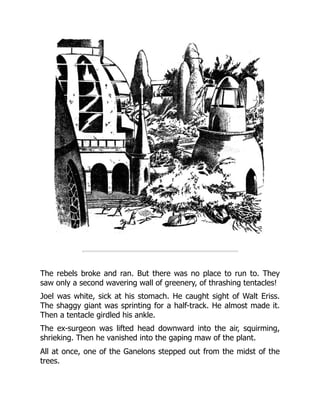
The rebels brokeand ran. But there was no place to run to. They
saw only a second wavering wall of greenery, of thrashing tentacles!
Joel was white, sick at his stomach. He caught sight of Walt Eriss.
The shaggy giant was sprinting for a half-track. He almost made it.
Then a tentacle girdled his ankle.
The ex-surgeon was lifted head downward into the air, squirming,
shrieking. Then he vanished into the gaping maw of the plant.
All at once, one of the Ganelons stepped out from the midst of the
trees.
21.
"Surrender!" he yelled."Surrender, and we'll call off the plants."
He had to repeat his offer a dozen times before he could catch the
attention of the frantic serfs. Then one of the rebels threw his
projector to the ground, raised his hands. Another and another
followed suit. It was over.
Joel felt dazed.
Tamis touched his shoulder. "The Thinkers are expressing their
thanks."
Thorp said, "You're on the air. You're a celebrity," and grinned.
But Joel didn't smile. "What about Eden?" he asked.
Tamis said, "The Thinkers are calling the neighboring tribes. There
will be a big round-up of nigel trees...."
Joel let his breath escape with relief. "Tamis," he said, "can the
Thinkers give me a guide to the palace? I've got to get back."
"Is it Priscilla Cameron, Joel?"
He looked at the Ganelon girl. She had tight hold of Nick Thorp's
hand.
"Yes," Joel, replied. "Lord knows what might have happened to her."
"We'll guide you."
"We're both with you," Thorp added.
Joel felt suddenly grateful to the strangely assorted pair. He'd had to
come all the way to Asgard to rediscover the meaning of friendship.
Like love, he thought.
Alpha Centauri B had set and Alpha Centauri A had not yet risen
when they arrived at the outskirts of Eden. The sky over the city was
22.
lurid from thereflection of burning buildings. Whole blocks must be
afire.
"There's Proxima Centauri," Tamis said, pointing to a drop of blood
gleaming in the night sky. "The little yellowish star above it is Sol."
Joel stared at it with a lump in his throat. It looked very cold and far
away. He hunched his shoulders, started down the street towards
the twinkling lights of Palace Hill.
The city itself was dark, lit only by ruddy flames. Gangs of looters
prowled the streets carrying torches. They paid no attention to Joel
and Thorp and the elfin Ganelon girl.
At the entrance to the tunnel beneath the palace, Joel halted.
"Tamis, it isn't safe for you to come any farther. You either, Nick."
But Tamis said, "I'll step out of sight," and did so. Thorp growled,
"You'll need me. Maybe Priscilla's alive."
Joel said, "Maybe," and touched the switch. A section of the wall slid
aside revealing the black tunnel mouth.
Thorp whistled softly.
"The walls of the palace are hollow," Joel explained. He closed the
door behind them.
At the first floor, he stopped the lift, crept out to one of the mirrors.
An immense hall met his eyes. It overflowed with guards armed with
ray projectors. The mutter of their voices was a low rumble in Joel's
ears.
"But can't they see us?" Thorp hissed.
"No." Joel explained the mirrors.
"Priscilla's not there," Thorp said. "How are you going to find her?"
"I'll find her," said Joel grimly and for the next hour he prowled
through the walls of the first floor like some ancestral ghost. Serfs
and police were everywhere. In some of the rooms indescribable
orgies were taking place.
23.
"It'll take ayear to search this maze," Thorp growled.
Joel stopped, wiped the sweat out of his eyes. Glancing through the
customary mirror, he saw a narrow passage down which a man was
walking.
"Hold it!" he said. He waited until the serf was passing the mirror,
touched the switch. The panel slid aside. The serf jerked his head
around. Joel hit him in the temple with his clubbed fist.
The rebel smashed into the wall across the corridor. Before he could
fall, Joel grabbed him by the collar, hauled him into the passage. The
panel clicked shut.
"Jupiter!" Thorp breathed. "Did you kill him?"
"No. He's just stunned." Joel slapped the man's face, shook him.
The rebel opened his eyes, stared at Joel groggily. Then he let out a
yell, tried to heave himself to his feet.
Joel shoved him back to the floor. "Yell your head off. Nobody can
hear you."
The man stopped yelling. "What's the idea?" he demanded.
"Who's in charge here?"
"The Emperor."
"The Emperor?" Joel felt a tingle of excitement. "Who's he?"
"He's the Emperor. That's all I know. I never saw him before today."
Joel shook his fist under the fellow's nose.
"So help me!" the man said in a scared voice, "that's all I know!"
"Where is this Emperor?"
"He's in his rooms on the top floor."
"What have they done with the governor and his daughter, the chief
of police?"
"Don't hit me. I don't know. It's the gospel truth."
24.
Joel said savagely,"Tie him up."
Thorp tore up the serf's tunic, bound his wrists and ankles, tied
them together so that he arched backward like a bow.
"Don't forget me," the serf pleaded. "I'll rot here in the walls."
But Joel was gone.
Subdued indirect lighting illuminated the top floor. Joel paused
behind a mirror with Thorp at his elbow. He glanced into Governor
Cameron's suite. The rooms were gutted, empty.
He said, "There's only one other apartment up here. That's
Priscilla's. He must be there."
"Emperor!" Disgust was heavy in Thorp's voice. "What does he think
this is, the pre-Atomic age?"
Joel didn't reply. He was conscious of Tamis' alien scent as he
threaded his way between the walls. He could see guards lounging
before Priscilla's door.
"That's where he is!" he said savagely. He was trembling, he
realized. He drew his paralyzer.
But when he reached the salon, it was empty. He ran through the
passage to Priscilla's bedroom, halted, icy fingers squeezing his
heart.
Through the one-way mirrors, he could see Priscilla sitting in a
relaxer. There was a frightened, defiant expression on her face. And
she was staring up at Fredrik Roos.
The lean saturnine chief of the Asgardian police was bending over
the green haired girl, saying furiously, "After what I've done, do you
think I'd hesitate to kill you?"
Priscilla shivered.
25.
Behind Joel, Thorpsaid, "The Emperor, Fredrik I of Asgard. He's
going to have the shortest reign in history!"
"Shut up!" said Joel. "He's talking."
Roos said, "I don't need the mutants; they need me! Look what
happened to Eden. Nelsville and Nuvenice will fall the same way. But
you can save thousands of lives if you persuade them to cooperate."
Joel said, "I'm going to take him," and touched the switch.
The panel made a faint squeak as it slid back. Joel leveled the
paralyzer, touched the stud.
Roos jerked around, his eyes widening. Then he leaped aside
spasmodically. The yellow flame splashed harmlessly against the
opposite wall.
Before Joel could catch the police chief in his sights again, the room
was plunged into darkness. Priscilla screamed.
"Stay back, Thorp!" Joel yelled. "He can see in the dark!"
Something snatched his paralyzer. He struck out blindly, felt his fist
crunch against flesh and bone. The paralyzer clattered on the floor.
Joel's eyes were adjusting. He could make out a dim gray silhouette
dancing in front of him. He struck at it. The shadow bobbed. Joel's
fist whistled through air.
He struck again and missed. Then a barrage of fists exploded in his
face. He was driven back against the wall.
He could see the elusive Roos more clearly, a weaving, bobbing
silhouette. He swung and missed, swung and missed.
Roos hit him in the mouth, in the solar plexus.
Joel sagged gasping to his knees. Roos kicked him viciously in the
kidneys. It was like the searing thrust of a knife.
He thought, I'm being licked. Once he'd seen a Histrofilm of a
prizefight. That was why he couldn't hit the police chief. Roos was a
skilled boxer.
26.
He pulled himselfgroggily to his feet, lunged for him. He could see
him quite clearly now but in varying shades of gray like a black and
white photograph.
Roos danced aside, clipped him behind the ear. He was grinning.
"Ox!" he said.
Joel felt like a bear attacked by a slashing pack of wolves. He shook
his head, shuffled after Roos cautiously. He took three hard punches
in the face without faltering, kept closing in.
Roos backed up. Joel crowded him in the corner, letting the police
chief hit him with everything he had.
At the last moment Roos guessed Joel's purpose. He tried to duck
and slide clear.
Joel grabbed him by the collar and belt. With a grunt, he heaved him
over his head.
The police chief kicked, squirmed frantically. The muscles in Joel's
shoulders cracked. But he held him aloft, began to walk deliberately
toward the crystal doors leading to the terrace.
Roos cursed, wrenched, flailing wildly with arms and legs. Joel
kicked the doors aside.
Alpha Centauri A was flooding the terrace with a clear dawn light.
Roos began to beg for his life.
27.
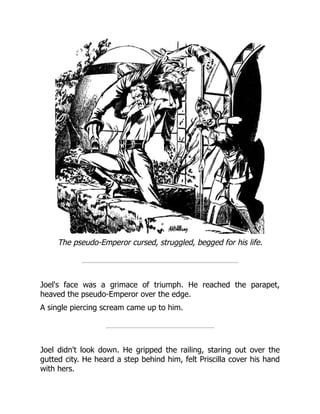
The pseudo-Emperor cursed,struggled, begged for his life.
Joel's face was a grimace of triumph. He reached the parapet,
heaved the pseudo-Emperor over the edge.
A single piercing scream came up to him.
Joel didn't look down. He gripped the railing, staring out over the
gutted city. He heard a step behind him, felt Priscilla cover his hand
with hers.
28.
"I knew you'dcome. But Joel, we mustn't waste time!" Her voice
was tremulous. "Please hurry before the alarm is given!"
"No," he said. "We'll wait here."
"Joel! Roos' death won't stop the revolt. There'll be a dozen men to
take his place. Maybe the Ganelons will take us in!"
"Look," he said simply, and pointed out over the parapet.
In perplexity the girl glanced down on the city spread out below.
Then she gave a little scream, clapped her hand over her mouth.
Slowly, inexorably, the encircling jungle was enveloping the city!
Already the outlying districts were submerged beneath a wave of
thrashing greenery.
Joel saw a band of ant-like men trying to stem the advance of the
nigel trees with ray projectors. Then they broke and ran.
Someone began to pound on the door to Priscilla's suite and shout
for the Emperor. Then he went away.
Thorp called, "What is it, Joel?"
"The plants! They're attacking!"
With a shout, the ex-spaceman rushed to the parapet, dragging
Tamis with him.
The Ganelon girl's ivory cheeks were flushed and she held tight to
Thorp's hand as she leaned over the parapet.
Priscilla's green eyes widened. "The Ganelons! They've set the nigel
trees onto the rebels."
Joel nodded.
"Oh, Joel! Then you did get through to the Thinkers!" She threw her
arms around his neck. Suddenly she drew back. "But are we safe
here?"
Tamis said, "My people are directing the trees. We're safe. So are
your father and the other captives."
29.
Priscilla let herselfgo limp in Joel's arms, nestled her head on his
shoulder.
Beneath them the sea of vegetation flooded down the streets,
swarmed over the buildings.
"The new Eden," said Joel. He glanced down into Priscilla's upturned
face. What he saw there set his pulse racing. He had come a long
way, he realized, from the dissatisfied specialist in animal husbandry.
He had come a long way, but it was only the beginning.
30.
*** END OFTHE PROJECT GUTENBERG EBOOK CITADEL OF THE
GREEN DEATH ***
Updated editions will replace the previous one—the old editions will
be renamed.
Creating the works from print editions not protected by U.S.
copyright law means that no one owns a United States copyright in
these works, so the Foundation (and you!) can copy and distribute it
in the United States without permission and without paying
copyright royalties. Special rules, set forth in the General Terms of
Use part of this license, apply to copying and distributing Project
Gutenberg™ electronic works to protect the PROJECT GUTENBERG™
concept and trademark. Project Gutenberg is a registered trademark,
and may not be used if you charge for an eBook, except by following
the terms of the trademark license, including paying royalties for use
of the Project Gutenberg trademark. If you do not charge anything
for copies of this eBook, complying with the trademark license is
very easy. You may use this eBook for nearly any purpose such as
creation of derivative works, reports, performances and research.
Project Gutenberg eBooks may be modified and printed and given
away—you may do practically ANYTHING in the United States with
eBooks not protected by U.S. copyright law. Redistribution is subject
to the trademark license, especially commercial redistribution.
START: FULL LICENSE
PLEASE READ THISBEFORE YOU DISTRIBUTE OR USE THIS WORK
To protect the Project Gutenberg™ mission of promoting the free
distribution of electronic works, by using or distributing this work (or
any other work associated in any way with the phrase “Project
Gutenberg”), you agree to comply with all the terms of the Full
Project Gutenberg™ License available with this file or online at
www.gutenberg.org/license.
Section 1. General Terms of Use and
Redistributing Project Gutenberg™
electronic works
1.A. By reading or using any part of this Project Gutenberg™
electronic work, you indicate that you have read, understand, agree
to and accept all the terms of this license and intellectual property
(trademark/copyright) agreement. If you do not agree to abide by all
the terms of this agreement, you must cease using and return or
destroy all copies of Project Gutenberg™ electronic works in your
possession. If you paid a fee for obtaining a copy of or access to a
Project Gutenberg™ electronic work and you do not agree to be
bound by the terms of this agreement, you may obtain a refund
from the person or entity to whom you paid the fee as set forth in
paragraph 1.E.8.
1.B. “Project Gutenberg” is a registered trademark. It may only be
used on or associated in any way with an electronic work by people
who agree to be bound by the terms of this agreement. There are a
few things that you can do with most Project Gutenberg™ electronic
works even without complying with the full terms of this agreement.
See paragraph 1.C below. There are a lot of things you can do with
Project Gutenberg™ electronic works if you follow the terms of this
agreement and help preserve free future access to Project
Gutenberg™ electronic works. See paragraph 1.E below.
33.
1.C. The ProjectGutenberg Literary Archive Foundation (“the
Foundation” or PGLAF), owns a compilation copyright in the
collection of Project Gutenberg™ electronic works. Nearly all the
individual works in the collection are in the public domain in the
United States. If an individual work is unprotected by copyright law
in the United States and you are located in the United States, we do
not claim a right to prevent you from copying, distributing,
performing, displaying or creating derivative works based on the
work as long as all references to Project Gutenberg are removed. Of
course, we hope that you will support the Project Gutenberg™
mission of promoting free access to electronic works by freely
sharing Project Gutenberg™ works in compliance with the terms of
this agreement for keeping the Project Gutenberg™ name associated
with the work. You can easily comply with the terms of this
agreement by keeping this work in the same format with its attached
full Project Gutenberg™ License when you share it without charge
with others.
1.D. The copyright laws of the place where you are located also
govern what you can do with this work. Copyright laws in most
countries are in a constant state of change. If you are outside the
United States, check the laws of your country in addition to the
terms of this agreement before downloading, copying, displaying,
performing, distributing or creating derivative works based on this
work or any other Project Gutenberg™ work. The Foundation makes
no representations concerning the copyright status of any work in
any country other than the United States.
1.E. Unless you have removed all references to Project Gutenberg:
1.E.1. The following sentence, with active links to, or other
immediate access to, the full Project Gutenberg™ License must
appear prominently whenever any copy of a Project Gutenberg™
work (any work on which the phrase “Project Gutenberg” appears,
or with which the phrase “Project Gutenberg” is associated) is
accessed, displayed, performed, viewed, copied or distributed:
34.
This eBook isfor the use of anyone anywhere in the United
States and most other parts of the world at no cost and with
almost no restrictions whatsoever. You may copy it, give it away
or re-use it under the terms of the Project Gutenberg License
included with this eBook or online at www.gutenberg.org. If you
are not located in the United States, you will have to check the
laws of the country where you are located before using this
eBook.
1.E.2. If an individual Project Gutenberg™ electronic work is derived
from texts not protected by U.S. copyright law (does not contain a
notice indicating that it is posted with permission of the copyright
holder), the work can be copied and distributed to anyone in the
United States without paying any fees or charges. If you are
redistributing or providing access to a work with the phrase “Project
Gutenberg” associated with or appearing on the work, you must
comply either with the requirements of paragraphs 1.E.1 through
1.E.7 or obtain permission for the use of the work and the Project
Gutenberg™ trademark as set forth in paragraphs 1.E.8 or 1.E.9.
1.E.3. If an individual Project Gutenberg™ electronic work is posted
with the permission of the copyright holder, your use and distribution
must comply with both paragraphs 1.E.1 through 1.E.7 and any
additional terms imposed by the copyright holder. Additional terms
will be linked to the Project Gutenberg™ License for all works posted
with the permission of the copyright holder found at the beginning
of this work.
1.E.4. Do not unlink or detach or remove the full Project
Gutenberg™ License terms from this work, or any files containing a
part of this work or any other work associated with Project
Gutenberg™.
1.E.5. Do not copy, display, perform, distribute or redistribute this
electronic work, or any part of this electronic work, without
prominently displaying the sentence set forth in paragraph 1.E.1
35.
with active linksor immediate access to the full terms of the Project
Gutenberg™ License.
1.E.6. You may convert to and distribute this work in any binary,
compressed, marked up, nonproprietary or proprietary form,
including any word processing or hypertext form. However, if you
provide access to or distribute copies of a Project Gutenberg™ work
in a format other than “Plain Vanilla ASCII” or other format used in
the official version posted on the official Project Gutenberg™ website
(www.gutenberg.org), you must, at no additional cost, fee or
expense to the user, provide a copy, a means of exporting a copy, or
a means of obtaining a copy upon request, of the work in its original
“Plain Vanilla ASCII” or other form. Any alternate format must
include the full Project Gutenberg™ License as specified in
paragraph 1.E.1.
1.E.7. Do not charge a fee for access to, viewing, displaying,
performing, copying or distributing any Project Gutenberg™ works
unless you comply with paragraph 1.E.8 or 1.E.9.
1.E.8. You may charge a reasonable fee for copies of or providing
access to or distributing Project Gutenberg™ electronic works
provided that:
• You pay a royalty fee of 20% of the gross profits you derive
from the use of Project Gutenberg™ works calculated using the
method you already use to calculate your applicable taxes. The
fee is owed to the owner of the Project Gutenberg™ trademark,
but he has agreed to donate royalties under this paragraph to
the Project Gutenberg Literary Archive Foundation. Royalty
payments must be paid within 60 days following each date on
which you prepare (or are legally required to prepare) your
periodic tax returns. Royalty payments should be clearly marked
as such and sent to the Project Gutenberg Literary Archive
Foundation at the address specified in Section 4, “Information
36.
about donations tothe Project Gutenberg Literary Archive
Foundation.”
• You provide a full refund of any money paid by a user who
notifies you in writing (or by e-mail) within 30 days of receipt
that s/he does not agree to the terms of the full Project
Gutenberg™ License. You must require such a user to return or
destroy all copies of the works possessed in a physical medium
and discontinue all use of and all access to other copies of
Project Gutenberg™ works.
• You provide, in accordance with paragraph 1.F.3, a full refund of
any money paid for a work or a replacement copy, if a defect in
the electronic work is discovered and reported to you within 90
days of receipt of the work.
• You comply with all other terms of this agreement for free
distribution of Project Gutenberg™ works.
1.E.9. If you wish to charge a fee or distribute a Project Gutenberg™
electronic work or group of works on different terms than are set
forth in this agreement, you must obtain permission in writing from
the Project Gutenberg Literary Archive Foundation, the manager of
the Project Gutenberg™ trademark. Contact the Foundation as set
forth in Section 3 below.
1.F.
1.F.1. Project Gutenberg volunteers and employees expend
considerable effort to identify, do copyright research on, transcribe
and proofread works not protected by U.S. copyright law in creating
the Project Gutenberg™ collection. Despite these efforts, Project
Gutenberg™ electronic works, and the medium on which they may
be stored, may contain “Defects,” such as, but not limited to,
incomplete, inaccurate or corrupt data, transcription errors, a
copyright or other intellectual property infringement, a defective or
37.
damaged disk orother medium, a computer virus, or computer
codes that damage or cannot be read by your equipment.
1.F.2. LIMITED WARRANTY, DISCLAIMER OF DAMAGES - Except for
the “Right of Replacement or Refund” described in paragraph 1.F.3,
the Project Gutenberg Literary Archive Foundation, the owner of the
Project Gutenberg™ trademark, and any other party distributing a
Project Gutenberg™ electronic work under this agreement, disclaim
all liability to you for damages, costs and expenses, including legal
fees. YOU AGREE THAT YOU HAVE NO REMEDIES FOR
NEGLIGENCE, STRICT LIABILITY, BREACH OF WARRANTY OR
BREACH OF CONTRACT EXCEPT THOSE PROVIDED IN PARAGRAPH
1.F.3. YOU AGREE THAT THE FOUNDATION, THE TRADEMARK
OWNER, AND ANY DISTRIBUTOR UNDER THIS AGREEMENT WILL
NOT BE LIABLE TO YOU FOR ACTUAL, DIRECT, INDIRECT,
CONSEQUENTIAL, PUNITIVE OR INCIDENTAL DAMAGES EVEN IF
YOU GIVE NOTICE OF THE POSSIBILITY OF SUCH DAMAGE.
1.F.3. LIMITED RIGHT OF REPLACEMENT OR REFUND - If you
discover a defect in this electronic work within 90 days of receiving
it, you can receive a refund of the money (if any) you paid for it by
sending a written explanation to the person you received the work
from. If you received the work on a physical medium, you must
return the medium with your written explanation. The person or
entity that provided you with the defective work may elect to provide
a replacement copy in lieu of a refund. If you received the work
electronically, the person or entity providing it to you may choose to
give you a second opportunity to receive the work electronically in
lieu of a refund. If the second copy is also defective, you may
demand a refund in writing without further opportunities to fix the
problem.
1.F.4. Except for the limited right of replacement or refund set forth
in paragraph 1.F.3, this work is provided to you ‘AS-IS’, WITH NO
OTHER WARRANTIES OF ANY KIND, EXPRESS OR IMPLIED,
38.
INCLUDING BUT NOTLIMITED TO WARRANTIES OF
MERCHANTABILITY OR FITNESS FOR ANY PURPOSE.
1.F.5. Some states do not allow disclaimers of certain implied
warranties or the exclusion or limitation of certain types of damages.
If any disclaimer or limitation set forth in this agreement violates the
law of the state applicable to this agreement, the agreement shall be
interpreted to make the maximum disclaimer or limitation permitted
by the applicable state law. The invalidity or unenforceability of any
provision of this agreement shall not void the remaining provisions.
1.F.6. INDEMNITY - You agree to indemnify and hold the Foundation,
the trademark owner, any agent or employee of the Foundation,
anyone providing copies of Project Gutenberg™ electronic works in
accordance with this agreement, and any volunteers associated with
the production, promotion and distribution of Project Gutenberg™
electronic works, harmless from all liability, costs and expenses,
including legal fees, that arise directly or indirectly from any of the
following which you do or cause to occur: (a) distribution of this or
any Project Gutenberg™ work, (b) alteration, modification, or
additions or deletions to any Project Gutenberg™ work, and (c) any
Defect you cause.
Section 2. Information about the Mission
of Project Gutenberg™
Project Gutenberg™ is synonymous with the free distribution of
electronic works in formats readable by the widest variety of
computers including obsolete, old, middle-aged and new computers.
It exists because of the efforts of hundreds of volunteers and
donations from people in all walks of life.
Volunteers and financial support to provide volunteers with the
assistance they need are critical to reaching Project Gutenberg™’s
goals and ensuring that the Project Gutenberg™ collection will
39.
remain freely availablefor generations to come. In 2001, the Project
Gutenberg Literary Archive Foundation was created to provide a
secure and permanent future for Project Gutenberg™ and future
generations. To learn more about the Project Gutenberg Literary
Archive Foundation and how your efforts and donations can help,
see Sections 3 and 4 and the Foundation information page at
www.gutenberg.org.
Section 3. Information about the Project
Gutenberg Literary Archive Foundation
The Project Gutenberg Literary Archive Foundation is a non-profit
501(c)(3) educational corporation organized under the laws of the
state of Mississippi and granted tax exempt status by the Internal
Revenue Service. The Foundation’s EIN or federal tax identification
number is 64-6221541. Contributions to the Project Gutenberg
Literary Archive Foundation are tax deductible to the full extent
permitted by U.S. federal laws and your state’s laws.
The Foundation’s business office is located at 809 North 1500 West,
Salt Lake City, UT 84116, (801) 596-1887. Email contact links and up
to date contact information can be found at the Foundation’s website
and official page at www.gutenberg.org/contact
Section 4. Information about Donations to
the Project Gutenberg Literary Archive
Foundation
Project Gutenberg™ depends upon and cannot survive without
widespread public support and donations to carry out its mission of
increasing the number of public domain and licensed works that can
be freely distributed in machine-readable form accessible by the
widest array of equipment including outdated equipment. Many
40.
small donations ($1to $5,000) are particularly important to
maintaining tax exempt status with the IRS.
The Foundation is committed to complying with the laws regulating
charities and charitable donations in all 50 states of the United
States. Compliance requirements are not uniform and it takes a
considerable effort, much paperwork and many fees to meet and
keep up with these requirements. We do not solicit donations in
locations where we have not received written confirmation of
compliance. To SEND DONATIONS or determine the status of
compliance for any particular state visit www.gutenberg.org/donate.
While we cannot and do not solicit contributions from states where
we have not met the solicitation requirements, we know of no
prohibition against accepting unsolicited donations from donors in
such states who approach us with offers to donate.
International donations are gratefully accepted, but we cannot make
any statements concerning tax treatment of donations received from
outside the United States. U.S. laws alone swamp our small staff.
Please check the Project Gutenberg web pages for current donation
methods and addresses. Donations are accepted in a number of
other ways including checks, online payments and credit card
donations. To donate, please visit: www.gutenberg.org/donate.
Section 5. General Information About
Project Gutenberg™ electronic works
Professor Michael S. Hart was the originator of the Project
Gutenberg™ concept of a library of electronic works that could be
freely shared with anyone. For forty years, he produced and
distributed Project Gutenberg™ eBooks with only a loose network of
volunteer support.
41.
Project Gutenberg™ eBooksare often created from several printed
editions, all of which are confirmed as not protected by copyright in
the U.S. unless a copyright notice is included. Thus, we do not
necessarily keep eBooks in compliance with any particular paper
edition.
Most people start at our website which has the main PG search
facility: www.gutenberg.org.
This website includes information about Project Gutenberg™,
including how to make donations to the Project Gutenberg Literary
Archive Foundation, how to help produce our new eBooks, and how
to subscribe to our email newsletter to hear about new eBooks.