Solution Manual for Interpreting and Analyzing
Financial Statements 6th Edition by Schoenebeck
install download
https://testbankmall.com/product/solution-manual-for-
interpreting-and-analyzing-financial-statements-6th-edition-by-
schoenebeck/
Download more testbank from https://testbankmall.com
Instant digital products (PDF, ePub, MOBI) available
Download now and explore formats that suit you...
Instructor Manual For Interpreting and Analyzing Financial
Statements (6th Edition) by Karen P. Schoenebeck, Mark P.
Holtzman
https://testbankmall.com/product/instructor-manual-for-interpreting-
and-analyzing-financial-statements-6th-edition-by-karen-p-schoenebeck-
mark-p-holtzman/
testbankmall.com
Solution manual for Financial Statements Analysis
Subramanyam Wild 11th edition
https://testbankmall.com/product/solution-manual-for-financial-
statements-analysis-subramanyam-wild-11th-edition/
testbankmall.com
Solution Manual for Business Analysis Valuation Using
Financial Statements, 5th Edition
https://testbankmall.com/product/solution-manual-for-business-
analysis-valuation-using-financial-statements-5th-edition/
testbankmall.com
Test Bank for Sociology 13th Edition by Macionis
https://testbankmall.com/product/test-bank-for-sociology-13th-edition-
by-macionis/
testbankmall.com
Test Bank for An Introduction to Management Science
Quantitative Approaches to Decision Making, Revised, 13th
Edition
https://testbankmall.com/product/test-bank-for-an-introduction-to-
management-science-quantitative-approaches-to-decision-making-
revised-13th-edition/
testbankmall.com
Test bank Pathophysiology Introductory Concepts and
Clinical Perspectives 2nd Edition Capriotti
https://testbankmall.com/product/test-bank-pathophysiology-
introductory-concepts-and-clinical-perspectives-2nd-edition-capriotti/
testbankmall.com
Fundamentals of Anatomy Physiology 10th Edition Martini
Nath Test Bank
https://testbankmall.com/product/fundamentals-of-anatomy-
physiology-10th-edition-martini-nath-test-bank/
testbankmall.com
Information Technology for Management Digital Strategies
for Insight Action and Sustainable Performance 10th
Edition Turban Test Bank
https://testbankmall.com/product/information-technology-for-
management-digital-strategies-for-insight-action-and-sustainable-
performance-10th-edition-turban-test-bank/
testbankmall.com
College Algebra Lial 11th Edition Solutions Manual
https://testbankmall.com/product/college-algebra-lial-11th-edition-
solutions-manual/
testbankmall.com
Test Bank for Comprehensive Radiographic Pathology, 5th
Edition: Eisenberg
https://testbankmall.com/product/test-bank-for-comprehensive-
radiographic-pathology-5th-edition-eisenberg/
testbankmall.com
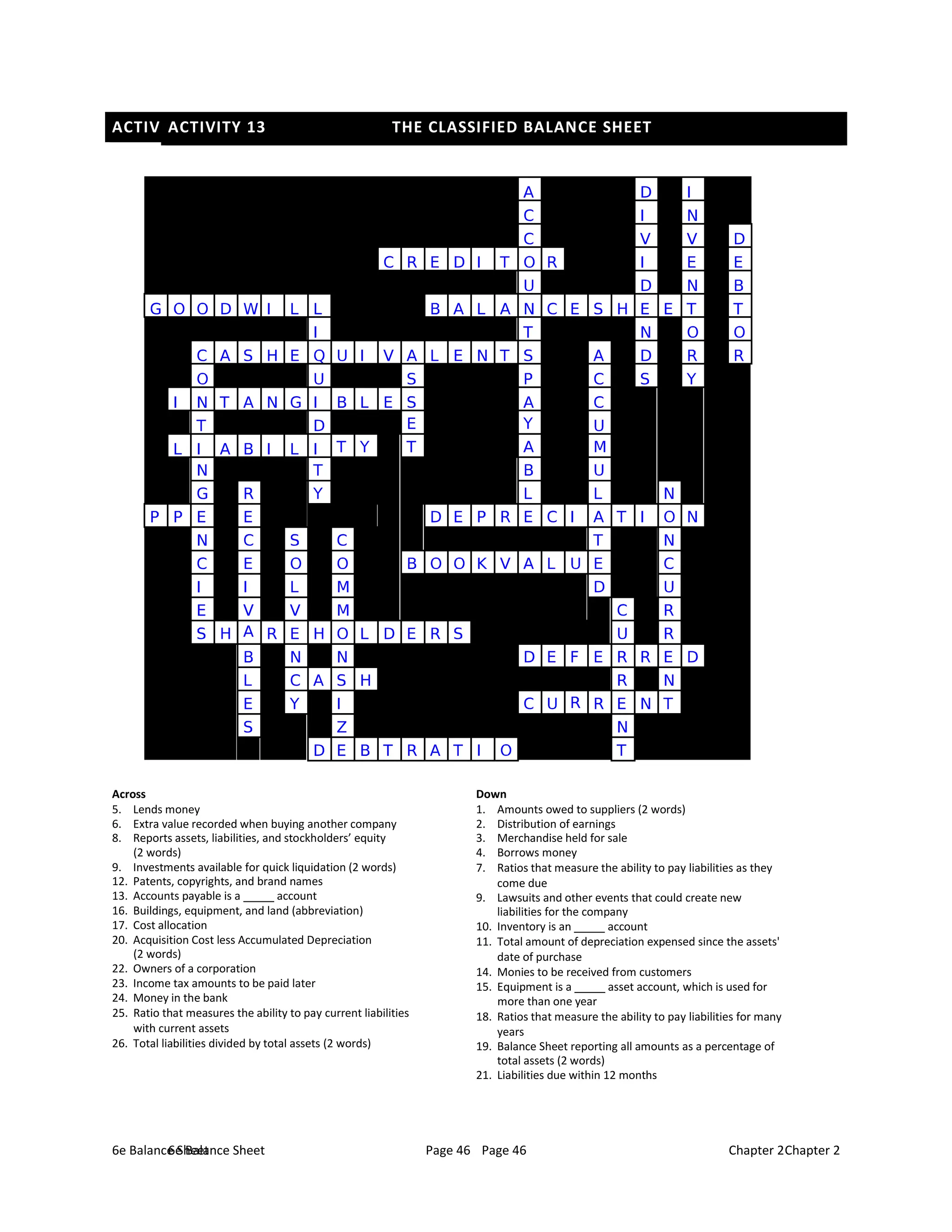
ACTIVITY 12 CROSSWORD PUZZLE FOR CHAPTER 2
ACTIVITY 13 THE CLASSIFIED BALANCE SHEET
6e Balance Sheet Page 46 Chapter 2
Across
5. Lends money
6. Extra value recorded when buying another company
8. Reports assets, liabilities, and stockholders’ equity
(2 words)
9. Investments available for quick liquidation (2 words)
12. Patents, copyrights, and brand names
13. Accounts payable is a account
16. Buildings, equipment, and land (abbreviation)
17. Cost allocation
20. Acquisition Cost less Accumulated Depreciation
(2 words)
22. Owners of a corporation
23. Income tax amounts to be paid later
24. Money in the bank
25. Ratio that measures the ability to pay current liabilities
with current assets
26. Total liabilities divided by total assets (2 words)
Down
1. Amounts owed to suppliers (2 words)
2. Distribution of earnings
3. Merchandise held for sale
4. Borrows money
7. Ratios that measure the ability to pay liabilities as they
come due
9. Lawsuits and other events that could create new
liabilities for the company
10. Inventory is an account
11. Total amount of depreciation expensed since the assets'
date of purchase
14. Monies to be received from customers
15. Equipment is a asset account, which is used for
more than one year
18. Ratios that measure the ability to pay liabilities for many
years
19. Balance Sheet reporting all amounts as a percentage of
total assets (2 words)
21. Liabilities due within 12 months
ACTIVITY 12 CROSSWORD PUZZLE FOR CHAPTER 2
ACTIVITY 13 THE CLASSIFIED BALANCE SHEET
6e Balance Sheet Page 47 Chapter 2
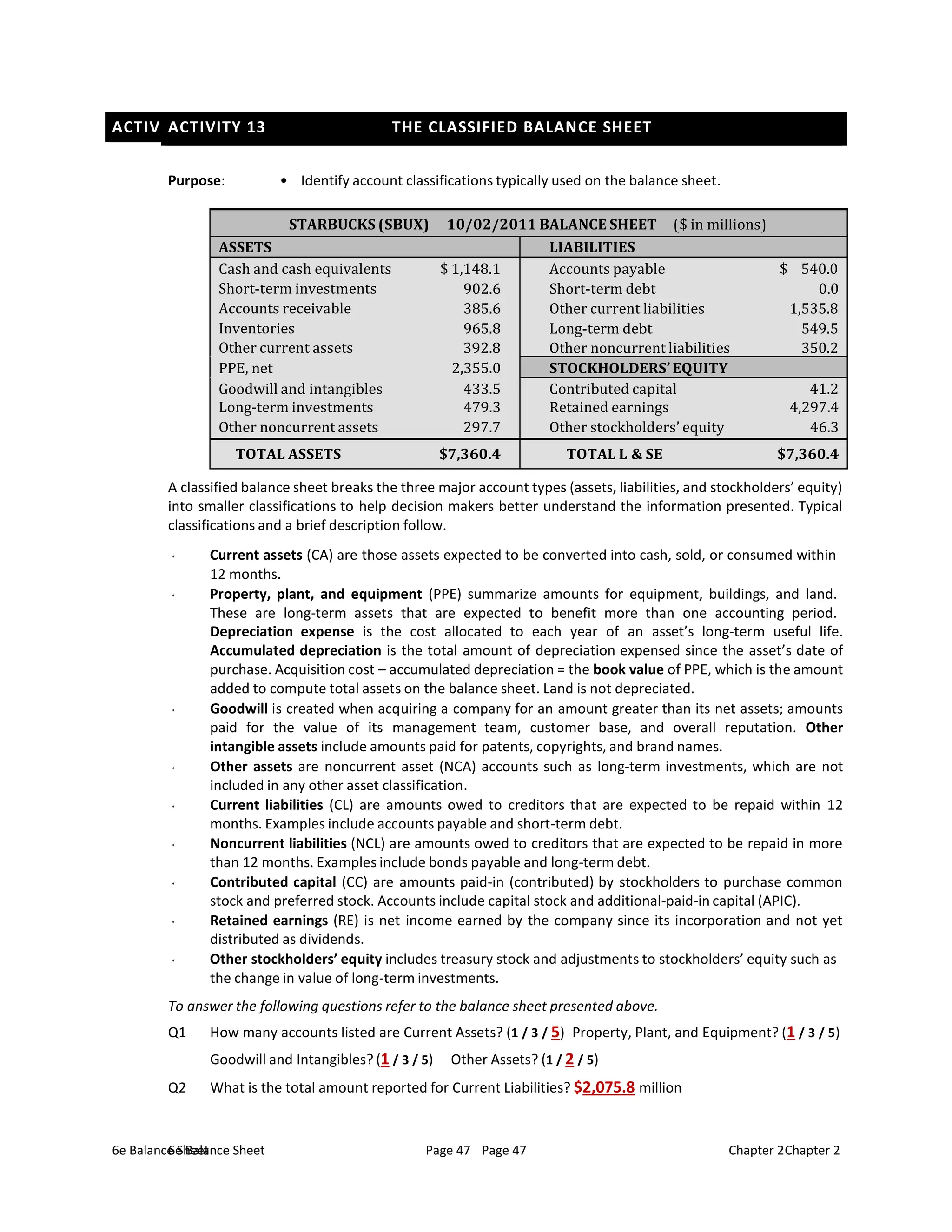
Purpose: • Identify account classifications typically used on the balance sheet.
STARBUCKS (SBUX) 10/02/2011 BALANCE SHEET ($ in millions)
ASSETS LIABILITIES
Cash and cash equivalents
Short-term investments
Accounts receivable
Inventories
Other current assets
$ 1,148.1
902.6
385.6
965.8
392.8
Accounts payable
Short-term debt
Other current liabilities
Long-term debt
Other noncurrent liabilities
$ 540.0
0.0
1,535.8
549.5
350.2
PPE, net 2,355.0 STOCKHOLDERS’EQUITY
Goodwill and intangibles 433.5 Contributed capital 41.2
Long-term investments 479.3 Retained earnings 4,297.4
Other noncurrent assets 297.7 Other stockholders’ equity 46.3
TOTAL ASSETS $7,360.4 TOTAL L & SE $7,360.4
A classified balance sheet breaks the three major account types (assets, liabilities, and stockholders’ equity)
into smaller classifications to help decision makers better understand the information presented. Typical
classifications and a brief description follow.
Current assets (CA) are those assets expected to be converted into cash, sold, or consumed within
12 months.
Property, plant, and equipment (PPE) summarize amounts for equipment, buildings, and land.
These are long-term assets that are expected to benefit more than one accounting period.
Depreciation expense is the cost allocated to each year of an asset’s long-term useful life.
Accumulated depreciation is the total amount of depreciation expensed since the asset’s date of
purchase. Acquisition cost – accumulated depreciation = the book value of PPE, which is the amount
added to compute total assets on the balance sheet. Land is not depreciated.
Goodwill is created when acquiring a company for an amount greater than its net assets; amounts
paid for the value of its management team, customer base, and overall reputation. Other
intangible assets include amounts paid for patents, copyrights, and brand names.
Other assets are noncurrent asset (NCA) accounts such as long-term investments, which are not
included in any other asset classification.
Current liabilities (CL) are amounts owed to creditors that are expected to be repaid within 12
months. Examples include accounts payable and short-term debt.
Noncurrent liabilities (NCL) are amounts owed to creditors that are expected to be repaid in more
than 12 months. Examples include bonds payable and long-term debt.
Contributed capital (CC) are amounts paid-in (contributed) by stockholders to purchase common
stock and preferred stock. Accounts include capital stock and additional-paid-in capital (APIC).
Retained earnings (RE) is net income earned by the company since its incorporation and not yet
distributed as dividends.
Other stockholders’ equity includes treasury stock and adjustments to stockholders’ equity such as
the change in value of long-term investments.
To answer the following questions refer to the balance sheet presented above.
Q1 How many accounts listed are Current Assets? (1 / 3 / 5) Property, Plant, and Equipment? (1 / 3 / 5)
Goodwill and Intangibles? (1 / 3 / 5) Other Assets? (1 / 2 / 5)
Q2 What is the total amount reported for Current Liabilities? $2,075.8 million
ACTIVITY 12 CROSSWORD PUZZLE FOR CHAPTER 2
ACTIVITY 13 THE CLASSIFIED BALANCE SHEET
6e Balance Sheet Page 48 Chapter 2
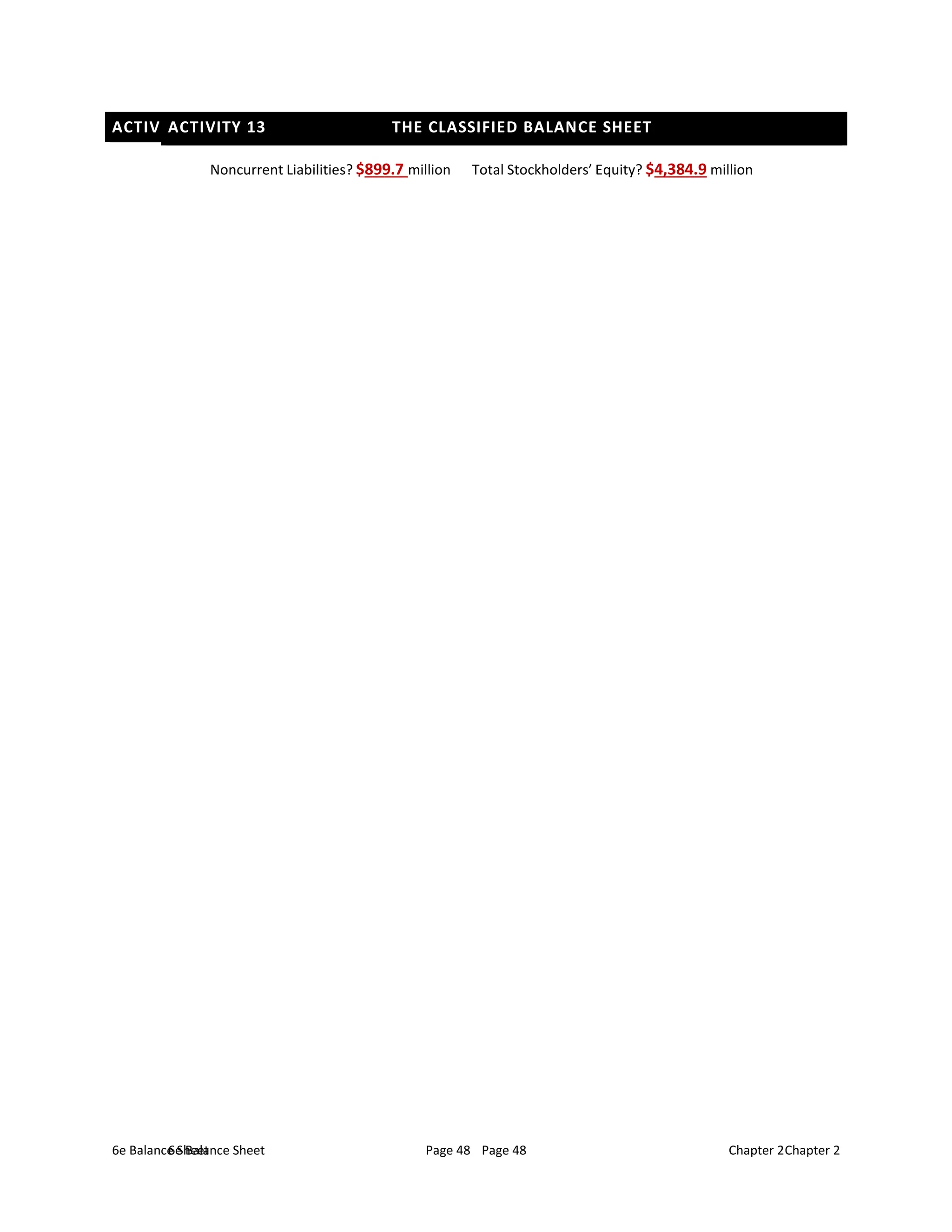
Noncurrent Liabilities? $899.7 million Total Stockholders’ Equity? $4,384.9 million
6e Balance Sheet Page 49 Chapter 2
ACTIVITY 14 UNDERSTANDING THE BALANCE SHEET
ACTIVITY 15 UNDERSTANDING THE BALANCE SHEET
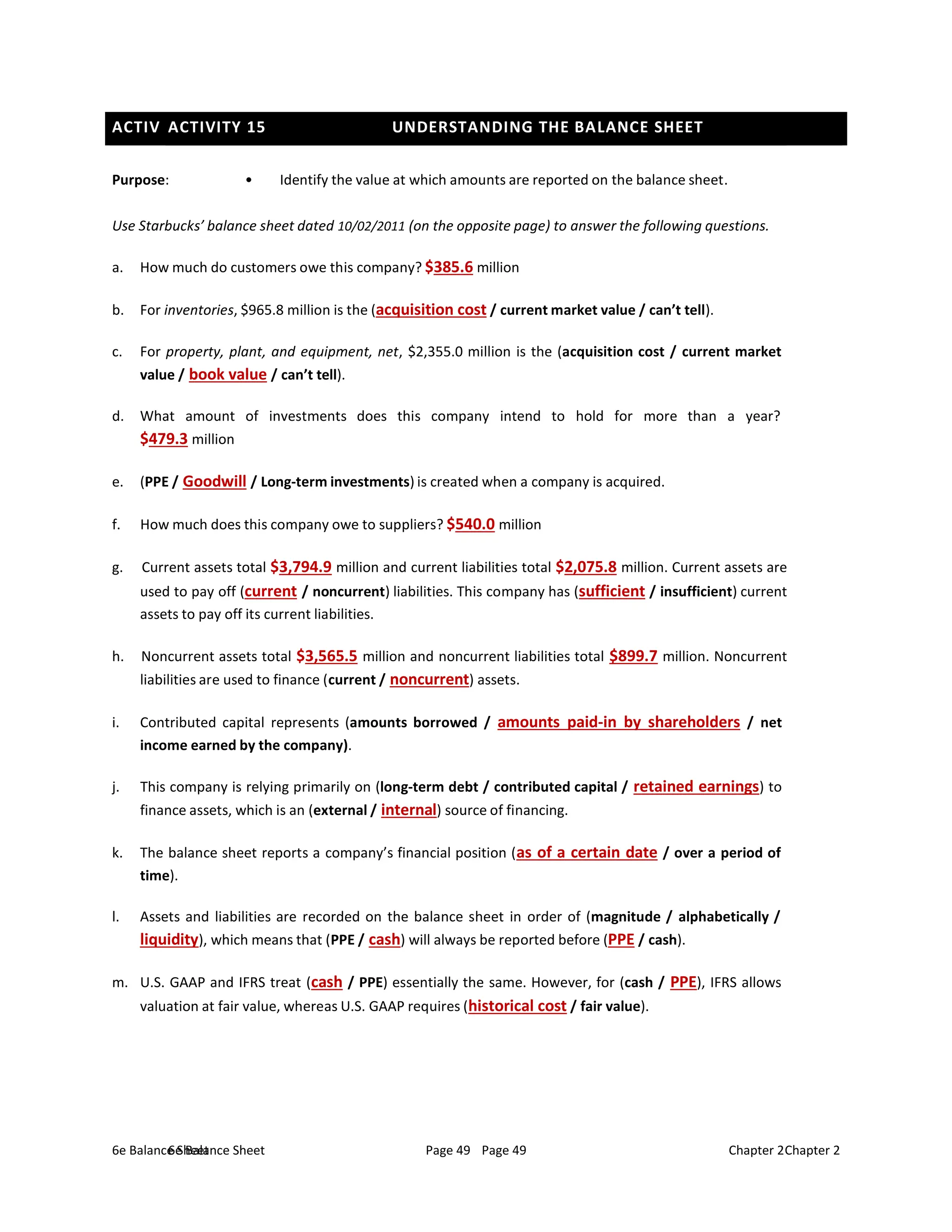
Purpose: • Identify the value at which amounts are reported on the balance sheet.
Use Starbucks’ balance sheet dated 10/02/2011 (on the opposite page) to answer the following questions.
a. How much do customers owe this company? $385.6 million
b. For inventories, $965.8 million is the (acquisition cost / current market value / can’t tell).
c. For property, plant, and equipment, net, $2,355.0 million is the (acquisition cost / current market
value / book value / can’t tell).
d. What amount of investments does this company intend to hold for more than a year?
$479.3 million
e. (PPE / Goodwill / Long-term investments) is created when a company is acquired.
f. How much does this company owe to suppliers? $540.0 million
g. Current assets total $3,794.9 million and current liabilities total $2,075.8 million. Current assets are
used to pay off (current / noncurrent) liabilities. This company has (sufficient / insufficient) current
assets to pay off its current liabilities.
h. Noncurrent assets total $3,565.5 million and noncurrent liabilities total $899.7 million. Noncurrent
liabilities are used to finance (current / noncurrent) assets.
i. Contributed capital represents (amounts borrowed / amounts paid-in by shareholders / net
income earned by the company).
j. This company is relying primarily on (long-term debt / contributed capital / retained earnings) to
finance assets, which is an (external / internal) source of financing.
k. The balance sheet reports a company’s financial position (as of a certain date / over a period of
time).
l. Assets and liabilities are recorded on the balance sheet in order of (magnitude / alphabetically /
liquidity), which means that (PPE / cash) will always be reported before (PPE / cash).
m. U.S. GAAP and IFRS treat (cash / PPE) essentially the same. However, for (cash / PPE), IFRS allows
valuation at fair value, whereas U.S. GAAP requires (historical cost / fair value).
6e Balance Sheet Page 50 Chapter 2
ACTIVITY 14 UNDERSTANDING THE BALANCE SHEET
ACTIVITY 15 UNDERSTANDING THE BALANCE SHEET
Purpose: • Identify the value at which amounts are reported on the balance sheet.
• Understand what an increase or a decrease in an account indicates.
• Develop strategies for analyzing the balance sheet.
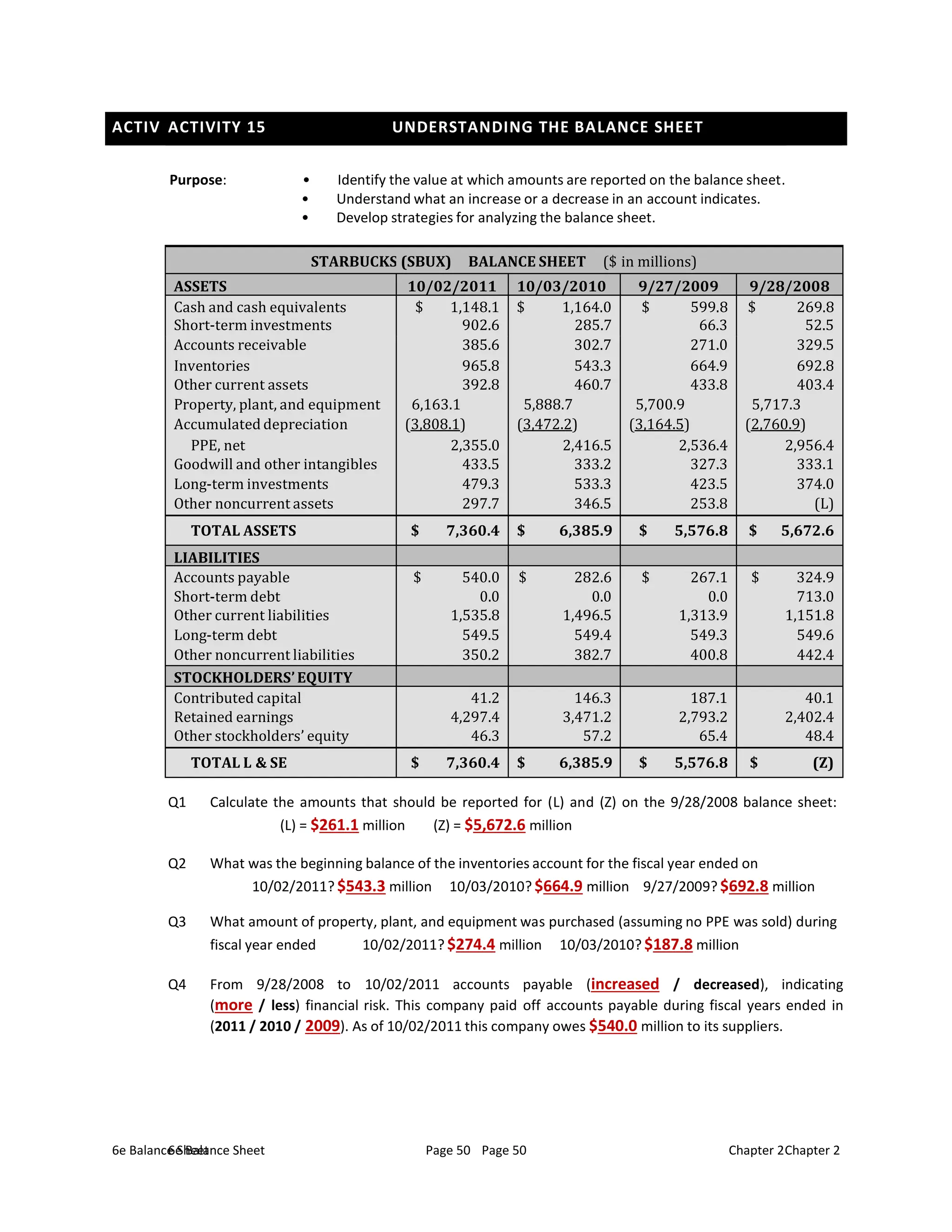
STARBUCKS (SBUX) BALANCE SHEET ($ in millions)
ASSETS 10/02/2011 10/03/2010 9/27/2009 9/28/2008
Cash and cash equivalents $ 1,148.1 $ 1,164.0 $ 599.8 $ 269.8
Short-term investments 902.6 285.7 66.3 52.5
Accounts receivable 385.6 302.7 271.0 329.5
Inventories 965.8 543.3 664.9 692.8
Other current assets 392.8 460.7 433.8 403.4
Property, plant, and equipment 6,163.1 5,888.7 5,700.9 5,717.3
Accumulated depreciation (3,808.1) (3,472.2) (3,164.5) (2,760.9)
PPE, net 2,355.0 2,416.5 2,536.4 2,956.4
Goodwill and other intangibles 433.5 333.2 327.3 333.1
Long-term investments 479.3 533.3 423.5 374.0
Other noncurrent assets 297.7 346.5 253.8 (L)
TOTAL ASSETS $ 7,360.4 $ 6,385.9 $ 5,576.8 $ 5,672.6
LIABILITIES
Accounts payable $ 540.0 $ 282.6 $ 267.1 $ 324.9
Short-term debt 0.0 0.0 0.0 713.0
Other current liabilities 1,535.8 1,496.5 1,313.9 1,151.8
Long-term debt 549.5 549.4 549.3 549.6
Other noncurrent liabilities 350.2 382.7 400.8 442.4
STOCKHOLDERS’EQUITY
Contributed capital 41.2 146.3 187.1 40.1
Retained earnings 4,297.4 3,471.2 2,793.2 2,402.4
Other stockholders’ equity 46.3 57.2 65.4 48.4
TOTAL L & SE $ 7,360.4 $ 6,385.9 $ 5,576.8 $ (Z)
Q1 Calculate the amounts that should be reported for (L) and (Z) on the 9/28/2008 balance sheet:
(L) = $261.1 million (Z) = $5,672.6 million
Q2 What was the beginning balance of the inventories account for the fiscal year ended on
10/02/2011? $543.3 million 10/03/2010? $664.9 million 9/27/2009? $692.8 million
Q3 What amount of property, plant, and equipment was purchased (assuming no PPE was sold) during
fiscal year ended 10/02/2011? $274.4 million 10/03/2010? $187.8 million
Q4 From 9/28/2008 to 10/02/2011 accounts payable (increased / decreased), indicating
(more / less) financial risk. This company paid off accounts payable during fiscal years ended in
(2011 / 2010 / 2009). As of 10/02/2011 this company owes $540.0 million to its suppliers.
6e Balance Sheet Page 49 Chapter 2
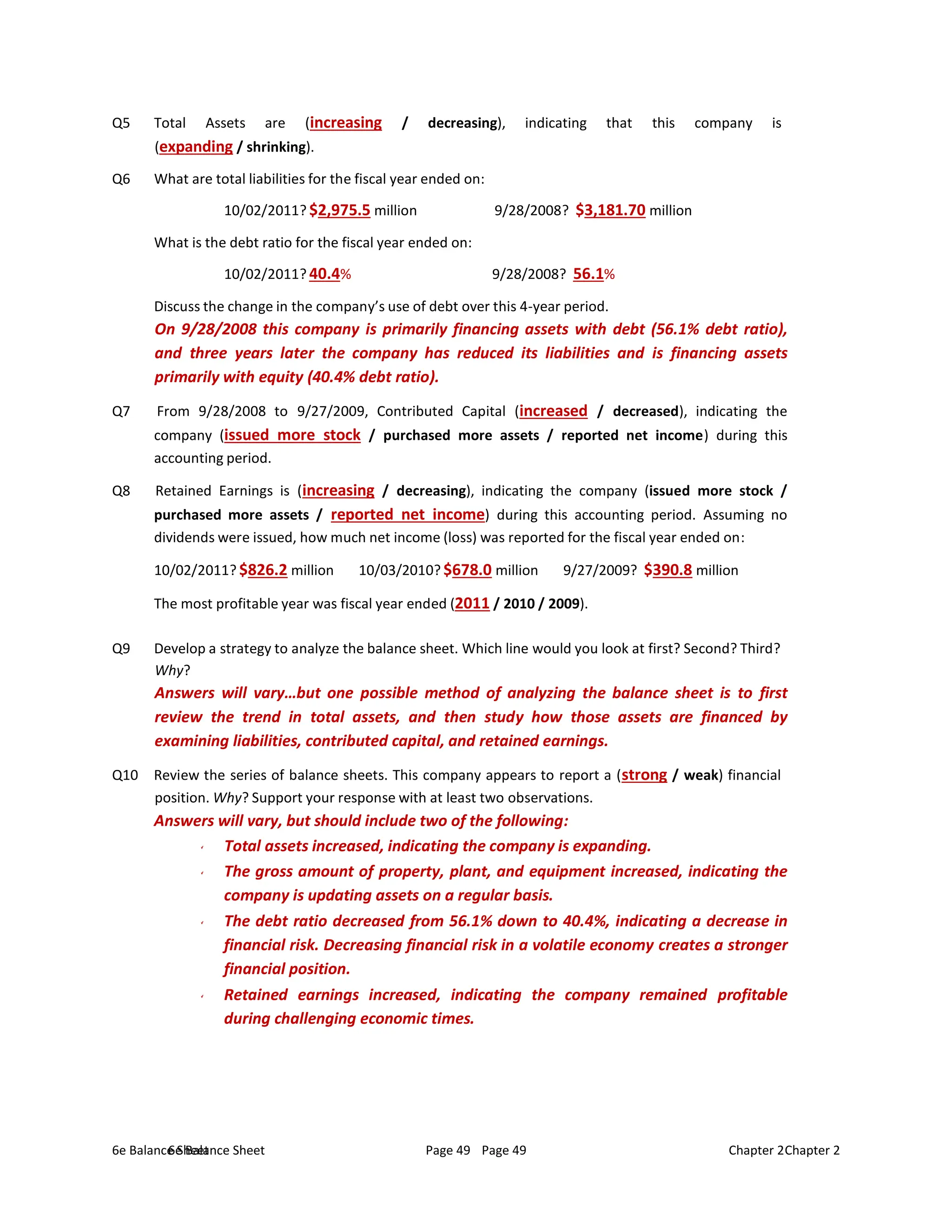
Q5 Total Assets are (increasing / decreasing), indicating that this company is
(expanding / shrinking).
Q6 What are total liabilities for the fiscal year ended on:
10/02/2011? $2,975.5 million 9/28/2008? $3,181.70 million
What is the debt ratio for the fiscal year ended on:
10/02/2011? 40.4% 9/28/2008? 56.1%
Discuss the change in the company’s use of debt over this 4-year period.
On 9/28/2008 this company is primarily financing assets with debt (56.1% debt ratio),
and three years later the company has reduced its liabilities and is financing assets
primarily with equity (40.4% debt ratio).
Q7 From 9/28/2008 to 9/27/2009, Contributed Capital (increased / decreased), indicating the
company (issued more stock / purchased more assets / reported net income) during this
accounting period.
Q8 Retained Earnings is (increasing / decreasing), indicating the company (issued more stock /
purchased more assets / reported net income) during this accounting period. Assuming no
dividends were issued, how much net income (loss) was reported for the fiscal year ended on:
10/02/2011? $826.2 million 10/03/2010? $678.0 million 9/27/2009? $390.8 million
The most profitable year was fiscal year ended (2011 / 2010 / 2009).
Q9 Develop a strategy to analyze the balance sheet. Which line would you look at first? Second? Third?
Why?
Answers will vary…but one possible method of analyzing the balance sheet is to first
review the trend in total assets, and then study how those assets are financed by
examining liabilities, contributed capital, and retained earnings.
Q10 Review the series of balance sheets. This company appears to report a (strong / weak) financial
position. Why? Support your response with at least two observations.
Answers will vary, but should include two of the following:
Total assets increased, indicating the company is expanding.
The gross amount of property, plant, and equipment increased, indicating the
company is updating assets on a regular basis.
The debt ratio decreased from 56.1% down to 40.4%, indicating a decrease in
financial risk. Decreasing financial risk in a volatile economy creates a stronger
financial position.
Retained earnings increased, indicating the company remained profitable
during challenging economic times.
6e Balance Sheet Page 50 Chapter 2
ACTIVITY 16 DEBT VS. EQUITY
Purpose: • Identify the characteristics of debt and equity.
• Assess financial risk.
Corporations externally finance the purchase of assets with debt (liabilities) or equity (common stock).
Assets = Liabilities + Stockholders’ Equity
Large amounts of debt are usually issued in the form of bonds. The borrowing corporation records a bond
payable and is referred to as the debtor, while the entity loaning the money records a bond receivable
and is referred to as the creditor. The debtor must pay back the amount borrowed plus interest to the
creditor. The interest paid by the borrowing corporation is an expense that reduces taxable income. The
return to creditors is the interest received. Creditors are not owners of the corporation and, therefore,
have no ownership rights.
Equity refers to the issuance of stock, which may be common stock or preferred stock. Entities owning
shares of stock are the owners of the corporation and are referred to as stockholders or shareholders.
Stockholders’ primary ownership rights include a right to vote at annual meetings and a right to a portion
of the profits (net income). Dividends are the distribution of profits to stockholders. The corporate board
of directors decides whether to pay dividends or not and has no obligation to purchase the shares of stock
back from the stockholders. If stockholders sell their shares of stock, they usually sell to another investor
using a stockbroker, who in turn executes the trade on a stock exchange such as the New York Stock
Exchange or NASDAQ. Stockholders earn a return on their investment by receiving dividends or selling the
stock for a greater amount than the purchase price.
The balance sheet helps investors, both creditors and stockholders, assess the degree of financial risk a
corporation is assuming. In general, the more a corporation relies on debt to finance assets, the greater
the financial risk of the corporation.
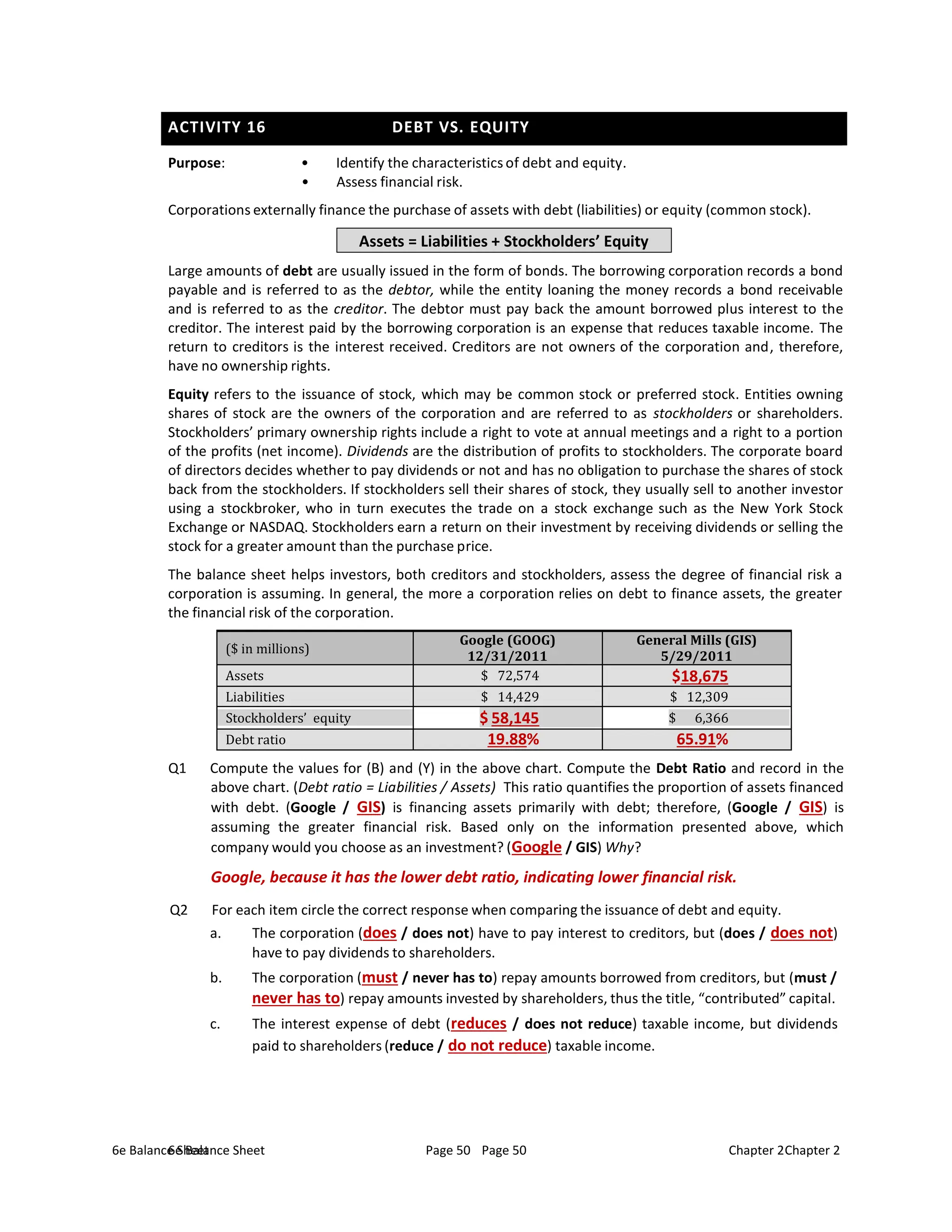
($ in millions)
Google (GOOG)
12/31/2011
General Mills (GIS)
5/29/2011
Assets $ 72,574 $18,675
Liabilities $ 14,429 $ 12,309
Stockholders’ equity $ 58,145 $ 6,366
Debt ratio 19.88% 65.91%
Q1 Compute the values for (B) and (Y) in the above chart. Compute the Debt Ratio and record in the
above chart. (Debt ratio = Liabilities / Assets) This ratio quantifies the proportion of assets financed
with debt. (Google / GIS) is financing assets primarily with debt; therefore, (Google / GIS) is
assuming the greater financial risk. Based only on the information presented above, which
company would you choose as an investment? (Google / GIS) Why?
Google, because it has the lower debt ratio, indicating lower financial risk.
Q2 For each item circle the correct response when comparing the issuance of debt and equity.
a. The corporation (does / does not) have to pay interest to creditors, but (does / does not)
have to pay dividends to shareholders.
b. The corporation (must / never has to) repay amounts borrowed from creditors, but (must /
never has to) repay amounts invested by shareholders, thus the title, “contributed” capital.
c. The interest expense of debt (reduces / does not reduce) taxable income, but dividends
paid to shareholders (reduce / do not reduce) taxable income.
6e Balance Sheet Page 51 Chapter 2
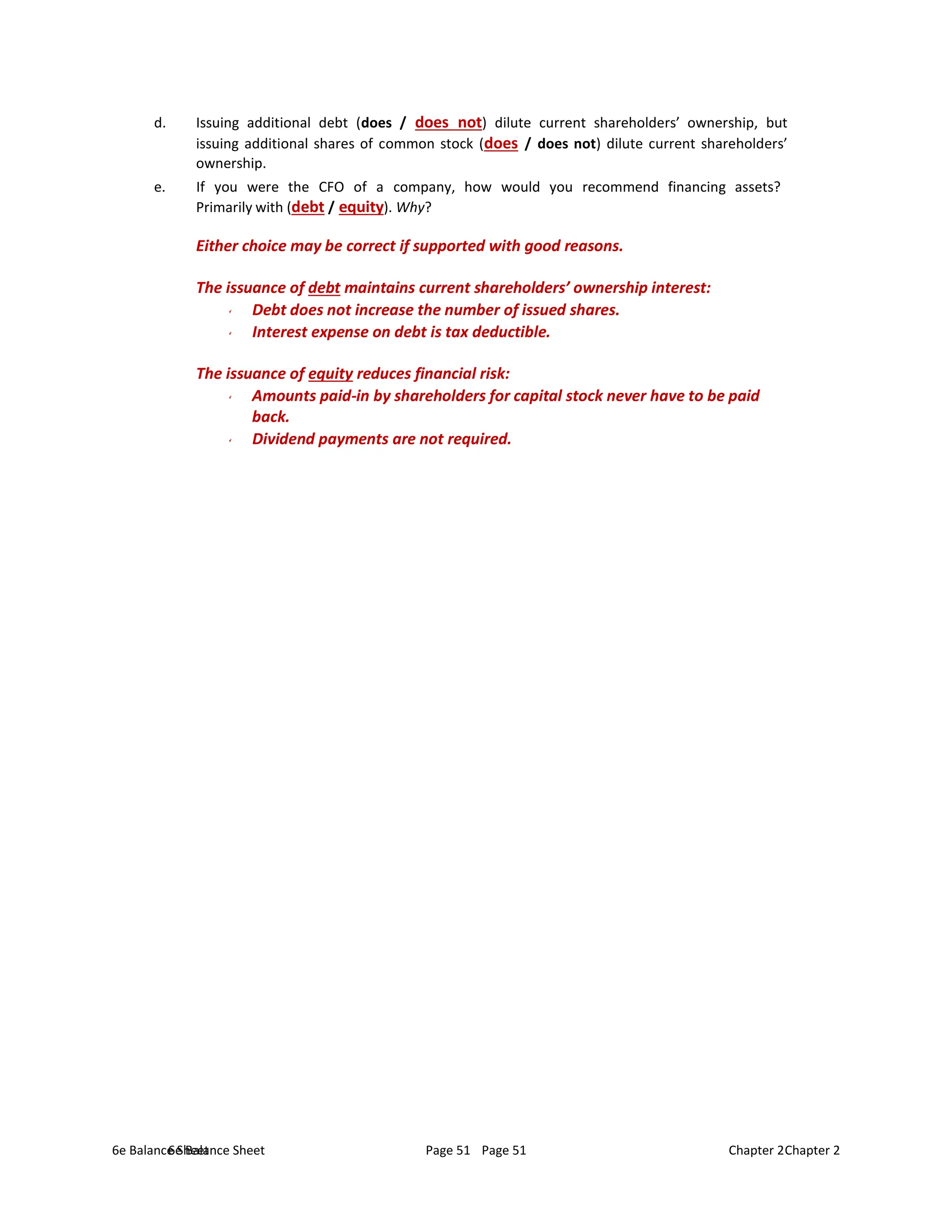
d. Issuing additional debt (does / does not) dilute current shareholders’ ownership, but
issuing additional shares of common stock (does / does not) dilute current shareholders’
ownership.
e. If you were the CFO of a company, how would you recommend financing assets?
Primarily with (debt / equity). Why?
Either choice may be correct if supported with good reasons.
The issuance of debt maintains current shareholders’ ownership interest:
Debt does not increase the number of issued shares.
Interest expense on debt is tax deductible.
The issuance of equity reduces financial risk:
Amounts paid-in by shareholders for capital stock never have to be paid
back.
Dividend payments are not required.
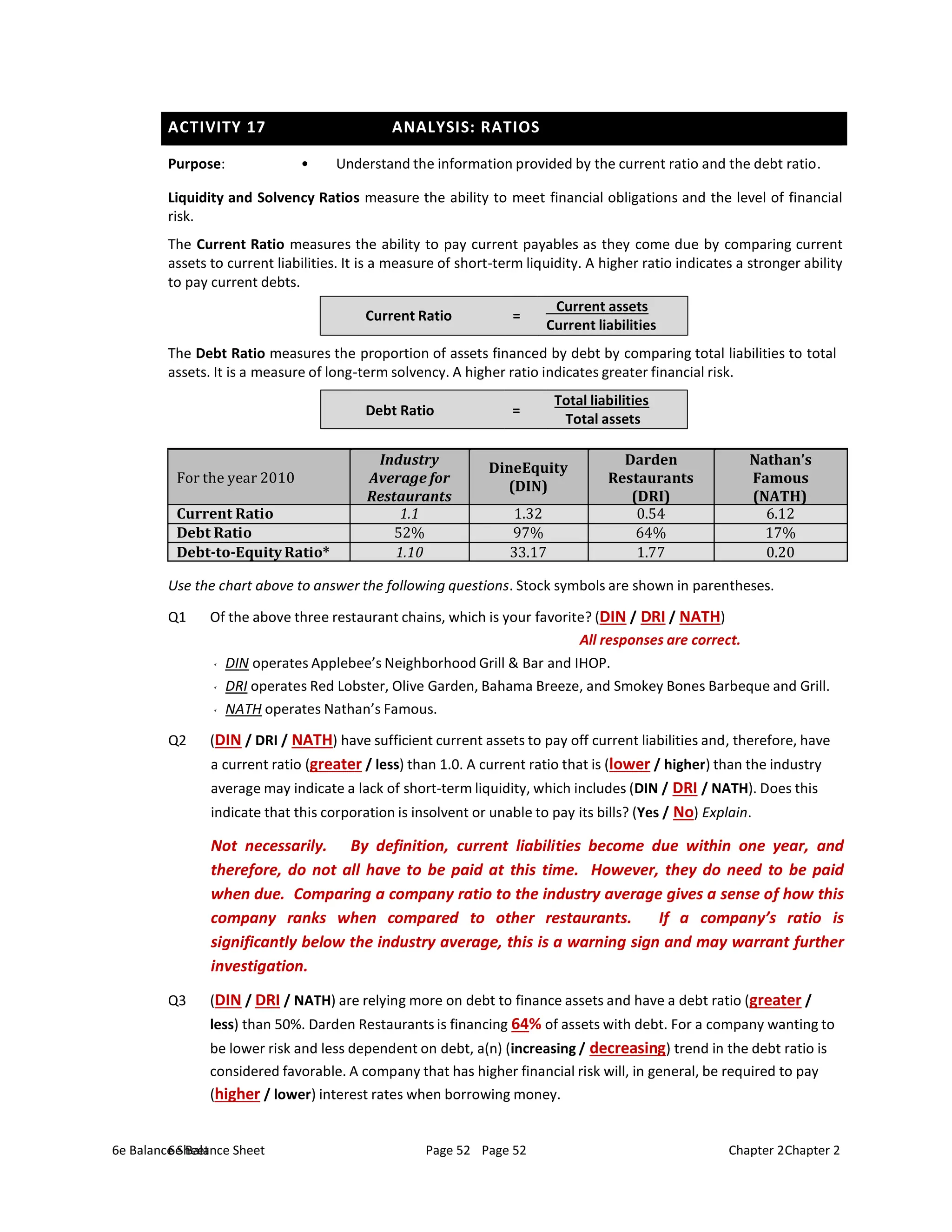
ACTIVITY 17 ANALYSIS: RATIOS
6e Balance Sheet Page 52 Chapter 2
Purpose: • Understand the information provided by the current ratio and the debt ratio.
Liquidity and Solvency Ratios measure the ability to meet financial obligations and the level of financial
risk.
The Current Ratio measures the ability to pay current payables as they come due by comparing current
assets to current liabilities. It is a measure of short-term liquidity. A higher ratio indicates a stronger ability
to pay current debts.
Current Ratio =
Current assets
Current liabilities
The Debt Ratio measures the proportion of assets financed by debt by comparing total liabilities to total
assets. It is a measure of long-term solvency. A higher ratio indicates greater financial risk.
Debt Ratio =
Total liabilities
Total assets
For the year 2010
Industry
Average for
Restaurants
DineEquity
(DIN)
Darden
Restaurants
(DRI)
Nathan’s
Famous
(NATH)
Current Ratio 1.1 1.32 0.54 6.12
Debt Ratio 52% 97% 64% 17%
Debt-to-EquityRatio* 1.10 33.17 1.77 0.20
Use the chart above to answer the following questions. Stock symbols are shown in parentheses.
Q1 Of the above three restaurant chains, which is your favorite? (DIN / DRI / NATH)
All responses are correct.
DIN operates Applebee’s Neighborhood Grill & Bar and IHOP.
DRI operates Red Lobster, Olive Garden, Bahama Breeze, and Smokey Bones Barbeque and Grill.
NATH operates Nathan’s Famous.
Q2 (DIN / DRI / NATH) have sufficient current assets to pay off current liabilities and, therefore, have
a current ratio (greater / less) than 1.0. A current ratio that is (lower / higher) than the industry
average may indicate a lack of short-term liquidity, which includes (DIN / DRI / NATH). Does this
indicate that this corporation is insolvent or unable to pay its bills? (Yes / No) Explain.
Not necessarily. By definition, current liabilities become due within one year, and
therefore, do not all have to be paid at this time. However, they do need to be paid
when due. Comparing a company ratio to the industry average gives a sense of how this
company ranks when compared to other restaurants. If a company’s ratio is
significantly below the industry average, this is a warning sign and may warrant further
investigation.
Q3 (DIN / DRI / NATH) are relying more on debt to finance assets and have a debt ratio (greater /
less) than 50%. Darden Restaurants is financing 64% of assets with debt. For a company wanting to
be lower risk and less dependent on debt, a(n) (increasing / decreasing) trend in the debt ratio is
considered favorable. A company that has higher financial risk will, in general, be required to pay
(higher / lower) interest rates when borrowing money.
6e Balance Sheet Page 53 Chapter 2
Q4 Why does a company with a higher debt ratio tend to have greater financial risk?
A higher debt ratio indicates greater debt. Debt is a legal liability that must be repaid
plus interest. If the principal or interest cannot be repaid, then a company can be forced
into bankruptcy and creditors may not get fully repaid. Therefore, creditors are at
financial risk of not receiving the full amount due to them. As the amount of company
debt increases, so does the financial risk of not being able to pay back that debt plus
interest when due.
Q5 Does a high debt ratio indicate a weak corporation? (Yes / No) Explain your answer.
The answer is no, not necessarily. Even though DineEquity has a higher debt ratio, it
may not be considered a weak corporation. Companies use different strategies to
finance assets. Companies within a stable industry have the ability to use more debt
than companies within a volatile industry. Companies with a large investment in PPE
can use that PPE as collateral for debt financing. Also, some corporations make the
decision to accept higher financial risk.
* Instead of reporting the Debt Ratio, some financial sources report the Debt-to-Equity ratio, computed as liabilities
divided by stockholders’ equity. To convert:
Debt ratio = [Debt-to-equity ratio/ (1 + Debt-to-equity ratio)]
For DineEquity 0.97 = 33.17 / 34.17
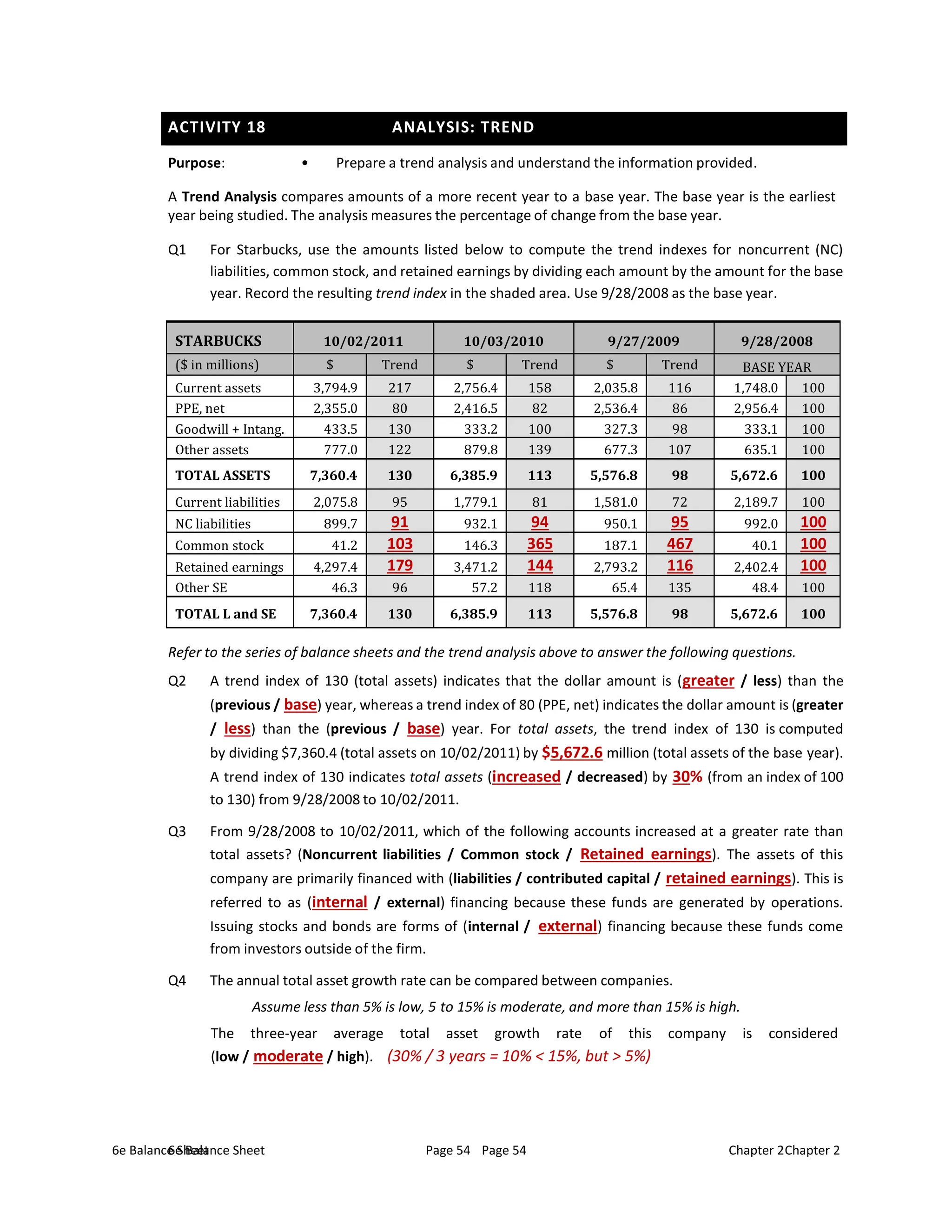
ACTIVITY 18 ANALYSIS: TREND
6e Balance Sheet Page 54 Chapter 2
Purpose: • Prepare a trend analysis and understand the information provided.
A Trend Analysis compares amounts of a more recent year to a base year. The base year is the earliest
year being studied. The analysis measures the percentage of change from the base year.
Q1 For Starbucks, use the amounts listed below to compute the trend indexes for noncurrent (NC)
liabilities, common stock, and retained earnings by dividing each amount by the amount for the base
year. Record the resulting trend index in the shaded area. Use 9/28/2008 as the base year.
STARBUCKS 10/02/2011 10/03/2010 9/27/2009 9/28/2008
($ in millions) $ Trend $ Trend $ Trend BASE YEAR
Current assets 3,794.9 217 2,756.4 158 2,035.8 116 1,748.0 100
PPE, net 2,355.0 80 2,416.5 82 2,536.4 86 2,956.4 100
Goodwill + Intang. 433.5 130 333.2 100 327.3 98 333.1 100
Other assets 777.0 122 879.8 139 677.3 107 635.1 100
TOTAL ASSETS 7,360.4 130 6,385.9 113 5,576.8 98 5,672.6 100
Current liabilities 2,075.8 95 1,779.1 81 1,581.0 72 2,189.7 100
NC liabilities 899.7 91 932.1 94 950.1 95 992.0 100
Common stock 41.2 103 146.3 365 187.1 467 40.1 100
Retained earnings 4,297.4 179 3,471.2 144 2,793.2 116 2,402.4 100
Other SE 46.3 96 57.2 118 65.4 135 48.4 100
TOTAL L and SE 7,360.4 130 6,385.9 113 5,576.8 98 5,672.6 100
Refer to the series of balance sheets and the trend analysis above to answer the following questions.
Q2 A trend index of 130 (total assets) indicates that the dollar amount is (greater / less) than the
(previous / base) year, whereas a trend index of 80 (PPE, net) indicates the dollar amount is (greater
/ less) than the (previous / base) year. For total assets, the trend index of 130 is computed
by dividing $7,360.4 (total assets on 10/02/2011) by $5,672.6 million (total assets of the base year).
A trend index of 130 indicates total assets (increased / decreased) by 30% (from an index of 100
to 130) from 9/28/2008 to 10/02/2011.
Q3 From 9/28/2008 to 10/02/2011, which of the following accounts increased at a greater rate than
total assets? (Noncurrent liabilities / Common stock / Retained earnings). The assets of this
company are primarily financed with (liabilities / contributed capital / retained earnings). This is
referred to as (internal / external) financing because these funds are generated by operations.
Issuing stocks and bonds are forms of (internal / external) financing because these funds come
from investors outside of the firm.
Q4 The annual total asset growth rate can be compared between companies.
Assume less than 5% is low, 5 to 15% is moderate, and more than 15% is high.
The three-year average total asset growth rate of this company is considered
(low / moderate / high). (30% / 3 years = 10% < 15%, but > 5%)
6e Balance Sheet Page 55 Chapter 2
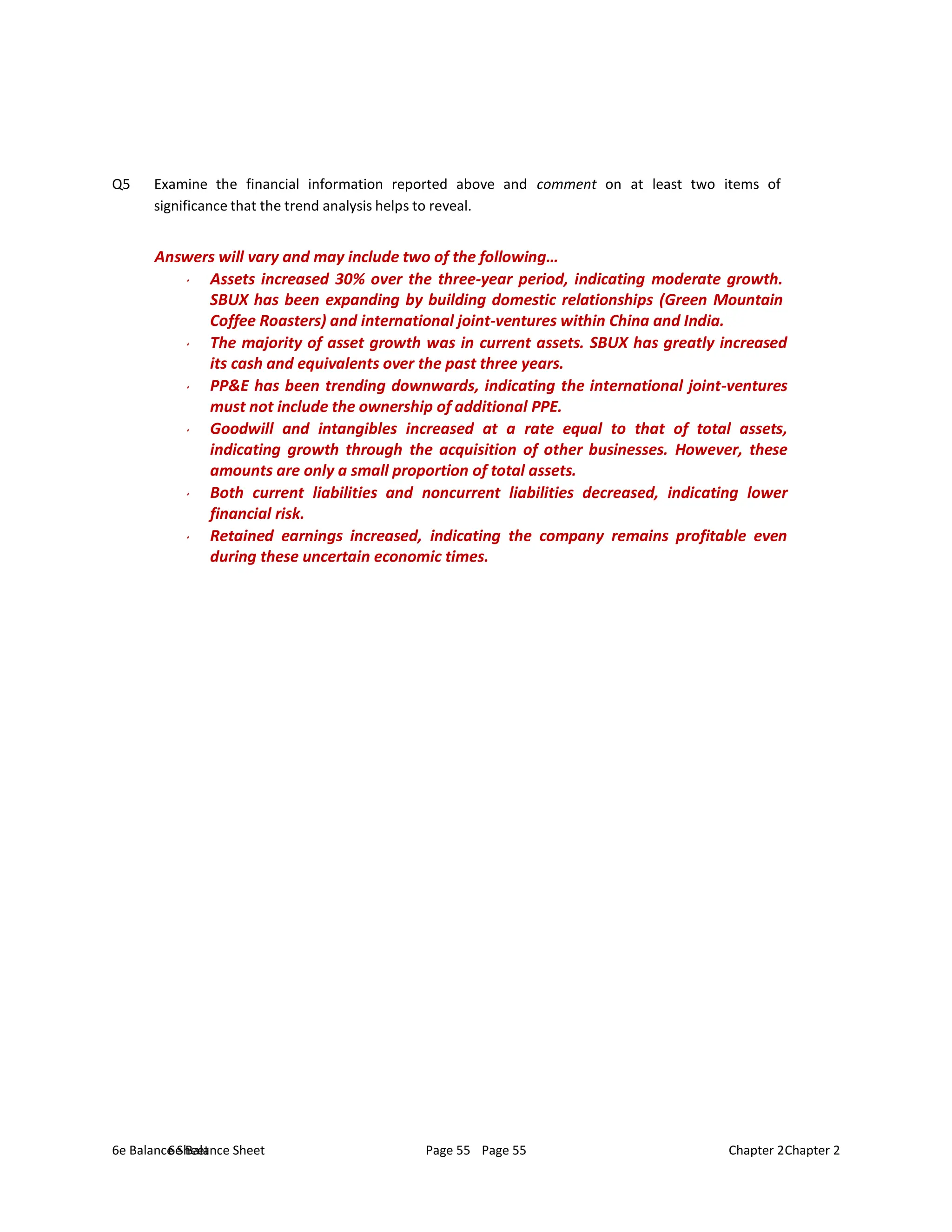
Q5 Examine the financial information reported above and comment on at least two items of
significance that the trend analysis helps to reveal.
Answers will vary and may include two of the following…
Assets increased 30% over the three-year period, indicating moderate growth.
SBUX has been expanding by building domestic relationships (Green Mountain
Coffee Roasters) and international joint-ventures within China and India.
The majority of asset growth was in current assets. SBUX has greatly increased
its cash and equivalents over the past three years.
PP&E has been trending downwards, indicating the international joint-ventures
must not include the ownership of additional PPE.
Goodwill and intangibles increased at a rate equal to that of total assets,
indicating growth through the acquisition of other businesses. However, these
amounts are only a small proportion of total assets.
Both current liabilities and noncurrent liabilities decreased, indicating lower
financial risk.
Retained earnings increased, indicating the company remains profitable even
during these uncertain economic times.
ACTIVITY 19 ANALYSIS: COMMON-SIZE STATEMENTS
6e Balance Sheet Page 56 Chapter 2
Purpose: • Prepare common-size statements and understand the information provided.
The Common-Size Balance Sheet compares all amounts to total assets of that same year. The analysis
measures each item as a percentage of total assets.
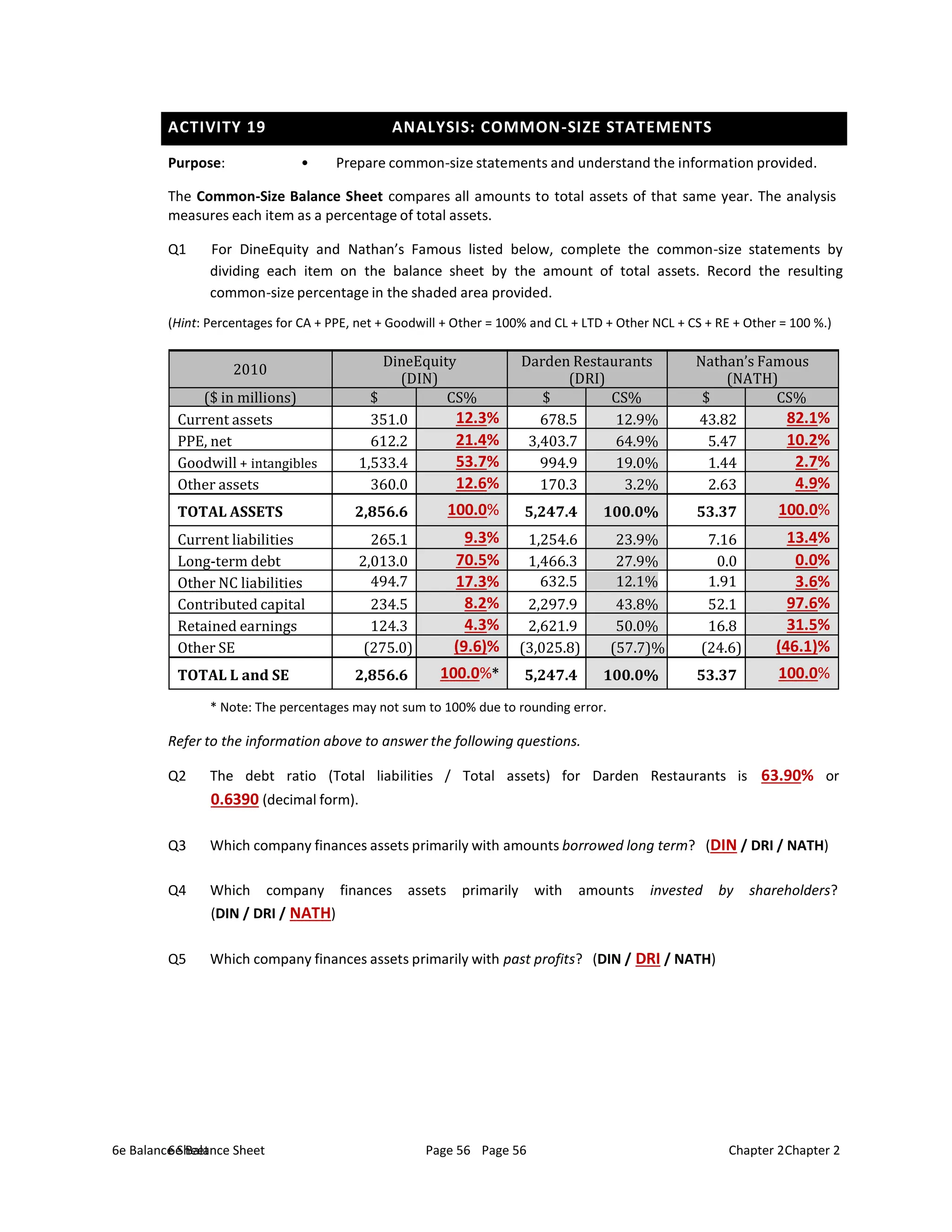
Q1 For DineEquity and Nathan’s Famous listed below, complete the common-size statements by
dividing each item on the balance sheet by the amount of total assets. Record the resulting
common-size percentage in the shaded area provided.
(Hint: Percentages for CA + PPE, net + Goodwill + Other = 100% and CL + LTD + Other NCL + CS + RE + Other = 100 %.)
2010
DineEquity
(DIN)
Darden Restaurants
(DRI)
Nathan’s Famous
(NATH)
($ in millions) $ CS% $ CS% $ CS%
Current assets 351.0 12.3% 678.5 12.9% 43.82 82.1%
PPE, net 612.2 21.4% 3,403.7 64.9% 5.47 10.2%
Goodwill + intangibles 1,533.4 53.7% 994.9 19.0% 1.44 2.7%
Other assets 360.0 12.6% 170.3 3.2% 2.63 4.9%
TOTAL ASSETS 2,856.6 100.0% 5,247.4 100.0% 53.37 100.0%
Current liabilities 265.1 9.3% 1,254.6 23.9% 7.16 13.4%
Long-term debt 2,013.0 70.5% 1,466.3 27.9% 0.0 0.0%
Other NC liabilities 494.7 17.3% 632.5 12.1% 1.91 3.6%
Contributed capital 234.5 8.2% 2,297.9 43.8% 52.1 97.6%
Retained earnings 124.3 4.3% 2,621.9 50.0% 16.8 31.5%
Other SE (275.0) (9.6)% (3,025.8) (57.7)% (24.6) (46.1)%
TOTAL L and SE 2,856.6 100.0%* 5,247.4 100.0% 53.37 100.0%
* Note: The percentages may not sum to 100% due to rounding error.
Refer to the information above to answer the following questions.
Q2 The debt ratio (Total liabilities / Total assets) for Darden Restaurants is 63.90% or
0.6390 (decimal form).
Q3 Which company finances assets primarily with amounts borrowed long term? (DIN / DRI / NATH)
Q4 Which company finances assets primarily with amounts invested by shareholders?
(DIN / DRI / NATH)
Q5 Which company finances assets primarily with past profits? (DIN / DRI / NATH)
6e Balance Sheet Page 57 Chapter 2
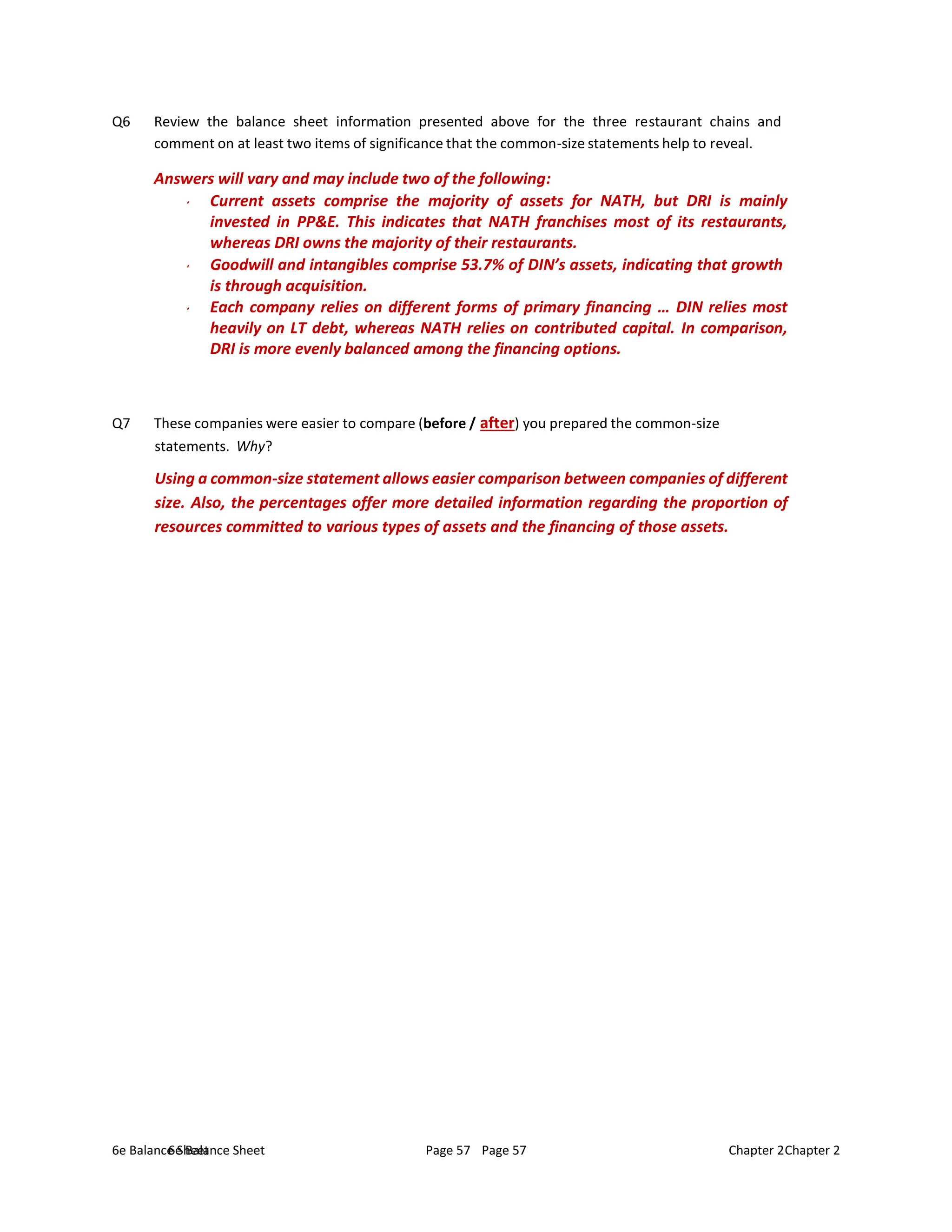
Q6 Review the balance sheet information presented above for the three restaurant chains and
comment on at least two items of significance that the common-size statements help to reveal.
Answers will vary and may include two of the following:
Current assets comprise the majority of assets for NATH, but DRI is mainly
invested in PP&E. This indicates that NATH franchises most of its restaurants,
whereas DRI owns the majority of their restaurants.
Goodwill and intangibles comprise 53.7% of DIN’s assets, indicating that growth
is through acquisition.
Each company relies on different forms of primary financing … DIN relies most
heavily on LT debt, whereas NATH relies on contributed capital. In comparison,
DRI is more evenly balanced among the financing options.
Q7 These companies were easier to compare (before / after) you prepared the common-size
statements. Why?
Using a common-size statement allows easier comparison between companies of different
size. Also, the percentages offer more detailed information regarding the proportion of
resources committed to various types of assets and the financing of those assets.
ACTIVITY 20 ANALYSIS OF YUM! BRANDS
6e Balance Sheet Page 58 Chapter 2
Purpose: • Understand and interpret amounts reported on the balance sheet.
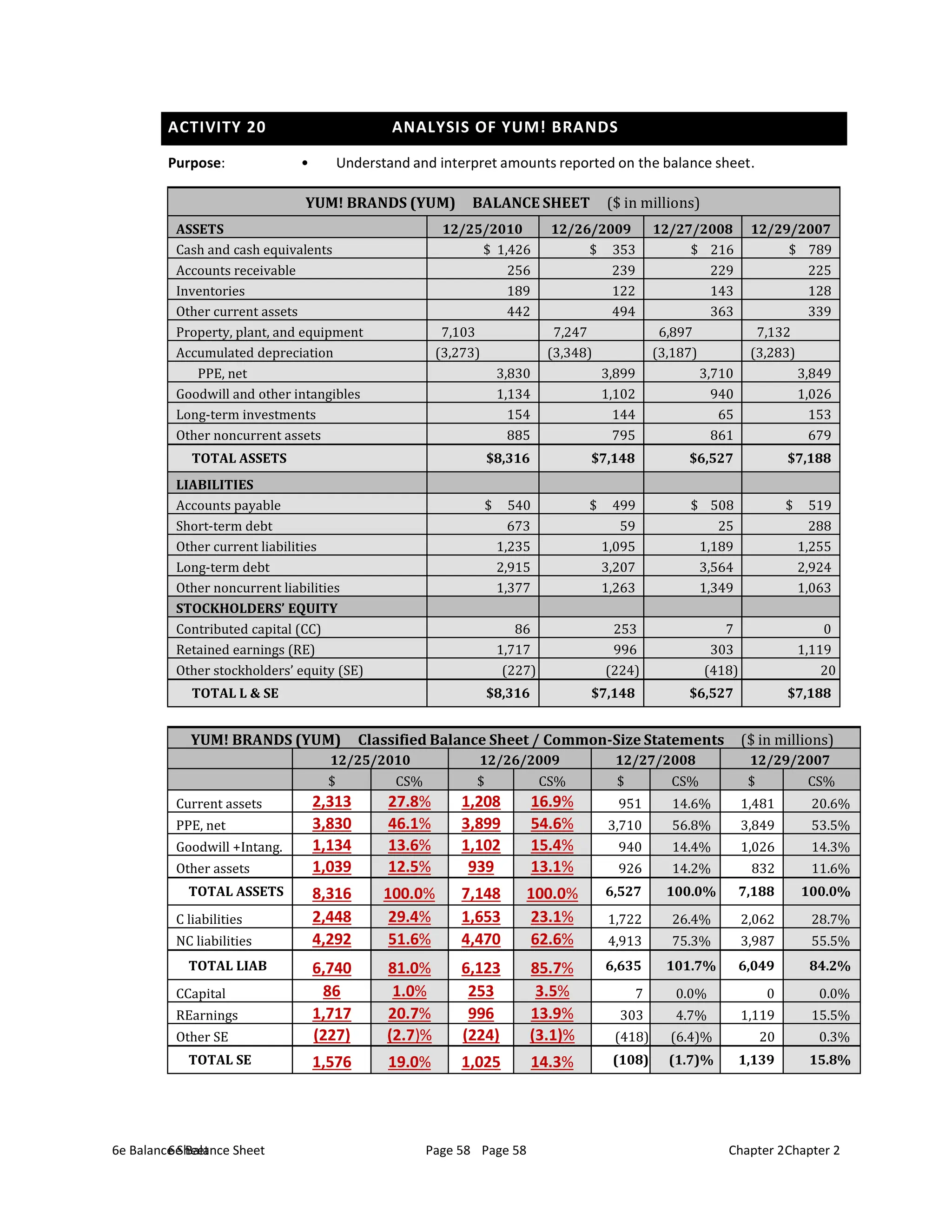
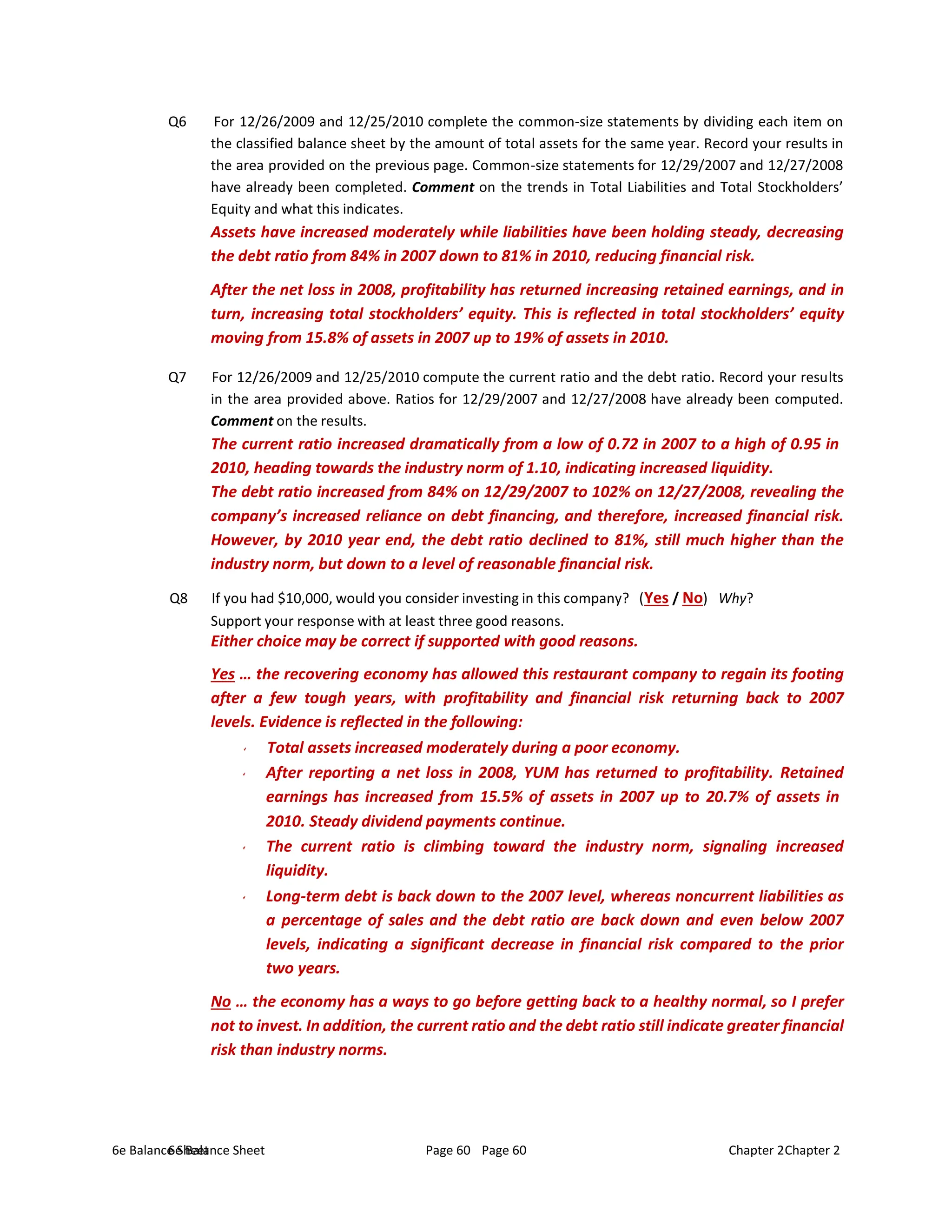
YUM! BRANDS (YUM) BALANCE SHEET ($ in millions)
ASSETS 12/25/2010 12/26/2009 12/27/2008 12/29/2007
Cash and cash equivalents $ 1,426 $ 353 $ 216 $ 789
Accounts receivable 256 239 229 225
Inventories 189 122 143 128
Other current assets 442 494 363 339
Property, plant, and equipment 7,103 7,247 6,897 7,132
Accumulated depreciation (3,273) (3,348) (3,187) (3,283)
PPE, net 3,830 3,899 3,710 3,849
Goodwill and other intangibles 1,134 1,102 940 1,026
Long-term investments 154 144 65 153
Other noncurrent assets 885 795 861 679
TOTAL ASSETS $8,316 $7,148 $6,527 $7,188
LIABILITIES
Accounts payable $ 540 $ 499 $ 508 $ 519
Short-term debt 673 59 25 288
Other current liabilities 1,235 1,095 1,189 1,255
Long-term debt 2,915 3,207 3,564 2,924
Other noncurrent liabilities 1,377 1,263 1,349 1,063
STOCKHOLDERS’ EQUITY
Contributed capital (CC) 86 253 7 0
Retained earnings (RE) 1,717 996 303 1,119
Other stockholders’ equity (SE) (227) (224) (418) 20
TOTAL L & SE $8,316 $7,148 $6,527 $7,188
YUM! BRANDS (YUM) Classified Balance Sheet / Common-Size Statements ($ in millions)
12/25/2010 12/26/2009 12/27/2008 12/29/2007
$ CS% $ CS% $ CS% $ CS%
Current assets 2,313 27.8% 1,208 16.9% 951 14.6% 1,481 20.6%
PPE, net 3,830 46.1% 3,899 54.6% 3,710 56.8% 3,849 53.5%
Goodwill +Intang. 1,134 13.6% 1,102 15.4% 940 14.4% 1,026 14.3%
Other assets 1,039 12.5% 939 13.1% 926 14.2% 832 11.6%
TOTAL ASSETS 8,316 100.0% 7,148 100.0% 6,527 100.0% 7,188 100.0%
C liabilities 2,448 29.4% 1,653 23.1% 1,722 26.4% 2,062 28.7%
NC liabilities 4,292 51.6% 4,470 62.6% 4,913 75.3% 3,987 55.5%
TOTAL LIAB 6,740 81.0% 6,123 85.7% 6,635 101.7% 6,049 84.2%
CCapital 86 1.0% 253 3.5% 7 0.0% 0 0.0%
REarnings 1,717 20.7% 996 13.9% 303 4.7% 1,119 15.5%
Other SE (227) (2.7)% (224) (3.1)% (418) (6.4)% 20 0.3%
TOTAL SE 1,576 19.0% 1,025 14.3% (108) (1.7)% 1,139 15.8%
6e Balance Sheet Page 59 Chapter 2
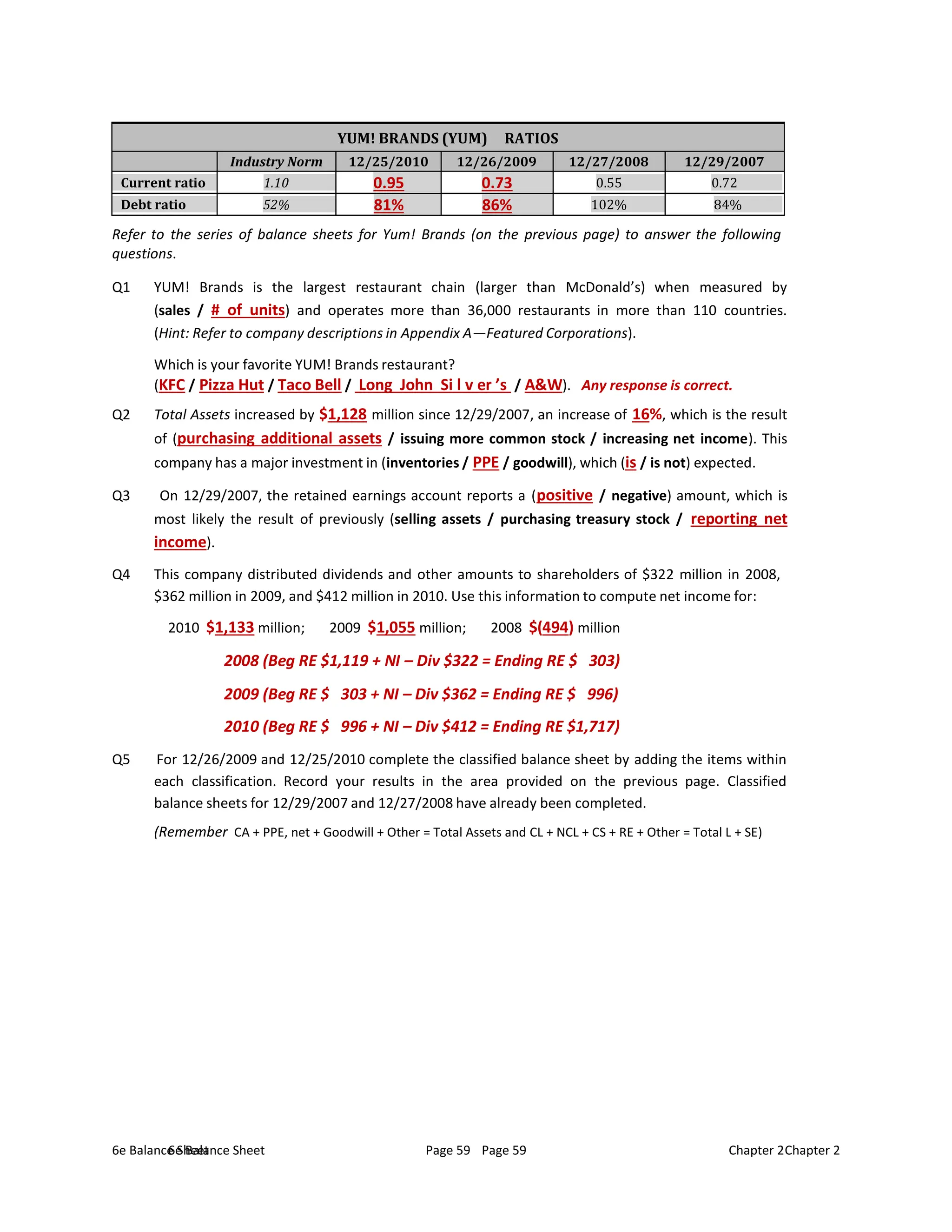
YUM! BRANDS (YUM) RATIOS
Industry Norm 12/25/2010 12/26/2009 12/27/2008 12/29/2007
Current ratio 1.10 0.95 0.73 0.55 0.72
Debt ratio 52% 81% 86% 102% 84%
Refer to the series of balance sheets for Yum! Brands (on the previous page) to answer the following
questions.
Q1 YUM! Brands is the largest restaurant chain (larger than McDonald’s) when measured by
(sales / # of units) and operates more than 36,000 restaurants in more than 110 countries.
(Hint: Refer to company descriptions in Appendix A—Featured Corporations).
Which is your favorite YUM! Brands restaurant?
(KFC / Pizza Hut / Taco Bell / Long John Si l v er ’s / A&W). Any response is correct.
Q2 Total Assets increased by $1,128 million since 12/29/2007, an increase of 16%, which is the result
of (purchasing additional assets / issuing more common stock / increasing net income). This
company has a major investment in (inventories / PPE / goodwill), which (is / is not) expected.
Q3 On 12/29/2007, the retained earnings account reports a (positive / negative) amount, which is
most likely the result of previously (selling assets / purchasing treasury stock / reporting net
income).
Q4 This company distributed dividends and other amounts to shareholders of $322 million in 2008,
$362 million in 2009, and $412 million in 2010. Use this information to compute net income for:
2010 $1,133 million; 2009 $1,055 million; 2008 $(494) million
2008 (Beg RE $1,119 + NI – Div $322 = Ending RE $ 303)
2009 (Beg RE $ 303 + NI – Div $362 = Ending RE $ 996)
2010 (Beg RE $ 996 + NI – Div $412 = Ending RE $1,717)
Q5 For 12/26/2009 and 12/25/2010 complete the classified balance sheet by adding the items within
each classification. Record your results in the area provided on the previous page. Classified
balance sheets for 12/29/2007 and 12/27/2008 have already been completed.
(Remember CA + PPE, net + Goodwill + Other = Total Assets and CL + NCL + CS + RE + Other = Total L + SE)
6e Balance Sheet Page 60 Chapter 2
Q6 For 12/26/2009 and 12/25/2010 complete the common-size statements by dividing each item on
the classified balance sheet by the amount of total assets for the same year. Record your results in
the area provided on the previous page. Common-size statements for 12/29/2007 and 12/27/2008
have already been completed. Comment on the trends in Total Liabilities and Total Stockholders’
Equity and what this indicates.
Assets have increased moderately while liabilities have been holding steady, decreasing
the debt ratio from 84% in 2007 down to 81% in 2010, reducing financial risk.
After the net loss in 2008, profitability has returned increasing retained earnings, and in
turn, increasing total stockholders’ equity. This is reflected in total stockholders’ equity
moving from 15.8% of assets in 2007 up to 19% of assets in 2010.
Q7 For 12/26/2009 and 12/25/2010 compute the current ratio and the debt ratio. Record your results
in the area provided above. Ratios for 12/29/2007 and 12/27/2008 have already been computed.
Comment on the results.
The current ratio increased dramatically from a low of 0.72 in 2007 to a high of 0.95 in
2010, heading towards the industry norm of 1.10, indicating increased liquidity.
The debt ratio increased from 84% on 12/29/2007 to 102% on 12/27/2008, revealing the
company’s increased reliance on debt financing, and therefore, increased financial risk.
However, by 2010 year end, the debt ratio declined to 81%, still much higher than the
industry norm, but down to a level of reasonable financial risk.
Q8 If you had $10,000, would you consider investing in this company? (Yes / No) Why?
Support your response with at least three good reasons.
Either choice may be correct if supported with good reasons.
Yes … the recovering economy has allowed this restaurant company to regain its footing
after a few tough years, with profitability and financial risk returning back to 2007
levels. Evidence is reflected in the following:
Total assets increased moderately during a poor economy.
After reporting a net loss in 2008, YUM has returned to profitability. Retained
earnings has increased from 15.5% of assets in 2007 up to 20.7% of assets in
2010. Steady dividend payments continue.
The current ratio is climbing toward the industry norm, signaling increased
liquidity.
Long-term debt is back down to the 2007 level, whereas noncurrent liabilities as
a percentage of sales and the debt ratio are back down and even below 2007
levels, indicating a significant decrease in financial risk compared to the prior
two years.
No … the economy has a ways to go before getting back to a healthy normal, so I prefer
not to invest. In addition, the current ratio and the debt ratio still indicate greater financial
risk than industry norms.
6e Balance Sheet Page 61 Chapter 2
ACTIVITY 21 ANALYSIS OF MCDONALD’S
Purpose: • Understand and interpret amounts reported on the balance sheet.
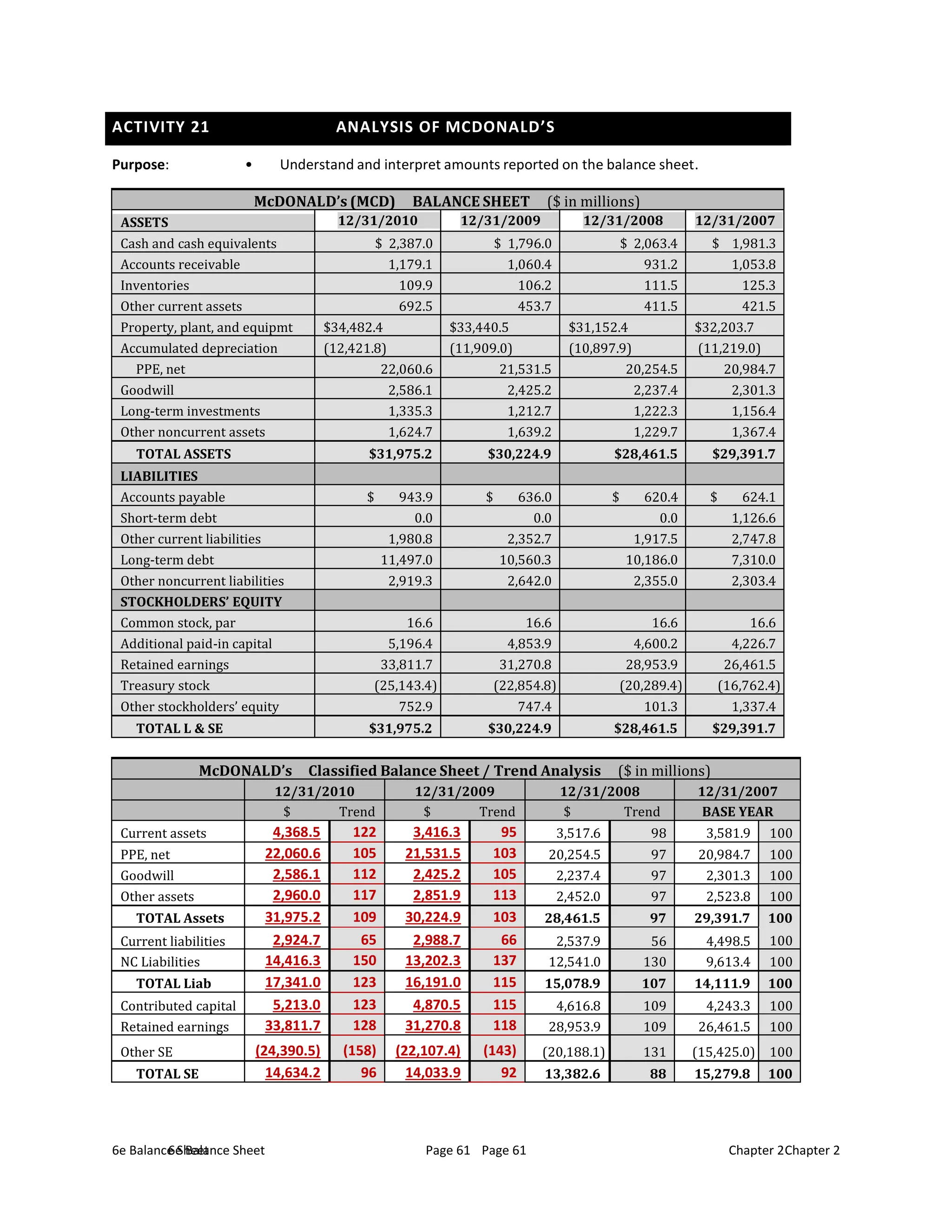
McDONALD’s (MCD) BALANCE SHEET ($ in millions)
ASSETS 12/31/2010 12/31/2009 12/31/2008 12/31/2007
Cash and cash equivalents $ 2,387.0 $ 1,796.0 $ 2,063.4 $ 1,981.3
Accounts receivable 1,179.1 1,060.4 931.2 1,053.8
Inventories 109.9 106.2 111.5 125.3
Other current assets 692.5 453.7 411.5 421.5
Property, plant, and equipmt $34,482.4 $33,440.5 $31,152.4 $32,203.7
Accumulated depreciation (12,421.8) (11,909.0) (10,897.9) (11,219.0)
PPE, net 22,060.6 21,531.5 20,254.5 20,984.7
Goodwill 2,586.1 2,425.2 2,237.4 2,301.3
Long-term investments 1,335.3 1,212.7 1,222.3 1,156.4
Other noncurrent assets 1,624.7 1,639.2 1,229.7 1,367.4
TOTAL ASSETS $31,975.2 $30,224.9 $28,461.5 $29,391.7
LIABILITIES
Accounts payable $ 943.9 $ 636.0 $ 620.4 $ 624.1
Short-term debt 0.0 0.0 0.0 1,126.6
Other current liabilities 1,980.8 2,352.7 1,917.5 2,747.8
Long-term debt 11,497.0 10,560.3 10,186.0 7,310.0
Other noncurrent liabilities 2,919.3 2,642.0 2,355.0 2,303.4
STOCKHOLDERS’ EQUITY
Common stock, par 16.6 16.6 16.6 16.6
Additional paid-in capital 5,196.4 4,853.9 4,600.2 4,226.7
Retained earnings 33,811.7 31,270.8 28,953.9 26,461.5
Treasury stock (25,143.4) (22,854.8) (20,289.4) (16,762.4)
Other stockholders’ equity 752.9 747.4 101.3 1,337.4
TOTAL L & SE $31,975.2 $30,224.9 $28,461.5 $29,391.7
McDONALD’s Classified Balance Sheet / Trend Analysis ($ in millions)
12/31/2010 12/31/2009 12/31/2008 12/31/2007
$ Trend $ Trend $ Trend BASE YEAR
Current assets 4,368.5 122 3,416.3 95 3,517.6 98 3,581.9 100
PPE, net 22,060.6 105 21,531.5 103 20,254.5 97 20,984.7 100
Goodwill 2,586.1 112 2,425.2 105 2,237.4 97 2,301.3 100
Other assets 2,960.0 117 2,851.9 113 2,452.0 97 2,523.8 100
TOTAL Assets 31,975.2 109 30,224.9 103 28,461.5 97 29,391.7 100
Current liabilities 2,924.7 65 2,988.7 66 2,537.9 56 4,498.5 100
NC Liabilities 14,416.3 150 13,202.3 137 12,541.0 130 9,613.4 100
TOTAL Liab 17,341.0 123 16,191.0 115 15,078.9 107 14,111.9 100
Contributed capital 5,213.0 123 4,870.5 115 4,616.8 109 4,243.3 100
Retained earnings 33,811.7 128 31,270.8 118 28,953.9 109 26,461.5 100
Other SE (24,390.5) (158) (22,107.4) (143) (20,188.1) 131 (15,425.0) 100
TOTAL SE 14,634.2 96 14,033.9 92 13,382.6 88 15,279.8 100
6e Balance Sheet Page 62 Chapter 2
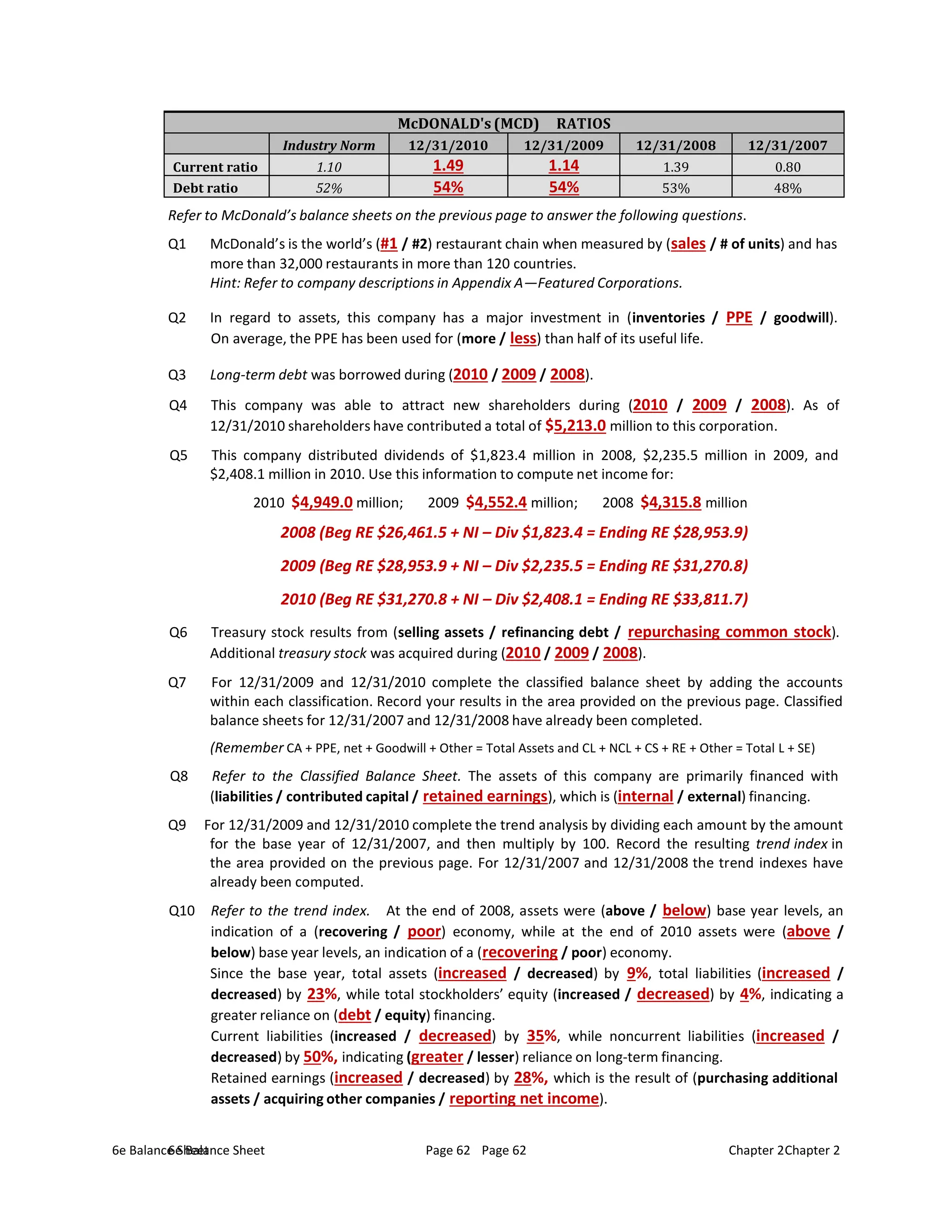
McDONALD's (MCD) RATIOS
Industry Norm 12/31/2010 12/31/2009 12/31/2008 12/31/2007
Current ratio 1.10 1.49 1.14 1.39 0.80
Debt ratio 52% 54% 54% 53% 48%
Refer to McDonald’s balance sheets on the previous page to answer the following questions.
Q1 McDonald’s is the world’s (#1 / #2) restaurant chain when measured by (sales / # of units) and has
more than 32,000 restaurants in more than 120 countries.
Hint: Refer to company descriptions in Appendix A—Featured Corporations.
Q2 In regard to assets, this company has a major investment in (inventories / PPE / goodwill).
On average, the PPE has been used for (more / less) than half of its useful life.
Q3 Long-term debt was borrowed during (2010 / 2009 / 2008).
Q4 This company was able to attract new shareholders during (2010 / 2009 / 2008). As of
12/31/2010 shareholders have contributed a total of $5,213.0 million to this corporation.
Q5 This company distributed dividends of $1,823.4 million in 2008, $2,235.5 million in 2009, and
$2,408.1 million in 2010. Use this information to compute net income for:
2010 $4,949.0 million; 2009 $4,552.4 million; 2008 $4,315.8 million
2008 (Beg RE $26,461.5 + NI – Div $1,823.4 = Ending RE $28,953.9)
2009 (Beg RE $28,953.9 + NI – Div $2,235.5 = Ending RE $31,270.8)
2010 (Beg RE $31,270.8 + NI – Div $2,408.1 = Ending RE $33,811.7)
Q6 Treasury stock results from (selling assets / refinancing debt / repurchasing common stock).
Additional treasury stock was acquired during (2010 / 2009 / 2008).
Q7 For 12/31/2009 and 12/31/2010 complete the classified balance sheet by adding the accounts
within each classification. Record your results in the area provided on the previous page. Classified
balance sheets for 12/31/2007 and 12/31/2008 have already been completed.
(Remember CA + PPE, net + Goodwill + Other = Total Assets and CL + NCL + CS + RE + Other = Total L + SE)
Q8 Refer to the Classified Balance Sheet. The assets of this company are primarily financed with
(liabilities / contributed capital / retained earnings), which is (internal / external) financing.
Q9 For 12/31/2009 and 12/31/2010 complete the trend analysis by dividing each amount by the amount
for the base year of 12/31/2007, and then multiply by 100. Record the resulting trend index in
the area provided on the previous page. For 12/31/2007 and 12/31/2008 the trend indexes have
already been computed.
Q10 Refer to the trend index. At the end of 2008, assets were (above / below) base year levels, an
indication of a (recovering / poor) economy, while at the end of 2010 assets were (above /
below) base year levels, an indication of a (recovering / poor) economy.
Since the base year, total assets (increased / decreased) by 9%, total liabilities (increased /
decreased) by 23%, while total stockholders’ equity (increased / decreased) by 4%, indicating a
greater reliance on (debt / equity) financing.
Current liabilities (increased / decreased) by 35%, while noncurrent liabilities (increased /
decreased) by 50%, indicating (greater / lesser) reliance on long-term financing.
Retained earnings (increased / decreased) by 28%, which is the result of (purchasing additional
assets / acquiring other companies / reporting net income).
6e Balance Sheet Page 63 Chapter 2
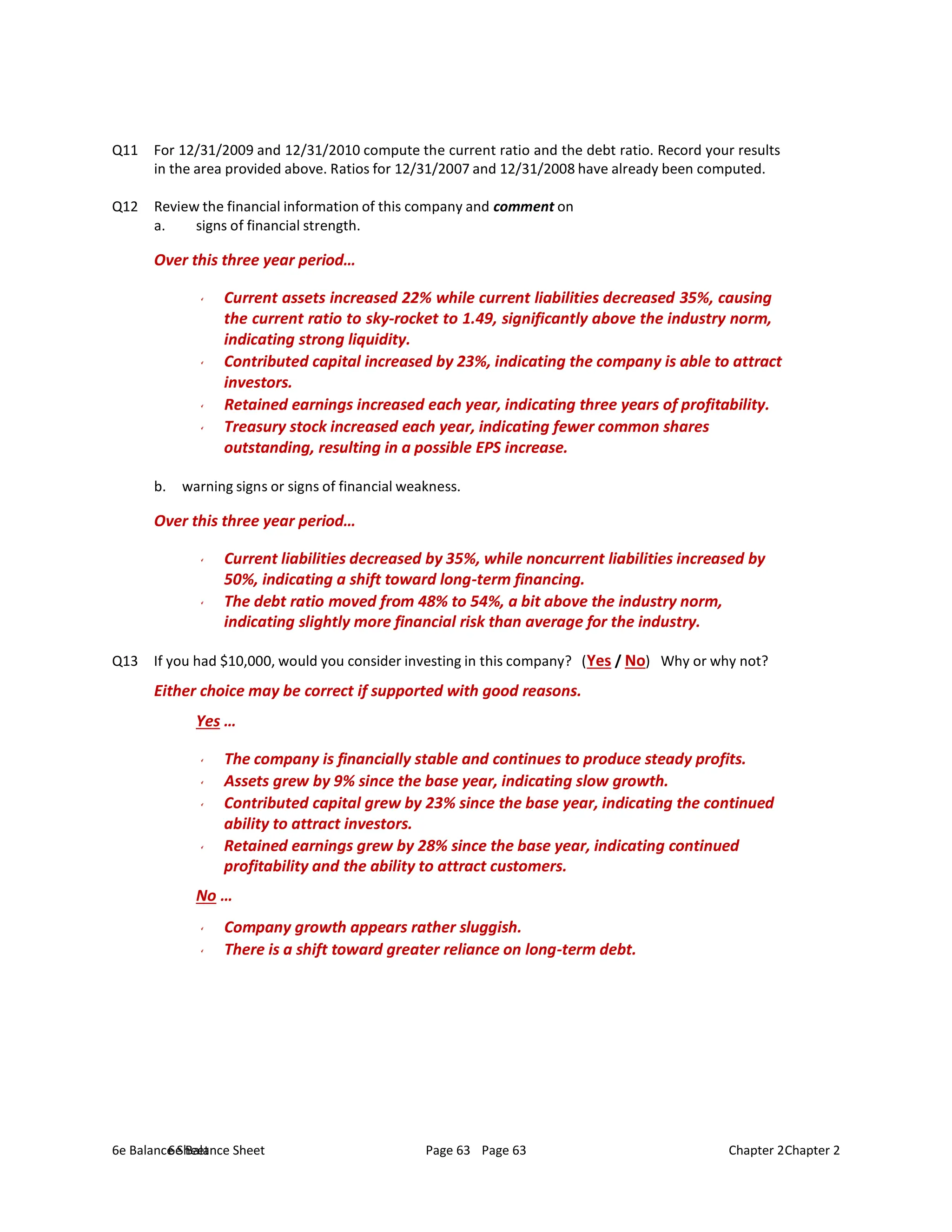
Q11 For 12/31/2009 and 12/31/2010 compute the current ratio and the debt ratio. Record your results
in the area provided above. Ratios for 12/31/2007 and 12/31/2008 have already been computed.
Q12 Review the financial information of this company and comment on
a. signs of financial strength.
Over this three year period…
Current assets increased 22% while current liabilities decreased 35%, causing
the current ratio to sky-rocket to 1.49, significantly above the industry norm,
indicating strong liquidity.
Contributed capital increased by 23%, indicating the company is able to attract
investors.
Retained earnings increased each year, indicating three years of profitability.
Treasury stock increased each year, indicating fewer common shares
outstanding, resulting in a possible EPS increase.
b. warning signs or signs of financial weakness.
Over this three year period…
Current liabilities decreased by 35%, while noncurrent liabilities increased by
50%, indicating a shift toward long-term financing.
The debt ratio moved from 48% to 54%, a bit above the industry norm,
indicating slightly more financial risk than average for the industry.
Q13 If you had $10,000, would you consider investing in this company? (Yes / No) Why or why not?
Either choice may be correct if supported with good reasons.
Yes …
The company is financially stable and continues to produce steady profits.
Assets grew by 9% since the base year, indicating slow growth.
Contributed capital grew by 23% since the base year, indicating the continued
ability to attract investors.
Retained earnings grew by 28% since the base year, indicating continued
profitability and the ability to attract customers.
No …
Company growth appears rather sluggish.
There is a shift toward greater reliance on long-term debt.
Other documents randomly have
different content
148
But the horses caught the scent of the bear and began
to whinny and stamp their hoofs in terror. The big
Kodiak’s ears went up and he lifted his head, probing
the air with his sensitive snout. Slowly he reared up on
his hind legs.
Jerry couldn’t restrain a gasp of astonishment and
wonder. “Wow! Will you look at the size of him! He must
be ten feet tall if he’s an inch.”
When the bear stood erect, Sandy could see a red,
matted spot on his left shoulder. “Someone shot him all
right,” he said. He pressed his lips firmly together and
lifted the big rifle to his shoulder. “Well, here goes.”
Then he added, “You take a bead on him too, Jerry, in
case I miss.”
“I’m so jittery, I don’t think I could hit the side of a
barn,” Jerry answered breathlessly. Nevertheless, he
brought up his rifle.
“It’s an easy shot,” Sandy told him. “Only about forty
yards. I’ll try for a head shot. You aim just below the left
shoulder. And take off your mittens, idiot.”
Sandy squinted down the long barrel, fixing the sight on
a spot directly between the bear’s eyes. Very gently he
squeezed the trigger. There was a tremendous explosion
and a numbing blow against his shoulder that sent him
somersaulting backward off the boulder. He lay there
stunned for an instant. Then Jerry grabbed the front of
his parka and pulled him to his feet.
“What a recoil,” Sandy mumbled.
“Forget the recoil!” Jerry was hopping up and down in
excitement. “You got him! Look! One-shot Steele, that’s
149
you. Bet you could have made a chump out of Buffalo
Bill.”
Sandy focused his bleary eyes across the ravine. The
Kodiak was just a big mound of motionless fur sprawled
out on the ground.
“Come on!” Jerry pulled at Sandy’s arm. “Let’s hurry
over there so we can make like big-game hunters when
those other guys show up.” Using his rifle as a staff, he
started down the slope into the ravine.
Sandy caught up to him at the bottom and grabbed the
rifle away from him. “Don’t ever do anything like that
again!” he snapped. “You dope! You might have blown
your head off—or at least your hand. This is a loaded
gun. You’ve got to have respect for it. Never point it at
yourself or anyone else.”
Jerry flushed and dropped his eyes. “Yeah, you’re right.
It was a dopey thing to do. I’m so crazy excited I
forgot.”
“Okay.” Sandy handed the rifle back to him and they
crashed through the brush and brambles that grew
among the trunks of the birches. Scrambling up the far
slope, Sandy was aware of a heavy weight banging
against his right hip. He slipped his hand into his pocket
on that side and touched the cold metal grip of the Colt
automatic. He had forgotten about it when he packed
the heavy parka away after the sled race.
He had just withdrawn his hand from his pocket when
Jerry, who was in the lead, reached the top of the
ravine. As his eyes cleared the rim, he stopped short
and let out a wild yell. Then the bear lumbered into full
view, looming over Jerry like a cat over a very small
150
151
mouse. The monster’s red-rimmed eyes blazed with
hatred and Sandy could see pink foam gleaming on the
long, bared fangs. It came to him as an incredible shock
that here they were face to face with the most
dangerous living thing in all the world—a wounded,
pain-crazed Kodiak bear.
“Jerry! The gun! Shoot!” Sandy spat the words out
jerkily.
Obeying mechanically, Jerry swung the long barrel up
and fired in the same motion. The slug plowed
harmlessly between the bear’s legs, kicking up dirt and
gravel. But it turned out to be a lifesaving shot. Caught
off balance, Jerry was kicked off his feet by the booming
recoil and went tumbling head over heels down the
steep grade. At the same time Sandy drew out the big
.45 pistol and cocked it. Then, as the bear dropped to
all fours, with the obvious intention of attacking, Sandy
fired at its hairy throat. The Army Colt .45-caliber packs
a tremendous wallop. At such close range, it knocked
the giant Kodiak back on its haunches.
Sandy pumped the last bullet into the bear’s midsection,
then turned and ran down the slope. Jerry was just
getting to his feet when he reached the bottom of the
ravine. “Find a tall tree and climb it,” Sandy yelled.
“Come on!”
Together they stumbled into the woods. Sandy
remembered that on their way over they had passed
one gnarled birch with a trunk as big around as a man’s
waist. In the manner of so many trees of this species, it
had branched out into three thick, sturdy limbs at a
height of about four feet. Without breaking his stride,
Sandy leaped up, planted one foot in the crotch and
152
clawed and shinnied his way up through the branches.
He kept climbing until the limb began to bend beneath
his weight. Then, with his heart fluttering like a
frightened bird, he looked down, half expecting to see
his friend in the embrace of the great bear. There was
no trace of either Jerry or the Kodiak.
“Here I am,” Jerry’s voice rang out, so startlingly close
that Sandy almost lost his hold on the branch. The sight
of Jerry swaying back and forth on an adjacent limb at
least five feet above him, arms and legs wrapped tightly
around it like a monkey, made him weak with relief. In
spite of their precarious position, he had to smile.
Jerry was appalled. “He’s hysterical. Stark, raving mad,”
he cried. “Sandy! Snap out of it.”
“I’m fine,” Sandy said. “It’s just that I didn’t expect to
see you up there.”
“Where did you think I’d be? Back there, Indian-
wrestling with old Smokey so you could escape?”
“I don’t know how you got up there so fast. I didn’t
even see you pass me.”
“Brother,” Jerry said huffily, “if you had been as close to
that critter as I was you’d be back in Valley View by
now.”
As yet there was still no sign of the bear on the ground
below them. Sandy searched the rocky shelf where they
had encountered him, but it was empty. The clatter of
horses’ hoofs drew his attention back to the side of the
ravine they had come from. Professor Stern and the
other two men came galloping into view and reined in
their horses.
153
“Here, in the tree!” Sandy hailed them. “We’re up in the
tree.”
Stern’s face reflected his relief—and not a little
amazement. “What on earth are you doing in a tree?
And what were those shots we heard?”
“We shot the bear. Then he came to life again and
chased us up here.” Sensing the professor’s
understandable confusion, he grinned. “I guess that
sounds pretty wild, doesn’t it?”
“Indeed it does,” Stern admitted. “But never mind that.
Where is the bear now?”
“I don’t know.”
Thorsen and Chris Hanson were already starting down
into the ravine, rifles ported for action. Stem
dismounted and followed them. Cautiously the men
made their way through the trees. Before they reached
the far side of the ravine the boys lost sight of them.
After several minutes of complete silence, Sandy began
to get anxious.
“Maybe that old bear was hiding behind a tree,” Jerry
suggested, “and clobbered each one of them as they
went by him, like the Indians used to do.”
Finally they heard Stern’s voice calling to them. “You
guys can come down now.”
Sandy was puzzled. “That’s funny. I guess the bear got
away after all.” He slid hurriedly to the ground.
154
When they emerged from the birch grove, both boys
stopped dead. Sandy shut his eyes tight, opened them,
shut them, and opened them again. He couldn’t believe
what he saw. The three men were standing at the
bottom of the slope, all flashing broad grins. At their
feet was the mountainous carcass of the bear.
“You—you sure he’s dead?” Sandy stammered.
“Yeah,” Jerry said. “He’s a tricky one.”
Thorsen jabbed his toe into the shaggy body. “Quite
dead, I assure you, my young friends.”
“We had just reached the end of the ravine when we
heard the shots,” Professor Stern said. “Now tell us what
happened.”
Both talking at once, the boys recited the story of their
escapade with the big Kodiak.
“You remember that old movie King Kong, where the
girl first sees this giant gorilla?” Jerry asked. “Well,
that’s how I felt when this thing came at me. Oh broth-
er!” He shuddered.
Sandy took out the black Colt pistol. “And this is what
saved our lives.”
Thorsen took it from him and examined it admiringly. “A
true gem. Do you know how this gun was developed?
During the Philippine Insurrection, American troops
were being demoralized by fierce Moro tribesmen,
savage warriors who carried wicked bolo knives. The
Moros would pop up out of the jungle without warning
and attack the soldiers at such close quarters that it was
impossible for them to use their rifles. And the Moros
155
156
were so physically powerful that the average pistol
couldn’t stop them. Even with a half dozen bullets in
them, they could decapitate an enemy with their bolos
before they died. The Army Colt .45 was designed
especially to stop them. And it did the job well—with
one slug.”
“It certainly stopped this monster,” said Chris Hanson.
“But it was a very lucky shot,” Professor Stern tempered
his praise. “The first shot you fired with the rifle creased
his skull and stunned him. He was probably still whoozy
when you ran into him, or you might not have had a
chance to get in a second shot. Your last shot severed
the jugular vein. It was a very lucky shot,” he
emphasized.
“You don’t have to convince me, Professor,” Sandy said
soberly. “As of now I am a retired bear hunter.”
157
CHAPTER THIRTEEN
The Ghost Mine
Two days later the Sterns and the Hansons came down
to the airstrip to see the boys off. Professor Stern
promised to send the bearskin to Valley View as soon as
it was cured. “It will make a nice trophy to spread out in
front of your fireplace,” he told Sandy.
“I think I’ll donate it to our local boys’ club,” Sandy said.
“And every time a new fellow joins up, he’ll have an
excuse to tell what a big hero he is,” Jerry joked.
Sandy laughed. “I bet I looked like a big hero up in that
tree all right.”
Russ Parker appeared in the doorway of the plane. “All
revved up and ready to go. You fellows set?”
The boys said their last goodbyes and climbed into the
cabin.
Mrs. Stern waved and yelled, “Thanks again for refilling
my freezer.”
“We’ll eat it up the next time we come,” Jerry said.
158
Parker slammed the door and bolted it, then went
forward to the cockpit. “Fasten your safety belts,” he
ordered. The little plane took off smoothly and climbed
over the bay. Through the window next to him, Sandy
caught a last glimpse of the twin domes of the Russian
church and the ancient sea wall with its great iron rings
where the fur traders used to tie up their ships. The sun
sparkled on the blue water and glinted briefly off the
metal oil tanks of the U.S. naval base far across the bay.
Parker leveled off at 10,000 feet and set a northeast
course.
Sandy unbuckled his seat belt and went up front to the
cockpit. “How long will it take to fly to Cordova?” he
inquired.
“With this tail wind no more than two hours,” Parker
said. “We should be landing a little after ten. Your dad
and the professor want to fly back to Juneau this
afternoon.”
Sandy nodded. “From there we’re taking a commercial
airline back to Seattle.”
Parker put the ship on automatic pilot and turned
sideways in the seat. “Not driving back down the
highway?”
“No. Professor Crowell decided the trip was too rugged
in the winter. He’s leaving his dogs up here until spring.
Anyway, Jerry and I have to get back to school, so we
were planning to fly back in any case.”
Listening to the conversation with one ear, Jerry looked
up from the book he was reading. “Hey, Sandy, back in
Valley View the guys are just steeling themselves for a
session with Miss Remson in English Four. Isn’t that
159
great? And here we are three thousand miles away and
two miles in the air. Think we’re safe from her?”
“Sure,” Sandy said. “And Miss Remson would probably
be just as glad if you stayed that far away from her.”
Parker pointed out a range of mountains just visible on
the northwest horizon. “Too bad you don’t have time to
visit the Valley of Ten Thousand Smokes.”
“That’s an interesting name. What is it?”
“Before Mount Katmai erupted in 1912 it was a fertile
farm region. Then the whole top of the mountain blew
off—two cubic miles of rock vaporized into thin air. One
hundred miles away in Kodiak they had to shovel the
dust and ashes off the roof tops.”
Sandy whistled. “That’s as bad as having an H-bomb
drop in your back yard.”
“Maybe worse,” Parker said grimly. “Then the entire
floor of the valley erupted into little fumaroles, or
volcanic potholes, that spewed out molten sand.
Thousands of them. That’s where they got the name
Ten Thousand Smokes. Today there are only seven of
them that are still active, but the valley is a desert
wasteland.”
Sandy squinted through the windshield, imagining he
could see a thin ribbon of smoke rising from one of the
peaks. “What happened to old Mount Katmai? Is it still
active?”
“Well, the experts think it’s still boiling way down inside.
There’s a big lake in the crater now, but it never
freezes. I’ve heard it’s warm enough to swim in.”
160
Jerry, who had come forward to listen to the story, was
wonderstruck. “Why, I bet you could land a plane on the
lake and find out,” he said.
“It’s a thought,” Parker agreed, not too enthusiastically.
“Maybe some day I’ll try it.”
For the remainder of the trip, he captivated the boys
with other tales about the big land, and almost before
they knew it they were approaching Cordova. The traffic
was light and the tower gave them immediate clearance
to land.
A quarter of an hour after the plane touched down, they
were on their way to town in the auto of a radio
technician who was going off duty. Russ Parker
remained at the field to give the Norseman a thorough
inspection before the afternoon flight to Juneau. “We’ll
take off about one, I guess,” he told them as they were
leaving.
The considerate radio man dropped them off in front of
the old-fashioned hotel where Dr. Steele had said they
would be staying. The clerk at the desk informed them
that the geologists were still registered, but that he had
not seen them since the previous morning.
“Are you certain they didn’t come back when you were
off duty?” Sandy asked him.
“Positive,” the clerk declared. “The chambermaid said
their beds haven’t been slept in.”
Sandy looked at Jerry helplessly. “Well, I guess we’ll just
have to wait for them.”
161
162
The clerk gave them a passkey to one of the two
adjoining rooms occupied by Dr. Steele and his party.
When they entered the room, the boys were surprised
to see that the geologists hadn’t even started to pack.
Clothing, books and toilet articles were scattered
everywhere.
Jerry looked at his wrist watch. “We’re never going to
take off for Juneau at one o’clock at this rate. It’s after
eleven now. Are you sure you didn’t get the days mixed
up, Sandy? Maybe your father wasn’t expecting us until
tomorrow.”
A little seed of fear began to grow inside of Sandy. “No,
he said the third. Professor Crowell told Russ he wanted
to fly to Juneau today, too. I can’t understand it, Jerry.
If Dad didn’t expect to be here when we got back from
Kodiak, he would have left word for us. Anyway, they
couldn’t have been planning to make any overnight
trips. They didn’t take razors, toothbrushes or anything;
my dad shaves every morning even when he’s on a
fishing trip miles from civilization. I don’t like it, Jerry.”
Jerry’s face turned pale under its perpetual tan. “Sandy,
you don’t think those enemy agents...?” He left the
sentence unfinished.
Before Sandy could reply, the telephone on the stand
between the twin beds jangled harshly. The boys looked
at each other hopefully.
“Maybe that’s Dad calling.” Sandy threw himself across
one of the beds and picked up the receiver eagerly. But
it was Russ Parker phoning from the airfield.
“I don’t think it’s anything to worry about,” Parker said,
“but I just found out that your dad and his friends
163
chartered a plane yesterday morning to fly out to
McCarthy. That’s an old ghost town near the abandoned
Kennecott copper mine. When they didn’t show back
last night, the authorities figured they had been forced
down somewhere with engine trouble. Search planes
have been combing the area all morning, but there’s no
sign of the plane, crashed or otherwise.”
“What do you think we should do, Russ?” Sandy asked
in a tight voice.
“I dunno. I sort of thought we might fly out that way
ourselves and have a look.”
“That’s a good idea, Russ. Jerry and I will be out as
soon as we can hitch a ride. Thanks for calling.” He
slammed down the receiver and related the latest
development to Jerry. Minutes later they were on their
way.
As they swooped low across the small ghost town of
McCarthy, Parker banked the plane sharply and
indicated the unblemished expanses of white around the
town. “No one has set down here since before the last
snow,” he said.
“Is there anywhere else they might have landed?”
Sandy asked.
“Maybe up at the mine proper. We’ll fly up that way and
have a look.”
“Imagine having a ghost town up here,” Jerry marveled.
“I thought they were exclusive to the old American
West. It’s kind of spooky, everyone packing up and
leaving a place. Almost as if it was haunted.”
164
“Ghost towns are haunted in a sense,” Sandy said. “By
poverty and hunger. They’re towns that build up around
mines and have no other livelihood. If the mines close
down they’re doomed.”
“Any community that puts all its eggs in one basket runs
the risk of becoming a ghost town,” Parker put in.
“Why did the Kennecott mine shut down?” Sandy asked
curiously.
“The ore just ran out,” Parker said. “Here we are now.”
Below them Sandy saw a sprawling shedlike structure
that seemed to be hanging on the side of a hill. “That’s
the main building,” Parker said. “See those long wires
that look like trolley cables? They used to send the ore
down from the shafts by cable car. Then it was loaded
on trains and shipped to Cordova to be put on ships.”
On a level plateau below the Kennecott mine, they
spotted the long twin ski marks of a plane. There were
two sets, one set almost parallel to the other.
“No doubt about it,” Parker said. “A plane landed here
recently. And it took off again.” He brought the
Norseman’s nose up and began climbing.
“But if they took off again, where did they go?” Sandy
was sick with fear. The idea of his father lying badly
injured—or worse—in the wreckage of a crashed plane
terrified him. “If—if they had cracked up, the search
planes would have found them by now, wouldn’t they?”
Parker chewed thoughtfully on his underlip. “I would
think so. Unless they wandered outlandishly far off
course. But there isn’t any reason why they should
165
have. The last two days and nights have been perfect
for flying.” Ominously, he added, “But we can’t discount
that possibility altogether. There’s so much territory to
cover even with an air search that a small plane might
be missed. In Canada they insist that private planes
follow well-traveled routes like the Alaska Highway
instead of flying the beam, for that very reason. If you
have to make a forced landing, there’s a better chance
you’ll be found promptly.”
“Listen,” Sandy implored the pilot, “let’s land here and
look around. Maybe we’ll find a clue or something to
show where they went.”
Parker shrugged. “Sure, if it’ll make you feel any better.
But if they were here, they definitely took off again.”
Parker landed the Norseman smoothly, cutting across
the ski tracks of the other plane. He taxied to the far
end of the clearing, turning her about in position for a
take-off, then cut the engines. The plane settled heavily
in the snow.
“Looks pretty deep out there,” Parker estimated. “We
better dig out snowshoes from the baggage
compartment.”
They had landed about a quarter of a mile away from
the main building of the mine, and because of the boys’
inexperience on snowshoes it was a slow walk.
“I feel just like a duck,” Jerry grumbled as he brought
up the rear, flopping along in the clumsy, webbed
footgear. “Overgrown tennis rackets, that’s all they are.”
“You’re not supposed to try and walk the way you do in
shoes,” Sandy instructed him. “You just shuffle along.”
166
167
At last they stood beneath the big ramshackle structure.
It was spooky, Sandy had to admit to himself, just as
Jerry said. Once this building had been the nerve center
of a booming industry, buzzing with activity and life.
Now it stood on the hillside, gaunt, decaying and silent.
Before many more years it would become a rickety
skeleton.
He shuddered as Parker led them up on the moldy
loading platform and into the tomblike dampness of the
shed. “We can go on up to the main building through
here. There are stairs right inside.” They passed through
a doorway into a room illuminated only by the slivers of
daylight that penetrated the cracked boards.
Suddenly, Russ Parker did an about-face and began
talking. “Well, here we are.” Only he seemed to be
talking to someone in back of them.
Sandy whirled quickly and saw that the doorway was
blocked by a huge man wearing a stocking cap and a
plaid mackinaw. His face was hidden in shadow. But the
big Lüger pistol in his right hand was very plain to see.
168
CHAPTER FOURTEEN
The Plot Revealed
In his other hand the stranger carried a square electric
lantern. He turned the powerful beam on Sandy and
Jerry. “Did you have any trouble with them, Parker?”
“Not a bit,” Parker said. “The Steele boy suggested
himself that we land here. And of course there was no
trouble at all persuading him to fly out here with me.”
The boys looked from Parker to the other man in
bewilderment. “Russ,” Sandy pleaded, “tell us what’s
going on. Who is this guy?” He turned on the stranger
belligerently. “Do you know where my father is?”
“My name is Kruger,” the man snapped. “And, yes, I do
know where your father is. Now, turn around and march
up those stairs.” He waved the pistol at them
threateningly.
As the boys started up the stairs, the men fell behind
and lowered their voices. “How do you like that!” Jerry
declared. “Russ Parker is in with these characters.”
“I can hardly believe it,” Sandy said miserably. “Anyhow,
at least I know Dad is okay—so far,” he amended.
169
“No conversation, please,” Kruger ordered sharply.
“Parker, you sneak,” Sandy said bitterly, “you won’t get
away with this. The authorities know my dad and his
friends are missing. And when we don’t show back at
the airfield there’ll be even more search planes combing
this area.”
The pilot began to laugh. “No one knows your father
and the others are missing. No one at all. By now the
hotel has received a telegram from Skagway saying that
Professor Crowell and his party returned there on urgent
business and that someone will pick up their luggage
and pay their hotel bill.”
Sandy was confused. “But—but what about the people
at the airport? You said there were search planes out
looking for the missing plane.”
“There is no missing plane. Yesterday morning four men
rented a plane. Last evening the plane returned—with
four men. There was another crew on duty at the
airport. They couldn’t suspect that the passengers were
four different men.”
Kruger seemed to enjoy the boys’ discomfort. “By the
time the American authorities discover that any of you
are missing you will be well out of reach in Siberia.”
“Across that narrow stretch of water we were talking
about,” Parker taunted them. “The Bering Strait.”
The man with the gun took them through a series of
tunnels that slanted up steeply through the
mountainside. The ascent was severe, and every ten
minutes or so they would stop to rest. When they
emerged into the open again, Sandy saw that they were
170
171
at the site of the main diggings. The terrain was
pockmarked with shafts and tunnels. Rusty train tracks
disappeared into the gloomy mine tunnels, and
abandoned dump cars tilted up through the snow drifts
about the entrances. Far below, the main building of the
Kennecott mine squatted at the foot of the mountain;
from this perspective it reminded Sandy of a miniature
cardboard house sitting on a floor of cotton beneath a
Christmas tree. They followed a path around a bend to
the mouth of a huge tunnel. To one side of it a flaking,
rusted cable car rocked gently from a metal cable that
was equally rusted. It scraped and screeched
monotonously at the slightest gust of wind.
“In here,” Kruger ordered. “This was one of the main
shafts of the mine.”
They walked along the rail ties back about one hundred
yards, where a rectangle of yellow light splashed into
the corridor from a doorway in one wall of the tunnel.
Kruger motioned them through the doorway into a big
chamber that evidently had served as a locker room for
the miners. Rotting wooden benches and tin lockers
cluttered up the room, many of them overturned, all of
them sagging. A large gasoline lantern burned on a long
wooden table in the middle of the room. On either side
of the table sat a strange man with a rifle across his
knees. Across the table, seated all in a row on a bench,
their hands and feet tied, were Dr. Steele, Professor
Crowell, Lou Mayer and Tagish Charley.
“Dad!” Sandy burst out. “Am I glad to see you! Are you
okay?”
Dr. Steele managed a strained smile. “I’m all right, Son.
We all are. But I can’t say I’m glad to see you boys.” He
172
turned to one of the men with the rifles. “Did you have
to drag them into it, Strak? They’re only boys. They
don’t even know what this is all about.”
The man he addressed, a short, intense fellow who
moved with the quick, nervous motions of a squirrel,
stood up and walked toward the new arrivals. He
stopped in front of Sandy and stroked his prominent
clean-shaven chin.
“So this is your son, Dr. Steele? A fine-looking lad.” He
spoke careful, formal English. “I, too, regret that he and
the other youth had to become involved. But we
couldn’t take any chances. They would have notified the
police that you were missing and....”
“Don’t be a fool!” Professor Crowell snapped. “The
police will discover our absence soon enough.”
Strak smiled patiently. “I disagree. Secrecy has been the
keynote of your project. Only a few people in both your
governments—high officials—know your real purpose in
coming to Alaska. By the time they discover you are
missing, we will all be safely out of the country.”
“Of course, Dr. Steele, you could spare your son and his
friend a lot of unnecessary hardship by co-operating
with us,” Kruger said. “Just the answer to one simple
question....”
“You’re wasting your time,” Dr. Steele said flatly.
“Have it your own way.” Strak sighed wearily. “You will
tell us, you know. That is certain. Today, tomorrow, next
week or six months from now. We can wait.”
173
Kruger pushed the boys toward the bench where the
other hostages were seated. “Parker, help me tie these
two up.”
When the boys were securely bound, Strak motioned
Parker to follow him. “Come, Parker. Let us go outside.
We have a few things to discuss in private.”
“You want Malik and me to stay here and guard the
prisoners?” Kruger asked.
Strak hesitated a moment, then shook his head. “No,
come along. You should all hear this.” He glanced at the
prisoners. “I don’t think they’ll get loose.” He smiled.
“And even if they did, where would they go? We’ll be up
at the entrance—the only entrance.”
The four men left the room and their footsteps echoed
off down the tunnel. In the dim light of the lantern Dr.
Steele’s face was drawn and pale.
“I’ll never forgive myself, getting you boys mixed up in
this,” he said. “Once I knew they were on to us, that we
hadn’t deceived them into thinking this was an innocent
geological expedition, I should have sent you back to
California on the first plane.”
“Don’t blame yourself, Dad,” Sandy said quietly. “I
wouldn’t have left you, knowing that you were in some
kind of serious trouble.”
“That goes for me too, sir,” Jerry backed him up.
“What I don’t understand,” Sandy said, “is how they
caught you.”
174
“We walked right into their hands,” Professor Crowell
explained. “Parker knew we were coming up to the
Kennecott mine and tipped them off. They flew up
ahead of us, hid their plane in the trees and covered up
the ski tracks. When we arrived they were waiting for
us.”
“A whole gang of them,” Lou Mayer put in. “Seven of
them, armed to the teeth. Four of them took our plane
back to Cordova so the people at the airport wouldn’t
report us missing.”
“I know,” Sandy said grimly. “They took care of the
hotel too. By the time the authorities get suspicious it
will be too late. The one called Kruger says we’ll be in
Russia by then.”
Dr. Steele and Professor Crowell looked at each other
hopelessly. “Unless we tell them what they want to
know,” Dr. Steele said.
Sandy’s eyes were puzzled. “Just what are they after? I
guess you can tell us now.”
Dr. Steele smiled wanly. “I guess we can.” He paused
before he went on. “Although he’s better known as a
geologist, Professor Crowell is one of Canada’s leading
physicists. During World War Two he was assigned to
rocket research work for the Canadian Army and
continued to specialize in this field after the war.
“About six months ago an old Yukon prospector
submitted an ore sample to a government assay office
at Whitehorse. He said he had been prospecting on the
Alaskan border and struck what he believed was a vein
of gold. An analysis of the sample revealed traces of
copper, but no gold. But much more important, it

Solution Manual for Interpreting and Analyzing Financial Statements 6th Edition by Schoenebeck
  • 1.
    Solution Manual forInterpreting and Analyzing Financial Statements 6th Edition by Schoenebeck install download https://testbankmall.com/product/solution-manual-for- interpreting-and-analyzing-financial-statements-6th-edition-by- schoenebeck/ Download more testbank from https://testbankmall.com
  • 2.
    Instant digital products(PDF, ePub, MOBI) available Download now and explore formats that suit you... Instructor Manual For Interpreting and Analyzing Financial Statements (6th Edition) by Karen P. Schoenebeck, Mark P. Holtzman https://testbankmall.com/product/instructor-manual-for-interpreting- and-analyzing-financial-statements-6th-edition-by-karen-p-schoenebeck- mark-p-holtzman/ testbankmall.com Solution manual for Financial Statements Analysis Subramanyam Wild 11th edition https://testbankmall.com/product/solution-manual-for-financial- statements-analysis-subramanyam-wild-11th-edition/ testbankmall.com Solution Manual for Business Analysis Valuation Using Financial Statements, 5th Edition https://testbankmall.com/product/solution-manual-for-business- analysis-valuation-using-financial-statements-5th-edition/ testbankmall.com Test Bank for Sociology 13th Edition by Macionis https://testbankmall.com/product/test-bank-for-sociology-13th-edition- by-macionis/ testbankmall.com
  • 3.
    Test Bank forAn Introduction to Management Science Quantitative Approaches to Decision Making, Revised, 13th Edition https://testbankmall.com/product/test-bank-for-an-introduction-to- management-science-quantitative-approaches-to-decision-making- revised-13th-edition/ testbankmall.com Test bank Pathophysiology Introductory Concepts and Clinical Perspectives 2nd Edition Capriotti https://testbankmall.com/product/test-bank-pathophysiology- introductory-concepts-and-clinical-perspectives-2nd-edition-capriotti/ testbankmall.com Fundamentals of Anatomy Physiology 10th Edition Martini Nath Test Bank https://testbankmall.com/product/fundamentals-of-anatomy- physiology-10th-edition-martini-nath-test-bank/ testbankmall.com Information Technology for Management Digital Strategies for Insight Action and Sustainable Performance 10th Edition Turban Test Bank https://testbankmall.com/product/information-technology-for- management-digital-strategies-for-insight-action-and-sustainable- performance-10th-edition-turban-test-bank/ testbankmall.com College Algebra Lial 11th Edition Solutions Manual https://testbankmall.com/product/college-algebra-lial-11th-edition- solutions-manual/ testbankmall.com
  • 4.
    Test Bank forComprehensive Radiographic Pathology, 5th Edition: Eisenberg https://testbankmall.com/product/test-bank-for-comprehensive- radiographic-pathology-5th-edition-eisenberg/ testbankmall.com
  • 5.
    ACTIVITY 12 CROSSWORDPUZZLE FOR CHAPTER 2 ACTIVITY 13 THE CLASSIFIED BALANCE SHEET 6e Balance Sheet Page 46 Chapter 2 6e Balance Sheet Page 46 Chapter 2 Across 5. Lends money 6. Extra value recorded when buying another company 8. Reports assets, liabilities, and stockholders’ equity (2 words) 9. Investments available for quick liquidation (2 words) 12. Patents, copyrights, and brand names 13. Accounts payable is a account 16. Buildings, equipment, and land (abbreviation) 17. Cost allocation 20. Acquisition Cost less Accumulated Depreciation (2 words) 22. Owners of a corporation 23. Income tax amounts to be paid later 24. Money in the bank 25. Ratio that measures the ability to pay current liabilities with current assets 26. Total liabilities divided by total assets (2 words) Down 1. Amounts owed to suppliers (2 words) 2. Distribution of earnings 3. Merchandise held for sale 4. Borrows money 7. Ratios that measure the ability to pay liabilities as they come due 9. Lawsuits and other events that could create new liabilities for the company 10. Inventory is an account 11. Total amount of depreciation expensed since the assets' date of purchase 14. Monies to be received from customers 15. Equipment is a asset account, which is used for more than one year 18. Ratios that measure the ability to pay liabilities for many years 19. Balance Sheet reporting all amounts as a percentage of total assets (2 words) 21. Liabilities due within 12 months
  • 6.
    ACTIVITY 12 CROSSWORDPUZZLE FOR CHAPTER 2 ACTIVITY 13 THE CLASSIFIED BALANCE SHEET 6e Balance Sheet Page 47 Chapter 2 6e Balance Sheet Page 47 Chapter 2 Purpose: • Identify account classifications typically used on the balance sheet. STARBUCKS (SBUX) 10/02/2011 BALANCE SHEET ($ in millions) ASSETS LIABILITIES Cash and cash equivalents Short-term investments Accounts receivable Inventories Other current assets $ 1,148.1 902.6 385.6 965.8 392.8 Accounts payable Short-term debt Other current liabilities Long-term debt Other noncurrent liabilities $ 540.0 0.0 1,535.8 549.5 350.2 PPE, net 2,355.0 STOCKHOLDERS’EQUITY Goodwill and intangibles 433.5 Contributed capital 41.2 Long-term investments 479.3 Retained earnings 4,297.4 Other noncurrent assets 297.7 Other stockholders’ equity 46.3 TOTAL ASSETS $7,360.4 TOTAL L & SE $7,360.4 A classified balance sheet breaks the three major account types (assets, liabilities, and stockholders’ equity) into smaller classifications to help decision makers better understand the information presented. Typical classifications and a brief description follow. Current assets (CA) are those assets expected to be converted into cash, sold, or consumed within 12 months. Property, plant, and equipment (PPE) summarize amounts for equipment, buildings, and land. These are long-term assets that are expected to benefit more than one accounting period. Depreciation expense is the cost allocated to each year of an asset’s long-term useful life. Accumulated depreciation is the total amount of depreciation expensed since the asset’s date of purchase. Acquisition cost – accumulated depreciation = the book value of PPE, which is the amount added to compute total assets on the balance sheet. Land is not depreciated. Goodwill is created when acquiring a company for an amount greater than its net assets; amounts paid for the value of its management team, customer base, and overall reputation. Other intangible assets include amounts paid for patents, copyrights, and brand names. Other assets are noncurrent asset (NCA) accounts such as long-term investments, which are not included in any other asset classification. Current liabilities (CL) are amounts owed to creditors that are expected to be repaid within 12 months. Examples include accounts payable and short-term debt. Noncurrent liabilities (NCL) are amounts owed to creditors that are expected to be repaid in more than 12 months. Examples include bonds payable and long-term debt. Contributed capital (CC) are amounts paid-in (contributed) by stockholders to purchase common stock and preferred stock. Accounts include capital stock and additional-paid-in capital (APIC). Retained earnings (RE) is net income earned by the company since its incorporation and not yet distributed as dividends. Other stockholders’ equity includes treasury stock and adjustments to stockholders’ equity such as the change in value of long-term investments. To answer the following questions refer to the balance sheet presented above. Q1 How many accounts listed are Current Assets? (1 / 3 / 5) Property, Plant, and Equipment? (1 / 3 / 5) Goodwill and Intangibles? (1 / 3 / 5) Other Assets? (1 / 2 / 5) Q2 What is the total amount reported for Current Liabilities? $2,075.8 million
  • 7.
    ACTIVITY 12 CROSSWORDPUZZLE FOR CHAPTER 2 ACTIVITY 13 THE CLASSIFIED BALANCE SHEET 6e Balance Sheet Page 48 Chapter 2 6e Balance Sheet Page 48 Chapter 2 Noncurrent Liabilities? $899.7 million Total Stockholders’ Equity? $4,384.9 million
  • 8.
    6e Balance SheetPage 49 Chapter 2 6e Balance Sheet Page 49 Chapter 2 ACTIVITY 14 UNDERSTANDING THE BALANCE SHEET ACTIVITY 15 UNDERSTANDING THE BALANCE SHEET Purpose: • Identify the value at which amounts are reported on the balance sheet. Use Starbucks’ balance sheet dated 10/02/2011 (on the opposite page) to answer the following questions. a. How much do customers owe this company? $385.6 million b. For inventories, $965.8 million is the (acquisition cost / current market value / can’t tell). c. For property, plant, and equipment, net, $2,355.0 million is the (acquisition cost / current market value / book value / can’t tell). d. What amount of investments does this company intend to hold for more than a year? $479.3 million e. (PPE / Goodwill / Long-term investments) is created when a company is acquired. f. How much does this company owe to suppliers? $540.0 million g. Current assets total $3,794.9 million and current liabilities total $2,075.8 million. Current assets are used to pay off (current / noncurrent) liabilities. This company has (sufficient / insufficient) current assets to pay off its current liabilities. h. Noncurrent assets total $3,565.5 million and noncurrent liabilities total $899.7 million. Noncurrent liabilities are used to finance (current / noncurrent) assets. i. Contributed capital represents (amounts borrowed / amounts paid-in by shareholders / net income earned by the company). j. This company is relying primarily on (long-term debt / contributed capital / retained earnings) to finance assets, which is an (external / internal) source of financing. k. The balance sheet reports a company’s financial position (as of a certain date / over a period of time). l. Assets and liabilities are recorded on the balance sheet in order of (magnitude / alphabetically / liquidity), which means that (PPE / cash) will always be reported before (PPE / cash). m. U.S. GAAP and IFRS treat (cash / PPE) essentially the same. However, for (cash / PPE), IFRS allows valuation at fair value, whereas U.S. GAAP requires (historical cost / fair value).
  • 9.
    6e Balance SheetPage 50 Chapter 2 6e Balance Sheet Page 50 Chapter 2 ACTIVITY 14 UNDERSTANDING THE BALANCE SHEET ACTIVITY 15 UNDERSTANDING THE BALANCE SHEET Purpose: • Identify the value at which amounts are reported on the balance sheet. • Understand what an increase or a decrease in an account indicates. • Develop strategies for analyzing the balance sheet. STARBUCKS (SBUX) BALANCE SHEET ($ in millions) ASSETS 10/02/2011 10/03/2010 9/27/2009 9/28/2008 Cash and cash equivalents $ 1,148.1 $ 1,164.0 $ 599.8 $ 269.8 Short-term investments 902.6 285.7 66.3 52.5 Accounts receivable 385.6 302.7 271.0 329.5 Inventories 965.8 543.3 664.9 692.8 Other current assets 392.8 460.7 433.8 403.4 Property, plant, and equipment 6,163.1 5,888.7 5,700.9 5,717.3 Accumulated depreciation (3,808.1) (3,472.2) (3,164.5) (2,760.9) PPE, net 2,355.0 2,416.5 2,536.4 2,956.4 Goodwill and other intangibles 433.5 333.2 327.3 333.1 Long-term investments 479.3 533.3 423.5 374.0 Other noncurrent assets 297.7 346.5 253.8 (L) TOTAL ASSETS $ 7,360.4 $ 6,385.9 $ 5,576.8 $ 5,672.6 LIABILITIES Accounts payable $ 540.0 $ 282.6 $ 267.1 $ 324.9 Short-term debt 0.0 0.0 0.0 713.0 Other current liabilities 1,535.8 1,496.5 1,313.9 1,151.8 Long-term debt 549.5 549.4 549.3 549.6 Other noncurrent liabilities 350.2 382.7 400.8 442.4 STOCKHOLDERS’EQUITY Contributed capital 41.2 146.3 187.1 40.1 Retained earnings 4,297.4 3,471.2 2,793.2 2,402.4 Other stockholders’ equity 46.3 57.2 65.4 48.4 TOTAL L & SE $ 7,360.4 $ 6,385.9 $ 5,576.8 $ (Z) Q1 Calculate the amounts that should be reported for (L) and (Z) on the 9/28/2008 balance sheet: (L) = $261.1 million (Z) = $5,672.6 million Q2 What was the beginning balance of the inventories account for the fiscal year ended on 10/02/2011? $543.3 million 10/03/2010? $664.9 million 9/27/2009? $692.8 million Q3 What amount of property, plant, and equipment was purchased (assuming no PPE was sold) during fiscal year ended 10/02/2011? $274.4 million 10/03/2010? $187.8 million Q4 From 9/28/2008 to 10/02/2011 accounts payable (increased / decreased), indicating (more / less) financial risk. This company paid off accounts payable during fiscal years ended in (2011 / 2010 / 2009). As of 10/02/2011 this company owes $540.0 million to its suppliers.
  • 10.
    6e Balance SheetPage 49 Chapter 2 6e Balance Sheet Page 49 Chapter 2 Q5 Total Assets are (increasing / decreasing), indicating that this company is (expanding / shrinking). Q6 What are total liabilities for the fiscal year ended on: 10/02/2011? $2,975.5 million 9/28/2008? $3,181.70 million What is the debt ratio for the fiscal year ended on: 10/02/2011? 40.4% 9/28/2008? 56.1% Discuss the change in the company’s use of debt over this 4-year period. On 9/28/2008 this company is primarily financing assets with debt (56.1% debt ratio), and three years later the company has reduced its liabilities and is financing assets primarily with equity (40.4% debt ratio). Q7 From 9/28/2008 to 9/27/2009, Contributed Capital (increased / decreased), indicating the company (issued more stock / purchased more assets / reported net income) during this accounting period. Q8 Retained Earnings is (increasing / decreasing), indicating the company (issued more stock / purchased more assets / reported net income) during this accounting period. Assuming no dividends were issued, how much net income (loss) was reported for the fiscal year ended on: 10/02/2011? $826.2 million 10/03/2010? $678.0 million 9/27/2009? $390.8 million The most profitable year was fiscal year ended (2011 / 2010 / 2009). Q9 Develop a strategy to analyze the balance sheet. Which line would you look at first? Second? Third? Why? Answers will vary…but one possible method of analyzing the balance sheet is to first review the trend in total assets, and then study how those assets are financed by examining liabilities, contributed capital, and retained earnings. Q10 Review the series of balance sheets. This company appears to report a (strong / weak) financial position. Why? Support your response with at least two observations. Answers will vary, but should include two of the following: Total assets increased, indicating the company is expanding. The gross amount of property, plant, and equipment increased, indicating the company is updating assets on a regular basis. The debt ratio decreased from 56.1% down to 40.4%, indicating a decrease in financial risk. Decreasing financial risk in a volatile economy creates a stronger financial position. Retained earnings increased, indicating the company remained profitable during challenging economic times.
  • 11.
    6e Balance SheetPage 50 Chapter 2 6e Balance Sheet Page 50 Chapter 2 ACTIVITY 16 DEBT VS. EQUITY Purpose: • Identify the characteristics of debt and equity. • Assess financial risk. Corporations externally finance the purchase of assets with debt (liabilities) or equity (common stock). Assets = Liabilities + Stockholders’ Equity Large amounts of debt are usually issued in the form of bonds. The borrowing corporation records a bond payable and is referred to as the debtor, while the entity loaning the money records a bond receivable and is referred to as the creditor. The debtor must pay back the amount borrowed plus interest to the creditor. The interest paid by the borrowing corporation is an expense that reduces taxable income. The return to creditors is the interest received. Creditors are not owners of the corporation and, therefore, have no ownership rights. Equity refers to the issuance of stock, which may be common stock or preferred stock. Entities owning shares of stock are the owners of the corporation and are referred to as stockholders or shareholders. Stockholders’ primary ownership rights include a right to vote at annual meetings and a right to a portion of the profits (net income). Dividends are the distribution of profits to stockholders. The corporate board of directors decides whether to pay dividends or not and has no obligation to purchase the shares of stock back from the stockholders. If stockholders sell their shares of stock, they usually sell to another investor using a stockbroker, who in turn executes the trade on a stock exchange such as the New York Stock Exchange or NASDAQ. Stockholders earn a return on their investment by receiving dividends or selling the stock for a greater amount than the purchase price. The balance sheet helps investors, both creditors and stockholders, assess the degree of financial risk a corporation is assuming. In general, the more a corporation relies on debt to finance assets, the greater the financial risk of the corporation. ($ in millions) Google (GOOG) 12/31/2011 General Mills (GIS) 5/29/2011 Assets $ 72,574 $18,675 Liabilities $ 14,429 $ 12,309 Stockholders’ equity $ 58,145 $ 6,366 Debt ratio 19.88% 65.91% Q1 Compute the values for (B) and (Y) in the above chart. Compute the Debt Ratio and record in the above chart. (Debt ratio = Liabilities / Assets) This ratio quantifies the proportion of assets financed with debt. (Google / GIS) is financing assets primarily with debt; therefore, (Google / GIS) is assuming the greater financial risk. Based only on the information presented above, which company would you choose as an investment? (Google / GIS) Why? Google, because it has the lower debt ratio, indicating lower financial risk. Q2 For each item circle the correct response when comparing the issuance of debt and equity. a. The corporation (does / does not) have to pay interest to creditors, but (does / does not) have to pay dividends to shareholders. b. The corporation (must / never has to) repay amounts borrowed from creditors, but (must / never has to) repay amounts invested by shareholders, thus the title, “contributed” capital. c. The interest expense of debt (reduces / does not reduce) taxable income, but dividends paid to shareholders (reduce / do not reduce) taxable income.
  • 12.
    6e Balance SheetPage 51 Chapter 2 6e Balance Sheet Page 51 Chapter 2 d. Issuing additional debt (does / does not) dilute current shareholders’ ownership, but issuing additional shares of common stock (does / does not) dilute current shareholders’ ownership. e. If you were the CFO of a company, how would you recommend financing assets? Primarily with (debt / equity). Why? Either choice may be correct if supported with good reasons. The issuance of debt maintains current shareholders’ ownership interest: Debt does not increase the number of issued shares. Interest expense on debt is tax deductible. The issuance of equity reduces financial risk: Amounts paid-in by shareholders for capital stock never have to be paid back. Dividend payments are not required.
  • 13.
    ACTIVITY 17 ANALYSIS:RATIOS 6e Balance Sheet Page 52 Chapter 2 6e Balance Sheet Page 52 Chapter 2 Purpose: • Understand the information provided by the current ratio and the debt ratio. Liquidity and Solvency Ratios measure the ability to meet financial obligations and the level of financial risk. The Current Ratio measures the ability to pay current payables as they come due by comparing current assets to current liabilities. It is a measure of short-term liquidity. A higher ratio indicates a stronger ability to pay current debts. Current Ratio = Current assets Current liabilities The Debt Ratio measures the proportion of assets financed by debt by comparing total liabilities to total assets. It is a measure of long-term solvency. A higher ratio indicates greater financial risk. Debt Ratio = Total liabilities Total assets For the year 2010 Industry Average for Restaurants DineEquity (DIN) Darden Restaurants (DRI) Nathan’s Famous (NATH) Current Ratio 1.1 1.32 0.54 6.12 Debt Ratio 52% 97% 64% 17% Debt-to-EquityRatio* 1.10 33.17 1.77 0.20 Use the chart above to answer the following questions. Stock symbols are shown in parentheses. Q1 Of the above three restaurant chains, which is your favorite? (DIN / DRI / NATH) All responses are correct. DIN operates Applebee’s Neighborhood Grill & Bar and IHOP. DRI operates Red Lobster, Olive Garden, Bahama Breeze, and Smokey Bones Barbeque and Grill. NATH operates Nathan’s Famous. Q2 (DIN / DRI / NATH) have sufficient current assets to pay off current liabilities and, therefore, have a current ratio (greater / less) than 1.0. A current ratio that is (lower / higher) than the industry average may indicate a lack of short-term liquidity, which includes (DIN / DRI / NATH). Does this indicate that this corporation is insolvent or unable to pay its bills? (Yes / No) Explain. Not necessarily. By definition, current liabilities become due within one year, and therefore, do not all have to be paid at this time. However, they do need to be paid when due. Comparing a company ratio to the industry average gives a sense of how this company ranks when compared to other restaurants. If a company’s ratio is significantly below the industry average, this is a warning sign and may warrant further investigation. Q3 (DIN / DRI / NATH) are relying more on debt to finance assets and have a debt ratio (greater / less) than 50%. Darden Restaurants is financing 64% of assets with debt. For a company wanting to be lower risk and less dependent on debt, a(n) (increasing / decreasing) trend in the debt ratio is considered favorable. A company that has higher financial risk will, in general, be required to pay (higher / lower) interest rates when borrowing money.
  • 14.
    6e Balance SheetPage 53 Chapter 2 6e Balance Sheet Page 53 Chapter 2 Q4 Why does a company with a higher debt ratio tend to have greater financial risk? A higher debt ratio indicates greater debt. Debt is a legal liability that must be repaid plus interest. If the principal or interest cannot be repaid, then a company can be forced into bankruptcy and creditors may not get fully repaid. Therefore, creditors are at financial risk of not receiving the full amount due to them. As the amount of company debt increases, so does the financial risk of not being able to pay back that debt plus interest when due. Q5 Does a high debt ratio indicate a weak corporation? (Yes / No) Explain your answer. The answer is no, not necessarily. Even though DineEquity has a higher debt ratio, it may not be considered a weak corporation. Companies use different strategies to finance assets. Companies within a stable industry have the ability to use more debt than companies within a volatile industry. Companies with a large investment in PPE can use that PPE as collateral for debt financing. Also, some corporations make the decision to accept higher financial risk. * Instead of reporting the Debt Ratio, some financial sources report the Debt-to-Equity ratio, computed as liabilities divided by stockholders’ equity. To convert: Debt ratio = [Debt-to-equity ratio/ (1 + Debt-to-equity ratio)] For DineEquity 0.97 = 33.17 / 34.17
  • 15.
    ACTIVITY 18 ANALYSIS:TREND 6e Balance Sheet Page 54 Chapter 2 6e Balance Sheet Page 54 Chapter 2 Purpose: • Prepare a trend analysis and understand the information provided. A Trend Analysis compares amounts of a more recent year to a base year. The base year is the earliest year being studied. The analysis measures the percentage of change from the base year. Q1 For Starbucks, use the amounts listed below to compute the trend indexes for noncurrent (NC) liabilities, common stock, and retained earnings by dividing each amount by the amount for the base year. Record the resulting trend index in the shaded area. Use 9/28/2008 as the base year. STARBUCKS 10/02/2011 10/03/2010 9/27/2009 9/28/2008 ($ in millions) $ Trend $ Trend $ Trend BASE YEAR Current assets 3,794.9 217 2,756.4 158 2,035.8 116 1,748.0 100 PPE, net 2,355.0 80 2,416.5 82 2,536.4 86 2,956.4 100 Goodwill + Intang. 433.5 130 333.2 100 327.3 98 333.1 100 Other assets 777.0 122 879.8 139 677.3 107 635.1 100 TOTAL ASSETS 7,360.4 130 6,385.9 113 5,576.8 98 5,672.6 100 Current liabilities 2,075.8 95 1,779.1 81 1,581.0 72 2,189.7 100 NC liabilities 899.7 91 932.1 94 950.1 95 992.0 100 Common stock 41.2 103 146.3 365 187.1 467 40.1 100 Retained earnings 4,297.4 179 3,471.2 144 2,793.2 116 2,402.4 100 Other SE 46.3 96 57.2 118 65.4 135 48.4 100 TOTAL L and SE 7,360.4 130 6,385.9 113 5,576.8 98 5,672.6 100 Refer to the series of balance sheets and the trend analysis above to answer the following questions. Q2 A trend index of 130 (total assets) indicates that the dollar amount is (greater / less) than the (previous / base) year, whereas a trend index of 80 (PPE, net) indicates the dollar amount is (greater / less) than the (previous / base) year. For total assets, the trend index of 130 is computed by dividing $7,360.4 (total assets on 10/02/2011) by $5,672.6 million (total assets of the base year). A trend index of 130 indicates total assets (increased / decreased) by 30% (from an index of 100 to 130) from 9/28/2008 to 10/02/2011. Q3 From 9/28/2008 to 10/02/2011, which of the following accounts increased at a greater rate than total assets? (Noncurrent liabilities / Common stock / Retained earnings). The assets of this company are primarily financed with (liabilities / contributed capital / retained earnings). This is referred to as (internal / external) financing because these funds are generated by operations. Issuing stocks and bonds are forms of (internal / external) financing because these funds come from investors outside of the firm. Q4 The annual total asset growth rate can be compared between companies. Assume less than 5% is low, 5 to 15% is moderate, and more than 15% is high. The three-year average total asset growth rate of this company is considered (low / moderate / high). (30% / 3 years = 10% < 15%, but > 5%)
  • 16.
    6e Balance SheetPage 55 Chapter 2 6e Balance Sheet Page 55 Chapter 2 Q5 Examine the financial information reported above and comment on at least two items of significance that the trend analysis helps to reveal. Answers will vary and may include two of the following… Assets increased 30% over the three-year period, indicating moderate growth. SBUX has been expanding by building domestic relationships (Green Mountain Coffee Roasters) and international joint-ventures within China and India. The majority of asset growth was in current assets. SBUX has greatly increased its cash and equivalents over the past three years. PP&E has been trending downwards, indicating the international joint-ventures must not include the ownership of additional PPE. Goodwill and intangibles increased at a rate equal to that of total assets, indicating growth through the acquisition of other businesses. However, these amounts are only a small proportion of total assets. Both current liabilities and noncurrent liabilities decreased, indicating lower financial risk. Retained earnings increased, indicating the company remains profitable even during these uncertain economic times.
  • 17.
    ACTIVITY 19 ANALYSIS:COMMON-SIZE STATEMENTS 6e Balance Sheet Page 56 Chapter 2 6e Balance Sheet Page 56 Chapter 2 Purpose: • Prepare common-size statements and understand the information provided. The Common-Size Balance Sheet compares all amounts to total assets of that same year. The analysis measures each item as a percentage of total assets. Q1 For DineEquity and Nathan’s Famous listed below, complete the common-size statements by dividing each item on the balance sheet by the amount of total assets. Record the resulting common-size percentage in the shaded area provided. (Hint: Percentages for CA + PPE, net + Goodwill + Other = 100% and CL + LTD + Other NCL + CS + RE + Other = 100 %.) 2010 DineEquity (DIN) Darden Restaurants (DRI) Nathan’s Famous (NATH) ($ in millions) $ CS% $ CS% $ CS% Current assets 351.0 12.3% 678.5 12.9% 43.82 82.1% PPE, net 612.2 21.4% 3,403.7 64.9% 5.47 10.2% Goodwill + intangibles 1,533.4 53.7% 994.9 19.0% 1.44 2.7% Other assets 360.0 12.6% 170.3 3.2% 2.63 4.9% TOTAL ASSETS 2,856.6 100.0% 5,247.4 100.0% 53.37 100.0% Current liabilities 265.1 9.3% 1,254.6 23.9% 7.16 13.4% Long-term debt 2,013.0 70.5% 1,466.3 27.9% 0.0 0.0% Other NC liabilities 494.7 17.3% 632.5 12.1% 1.91 3.6% Contributed capital 234.5 8.2% 2,297.9 43.8% 52.1 97.6% Retained earnings 124.3 4.3% 2,621.9 50.0% 16.8 31.5% Other SE (275.0) (9.6)% (3,025.8) (57.7)% (24.6) (46.1)% TOTAL L and SE 2,856.6 100.0%* 5,247.4 100.0% 53.37 100.0% * Note: The percentages may not sum to 100% due to rounding error. Refer to the information above to answer the following questions. Q2 The debt ratio (Total liabilities / Total assets) for Darden Restaurants is 63.90% or 0.6390 (decimal form). Q3 Which company finances assets primarily with amounts borrowed long term? (DIN / DRI / NATH) Q4 Which company finances assets primarily with amounts invested by shareholders? (DIN / DRI / NATH) Q5 Which company finances assets primarily with past profits? (DIN / DRI / NATH)
  • 18.
    6e Balance SheetPage 57 Chapter 2 6e Balance Sheet Page 57 Chapter 2 Q6 Review the balance sheet information presented above for the three restaurant chains and comment on at least two items of significance that the common-size statements help to reveal. Answers will vary and may include two of the following: Current assets comprise the majority of assets for NATH, but DRI is mainly invested in PP&E. This indicates that NATH franchises most of its restaurants, whereas DRI owns the majority of their restaurants. Goodwill and intangibles comprise 53.7% of DIN’s assets, indicating that growth is through acquisition. Each company relies on different forms of primary financing … DIN relies most heavily on LT debt, whereas NATH relies on contributed capital. In comparison, DRI is more evenly balanced among the financing options. Q7 These companies were easier to compare (before / after) you prepared the common-size statements. Why? Using a common-size statement allows easier comparison between companies of different size. Also, the percentages offer more detailed information regarding the proportion of resources committed to various types of assets and the financing of those assets.
  • 19.
    ACTIVITY 20 ANALYSISOF YUM! BRANDS 6e Balance Sheet Page 58 Chapter 2 6e Balance Sheet Page 58 Chapter 2 Purpose: • Understand and interpret amounts reported on the balance sheet. YUM! BRANDS (YUM) BALANCE SHEET ($ in millions) ASSETS 12/25/2010 12/26/2009 12/27/2008 12/29/2007 Cash and cash equivalents $ 1,426 $ 353 $ 216 $ 789 Accounts receivable 256 239 229 225 Inventories 189 122 143 128 Other current assets 442 494 363 339 Property, plant, and equipment 7,103 7,247 6,897 7,132 Accumulated depreciation (3,273) (3,348) (3,187) (3,283) PPE, net 3,830 3,899 3,710 3,849 Goodwill and other intangibles 1,134 1,102 940 1,026 Long-term investments 154 144 65 153 Other noncurrent assets 885 795 861 679 TOTAL ASSETS $8,316 $7,148 $6,527 $7,188 LIABILITIES Accounts payable $ 540 $ 499 $ 508 $ 519 Short-term debt 673 59 25 288 Other current liabilities 1,235 1,095 1,189 1,255 Long-term debt 2,915 3,207 3,564 2,924 Other noncurrent liabilities 1,377 1,263 1,349 1,063 STOCKHOLDERS’ EQUITY Contributed capital (CC) 86 253 7 0 Retained earnings (RE) 1,717 996 303 1,119 Other stockholders’ equity (SE) (227) (224) (418) 20 TOTAL L & SE $8,316 $7,148 $6,527 $7,188 YUM! BRANDS (YUM) Classified Balance Sheet / Common-Size Statements ($ in millions) 12/25/2010 12/26/2009 12/27/2008 12/29/2007 $ CS% $ CS% $ CS% $ CS% Current assets 2,313 27.8% 1,208 16.9% 951 14.6% 1,481 20.6% PPE, net 3,830 46.1% 3,899 54.6% 3,710 56.8% 3,849 53.5% Goodwill +Intang. 1,134 13.6% 1,102 15.4% 940 14.4% 1,026 14.3% Other assets 1,039 12.5% 939 13.1% 926 14.2% 832 11.6% TOTAL ASSETS 8,316 100.0% 7,148 100.0% 6,527 100.0% 7,188 100.0% C liabilities 2,448 29.4% 1,653 23.1% 1,722 26.4% 2,062 28.7% NC liabilities 4,292 51.6% 4,470 62.6% 4,913 75.3% 3,987 55.5% TOTAL LIAB 6,740 81.0% 6,123 85.7% 6,635 101.7% 6,049 84.2% CCapital 86 1.0% 253 3.5% 7 0.0% 0 0.0% REarnings 1,717 20.7% 996 13.9% 303 4.7% 1,119 15.5% Other SE (227) (2.7)% (224) (3.1)% (418) (6.4)% 20 0.3% TOTAL SE 1,576 19.0% 1,025 14.3% (108) (1.7)% 1,139 15.8%
  • 20.
    6e Balance SheetPage 59 Chapter 2 6e Balance Sheet Page 59 Chapter 2 YUM! BRANDS (YUM) RATIOS Industry Norm 12/25/2010 12/26/2009 12/27/2008 12/29/2007 Current ratio 1.10 0.95 0.73 0.55 0.72 Debt ratio 52% 81% 86% 102% 84% Refer to the series of balance sheets for Yum! Brands (on the previous page) to answer the following questions. Q1 YUM! Brands is the largest restaurant chain (larger than McDonald’s) when measured by (sales / # of units) and operates more than 36,000 restaurants in more than 110 countries. (Hint: Refer to company descriptions in Appendix A—Featured Corporations). Which is your favorite YUM! Brands restaurant? (KFC / Pizza Hut / Taco Bell / Long John Si l v er ’s / A&W). Any response is correct. Q2 Total Assets increased by $1,128 million since 12/29/2007, an increase of 16%, which is the result of (purchasing additional assets / issuing more common stock / increasing net income). This company has a major investment in (inventories / PPE / goodwill), which (is / is not) expected. Q3 On 12/29/2007, the retained earnings account reports a (positive / negative) amount, which is most likely the result of previously (selling assets / purchasing treasury stock / reporting net income). Q4 This company distributed dividends and other amounts to shareholders of $322 million in 2008, $362 million in 2009, and $412 million in 2010. Use this information to compute net income for: 2010 $1,133 million; 2009 $1,055 million; 2008 $(494) million 2008 (Beg RE $1,119 + NI – Div $322 = Ending RE $ 303) 2009 (Beg RE $ 303 + NI – Div $362 = Ending RE $ 996) 2010 (Beg RE $ 996 + NI – Div $412 = Ending RE $1,717) Q5 For 12/26/2009 and 12/25/2010 complete the classified balance sheet by adding the items within each classification. Record your results in the area provided on the previous page. Classified balance sheets for 12/29/2007 and 12/27/2008 have already been completed. (Remember CA + PPE, net + Goodwill + Other = Total Assets and CL + NCL + CS + RE + Other = Total L + SE)
  • 21.
    6e Balance SheetPage 60 Chapter 2 6e Balance Sheet Page 60 Chapter 2 Q6 For 12/26/2009 and 12/25/2010 complete the common-size statements by dividing each item on the classified balance sheet by the amount of total assets for the same year. Record your results in the area provided on the previous page. Common-size statements for 12/29/2007 and 12/27/2008 have already been completed. Comment on the trends in Total Liabilities and Total Stockholders’ Equity and what this indicates. Assets have increased moderately while liabilities have been holding steady, decreasing the debt ratio from 84% in 2007 down to 81% in 2010, reducing financial risk. After the net loss in 2008, profitability has returned increasing retained earnings, and in turn, increasing total stockholders’ equity. This is reflected in total stockholders’ equity moving from 15.8% of assets in 2007 up to 19% of assets in 2010. Q7 For 12/26/2009 and 12/25/2010 compute the current ratio and the debt ratio. Record your results in the area provided above. Ratios for 12/29/2007 and 12/27/2008 have already been computed. Comment on the results. The current ratio increased dramatically from a low of 0.72 in 2007 to a high of 0.95 in 2010, heading towards the industry norm of 1.10, indicating increased liquidity. The debt ratio increased from 84% on 12/29/2007 to 102% on 12/27/2008, revealing the company’s increased reliance on debt financing, and therefore, increased financial risk. However, by 2010 year end, the debt ratio declined to 81%, still much higher than the industry norm, but down to a level of reasonable financial risk. Q8 If you had $10,000, would you consider investing in this company? (Yes / No) Why? Support your response with at least three good reasons. Either choice may be correct if supported with good reasons. Yes … the recovering economy has allowed this restaurant company to regain its footing after a few tough years, with profitability and financial risk returning back to 2007 levels. Evidence is reflected in the following: Total assets increased moderately during a poor economy. After reporting a net loss in 2008, YUM has returned to profitability. Retained earnings has increased from 15.5% of assets in 2007 up to 20.7% of assets in 2010. Steady dividend payments continue. The current ratio is climbing toward the industry norm, signaling increased liquidity. Long-term debt is back down to the 2007 level, whereas noncurrent liabilities as a percentage of sales and the debt ratio are back down and even below 2007 levels, indicating a significant decrease in financial risk compared to the prior two years. No … the economy has a ways to go before getting back to a healthy normal, so I prefer not to invest. In addition, the current ratio and the debt ratio still indicate greater financial risk than industry norms.
  • 22.
    6e Balance SheetPage 61 Chapter 2 6e Balance Sheet Page 61 Chapter 2 ACTIVITY 21 ANALYSIS OF MCDONALD’S Purpose: • Understand and interpret amounts reported on the balance sheet. McDONALD’s (MCD) BALANCE SHEET ($ in millions) ASSETS 12/31/2010 12/31/2009 12/31/2008 12/31/2007 Cash and cash equivalents $ 2,387.0 $ 1,796.0 $ 2,063.4 $ 1,981.3 Accounts receivable 1,179.1 1,060.4 931.2 1,053.8 Inventories 109.9 106.2 111.5 125.3 Other current assets 692.5 453.7 411.5 421.5 Property, plant, and equipmt $34,482.4 $33,440.5 $31,152.4 $32,203.7 Accumulated depreciation (12,421.8) (11,909.0) (10,897.9) (11,219.0) PPE, net 22,060.6 21,531.5 20,254.5 20,984.7 Goodwill 2,586.1 2,425.2 2,237.4 2,301.3 Long-term investments 1,335.3 1,212.7 1,222.3 1,156.4 Other noncurrent assets 1,624.7 1,639.2 1,229.7 1,367.4 TOTAL ASSETS $31,975.2 $30,224.9 $28,461.5 $29,391.7 LIABILITIES Accounts payable $ 943.9 $ 636.0 $ 620.4 $ 624.1 Short-term debt 0.0 0.0 0.0 1,126.6 Other current liabilities 1,980.8 2,352.7 1,917.5 2,747.8 Long-term debt 11,497.0 10,560.3 10,186.0 7,310.0 Other noncurrent liabilities 2,919.3 2,642.0 2,355.0 2,303.4 STOCKHOLDERS’ EQUITY Common stock, par 16.6 16.6 16.6 16.6 Additional paid-in capital 5,196.4 4,853.9 4,600.2 4,226.7 Retained earnings 33,811.7 31,270.8 28,953.9 26,461.5 Treasury stock (25,143.4) (22,854.8) (20,289.4) (16,762.4) Other stockholders’ equity 752.9 747.4 101.3 1,337.4 TOTAL L & SE $31,975.2 $30,224.9 $28,461.5 $29,391.7 McDONALD’s Classified Balance Sheet / Trend Analysis ($ in millions) 12/31/2010 12/31/2009 12/31/2008 12/31/2007 $ Trend $ Trend $ Trend BASE YEAR Current assets 4,368.5 122 3,416.3 95 3,517.6 98 3,581.9 100 PPE, net 22,060.6 105 21,531.5 103 20,254.5 97 20,984.7 100 Goodwill 2,586.1 112 2,425.2 105 2,237.4 97 2,301.3 100 Other assets 2,960.0 117 2,851.9 113 2,452.0 97 2,523.8 100 TOTAL Assets 31,975.2 109 30,224.9 103 28,461.5 97 29,391.7 100 Current liabilities 2,924.7 65 2,988.7 66 2,537.9 56 4,498.5 100 NC Liabilities 14,416.3 150 13,202.3 137 12,541.0 130 9,613.4 100 TOTAL Liab 17,341.0 123 16,191.0 115 15,078.9 107 14,111.9 100 Contributed capital 5,213.0 123 4,870.5 115 4,616.8 109 4,243.3 100 Retained earnings 33,811.7 128 31,270.8 118 28,953.9 109 26,461.5 100 Other SE (24,390.5) (158) (22,107.4) (143) (20,188.1) 131 (15,425.0) 100 TOTAL SE 14,634.2 96 14,033.9 92 13,382.6 88 15,279.8 100
  • 23.
    6e Balance SheetPage 62 Chapter 2 6e Balance Sheet Page 62 Chapter 2 McDONALD's (MCD) RATIOS Industry Norm 12/31/2010 12/31/2009 12/31/2008 12/31/2007 Current ratio 1.10 1.49 1.14 1.39 0.80 Debt ratio 52% 54% 54% 53% 48% Refer to McDonald’s balance sheets on the previous page to answer the following questions. Q1 McDonald’s is the world’s (#1 / #2) restaurant chain when measured by (sales / # of units) and has more than 32,000 restaurants in more than 120 countries. Hint: Refer to company descriptions in Appendix A—Featured Corporations. Q2 In regard to assets, this company has a major investment in (inventories / PPE / goodwill). On average, the PPE has been used for (more / less) than half of its useful life. Q3 Long-term debt was borrowed during (2010 / 2009 / 2008). Q4 This company was able to attract new shareholders during (2010 / 2009 / 2008). As of 12/31/2010 shareholders have contributed a total of $5,213.0 million to this corporation. Q5 This company distributed dividends of $1,823.4 million in 2008, $2,235.5 million in 2009, and $2,408.1 million in 2010. Use this information to compute net income for: 2010 $4,949.0 million; 2009 $4,552.4 million; 2008 $4,315.8 million 2008 (Beg RE $26,461.5 + NI – Div $1,823.4 = Ending RE $28,953.9) 2009 (Beg RE $28,953.9 + NI – Div $2,235.5 = Ending RE $31,270.8) 2010 (Beg RE $31,270.8 + NI – Div $2,408.1 = Ending RE $33,811.7) Q6 Treasury stock results from (selling assets / refinancing debt / repurchasing common stock). Additional treasury stock was acquired during (2010 / 2009 / 2008). Q7 For 12/31/2009 and 12/31/2010 complete the classified balance sheet by adding the accounts within each classification. Record your results in the area provided on the previous page. Classified balance sheets for 12/31/2007 and 12/31/2008 have already been completed. (Remember CA + PPE, net + Goodwill + Other = Total Assets and CL + NCL + CS + RE + Other = Total L + SE) Q8 Refer to the Classified Balance Sheet. The assets of this company are primarily financed with (liabilities / contributed capital / retained earnings), which is (internal / external) financing. Q9 For 12/31/2009 and 12/31/2010 complete the trend analysis by dividing each amount by the amount for the base year of 12/31/2007, and then multiply by 100. Record the resulting trend index in the area provided on the previous page. For 12/31/2007 and 12/31/2008 the trend indexes have already been computed. Q10 Refer to the trend index. At the end of 2008, assets were (above / below) base year levels, an indication of a (recovering / poor) economy, while at the end of 2010 assets were (above / below) base year levels, an indication of a (recovering / poor) economy. Since the base year, total assets (increased / decreased) by 9%, total liabilities (increased / decreased) by 23%, while total stockholders’ equity (increased / decreased) by 4%, indicating a greater reliance on (debt / equity) financing. Current liabilities (increased / decreased) by 35%, while noncurrent liabilities (increased / decreased) by 50%, indicating (greater / lesser) reliance on long-term financing. Retained earnings (increased / decreased) by 28%, which is the result of (purchasing additional assets / acquiring other companies / reporting net income).
  • 24.
    6e Balance SheetPage 63 Chapter 2 6e Balance Sheet Page 63 Chapter 2 Q11 For 12/31/2009 and 12/31/2010 compute the current ratio and the debt ratio. Record your results in the area provided above. Ratios for 12/31/2007 and 12/31/2008 have already been computed. Q12 Review the financial information of this company and comment on a. signs of financial strength. Over this three year period… Current assets increased 22% while current liabilities decreased 35%, causing the current ratio to sky-rocket to 1.49, significantly above the industry norm, indicating strong liquidity. Contributed capital increased by 23%, indicating the company is able to attract investors. Retained earnings increased each year, indicating three years of profitability. Treasury stock increased each year, indicating fewer common shares outstanding, resulting in a possible EPS increase. b. warning signs or signs of financial weakness. Over this three year period… Current liabilities decreased by 35%, while noncurrent liabilities increased by 50%, indicating a shift toward long-term financing. The debt ratio moved from 48% to 54%, a bit above the industry norm, indicating slightly more financial risk than average for the industry. Q13 If you had $10,000, would you consider investing in this company? (Yes / No) Why or why not? Either choice may be correct if supported with good reasons. Yes … The company is financially stable and continues to produce steady profits. Assets grew by 9% since the base year, indicating slow growth. Contributed capital grew by 23% since the base year, indicating the continued ability to attract investors. Retained earnings grew by 28% since the base year, indicating continued profitability and the ability to attract customers. No … Company growth appears rather sluggish. There is a shift toward greater reliance on long-term debt.
  • 25.
    Other documents randomlyhave different content
  • 26.
    148 But the horsescaught the scent of the bear and began to whinny and stamp their hoofs in terror. The big Kodiak’s ears went up and he lifted his head, probing the air with his sensitive snout. Slowly he reared up on his hind legs. Jerry couldn’t restrain a gasp of astonishment and wonder. “Wow! Will you look at the size of him! He must be ten feet tall if he’s an inch.” When the bear stood erect, Sandy could see a red, matted spot on his left shoulder. “Someone shot him all right,” he said. He pressed his lips firmly together and lifted the big rifle to his shoulder. “Well, here goes.” Then he added, “You take a bead on him too, Jerry, in case I miss.” “I’m so jittery, I don’t think I could hit the side of a barn,” Jerry answered breathlessly. Nevertheless, he brought up his rifle. “It’s an easy shot,” Sandy told him. “Only about forty yards. I’ll try for a head shot. You aim just below the left shoulder. And take off your mittens, idiot.” Sandy squinted down the long barrel, fixing the sight on a spot directly between the bear’s eyes. Very gently he squeezed the trigger. There was a tremendous explosion and a numbing blow against his shoulder that sent him somersaulting backward off the boulder. He lay there stunned for an instant. Then Jerry grabbed the front of his parka and pulled him to his feet. “What a recoil,” Sandy mumbled. “Forget the recoil!” Jerry was hopping up and down in excitement. “You got him! Look! One-shot Steele, that’s
  • 27.
    149 you. Bet youcould have made a chump out of Buffalo Bill.” Sandy focused his bleary eyes across the ravine. The Kodiak was just a big mound of motionless fur sprawled out on the ground. “Come on!” Jerry pulled at Sandy’s arm. “Let’s hurry over there so we can make like big-game hunters when those other guys show up.” Using his rifle as a staff, he started down the slope into the ravine. Sandy caught up to him at the bottom and grabbed the rifle away from him. “Don’t ever do anything like that again!” he snapped. “You dope! You might have blown your head off—or at least your hand. This is a loaded gun. You’ve got to have respect for it. Never point it at yourself or anyone else.” Jerry flushed and dropped his eyes. “Yeah, you’re right. It was a dopey thing to do. I’m so crazy excited I forgot.” “Okay.” Sandy handed the rifle back to him and they crashed through the brush and brambles that grew among the trunks of the birches. Scrambling up the far slope, Sandy was aware of a heavy weight banging against his right hip. He slipped his hand into his pocket on that side and touched the cold metal grip of the Colt automatic. He had forgotten about it when he packed the heavy parka away after the sled race. He had just withdrawn his hand from his pocket when Jerry, who was in the lead, reached the top of the ravine. As his eyes cleared the rim, he stopped short and let out a wild yell. Then the bear lumbered into full view, looming over Jerry like a cat over a very small
  • 28.
    150 151 mouse. The monster’sred-rimmed eyes blazed with hatred and Sandy could see pink foam gleaming on the long, bared fangs. It came to him as an incredible shock that here they were face to face with the most dangerous living thing in all the world—a wounded, pain-crazed Kodiak bear. “Jerry! The gun! Shoot!” Sandy spat the words out jerkily. Obeying mechanically, Jerry swung the long barrel up and fired in the same motion. The slug plowed harmlessly between the bear’s legs, kicking up dirt and gravel. But it turned out to be a lifesaving shot. Caught off balance, Jerry was kicked off his feet by the booming recoil and went tumbling head over heels down the steep grade. At the same time Sandy drew out the big .45 pistol and cocked it. Then, as the bear dropped to all fours, with the obvious intention of attacking, Sandy fired at its hairy throat. The Army Colt .45-caliber packs a tremendous wallop. At such close range, it knocked the giant Kodiak back on its haunches. Sandy pumped the last bullet into the bear’s midsection, then turned and ran down the slope. Jerry was just getting to his feet when he reached the bottom of the ravine. “Find a tall tree and climb it,” Sandy yelled. “Come on!” Together they stumbled into the woods. Sandy remembered that on their way over they had passed one gnarled birch with a trunk as big around as a man’s waist. In the manner of so many trees of this species, it had branched out into three thick, sturdy limbs at a height of about four feet. Without breaking his stride, Sandy leaped up, planted one foot in the crotch and
  • 29.
    152 clawed and shinniedhis way up through the branches. He kept climbing until the limb began to bend beneath his weight. Then, with his heart fluttering like a frightened bird, he looked down, half expecting to see his friend in the embrace of the great bear. There was no trace of either Jerry or the Kodiak. “Here I am,” Jerry’s voice rang out, so startlingly close that Sandy almost lost his hold on the branch. The sight of Jerry swaying back and forth on an adjacent limb at least five feet above him, arms and legs wrapped tightly around it like a monkey, made him weak with relief. In spite of their precarious position, he had to smile. Jerry was appalled. “He’s hysterical. Stark, raving mad,” he cried. “Sandy! Snap out of it.” “I’m fine,” Sandy said. “It’s just that I didn’t expect to see you up there.” “Where did you think I’d be? Back there, Indian- wrestling with old Smokey so you could escape?” “I don’t know how you got up there so fast. I didn’t even see you pass me.” “Brother,” Jerry said huffily, “if you had been as close to that critter as I was you’d be back in Valley View by now.” As yet there was still no sign of the bear on the ground below them. Sandy searched the rocky shelf where they had encountered him, but it was empty. The clatter of horses’ hoofs drew his attention back to the side of the ravine they had come from. Professor Stern and the other two men came galloping into view and reined in their horses.
  • 30.
    153 “Here, in thetree!” Sandy hailed them. “We’re up in the tree.” Stern’s face reflected his relief—and not a little amazement. “What on earth are you doing in a tree? And what were those shots we heard?” “We shot the bear. Then he came to life again and chased us up here.” Sensing the professor’s understandable confusion, he grinned. “I guess that sounds pretty wild, doesn’t it?” “Indeed it does,” Stern admitted. “But never mind that. Where is the bear now?” “I don’t know.” Thorsen and Chris Hanson were already starting down into the ravine, rifles ported for action. Stem dismounted and followed them. Cautiously the men made their way through the trees. Before they reached the far side of the ravine the boys lost sight of them. After several minutes of complete silence, Sandy began to get anxious. “Maybe that old bear was hiding behind a tree,” Jerry suggested, “and clobbered each one of them as they went by him, like the Indians used to do.” Finally they heard Stern’s voice calling to them. “You guys can come down now.” Sandy was puzzled. “That’s funny. I guess the bear got away after all.” He slid hurriedly to the ground.
  • 31.
    154 When they emergedfrom the birch grove, both boys stopped dead. Sandy shut his eyes tight, opened them, shut them, and opened them again. He couldn’t believe what he saw. The three men were standing at the bottom of the slope, all flashing broad grins. At their feet was the mountainous carcass of the bear. “You—you sure he’s dead?” Sandy stammered. “Yeah,” Jerry said. “He’s a tricky one.” Thorsen jabbed his toe into the shaggy body. “Quite dead, I assure you, my young friends.” “We had just reached the end of the ravine when we heard the shots,” Professor Stern said. “Now tell us what happened.” Both talking at once, the boys recited the story of their escapade with the big Kodiak. “You remember that old movie King Kong, where the girl first sees this giant gorilla?” Jerry asked. “Well, that’s how I felt when this thing came at me. Oh broth- er!” He shuddered. Sandy took out the black Colt pistol. “And this is what saved our lives.” Thorsen took it from him and examined it admiringly. “A true gem. Do you know how this gun was developed? During the Philippine Insurrection, American troops were being demoralized by fierce Moro tribesmen, savage warriors who carried wicked bolo knives. The Moros would pop up out of the jungle without warning and attack the soldiers at such close quarters that it was impossible for them to use their rifles. And the Moros
  • 32.
    155 156 were so physicallypowerful that the average pistol couldn’t stop them. Even with a half dozen bullets in them, they could decapitate an enemy with their bolos before they died. The Army Colt .45 was designed especially to stop them. And it did the job well—with one slug.” “It certainly stopped this monster,” said Chris Hanson. “But it was a very lucky shot,” Professor Stern tempered his praise. “The first shot you fired with the rifle creased his skull and stunned him. He was probably still whoozy when you ran into him, or you might not have had a chance to get in a second shot. Your last shot severed the jugular vein. It was a very lucky shot,” he emphasized. “You don’t have to convince me, Professor,” Sandy said soberly. “As of now I am a retired bear hunter.”
  • 33.
    157 CHAPTER THIRTEEN The GhostMine Two days later the Sterns and the Hansons came down to the airstrip to see the boys off. Professor Stern promised to send the bearskin to Valley View as soon as it was cured. “It will make a nice trophy to spread out in front of your fireplace,” he told Sandy. “I think I’ll donate it to our local boys’ club,” Sandy said. “And every time a new fellow joins up, he’ll have an excuse to tell what a big hero he is,” Jerry joked. Sandy laughed. “I bet I looked like a big hero up in that tree all right.” Russ Parker appeared in the doorway of the plane. “All revved up and ready to go. You fellows set?” The boys said their last goodbyes and climbed into the cabin. Mrs. Stern waved and yelled, “Thanks again for refilling my freezer.” “We’ll eat it up the next time we come,” Jerry said.
  • 34.
    158 Parker slammed thedoor and bolted it, then went forward to the cockpit. “Fasten your safety belts,” he ordered. The little plane took off smoothly and climbed over the bay. Through the window next to him, Sandy caught a last glimpse of the twin domes of the Russian church and the ancient sea wall with its great iron rings where the fur traders used to tie up their ships. The sun sparkled on the blue water and glinted briefly off the metal oil tanks of the U.S. naval base far across the bay. Parker leveled off at 10,000 feet and set a northeast course. Sandy unbuckled his seat belt and went up front to the cockpit. “How long will it take to fly to Cordova?” he inquired. “With this tail wind no more than two hours,” Parker said. “We should be landing a little after ten. Your dad and the professor want to fly back to Juneau this afternoon.” Sandy nodded. “From there we’re taking a commercial airline back to Seattle.” Parker put the ship on automatic pilot and turned sideways in the seat. “Not driving back down the highway?” “No. Professor Crowell decided the trip was too rugged in the winter. He’s leaving his dogs up here until spring. Anyway, Jerry and I have to get back to school, so we were planning to fly back in any case.” Listening to the conversation with one ear, Jerry looked up from the book he was reading. “Hey, Sandy, back in Valley View the guys are just steeling themselves for a session with Miss Remson in English Four. Isn’t that
  • 35.
    159 great? And herewe are three thousand miles away and two miles in the air. Think we’re safe from her?” “Sure,” Sandy said. “And Miss Remson would probably be just as glad if you stayed that far away from her.” Parker pointed out a range of mountains just visible on the northwest horizon. “Too bad you don’t have time to visit the Valley of Ten Thousand Smokes.” “That’s an interesting name. What is it?” “Before Mount Katmai erupted in 1912 it was a fertile farm region. Then the whole top of the mountain blew off—two cubic miles of rock vaporized into thin air. One hundred miles away in Kodiak they had to shovel the dust and ashes off the roof tops.” Sandy whistled. “That’s as bad as having an H-bomb drop in your back yard.” “Maybe worse,” Parker said grimly. “Then the entire floor of the valley erupted into little fumaroles, or volcanic potholes, that spewed out molten sand. Thousands of them. That’s where they got the name Ten Thousand Smokes. Today there are only seven of them that are still active, but the valley is a desert wasteland.” Sandy squinted through the windshield, imagining he could see a thin ribbon of smoke rising from one of the peaks. “What happened to old Mount Katmai? Is it still active?” “Well, the experts think it’s still boiling way down inside. There’s a big lake in the crater now, but it never freezes. I’ve heard it’s warm enough to swim in.”
  • 36.
    160 Jerry, who hadcome forward to listen to the story, was wonderstruck. “Why, I bet you could land a plane on the lake and find out,” he said. “It’s a thought,” Parker agreed, not too enthusiastically. “Maybe some day I’ll try it.” For the remainder of the trip, he captivated the boys with other tales about the big land, and almost before they knew it they were approaching Cordova. The traffic was light and the tower gave them immediate clearance to land. A quarter of an hour after the plane touched down, they were on their way to town in the auto of a radio technician who was going off duty. Russ Parker remained at the field to give the Norseman a thorough inspection before the afternoon flight to Juneau. “We’ll take off about one, I guess,” he told them as they were leaving. The considerate radio man dropped them off in front of the old-fashioned hotel where Dr. Steele had said they would be staying. The clerk at the desk informed them that the geologists were still registered, but that he had not seen them since the previous morning. “Are you certain they didn’t come back when you were off duty?” Sandy asked him. “Positive,” the clerk declared. “The chambermaid said their beds haven’t been slept in.” Sandy looked at Jerry helplessly. “Well, I guess we’ll just have to wait for them.”
  • 37.
    161 162 The clerk gavethem a passkey to one of the two adjoining rooms occupied by Dr. Steele and his party. When they entered the room, the boys were surprised to see that the geologists hadn’t even started to pack. Clothing, books and toilet articles were scattered everywhere. Jerry looked at his wrist watch. “We’re never going to take off for Juneau at one o’clock at this rate. It’s after eleven now. Are you sure you didn’t get the days mixed up, Sandy? Maybe your father wasn’t expecting us until tomorrow.” A little seed of fear began to grow inside of Sandy. “No, he said the third. Professor Crowell told Russ he wanted to fly to Juneau today, too. I can’t understand it, Jerry. If Dad didn’t expect to be here when we got back from Kodiak, he would have left word for us. Anyway, they couldn’t have been planning to make any overnight trips. They didn’t take razors, toothbrushes or anything; my dad shaves every morning even when he’s on a fishing trip miles from civilization. I don’t like it, Jerry.” Jerry’s face turned pale under its perpetual tan. “Sandy, you don’t think those enemy agents...?” He left the sentence unfinished. Before Sandy could reply, the telephone on the stand between the twin beds jangled harshly. The boys looked at each other hopefully. “Maybe that’s Dad calling.” Sandy threw himself across one of the beds and picked up the receiver eagerly. But it was Russ Parker phoning from the airfield. “I don’t think it’s anything to worry about,” Parker said, “but I just found out that your dad and his friends
  • 38.
    163 chartered a planeyesterday morning to fly out to McCarthy. That’s an old ghost town near the abandoned Kennecott copper mine. When they didn’t show back last night, the authorities figured they had been forced down somewhere with engine trouble. Search planes have been combing the area all morning, but there’s no sign of the plane, crashed or otherwise.” “What do you think we should do, Russ?” Sandy asked in a tight voice. “I dunno. I sort of thought we might fly out that way ourselves and have a look.” “That’s a good idea, Russ. Jerry and I will be out as soon as we can hitch a ride. Thanks for calling.” He slammed down the receiver and related the latest development to Jerry. Minutes later they were on their way. As they swooped low across the small ghost town of McCarthy, Parker banked the plane sharply and indicated the unblemished expanses of white around the town. “No one has set down here since before the last snow,” he said. “Is there anywhere else they might have landed?” Sandy asked. “Maybe up at the mine proper. We’ll fly up that way and have a look.” “Imagine having a ghost town up here,” Jerry marveled. “I thought they were exclusive to the old American West. It’s kind of spooky, everyone packing up and leaving a place. Almost as if it was haunted.”
  • 39.
    164 “Ghost towns arehaunted in a sense,” Sandy said. “By poverty and hunger. They’re towns that build up around mines and have no other livelihood. If the mines close down they’re doomed.” “Any community that puts all its eggs in one basket runs the risk of becoming a ghost town,” Parker put in. “Why did the Kennecott mine shut down?” Sandy asked curiously. “The ore just ran out,” Parker said. “Here we are now.” Below them Sandy saw a sprawling shedlike structure that seemed to be hanging on the side of a hill. “That’s the main building,” Parker said. “See those long wires that look like trolley cables? They used to send the ore down from the shafts by cable car. Then it was loaded on trains and shipped to Cordova to be put on ships.” On a level plateau below the Kennecott mine, they spotted the long twin ski marks of a plane. There were two sets, one set almost parallel to the other. “No doubt about it,” Parker said. “A plane landed here recently. And it took off again.” He brought the Norseman’s nose up and began climbing. “But if they took off again, where did they go?” Sandy was sick with fear. The idea of his father lying badly injured—or worse—in the wreckage of a crashed plane terrified him. “If—if they had cracked up, the search planes would have found them by now, wouldn’t they?” Parker chewed thoughtfully on his underlip. “I would think so. Unless they wandered outlandishly far off course. But there isn’t any reason why they should
  • 40.
    165 have. The lasttwo days and nights have been perfect for flying.” Ominously, he added, “But we can’t discount that possibility altogether. There’s so much territory to cover even with an air search that a small plane might be missed. In Canada they insist that private planes follow well-traveled routes like the Alaska Highway instead of flying the beam, for that very reason. If you have to make a forced landing, there’s a better chance you’ll be found promptly.” “Listen,” Sandy implored the pilot, “let’s land here and look around. Maybe we’ll find a clue or something to show where they went.” Parker shrugged. “Sure, if it’ll make you feel any better. But if they were here, they definitely took off again.” Parker landed the Norseman smoothly, cutting across the ski tracks of the other plane. He taxied to the far end of the clearing, turning her about in position for a take-off, then cut the engines. The plane settled heavily in the snow. “Looks pretty deep out there,” Parker estimated. “We better dig out snowshoes from the baggage compartment.” They had landed about a quarter of a mile away from the main building of the mine, and because of the boys’ inexperience on snowshoes it was a slow walk. “I feel just like a duck,” Jerry grumbled as he brought up the rear, flopping along in the clumsy, webbed footgear. “Overgrown tennis rackets, that’s all they are.” “You’re not supposed to try and walk the way you do in shoes,” Sandy instructed him. “You just shuffle along.”
  • 41.
    166 167 At last theystood beneath the big ramshackle structure. It was spooky, Sandy had to admit to himself, just as Jerry said. Once this building had been the nerve center of a booming industry, buzzing with activity and life. Now it stood on the hillside, gaunt, decaying and silent. Before many more years it would become a rickety skeleton. He shuddered as Parker led them up on the moldy loading platform and into the tomblike dampness of the shed. “We can go on up to the main building through here. There are stairs right inside.” They passed through a doorway into a room illuminated only by the slivers of daylight that penetrated the cracked boards. Suddenly, Russ Parker did an about-face and began talking. “Well, here we are.” Only he seemed to be talking to someone in back of them. Sandy whirled quickly and saw that the doorway was blocked by a huge man wearing a stocking cap and a plaid mackinaw. His face was hidden in shadow. But the big Lüger pistol in his right hand was very plain to see.
  • 42.
    168 CHAPTER FOURTEEN The PlotRevealed In his other hand the stranger carried a square electric lantern. He turned the powerful beam on Sandy and Jerry. “Did you have any trouble with them, Parker?” “Not a bit,” Parker said. “The Steele boy suggested himself that we land here. And of course there was no trouble at all persuading him to fly out here with me.” The boys looked from Parker to the other man in bewilderment. “Russ,” Sandy pleaded, “tell us what’s going on. Who is this guy?” He turned on the stranger belligerently. “Do you know where my father is?” “My name is Kruger,” the man snapped. “And, yes, I do know where your father is. Now, turn around and march up those stairs.” He waved the pistol at them threateningly. As the boys started up the stairs, the men fell behind and lowered their voices. “How do you like that!” Jerry declared. “Russ Parker is in with these characters.” “I can hardly believe it,” Sandy said miserably. “Anyhow, at least I know Dad is okay—so far,” he amended.
  • 43.
    169 “No conversation, please,”Kruger ordered sharply. “Parker, you sneak,” Sandy said bitterly, “you won’t get away with this. The authorities know my dad and his friends are missing. And when we don’t show back at the airfield there’ll be even more search planes combing this area.” The pilot began to laugh. “No one knows your father and the others are missing. No one at all. By now the hotel has received a telegram from Skagway saying that Professor Crowell and his party returned there on urgent business and that someone will pick up their luggage and pay their hotel bill.” Sandy was confused. “But—but what about the people at the airport? You said there were search planes out looking for the missing plane.” “There is no missing plane. Yesterday morning four men rented a plane. Last evening the plane returned—with four men. There was another crew on duty at the airport. They couldn’t suspect that the passengers were four different men.” Kruger seemed to enjoy the boys’ discomfort. “By the time the American authorities discover that any of you are missing you will be well out of reach in Siberia.” “Across that narrow stretch of water we were talking about,” Parker taunted them. “The Bering Strait.” The man with the gun took them through a series of tunnels that slanted up steeply through the mountainside. The ascent was severe, and every ten minutes or so they would stop to rest. When they emerged into the open again, Sandy saw that they were
  • 44.
    170 171 at the siteof the main diggings. The terrain was pockmarked with shafts and tunnels. Rusty train tracks disappeared into the gloomy mine tunnels, and abandoned dump cars tilted up through the snow drifts about the entrances. Far below, the main building of the Kennecott mine squatted at the foot of the mountain; from this perspective it reminded Sandy of a miniature cardboard house sitting on a floor of cotton beneath a Christmas tree. They followed a path around a bend to the mouth of a huge tunnel. To one side of it a flaking, rusted cable car rocked gently from a metal cable that was equally rusted. It scraped and screeched monotonously at the slightest gust of wind. “In here,” Kruger ordered. “This was one of the main shafts of the mine.” They walked along the rail ties back about one hundred yards, where a rectangle of yellow light splashed into the corridor from a doorway in one wall of the tunnel. Kruger motioned them through the doorway into a big chamber that evidently had served as a locker room for the miners. Rotting wooden benches and tin lockers cluttered up the room, many of them overturned, all of them sagging. A large gasoline lantern burned on a long wooden table in the middle of the room. On either side of the table sat a strange man with a rifle across his knees. Across the table, seated all in a row on a bench, their hands and feet tied, were Dr. Steele, Professor Crowell, Lou Mayer and Tagish Charley. “Dad!” Sandy burst out. “Am I glad to see you! Are you okay?” Dr. Steele managed a strained smile. “I’m all right, Son. We all are. But I can’t say I’m glad to see you boys.” He
  • 45.
    172 turned to oneof the men with the rifles. “Did you have to drag them into it, Strak? They’re only boys. They don’t even know what this is all about.” The man he addressed, a short, intense fellow who moved with the quick, nervous motions of a squirrel, stood up and walked toward the new arrivals. He stopped in front of Sandy and stroked his prominent clean-shaven chin. “So this is your son, Dr. Steele? A fine-looking lad.” He spoke careful, formal English. “I, too, regret that he and the other youth had to become involved. But we couldn’t take any chances. They would have notified the police that you were missing and....” “Don’t be a fool!” Professor Crowell snapped. “The police will discover our absence soon enough.” Strak smiled patiently. “I disagree. Secrecy has been the keynote of your project. Only a few people in both your governments—high officials—know your real purpose in coming to Alaska. By the time they discover you are missing, we will all be safely out of the country.” “Of course, Dr. Steele, you could spare your son and his friend a lot of unnecessary hardship by co-operating with us,” Kruger said. “Just the answer to one simple question....” “You’re wasting your time,” Dr. Steele said flatly. “Have it your own way.” Strak sighed wearily. “You will tell us, you know. That is certain. Today, tomorrow, next week or six months from now. We can wait.”
  • 46.
    173 Kruger pushed theboys toward the bench where the other hostages were seated. “Parker, help me tie these two up.” When the boys were securely bound, Strak motioned Parker to follow him. “Come, Parker. Let us go outside. We have a few things to discuss in private.” “You want Malik and me to stay here and guard the prisoners?” Kruger asked. Strak hesitated a moment, then shook his head. “No, come along. You should all hear this.” He glanced at the prisoners. “I don’t think they’ll get loose.” He smiled. “And even if they did, where would they go? We’ll be up at the entrance—the only entrance.” The four men left the room and their footsteps echoed off down the tunnel. In the dim light of the lantern Dr. Steele’s face was drawn and pale. “I’ll never forgive myself, getting you boys mixed up in this,” he said. “Once I knew they were on to us, that we hadn’t deceived them into thinking this was an innocent geological expedition, I should have sent you back to California on the first plane.” “Don’t blame yourself, Dad,” Sandy said quietly. “I wouldn’t have left you, knowing that you were in some kind of serious trouble.” “That goes for me too, sir,” Jerry backed him up. “What I don’t understand,” Sandy said, “is how they caught you.”
  • 47.
    174 “We walked rightinto their hands,” Professor Crowell explained. “Parker knew we were coming up to the Kennecott mine and tipped them off. They flew up ahead of us, hid their plane in the trees and covered up the ski tracks. When we arrived they were waiting for us.” “A whole gang of them,” Lou Mayer put in. “Seven of them, armed to the teeth. Four of them took our plane back to Cordova so the people at the airport wouldn’t report us missing.” “I know,” Sandy said grimly. “They took care of the hotel too. By the time the authorities get suspicious it will be too late. The one called Kruger says we’ll be in Russia by then.” Dr. Steele and Professor Crowell looked at each other hopelessly. “Unless we tell them what they want to know,” Dr. Steele said. Sandy’s eyes were puzzled. “Just what are they after? I guess you can tell us now.” Dr. Steele smiled wanly. “I guess we can.” He paused before he went on. “Although he’s better known as a geologist, Professor Crowell is one of Canada’s leading physicists. During World War Two he was assigned to rocket research work for the Canadian Army and continued to specialize in this field after the war. “About six months ago an old Yukon prospector submitted an ore sample to a government assay office at Whitehorse. He said he had been prospecting on the Alaskan border and struck what he believed was a vein of gold. An analysis of the sample revealed traces of copper, but no gold. But much more important, it