Download the full version and explore a variety of test banks
or solution manuals at https://testbankmall.com
Solution Manual for Interpreting and Analyzing
Financial Statements 6th Edition by Schoenebeck
_____ Tap the link below to start your download _____
https://testbankmall.com/product/solution-manual-for-
interpreting-and-analyzing-financial-statements-6th-edition-
by-schoenebeck/
Find test banks or solution manuals at testbankmall.com today!
We have selected some products that you may be interested in
Click the link to download now or visit testbankmall.com
for more options!.
Instructor Manual For Interpreting and Analyzing Financial
Statements (6th Edition) by Karen P. Schoenebeck, Mark P.
Holtzman
https://testbankmall.com/product/instructor-manual-for-interpreting-
and-analyzing-financial-statements-6th-edition-by-karen-p-schoenebeck-
mark-p-holtzman/
Solution manual for Financial Statements Analysis
Subramanyam Wild 11th edition
https://testbankmall.com/product/solution-manual-for-financial-
statements-analysis-subramanyam-wild-11th-edition/
Solution Manual for Business Analysis Valuation Using
Financial Statements, 5th Edition
https://testbankmall.com/product/solution-manual-for-business-
analysis-valuation-using-financial-statements-5th-edition/
Test Bank for Pediatric Nursing: The Critical Components
of Nursing Care, 1st Edition, by Kathryn Rudd, Diane
Kocisko
https://testbankmall.com/product/test-bank-for-pediatric-nursing-the-
critical-components-of-nursing-care-1st-edition-by-kathryn-rudd-diane-
kocisko/
Solution Manual for Cognition, 6/E Mark H. Ashcraft
Gabriel A. Radvansky
https://testbankmall.com/product/solution-manual-for-
cognition-6-e-mark-h-ashcraft-gabriel-a-radvansky/
Fundamentals of Nursing, 7th Edition Test Bank
https://testbankmall.com/product/fundamentals-of-nursing-7th-edition-
test-bank/
Solution Manual for Data Structures and Problem Solving
Using C++ 2/E Mark A. Weiss
https://testbankmall.com/product/solution-manual-for-data-structures-
and-problem-solving-using-c-2-e-mark-a-weiss/
Test Bank for Out of Many, 9th Edition John M. Faragher
https://testbankmall.com/product/test-bank-for-out-of-many-9th-
edition-john-m-faragher/
Solutions Manual to accompany Bond Markets, Analysis and
Strategies 8th edition 013274354x
https://testbankmall.com/product/solutions-manual-to-accompany-bond-
markets-analysis-and-strategies-8th-edition-013274354x/
Test Bank for Connect for Computer Accounting with
QuickBooks Online 1st Edition
https://testbankmall.com/product/test-bank-for-connect-for-computer-
accounting-with-quickbooks-online-1st-edition/
ACTIVITY 12 CROSSWORD PUZZLE FOR CHAPTER 2
ACTIVITY 13 THE CLASSIFIED BALANCE SHEET
6e Balance Sheet Page 46 Chapter 2
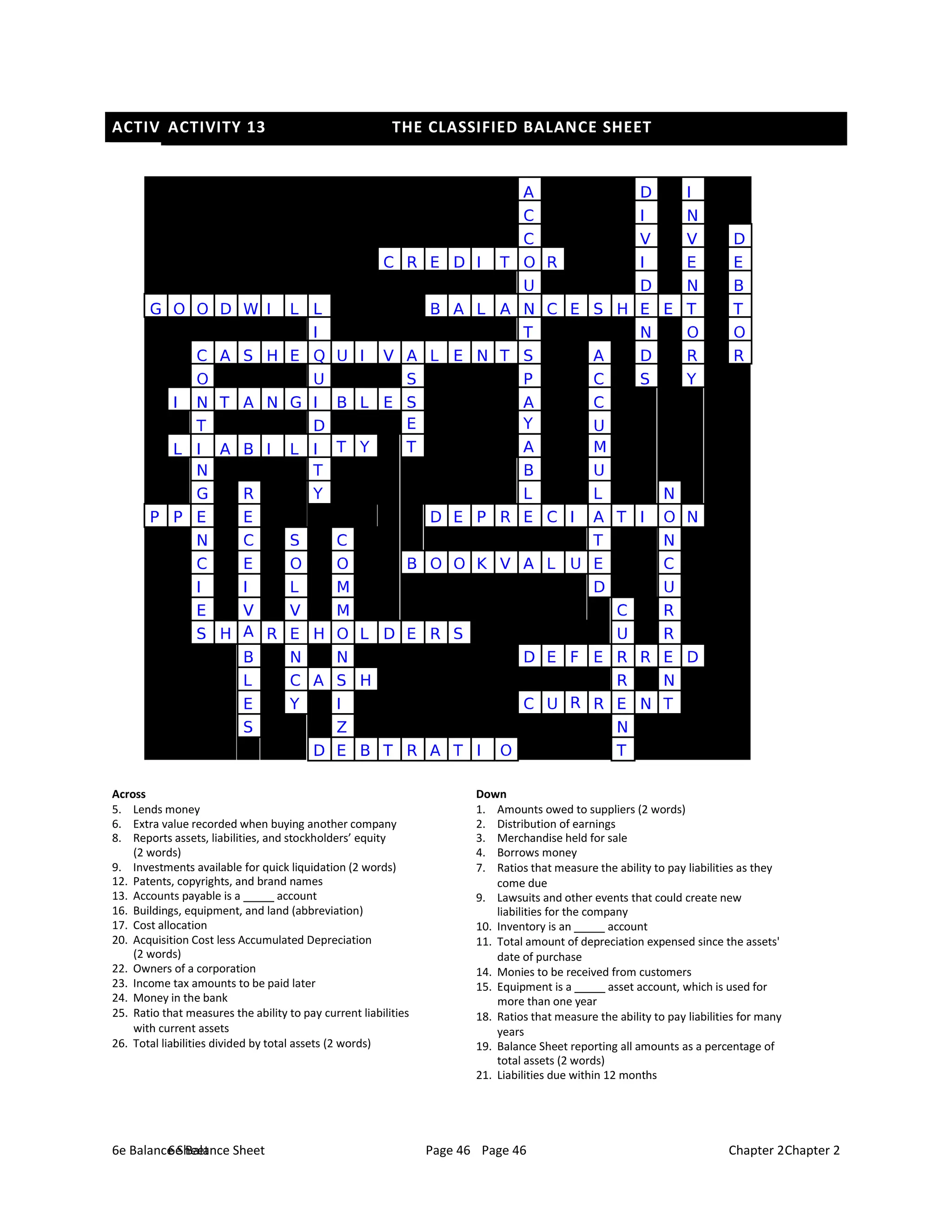
Across
5. Lends money
6. Extra value recorded when buying another company
8. Reports assets, liabilities, and stockholders’ equity
(2 words)
9. Investments available for quick liquidation (2 words)
12. Patents, copyrights, and brand names
13. Accounts payable is a account
16. Buildings, equipment, and land (abbreviation)
17. Cost allocation
20. Acquisition Cost less Accumulated Depreciation
(2 words)
22. Owners of a corporation
23. Income tax amounts to be paid later
24. Money in the bank
25. Ratio that measures the ability to pay current liabilities
with current assets
26. Total liabilities divided by total assets (2 words)
Down
1. Amounts owed to suppliers (2 words)
2. Distribution of earnings
3. Merchandise held for sale
4. Borrows money
7. Ratios that measure the ability to pay liabilities as they
come due
9. Lawsuits and other events that could create new
liabilities for the company
10. Inventory is an account
11. Total amount of depreciation expensed since the assets'
date of purchase
14. Monies to be received from customers
15. Equipment is a asset account, which is used for
more than one year
18. Ratios that measure the ability to pay liabilities for many
years
19. Balance Sheet reporting all amounts as a percentage of
total assets (2 words)
21. Liabilities due within 12 months
ACTIVITY 12 CROSSWORD PUZZLE FOR CHAPTER 2
ACTIVITY 13 THE CLASSIFIED BALANCE SHEET
6e Balance Sheet Page 47 Chapter 2
Purpose: • Identify account classifications typically used on the balance sheet.
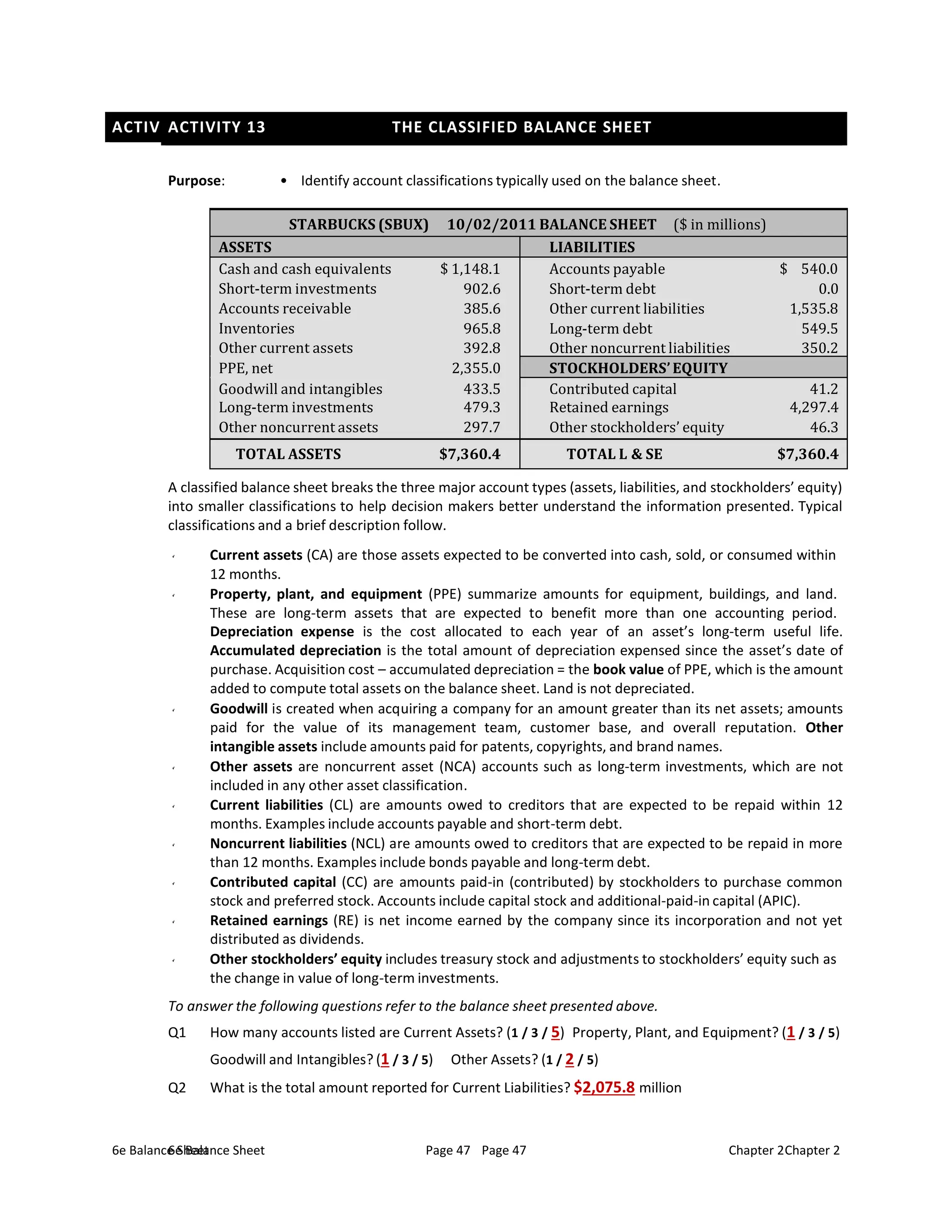
STARBUCKS (SBUX) 10/02/2011 BALANCE SHEET ($ in millions)
ASSETS LIABILITIES
Cash and cash equivalents
Short-term investments
Accounts receivable
Inventories
Other current assets
$ 1,148.1
902.6
385.6
965.8
392.8
Accounts payable
Short-term debt
Other current liabilities
Long-term debt
Other noncurrent liabilities
$ 540.0
0.0
1,535.8
549.5
350.2
PPE, net 2,355.0 STOCKHOLDERS’EQUITY
Goodwill and intangibles 433.5 Contributed capital 41.2
Long-term investments 479.3 Retained earnings 4,297.4
Other noncurrent assets 297.7 Other stockholders’ equity 46.3
TOTAL ASSETS $7,360.4 TOTAL L & SE $7,360.4
A classified balance sheet breaks the three major account types (assets, liabilities, and stockholders’ equity)
into smaller classifications to help decision makers better understand the information presented. Typical
classifications and a brief description follow.
Current assets (CA) are those assets expected to be converted into cash, sold, or consumed within
12 months.
Property, plant, and equipment (PPE) summarize amounts for equipment, buildings, and land.
These are long-term assets that are expected to benefit more than one accounting period.
Depreciation expense is the cost allocated to each year of an asset’s long-term useful life.
Accumulated depreciation is the total amount of depreciation expensed since the asset’s date of
purchase. Acquisition cost – accumulated depreciation = the book value of PPE, which is the amount
added to compute total assets on the balance sheet. Land is not depreciated.
Goodwill is created when acquiring a company for an amount greater than its net assets; amounts
paid for the value of its management team, customer base, and overall reputation. Other
intangible assets include amounts paid for patents, copyrights, and brand names.
Other assets are noncurrent asset (NCA) accounts such as long-term investments, which are not
included in any other asset classification.
Current liabilities (CL) are amounts owed to creditors that are expected to be repaid within 12
months. Examples include accounts payable and short-term debt.
Noncurrent liabilities (NCL) are amounts owed to creditors that are expected to be repaid in more
than 12 months. Examples include bonds payable and long-term debt.
Contributed capital (CC) are amounts paid-in (contributed) by stockholders to purchase common
stock and preferred stock. Accounts include capital stock and additional-paid-in capital (APIC).
Retained earnings (RE) is net income earned by the company since its incorporation and not yet
distributed as dividends.
Other stockholders’ equity includes treasury stock and adjustments to stockholders’ equity such as
the change in value of long-term investments.
To answer the following questions refer to the balance sheet presented above.
Q1 How many accounts listed are Current Assets? (1 / 3 / 5) Property, Plant, and Equipment? (1 / 3 / 5)
Goodwill and Intangibles? (1 / 3 / 5) Other Assets? (1 / 2 / 5)
Q2 What is the total amount reported for Current Liabilities? $2,075.8 million
ACTIVITY 12 CROSSWORD PUZZLE FOR CHAPTER 2
ACTIVITY 13 THE CLASSIFIED BALANCE SHEET
6e Balance Sheet Page 48 Chapter 2
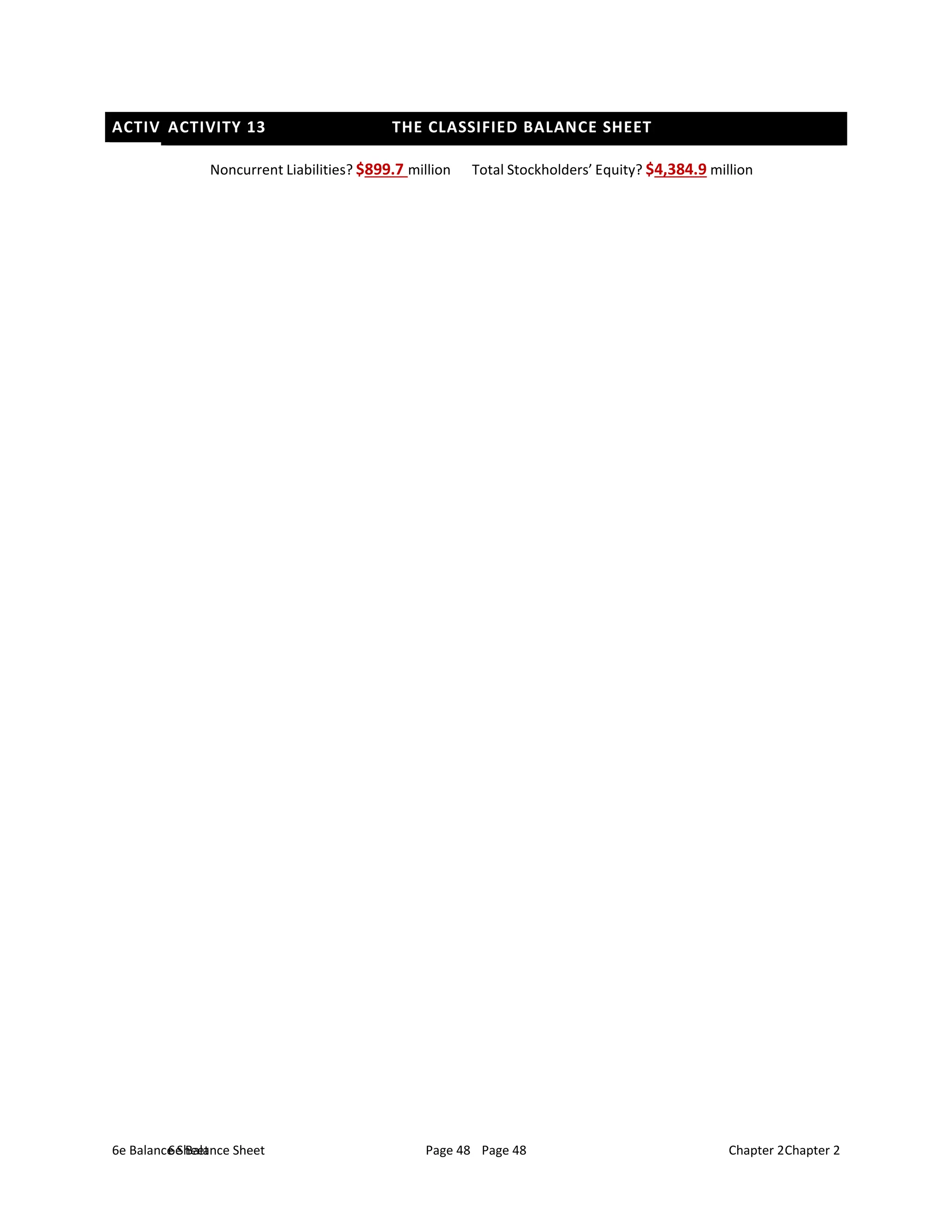
Noncurrent Liabilities? $899.7 million Total Stockholders’ Equity? $4,384.9 million
6e Balance Sheet Page 49 Chapter 2
ACTIVITY 14 UNDERSTANDING THE BALANCE SHEET
ACTIVITY 15 UNDERSTANDING THE BALANCE SHEET
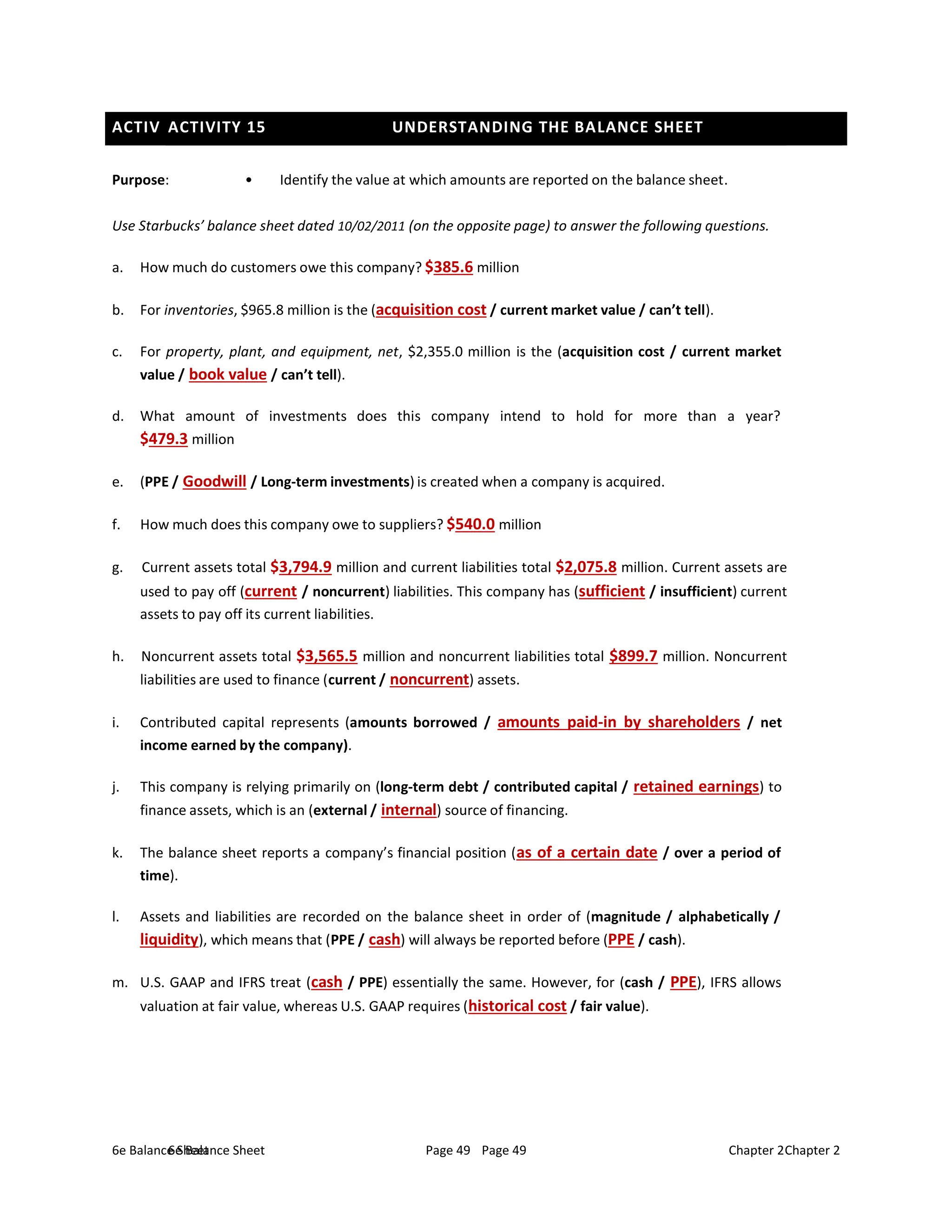
Purpose: • Identify the value at which amounts are reported on the balance sheet.
Use Starbucks’ balance sheet dated 10/02/2011 (on the opposite page) to answer the following questions.
a. How much do customers owe this company? $385.6 million
b. For inventories, $965.8 million is the (acquisition cost / current market value / can’t tell).
c. For property, plant, and equipment, net, $2,355.0 million is the (acquisition cost / current market
value / book value / can’t tell).
d. What amount of investments does this company intend to hold for more than a year?
$479.3 million
e. (PPE / Goodwill / Long-term investments) is created when a company is acquired.
f. How much does this company owe to suppliers? $540.0 million
g. Current assets total $3,794.9 million and current liabilities total $2,075.8 million. Current assets are
used to pay off (current / noncurrent) liabilities. This company has (sufficient / insufficient) current
assets to pay off its current liabilities.
h. Noncurrent assets total $3,565.5 million and noncurrent liabilities total $899.7 million. Noncurrent
liabilities are used to finance (current / noncurrent) assets.
i. Contributed capital represents (amounts borrowed / amounts paid-in by shareholders / net
income earned by the company).
j. This company is relying primarily on (long-term debt / contributed capital / retained earnings) to
finance assets, which is an (external / internal) source of financing.
k. The balance sheet reports a company’s financial position (as of a certain date / over a period of
time).
l. Assets and liabilities are recorded on the balance sheet in order of (magnitude / alphabetically /
liquidity), which means that (PPE / cash) will always be reported before (PPE / cash).
m. U.S. GAAP and IFRS treat (cash / PPE) essentially the same. However, for (cash / PPE), IFRS allows
valuation at fair value, whereas U.S. GAAP requires (historical cost / fair value).
6e Balance Sheet Page 50 Chapter 2
ACTIVITY 14 UNDERSTANDING THE BALANCE SHEET
ACTIVITY 15 UNDERSTANDING THE BALANCE SHEET
Purpose: • Identify the value at which amounts are reported on the balance sheet.
• Understand what an increase or a decrease in an account indicates.
• Develop strategies for analyzing the balance sheet.
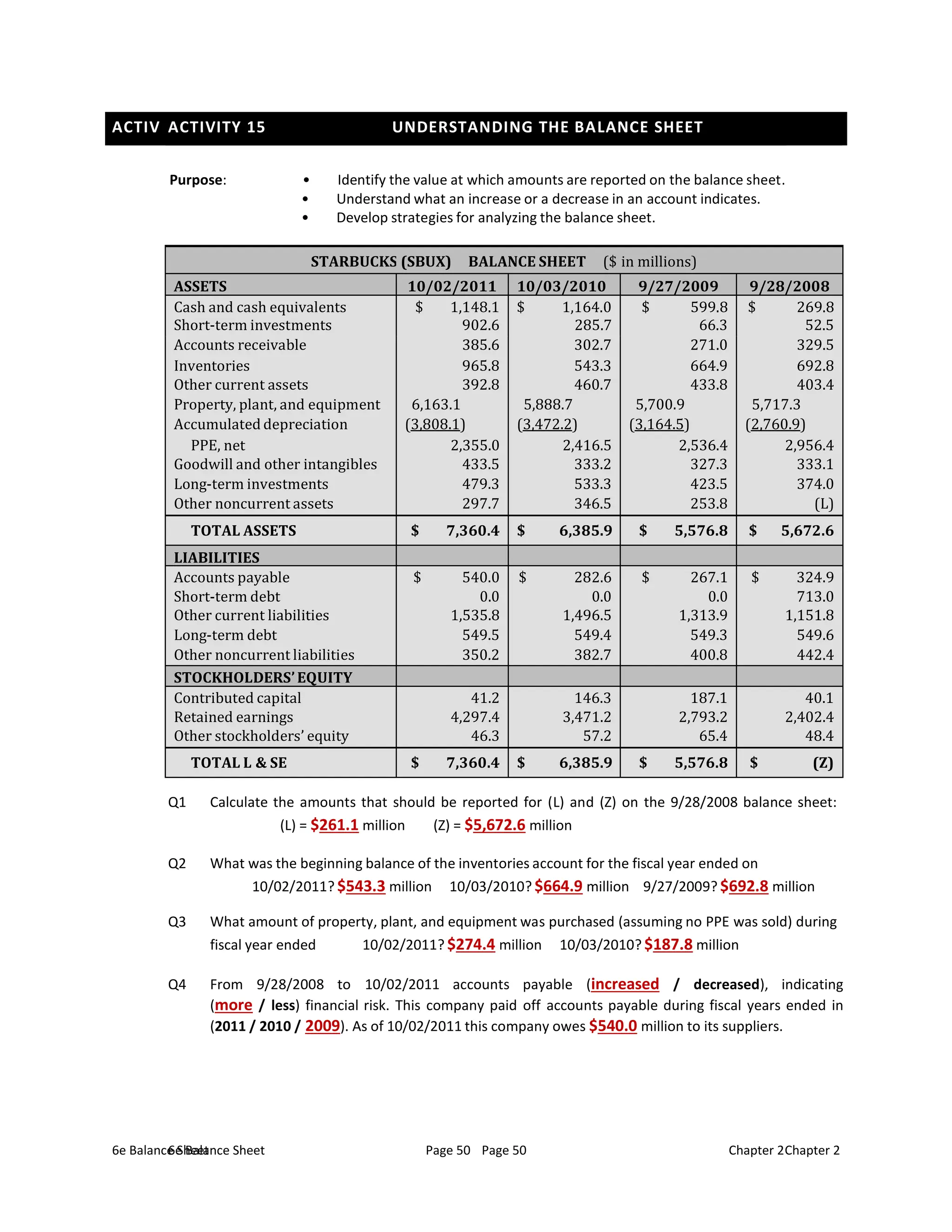
STARBUCKS (SBUX) BALANCE SHEET ($ in millions)
ASSETS 10/02/2011 10/03/2010 9/27/2009 9/28/2008
Cash and cash equivalents $ 1,148.1 $ 1,164.0 $ 599.8 $ 269.8
Short-term investments 902.6 285.7 66.3 52.5
Accounts receivable 385.6 302.7 271.0 329.5
Inventories 965.8 543.3 664.9 692.8
Other current assets 392.8 460.7 433.8 403.4
Property, plant, and equipment 6,163.1 5,888.7 5,700.9 5,717.3
Accumulated depreciation (3,808.1) (3,472.2) (3,164.5) (2,760.9)
PPE, net 2,355.0 2,416.5 2,536.4 2,956.4
Goodwill and other intangibles 433.5 333.2 327.3 333.1
Long-term investments 479.3 533.3 423.5 374.0
Other noncurrent assets 297.7 346.5 253.8 (L)
TOTAL ASSETS $ 7,360.4 $ 6,385.9 $ 5,576.8 $ 5,672.6
LIABILITIES
Accounts payable $ 540.0 $ 282.6 $ 267.1 $ 324.9
Short-term debt 0.0 0.0 0.0 713.0
Other current liabilities 1,535.8 1,496.5 1,313.9 1,151.8
Long-term debt 549.5 549.4 549.3 549.6
Other noncurrent liabilities 350.2 382.7 400.8 442.4
STOCKHOLDERS’EQUITY
Contributed capital 41.2 146.3 187.1 40.1
Retained earnings 4,297.4 3,471.2 2,793.2 2,402.4
Other stockholders’ equity 46.3 57.2 65.4 48.4
TOTAL L & SE $ 7,360.4 $ 6,385.9 $ 5,576.8 $ (Z)
Q1 Calculate the amounts that should be reported for (L) and (Z) on the 9/28/2008 balance sheet:
(L) = $261.1 million (Z) = $5,672.6 million
Q2 What was the beginning balance of the inventories account for the fiscal year ended on
10/02/2011? $543.3 million 10/03/2010? $664.9 million 9/27/2009? $692.8 million
Q3 What amount of property, plant, and equipment was purchased (assuming no PPE was sold) during
fiscal year ended 10/02/2011? $274.4 million 10/03/2010? $187.8 million
Q4 From 9/28/2008 to 10/02/2011 accounts payable (increased / decreased), indicating
(more / less) financial risk. This company paid off accounts payable during fiscal years ended in
(2011 / 2010 / 2009). As of 10/02/2011 this company owes $540.0 million to its suppliers.
6e Balance Sheet Page 49 Chapter 2
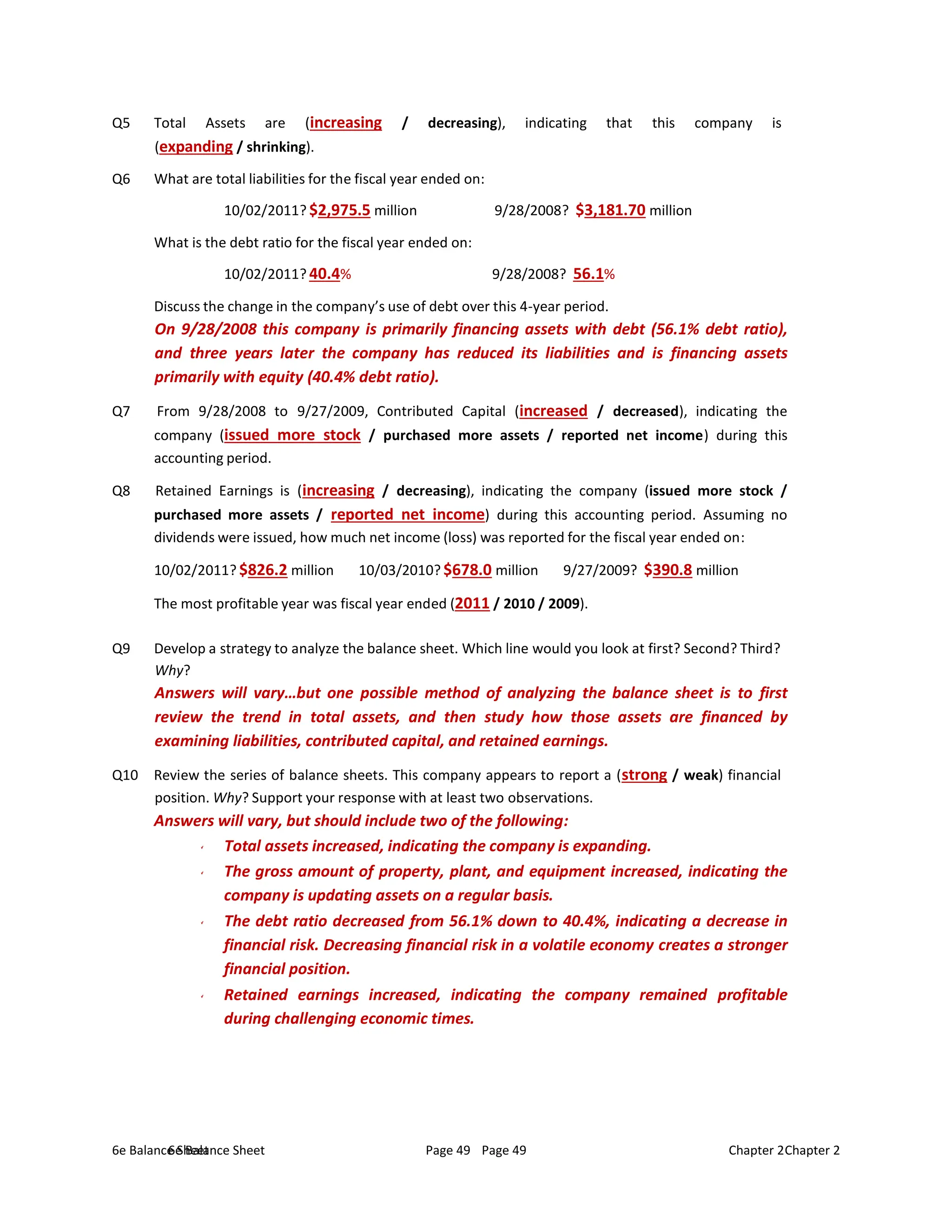
Q5 Total Assets are (increasing / decreasing), indicating that this company is
(expanding / shrinking).
Q6 What are total liabilities for the fiscal year ended on:
10/02/2011? $2,975.5 million 9/28/2008? $3,181.70 million
What is the debt ratio for the fiscal year ended on:
10/02/2011? 40.4% 9/28/2008? 56.1%
Discuss the change in the company’s use of debt over this 4-year period.
On 9/28/2008 this company is primarily financing assets with debt (56.1% debt ratio),
and three years later the company has reduced its liabilities and is financing assets
primarily with equity (40.4% debt ratio).
Q7 From 9/28/2008 to 9/27/2009, Contributed Capital (increased / decreased), indicating the
company (issued more stock / purchased more assets / reported net income) during this
accounting period.
Q8 Retained Earnings is (increasing / decreasing), indicating the company (issued more stock /
purchased more assets / reported net income) during this accounting period. Assuming no
dividends were issued, how much net income (loss) was reported for the fiscal year ended on:
10/02/2011? $826.2 million 10/03/2010? $678.0 million 9/27/2009? $390.8 million
The most profitable year was fiscal year ended (2011 / 2010 / 2009).
Q9 Develop a strategy to analyze the balance sheet. Which line would you look at first? Second? Third?
Why?
Answers will vary…but one possible method of analyzing the balance sheet is to first
review the trend in total assets, and then study how those assets are financed by
examining liabilities, contributed capital, and retained earnings.
Q10 Review the series of balance sheets. This company appears to report a (strong / weak) financial
position. Why? Support your response with at least two observations.
Answers will vary, but should include two of the following:
Total assets increased, indicating the company is expanding.
The gross amount of property, plant, and equipment increased, indicating the
company is updating assets on a regular basis.
The debt ratio decreased from 56.1% down to 40.4%, indicating a decrease in
financial risk. Decreasing financial risk in a volatile economy creates a stronger
financial position.
Retained earnings increased, indicating the company remained profitable
during challenging economic times.
6e Balance Sheet Page 50 Chapter 2
ACTIVITY 16 DEBT VS. EQUITY
Purpose: • Identify the characteristics of debt and equity.
• Assess financial risk.
Corporations externally finance the purchase of assets with debt (liabilities) or equity (common stock).
Assets = Liabilities + Stockholders’ Equity
Large amounts of debt are usually issued in the form of bonds. The borrowing corporation records a bond
payable and is referred to as the debtor, while the entity loaning the money records a bond receivable
and is referred to as the creditor. The debtor must pay back the amount borrowed plus interest to the
creditor. The interest paid by the borrowing corporation is an expense that reduces taxable income. The
return to creditors is the interest received. Creditors are not owners of the corporation and, therefore,
have no ownership rights.
Equity refers to the issuance of stock, which may be common stock or preferred stock. Entities owning
shares of stock are the owners of the corporation and are referred to as stockholders or shareholders.
Stockholders’ primary ownership rights include a right to vote at annual meetings and a right to a portion
of the profits (net income). Dividends are the distribution of profits to stockholders. The corporate board
of directors decides whether to pay dividends or not and has no obligation to purchase the shares of stock
back from the stockholders. If stockholders sell their shares of stock, they usually sell to another investor
using a stockbroker, who in turn executes the trade on a stock exchange such as the New York Stock
Exchange or NASDAQ. Stockholders earn a return on their investment by receiving dividends or selling the
stock for a greater amount than the purchase price.
The balance sheet helps investors, both creditors and stockholders, assess the degree of financial risk a
corporation is assuming. In general, the more a corporation relies on debt to finance assets, the greater
the financial risk of the corporation.
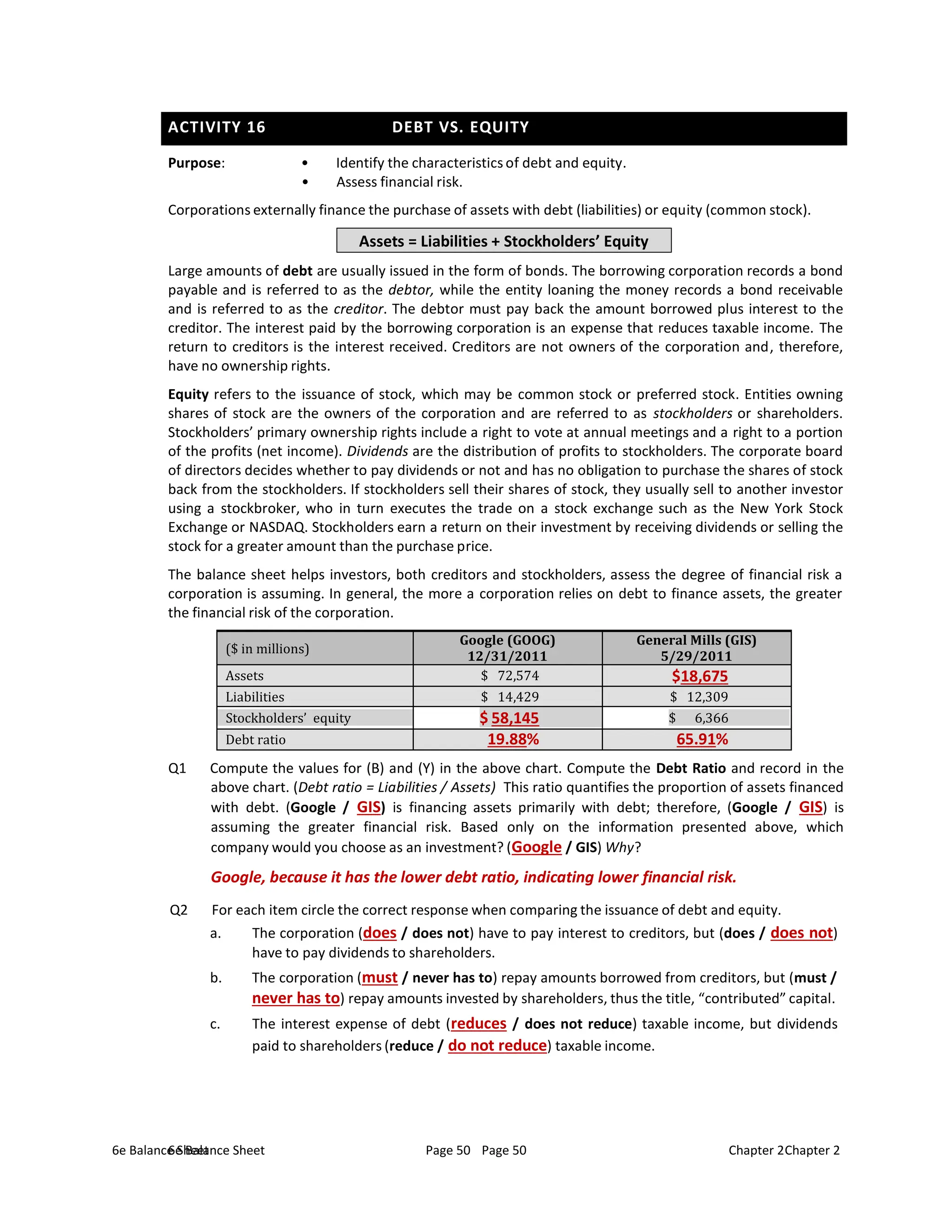
($ in millions)
Google (GOOG)
12/31/2011
General Mills (GIS)
5/29/2011
Assets $ 72,574 $18,675
Liabilities $ 14,429 $ 12,309
Stockholders’ equity $ 58,145 $ 6,366
Debt ratio 19.88% 65.91%
Q1 Compute the values for (B) and (Y) in the above chart. Compute the Debt Ratio and record in the
above chart. (Debt ratio = Liabilities / Assets) This ratio quantifies the proportion of assets financed
with debt. (Google / GIS) is financing assets primarily with debt; therefore, (Google / GIS) is
assuming the greater financial risk. Based only on the information presented above, which
company would you choose as an investment? (Google / GIS) Why?
Google, because it has the lower debt ratio, indicating lower financial risk.
Q2 For each item circle the correct response when comparing the issuance of debt and equity.
a. The corporation (does / does not) have to pay interest to creditors, but (does / does not)
have to pay dividends to shareholders.
b. The corporation (must / never has to) repay amounts borrowed from creditors, but (must /
never has to) repay amounts invested by shareholders, thus the title, “contributed” capital.
c. The interest expense of debt (reduces / does not reduce) taxable income, but dividends
paid to shareholders (reduce / do not reduce) taxable income.
6e Balance Sheet Page 51 Chapter 2
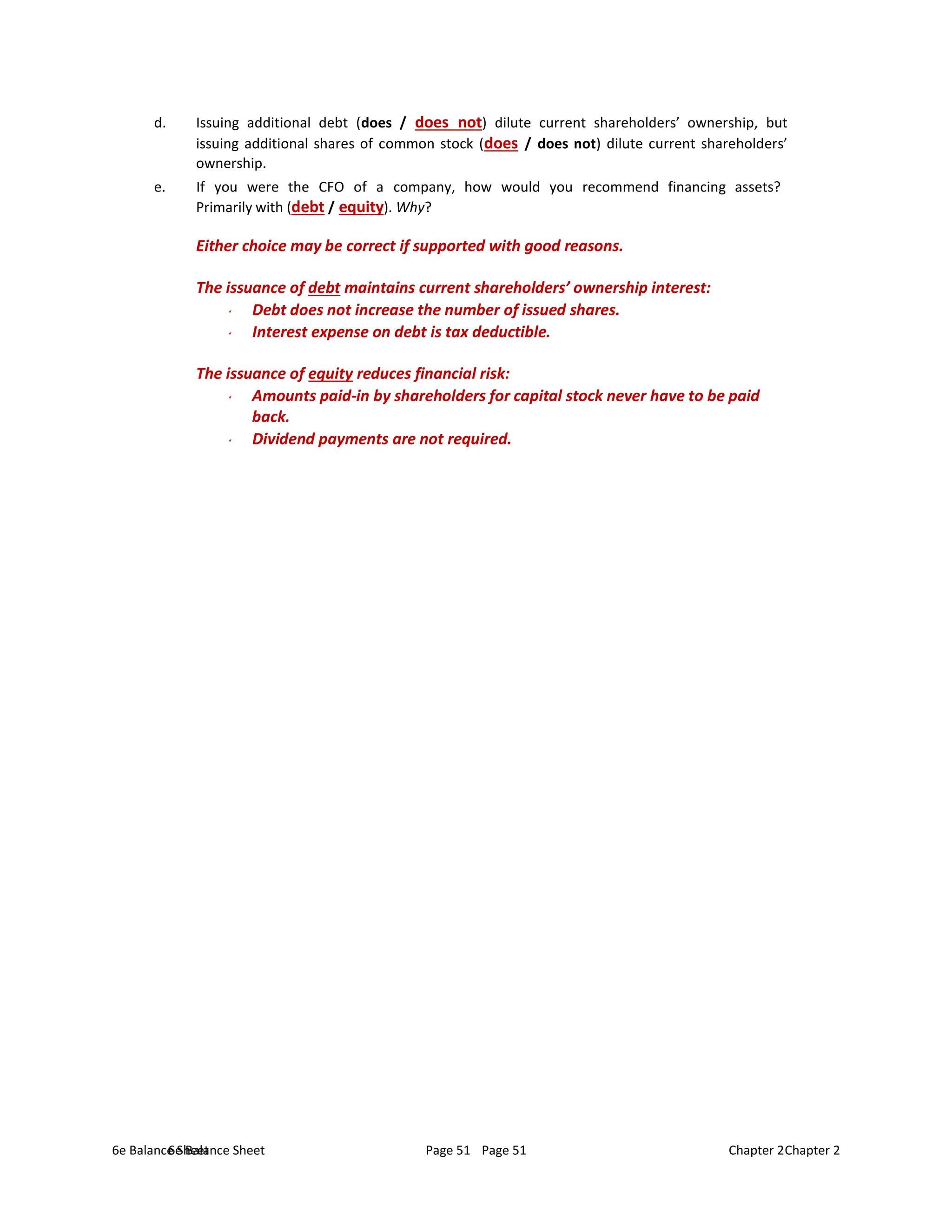
d. Issuing additional debt (does / does not) dilute current shareholders’ ownership, but
issuing additional shares of common stock (does / does not) dilute current shareholders’
ownership.
e. If you were the CFO of a company, how would you recommend financing assets?
Primarily with (debt / equity). Why?
Either choice may be correct if supported with good reasons.
The issuance of debt maintains current shareholders’ ownership interest:
Debt does not increase the number of issued shares.
Interest expense on debt is tax deductible.
The issuance of equity reduces financial risk:
Amounts paid-in by shareholders for capital stock never have to be paid
back.
Dividend payments are not required.
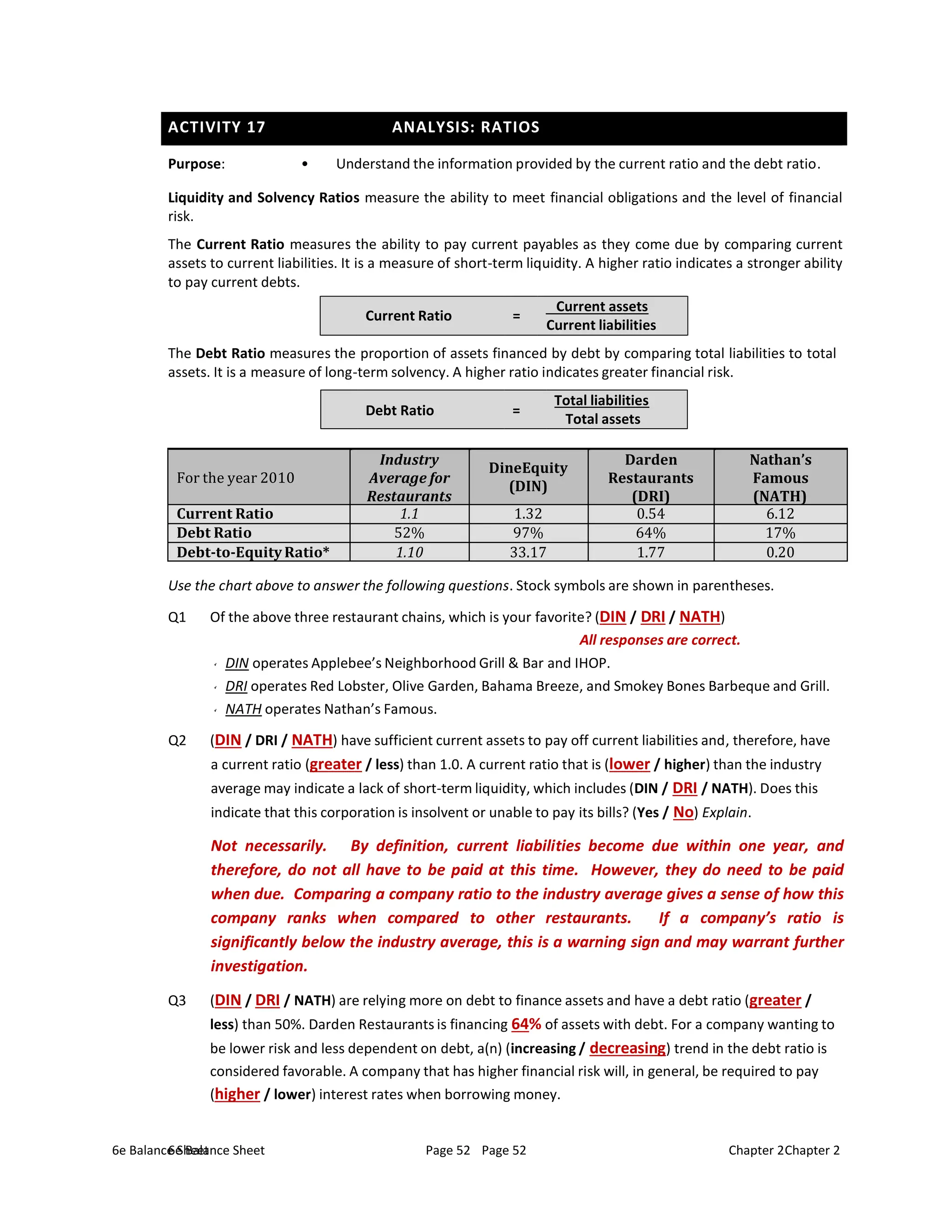
ACTIVITY 17 ANALYSIS: RATIOS
6e Balance Sheet Page 52 Chapter 2
Purpose: • Understand the information provided by the current ratio and the debt ratio.
Liquidity and Solvency Ratios measure the ability to meet financial obligations and the level of financial
risk.
The Current Ratio measures the ability to pay current payables as they come due by comparing current
assets to current liabilities. It is a measure of short-term liquidity. A higher ratio indicates a stronger ability
to pay current debts.
Current Ratio =
Current assets
Current liabilities
The Debt Ratio measures the proportion of assets financed by debt by comparing total liabilities to total
assets. It is a measure of long-term solvency. A higher ratio indicates greater financial risk.
Debt Ratio =
Total liabilities
Total assets
For the year 2010
Industry
Average for
Restaurants
DineEquity
(DIN)
Darden
Restaurants
(DRI)
Nathan’s
Famous
(NATH)
Current Ratio 1.1 1.32 0.54 6.12
Debt Ratio 52% 97% 64% 17%
Debt-to-EquityRatio* 1.10 33.17 1.77 0.20
Use the chart above to answer the following questions. Stock symbols are shown in parentheses.
Q1 Of the above three restaurant chains, which is your favorite? (DIN / DRI / NATH)
All responses are correct.
DIN operates Applebee’s Neighborhood Grill & Bar and IHOP.
DRI operates Red Lobster, Olive Garden, Bahama Breeze, and Smokey Bones Barbeque and Grill.
NATH operates Nathan’s Famous.
Q2 (DIN / DRI / NATH) have sufficient current assets to pay off current liabilities and, therefore, have
a current ratio (greater / less) than 1.0. A current ratio that is (lower / higher) than the industry
average may indicate a lack of short-term liquidity, which includes (DIN / DRI / NATH). Does this
indicate that this corporation is insolvent or unable to pay its bills? (Yes / No) Explain.
Not necessarily. By definition, current liabilities become due within one year, and
therefore, do not all have to be paid at this time. However, they do need to be paid
when due. Comparing a company ratio to the industry average gives a sense of how this
company ranks when compared to other restaurants. If a company’s ratio is
significantly below the industry average, this is a warning sign and may warrant further
investigation.
Q3 (DIN / DRI / NATH) are relying more on debt to finance assets and have a debt ratio (greater /
less) than 50%. Darden Restaurants is financing 64% of assets with debt. For a company wanting to
be lower risk and less dependent on debt, a(n) (increasing / decreasing) trend in the debt ratio is
considered favorable. A company that has higher financial risk will, in general, be required to pay
(higher / lower) interest rates when borrowing money.
6e Balance Sheet Page 53 Chapter 2
Q4 Why does a company with a higher debt ratio tend to have greater financial risk?
A higher debt ratio indicates greater debt. Debt is a legal liability that must be repaid
plus interest. If the principal or interest cannot be repaid, then a company can be forced
into bankruptcy and creditors may not get fully repaid. Therefore, creditors are at
financial risk of not receiving the full amount due to them. As the amount of company
debt increases, so does the financial risk of not being able to pay back that debt plus
interest when due.
Q5 Does a high debt ratio indicate a weak corporation? (Yes / No) Explain your answer.
The answer is no, not necessarily. Even though DineEquity has a higher debt ratio, it
may not be considered a weak corporation. Companies use different strategies to
finance assets. Companies within a stable industry have the ability to use more debt
than companies within a volatile industry. Companies with a large investment in PPE
can use that PPE as collateral for debt financing. Also, some corporations make the
decision to accept higher financial risk.
* Instead of reporting the Debt Ratio, some financial sources report the Debt-to-Equity ratio, computed as liabilities
divided by stockholders’ equity. To convert:
Debt ratio = [Debt-to-equity ratio/ (1 + Debt-to-equity ratio)]
For DineEquity 0.97 = 33.17 / 34.17
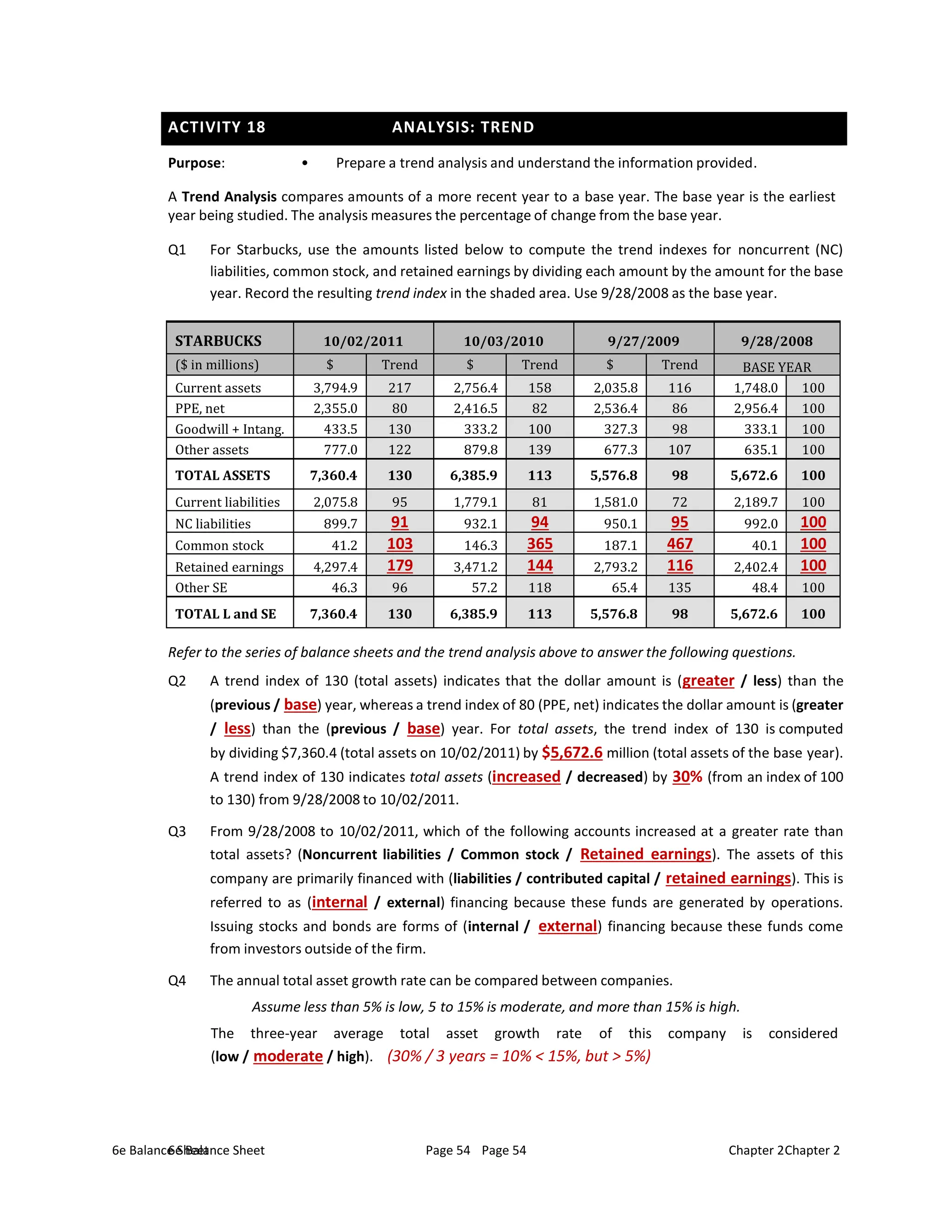
ACTIVITY 18 ANALYSIS: TREND
6e Balance Sheet Page 54 Chapter 2
Purpose: • Prepare a trend analysis and understand the information provided.
A Trend Analysis compares amounts of a more recent year to a base year. The base year is the earliest
year being studied. The analysis measures the percentage of change from the base year.
Q1 For Starbucks, use the amounts listed below to compute the trend indexes for noncurrent (NC)
liabilities, common stock, and retained earnings by dividing each amount by the amount for the base
year. Record the resulting trend index in the shaded area. Use 9/28/2008 as the base year.
STARBUCKS 10/02/2011 10/03/2010 9/27/2009 9/28/2008
($ in millions) $ Trend $ Trend $ Trend BASE YEAR
Current assets 3,794.9 217 2,756.4 158 2,035.8 116 1,748.0 100
PPE, net 2,355.0 80 2,416.5 82 2,536.4 86 2,956.4 100
Goodwill + Intang. 433.5 130 333.2 100 327.3 98 333.1 100
Other assets 777.0 122 879.8 139 677.3 107 635.1 100
TOTAL ASSETS 7,360.4 130 6,385.9 113 5,576.8 98 5,672.6 100
Current liabilities 2,075.8 95 1,779.1 81 1,581.0 72 2,189.7 100
NC liabilities 899.7 91 932.1 94 950.1 95 992.0 100
Common stock 41.2 103 146.3 365 187.1 467 40.1 100
Retained earnings 4,297.4 179 3,471.2 144 2,793.2 116 2,402.4 100
Other SE 46.3 96 57.2 118 65.4 135 48.4 100
TOTAL L and SE 7,360.4 130 6,385.9 113 5,576.8 98 5,672.6 100
Refer to the series of balance sheets and the trend analysis above to answer the following questions.
Q2 A trend index of 130 (total assets) indicates that the dollar amount is (greater / less) than the
(previous / base) year, whereas a trend index of 80 (PPE, net) indicates the dollar amount is (greater
/ less) than the (previous / base) year. For total assets, the trend index of 130 is computed
by dividing $7,360.4 (total assets on 10/02/2011) by $5,672.6 million (total assets of the base year).
A trend index of 130 indicates total assets (increased / decreased) by 30% (from an index of 100
to 130) from 9/28/2008 to 10/02/2011.
Q3 From 9/28/2008 to 10/02/2011, which of the following accounts increased at a greater rate than
total assets? (Noncurrent liabilities / Common stock / Retained earnings). The assets of this
company are primarily financed with (liabilities / contributed capital / retained earnings). This is
referred to as (internal / external) financing because these funds are generated by operations.
Issuing stocks and bonds are forms of (internal / external) financing because these funds come
from investors outside of the firm.
Q4 The annual total asset growth rate can be compared between companies.
Assume less than 5% is low, 5 to 15% is moderate, and more than 15% is high.
The three-year average total asset growth rate of this company is considered
(low / moderate / high). (30% / 3 years = 10% < 15%, but > 5%)
6e Balance Sheet Page 55 Chapter 2
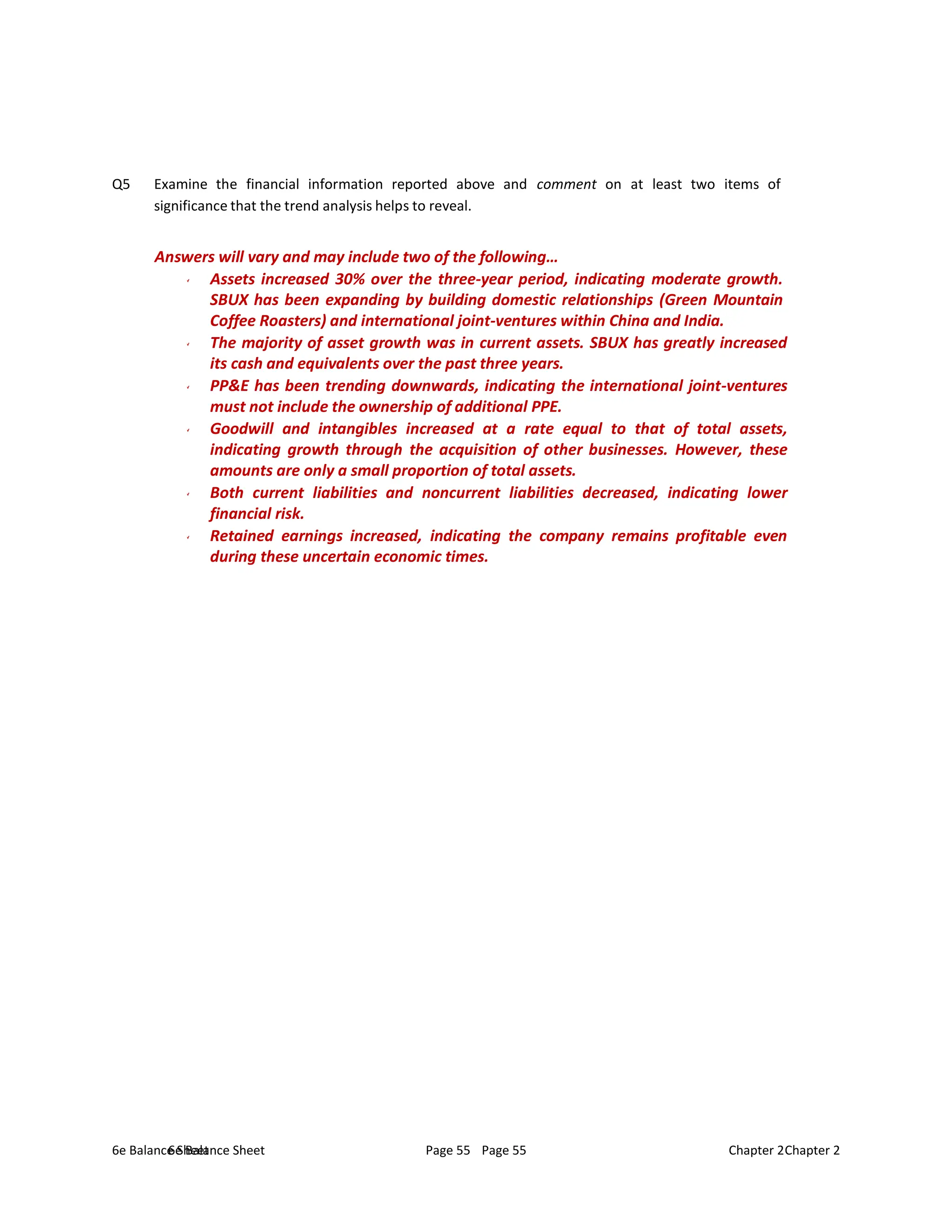
Q5 Examine the financial information reported above and comment on at least two items of
significance that the trend analysis helps to reveal.
Answers will vary and may include two of the following…
Assets increased 30% over the three-year period, indicating moderate growth.
SBUX has been expanding by building domestic relationships (Green Mountain
Coffee Roasters) and international joint-ventures within China and India.
The majority of asset growth was in current assets. SBUX has greatly increased
its cash and equivalents over the past three years.
PP&E has been trending downwards, indicating the international joint-ventures
must not include the ownership of additional PPE.
Goodwill and intangibles increased at a rate equal to that of total assets,
indicating growth through the acquisition of other businesses. However, these
amounts are only a small proportion of total assets.
Both current liabilities and noncurrent liabilities decreased, indicating lower
financial risk.
Retained earnings increased, indicating the company remains profitable even
during these uncertain economic times.
ACTIVITY 19 ANALYSIS: COMMON-SIZE STATEMENTS
6e Balance Sheet Page 56 Chapter 2
Purpose: • Prepare common-size statements and understand the information provided.
The Common-Size Balance Sheet compares all amounts to total assets of that same year. The analysis
measures each item as a percentage of total assets.
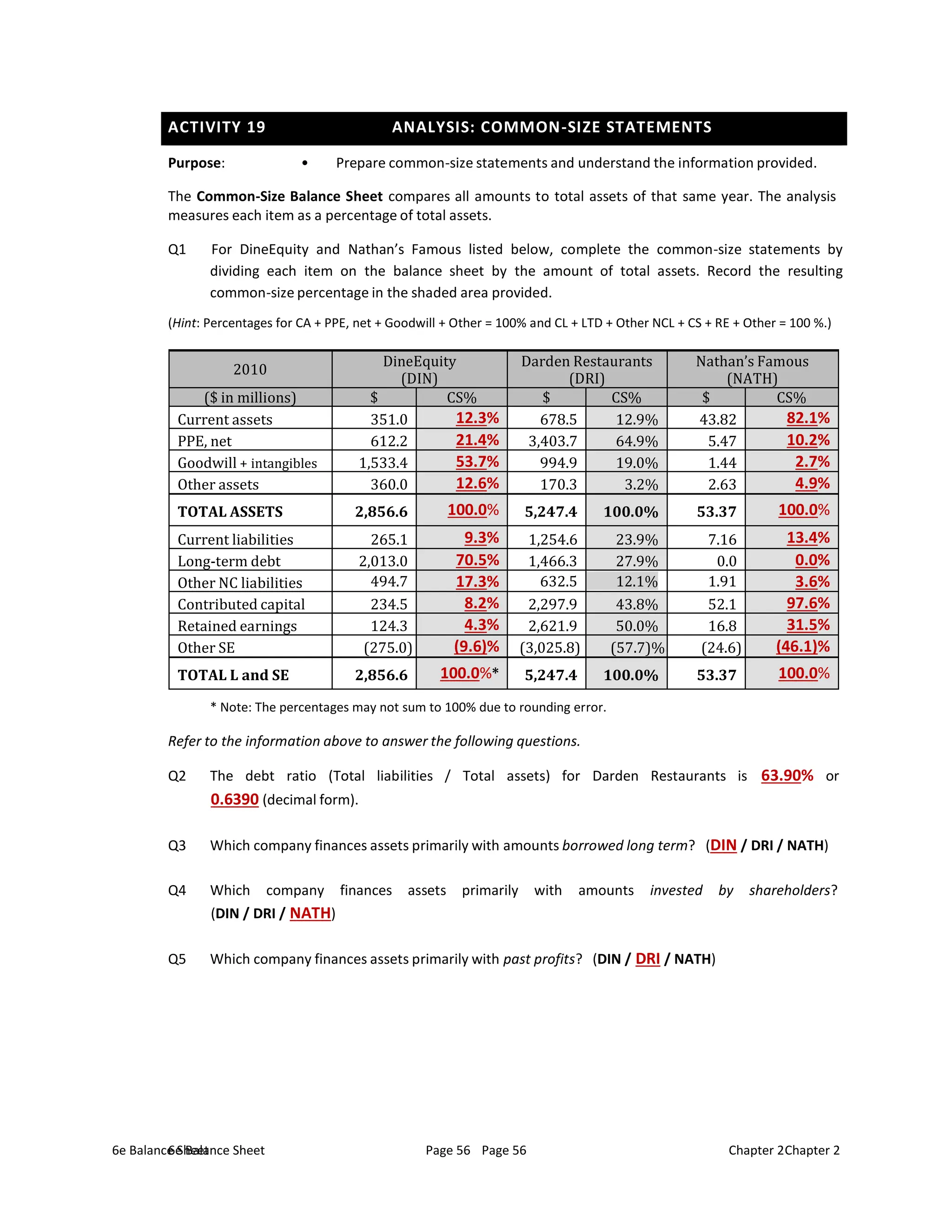
Q1 For DineEquity and Nathan’s Famous listed below, complete the common-size statements by
dividing each item on the balance sheet by the amount of total assets. Record the resulting
common-size percentage in the shaded area provided.
(Hint: Percentages for CA + PPE, net + Goodwill + Other = 100% and CL + LTD + Other NCL + CS + RE + Other = 100 %.)
2010
DineEquity
(DIN)
Darden Restaurants
(DRI)
Nathan’s Famous
(NATH)
($ in millions) $ CS% $ CS% $ CS%
Current assets 351.0 12.3% 678.5 12.9% 43.82 82.1%
PPE, net 612.2 21.4% 3,403.7 64.9% 5.47 10.2%
Goodwill + intangibles 1,533.4 53.7% 994.9 19.0% 1.44 2.7%
Other assets 360.0 12.6% 170.3 3.2% 2.63 4.9%
TOTAL ASSETS 2,856.6 100.0% 5,247.4 100.0% 53.37 100.0%
Current liabilities 265.1 9.3% 1,254.6 23.9% 7.16 13.4%
Long-term debt 2,013.0 70.5% 1,466.3 27.9% 0.0 0.0%
Other NC liabilities 494.7 17.3% 632.5 12.1% 1.91 3.6%
Contributed capital 234.5 8.2% 2,297.9 43.8% 52.1 97.6%
Retained earnings 124.3 4.3% 2,621.9 50.0% 16.8 31.5%
Other SE (275.0) (9.6)% (3,025.8) (57.7)% (24.6) (46.1)%
TOTAL L and SE 2,856.6 100.0%* 5,247.4 100.0% 53.37 100.0%
* Note: The percentages may not sum to 100% due to rounding error.
Refer to the information above to answer the following questions.
Q2 The debt ratio (Total liabilities / Total assets) for Darden Restaurants is 63.90% or
0.6390 (decimal form).
Q3 Which company finances assets primarily with amounts borrowed long term? (DIN / DRI / NATH)
Q4 Which company finances assets primarily with amounts invested by shareholders?
(DIN / DRI / NATH)
Q5 Which company finances assets primarily with past profits? (DIN / DRI / NATH)
6e Balance Sheet Page 57 Chapter 2
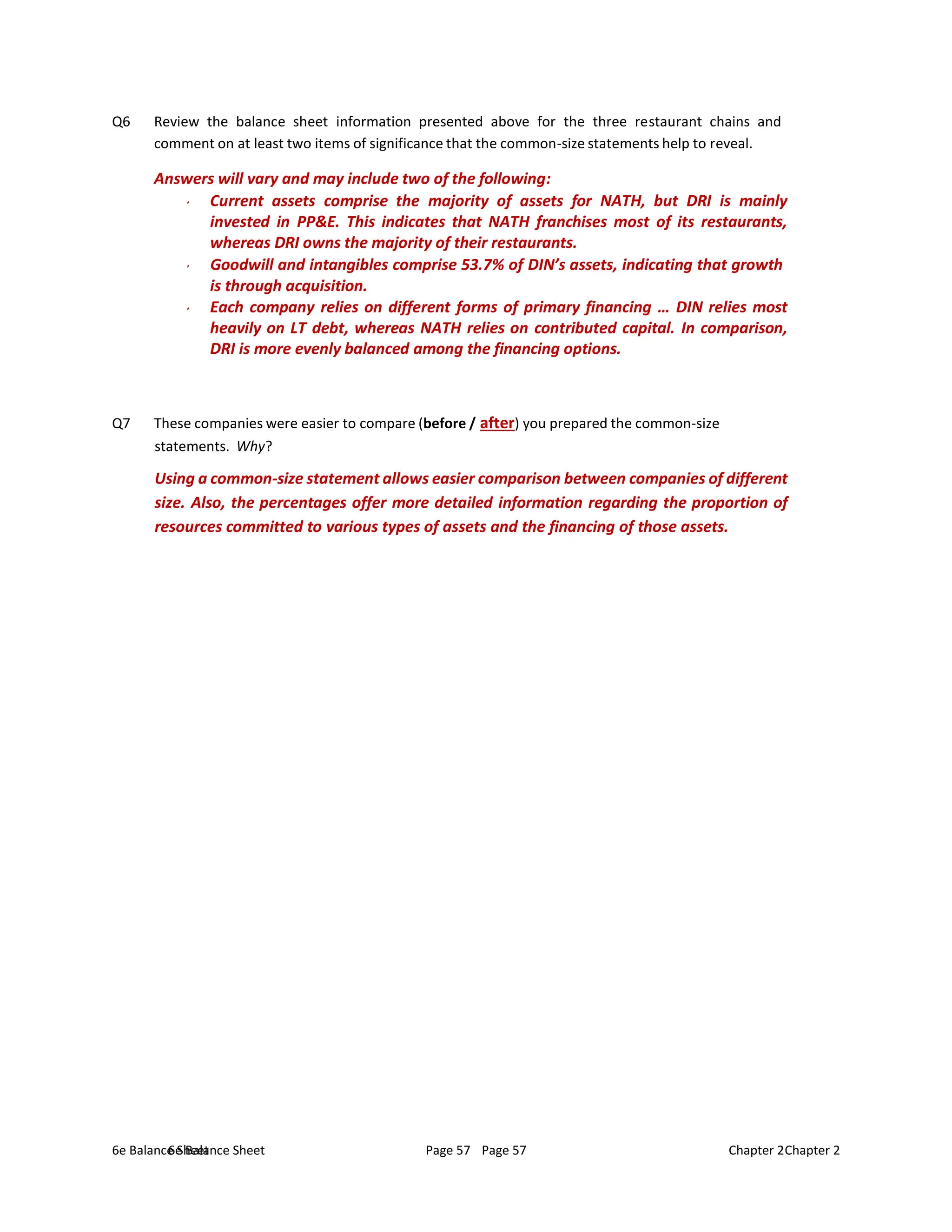
Q6 Review the balance sheet information presented above for the three restaurant chains and
comment on at least two items of significance that the common-size statements help to reveal.
Answers will vary and may include two of the following:
Current assets comprise the majority of assets for NATH, but DRI is mainly
invested in PP&E. This indicates that NATH franchises most of its restaurants,
whereas DRI owns the majority of their restaurants.
Goodwill and intangibles comprise 53.7% of DIN’s assets, indicating that growth
is through acquisition.
Each company relies on different forms of primary financing … DIN relies most
heavily on LT debt, whereas NATH relies on contributed capital. In comparison,
DRI is more evenly balanced among the financing options.
Q7 These companies were easier to compare (before / after) you prepared the common-size
statements. Why?
Using a common-size statement allows easier comparison between companies of different
size. Also, the percentages offer more detailed information regarding the proportion of
resources committed to various types of assets and the financing of those assets.
ACTIVITY 20 ANALYSIS OF YUM! BRANDS
6e Balance Sheet Page 58 Chapter 2
Purpose: • Understand and interpret amounts reported on the balance sheet.
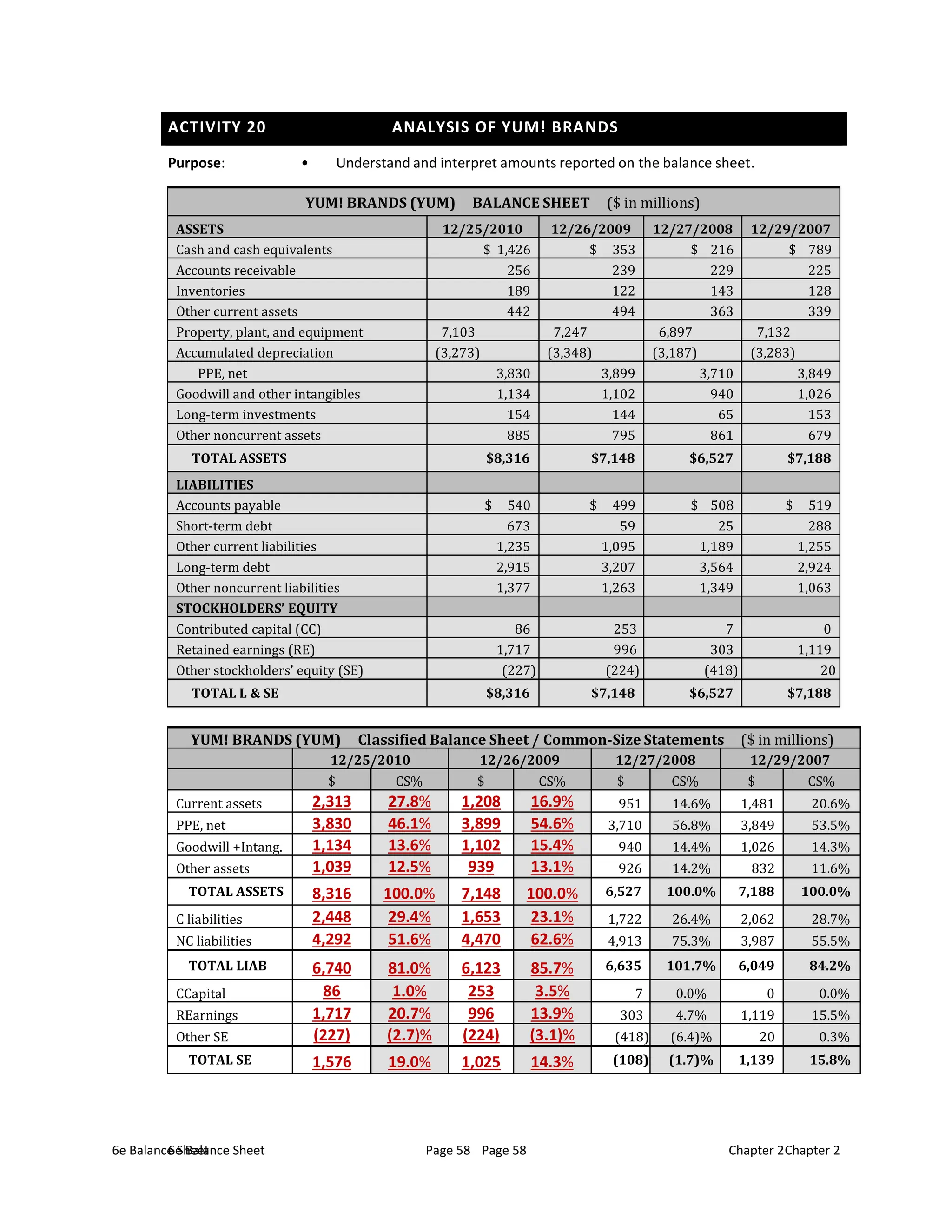
YUM! BRANDS (YUM) BALANCE SHEET ($ in millions)
ASSETS 12/25/2010 12/26/2009 12/27/2008 12/29/2007
Cash and cash equivalents $ 1,426 $ 353 $ 216 $ 789
Accounts receivable 256 239 229 225
Inventories 189 122 143 128
Other current assets 442 494 363 339
Property, plant, and equipment 7,103 7,247 6,897 7,132
Accumulated depreciation (3,273) (3,348) (3,187) (3,283)
PPE, net 3,830 3,899 3,710 3,849
Goodwill and other intangibles 1,134 1,102 940 1,026
Long-term investments 154 144 65 153
Other noncurrent assets 885 795 861 679
TOTAL ASSETS $8,316 $7,148 $6,527 $7,188
LIABILITIES
Accounts payable $ 540 $ 499 $ 508 $ 519
Short-term debt 673 59 25 288
Other current liabilities 1,235 1,095 1,189 1,255
Long-term debt 2,915 3,207 3,564 2,924
Other noncurrent liabilities 1,377 1,263 1,349 1,063
STOCKHOLDERS’ EQUITY
Contributed capital (CC) 86 253 7 0
Retained earnings (RE) 1,717 996 303 1,119
Other stockholders’ equity (SE) (227) (224) (418) 20
TOTAL L & SE $8,316 $7,148 $6,527 $7,188
YUM! BRANDS (YUM) Classified Balance Sheet / Common-Size Statements ($ in millions)
12/25/2010 12/26/2009 12/27/2008 12/29/2007
$ CS% $ CS% $ CS% $ CS%
Current assets 2,313 27.8% 1,208 16.9% 951 14.6% 1,481 20.6%
PPE, net 3,830 46.1% 3,899 54.6% 3,710 56.8% 3,849 53.5%
Goodwill +Intang. 1,134 13.6% 1,102 15.4% 940 14.4% 1,026 14.3%
Other assets 1,039 12.5% 939 13.1% 926 14.2% 832 11.6%
TOTAL ASSETS 8,316 100.0% 7,148 100.0% 6,527 100.0% 7,188 100.0%
C liabilities 2,448 29.4% 1,653 23.1% 1,722 26.4% 2,062 28.7%
NC liabilities 4,292 51.6% 4,470 62.6% 4,913 75.3% 3,987 55.5%
TOTAL LIAB 6,740 81.0% 6,123 85.7% 6,635 101.7% 6,049 84.2%
CCapital 86 1.0% 253 3.5% 7 0.0% 0 0.0%
REarnings 1,717 20.7% 996 13.9% 303 4.7% 1,119 15.5%
Other SE (227) (2.7)% (224) (3.1)% (418) (6.4)% 20 0.3%
TOTAL SE 1,576 19.0% 1,025 14.3% (108) (1.7)% 1,139 15.8%
6e Balance Sheet Page 59 Chapter 2
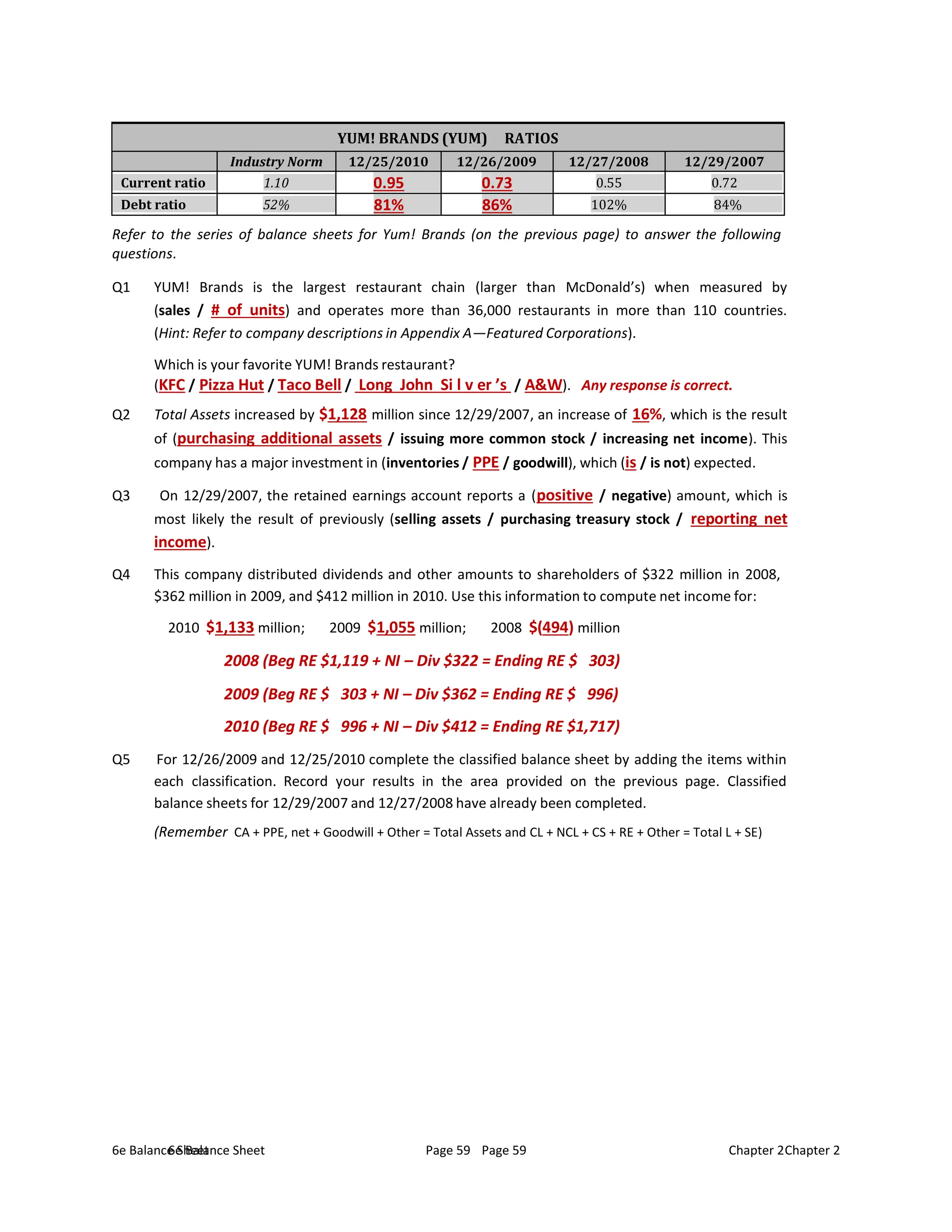
YUM! BRANDS (YUM) RATIOS
Industry Norm 12/25/2010 12/26/2009 12/27/2008 12/29/2007
Current ratio 1.10 0.95 0.73 0.55 0.72
Debt ratio 52% 81% 86% 102% 84%
Refer to the series of balance sheets for Yum! Brands (on the previous page) to answer the following
questions.
Q1 YUM! Brands is the largest restaurant chain (larger than McDonald’s) when measured by
(sales / # of units) and operates more than 36,000 restaurants in more than 110 countries.
(Hint: Refer to company descriptions in Appendix A—Featured Corporations).
Which is your favorite YUM! Brands restaurant?
(KFC / Pizza Hut / Taco Bell / Long John Si l v er ’s / A&W). Any response is correct.
Q2 Total Assets increased by $1,128 million since 12/29/2007, an increase of 16%, which is the result
of (purchasing additional assets / issuing more common stock / increasing net income). This
company has a major investment in (inventories / PPE / goodwill), which (is / is not) expected.
Q3 On 12/29/2007, the retained earnings account reports a (positive / negative) amount, which is
most likely the result of previously (selling assets / purchasing treasury stock / reporting net
income).
Q4 This company distributed dividends and other amounts to shareholders of $322 million in 2008,
$362 million in 2009, and $412 million in 2010. Use this information to compute net income for:
2010 $1,133 million; 2009 $1,055 million; 2008 $(494) million
2008 (Beg RE $1,119 + NI – Div $322 = Ending RE $ 303)
2009 (Beg RE $ 303 + NI – Div $362 = Ending RE $ 996)
2010 (Beg RE $ 996 + NI – Div $412 = Ending RE $1,717)
Q5 For 12/26/2009 and 12/25/2010 complete the classified balance sheet by adding the items within
each classification. Record your results in the area provided on the previous page. Classified
balance sheets for 12/29/2007 and 12/27/2008 have already been completed.
(Remember CA + PPE, net + Goodwill + Other = Total Assets and CL + NCL + CS + RE + Other = Total L + SE)
6e Balance Sheet Page 60 Chapter 2
Q6 For 12/26/2009 and 12/25/2010 complete the common-size statements by dividing each item on
the classified balance sheet by the amount of total assets for the same year. Record your results in
the area provided on the previous page. Common-size statements for 12/29/2007 and 12/27/2008
have already been completed. Comment on the trends in Total Liabilities and Total Stockholders’
Equity and what this indicates.
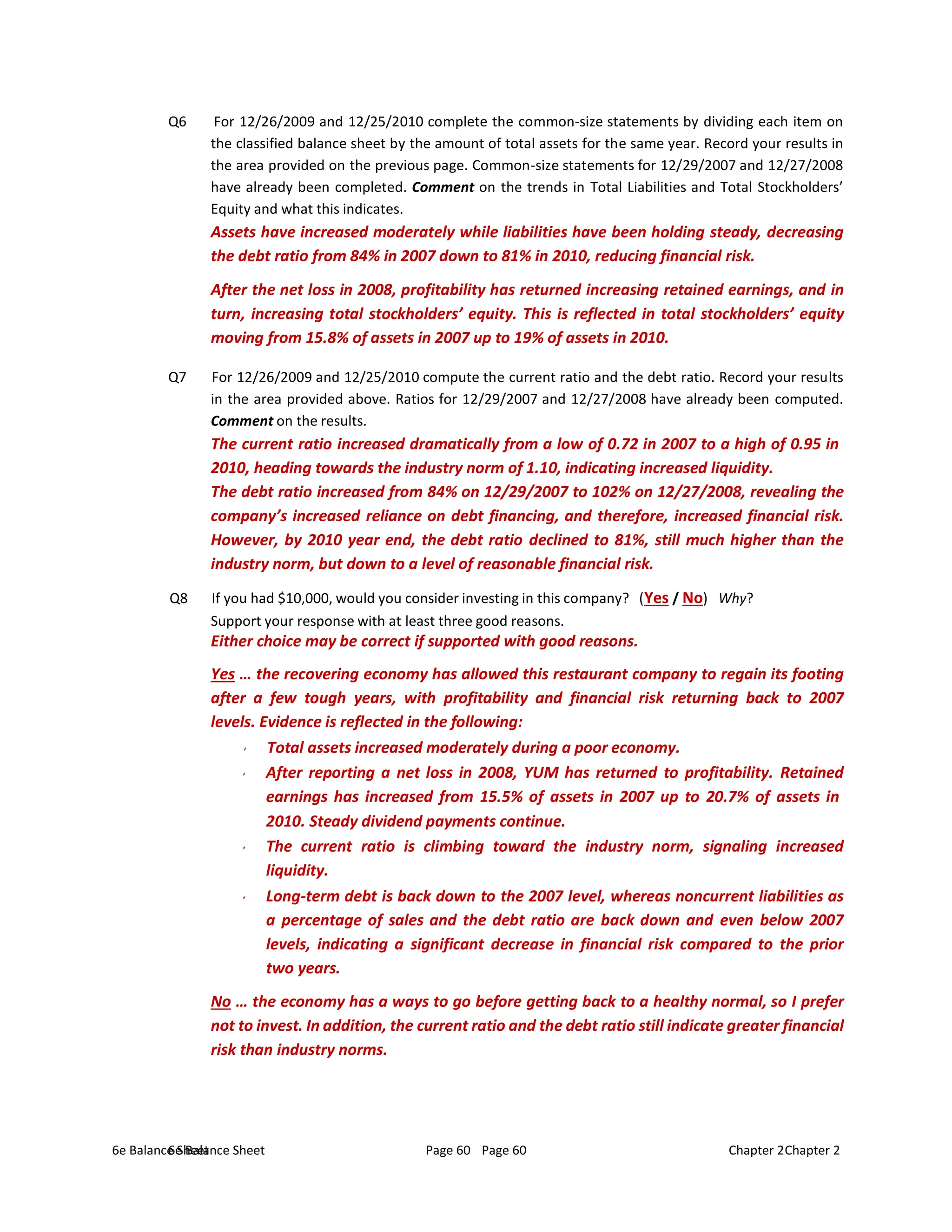
Assets have increased moderately while liabilities have been holding steady, decreasing
the debt ratio from 84% in 2007 down to 81% in 2010, reducing financial risk.
After the net loss in 2008, profitability has returned increasing retained earnings, and in
turn, increasing total stockholders’ equity. This is reflected in total stockholders’ equity
moving from 15.8% of assets in 2007 up to 19% of assets in 2010.
Q7 For 12/26/2009 and 12/25/2010 compute the current ratio and the debt ratio. Record your results
in the area provided above. Ratios for 12/29/2007 and 12/27/2008 have already been computed.
Comment on the results.
The current ratio increased dramatically from a low of 0.72 in 2007 to a high of 0.95 in
2010, heading towards the industry norm of 1.10, indicating increased liquidity.
The debt ratio increased from 84% on 12/29/2007 to 102% on 12/27/2008, revealing the
company’s increased reliance on debt financing, and therefore, increased financial risk.
However, by 2010 year end, the debt ratio declined to 81%, still much higher than the
industry norm, but down to a level of reasonable financial risk.
Q8 If you had $10,000, would you consider investing in this company? (Yes / No) Why?
Support your response with at least three good reasons.
Either choice may be correct if supported with good reasons.
Yes … the recovering economy has allowed this restaurant company to regain its footing
after a few tough years, with profitability and financial risk returning back to 2007
levels. Evidence is reflected in the following:
Total assets increased moderately during a poor economy.
After reporting a net loss in 2008, YUM has returned to profitability. Retained
earnings has increased from 15.5% of assets in 2007 up to 20.7% of assets in
2010. Steady dividend payments continue.
The current ratio is climbing toward the industry norm, signaling increased
liquidity.
Long-term debt is back down to the 2007 level, whereas noncurrent liabilities as
a percentage of sales and the debt ratio are back down and even below 2007
levels, indicating a significant decrease in financial risk compared to the prior
two years.
No … the economy has a ways to go before getting back to a healthy normal, so I prefer
not to invest. In addition, the current ratio and the debt ratio still indicate greater financial
risk than industry norms.
6e Balance Sheet Page 61 Chapter 2
ACTIVITY 21 ANALYSIS OF MCDONALD’S
Purpose: • Understand and interpret amounts reported on the balance sheet.
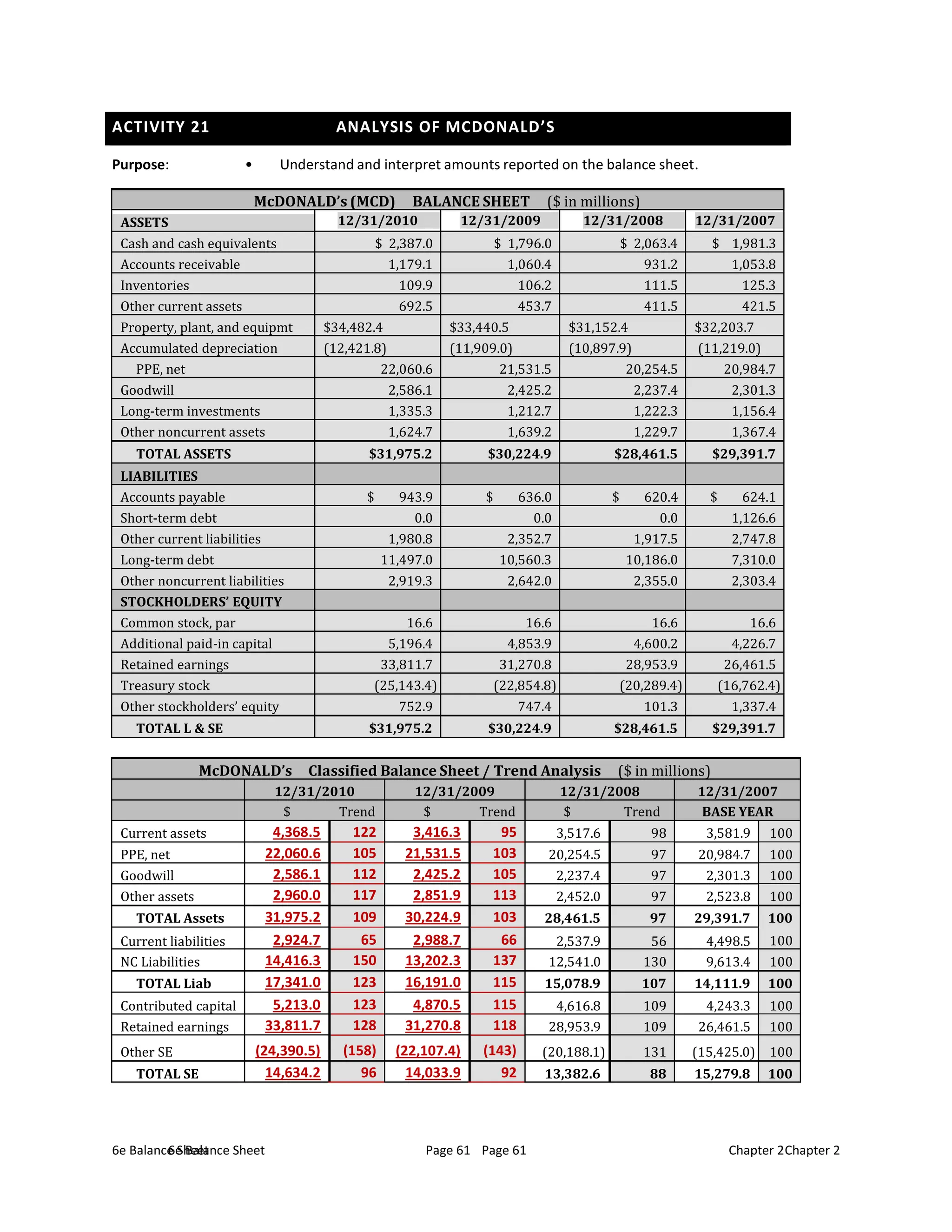
McDONALD’s (MCD) BALANCE SHEET ($ in millions)
ASSETS 12/31/2010 12/31/2009 12/31/2008 12/31/2007
Cash and cash equivalents $ 2,387.0 $ 1,796.0 $ 2,063.4 $ 1,981.3
Accounts receivable 1,179.1 1,060.4 931.2 1,053.8
Inventories 109.9 106.2 111.5 125.3
Other current assets 692.5 453.7 411.5 421.5
Property, plant, and equipmt $34,482.4 $33,440.5 $31,152.4 $32,203.7
Accumulated depreciation (12,421.8) (11,909.0) (10,897.9) (11,219.0)
PPE, net 22,060.6 21,531.5 20,254.5 20,984.7
Goodwill 2,586.1 2,425.2 2,237.4 2,301.3
Long-term investments 1,335.3 1,212.7 1,222.3 1,156.4
Other noncurrent assets 1,624.7 1,639.2 1,229.7 1,367.4
TOTAL ASSETS $31,975.2 $30,224.9 $28,461.5 $29,391.7
LIABILITIES
Accounts payable $ 943.9 $ 636.0 $ 620.4 $ 624.1
Short-term debt 0.0 0.0 0.0 1,126.6
Other current liabilities 1,980.8 2,352.7 1,917.5 2,747.8
Long-term debt 11,497.0 10,560.3 10,186.0 7,310.0
Other noncurrent liabilities 2,919.3 2,642.0 2,355.0 2,303.4
STOCKHOLDERS’ EQUITY
Common stock, par 16.6 16.6 16.6 16.6
Additional paid-in capital 5,196.4 4,853.9 4,600.2 4,226.7
Retained earnings 33,811.7 31,270.8 28,953.9 26,461.5
Treasury stock (25,143.4) (22,854.8) (20,289.4) (16,762.4)
Other stockholders’ equity 752.9 747.4 101.3 1,337.4
TOTAL L & SE $31,975.2 $30,224.9 $28,461.5 $29,391.7
McDONALD’s Classified Balance Sheet / Trend Analysis ($ in millions)
12/31/2010 12/31/2009 12/31/2008 12/31/2007
$ Trend $ Trend $ Trend BASE YEAR
Current assets 4,368.5 122 3,416.3 95 3,517.6 98 3,581.9 100
PPE, net 22,060.6 105 21,531.5 103 20,254.5 97 20,984.7 100
Goodwill 2,586.1 112 2,425.2 105 2,237.4 97 2,301.3 100
Other assets 2,960.0 117 2,851.9 113 2,452.0 97 2,523.8 100
TOTAL Assets 31,975.2 109 30,224.9 103 28,461.5 97 29,391.7 100
Current liabilities 2,924.7 65 2,988.7 66 2,537.9 56 4,498.5 100
NC Liabilities 14,416.3 150 13,202.3 137 12,541.0 130 9,613.4 100
TOTAL Liab 17,341.0 123 16,191.0 115 15,078.9 107 14,111.9 100
Contributed capital 5,213.0 123 4,870.5 115 4,616.8 109 4,243.3 100
Retained earnings 33,811.7 128 31,270.8 118 28,953.9 109 26,461.5 100
Other SE (24,390.5) (158) (22,107.4) (143) (20,188.1) 131 (15,425.0) 100
TOTAL SE 14,634.2 96 14,033.9 92 13,382.6 88 15,279.8 100
6e Balance Sheet Page 62 Chapter 2
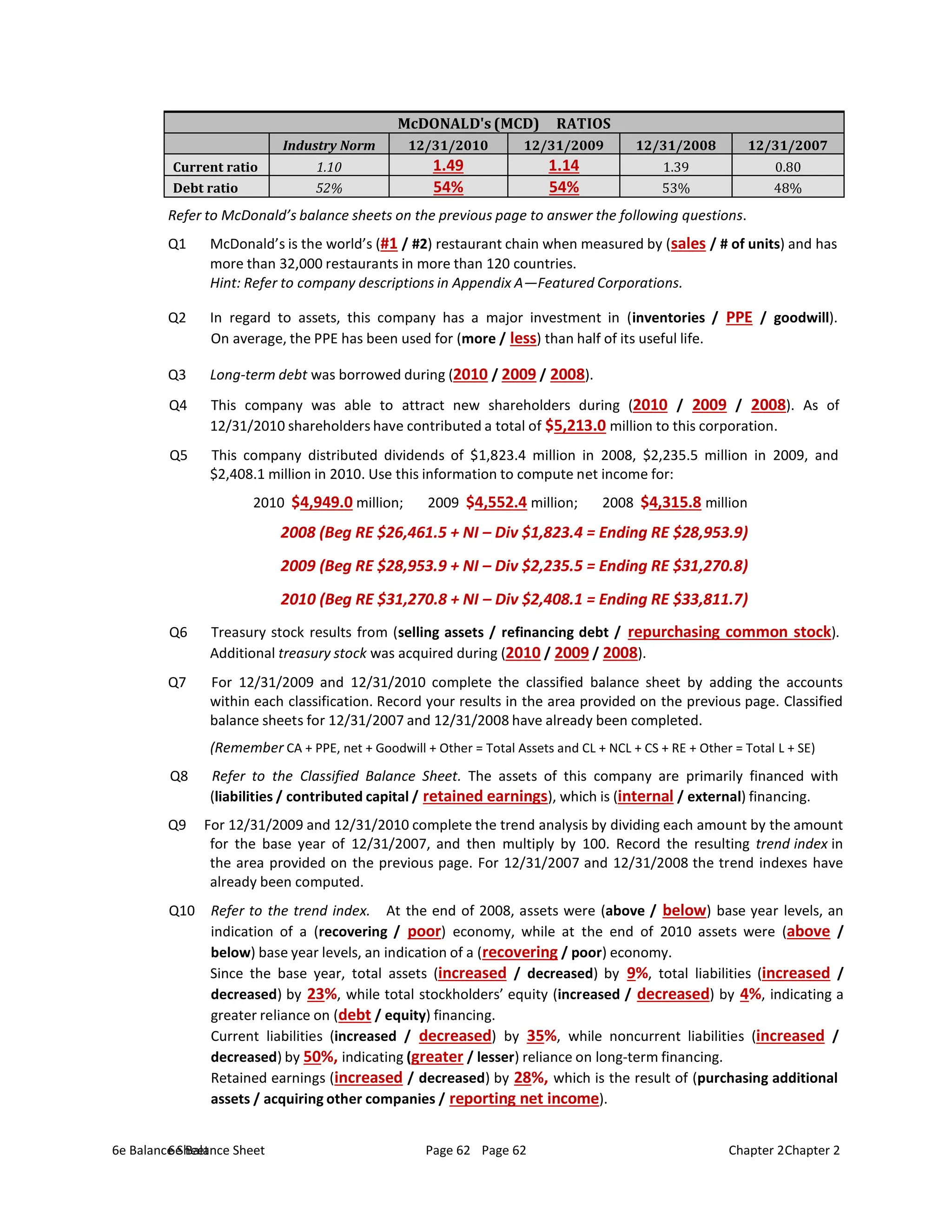
McDONALD's (MCD) RATIOS
Industry Norm 12/31/2010 12/31/2009 12/31/2008 12/31/2007
Current ratio 1.10 1.49 1.14 1.39 0.80
Debt ratio 52% 54% 54% 53% 48%
Refer to McDonald’s balance sheets on the previous page to answer the following questions.
Q1 McDonald’s is the world’s (#1 / #2) restaurant chain when measured by (sales / # of units) and has
more than 32,000 restaurants in more than 120 countries.
Hint: Refer to company descriptions in Appendix A—Featured Corporations.
Q2 In regard to assets, this company has a major investment in (inventories / PPE / goodwill).
On average, the PPE has been used for (more / less) than half of its useful life.
Q3 Long-term debt was borrowed during (2010 / 2009 / 2008).
Q4 This company was able to attract new shareholders during (2010 / 2009 / 2008). As of
12/31/2010 shareholders have contributed a total of $5,213.0 million to this corporation.
Q5 This company distributed dividends of $1,823.4 million in 2008, $2,235.5 million in 2009, and
$2,408.1 million in 2010. Use this information to compute net income for:
2010 $4,949.0 million; 2009 $4,552.4 million; 2008 $4,315.8 million
2008 (Beg RE $26,461.5 + NI – Div $1,823.4 = Ending RE $28,953.9)
2009 (Beg RE $28,953.9 + NI – Div $2,235.5 = Ending RE $31,270.8)
2010 (Beg RE $31,270.8 + NI – Div $2,408.1 = Ending RE $33,811.7)
Q6 Treasury stock results from (selling assets / refinancing debt / repurchasing common stock).
Additional treasury stock was acquired during (2010 / 2009 / 2008).
Q7 For 12/31/2009 and 12/31/2010 complete the classified balance sheet by adding the accounts
within each classification. Record your results in the area provided on the previous page. Classified
balance sheets for 12/31/2007 and 12/31/2008 have already been completed.
(Remember CA + PPE, net + Goodwill + Other = Total Assets and CL + NCL + CS + RE + Other = Total L + SE)
Q8 Refer to the Classified Balance Sheet. The assets of this company are primarily financed with
(liabilities / contributed capital / retained earnings), which is (internal / external) financing.
Q9 For 12/31/2009 and 12/31/2010 complete the trend analysis by dividing each amount by the amount
for the base year of 12/31/2007, and then multiply by 100. Record the resulting trend index in
the area provided on the previous page. For 12/31/2007 and 12/31/2008 the trend indexes have
already been computed.
Q10 Refer to the trend index. At the end of 2008, assets were (above / below) base year levels, an
indication of a (recovering / poor) economy, while at the end of 2010 assets were (above /
below) base year levels, an indication of a (recovering / poor) economy.
Since the base year, total assets (increased / decreased) by 9%, total liabilities (increased /
decreased) by 23%, while total stockholders’ equity (increased / decreased) by 4%, indicating a
greater reliance on (debt / equity) financing.
Current liabilities (increased / decreased) by 35%, while noncurrent liabilities (increased /
decreased) by 50%, indicating (greater / lesser) reliance on long-term financing.
Retained earnings (increased / decreased) by 28%, which is the result of (purchasing additional
assets / acquiring other companies / reporting net income).
6e Balance Sheet Page 63 Chapter 2
Q11 For 12/31/2009 and 12/31/2010 compute the current ratio and the debt ratio. Record your results
in the area provided above. Ratios for 12/31/2007 and 12/31/2008 have already been computed.
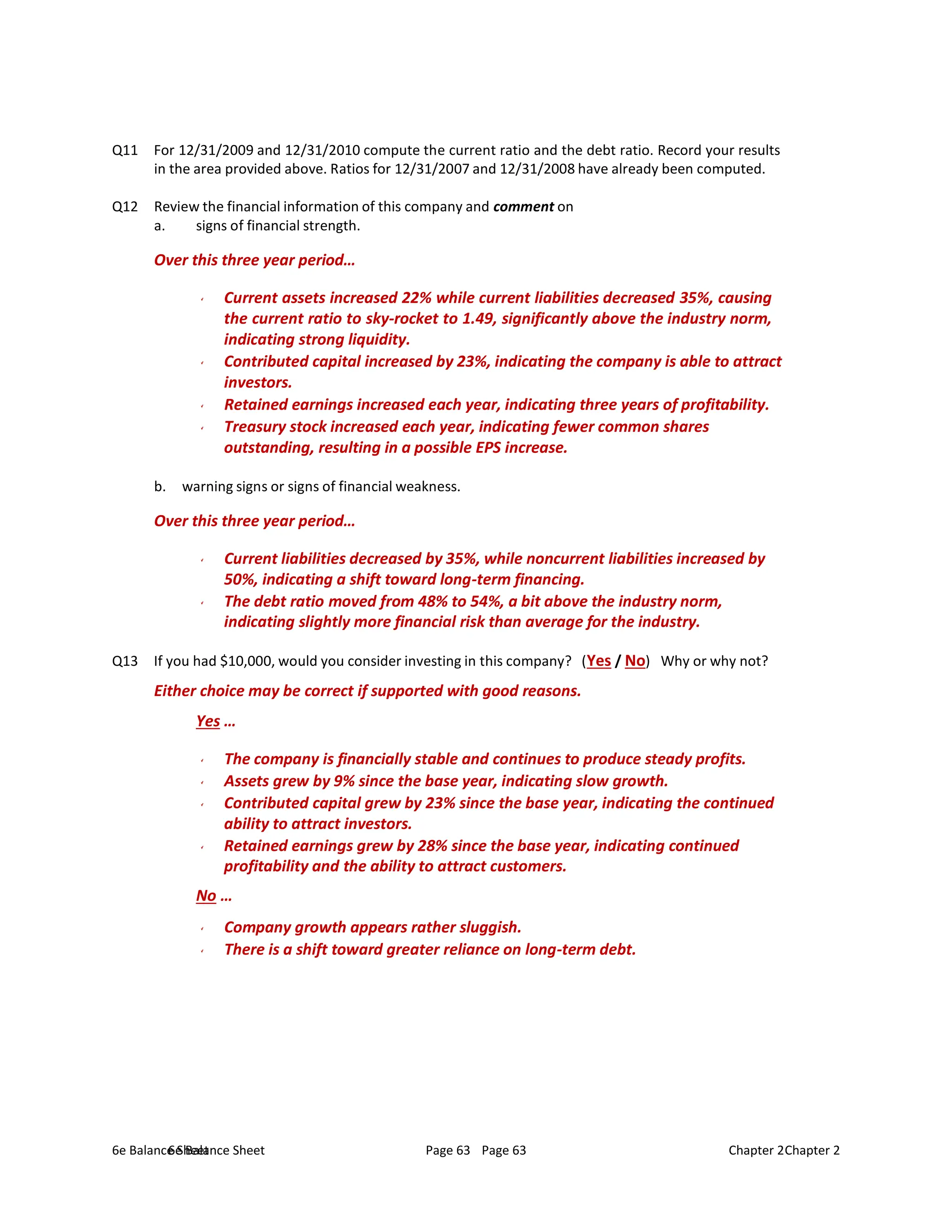
Q12 Review the financial information of this company and comment on
a. signs of financial strength.
Over this three year period…
Current assets increased 22% while current liabilities decreased 35%, causing
the current ratio to sky-rocket to 1.49, significantly above the industry norm,
indicating strong liquidity.
Contributed capital increased by 23%, indicating the company is able to attract
investors.
Retained earnings increased each year, indicating three years of profitability.
Treasury stock increased each year, indicating fewer common shares
outstanding, resulting in a possible EPS increase.
b. warning signs or signs of financial weakness.
Over this three year period…
Current liabilities decreased by 35%, while noncurrent liabilities increased by
50%, indicating a shift toward long-term financing.
The debt ratio moved from 48% to 54%, a bit above the industry norm,
indicating slightly more financial risk than average for the industry.
Q13 If you had $10,000, would you consider investing in this company? (Yes / No) Why or why not?
Either choice may be correct if supported with good reasons.
Yes …
The company is financially stable and continues to produce steady profits.
Assets grew by 9% since the base year, indicating slow growth.
Contributed capital grew by 23% since the base year, indicating the continued
ability to attract investors.
Retained earnings grew by 28% since the base year, indicating continued
profitability and the ability to attract customers.
No …
Company growth appears rather sluggish.
There is a shift toward greater reliance on long-term debt.
6e Balance Sheet Page 64 Chapter 2
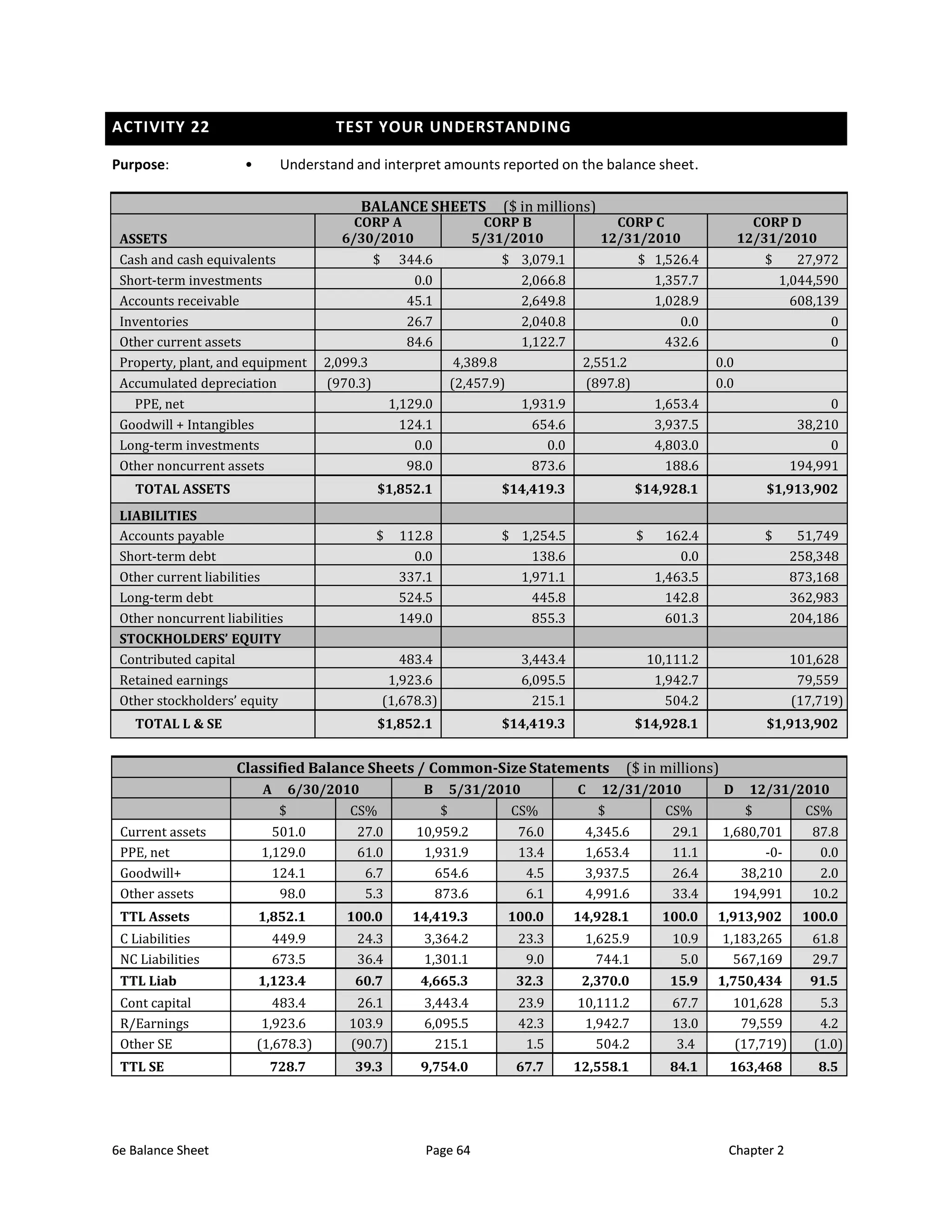
ACTIVITY 22 TEST YOUR UNDERSTANDING
Purpose: • Understand and interpret amounts reported on the balance sheet.
BALANCE SHEETS ($ in millions)
ASSETS
CORP A CORP B CORP C CORP D
6/30/2010 5/31/2010 12/31/2010 12/31/2010
Cash and cash equivalents $ 344.6 $ 3,079.1 $ 1,526.4 $ 27,972
Short-term investments 0.0 2,066.8 1,357.7 1,044,590
Accounts receivable 45.1 2,649.8 1,028.9 608,139
Inventories 26.7 2,040.8 0.0 0
Other current assets 84.6 1,122.7 432.6 0
Property, plant, and equipment 2,099.3 4,389.8 2,551.2 0.0
Accumulated depreciation (970.3) (2,457.9) (897.8) 0.0
PPE, net 1,129.0 1,931.9 1,653.4 0
Goodwill + Intangibles 124.1 654.6 3,937.5 38,210
Long-term investments 0.0 0.0 4,803.0 0
Other noncurrent assets 98.0 873.6 188.6 194,991
TOTAL ASSETS $1,852.1 $14,419.3 $14,928.1 $1,913,902
LIABILITIES
Accounts payable $ 112.8 $ 1,254.5 $ 162.4 $ 51,749
Short-term debt 0.0 138.6 0.0 258,348
Other current liabilities 337.1 1,971.1 1,463.5 873,168
Long-term debt 524.5 445.8 142.8 362,983
Other noncurrent liabilities 149.0 855.3 601.3 204,186
STOCKHOLDERS’ EQUITY
Contributed capital 483.4 3,443.4 10,111.2 101,628
Retained earnings 1,923.6 6,095.5 1,942.7 79,559
Other stockholders’ equity (1,678.3) 215.1 504.2 (17,719)
TOTAL L & SE $1,852.1 $14,419.3 $14,928.1 $1,913,902
Classified Balance Sheets / Common-Size Statements ($ in millions)
A 6/30/2010 B 5/31/2010 C 12/31/2010 D 12/31/2010
$ CS% $ CS% $ CS% $ CS%
Current assets 501.0 27.0 10,959.2 76.0 4,345.6 29.1 1,680,701 87.8
PPE, net 1,129.0 61.0 1,931.9 13.4 1,653.4 11.1 -0- 0.0
Goodwill+ 124.1 6.7 654.6 4.5 3,937.5 26.4 38,210 2.0
Other assets 98.0 5.3 873.6 6.1 4,991.6 33.4 194,991 10.2
TTL Assets 1,852.1 100.0 14,419.3 100.0 14,928.1 100.0 1,913,902 100.0
C Liabilities 449.9 24.3 3,364.2 23.3 1,625.9 10.9 1,183,265 61.8
NC Liabilities 673.5 36.4 1,301.1 9.0 744.1 5.0 567,169 29.7
TTL Liab 1,123.4 60.7 4,665.3 32.3 2,370.0 15.9 1,750,434 91.5
Cont capital 483.4 26.1 3,443.4 23.9 10,111.2 67.7 101,628 5.3
R/Earnings 1,923.6 103.9 6,095.5 42.3 1,942.7 13.0 79,559 4.2
Other SE (1,678.3) (90.7) 215.1 1.5 504.2 3.4 (17,719) (1.0)
TTL SE 728.7 39.3 9,754.0 67.7 12,558.1 84.1 163,468 8.5
6e Balance Sheet Page 65 Chapter 2
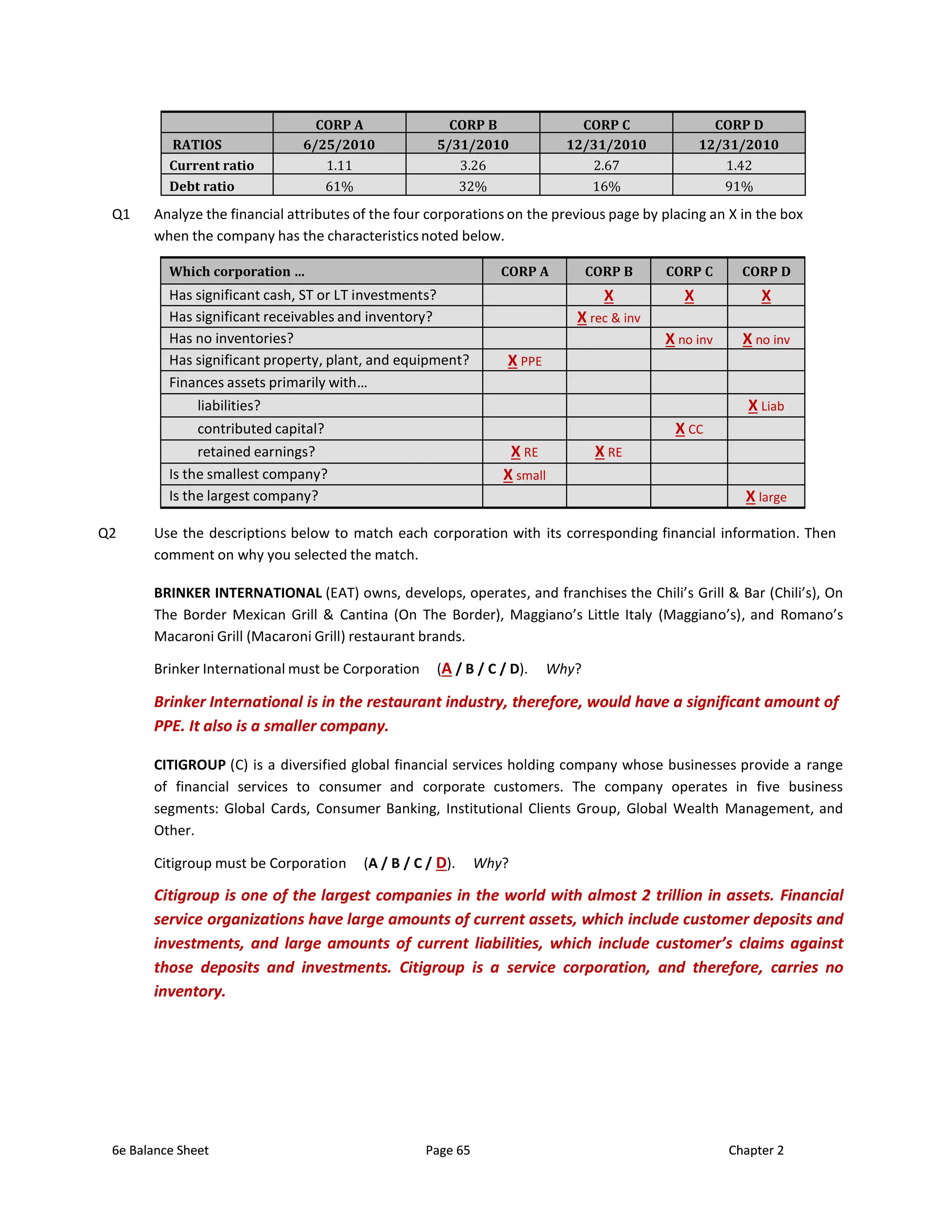
CORP A CORP B CORP C CORP D
RATIOS 6/25/2010 5/31/2010 12/31/2010 12/31/2010
Current ratio 1.11 3.26 2.67 1.42
Debt ratio 61% 32% 16% 91%
Q1 Analyze the financial attributes of the four corporations on the previous page by placing an X in the box
when the company has the characteristics noted below.
Which corporation … CORP A CORP B CORP C CORP D
Has significant cash, ST or LT investments? X X X
Has significant receivables and inventory? X rec & inv
Has no inventories? X no inv X no inv
Has significant property, plant, and equipment? X PPE
Finances assets primarily with…
liabilities? X Liab
contributed capital? X CC
retained earnings? X RE X RE
Is the smallest company? X small
Is the largest company? X large
Q2 Use the descriptions below to match each corporation with its corresponding financial information. Then
comment on why you selected the match.
BRINKER INTERNATIONAL (EAT) owns, develops, operates, and franchises the Chili’s Grill & Bar (Chili’s), On
The Border Mexican Grill & Cantina (On The Border), Maggiano’s Little Italy (Maggiano’s), and Romano’s
Macaroni Grill (Macaroni Grill) restaurant brands.
Brinker International must be Corporation (A / B / C / D). Why?
Brinker International is in the restaurant industry, therefore, would have a significant amount of
PPE. It also is a smaller company.
CITIGROUP (C) is a diversified global financial services holding company whose businesses provide a range
of financial services to consumer and corporate customers. The company operates in five business
segments: Global Cards, Consumer Banking, Institutional Clients Group, Global Wealth Management, and
Other.
Citigroup must be Corporation (A / B / C / D). Why?
Citigroup is one of the largest companies in the world with almost 2 trillion in assets. Financial
service organizations have large amounts of current assets, which include customer deposits and
investments, and large amounts of current liabilities, which include customer’s claims against
those deposits and investments. Citigroup is a service corporation, and therefore, carries no
inventory.
6e Balance Sheet Page 66 Chapter 2
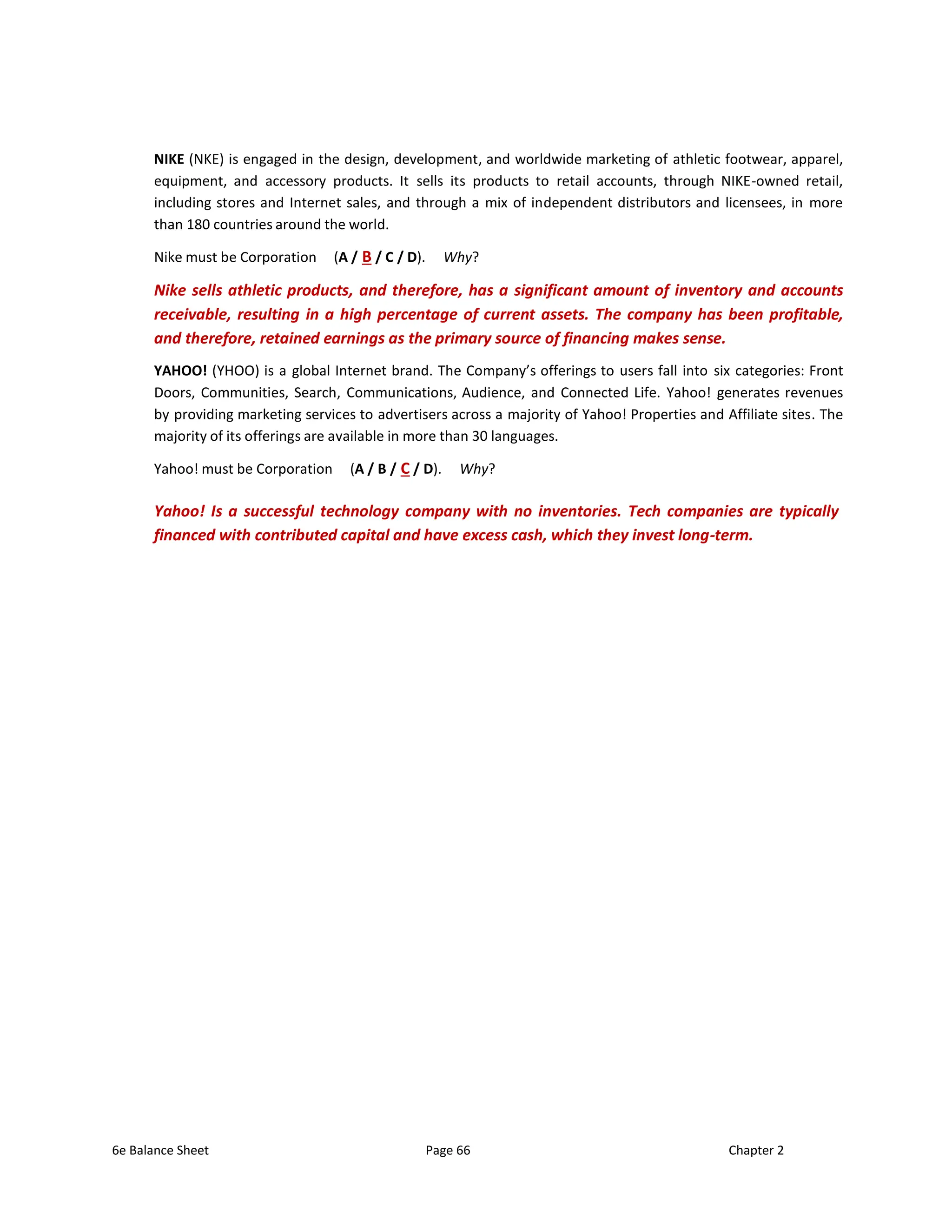
NIKE (NKE) is engaged in the design, development, and worldwide marketing of athletic footwear, apparel,
equipment, and accessory products. It sells its products to retail accounts, through NIKE-owned retail,
including stores and Internet sales, and through a mix of independent distributors and licensees, in more
than 180 countries around the world.
Nike must be Corporation (A / B / C / D). Why?
Nike sells athletic products, and therefore, has a significant amount of inventory and accounts
receivable, resulting in a high percentage of current assets. The company has been profitable,
and therefore, retained earnings as the primary source of financing makes sense.
YAHOO! (YHOO) is a global Internet brand. The Company’s offerings to users fall into six categories: Front
Doors, Communities, Search, Communications, Audience, and Connected Life. Yahoo! generates revenues
by providing marketing services to advertisers across a majority of Yahoo! Properties and Affiliate sites. The
majority of its offerings are available in more than 30 languages.
Yahoo! must be Corporation (A / B / C / D). Why?
Yahoo! Is a successful technology company with no inventories. Tech companies are typically
financed with contributed capital and have excess cash, which they invest long-term.
Other documents randomly have
different content
“Yes, here he comes!” cried Dave. “He’s been to the stern,
rounded it, and here he comes up alongside like the wind. He’s
trying to pass us!”
“But he never will,” spoke Mr. King. “Here goes for the final test.
Perhaps it’s foolish to use our greatest speed on a new motor before
it’s been warmed up and run longer than this has, but we might as
well know first as last just what the Albatross will do. Now for the
test!”
He pressed a button that communicated with the motor room, and
there came such a vibration to the craft that one and all, who were
not aware of the reserve power, looked at one another in some
alarm.
“How about it, Dave?” inquired Mr. King. “Are we holding our
own?”
“Yes! Yes!” eagerly answered the young aviator. “The gull is
straining every wing feather, but he’s falling back. Look, no he’s even
with us now! He’s going ahead—see—see!”
Was the Albatross, after all, to be beaten?
The gull was now flying alongside in such a position as to be
visible to all. Clearly the bird was exerting every last ounce of
strength. Its wings were wildly beating the air, and its slender head
and hooked bill were stretched out like the prow of some slave-
galley—cutting the air.
“It’s falling back—it’s falling back—we win!” cried Dave exultantly.
It was so. The gull, unable to keep up the terrific speed, was
losing ground. The airship kept on, its awful power forcing it
forward. Foot by foot the bird fell back until like some express train
passing a slow freight, the Albatross shot ahead of the weary bird,
and the creature, as if humiliated by the test, folded its wings and
dropped downward like a shot, in order to rest. Then spreading wide
its pinions again, it floated in the air, far below the rival craft.
“We sure did go!” cried Dave in triumph, as some of the terrific
power was cut down. “But what was it you said you wanted to do,
Mr. Dale—something that the sight of the gull reminded you about?”
“Oh, yes. Well, it’s nothing more or less than to release a carrier
pigeon I have on board.”
“A carrier pigeon?” cried several.
“Yes, a friend of mine, who is interested in aeronautics, and who
published a magazine about them, asked me to do this for him. He
gave me a carrier pigeon a few days ago, and requested me to
release it on our trial trip. I said I would, and now I am going to
send him a message of our success. The bird will fly directly to his
coop, and later, when I give him the time we liberated it, and he
notes the time of arrival, he can figure the speed.”
“Good!” cried Dave. “Where is the pigeon?”
It was brought out in the basket where it had been held captive,
and Mr. Dale, who understood such matters, prepared a short
message on thin paper. The paper was put in a quill, sealed at both
ends, and then tied by silk thread to one of the pigeon’s wings.
The bird was taken to the deck of the craft and liberated. It
soared high in the air, circled about once or twice and, then even in
that void, seeming to get its bearings, it darted off to the south.
“Later we will learn how my friend received the message,” said Mr.
Dale. “And now I think we had better change our course.”
The Albatross lined the coast a few miles to the interior. Until dusk
Dave and the others viewed a constantly changing panorama. Then
there was supper, a bountiful meal, well prepared, and immensely
relished by all hands.
After that lights were set, the big headlights, front and rear,
sending out far-reaching shafts of radiance that must have appeared
to uninitiated landsmen as streaming meteors.
Mr. King was in the cabin when the electric call bell took him to
the speaking tube. He dropped it as if some important message
called him instantly to the pilot room.
His manner and face indicated to the young aviator that whatever
message he had received had urged him to seriousness and haste.
“Something’s up; eh, Dave?” shot out Hiram, as the airman
hurried from the cabin.
“It looks that way,” assented Dave. “I wonder what?”
CHAPTER XII
ADRIFT IN THE STORM
The two young aviators, alive to every motion of the Albatross and
the movements of its operators, sat together on one of the
observation benches.
“I don’t see any change in our course,” remarked Hiram, glancing
from the window.
“Neither do I,” said Dave. “There’s a flash, though.”
“Yes, I saw it,” spoke Hiram, quickly. “Lightning, wasn’t it?”
“I think so. In fact, I am sure of it. Yes, it has all clouded up.”
“And a wind coming,” added Hiram. “What is it, Mr. Grimshaw?” he
questioned, as there was a ring at the tube hook.
“Orders to close everything up fast and tight,” reported the
veteran aeronaut.
“Then there’s a storm coming, sure enough,” said Hiram.
Even before they had all the windows closed a change of
atmosphere was noticeable. A blast of wind roared around the giant
airship.
“Of course, this isn’t serious,” observed Hiram.
“Oh, I think not,” rejoined the young aviator.
“If the Albatross can’t weather a little land zephyr, she’s no good
over the ocean.”
“Mr. King is simply taking all precautions,” said Dave.
“Whew! did you feel that!”
There was a whirl that made the young airmen think of their past
experience in striking an air pocket when aboard their monoplane.
Bang! went a pitcher of water from the table in the center of the
cabin.
“We’re tipping,” exclaimed Hiram.
“Yes, upwards,” said Grimshaw.
“Trying to strike a calmer upper current, I fancy,” suggested Mr.
Dale.
Hiram made his way to a window and tried to peer out. The rain
was beating in rattling dashes against the thick panes.
“Say,” he reported, “if you want to see a sea of black ink, come
here.”
“I call it a blaze of dazzling light,” submitted Grimshaw, as there
was a vivid flash of lightning, followed by a tremendous crack of
thunder.
“It’s all below us now,” reported Hiram, a few minutes later.
“We must be above the storm cloud, then,” said Grimshaw.
“There’s some wind yet, I’m thinking,” observed Mr. Dale.
There came a signal from the tube bell just then. Grimshaw being
nearest, took up the tube and received the message.
“You, Dashaway,” he spoke in his quick, laconic way.
“From Mr. King?”
“Yes.”
“All right.”
The young aviator left the cabin at once. All over the hull of the
great airship was an electric light system. The lamps were placed at
intervals along the passages, and Dave found no difficulty in
threading them. He arrived at the pilot room to find Mr. King at the
glass table and Professor Leblance holding his hand out through a
small porthole, the inside glass shield of which was thrown back.
The airman looked serious and occupied with the various buttons
on the table. The Frenchman’s face wore a somewhat anxious look.
He drew in his arm. As he did so Dave observed that his hand held
a little meteorological instrument he had noticed before. It was a
barometric contrivance. The professor held it up to the light and
scanned its surface closely.
“It won’t do at all,” he announced. “The index is not broad enough
to give exact conditions.”
“There is the aerometer, Professor,” suggested Mr. King.
“Did I not tell you I found one of its tubes shattered? Such
carelessness! I would no more start across the ocean without a
perfect instrument than without food.”
“Then it’s a stop?”
“Somewhere.”
“And a descent?”
“Of course.”
“When, and where?”
Professor Leblance indulged in his accustomed shrug of the
shoulders.
“I dare not descend, not knowing the exact conditions below, as I
stated. We are on a fair level.”
“Then why not continue till the situation clears?”
“We can only run one way.”
“Yes, with the storm, but we are not leaving the coast line to any
appreciable degree.”
“That is true, but we may get too far south.”
“Oh, we can soon make that up. We will have to land near some
large city, I suppose, to get what you want.”
“Not necessarily,” replied the Frenchman. “All I need is some
quicksilver. I have plenty of surplus tubes.”
“Well, what is the programme?”
“Straight ahead, watching the wind gauge and the grade guide.”
“Very good.”
“I will go to the engine room.”
“Come here, Dashaway,” ordered the expert airman.
His junior assistant was prompt to gain the side of his superior.
“You understand the guide?” inquired Mr. King.
“It is on the same principle as the aeroplane apparatus?”
“Yes.”
“Then—perfectly,” assented Dave.
“Watch it closely for variations, and the wind record. If the mirror
shows a deviation past the fifteen mark, notify me.”
“And the wind?”
“Over fifty miles an hour is dangerous.”
“And we will have to descend?”
“Or ascend, that’s it.”
Dave seated himself in a chair at one end of the table. The guide,
a delicately adjusted instrument, recorded every variation in the
progress of the airship. The wind gauge was connected by wires
with a vane on top of the gas bag.
Dave turned to his duty with interest and carefulness. His
monoplane experience stood him in good stead. He felt a great deal
of satisfaction in realizing that he was actually sharing in operating
the Albatross, and in addition to that learning something practical
and of value.
Inside of five minutes he had mastered the requirements of the
occasion and was working in entire harmony with the airman.
For over three hours the Albatross was kept on as perfectly
straight a course as could be mapped out.
“We seem to have encountered a heavy southwest storm of great
extent,” Mr. King told him.
“Have we got to pass over its entire length before we land?” asked
the young aviator.
“Professor Leblance thinks that plan best,” replied Mr. King.
It must have been nearly midnight when the Frenchman came
back from the engine room.
“Superb!” was his first commendatory word. “The Albatross does
not seem to have strained a seam. I must congratulate you both.”
The airman smiled pleasantly at this praise and Dave bowed
modestly. The professor again took the barometric readings.
“I think we have hit the tail of the wind,” he announced a few
minutes later. “As soon as we are sure of it, we will make a descent.”
“What’s that?” suddenly called out the young aviator.
Boom! A great shock traversed the airship!
Boom—boom—twice in succession there followed a muffled bang,
and it was apparent that the sounds were caused by some trouble in
the airship.
Professor Leblance rushed from the room.
CHAPTER XIII
A FIRST LANDING
The young aviator was not unused to “thrills” in his professional
experience. He noted no deviation in the straight progress of the
Albatross. Mr. King did not distract attention from the signal plate.
Still Dave awaited some explanation of the detonation with curiosity
and anxiety.
“It’s all right,” reported Professor Leblance, reappearing a few
minutes later.
“Explosions?” questioned the airman, simply.
“Yes. Three of the balloonets blew up.”
“Which means?”
“Nothing,” replied the Frenchman, with his accustomed shrug of
the shoulders. “We must have struck a warm current. Ah, yes, that is
true,” he added, as he made the thermometer test. “You see, the
sudden transition from cold caused an expansion and affected the
balloonets.”
“Does that weaken the lifting force, Professor?” inquired Dave.
“Not perceptibly. I count on such accidents, more or less. I can
duplicate the balloonets, and as to the gas—we have arranged for all
necessary replenishment in that direction. Mr. King, everything is
favorable for a descent.”
“All right,” replied the airman. “Have you any idea where we are?”
“I should say, south of Washington.”
“In Virginia, then?”
“Or still farther south. I have measured the distance covered since
our start, but I do not know how far we are inland.”
Mr. King left Dave in charge of the signal table for a few moments.
He went to the lookout, meantime instructing the young aviator as
to what buttons he should operate. This brought the Albatross on a
lateral slant. The enormous headlight at the prow of the airship cast
a glow far below. Mr. King was able to trace outlines on the
landscape. He returned to the pilot table, and following his directions
there were many changes made in the course of the giant airship
during the next half hour.
Once more the aviator consulted the lookout. Then, back again at
his post, he ordered a slow-up and a gentle, gradual drop.
“Landed,” breathed Dave at last, intensely interested in all the
gentle and natural movements of the descent.
“Yes, and that was certainly easy,” replied his patron, with a sigh
of relief and satisfaction “The professor understands his business.”
The Frenchman soon appeared, followed by two of his assistants.
The aviator and Dave accompanied him to the cabin.
“You people had better go to bed,” he directed all hands. “My men
will attend to securing the machine safe and sound. We can do
nothing now until morning.”
This order was obeyed. Dave and Hiram had what might be called
a stateroom to themselves. It was narrow, but cozy. It had a window
opening, and there the young aviator posted himself for some time.
By the aid of the headlights Dave could make out Leblance and his
men securing the Albatross. The craft seemed to have landed on flat
land rather bare of verdure and with no trees.
“An ideal spot for landing,” Dave reported to his comrade.
“Yes, but where are we?” questioned Hiram.
“In some wild mountain district, I should say,” responded Dave
—“maybe Virginia, maybe North Carolina.”
“Well, it has been a dandy cruise,” declared Hiram. “Say, I’ve gone
through so much excitement I don’t believe I can sleep a wink.”
“Try it, anyhow,” recommended Dave. “There may be a lot to do in
the morning, and we want to be rested and strong to take our share
in it.”
How long he rested Dave Dashaway did not know, but he was
suddenly awakened by feeling the Albatross moving. At first he
imagined that he must be dreaming, for certainly he did not think
they would start off again after making a landing with such trouble.
“But she sure is moving,” decided the lad, “though not in the air, if
my senses are good for anything. That is unless we’re bumping
along a cloud bank.”
He sat up in his berth, and could make out a dim light in the room
beyond. He listened and heard Hiram breathing heavily.
“He’s fast asleep, anyhow,” decided the young aviator. “It takes a
good deal to disturb him. But we sure are moving. I wonder——?”
Such a strange thought came to him that he hesitated to put it
into form. But he decided to reason it out.
“Can it be?” he mused, “that I have slept through a whole night
and day without knowing it, and that we are on the move again. Can
anything have happened—to me—or the others? Have—I been
unconscious—hurt—and not have known what has happened? It
doesn’t seem possible, and yet——”
His self-communing was interrupted by a more violent motion of
the airship. It seemed to careen to one side, and then right itself.
Dave found himself clutching the sides of his bunk. Then came a
period of calm.
“I’m going to wake Hiram up,” decided Dave. “He may not like it,
but I want to talk to some one about this, and if he gets mad, in
case it isn’t anything, he can easily get to sleep again. And that’s
what I won’t do unless I find out what’s going on.”
Dave cautiously got out of bed. As he did so he again felt the lurch
of the big craft. At the same time he heard a voice speaking softly
outside.
“By hickory!” came the tones. “I don’t seem to be movin’ th’ ole
shebang much. Guess I’ll hev t’ go git another mule critter or two t’
snake it away. Whoa there!”
“What in the name of sweet spirits of nitre is going on?”
murmured Dave. “Is some one trying to steal the Albatross?”
He crossed softly to look out of one of the windows, but could see
nothing. The big headlights had been extinguished, and, save for
some few incandescents here and there, which were only dimly
glowing there was no illumination inside the ship. It had been
decided to make it dark so all hands would sleep better.
“This is sure mysterious,” went on Dave. “I can’t see anything, but
I can hear, and I can—feel!” he added a moment later, for again the
craft moved slightly.
Once more the young aviator peered out, but he could discern
nothing. The night was very black.
“If I thought——” he began, when a sleepy voice from the
adjoining berth inquired:
“Whatsmatter, Dave? Time f’r brkfust?”
“Hiram! Hiram!” whispered Dave shrilly. “Wake up! Something has
happened—it’s happening now!”
Instantly Hiram sat upright in his bed. He was rather a slow chap,
but on occasions could move lively.
“What is it?” he inquired in a low voice. “Burglars in here, Dave?”
“I don’t know. Maybe it is and maybe it isn’t. Anyhow, I don’t think
they’re in yet.”
“All right, then; wait until they do get in an’ we’ll nab ’em. Lay
low!”
“That’s just what I don’t want to do,” replied Dave. “Something
may happen unless we get busy. They may even get away with the
Albatross.”
“Get away with the Albatross?” cried Hiram. “What are you talking
about, Dave? How can they——?”
But he did not finish his sentence. At that moment there came
another lurch to the craft, and it moved several feet.
“There!” hoarsely whispered Dave. “What did I tell you?”
“Are we going up—a night flight?” asked Hiram.
“I don’t know. I was awakened by the movement, and it’s been
going on ever since. Someone is outside, that’s sure. Listen now!”
There was silence for a moment, and then a cautious voice could
be heard saying:
“I suah will have t’ done go an’ git another mule critter t’ move
this contraption. An’ I ain’t got no mo’ of my own. I’ll have to borrow
one off Nate Jackson, an’ then he’ll want me t’ whack up with him.
Wa’al, there ain’t no help, fer as I kin see!”
“There!” exclaimed Dave in triumph.
“It sure is strange,” said Hiram. “I guess we’d better wake up the
others. Mr. King and Mr. Dale ought to know about this.”
But there was no need for the boys to awaken their companions.
The next moment there came such a violent motion to the ship that
not a sleeper continued to slumber. With one accord they tumbled
out of their berths.
Then from without came a chorus of excited shouts.
“Whoa, there! Consarn ye all, what d’ ye mean by backin’ and
fillin’ that a-way? Stand still, pesky mule critters that ye be! Ye
wouldn’t pull this shebang when I wanted ye to, an’ now ye’re tryin’
t’ run away with it. Whoa!”
“Who’s there?” cried Mr. King.
“What is going on?” demanded Mr. Dale.
“Something has happened!” shouted Professor Leblance.
“That’s right!” agreed Dave, “and it’s going on now.”
“Someone is trying to make off with the airship,” added Hiram.
“Make off with the airship!” repeated the professor. “Can it be——”
He did not finish, but in a moment he had switched on a number
of lights, including the two big ones outside the craft. Then, as they
looked from the windows, they saw a strange sight.
An unkempt man, with a team of sorry-looking mules, had
fastened a rope to the Albatross and was evidently trying to drag it
away. He started back in alarm at the sudden illumination, and
hastily began taking off the rope.
“Here! What are you trying to do?” cried Mr. King, through an
open window.
“Good land! Is there folks in this shebang!” asked the
mountaineer. “Land a’massy! I thought it was a balloon that had
come down.”
“And you were going to haul it away and claim a reward, I
suppose,” put in the professor, beginning to understand the
situation.
“That’s what I was, stranger” came the answer. “But my mules
wa’n’t strong enough. I was goin’ arter another pair when yo’-all
turned up your kerosene lamps. She wouldn’t hardly budge.”
“I should say not, with the way she is fastened,” said the
Frenchman. “But explain yourself, monsieur.”
“That ain’t my name, but it don’t much matter,” came the answer.
“I was on my way home from th’ settlement, with a load of stuff t’
keep my wife an’ kids in bacon an’ flour, when I seen ye come down
last evenin’. I once went t’ a county fair, an’ they had a balloon
assent. Th’ perfesser offered five dollars t’ whoever’d git his balloon
arter he jumped out of it, an’ she drifted away.”
“Nate Jackson was th’ lucky man, an’ he found th’ balloon in Black
Cedar swamp. He hauled it t’ town an’ got his five. When I seen this
contraption come down, I just laid low, aimin’ t’ git th’ reward. I
s’posed you folks would all go home until mornin’ anyhow. But ye
didn’t. I onhitched my mules arter dark, an’ got a rope from my
wagon, an’ tried t’ haul th’ balloon away. But she wouldn’t haul. I’m
mighty sorry if I disturbed ye’ an’ I’ll travel on now. This is th’ most
forsaken country I ever knowed, an’ it’s hard t’ git money. I thought
I saw an easy way t’ make a five dollar bill.”
“It’s worth more than that to have our airship let alone, my man,”
said the professor. “This is the kind of a balloon you never saw
before. Here are ten dollars for the wife and little ones,” and he
passed over a bill.
The man was overwhelmingly grateful and apologized again for
the trouble he had caused. A hasty examination showed that he had
not damaged the craft any by his pulling and hauling, and a little
later he had disappeared in the darkness with his “mule critters,” and
soon the rumble of his wagon over the road, that was hardly more
than a trail, came fainter and fainter to the ears of the aviators.
“Well, that sure was a scare!” exclaimed Dave, when quiet was
once more restored.
“I should say yes!” agreed Hiram. “The idea of trying to cart off
the Albatross!”
“Well, his explanation was natural,” said the professor. “These
mountaineers, in this lonely region, scarcely ever see money, I
guess. But now, boys, get to bed. We’ve got lots to do to-morrow.”
Everyone again retired after the lights had again been turned low,
and Dave and Hiram were soon asleep again. It was two hours after
daylight when Grimshaw routed them out of their berths.
“Come, get up here,” he ordered; “if you don’t want to miss
breakfast.”
“I certainly don’t,” announced the active Hiram. “I’m hungry as a
bear.”
“Well, there’s a capital meal waiting for you,” observed the old
aeronaut.
The boys found this true as they came in at second table in the
cabin. They hurried through with the meal, for outside on the
ground Mr. King and the others were assembled. From their actions
the young aviator concluded that some active discussion was in
progress.
Exit from the cabin was made through a trap door and a balancing
ladder.
“Hurrah!” piped Hiram, as he reached the ground. “Here’s a
chance to stretch our legs and breathe some fresh air.”
“Let’s see what is going on with the others,” suggested Dave, and
they approached the group made up of Professor Leblance, Mr. King,
Grimshaw and Mr. Dale.
“We are evidently in some remote spot,” the Frenchman was
saying. “All the better that, for we shall have no troublesome
visitors. My men can attend to the balloonet and some other needful
repairs while we send for that quicksilver.”
“Which means the location of the nearest town?” submitted the
airman. “There was so much excitement last night I forgot to ask
that old mountaineer. But we must locate a store.”
“Exactly.”
“And that may be somewhat difficult.”
“Perhaps,” agreed the Frenchman, “but once down in the valley
yonder it is to be supposed there are some tokens of civilization.”
“Who is to go?” inquired Mr. Dale.
“I think you had better entrust the matter to me, Professor,” said
the aviator. “Here, let one of the boys—you, Dashaway—go with
me.”
“I shall be glad,” said Dave, eagerly.
“Hold on,” broke in Hiram; “give me a show too; won’t you, Mr.
King?”
The aviator took a brief look at the earnest, beseeching face of
the willing and accommodating young aeronaut, and smiled
indulgently.
“Well, you two make a hardy, useful team, so make it so, if you
like.”
Arrangements were made for the departure at once. It was
understood that the Albatross would remain at its present landing
place until the exploring party returned with the quicksilver, even if
they had to consume considerable time in locating a town.
“I think we can make it and return by nightfall,” said the airman.
“Don’t worry, though, if we are longer away.”
“No,” spoke the professor. “We can’t leave till we get that
quicksilver, no matter how long it takes.”
A plentiful lunch, a compass, and a gun were gotten ready by the
cabin man. Then, waving a cheery adieu to their friends, the airman
and the boys started down the mountain side.
CHAPTER XIV
LOST
“It’s no use, Dave.”
“Why not?”
“We’ve shouted ourselves hoarse, and in this still air and the way
we have kept up the hollering, anyone could hear us five miles away,
it seems to me.”
“Then there is only one conclusion to arrive at,” observed the
young aviator quite seriously.
“What’s that, Dave?”
“We are lost.”
“I reckon you’re right,” assented Hiram ruefully, dropping to the
ground and reclining on the grass.
His companion followed his example. It was six o’clock in the
afternoon, the sun was descending, and at the end of ten hours
spent in persistent search of a town or settlement, this had been the
result of their hard travel and laborious investigations.
The trio who had left the Albatross had kept together until about
noon. Not a wagon track or even a footpath had they come across,
much less a human habitation. The landscape seemed as wild and
untenanted as if it were a primeval wilderness.
“I hardly know what to do,” said the old aviator, about the middle
of the afternoon, as they concluded a rest and a lunch.
“Yes, we may go on for miles and miles and not run across a
human being,” returned Hiram, who was tired out.
“I have half a mind to return to the Albatross while we are pretty
sure to find our way,” remarked Mr. King; “and advise that we make
an air flight for civilized territory.”
“We might try as far as the other side of that big hill,” suggested
Dave, pointing to a lofty eminence in the distance.
“That may not be a bad idea,” replied Mr. King. “See here, we’ll
make a circuit. It can’t be over a few miles. I’ll trail the valley this
way; you boys take the other direction, and we’ll meet on the other
side of the hill.”
“That’s a good arrangement,” declared Hiram; and the divided
journey was begun.
It proved a very unwise experiment, the way things turned out.
The circuit was not so easy to follow as it had seemed. Pursuing a
ravine and its branches, at the end of three hours the boys found
themselves inextricably mixed up as to location or direction, with so
many hills in view that they could not tell which was the one they
had had in view when they separated from the aviator.
“Yes,” observed Hiram now, looking rather hopelessly about them;
“we’re lost, that’s sure.”
“Then the thing is to find ourselves,” said Dave, cheerily.
“Worst of all, Mr. King has got all the lunch,” mourned Hiram. “See
here, Dave, when are you going to make a start from here?”
“Why, when we get rested we’ll press right forward and get to a
town or back to the Albatross.”
“That’s easily said; but not done.”
“Well, we can try; can’t we?”
“I suppose so.”
Hiram was out of sorts. His gloom somewhat abated, however,
and finally walking on, they came across a big patch of wild
raspberries. When, a little later, Dave discovered a pecan tree, Hiram
quite recovered his spirits.
“I hardly hope to rejoin Mr. King,” said Dave. “I think I can keep
the general direction of the Albatross in view. What I say is to brace
up and keep steadily ahead for a few hours, and see if we don’t
come across something encouraging. There’s a full moon, you know.
Besides, at night we could make out lights at a distance. You see,
even if we fail, we can surely get back to the airship.”
“Not if we lose our reckoning.”
“Yes, even then,” persisted Dave.
“How can we?”
“Why, I heard Professor Leblance tell Mr. King that if we did not
return by midnight, he would have the big searchlight on the
Albatross at work.”
“That’s grand!” cried Hiram, bracing up magically. “We can see the
searchlight for a good many miles, you know.”
The wayfarers threaded several tortuous valleys. They reasoned
that if they could get out of the mountains they were sure to come
upon some little farm. It was near dusk when Hiram, who was a little
in advance of Dave, shouted suddenly:
“Here’s something!”
“What is it?” questioned our hero, hurrying up to where he stood.
His companion held up what looked like a broken tree branch, only
the bark had been peeled off from it, and one end had evidently
been fashioned into a handle with a pocket knife.
“Someone driving live stock has been here—lately, too,” declared
Hiram, inspecting the whip. “It broke, and he threw it away. Hold on.
I was long enough on a farm to trail a cattle track, if there’s one
around here. Yes, there is,” and the speaker’s tone rose in volume as
he bent over and, running along, inspected the ground keenly.
“Found it?” asked the young aviator, pressing close after his
comrade.
“Yes. It’s plain enough, now. Come on, Dave; we’re in luck, sure.”
They could now make out a beaten track, and tell the irregularities
in the ground made by the trampling of many feet. The track finally
ended at the edge of a small stream.
“Here’s where they forded the brook,” explained Hiram. “We’ll take
off our shoes and stockings and wade over.”
This they did. The opposite bank gained, they saw through a
fringe of bushes what looked like a level field. They could hear
occasional bleatings.
“Oh, say, we’re all right now,” declared the sanguine Hiram.
They hurried on their shoes, eager to pursue their investigations.
“The sheep are over yonder,” said Hiram, pointing to a corner of
the field. “We’re surely near some farm now. I shouldn’t wonder if
we found some one guarding the sheep, too, for—hear that!”
It was the echo of distant yelping and barking to which Hiram
called attention.
“Wolves?” asked Dave, guessing quickly.
“That’s what; I know them. Saw lots of them when I was out
West. Come ahead. We’re going to find somebody right away, I’m
sure.”
The boys now noticed a little knoll. The bleating sounds seemed to
echo from behind it. As they started up the incline, Hiram grabbed
his companion in some affright and dismay, and both fell back
startled.
A sudden flash split the air. It started a sweep in a perfect circle,
like a revolving searchlight. Its bright rays sent out a glare a
hundred yards from its base. Then, the circle complete, as suddenly
it died out.
“Now what do you think of that?” gasped the bewildered Hiram.
“Worse, and more of it!”
Bang!
From the same spot, just as abruptly, some gun or cannon
belched out a sheet of flame, followed by a report that awoke the
echoes for miles in every direction.
Facing a mystery they could not explain, the two young aviators
stood staring mutely towards the spot from which flash and report
had so unaccountably come.
CHAPTER XV
“THE TERRIBLE MACGUFFINS”
“Now what do you think of that?” challenged Hiram, after a long
spell of wondering silence.
“I don’t think it was intended for us,” responded the young aviator.
“Why not?”
“Because that revolving light, or whatever it is, flashed in every
direction, and that firearm wasn’t aimed towards us.”
“That’s so,” agreed Hiram. “But what was it done for at all?”
“We had better try and find out,” suggested the young aviator.
The boys waited for some little time, expecting a renewal of the
strange manifestations, but it did not come. Then Dave led the way,
creeping up the incline. As they reached the top of the knoll, they
paused and looked about them. Sheltered in a kind of a dip of the
ground, they could make out half a hundred sheep huddled together.
No human being was visible.
“There’s the contrivance that flashed and fired,” announced Hiram,
pointing to a small raised platform at the edge of the knoll.
“I guess it is,” assented the young aviator; “go slow, Hiram. No
need to run any risks.”
Neither could refrain from satisfying his curiosity as to the purpose
of the device near to them. As they neared it, proceeding cautiously,
the bright rays of the moon, just rising, showed clear outlines of the
platform and the object upon it.
“Hark—listen!” ordered Dave, suddenly.
As they waited a sharp tick—tick, regular and prolonged, struck
their hearing.
“It’s a clock,” declared Hiram. “Look there—seven or eight gun
barrels. And wires running to that box. There’s clock works in it. See,
the light is still burning, but shut in with a cover.”
“That’s so,” nodded Dave, surprised and still puzzled.
“Oh, say!” cried Hiram, suddenly, “I’ve guessed out the whole
scheme.”
“Have you?”
“I think so.”
“What is it?” asked the young aviator.
“Why, this is a contrivance for scaring away wolves. It’s mighty
cute, and it must be a smart fellow who got it up. Don’t you see,
probably every hour the light flashes and one of those firearms goes
off. That would scare wolves good and right.”
“I believe you have solved the problem,” said Dave.
He was certain of it as they made a closer inspection of the queer
contrivance. Some backwood genius had spent time and some
money in rigging up a wolf-scarer that kept up an alarm and
illumination through the night, serving as a protection for the
sheepfold.
“Of course there’s a house somewhere near,” said Hiram, as they
started from the spot.
“Yes, look there—a light!” cried Dave.
What looked like a candle or lamp in a window showed at a little
distance. The young adventurers hurried along with a good deal of
satisfaction.
They finally reached a roomy log cabin with a barn behind it. As
they passed around the house they were unable to discover anybody
about the premises. They knocked and then hammered at the front
door. There was no response, and Hiram shouted, but no one
appeared. Walking around the house, they could see through the
uncurtained windows into every room.
“There’s no one in the house, it seems,” said the young aviator.
“Probably gone to some neighbor’s,” suggested Hiram.
“What is that?” suddenly exclaimed Dave.
Towards the southeast a growing glare showed in the sky. It
increased in brightness each moment.
“It’s a fire!” declared Dave.
“I think so, too. Let’s run for it,” spoke Hiram.
They had gone perhaps a quarter of a mile when shots and then
shouts rang out on the still night air.
“Someone is running this way,” said Dave.
Against the radiance of the mingled fire glow and the moonlight
the boys saw a woman hurriedly crossing a clear space beyond the
trees. She held a baby in her arms. A little girl she clasped by the
hand. The baby was crying, and the woman, with many a fearful
glance back of her, was sobbing audibly.
She came directly towards the boys. Dave stepped forward in her
path. The woman drew back with a shriek of alarm.
“Don’t be frightened,” said Dave.
“You do not belong to the raiders?” the woman faltered, all in a
tremble.
“What raiders?” asked Hiram.
“The MacGuffins—the terrible MacGuffins!” almost wailed the
woman.
“Who are they?”
“Don’t you know?” asked the woman, incredulously.
“We are strangers here, madam,” explained the young airman.
“What is the fire and what is the trouble?”
“All our men are away—hiding from the officers down at Brambly
Fork,” said the woman. “The MacGuffins have made a raid and are
burning us all out! They may kill us if they catch us. Oh, sirs, help
me get our little ones in hiding,” she pleaded.
“To your home, do you mean?” inquired Dave.
“Oh, no, no,” dissented the woman instantly. “That is the worst
place in the world to go to just now. They will burn our house next.”
“They may not harm you,” suggested Dave.
“Yes, they will. My husband is the man they hate the most. It’s an
old quarrel between the MacGuffins and our people. They will harm
you, too, if they catch you.”
“Why should they?” asked Hiram.
“Because no stranger is ever allowed in these Carolina mountains.
They are all moonshiners, and will take you for detectives. They shot
two suspicious characters only a few days ago.”
“H’m,” remarked Hiram under his breath. “We’re in a nice
country!”
The young aviator comprehended the situation at once. He had
read and heard of these North Carolina outlaws and their family
feuds, sometimes running through half a dozen generations.
“How can we help you?” he said to the woman.
“It isn’t safe for us anywhere around here,” she declared. “I must
get to my husband.”
“At Brambly Fork, you mean?”
“Yes, that’s where he is, and his crowd.”
“Is it far from here?”
“About fifteen miles. He ought to know about the MacGuffins, so
as to drive them away before they steal our cattle and crops. I can
manage to get along with the baby, but the little girl is ready to drop
down from tiredness. See, oh, hide! hide! They are coming this
way!”
Among the trees beyond the clearing the boys could see men with
torches and armed with rifles coming in their direction.
“They are going to fire our house next!” cried the woman, bursting
into tears.
“I am afraid it would be foolish for us to try and prevent them,”
remarked Dave. “They are armed and in a dangerous mood.”
“You would simply risk your lives.”
The young aviator snatched up the little girl in his arms.
“Help the lady, Hiram,” he directed, “and follow me.”
Dave led the way to a thick copse. The woman told the little girl to
keep perfectly quiet. In a few minutes the men they had seen
passed by without discovering them.
“I must get to my husband at once,” said the woman, eagerly, as
soon as the horde of raiders was out of sight and hearing.
“You can’t go alone,” observed Dave. “Here, we will go with you.
Take turns at carrying the little girl, Hiram.”
The woman sobbed out her heartfelt gratitude. Then Dave
questioned her as to the direction of Brambly Fork, and all were
soon on the way.
Welcome to our website – the perfect destination for book lovers and
knowledge seekers. We believe that every book holds a new world,
offering opportunities for learning, discovery, and personal growth.
That’s why we are dedicated to bringing you a diverse collection of
books, ranging from classic literature and specialized publications to
self-development guides and children's books.
More than just a book-buying platform, we strive to be a bridge
connecting you with timeless cultural and intellectual values. With an
elegant, user-friendly interface and a smart search system, you can
quickly find the books that best suit your interests. Additionally,
our special promotions and home delivery services help you save time
and fully enjoy the joy of reading.
Join us on a journey of knowledge exploration, passion nurturing, and
personal growth every day!
testbankmall.com

Solution Manual for Interpreting and Analyzing Financial Statements 6th Edition by Schoenebeck
  • 1.
    Download the fullversion and explore a variety of test banks or solution manuals at https://testbankmall.com Solution Manual for Interpreting and Analyzing Financial Statements 6th Edition by Schoenebeck _____ Tap the link below to start your download _____ https://testbankmall.com/product/solution-manual-for- interpreting-and-analyzing-financial-statements-6th-edition- by-schoenebeck/ Find test banks or solution manuals at testbankmall.com today!
  • 2.
    We have selectedsome products that you may be interested in Click the link to download now or visit testbankmall.com for more options!. Instructor Manual For Interpreting and Analyzing Financial Statements (6th Edition) by Karen P. Schoenebeck, Mark P. Holtzman https://testbankmall.com/product/instructor-manual-for-interpreting- and-analyzing-financial-statements-6th-edition-by-karen-p-schoenebeck- mark-p-holtzman/ Solution manual for Financial Statements Analysis Subramanyam Wild 11th edition https://testbankmall.com/product/solution-manual-for-financial- statements-analysis-subramanyam-wild-11th-edition/ Solution Manual for Business Analysis Valuation Using Financial Statements, 5th Edition https://testbankmall.com/product/solution-manual-for-business- analysis-valuation-using-financial-statements-5th-edition/ Test Bank for Pediatric Nursing: The Critical Components of Nursing Care, 1st Edition, by Kathryn Rudd, Diane Kocisko https://testbankmall.com/product/test-bank-for-pediatric-nursing-the- critical-components-of-nursing-care-1st-edition-by-kathryn-rudd-diane- kocisko/
  • 3.
    Solution Manual forCognition, 6/E Mark H. Ashcraft Gabriel A. Radvansky https://testbankmall.com/product/solution-manual-for- cognition-6-e-mark-h-ashcraft-gabriel-a-radvansky/ Fundamentals of Nursing, 7th Edition Test Bank https://testbankmall.com/product/fundamentals-of-nursing-7th-edition- test-bank/ Solution Manual for Data Structures and Problem Solving Using C++ 2/E Mark A. Weiss https://testbankmall.com/product/solution-manual-for-data-structures- and-problem-solving-using-c-2-e-mark-a-weiss/ Test Bank for Out of Many, 9th Edition John M. Faragher https://testbankmall.com/product/test-bank-for-out-of-many-9th- edition-john-m-faragher/ Solutions Manual to accompany Bond Markets, Analysis and Strategies 8th edition 013274354x https://testbankmall.com/product/solutions-manual-to-accompany-bond- markets-analysis-and-strategies-8th-edition-013274354x/
  • 4.
    Test Bank forConnect for Computer Accounting with QuickBooks Online 1st Edition https://testbankmall.com/product/test-bank-for-connect-for-computer- accounting-with-quickbooks-online-1st-edition/
  • 5.
    ACTIVITY 12 CROSSWORDPUZZLE FOR CHAPTER 2 ACTIVITY 13 THE CLASSIFIED BALANCE SHEET 6e Balance Sheet Page 46 Chapter 2 6e Balance Sheet Page 46 Chapter 2 Across 5. Lends money 6. Extra value recorded when buying another company 8. Reports assets, liabilities, and stockholders’ equity (2 words) 9. Investments available for quick liquidation (2 words) 12. Patents, copyrights, and brand names 13. Accounts payable is a account 16. Buildings, equipment, and land (abbreviation) 17. Cost allocation 20. Acquisition Cost less Accumulated Depreciation (2 words) 22. Owners of a corporation 23. Income tax amounts to be paid later 24. Money in the bank 25. Ratio that measures the ability to pay current liabilities with current assets 26. Total liabilities divided by total assets (2 words) Down 1. Amounts owed to suppliers (2 words) 2. Distribution of earnings 3. Merchandise held for sale 4. Borrows money 7. Ratios that measure the ability to pay liabilities as they come due 9. Lawsuits and other events that could create new liabilities for the company 10. Inventory is an account 11. Total amount of depreciation expensed since the assets' date of purchase 14. Monies to be received from customers 15. Equipment is a asset account, which is used for more than one year 18. Ratios that measure the ability to pay liabilities for many years 19. Balance Sheet reporting all amounts as a percentage of total assets (2 words) 21. Liabilities due within 12 months
  • 6.
    ACTIVITY 12 CROSSWORDPUZZLE FOR CHAPTER 2 ACTIVITY 13 THE CLASSIFIED BALANCE SHEET 6e Balance Sheet Page 47 Chapter 2 6e Balance Sheet Page 47 Chapter 2 Purpose: • Identify account classifications typically used on the balance sheet. STARBUCKS (SBUX) 10/02/2011 BALANCE SHEET ($ in millions) ASSETS LIABILITIES Cash and cash equivalents Short-term investments Accounts receivable Inventories Other current assets $ 1,148.1 902.6 385.6 965.8 392.8 Accounts payable Short-term debt Other current liabilities Long-term debt Other noncurrent liabilities $ 540.0 0.0 1,535.8 549.5 350.2 PPE, net 2,355.0 STOCKHOLDERS’EQUITY Goodwill and intangibles 433.5 Contributed capital 41.2 Long-term investments 479.3 Retained earnings 4,297.4 Other noncurrent assets 297.7 Other stockholders’ equity 46.3 TOTAL ASSETS $7,360.4 TOTAL L & SE $7,360.4 A classified balance sheet breaks the three major account types (assets, liabilities, and stockholders’ equity) into smaller classifications to help decision makers better understand the information presented. Typical classifications and a brief description follow. Current assets (CA) are those assets expected to be converted into cash, sold, or consumed within 12 months. Property, plant, and equipment (PPE) summarize amounts for equipment, buildings, and land. These are long-term assets that are expected to benefit more than one accounting period. Depreciation expense is the cost allocated to each year of an asset’s long-term useful life. Accumulated depreciation is the total amount of depreciation expensed since the asset’s date of purchase. Acquisition cost – accumulated depreciation = the book value of PPE, which is the amount added to compute total assets on the balance sheet. Land is not depreciated. Goodwill is created when acquiring a company for an amount greater than its net assets; amounts paid for the value of its management team, customer base, and overall reputation. Other intangible assets include amounts paid for patents, copyrights, and brand names. Other assets are noncurrent asset (NCA) accounts such as long-term investments, which are not included in any other asset classification. Current liabilities (CL) are amounts owed to creditors that are expected to be repaid within 12 months. Examples include accounts payable and short-term debt. Noncurrent liabilities (NCL) are amounts owed to creditors that are expected to be repaid in more than 12 months. Examples include bonds payable and long-term debt. Contributed capital (CC) are amounts paid-in (contributed) by stockholders to purchase common stock and preferred stock. Accounts include capital stock and additional-paid-in capital (APIC). Retained earnings (RE) is net income earned by the company since its incorporation and not yet distributed as dividends. Other stockholders’ equity includes treasury stock and adjustments to stockholders’ equity such as the change in value of long-term investments. To answer the following questions refer to the balance sheet presented above. Q1 How many accounts listed are Current Assets? (1 / 3 / 5) Property, Plant, and Equipment? (1 / 3 / 5) Goodwill and Intangibles? (1 / 3 / 5) Other Assets? (1 / 2 / 5) Q2 What is the total amount reported for Current Liabilities? $2,075.8 million
  • 7.
    ACTIVITY 12 CROSSWORDPUZZLE FOR CHAPTER 2 ACTIVITY 13 THE CLASSIFIED BALANCE SHEET 6e Balance Sheet Page 48 Chapter 2 6e Balance Sheet Page 48 Chapter 2 Noncurrent Liabilities? $899.7 million Total Stockholders’ Equity? $4,384.9 million
  • 8.
    6e Balance SheetPage 49 Chapter 2 6e Balance Sheet Page 49 Chapter 2 ACTIVITY 14 UNDERSTANDING THE BALANCE SHEET ACTIVITY 15 UNDERSTANDING THE BALANCE SHEET Purpose: • Identify the value at which amounts are reported on the balance sheet. Use Starbucks’ balance sheet dated 10/02/2011 (on the opposite page) to answer the following questions. a. How much do customers owe this company? $385.6 million b. For inventories, $965.8 million is the (acquisition cost / current market value / can’t tell). c. For property, plant, and equipment, net, $2,355.0 million is the (acquisition cost / current market value / book value / can’t tell). d. What amount of investments does this company intend to hold for more than a year? $479.3 million e. (PPE / Goodwill / Long-term investments) is created when a company is acquired. f. How much does this company owe to suppliers? $540.0 million g. Current assets total $3,794.9 million and current liabilities total $2,075.8 million. Current assets are used to pay off (current / noncurrent) liabilities. This company has (sufficient / insufficient) current assets to pay off its current liabilities. h. Noncurrent assets total $3,565.5 million and noncurrent liabilities total $899.7 million. Noncurrent liabilities are used to finance (current / noncurrent) assets. i. Contributed capital represents (amounts borrowed / amounts paid-in by shareholders / net income earned by the company). j. This company is relying primarily on (long-term debt / contributed capital / retained earnings) to finance assets, which is an (external / internal) source of financing. k. The balance sheet reports a company’s financial position (as of a certain date / over a period of time). l. Assets and liabilities are recorded on the balance sheet in order of (magnitude / alphabetically / liquidity), which means that (PPE / cash) will always be reported before (PPE / cash). m. U.S. GAAP and IFRS treat (cash / PPE) essentially the same. However, for (cash / PPE), IFRS allows valuation at fair value, whereas U.S. GAAP requires (historical cost / fair value).
  • 9.
    6e Balance SheetPage 50 Chapter 2 6e Balance Sheet Page 50 Chapter 2 ACTIVITY 14 UNDERSTANDING THE BALANCE SHEET ACTIVITY 15 UNDERSTANDING THE BALANCE SHEET Purpose: • Identify the value at which amounts are reported on the balance sheet. • Understand what an increase or a decrease in an account indicates. • Develop strategies for analyzing the balance sheet. STARBUCKS (SBUX) BALANCE SHEET ($ in millions) ASSETS 10/02/2011 10/03/2010 9/27/2009 9/28/2008 Cash and cash equivalents $ 1,148.1 $ 1,164.0 $ 599.8 $ 269.8 Short-term investments 902.6 285.7 66.3 52.5 Accounts receivable 385.6 302.7 271.0 329.5 Inventories 965.8 543.3 664.9 692.8 Other current assets 392.8 460.7 433.8 403.4 Property, plant, and equipment 6,163.1 5,888.7 5,700.9 5,717.3 Accumulated depreciation (3,808.1) (3,472.2) (3,164.5) (2,760.9) PPE, net 2,355.0 2,416.5 2,536.4 2,956.4 Goodwill and other intangibles 433.5 333.2 327.3 333.1 Long-term investments 479.3 533.3 423.5 374.0 Other noncurrent assets 297.7 346.5 253.8 (L) TOTAL ASSETS $ 7,360.4 $ 6,385.9 $ 5,576.8 $ 5,672.6 LIABILITIES Accounts payable $ 540.0 $ 282.6 $ 267.1 $ 324.9 Short-term debt 0.0 0.0 0.0 713.0 Other current liabilities 1,535.8 1,496.5 1,313.9 1,151.8 Long-term debt 549.5 549.4 549.3 549.6 Other noncurrent liabilities 350.2 382.7 400.8 442.4 STOCKHOLDERS’EQUITY Contributed capital 41.2 146.3 187.1 40.1 Retained earnings 4,297.4 3,471.2 2,793.2 2,402.4 Other stockholders’ equity 46.3 57.2 65.4 48.4 TOTAL L & SE $ 7,360.4 $ 6,385.9 $ 5,576.8 $ (Z) Q1 Calculate the amounts that should be reported for (L) and (Z) on the 9/28/2008 balance sheet: (L) = $261.1 million (Z) = $5,672.6 million Q2 What was the beginning balance of the inventories account for the fiscal year ended on 10/02/2011? $543.3 million 10/03/2010? $664.9 million 9/27/2009? $692.8 million Q3 What amount of property, plant, and equipment was purchased (assuming no PPE was sold) during fiscal year ended 10/02/2011? $274.4 million 10/03/2010? $187.8 million Q4 From 9/28/2008 to 10/02/2011 accounts payable (increased / decreased), indicating (more / less) financial risk. This company paid off accounts payable during fiscal years ended in (2011 / 2010 / 2009). As of 10/02/2011 this company owes $540.0 million to its suppliers.
  • 10.
    6e Balance SheetPage 49 Chapter 2 6e Balance Sheet Page 49 Chapter 2 Q5 Total Assets are (increasing / decreasing), indicating that this company is (expanding / shrinking). Q6 What are total liabilities for the fiscal year ended on: 10/02/2011? $2,975.5 million 9/28/2008? $3,181.70 million What is the debt ratio for the fiscal year ended on: 10/02/2011? 40.4% 9/28/2008? 56.1% Discuss the change in the company’s use of debt over this 4-year period. On 9/28/2008 this company is primarily financing assets with debt (56.1% debt ratio), and three years later the company has reduced its liabilities and is financing assets primarily with equity (40.4% debt ratio). Q7 From 9/28/2008 to 9/27/2009, Contributed Capital (increased / decreased), indicating the company (issued more stock / purchased more assets / reported net income) during this accounting period. Q8 Retained Earnings is (increasing / decreasing), indicating the company (issued more stock / purchased more assets / reported net income) during this accounting period. Assuming no dividends were issued, how much net income (loss) was reported for the fiscal year ended on: 10/02/2011? $826.2 million 10/03/2010? $678.0 million 9/27/2009? $390.8 million The most profitable year was fiscal year ended (2011 / 2010 / 2009). Q9 Develop a strategy to analyze the balance sheet. Which line would you look at first? Second? Third? Why? Answers will vary…but one possible method of analyzing the balance sheet is to first review the trend in total assets, and then study how those assets are financed by examining liabilities, contributed capital, and retained earnings. Q10 Review the series of balance sheets. This company appears to report a (strong / weak) financial position. Why? Support your response with at least two observations. Answers will vary, but should include two of the following: Total assets increased, indicating the company is expanding. The gross amount of property, plant, and equipment increased, indicating the company is updating assets on a regular basis. The debt ratio decreased from 56.1% down to 40.4%, indicating a decrease in financial risk. Decreasing financial risk in a volatile economy creates a stronger financial position. Retained earnings increased, indicating the company remained profitable during challenging economic times.
  • 11.
    6e Balance SheetPage 50 Chapter 2 6e Balance Sheet Page 50 Chapter 2 ACTIVITY 16 DEBT VS. EQUITY Purpose: • Identify the characteristics of debt and equity. • Assess financial risk. Corporations externally finance the purchase of assets with debt (liabilities) or equity (common stock). Assets = Liabilities + Stockholders’ Equity Large amounts of debt are usually issued in the form of bonds. The borrowing corporation records a bond payable and is referred to as the debtor, while the entity loaning the money records a bond receivable and is referred to as the creditor. The debtor must pay back the amount borrowed plus interest to the creditor. The interest paid by the borrowing corporation is an expense that reduces taxable income. The return to creditors is the interest received. Creditors are not owners of the corporation and, therefore, have no ownership rights. Equity refers to the issuance of stock, which may be common stock or preferred stock. Entities owning shares of stock are the owners of the corporation and are referred to as stockholders or shareholders. Stockholders’ primary ownership rights include a right to vote at annual meetings and a right to a portion of the profits (net income). Dividends are the distribution of profits to stockholders. The corporate board of directors decides whether to pay dividends or not and has no obligation to purchase the shares of stock back from the stockholders. If stockholders sell their shares of stock, they usually sell to another investor using a stockbroker, who in turn executes the trade on a stock exchange such as the New York Stock Exchange or NASDAQ. Stockholders earn a return on their investment by receiving dividends or selling the stock for a greater amount than the purchase price. The balance sheet helps investors, both creditors and stockholders, assess the degree of financial risk a corporation is assuming. In general, the more a corporation relies on debt to finance assets, the greater the financial risk of the corporation. ($ in millions) Google (GOOG) 12/31/2011 General Mills (GIS) 5/29/2011 Assets $ 72,574 $18,675 Liabilities $ 14,429 $ 12,309 Stockholders’ equity $ 58,145 $ 6,366 Debt ratio 19.88% 65.91% Q1 Compute the values for (B) and (Y) in the above chart. Compute the Debt Ratio and record in the above chart. (Debt ratio = Liabilities / Assets) This ratio quantifies the proportion of assets financed with debt. (Google / GIS) is financing assets primarily with debt; therefore, (Google / GIS) is assuming the greater financial risk. Based only on the information presented above, which company would you choose as an investment? (Google / GIS) Why? Google, because it has the lower debt ratio, indicating lower financial risk. Q2 For each item circle the correct response when comparing the issuance of debt and equity. a. The corporation (does / does not) have to pay interest to creditors, but (does / does not) have to pay dividends to shareholders. b. The corporation (must / never has to) repay amounts borrowed from creditors, but (must / never has to) repay amounts invested by shareholders, thus the title, “contributed” capital. c. The interest expense of debt (reduces / does not reduce) taxable income, but dividends paid to shareholders (reduce / do not reduce) taxable income.
  • 12.
    6e Balance SheetPage 51 Chapter 2 6e Balance Sheet Page 51 Chapter 2 d. Issuing additional debt (does / does not) dilute current shareholders’ ownership, but issuing additional shares of common stock (does / does not) dilute current shareholders’ ownership. e. If you were the CFO of a company, how would you recommend financing assets? Primarily with (debt / equity). Why? Either choice may be correct if supported with good reasons. The issuance of debt maintains current shareholders’ ownership interest: Debt does not increase the number of issued shares. Interest expense on debt is tax deductible. The issuance of equity reduces financial risk: Amounts paid-in by shareholders for capital stock never have to be paid back. Dividend payments are not required.
  • 13.
    ACTIVITY 17 ANALYSIS:RATIOS 6e Balance Sheet Page 52 Chapter 2 6e Balance Sheet Page 52 Chapter 2 Purpose: • Understand the information provided by the current ratio and the debt ratio. Liquidity and Solvency Ratios measure the ability to meet financial obligations and the level of financial risk. The Current Ratio measures the ability to pay current payables as they come due by comparing current assets to current liabilities. It is a measure of short-term liquidity. A higher ratio indicates a stronger ability to pay current debts. Current Ratio = Current assets Current liabilities The Debt Ratio measures the proportion of assets financed by debt by comparing total liabilities to total assets. It is a measure of long-term solvency. A higher ratio indicates greater financial risk. Debt Ratio = Total liabilities Total assets For the year 2010 Industry Average for Restaurants DineEquity (DIN) Darden Restaurants (DRI) Nathan’s Famous (NATH) Current Ratio 1.1 1.32 0.54 6.12 Debt Ratio 52% 97% 64% 17% Debt-to-EquityRatio* 1.10 33.17 1.77 0.20 Use the chart above to answer the following questions. Stock symbols are shown in parentheses. Q1 Of the above three restaurant chains, which is your favorite? (DIN / DRI / NATH) All responses are correct. DIN operates Applebee’s Neighborhood Grill & Bar and IHOP. DRI operates Red Lobster, Olive Garden, Bahama Breeze, and Smokey Bones Barbeque and Grill. NATH operates Nathan’s Famous. Q2 (DIN / DRI / NATH) have sufficient current assets to pay off current liabilities and, therefore, have a current ratio (greater / less) than 1.0. A current ratio that is (lower / higher) than the industry average may indicate a lack of short-term liquidity, which includes (DIN / DRI / NATH). Does this indicate that this corporation is insolvent or unable to pay its bills? (Yes / No) Explain. Not necessarily. By definition, current liabilities become due within one year, and therefore, do not all have to be paid at this time. However, they do need to be paid when due. Comparing a company ratio to the industry average gives a sense of how this company ranks when compared to other restaurants. If a company’s ratio is significantly below the industry average, this is a warning sign and may warrant further investigation. Q3 (DIN / DRI / NATH) are relying more on debt to finance assets and have a debt ratio (greater / less) than 50%. Darden Restaurants is financing 64% of assets with debt. For a company wanting to be lower risk and less dependent on debt, a(n) (increasing / decreasing) trend in the debt ratio is considered favorable. A company that has higher financial risk will, in general, be required to pay (higher / lower) interest rates when borrowing money.
  • 14.
    6e Balance SheetPage 53 Chapter 2 6e Balance Sheet Page 53 Chapter 2 Q4 Why does a company with a higher debt ratio tend to have greater financial risk? A higher debt ratio indicates greater debt. Debt is a legal liability that must be repaid plus interest. If the principal or interest cannot be repaid, then a company can be forced into bankruptcy and creditors may not get fully repaid. Therefore, creditors are at financial risk of not receiving the full amount due to them. As the amount of company debt increases, so does the financial risk of not being able to pay back that debt plus interest when due. Q5 Does a high debt ratio indicate a weak corporation? (Yes / No) Explain your answer. The answer is no, not necessarily. Even though DineEquity has a higher debt ratio, it may not be considered a weak corporation. Companies use different strategies to finance assets. Companies within a stable industry have the ability to use more debt than companies within a volatile industry. Companies with a large investment in PPE can use that PPE as collateral for debt financing. Also, some corporations make the decision to accept higher financial risk. * Instead of reporting the Debt Ratio, some financial sources report the Debt-to-Equity ratio, computed as liabilities divided by stockholders’ equity. To convert: Debt ratio = [Debt-to-equity ratio/ (1 + Debt-to-equity ratio)] For DineEquity 0.97 = 33.17 / 34.17
  • 15.
    ACTIVITY 18 ANALYSIS:TREND 6e Balance Sheet Page 54 Chapter 2 6e Balance Sheet Page 54 Chapter 2 Purpose: • Prepare a trend analysis and understand the information provided. A Trend Analysis compares amounts of a more recent year to a base year. The base year is the earliest year being studied. The analysis measures the percentage of change from the base year. Q1 For Starbucks, use the amounts listed below to compute the trend indexes for noncurrent (NC) liabilities, common stock, and retained earnings by dividing each amount by the amount for the base year. Record the resulting trend index in the shaded area. Use 9/28/2008 as the base year. STARBUCKS 10/02/2011 10/03/2010 9/27/2009 9/28/2008 ($ in millions) $ Trend $ Trend $ Trend BASE YEAR Current assets 3,794.9 217 2,756.4 158 2,035.8 116 1,748.0 100 PPE, net 2,355.0 80 2,416.5 82 2,536.4 86 2,956.4 100 Goodwill + Intang. 433.5 130 333.2 100 327.3 98 333.1 100 Other assets 777.0 122 879.8 139 677.3 107 635.1 100 TOTAL ASSETS 7,360.4 130 6,385.9 113 5,576.8 98 5,672.6 100 Current liabilities 2,075.8 95 1,779.1 81 1,581.0 72 2,189.7 100 NC liabilities 899.7 91 932.1 94 950.1 95 992.0 100 Common stock 41.2 103 146.3 365 187.1 467 40.1 100 Retained earnings 4,297.4 179 3,471.2 144 2,793.2 116 2,402.4 100 Other SE 46.3 96 57.2 118 65.4 135 48.4 100 TOTAL L and SE 7,360.4 130 6,385.9 113 5,576.8 98 5,672.6 100 Refer to the series of balance sheets and the trend analysis above to answer the following questions. Q2 A trend index of 130 (total assets) indicates that the dollar amount is (greater / less) than the (previous / base) year, whereas a trend index of 80 (PPE, net) indicates the dollar amount is (greater / less) than the (previous / base) year. For total assets, the trend index of 130 is computed by dividing $7,360.4 (total assets on 10/02/2011) by $5,672.6 million (total assets of the base year). A trend index of 130 indicates total assets (increased / decreased) by 30% (from an index of 100 to 130) from 9/28/2008 to 10/02/2011. Q3 From 9/28/2008 to 10/02/2011, which of the following accounts increased at a greater rate than total assets? (Noncurrent liabilities / Common stock / Retained earnings). The assets of this company are primarily financed with (liabilities / contributed capital / retained earnings). This is referred to as (internal / external) financing because these funds are generated by operations. Issuing stocks and bonds are forms of (internal / external) financing because these funds come from investors outside of the firm. Q4 The annual total asset growth rate can be compared between companies. Assume less than 5% is low, 5 to 15% is moderate, and more than 15% is high. The three-year average total asset growth rate of this company is considered (low / moderate / high). (30% / 3 years = 10% < 15%, but > 5%)
  • 16.
    6e Balance SheetPage 55 Chapter 2 6e Balance Sheet Page 55 Chapter 2 Q5 Examine the financial information reported above and comment on at least two items of significance that the trend analysis helps to reveal. Answers will vary and may include two of the following… Assets increased 30% over the three-year period, indicating moderate growth. SBUX has been expanding by building domestic relationships (Green Mountain Coffee Roasters) and international joint-ventures within China and India. The majority of asset growth was in current assets. SBUX has greatly increased its cash and equivalents over the past three years. PP&E has been trending downwards, indicating the international joint-ventures must not include the ownership of additional PPE. Goodwill and intangibles increased at a rate equal to that of total assets, indicating growth through the acquisition of other businesses. However, these amounts are only a small proportion of total assets. Both current liabilities and noncurrent liabilities decreased, indicating lower financial risk. Retained earnings increased, indicating the company remains profitable even during these uncertain economic times.
  • 17.
    ACTIVITY 19 ANALYSIS:COMMON-SIZE STATEMENTS 6e Balance Sheet Page 56 Chapter 2 6e Balance Sheet Page 56 Chapter 2 Purpose: • Prepare common-size statements and understand the information provided. The Common-Size Balance Sheet compares all amounts to total assets of that same year. The analysis measures each item as a percentage of total assets. Q1 For DineEquity and Nathan’s Famous listed below, complete the common-size statements by dividing each item on the balance sheet by the amount of total assets. Record the resulting common-size percentage in the shaded area provided. (Hint: Percentages for CA + PPE, net + Goodwill + Other = 100% and CL + LTD + Other NCL + CS + RE + Other = 100 %.) 2010 DineEquity (DIN) Darden Restaurants (DRI) Nathan’s Famous (NATH) ($ in millions) $ CS% $ CS% $ CS% Current assets 351.0 12.3% 678.5 12.9% 43.82 82.1% PPE, net 612.2 21.4% 3,403.7 64.9% 5.47 10.2% Goodwill + intangibles 1,533.4 53.7% 994.9 19.0% 1.44 2.7% Other assets 360.0 12.6% 170.3 3.2% 2.63 4.9% TOTAL ASSETS 2,856.6 100.0% 5,247.4 100.0% 53.37 100.0% Current liabilities 265.1 9.3% 1,254.6 23.9% 7.16 13.4% Long-term debt 2,013.0 70.5% 1,466.3 27.9% 0.0 0.0% Other NC liabilities 494.7 17.3% 632.5 12.1% 1.91 3.6% Contributed capital 234.5 8.2% 2,297.9 43.8% 52.1 97.6% Retained earnings 124.3 4.3% 2,621.9 50.0% 16.8 31.5% Other SE (275.0) (9.6)% (3,025.8) (57.7)% (24.6) (46.1)% TOTAL L and SE 2,856.6 100.0%* 5,247.4 100.0% 53.37 100.0% * Note: The percentages may not sum to 100% due to rounding error. Refer to the information above to answer the following questions. Q2 The debt ratio (Total liabilities / Total assets) for Darden Restaurants is 63.90% or 0.6390 (decimal form). Q3 Which company finances assets primarily with amounts borrowed long term? (DIN / DRI / NATH) Q4 Which company finances assets primarily with amounts invested by shareholders? (DIN / DRI / NATH) Q5 Which company finances assets primarily with past profits? (DIN / DRI / NATH)
  • 18.
    6e Balance SheetPage 57 Chapter 2 6e Balance Sheet Page 57 Chapter 2 Q6 Review the balance sheet information presented above for the three restaurant chains and comment on at least two items of significance that the common-size statements help to reveal. Answers will vary and may include two of the following: Current assets comprise the majority of assets for NATH, but DRI is mainly invested in PP&E. This indicates that NATH franchises most of its restaurants, whereas DRI owns the majority of their restaurants. Goodwill and intangibles comprise 53.7% of DIN’s assets, indicating that growth is through acquisition. Each company relies on different forms of primary financing … DIN relies most heavily on LT debt, whereas NATH relies on contributed capital. In comparison, DRI is more evenly balanced among the financing options. Q7 These companies were easier to compare (before / after) you prepared the common-size statements. Why? Using a common-size statement allows easier comparison between companies of different size. Also, the percentages offer more detailed information regarding the proportion of resources committed to various types of assets and the financing of those assets.
  • 19.
    ACTIVITY 20 ANALYSISOF YUM! BRANDS 6e Balance Sheet Page 58 Chapter 2 6e Balance Sheet Page 58 Chapter 2 Purpose: • Understand and interpret amounts reported on the balance sheet. YUM! BRANDS (YUM) BALANCE SHEET ($ in millions) ASSETS 12/25/2010 12/26/2009 12/27/2008 12/29/2007 Cash and cash equivalents $ 1,426 $ 353 $ 216 $ 789 Accounts receivable 256 239 229 225 Inventories 189 122 143 128 Other current assets 442 494 363 339 Property, plant, and equipment 7,103 7,247 6,897 7,132 Accumulated depreciation (3,273) (3,348) (3,187) (3,283) PPE, net 3,830 3,899 3,710 3,849 Goodwill and other intangibles 1,134 1,102 940 1,026 Long-term investments 154 144 65 153 Other noncurrent assets 885 795 861 679 TOTAL ASSETS $8,316 $7,148 $6,527 $7,188 LIABILITIES Accounts payable $ 540 $ 499 $ 508 $ 519 Short-term debt 673 59 25 288 Other current liabilities 1,235 1,095 1,189 1,255 Long-term debt 2,915 3,207 3,564 2,924 Other noncurrent liabilities 1,377 1,263 1,349 1,063 STOCKHOLDERS’ EQUITY Contributed capital (CC) 86 253 7 0 Retained earnings (RE) 1,717 996 303 1,119 Other stockholders’ equity (SE) (227) (224) (418) 20 TOTAL L & SE $8,316 $7,148 $6,527 $7,188 YUM! BRANDS (YUM) Classified Balance Sheet / Common-Size Statements ($ in millions) 12/25/2010 12/26/2009 12/27/2008 12/29/2007 $ CS% $ CS% $ CS% $ CS% Current assets 2,313 27.8% 1,208 16.9% 951 14.6% 1,481 20.6% PPE, net 3,830 46.1% 3,899 54.6% 3,710 56.8% 3,849 53.5% Goodwill +Intang. 1,134 13.6% 1,102 15.4% 940 14.4% 1,026 14.3% Other assets 1,039 12.5% 939 13.1% 926 14.2% 832 11.6% TOTAL ASSETS 8,316 100.0% 7,148 100.0% 6,527 100.0% 7,188 100.0% C liabilities 2,448 29.4% 1,653 23.1% 1,722 26.4% 2,062 28.7% NC liabilities 4,292 51.6% 4,470 62.6% 4,913 75.3% 3,987 55.5% TOTAL LIAB 6,740 81.0% 6,123 85.7% 6,635 101.7% 6,049 84.2% CCapital 86 1.0% 253 3.5% 7 0.0% 0 0.0% REarnings 1,717 20.7% 996 13.9% 303 4.7% 1,119 15.5% Other SE (227) (2.7)% (224) (3.1)% (418) (6.4)% 20 0.3% TOTAL SE 1,576 19.0% 1,025 14.3% (108) (1.7)% 1,139 15.8%
  • 20.
    6e Balance SheetPage 59 Chapter 2 6e Balance Sheet Page 59 Chapter 2 YUM! BRANDS (YUM) RATIOS Industry Norm 12/25/2010 12/26/2009 12/27/2008 12/29/2007 Current ratio 1.10 0.95 0.73 0.55 0.72 Debt ratio 52% 81% 86% 102% 84% Refer to the series of balance sheets for Yum! Brands (on the previous page) to answer the following questions. Q1 YUM! Brands is the largest restaurant chain (larger than McDonald’s) when measured by (sales / # of units) and operates more than 36,000 restaurants in more than 110 countries. (Hint: Refer to company descriptions in Appendix A—Featured Corporations). Which is your favorite YUM! Brands restaurant? (KFC / Pizza Hut / Taco Bell / Long John Si l v er ’s / A&W). Any response is correct. Q2 Total Assets increased by $1,128 million since 12/29/2007, an increase of 16%, which is the result of (purchasing additional assets / issuing more common stock / increasing net income). This company has a major investment in (inventories / PPE / goodwill), which (is / is not) expected. Q3 On 12/29/2007, the retained earnings account reports a (positive / negative) amount, which is most likely the result of previously (selling assets / purchasing treasury stock / reporting net income). Q4 This company distributed dividends and other amounts to shareholders of $322 million in 2008, $362 million in 2009, and $412 million in 2010. Use this information to compute net income for: 2010 $1,133 million; 2009 $1,055 million; 2008 $(494) million 2008 (Beg RE $1,119 + NI – Div $322 = Ending RE $ 303) 2009 (Beg RE $ 303 + NI – Div $362 = Ending RE $ 996) 2010 (Beg RE $ 996 + NI – Div $412 = Ending RE $1,717) Q5 For 12/26/2009 and 12/25/2010 complete the classified balance sheet by adding the items within each classification. Record your results in the area provided on the previous page. Classified balance sheets for 12/29/2007 and 12/27/2008 have already been completed. (Remember CA + PPE, net + Goodwill + Other = Total Assets and CL + NCL + CS + RE + Other = Total L + SE)
  • 21.
    6e Balance SheetPage 60 Chapter 2 6e Balance Sheet Page 60 Chapter 2 Q6 For 12/26/2009 and 12/25/2010 complete the common-size statements by dividing each item on the classified balance sheet by the amount of total assets for the same year. Record your results in the area provided on the previous page. Common-size statements for 12/29/2007 and 12/27/2008 have already been completed. Comment on the trends in Total Liabilities and Total Stockholders’ Equity and what this indicates. Assets have increased moderately while liabilities have been holding steady, decreasing the debt ratio from 84% in 2007 down to 81% in 2010, reducing financial risk. After the net loss in 2008, profitability has returned increasing retained earnings, and in turn, increasing total stockholders’ equity. This is reflected in total stockholders’ equity moving from 15.8% of assets in 2007 up to 19% of assets in 2010. Q7 For 12/26/2009 and 12/25/2010 compute the current ratio and the debt ratio. Record your results in the area provided above. Ratios for 12/29/2007 and 12/27/2008 have already been computed. Comment on the results. The current ratio increased dramatically from a low of 0.72 in 2007 to a high of 0.95 in 2010, heading towards the industry norm of 1.10, indicating increased liquidity. The debt ratio increased from 84% on 12/29/2007 to 102% on 12/27/2008, revealing the company’s increased reliance on debt financing, and therefore, increased financial risk. However, by 2010 year end, the debt ratio declined to 81%, still much higher than the industry norm, but down to a level of reasonable financial risk. Q8 If you had $10,000, would you consider investing in this company? (Yes / No) Why? Support your response with at least three good reasons. Either choice may be correct if supported with good reasons. Yes … the recovering economy has allowed this restaurant company to regain its footing after a few tough years, with profitability and financial risk returning back to 2007 levels. Evidence is reflected in the following: Total assets increased moderately during a poor economy. After reporting a net loss in 2008, YUM has returned to profitability. Retained earnings has increased from 15.5% of assets in 2007 up to 20.7% of assets in 2010. Steady dividend payments continue. The current ratio is climbing toward the industry norm, signaling increased liquidity. Long-term debt is back down to the 2007 level, whereas noncurrent liabilities as a percentage of sales and the debt ratio are back down and even below 2007 levels, indicating a significant decrease in financial risk compared to the prior two years. No … the economy has a ways to go before getting back to a healthy normal, so I prefer not to invest. In addition, the current ratio and the debt ratio still indicate greater financial risk than industry norms.
  • 22.
    6e Balance SheetPage 61 Chapter 2 6e Balance Sheet Page 61 Chapter 2 ACTIVITY 21 ANALYSIS OF MCDONALD’S Purpose: • Understand and interpret amounts reported on the balance sheet. McDONALD’s (MCD) BALANCE SHEET ($ in millions) ASSETS 12/31/2010 12/31/2009 12/31/2008 12/31/2007 Cash and cash equivalents $ 2,387.0 $ 1,796.0 $ 2,063.4 $ 1,981.3 Accounts receivable 1,179.1 1,060.4 931.2 1,053.8 Inventories 109.9 106.2 111.5 125.3 Other current assets 692.5 453.7 411.5 421.5 Property, plant, and equipmt $34,482.4 $33,440.5 $31,152.4 $32,203.7 Accumulated depreciation (12,421.8) (11,909.0) (10,897.9) (11,219.0) PPE, net 22,060.6 21,531.5 20,254.5 20,984.7 Goodwill 2,586.1 2,425.2 2,237.4 2,301.3 Long-term investments 1,335.3 1,212.7 1,222.3 1,156.4 Other noncurrent assets 1,624.7 1,639.2 1,229.7 1,367.4 TOTAL ASSETS $31,975.2 $30,224.9 $28,461.5 $29,391.7 LIABILITIES Accounts payable $ 943.9 $ 636.0 $ 620.4 $ 624.1 Short-term debt 0.0 0.0 0.0 1,126.6 Other current liabilities 1,980.8 2,352.7 1,917.5 2,747.8 Long-term debt 11,497.0 10,560.3 10,186.0 7,310.0 Other noncurrent liabilities 2,919.3 2,642.0 2,355.0 2,303.4 STOCKHOLDERS’ EQUITY Common stock, par 16.6 16.6 16.6 16.6 Additional paid-in capital 5,196.4 4,853.9 4,600.2 4,226.7 Retained earnings 33,811.7 31,270.8 28,953.9 26,461.5 Treasury stock (25,143.4) (22,854.8) (20,289.4) (16,762.4) Other stockholders’ equity 752.9 747.4 101.3 1,337.4 TOTAL L & SE $31,975.2 $30,224.9 $28,461.5 $29,391.7 McDONALD’s Classified Balance Sheet / Trend Analysis ($ in millions) 12/31/2010 12/31/2009 12/31/2008 12/31/2007 $ Trend $ Trend $ Trend BASE YEAR Current assets 4,368.5 122 3,416.3 95 3,517.6 98 3,581.9 100 PPE, net 22,060.6 105 21,531.5 103 20,254.5 97 20,984.7 100 Goodwill 2,586.1 112 2,425.2 105 2,237.4 97 2,301.3 100 Other assets 2,960.0 117 2,851.9 113 2,452.0 97 2,523.8 100 TOTAL Assets 31,975.2 109 30,224.9 103 28,461.5 97 29,391.7 100 Current liabilities 2,924.7 65 2,988.7 66 2,537.9 56 4,498.5 100 NC Liabilities 14,416.3 150 13,202.3 137 12,541.0 130 9,613.4 100 TOTAL Liab 17,341.0 123 16,191.0 115 15,078.9 107 14,111.9 100 Contributed capital 5,213.0 123 4,870.5 115 4,616.8 109 4,243.3 100 Retained earnings 33,811.7 128 31,270.8 118 28,953.9 109 26,461.5 100 Other SE (24,390.5) (158) (22,107.4) (143) (20,188.1) 131 (15,425.0) 100 TOTAL SE 14,634.2 96 14,033.9 92 13,382.6 88 15,279.8 100
  • 23.
    6e Balance SheetPage 62 Chapter 2 6e Balance Sheet Page 62 Chapter 2 McDONALD's (MCD) RATIOS Industry Norm 12/31/2010 12/31/2009 12/31/2008 12/31/2007 Current ratio 1.10 1.49 1.14 1.39 0.80 Debt ratio 52% 54% 54% 53% 48% Refer to McDonald’s balance sheets on the previous page to answer the following questions. Q1 McDonald’s is the world’s (#1 / #2) restaurant chain when measured by (sales / # of units) and has more than 32,000 restaurants in more than 120 countries. Hint: Refer to company descriptions in Appendix A—Featured Corporations. Q2 In regard to assets, this company has a major investment in (inventories / PPE / goodwill). On average, the PPE has been used for (more / less) than half of its useful life. Q3 Long-term debt was borrowed during (2010 / 2009 / 2008). Q4 This company was able to attract new shareholders during (2010 / 2009 / 2008). As of 12/31/2010 shareholders have contributed a total of $5,213.0 million to this corporation. Q5 This company distributed dividends of $1,823.4 million in 2008, $2,235.5 million in 2009, and $2,408.1 million in 2010. Use this information to compute net income for: 2010 $4,949.0 million; 2009 $4,552.4 million; 2008 $4,315.8 million 2008 (Beg RE $26,461.5 + NI – Div $1,823.4 = Ending RE $28,953.9) 2009 (Beg RE $28,953.9 + NI – Div $2,235.5 = Ending RE $31,270.8) 2010 (Beg RE $31,270.8 + NI – Div $2,408.1 = Ending RE $33,811.7) Q6 Treasury stock results from (selling assets / refinancing debt / repurchasing common stock). Additional treasury stock was acquired during (2010 / 2009 / 2008). Q7 For 12/31/2009 and 12/31/2010 complete the classified balance sheet by adding the accounts within each classification. Record your results in the area provided on the previous page. Classified balance sheets for 12/31/2007 and 12/31/2008 have already been completed. (Remember CA + PPE, net + Goodwill + Other = Total Assets and CL + NCL + CS + RE + Other = Total L + SE) Q8 Refer to the Classified Balance Sheet. The assets of this company are primarily financed with (liabilities / contributed capital / retained earnings), which is (internal / external) financing. Q9 For 12/31/2009 and 12/31/2010 complete the trend analysis by dividing each amount by the amount for the base year of 12/31/2007, and then multiply by 100. Record the resulting trend index in the area provided on the previous page. For 12/31/2007 and 12/31/2008 the trend indexes have already been computed. Q10 Refer to the trend index. At the end of 2008, assets were (above / below) base year levels, an indication of a (recovering / poor) economy, while at the end of 2010 assets were (above / below) base year levels, an indication of a (recovering / poor) economy. Since the base year, total assets (increased / decreased) by 9%, total liabilities (increased / decreased) by 23%, while total stockholders’ equity (increased / decreased) by 4%, indicating a greater reliance on (debt / equity) financing. Current liabilities (increased / decreased) by 35%, while noncurrent liabilities (increased / decreased) by 50%, indicating (greater / lesser) reliance on long-term financing. Retained earnings (increased / decreased) by 28%, which is the result of (purchasing additional assets / acquiring other companies / reporting net income).
  • 24.
    6e Balance SheetPage 63 Chapter 2 6e Balance Sheet Page 63 Chapter 2 Q11 For 12/31/2009 and 12/31/2010 compute the current ratio and the debt ratio. Record your results in the area provided above. Ratios for 12/31/2007 and 12/31/2008 have already been computed. Q12 Review the financial information of this company and comment on a. signs of financial strength. Over this three year period… Current assets increased 22% while current liabilities decreased 35%, causing the current ratio to sky-rocket to 1.49, significantly above the industry norm, indicating strong liquidity. Contributed capital increased by 23%, indicating the company is able to attract investors. Retained earnings increased each year, indicating three years of profitability. Treasury stock increased each year, indicating fewer common shares outstanding, resulting in a possible EPS increase. b. warning signs or signs of financial weakness. Over this three year period… Current liabilities decreased by 35%, while noncurrent liabilities increased by 50%, indicating a shift toward long-term financing. The debt ratio moved from 48% to 54%, a bit above the industry norm, indicating slightly more financial risk than average for the industry. Q13 If you had $10,000, would you consider investing in this company? (Yes / No) Why or why not? Either choice may be correct if supported with good reasons. Yes … The company is financially stable and continues to produce steady profits. Assets grew by 9% since the base year, indicating slow growth. Contributed capital grew by 23% since the base year, indicating the continued ability to attract investors. Retained earnings grew by 28% since the base year, indicating continued profitability and the ability to attract customers. No … Company growth appears rather sluggish. There is a shift toward greater reliance on long-term debt.
  • 25.
    6e Balance SheetPage 64 Chapter 2 6e Balance Sheet Page 64 Chapter 2 ACTIVITY 22 TEST YOUR UNDERSTANDING Purpose: • Understand and interpret amounts reported on the balance sheet. BALANCE SHEETS ($ in millions) ASSETS CORP A CORP B CORP C CORP D 6/30/2010 5/31/2010 12/31/2010 12/31/2010 Cash and cash equivalents $ 344.6 $ 3,079.1 $ 1,526.4 $ 27,972 Short-term investments 0.0 2,066.8 1,357.7 1,044,590 Accounts receivable 45.1 2,649.8 1,028.9 608,139 Inventories 26.7 2,040.8 0.0 0 Other current assets 84.6 1,122.7 432.6 0 Property, plant, and equipment 2,099.3 4,389.8 2,551.2 0.0 Accumulated depreciation (970.3) (2,457.9) (897.8) 0.0 PPE, net 1,129.0 1,931.9 1,653.4 0 Goodwill + Intangibles 124.1 654.6 3,937.5 38,210 Long-term investments 0.0 0.0 4,803.0 0 Other noncurrent assets 98.0 873.6 188.6 194,991 TOTAL ASSETS $1,852.1 $14,419.3 $14,928.1 $1,913,902 LIABILITIES Accounts payable $ 112.8 $ 1,254.5 $ 162.4 $ 51,749 Short-term debt 0.0 138.6 0.0 258,348 Other current liabilities 337.1 1,971.1 1,463.5 873,168 Long-term debt 524.5 445.8 142.8 362,983 Other noncurrent liabilities 149.0 855.3 601.3 204,186 STOCKHOLDERS’ EQUITY Contributed capital 483.4 3,443.4 10,111.2 101,628 Retained earnings 1,923.6 6,095.5 1,942.7 79,559 Other stockholders’ equity (1,678.3) 215.1 504.2 (17,719) TOTAL L & SE $1,852.1 $14,419.3 $14,928.1 $1,913,902 Classified Balance Sheets / Common-Size Statements ($ in millions) A 6/30/2010 B 5/31/2010 C 12/31/2010 D 12/31/2010 $ CS% $ CS% $ CS% $ CS% Current assets 501.0 27.0 10,959.2 76.0 4,345.6 29.1 1,680,701 87.8 PPE, net 1,129.0 61.0 1,931.9 13.4 1,653.4 11.1 -0- 0.0 Goodwill+ 124.1 6.7 654.6 4.5 3,937.5 26.4 38,210 2.0 Other assets 98.0 5.3 873.6 6.1 4,991.6 33.4 194,991 10.2 TTL Assets 1,852.1 100.0 14,419.3 100.0 14,928.1 100.0 1,913,902 100.0 C Liabilities 449.9 24.3 3,364.2 23.3 1,625.9 10.9 1,183,265 61.8 NC Liabilities 673.5 36.4 1,301.1 9.0 744.1 5.0 567,169 29.7 TTL Liab 1,123.4 60.7 4,665.3 32.3 2,370.0 15.9 1,750,434 91.5 Cont capital 483.4 26.1 3,443.4 23.9 10,111.2 67.7 101,628 5.3 R/Earnings 1,923.6 103.9 6,095.5 42.3 1,942.7 13.0 79,559 4.2 Other SE (1,678.3) (90.7) 215.1 1.5 504.2 3.4 (17,719) (1.0) TTL SE 728.7 39.3 9,754.0 67.7 12,558.1 84.1 163,468 8.5
  • 26.
    6e Balance SheetPage 65 Chapter 2 6e Balance Sheet Page 65 Chapter 2 CORP A CORP B CORP C CORP D RATIOS 6/25/2010 5/31/2010 12/31/2010 12/31/2010 Current ratio 1.11 3.26 2.67 1.42 Debt ratio 61% 32% 16% 91% Q1 Analyze the financial attributes of the four corporations on the previous page by placing an X in the box when the company has the characteristics noted below. Which corporation … CORP A CORP B CORP C CORP D Has significant cash, ST or LT investments? X X X Has significant receivables and inventory? X rec & inv Has no inventories? X no inv X no inv Has significant property, plant, and equipment? X PPE Finances assets primarily with… liabilities? X Liab contributed capital? X CC retained earnings? X RE X RE Is the smallest company? X small Is the largest company? X large Q2 Use the descriptions below to match each corporation with its corresponding financial information. Then comment on why you selected the match. BRINKER INTERNATIONAL (EAT) owns, develops, operates, and franchises the Chili’s Grill & Bar (Chili’s), On The Border Mexican Grill & Cantina (On The Border), Maggiano’s Little Italy (Maggiano’s), and Romano’s Macaroni Grill (Macaroni Grill) restaurant brands. Brinker International must be Corporation (A / B / C / D). Why? Brinker International is in the restaurant industry, therefore, would have a significant amount of PPE. It also is a smaller company. CITIGROUP (C) is a diversified global financial services holding company whose businesses provide a range of financial services to consumer and corporate customers. The company operates in five business segments: Global Cards, Consumer Banking, Institutional Clients Group, Global Wealth Management, and Other. Citigroup must be Corporation (A / B / C / D). Why? Citigroup is one of the largest companies in the world with almost 2 trillion in assets. Financial service organizations have large amounts of current assets, which include customer deposits and investments, and large amounts of current liabilities, which include customer’s claims against those deposits and investments. Citigroup is a service corporation, and therefore, carries no inventory.
  • 27.
    6e Balance SheetPage 66 Chapter 2 NIKE (NKE) is engaged in the design, development, and worldwide marketing of athletic footwear, apparel, equipment, and accessory products. It sells its products to retail accounts, through NIKE-owned retail, including stores and Internet sales, and through a mix of independent distributors and licensees, in more than 180 countries around the world. Nike must be Corporation (A / B / C / D). Why? Nike sells athletic products, and therefore, has a significant amount of inventory and accounts receivable, resulting in a high percentage of current assets. The company has been profitable, and therefore, retained earnings as the primary source of financing makes sense. YAHOO! (YHOO) is a global Internet brand. The Company’s offerings to users fall into six categories: Front Doors, Communities, Search, Communications, Audience, and Connected Life. Yahoo! generates revenues by providing marketing services to advertisers across a majority of Yahoo! Properties and Affiliate sites. The majority of its offerings are available in more than 30 languages. Yahoo! must be Corporation (A / B / C / D). Why? Yahoo! Is a successful technology company with no inventories. Tech companies are typically financed with contributed capital and have excess cash, which they invest long-term.
  • 28.
    Other documents randomlyhave different content
  • 29.
    “Yes, here hecomes!” cried Dave. “He’s been to the stern, rounded it, and here he comes up alongside like the wind. He’s trying to pass us!” “But he never will,” spoke Mr. King. “Here goes for the final test. Perhaps it’s foolish to use our greatest speed on a new motor before it’s been warmed up and run longer than this has, but we might as well know first as last just what the Albatross will do. Now for the test!” He pressed a button that communicated with the motor room, and there came such a vibration to the craft that one and all, who were not aware of the reserve power, looked at one another in some alarm. “How about it, Dave?” inquired Mr. King. “Are we holding our own?” “Yes! Yes!” eagerly answered the young aviator. “The gull is straining every wing feather, but he’s falling back. Look, no he’s even with us now! He’s going ahead—see—see!” Was the Albatross, after all, to be beaten? The gull was now flying alongside in such a position as to be visible to all. Clearly the bird was exerting every last ounce of strength. Its wings were wildly beating the air, and its slender head and hooked bill were stretched out like the prow of some slave- galley—cutting the air. “It’s falling back—it’s falling back—we win!” cried Dave exultantly. It was so. The gull, unable to keep up the terrific speed, was losing ground. The airship kept on, its awful power forcing it forward. Foot by foot the bird fell back until like some express train passing a slow freight, the Albatross shot ahead of the weary bird, and the creature, as if humiliated by the test, folded its wings and dropped downward like a shot, in order to rest. Then spreading wide its pinions again, it floated in the air, far below the rival craft. “We sure did go!” cried Dave in triumph, as some of the terrific power was cut down. “But what was it you said you wanted to do, Mr. Dale—something that the sight of the gull reminded you about?” “Oh, yes. Well, it’s nothing more or less than to release a carrier pigeon I have on board.”
  • 30.
    “A carrier pigeon?”cried several. “Yes, a friend of mine, who is interested in aeronautics, and who published a magazine about them, asked me to do this for him. He gave me a carrier pigeon a few days ago, and requested me to release it on our trial trip. I said I would, and now I am going to send him a message of our success. The bird will fly directly to his coop, and later, when I give him the time we liberated it, and he notes the time of arrival, he can figure the speed.” “Good!” cried Dave. “Where is the pigeon?” It was brought out in the basket where it had been held captive, and Mr. Dale, who understood such matters, prepared a short message on thin paper. The paper was put in a quill, sealed at both ends, and then tied by silk thread to one of the pigeon’s wings. The bird was taken to the deck of the craft and liberated. It soared high in the air, circled about once or twice and, then even in that void, seeming to get its bearings, it darted off to the south. “Later we will learn how my friend received the message,” said Mr. Dale. “And now I think we had better change our course.” The Albatross lined the coast a few miles to the interior. Until dusk Dave and the others viewed a constantly changing panorama. Then there was supper, a bountiful meal, well prepared, and immensely relished by all hands. After that lights were set, the big headlights, front and rear, sending out far-reaching shafts of radiance that must have appeared to uninitiated landsmen as streaming meteors. Mr. King was in the cabin when the electric call bell took him to the speaking tube. He dropped it as if some important message called him instantly to the pilot room. His manner and face indicated to the young aviator that whatever message he had received had urged him to seriousness and haste. “Something’s up; eh, Dave?” shot out Hiram, as the airman hurried from the cabin. “It looks that way,” assented Dave. “I wonder what?”
  • 31.
    CHAPTER XII ADRIFT INTHE STORM The two young aviators, alive to every motion of the Albatross and the movements of its operators, sat together on one of the observation benches. “I don’t see any change in our course,” remarked Hiram, glancing from the window. “Neither do I,” said Dave. “There’s a flash, though.” “Yes, I saw it,” spoke Hiram, quickly. “Lightning, wasn’t it?” “I think so. In fact, I am sure of it. Yes, it has all clouded up.” “And a wind coming,” added Hiram. “What is it, Mr. Grimshaw?” he questioned, as there was a ring at the tube hook. “Orders to close everything up fast and tight,” reported the veteran aeronaut. “Then there’s a storm coming, sure enough,” said Hiram. Even before they had all the windows closed a change of atmosphere was noticeable. A blast of wind roared around the giant airship. “Of course, this isn’t serious,” observed Hiram. “Oh, I think not,” rejoined the young aviator. “If the Albatross can’t weather a little land zephyr, she’s no good over the ocean.” “Mr. King is simply taking all precautions,” said Dave. “Whew! did you feel that!” There was a whirl that made the young airmen think of their past experience in striking an air pocket when aboard their monoplane.
  • 32.
    Bang! went apitcher of water from the table in the center of the cabin. “We’re tipping,” exclaimed Hiram. “Yes, upwards,” said Grimshaw. “Trying to strike a calmer upper current, I fancy,” suggested Mr. Dale. Hiram made his way to a window and tried to peer out. The rain was beating in rattling dashes against the thick panes. “Say,” he reported, “if you want to see a sea of black ink, come here.” “I call it a blaze of dazzling light,” submitted Grimshaw, as there was a vivid flash of lightning, followed by a tremendous crack of thunder. “It’s all below us now,” reported Hiram, a few minutes later. “We must be above the storm cloud, then,” said Grimshaw. “There’s some wind yet, I’m thinking,” observed Mr. Dale. There came a signal from the tube bell just then. Grimshaw being nearest, took up the tube and received the message. “You, Dashaway,” he spoke in his quick, laconic way. “From Mr. King?” “Yes.” “All right.” The young aviator left the cabin at once. All over the hull of the great airship was an electric light system. The lamps were placed at intervals along the passages, and Dave found no difficulty in threading them. He arrived at the pilot room to find Mr. King at the glass table and Professor Leblance holding his hand out through a small porthole, the inside glass shield of which was thrown back. The airman looked serious and occupied with the various buttons on the table. The Frenchman’s face wore a somewhat anxious look. He drew in his arm. As he did so Dave observed that his hand held a little meteorological instrument he had noticed before. It was a barometric contrivance. The professor held it up to the light and scanned its surface closely. “It won’t do at all,” he announced. “The index is not broad enough to give exact conditions.”
  • 33.
    “There is theaerometer, Professor,” suggested Mr. King. “Did I not tell you I found one of its tubes shattered? Such carelessness! I would no more start across the ocean without a perfect instrument than without food.” “Then it’s a stop?” “Somewhere.” “And a descent?” “Of course.” “When, and where?” Professor Leblance indulged in his accustomed shrug of the shoulders. “I dare not descend, not knowing the exact conditions below, as I stated. We are on a fair level.” “Then why not continue till the situation clears?” “We can only run one way.” “Yes, with the storm, but we are not leaving the coast line to any appreciable degree.” “That is true, but we may get too far south.” “Oh, we can soon make that up. We will have to land near some large city, I suppose, to get what you want.” “Not necessarily,” replied the Frenchman. “All I need is some quicksilver. I have plenty of surplus tubes.” “Well, what is the programme?” “Straight ahead, watching the wind gauge and the grade guide.” “Very good.” “I will go to the engine room.” “Come here, Dashaway,” ordered the expert airman. His junior assistant was prompt to gain the side of his superior. “You understand the guide?” inquired Mr. King. “It is on the same principle as the aeroplane apparatus?” “Yes.” “Then—perfectly,” assented Dave. “Watch it closely for variations, and the wind record. If the mirror shows a deviation past the fifteen mark, notify me.” “And the wind?” “Over fifty miles an hour is dangerous.”
  • 34.
    “And we willhave to descend?” “Or ascend, that’s it.” Dave seated himself in a chair at one end of the table. The guide, a delicately adjusted instrument, recorded every variation in the progress of the airship. The wind gauge was connected by wires with a vane on top of the gas bag. Dave turned to his duty with interest and carefulness. His monoplane experience stood him in good stead. He felt a great deal of satisfaction in realizing that he was actually sharing in operating the Albatross, and in addition to that learning something practical and of value. Inside of five minutes he had mastered the requirements of the occasion and was working in entire harmony with the airman. For over three hours the Albatross was kept on as perfectly straight a course as could be mapped out. “We seem to have encountered a heavy southwest storm of great extent,” Mr. King told him. “Have we got to pass over its entire length before we land?” asked the young aviator. “Professor Leblance thinks that plan best,” replied Mr. King. It must have been nearly midnight when the Frenchman came back from the engine room. “Superb!” was his first commendatory word. “The Albatross does not seem to have strained a seam. I must congratulate you both.” The airman smiled pleasantly at this praise and Dave bowed modestly. The professor again took the barometric readings. “I think we have hit the tail of the wind,” he announced a few minutes later. “As soon as we are sure of it, we will make a descent.” “What’s that?” suddenly called out the young aviator. Boom! A great shock traversed the airship! Boom—boom—twice in succession there followed a muffled bang, and it was apparent that the sounds were caused by some trouble in the airship. Professor Leblance rushed from the room.
  • 35.
    CHAPTER XIII A FIRSTLANDING The young aviator was not unused to “thrills” in his professional experience. He noted no deviation in the straight progress of the Albatross. Mr. King did not distract attention from the signal plate. Still Dave awaited some explanation of the detonation with curiosity and anxiety. “It’s all right,” reported Professor Leblance, reappearing a few minutes later. “Explosions?” questioned the airman, simply. “Yes. Three of the balloonets blew up.” “Which means?” “Nothing,” replied the Frenchman, with his accustomed shrug of the shoulders. “We must have struck a warm current. Ah, yes, that is true,” he added, as he made the thermometer test. “You see, the sudden transition from cold caused an expansion and affected the balloonets.” “Does that weaken the lifting force, Professor?” inquired Dave. “Not perceptibly. I count on such accidents, more or less. I can duplicate the balloonets, and as to the gas—we have arranged for all necessary replenishment in that direction. Mr. King, everything is favorable for a descent.” “All right,” replied the airman. “Have you any idea where we are?” “I should say, south of Washington.” “In Virginia, then?” “Or still farther south. I have measured the distance covered since our start, but I do not know how far we are inland.”
  • 36.
    Mr. King leftDave in charge of the signal table for a few moments. He went to the lookout, meantime instructing the young aviator as to what buttons he should operate. This brought the Albatross on a lateral slant. The enormous headlight at the prow of the airship cast a glow far below. Mr. King was able to trace outlines on the landscape. He returned to the pilot table, and following his directions there were many changes made in the course of the giant airship during the next half hour. Once more the aviator consulted the lookout. Then, back again at his post, he ordered a slow-up and a gentle, gradual drop. “Landed,” breathed Dave at last, intensely interested in all the gentle and natural movements of the descent. “Yes, and that was certainly easy,” replied his patron, with a sigh of relief and satisfaction “The professor understands his business.” The Frenchman soon appeared, followed by two of his assistants. The aviator and Dave accompanied him to the cabin. “You people had better go to bed,” he directed all hands. “My men will attend to securing the machine safe and sound. We can do nothing now until morning.” This order was obeyed. Dave and Hiram had what might be called a stateroom to themselves. It was narrow, but cozy. It had a window opening, and there the young aviator posted himself for some time. By the aid of the headlights Dave could make out Leblance and his men securing the Albatross. The craft seemed to have landed on flat land rather bare of verdure and with no trees. “An ideal spot for landing,” Dave reported to his comrade. “Yes, but where are we?” questioned Hiram. “In some wild mountain district, I should say,” responded Dave —“maybe Virginia, maybe North Carolina.” “Well, it has been a dandy cruise,” declared Hiram. “Say, I’ve gone through so much excitement I don’t believe I can sleep a wink.” “Try it, anyhow,” recommended Dave. “There may be a lot to do in the morning, and we want to be rested and strong to take our share in it.” How long he rested Dave Dashaway did not know, but he was suddenly awakened by feeling the Albatross moving. At first he
  • 37.
    imagined that hemust be dreaming, for certainly he did not think they would start off again after making a landing with such trouble. “But she sure is moving,” decided the lad, “though not in the air, if my senses are good for anything. That is unless we’re bumping along a cloud bank.” He sat up in his berth, and could make out a dim light in the room beyond. He listened and heard Hiram breathing heavily. “He’s fast asleep, anyhow,” decided the young aviator. “It takes a good deal to disturb him. But we sure are moving. I wonder——?” Such a strange thought came to him that he hesitated to put it into form. But he decided to reason it out. “Can it be?” he mused, “that I have slept through a whole night and day without knowing it, and that we are on the move again. Can anything have happened—to me—or the others? Have—I been unconscious—hurt—and not have known what has happened? It doesn’t seem possible, and yet——” His self-communing was interrupted by a more violent motion of the airship. It seemed to careen to one side, and then right itself. Dave found himself clutching the sides of his bunk. Then came a period of calm. “I’m going to wake Hiram up,” decided Dave. “He may not like it, but I want to talk to some one about this, and if he gets mad, in case it isn’t anything, he can easily get to sleep again. And that’s what I won’t do unless I find out what’s going on.” Dave cautiously got out of bed. As he did so he again felt the lurch of the big craft. At the same time he heard a voice speaking softly outside. “By hickory!” came the tones. “I don’t seem to be movin’ th’ ole shebang much. Guess I’ll hev t’ go git another mule critter or two t’ snake it away. Whoa there!” “What in the name of sweet spirits of nitre is going on?” murmured Dave. “Is some one trying to steal the Albatross?” He crossed softly to look out of one of the windows, but could see nothing. The big headlights had been extinguished, and, save for some few incandescents here and there, which were only dimly
  • 38.
    glowing there wasno illumination inside the ship. It had been decided to make it dark so all hands would sleep better. “This is sure mysterious,” went on Dave. “I can’t see anything, but I can hear, and I can—feel!” he added a moment later, for again the craft moved slightly. Once more the young aviator peered out, but he could discern nothing. The night was very black. “If I thought——” he began, when a sleepy voice from the adjoining berth inquired: “Whatsmatter, Dave? Time f’r brkfust?” “Hiram! Hiram!” whispered Dave shrilly. “Wake up! Something has happened—it’s happening now!” Instantly Hiram sat upright in his bed. He was rather a slow chap, but on occasions could move lively. “What is it?” he inquired in a low voice. “Burglars in here, Dave?” “I don’t know. Maybe it is and maybe it isn’t. Anyhow, I don’t think they’re in yet.” “All right, then; wait until they do get in an’ we’ll nab ’em. Lay low!” “That’s just what I don’t want to do,” replied Dave. “Something may happen unless we get busy. They may even get away with the Albatross.” “Get away with the Albatross?” cried Hiram. “What are you talking about, Dave? How can they——?” But he did not finish his sentence. At that moment there came another lurch to the craft, and it moved several feet. “There!” hoarsely whispered Dave. “What did I tell you?” “Are we going up—a night flight?” asked Hiram. “I don’t know. I was awakened by the movement, and it’s been going on ever since. Someone is outside, that’s sure. Listen now!” There was silence for a moment, and then a cautious voice could be heard saying: “I suah will have t’ done go an’ git another mule critter t’ move this contraption. An’ I ain’t got no mo’ of my own. I’ll have to borrow one off Nate Jackson, an’ then he’ll want me t’ whack up with him. Wa’al, there ain’t no help, fer as I kin see!”
  • 39.
    “There!” exclaimed Davein triumph. “It sure is strange,” said Hiram. “I guess we’d better wake up the others. Mr. King and Mr. Dale ought to know about this.” But there was no need for the boys to awaken their companions. The next moment there came such a violent motion to the ship that not a sleeper continued to slumber. With one accord they tumbled out of their berths. Then from without came a chorus of excited shouts. “Whoa, there! Consarn ye all, what d’ ye mean by backin’ and fillin’ that a-way? Stand still, pesky mule critters that ye be! Ye wouldn’t pull this shebang when I wanted ye to, an’ now ye’re tryin’ t’ run away with it. Whoa!” “Who’s there?” cried Mr. King. “What is going on?” demanded Mr. Dale. “Something has happened!” shouted Professor Leblance. “That’s right!” agreed Dave, “and it’s going on now.” “Someone is trying to make off with the airship,” added Hiram. “Make off with the airship!” repeated the professor. “Can it be——” He did not finish, but in a moment he had switched on a number of lights, including the two big ones outside the craft. Then, as they looked from the windows, they saw a strange sight. An unkempt man, with a team of sorry-looking mules, had fastened a rope to the Albatross and was evidently trying to drag it away. He started back in alarm at the sudden illumination, and hastily began taking off the rope. “Here! What are you trying to do?” cried Mr. King, through an open window. “Good land! Is there folks in this shebang!” asked the mountaineer. “Land a’massy! I thought it was a balloon that had come down.” “And you were going to haul it away and claim a reward, I suppose,” put in the professor, beginning to understand the situation. “That’s what I was, stranger” came the answer. “But my mules wa’n’t strong enough. I was goin’ arter another pair when yo’-all turned up your kerosene lamps. She wouldn’t hardly budge.”
  • 40.
    “I should saynot, with the way she is fastened,” said the Frenchman. “But explain yourself, monsieur.” “That ain’t my name, but it don’t much matter,” came the answer. “I was on my way home from th’ settlement, with a load of stuff t’ keep my wife an’ kids in bacon an’ flour, when I seen ye come down last evenin’. I once went t’ a county fair, an’ they had a balloon assent. Th’ perfesser offered five dollars t’ whoever’d git his balloon arter he jumped out of it, an’ she drifted away.” “Nate Jackson was th’ lucky man, an’ he found th’ balloon in Black Cedar swamp. He hauled it t’ town an’ got his five. When I seen this contraption come down, I just laid low, aimin’ t’ git th’ reward. I s’posed you folks would all go home until mornin’ anyhow. But ye didn’t. I onhitched my mules arter dark, an’ got a rope from my wagon, an’ tried t’ haul th’ balloon away. But she wouldn’t haul. I’m mighty sorry if I disturbed ye’ an’ I’ll travel on now. This is th’ most forsaken country I ever knowed, an’ it’s hard t’ git money. I thought I saw an easy way t’ make a five dollar bill.” “It’s worth more than that to have our airship let alone, my man,” said the professor. “This is the kind of a balloon you never saw before. Here are ten dollars for the wife and little ones,” and he passed over a bill. The man was overwhelmingly grateful and apologized again for the trouble he had caused. A hasty examination showed that he had not damaged the craft any by his pulling and hauling, and a little later he had disappeared in the darkness with his “mule critters,” and soon the rumble of his wagon over the road, that was hardly more than a trail, came fainter and fainter to the ears of the aviators. “Well, that sure was a scare!” exclaimed Dave, when quiet was once more restored. “I should say yes!” agreed Hiram. “The idea of trying to cart off the Albatross!” “Well, his explanation was natural,” said the professor. “These mountaineers, in this lonely region, scarcely ever see money, I guess. But now, boys, get to bed. We’ve got lots to do to-morrow.” Everyone again retired after the lights had again been turned low, and Dave and Hiram were soon asleep again. It was two hours after
  • 41.
    daylight when Grimshawrouted them out of their berths. “Come, get up here,” he ordered; “if you don’t want to miss breakfast.” “I certainly don’t,” announced the active Hiram. “I’m hungry as a bear.” “Well, there’s a capital meal waiting for you,” observed the old aeronaut. The boys found this true as they came in at second table in the cabin. They hurried through with the meal, for outside on the ground Mr. King and the others were assembled. From their actions the young aviator concluded that some active discussion was in progress. Exit from the cabin was made through a trap door and a balancing ladder. “Hurrah!” piped Hiram, as he reached the ground. “Here’s a chance to stretch our legs and breathe some fresh air.” “Let’s see what is going on with the others,” suggested Dave, and they approached the group made up of Professor Leblance, Mr. King, Grimshaw and Mr. Dale. “We are evidently in some remote spot,” the Frenchman was saying. “All the better that, for we shall have no troublesome visitors. My men can attend to the balloonet and some other needful repairs while we send for that quicksilver.” “Which means the location of the nearest town?” submitted the airman. “There was so much excitement last night I forgot to ask that old mountaineer. But we must locate a store.” “Exactly.” “And that may be somewhat difficult.” “Perhaps,” agreed the Frenchman, “but once down in the valley yonder it is to be supposed there are some tokens of civilization.” “Who is to go?” inquired Mr. Dale. “I think you had better entrust the matter to me, Professor,” said the aviator. “Here, let one of the boys—you, Dashaway—go with me.” “I shall be glad,” said Dave, eagerly.
  • 42.
    “Hold on,” brokein Hiram; “give me a show too; won’t you, Mr. King?” The aviator took a brief look at the earnest, beseeching face of the willing and accommodating young aeronaut, and smiled indulgently. “Well, you two make a hardy, useful team, so make it so, if you like.” Arrangements were made for the departure at once. It was understood that the Albatross would remain at its present landing place until the exploring party returned with the quicksilver, even if they had to consume considerable time in locating a town. “I think we can make it and return by nightfall,” said the airman. “Don’t worry, though, if we are longer away.” “No,” spoke the professor. “We can’t leave till we get that quicksilver, no matter how long it takes.” A plentiful lunch, a compass, and a gun were gotten ready by the cabin man. Then, waving a cheery adieu to their friends, the airman and the boys started down the mountain side.
  • 43.
    CHAPTER XIV LOST “It’s nouse, Dave.” “Why not?” “We’ve shouted ourselves hoarse, and in this still air and the way we have kept up the hollering, anyone could hear us five miles away, it seems to me.” “Then there is only one conclusion to arrive at,” observed the young aviator quite seriously. “What’s that, Dave?” “We are lost.” “I reckon you’re right,” assented Hiram ruefully, dropping to the ground and reclining on the grass. His companion followed his example. It was six o’clock in the afternoon, the sun was descending, and at the end of ten hours spent in persistent search of a town or settlement, this had been the result of their hard travel and laborious investigations. The trio who had left the Albatross had kept together until about noon. Not a wagon track or even a footpath had they come across, much less a human habitation. The landscape seemed as wild and untenanted as if it were a primeval wilderness. “I hardly know what to do,” said the old aviator, about the middle of the afternoon, as they concluded a rest and a lunch. “Yes, we may go on for miles and miles and not run across a human being,” returned Hiram, who was tired out. “I have half a mind to return to the Albatross while we are pretty sure to find our way,” remarked Mr. King; “and advise that we make
  • 44.
    an air flightfor civilized territory.” “We might try as far as the other side of that big hill,” suggested Dave, pointing to a lofty eminence in the distance. “That may not be a bad idea,” replied Mr. King. “See here, we’ll make a circuit. It can’t be over a few miles. I’ll trail the valley this way; you boys take the other direction, and we’ll meet on the other side of the hill.” “That’s a good arrangement,” declared Hiram; and the divided journey was begun. It proved a very unwise experiment, the way things turned out. The circuit was not so easy to follow as it had seemed. Pursuing a ravine and its branches, at the end of three hours the boys found themselves inextricably mixed up as to location or direction, with so many hills in view that they could not tell which was the one they had had in view when they separated from the aviator. “Yes,” observed Hiram now, looking rather hopelessly about them; “we’re lost, that’s sure.” “Then the thing is to find ourselves,” said Dave, cheerily. “Worst of all, Mr. King has got all the lunch,” mourned Hiram. “See here, Dave, when are you going to make a start from here?” “Why, when we get rested we’ll press right forward and get to a town or back to the Albatross.” “That’s easily said; but not done.” “Well, we can try; can’t we?” “I suppose so.” Hiram was out of sorts. His gloom somewhat abated, however, and finally walking on, they came across a big patch of wild raspberries. When, a little later, Dave discovered a pecan tree, Hiram quite recovered his spirits. “I hardly hope to rejoin Mr. King,” said Dave. “I think I can keep the general direction of the Albatross in view. What I say is to brace up and keep steadily ahead for a few hours, and see if we don’t come across something encouraging. There’s a full moon, you know. Besides, at night we could make out lights at a distance. You see, even if we fail, we can surely get back to the airship.” “Not if we lose our reckoning.”
  • 45.
    “Yes, even then,”persisted Dave. “How can we?” “Why, I heard Professor Leblance tell Mr. King that if we did not return by midnight, he would have the big searchlight on the Albatross at work.” “That’s grand!” cried Hiram, bracing up magically. “We can see the searchlight for a good many miles, you know.” The wayfarers threaded several tortuous valleys. They reasoned that if they could get out of the mountains they were sure to come upon some little farm. It was near dusk when Hiram, who was a little in advance of Dave, shouted suddenly: “Here’s something!” “What is it?” questioned our hero, hurrying up to where he stood. His companion held up what looked like a broken tree branch, only the bark had been peeled off from it, and one end had evidently been fashioned into a handle with a pocket knife. “Someone driving live stock has been here—lately, too,” declared Hiram, inspecting the whip. “It broke, and he threw it away. Hold on. I was long enough on a farm to trail a cattle track, if there’s one around here. Yes, there is,” and the speaker’s tone rose in volume as he bent over and, running along, inspected the ground keenly. “Found it?” asked the young aviator, pressing close after his comrade. “Yes. It’s plain enough, now. Come on, Dave; we’re in luck, sure.” They could now make out a beaten track, and tell the irregularities in the ground made by the trampling of many feet. The track finally ended at the edge of a small stream. “Here’s where they forded the brook,” explained Hiram. “We’ll take off our shoes and stockings and wade over.” This they did. The opposite bank gained, they saw through a fringe of bushes what looked like a level field. They could hear occasional bleatings. “Oh, say, we’re all right now,” declared the sanguine Hiram. They hurried on their shoes, eager to pursue their investigations. “The sheep are over yonder,” said Hiram, pointing to a corner of the field. “We’re surely near some farm now. I shouldn’t wonder if
  • 46.
    we found someone guarding the sheep, too, for—hear that!” It was the echo of distant yelping and barking to which Hiram called attention. “Wolves?” asked Dave, guessing quickly. “That’s what; I know them. Saw lots of them when I was out West. Come ahead. We’re going to find somebody right away, I’m sure.” The boys now noticed a little knoll. The bleating sounds seemed to echo from behind it. As they started up the incline, Hiram grabbed his companion in some affright and dismay, and both fell back startled. A sudden flash split the air. It started a sweep in a perfect circle, like a revolving searchlight. Its bright rays sent out a glare a hundred yards from its base. Then, the circle complete, as suddenly it died out. “Now what do you think of that?” gasped the bewildered Hiram. “Worse, and more of it!” Bang! From the same spot, just as abruptly, some gun or cannon belched out a sheet of flame, followed by a report that awoke the echoes for miles in every direction. Facing a mystery they could not explain, the two young aviators stood staring mutely towards the spot from which flash and report had so unaccountably come.
  • 47.
    CHAPTER XV “THE TERRIBLEMACGUFFINS” “Now what do you think of that?” challenged Hiram, after a long spell of wondering silence. “I don’t think it was intended for us,” responded the young aviator. “Why not?” “Because that revolving light, or whatever it is, flashed in every direction, and that firearm wasn’t aimed towards us.” “That’s so,” agreed Hiram. “But what was it done for at all?” “We had better try and find out,” suggested the young aviator. The boys waited for some little time, expecting a renewal of the strange manifestations, but it did not come. Then Dave led the way, creeping up the incline. As they reached the top of the knoll, they paused and looked about them. Sheltered in a kind of a dip of the ground, they could make out half a hundred sheep huddled together. No human being was visible. “There’s the contrivance that flashed and fired,” announced Hiram, pointing to a small raised platform at the edge of the knoll. “I guess it is,” assented the young aviator; “go slow, Hiram. No need to run any risks.” Neither could refrain from satisfying his curiosity as to the purpose of the device near to them. As they neared it, proceeding cautiously, the bright rays of the moon, just rising, showed clear outlines of the platform and the object upon it. “Hark—listen!” ordered Dave, suddenly. As they waited a sharp tick—tick, regular and prolonged, struck their hearing.
  • 48.
    “It’s a clock,”declared Hiram. “Look there—seven or eight gun barrels. And wires running to that box. There’s clock works in it. See, the light is still burning, but shut in with a cover.” “That’s so,” nodded Dave, surprised and still puzzled. “Oh, say!” cried Hiram, suddenly, “I’ve guessed out the whole scheme.” “Have you?” “I think so.” “What is it?” asked the young aviator. “Why, this is a contrivance for scaring away wolves. It’s mighty cute, and it must be a smart fellow who got it up. Don’t you see, probably every hour the light flashes and one of those firearms goes off. That would scare wolves good and right.” “I believe you have solved the problem,” said Dave. He was certain of it as they made a closer inspection of the queer contrivance. Some backwood genius had spent time and some money in rigging up a wolf-scarer that kept up an alarm and illumination through the night, serving as a protection for the sheepfold. “Of course there’s a house somewhere near,” said Hiram, as they started from the spot. “Yes, look there—a light!” cried Dave. What looked like a candle or lamp in a window showed at a little distance. The young adventurers hurried along with a good deal of satisfaction. They finally reached a roomy log cabin with a barn behind it. As they passed around the house they were unable to discover anybody about the premises. They knocked and then hammered at the front door. There was no response, and Hiram shouted, but no one appeared. Walking around the house, they could see through the uncurtained windows into every room. “There’s no one in the house, it seems,” said the young aviator. “Probably gone to some neighbor’s,” suggested Hiram. “What is that?” suddenly exclaimed Dave. Towards the southeast a growing glare showed in the sky. It increased in brightness each moment.
  • 49.
    “It’s a fire!”declared Dave. “I think so, too. Let’s run for it,” spoke Hiram. They had gone perhaps a quarter of a mile when shots and then shouts rang out on the still night air. “Someone is running this way,” said Dave. Against the radiance of the mingled fire glow and the moonlight the boys saw a woman hurriedly crossing a clear space beyond the trees. She held a baby in her arms. A little girl she clasped by the hand. The baby was crying, and the woman, with many a fearful glance back of her, was sobbing audibly. She came directly towards the boys. Dave stepped forward in her path. The woman drew back with a shriek of alarm. “Don’t be frightened,” said Dave. “You do not belong to the raiders?” the woman faltered, all in a tremble. “What raiders?” asked Hiram. “The MacGuffins—the terrible MacGuffins!” almost wailed the woman. “Who are they?” “Don’t you know?” asked the woman, incredulously. “We are strangers here, madam,” explained the young airman. “What is the fire and what is the trouble?” “All our men are away—hiding from the officers down at Brambly Fork,” said the woman. “The MacGuffins have made a raid and are burning us all out! They may kill us if they catch us. Oh, sirs, help me get our little ones in hiding,” she pleaded. “To your home, do you mean?” inquired Dave. “Oh, no, no,” dissented the woman instantly. “That is the worst place in the world to go to just now. They will burn our house next.” “They may not harm you,” suggested Dave. “Yes, they will. My husband is the man they hate the most. It’s an old quarrel between the MacGuffins and our people. They will harm you, too, if they catch you.” “Why should they?” asked Hiram. “Because no stranger is ever allowed in these Carolina mountains. They are all moonshiners, and will take you for detectives. They shot
  • 50.
    two suspicious charactersonly a few days ago.” “H’m,” remarked Hiram under his breath. “We’re in a nice country!” The young aviator comprehended the situation at once. He had read and heard of these North Carolina outlaws and their family feuds, sometimes running through half a dozen generations. “How can we help you?” he said to the woman. “It isn’t safe for us anywhere around here,” she declared. “I must get to my husband.” “At Brambly Fork, you mean?” “Yes, that’s where he is, and his crowd.” “Is it far from here?” “About fifteen miles. He ought to know about the MacGuffins, so as to drive them away before they steal our cattle and crops. I can manage to get along with the baby, but the little girl is ready to drop down from tiredness. See, oh, hide! hide! They are coming this way!” Among the trees beyond the clearing the boys could see men with torches and armed with rifles coming in their direction. “They are going to fire our house next!” cried the woman, bursting into tears. “I am afraid it would be foolish for us to try and prevent them,” remarked Dave. “They are armed and in a dangerous mood.” “You would simply risk your lives.” The young aviator snatched up the little girl in his arms. “Help the lady, Hiram,” he directed, “and follow me.” Dave led the way to a thick copse. The woman told the little girl to keep perfectly quiet. In a few minutes the men they had seen passed by without discovering them. “I must get to my husband at once,” said the woman, eagerly, as soon as the horde of raiders was out of sight and hearing. “You can’t go alone,” observed Dave. “Here, we will go with you. Take turns at carrying the little girl, Hiram.” The woman sobbed out her heartfelt gratitude. Then Dave questioned her as to the direction of Brambly Fork, and all were soon on the way.
  • 51.
    Welcome to ourwebsite – the perfect destination for book lovers and knowledge seekers. We believe that every book holds a new world, offering opportunities for learning, discovery, and personal growth. That’s why we are dedicated to bringing you a diverse collection of books, ranging from classic literature and specialized publications to self-development guides and children's books. More than just a book-buying platform, we strive to be a bridge connecting you with timeless cultural and intellectual values. With an elegant, user-friendly interface and a smart search system, you can quickly find the books that best suit your interests. Additionally, our special promotions and home delivery services help you save time and fully enjoy the joy of reading. Join us on a journey of knowledge exploration, passion nurturing, and personal growth every day! testbankmall.com